Showing posts with label Texas. Show all posts

Monday, January 18, 2021

Amanuensis Monday: Samuel J. Denyer and the Santa Fe Expedition

Amanuensis: A person employed to write what another dictates or to copy what has been written by another.I continue my project to transcribe family letters, journals, newspaper articles, audiotapes, and other historical artifacts. Not only do the documents contain genealogical information, the words breathe life into kin - some I never met - others I see a time in their life before I knew them.

Today I share a news article containing a narration of some of the events of the Texan Santa Fe Expedition by Samuel J. Denyer, the brother of my second great grandfather, Ebenezer Denyer. I do not know how closely this narration resembles what other survivors said. or how it compares to the historical record. Reading it from the perspective of our own times, it is easy to see a markedly different narration of events could be written by other participants.

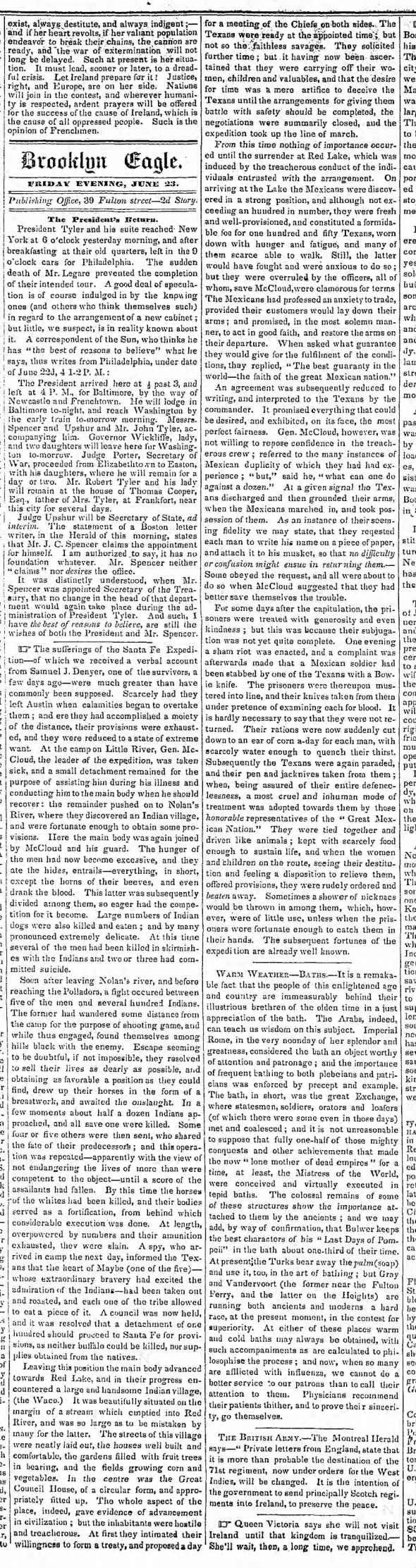
Santa Fe Expedition as told by Samuel J DenyerThe Brooklyn Daily Eagle 
Brooklyn, New York 
23 Jun 1843, Fri • Page 2

The sufferings of the Santa Fe Expedition — of which we received a verbal account from Samuel J. Denyer, one of the survivors, a few days ago — were much greater than have commonly been supposed. Scarcely had they left Austin when calamities began to overtake them ; and ere they had accomplished a moiety of the distance, their provisions were exhausted, and they were reduced to a state of extreme want. At the camp on Little River, Gen. McCloud, the leader of the expedition, was taken sick, and a small detachment remained for the purpose of assisting him during his illness and conducting him to the main body when he should recover: the remainder pushed onto Nolan's River, where they discovered an Indian village, and were fortunate enough to obtain some provisions. Here the main body was again joined by McCloud and his guard. The hunger of the men had now become excessive, and they ate the hides, entrails everything, in short, except the horns of their beeves, and even drank the blood. This latter was subsequently divided among them, so eager had the competition for it become. Large numbers of Indian dogs were also killed and eaten : and by many pronounced extremely delicate. At this time several of the men had been killed in skirmishes with the Indians and two or three had committed suicide.

Soon after leaving Nolan's river, and before reaching the Polladora, a fight occurred between five of the men and several hundred Indians. The former had wandered some distance from the camp for the purpose of shooting game, and while thus engaged, found themselves among hills black with the enemy. Escape seeming to be doubtful, if not impossible, they resolved to sell their lives as dearly as possible, and obtaining as favorable a position as they could find, drew up their horses in the form of a breastwork, and awaited the onslaught. In a few moments about half a dozen Indians approached, and all save one were killed. Some four or five others were then sent, who shared the fate of their predecessors ; and this operation was repeated apparently with the view of not endangering the lives of more than were competent to the object until a score of the assailants had fallen. By this time the horses of the whites had been killed, and their bodies served as a fortification, from behind which considerable execution was done. At length, overpowered by numbers and their ammunition exhausted, they were slain. A spy, who arrived in camp the next day, informed the Texans that the heart of Maybe (one of the five) whose extraordinary bravery had excited the admiration of the Indians hid been taken out and roasted, and each one of the tribe allowed to eat a piece of it. A council was now held, and it was resolved that a detachment of one hundred should proceed to Santa Fe for provisions, as neither buffalo could be killed, or supplies obtained from the natives.

Leaving this position the main body advanced towards Red Lake, and in their progress encountered a large and handsome Indian village, (the Waco.) It was beautifully situated on the margin of a stream which emptied into Red River, and was so large as to be mistaken by many for the latter. The streets of this village were neatly laid out, the houses well built and comfortable, the gardens filled with fruit trees in bearing, and the fields growing corn and vegetables. In the centre was the Great Council House, of a circular form, and appropriately fitted up. Tho whole aspect of the place, indeed, gave evidence of advancement in civilization ; but the inhabitants were hostile and treacherous. At first they intimated their willingness to form a treaty, and proposed a day for a meeting of the Chiefs on both sides. The Texans were ready at the appointed time, but not so the faithless savages. They solicited further time ; but it having now been ascertained that they were carrying off their women, children and valuables, and that the desire for time was a mere artifice to deceive the Texans until the arrangements for giving them battle with safety should be completed, the negotiations were summarily closed, and the expedition took up the line of march.

From this time nothing of importance occurred until the surrender at Red Lake, which was induced by the treacherous conduct of the individuals entrusted with the arrangement. On arriving at the Lake the Mexicans were discovered in a strong position, and although not exceeding an hundred in number, they were fresh and well-provisioned, and constituted a formidable foe for one hundred and fifty Texans, worn down with hunger and fatigue, and many of them scarce able to walk. Still, the latter would have fought and were anxious to do so ; but they were overruled by the officers, all of whom, save McCloud, were clamorous for terms. The Mexicans had professed an anxiety to trade, provided their customers would lay down their arms; and promised, in the most solemn manner, to act in good faith, and restore the arms on their departure. When asked what guarantee they would give for the fulfillment of the conditions, they replied, "The best guaranty in the world the faith of the great Mexican nation."

An agreement was subsequently reduced to writing, and interpreted to the Texans by the commander. It promised everything that could be desired, and exhibited, on its face, the most perfect fairness. Gen. McCloud, however, was not willing to repose confidence in the treacherous crew ; referred to the many instances of Mexican duplicity of which they had had experience ; " but," said he, "what can one do against a dozen." At a given signal the Texans discharged and then grounded their arms, when the Mexicans marched in, and took possession of them. As an instance of their seeming fidelity we may state, that they requested each man to write his name on a piece of paper, and attach it to his musket, so that no difficulty or confusion might ensue in returning them. Some obeyed the request, and all were about to do so when McCloud suggested that they had better save themselves the trouble.

For some days after the capitulation, the prisoners were treated with generosity and even kindness ; but this was because their subjugation was not yet quite complete. One evening a sham riot was enacted, and a complaint was afterwards made that a Mexican soldier had been stabbed by one of the Texans with a Bowie knife. The prisoners were thereupon mustered into line, and their knives taken from them under pretense of examining each for blood. It is hardly necessary to say that they were not returned. Their rations were now suddenly cut down to an ear of corn a-day for each man, with scarcely water enough to quench their thirst. Subsequently the Texans were again paraded, and their pen and jacknives taken from them; when, being assured of their entire defenselessness, a most cruel and inhuman mode of treatment was adopted towards them by those honorable representatives of the " Great Mexican Nation." They were tied together and driven like animals ; kept with scarcely food enough to sustain life, and when the women and children on the route, seeing their destitution and feeling a disposition to relieve them, offered provisions, they were rudely ordered and beaten away. Sometimes a shower of nicknacs would be thrown in among them, which, however, were of little use, unless when the prisoners were fortunate enough to catch them in their hands. The subsequent fortunes of the expedition are already well known.


Notes:

1) My third great grandfather, William Denyer, the father of Samuel Denyer and his brother, my second great grandfather, Ebenezer Denyer, was born in England and immigrated to the US in the early 1820s. Samuel was born in Baltimore, Maryland in 1822 and Ebenezer in Bucks County, Pennsylvania in 1828. It's not clear exactly when the family headed south to the Republic of Texas, but at least Samuel was clearly there before Texas became a State in 1845, and likely the rest of the family as well. William died in Louisiana in 1848, and was likely a resident of three countries during his lifetime. Samuel Denyer was killed by an "Indian" April 30,1861.

Friday, January 24, 2020

Mineral Wells Texas - What Were Morris & Mollie Blatt Doing There?

Back in 1987, my paternal grandmother was interviewed, and she stated that her mother, Anna Blatt Feinstein, first arrived in the United States in Mineral Wells, Texas. In 2010, when I transcribed the interview, I knew there had to be some story behind this, as no one comes up with the town Mineral Wells, Texas out of thin air.

However
  • My great grandmother, Anna, was born in 1890, in Poland.
  • In 1893 my great great grandfather Moshe "Morris" Blatt married his second wife, Mollie, in St. Louis.
  • In 1898 their first child, Henry, was born, in St. Louis
  • In 1900 they, and his daughters from his first marriage, Anna and Blanche, are all recorded in St. Louis
  • In 1903 Morris and Mollie's second child, Pearl was born, in St. Louis
  • In the 1910 census they are all still recorded in St. Louis.
So I was left wondering.

Below is a page from the 1907 Mineral Wells, Texas City Directory

There is a Moses (and Mallie) Blatt
And in the next line there is an Annie.

Moses is a tailor, which matches my 2nd great grandfather's profession.

In 1909 Moses and Mallie were still in Mineral Wells, though Annie doesn't appear in that city directory.

City directories prior to 1907 currently aren’t available online.

So, while these could be different Blatts, it is likely I have confirmed they did spend some time in that city, and have an approximate time-span.

But why did they move to Mineral Wells, Texas, and why did they return to St. Louis? Will I ever know?

I will also note I still have not found my great grandmother's immigration records. So it is possible that at some point in time between 1890 and 1900 she did immigrate to the US through Texas, with other relatives perhaps, met up with her father in St. Louis, and then returned briefly around 1907.

Possible record sources for further research might include researching the community to see if there were any synagogues in or near Mineral Wells at the time and seeing if any membership records still exist.

Monday, April 22, 2019

Amanuensis Monday: Melvin Van Every and Cotton in the El Paso Valley - 1917

Amanuensis: A person employed to write what another dictates or to copy what has been written by another.

I continue my project to transcribe family letters, journals, newspaper articles, audiotapes, and other historical artifacts. Not only do the documents contain genealogical information, the words breathe life into kin - some I never met - others I see a time in their life before I knew them.

Today I transcribe two newspaper clippings. One my great grandfather's obituary from 1929, and a letter to the editor one of his daughters, Minnie Van Every Benold, wrote in 1965. Both discuss my great grandfather's role in growing cotton in the El Paso valley.

El Paso Times, May 28, 1929, page 14 

MELVIN E. VAN EVERY, 60, died at Garfield, N.M., Sunday. Services will be held at 4 o’clock this afternoon at the chapel of Kaster & Maxon the Rev. W. Angie Smith officiating. Burial will be in Evergreen cemetery.

Mr. Van Every was one of the pioneer residents of the lower valley and was engaged in cotton growing and ginning. He was the builder of the first cotton gin in the valley.

He is survived by his widow, Mrs. Josie Van Every, three daughters, Mrs. Minnie Benold and Mrs. I.T. Herrin, both of El Paso, and Miss Myrtle Van Every of Kansas City, Mo., also by one son, Dr. S.O. Van Every of Kansas City, Mo. Pallbearers will be selected from the W.O.W. of which he was a member.

El Paso Times, Feb 12, 1965, p.4. 

Dear Mr. Hooten: I have just read your request for information as to who raised the Valley’s first cotton. I think I know!

My father, M.E. Van Every “scouted” for good cotton land in 1917 from South Texas to California and bought land two miles below Fabens. There he cleared and ditched the land for irrigation in time to plant cotton for the spring of 1918.

Louis J. Ivey was his good friend and may have experimented before, but all had decided the summers were too short. My father contended that some seasons were not and planted 11 acres, from which he harvested 14 bales, taking the cotton somewhere over in Texas for ginning. He then built a cotton gin in Fabens or Tornillo.

This set the Valley “on fire” and the farmers turned their alfalfa and wheat fields and orchards into cotton patches! He sent letters and telegrams to us, begging us to move out, until we did in 1919 to take charge of my uncle’s farm who was to ill to farm.

This is the story of how our family came West. That year we made enough on our cotton to buy a car and put $1,000 in the bank. Cotton was 39 cents a pound, the highest since the Civil War. I believe this to be the true story of cotton here.

Notes:

1) My great grandfather and Louis.J. Ivey were both mentioned in a 1919 article on El Paso cotton growing.

2) An obituary I previously transcribed from May 29th states he was 66. 66 is the correct age.

3) Minnie's letter clarifies that my great grandfather scouted out land in El Paso while his family remained in San Marcos, on the opposite side of Texas. Minnie, the eldest child, was 33 in 1917. His youngest child, my grandmother, Myrtle, was only 17 in 1917.

4) Minnie is the same great-aunt who wrote a series of letters to the Houston Post as a child for their Happy Hammers children's section.

Monday, November 5, 2018

Amanuensis Monday: A Protest Against Agitation Against Japanese Farmers - 1919

Amanuensis: A person employed to write what another dictates or to copy what has been written by another.

I continue my project to transcribe family letters, journals, newspaper articles, audiotapes, and other historical artifacts. Not only do the documents contain genealogical information, the words breathe life into kin - some I never met - others I see a time in their life before I knew them.

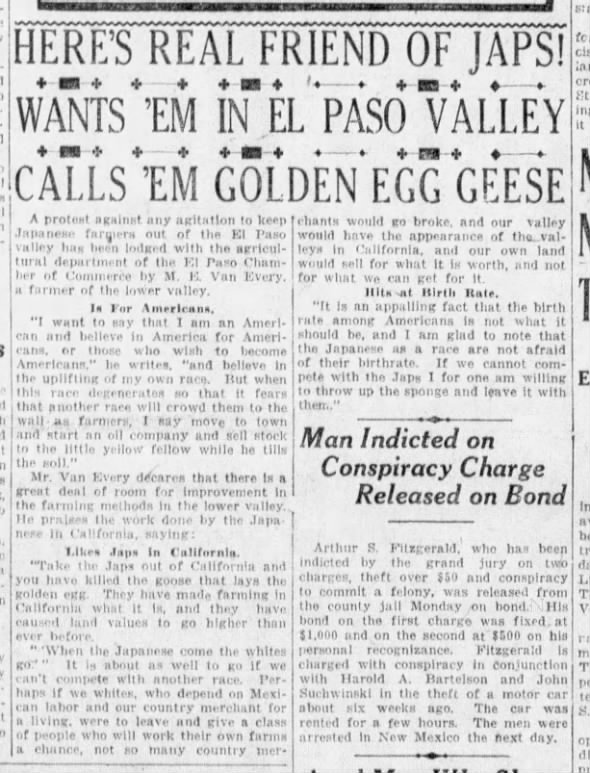
Today I transcribe a newspaper transcript of a protest my maternal grandmother's father lodged with the agricultural department of the El Paso Chamber of Commerce against any agitation to keep Japanese farmers out of the El Paso valley. It's not clear if the newspaper included the entire text of the protest. Some of the language makes me cringe, but giving some leeway for the year, I am glad my great grandfather didn't fall victim to the xenophobia of his times.

Tue, Nov 18, 1919 – 8 · El Paso Times (El Paso, El Paso, Texas, United States of America) · Newspapers.com
HERE’S REAL FRIEND OF JAPS!
WANTS ‘EM IN EL PASO VALLEY
CALLS ‘EM GOLDEN EGG GEESE

A protest against any agitation to keep Japanese farmers out of the El Paso Valley has been lodged with the agricultural department of the El Paso Chamber of Commerce by M.E. Van Every, a farmer of the lower valley.

Is For Americans

“I want to say that I am an American and believe in America for Americans, or those who wish to become Americans,” he writes, “and believe in the uplifting of my own race. But when this race degenerates so that it fears that another race will crowd them to the wall as farmers, I say move to town and start an oil company and sell stock to the little yellow fellow while he tills the soil.”

Mr. Van Every declares that there is a great deal of room for improvement in the farming methods in the lower valley. He praises the work done by the Japanese in California, saying:

Likes Japs in California

“Take the Japs out of California and you have killed the goose that lays the golden egg. They have made farming in California what it is, and they have caused land values to go higher than ever before.

“’When the Japanese come the whites go.’ It is about as well to go if we can’t compete with another race. Perhaps if we whites, who depend on Mexican labor and our country merchant for a living, were to leave and give a class of people who will work their own farms a chance, not so many country merchants would go broke, and our valley would have the appearance of the valleys in California, and our own land would sell for what it is worth, and not for what we can get for it.

Hits at Birth Rate.

“It is an appalling fact that the birth rate among Americans is not what it should be, and I am glad to note that the Japanese as a race are not afraid of their birthrate. If we cannot compete with the Japs I for one am willing to throw up the sponge and leave it with them.”

Friday, September 18, 2015

Sepia Saturday 297: Washing Lines

Sepia Saturday - A weekly meme providing a visual prompt for participants to share their own photographs. (I'm going to share some poetry as well. Follow the links for the complete poems.)

From "The World Transformed"
by John Greenleaf Whittier (1807-1892)

UNWARMED by any sunset light
The gray day darkened into night,
A night made hoary with the swarm
And whirl-dance of the blinding storm,
As zigzag, wavering to and fro,
Crossed and recrossed the wingëd snow:
And ere the early bedtime came
The white drift piled the window-frame,
And through the glass the clothes-line posts
Looked in like tall and sheeted ghosts.

From "Jerusalem" by Yehuda Amichai (1924-2000)

On a roof in the Old City
laundry hanging in the late afternoon sunlight

***
I noticed this week's image comes from the Missouri State Archives. I also recalled seeing washing lines in photographs from the 1908 report bythe Civic League of St. Louis on the housing conditions in the Carr Square tenements.

I have several ancestors who lived in or very near to the neighborhood, before and after the report.

Here's one of the said images:

I'm not entirely sure how the washing lines between the buildings worked. I'm guessing there was a pulley system.

Here's a photograph of my great grandmother, Margaret (Denyer) Vanevery. She is outside of her El Paso, Texas home. I believe a washboard can be seen leaning against the house. It was probably taken in the early 1920s. Evva (or Evelyn), the photographer, mailed it to her sister, Myrtle, my grandmother. Myrtle moved to St. Louis in 1920. Margaret died in 1923.


Monday, June 1, 2015

Amanuensis Monday: On Beekeeping in Goliad County, and the Importance of the Source

Amanuensis: A person employed to write what another dictates or to copy what has been written by another.

I continue my project to transcribe family letters, journals, newspaper articles, audiotapes, and other historical artifacts. Not only do the documents contain genealogical information, the words breathe life into kin - some I never met - others I see a time in their life before I knew them.

I began this project back on February 16, 2009. Since I began, many others have joined in on the meme. I am thrilled that this meme I started has inspired so many to transcribe and share their family history documents. Why do we transcribe? I provide my three reasons in the linked post. You may find others.

***
This week I transcribe a newspaper article from 1916 mentioning my great grandfather, Melvin Van Every, and his apiary business.

Galveston Daily News
Sept 10, 1916

GOLIAD COUNTY’S BEE COLONIES PRODUCE 125,000 POUNDS HONEY
W.C. Collier has 800 and Others in Various Sections
Increase Total Hives to 2,635 – Business is Remunerative, Though Need for State Association And Selling Agency is Recognized.

Goliad, Tex. Sept. 9 – The bee-keeping industry in Goliad County has been recognized for a good many years as one of the best money crops of this section. Blessed by natural vegetation readily adaptable to the culture of bees and the production of an excellent quality of honey, substantial farmers long since recognized the values to be derived from the industry. The growth of the industry has been substantial and at present there are within the borders of Goliad County 2,635 colonies of bees yielding on an average 125,000 pounds of honey. Though the price fluctuates from year to year and there is a pressing need for a state organization to foster the industry and promote selling agencies, several thousands of dollars annually are brought into the county from the sale of honey.

[…]

Mr. Collier has prepared for The News a list of the names of persons who follow the business of bee-keeping as a principal vocation or as side line. The list follows:

Geo. M. Farwell, Berclair……100
ME Van Every, Berclair……..550
Jno. W. Pharr, Berclair………100
EN Pharr, Berclair…………...100
Horace Nutt, Berclair………..200
AV Nutt, Berclair…................50
Mr. Hardin, Berclair…............150
CM Collier, Goliad…..............200
JM Collier, Goliad…...............200
WC Collier, Goliad…..............800
JR Stoedtler, Goliad….............60
Richard Gibb, Goliad…...........25
All others about…....................100
Total colonies, Goliad County.2,635

Few queens Are Sold.

Mr. Collier has prepared also a paper regarding the industry in this county, which follows:

“The business of rearing queens and selling them is not carried on extensively. John W. Pharr of Berclair is the only one in the county who carries an advertisement in the bee journals of the United States. M.E. Van Every sells a good many queen bees, but gives more attention to the production of honey than to rearing queens.”

[…]

“I should say, making a rough guess, that at least 125,000 pounds has been taken from the bees in this county, this year. It is hard to set the value on it, as a large bulk of it has not been sold.  The highest price paid for honey here this year in wholesale lots was (?)c per pound for comb honey, which means 7c for the extracted or strained. Just now I am only getting (?)c for the comb honey and (?)c for the extracted. This is using the two 60-pound case for a base. Smaller cans, of course, have a small differential in their favor.”

***

Notes:

1) I include images where I had difficulty reading.  CM Collier might actually have had 300 colonies, but if that's the case, I'm off a 100 in the other direction on one of the others, since they have to total 2,635.

2) I am reminded of one of Elizabeth Shown Mills' presentation on dealing with families with common names at the NGS Conference. One of her case studies included a list of names from a newspaper article, and she drew attention to the order the names were presented. They weren't alphabetical, or any other logical format. It turned out they were likely in the order the author of the article thought of them.

Similarly, the listed apiarists appear to be in the order WC Collier placed them, not the newspaper, and while he does organize them by city, within the cities they aren't in alphabetical or number order.

I'm more interested in whether the numbers are accurate. A 1910 article stated my great grandfather had 609 colonies, up from the 11 colonies he started with in 1903, and twice the 300 he had in 1907. If the number of colonies he had grew from year to year, how come he only had 550 in 1916?

3) WC Collier may have been accurate - for the Van Every apiary in Berclair. The 1910 article states he was moving 609 colonies by rail. The signature stated he was writing from Maxwell, Texas in Caldwell County. Where was he moving them too? Berclair? Did he keep some in Maxwell? I believe he may have maintained more than one farm, and thus possibly more than one apiary.

3) Melvin's sister, Lettie, married a Robert Collier. Looking for Robert in the 1910 census, he is a lodger in another Vanevery home, Pearl Vanevery Mooney. There are lots of Robert Colliers, but this almost has to be the correct one. Using the birth year from the 1910 census, In the 1900 census, we find likely siblings, but no William or any of the other initials of the Colliers in Goliad. So while they could be related, it's likely not closely.

I believe I have found the parents of WC Collier - It seems he is Willis Cathey Collier (1877-). Carleton M, might actually be Charles Marmaduke Collier, who appears to be a brother of Willis. Their parents are possibly John Willis Collier and Sarah Cathey, from Kentucky. (I'm relying partially on an online discussion post in addition to the census results, and I'm not positive of its accuracy. Since I don't think they are related to Lettie's husband, I'm not going to spend a lot of time verifying the information right now.)

Wednesday, November 7, 2012

Ebenezer Denyer Registers to Vote

Below is the Voter Registration of my second great grandfather, Ebenezer Denyer. (bottom line of cropped images below.)


Transcription:

Date of Registry: Nov 24, 1869
Name: E. Danyer (Denyer)
Place of Residence: Hays County
Precinct: 1
In State: Twelve Months
In County: Thirty Days
In Precinct: Thirty Days
Native: Pennsylvania
General Remarks: White

I don't learn much I didn't already know from this record (retrieved from a database of Texas Voter Registrations at Ancestry). I believe his state of Nativity positively identifies him as my second great grandfather, as opposed to somebody else with a similar name. 

The length of time in State, County and Precinct is of course the minimum requirement, not the specific amount for each individual.

I did at first wonder why he was registering in November of 1869 - what seemed an off-political year. Of course, I'm not overly familiar with Texas history. He appears to have been registering to vote in the first election following the Texas Constitution of 1869. From Ulysses S Grant's First Annual Message (Dec 6, 1869)

Elections were called in Mississippi and Texas, to commence on the 30th of November, 1869, and to last two days in Mississippi and four days in Texas. The elections have taken place, but the result is not known. It is to be hoped that the acts of the legislatures of these States, when they meet, will be such to win your approval, and thus close the work of reconstruction.

Was he registered to vote anywhere else in Texas prior to 1869? That I don't know.

Tuesday, October 26, 2010

Second Annual GALPSGC: Texas, Our Texas

Bill West at West in New England presents the Second Annual Great American Local Poem and Song Genealogy Challenge
  1. Find a poem by a local poet, famous or obscure, from the region one of your ancestors lived in. It can be about an historical event, a legend, a person, or even about some place (like a river)or a local animal. Or if you prefer, post the lyrics of a song or a link to a video of someone performing the song.
  2. Post the poem or song to your blog (remembering to cite the source where you found it.)
  3. Tell us how the subject of the poem or song relates to your ancestor's home or life.
As I mentioned last year, when it comes to poetry challenges, "I'm just a guy who can't say no."  I submitted three poems.  One by a Hungarian poet, one by an American-born expatriate, and one by a Lithuanian-born Polish poet who spent several years in America. (Most people will be familiar with the American expat.)

This year, the challenge is being broadened to include song, so my first submission will come from the State of Texas.  My 3rd great grandparents, William and Elizabeth (Sliver) Denyer, entered Texas in 1839, before it became a state, and my grandmother, Myrtle Van Every, was born in Texas in 1900.  She left Texas for Missouri in 1920.  I no longer had any direct ancestors living in Texas when the State Legislature on May 28, 1929 declared "Texas, Our Texas" the state song.  (The song was written in 1924 by William J. Marsh and Gladys Yoakum Wright.)


While she was no longer living in Texas, I have some evidence a place for her home state remained in my grandmother's heart: A copy of the sheet music, autographed by Gladys Yoakum Wright.


The original lyrics to the song were slightly different from what they are today.  When Alaska was added to the Union, they changed the word 'largest' to 'boldest' in the first verse.

Friday, May 14, 2010

Follow Friday: Texas State Library and Archives Commission

If your research takes you through Texas, you may want to visit the Texas State Library and Archives Commission, particularly their County Records Available on Microfilm.

The records are extensive, including vital statistics, probate records, naturalization records, and more. The microfilm can be borrowed through any public or private library that offers inter-library loan services.

Friday, January 29, 2010

Minnie Van Every and the Happyhammers

Randy at Genea-Musings talks about his Forest Gump Method of Genealogy Research:
Genealogy research is like a box of chocolates - you never know what you're going to find, but you have to look everywhere your 'genealogy gem' might be hiding
He wrote about searching the newspapers at the Library of Congress’s Chronicling America. (Containing newspapers from 1880-1922 in Arizona, California, District of Columbia, Florida, Hawaii, Kentucky, Minnesota, Missouri, Nebraska, New York, Ohio, Pennsylvania, Texas, Utah, Virginia and Washington.)

I hadn’t searched it before, and I agree with the method, so I followed the link.

First I searched in Missouri for some paternal surnames, without any success. (None of the newspapers are from the St. Louis area.)

Then I went south to Texas and searched for some maternal surnames, and hit a jackpot of Happyhammers.

What’s a Happyhammer?
“The Happyhammers are the young people...who read the Youth’s Department of The Houston Post. There are no fees or charges of any kind connected with the club. Boys and girls who read The Post may be enrolled as active members by sending name, age, and address.


It is the object of all Happyhammers to hammer happiness when and wherever possible.” Hence the club name and motto.
My maternal great aunt, Minnie Van Every wrote almost a dozen letters that were published between 1897 and 1901, between the age of 13 and 17. (The final one was cosigned by her younger sister, Willa)

The letters are great fun to read, and show she was receiving a solid education in the Texas schools of that time.

There was even a tidbit of genealogical interest to record, as each letter indicated the town from which she wrote. Most of the letters came from Maxwell, Texas, where I knew my grandmother was born in 1900. However, a couple letters in 1898 came from Ganado, Texas, which is a good 100 miles Southeast of Maxwell. I didn't know the Van Every family had spent some time there. It was very brief though, since the 1897 letters were from Maxwell, too. It's even possible she was writing from there, but not living there. (Maybe visiting relatives.)

Sunday, November 22, 2009

Indexing Error in Ancestry's Texas Birth Index

In Ancestry's database: Texas Birth Index 1903-1997, there is a major indexing error worth noting, even though Ancestry does warn users about it.

In some years, a lot of children were simply recorded as Infant of X. X usually being the father's name, though occasionally it was the mother's. It appears Ancestry indexed all the names as the mother's name. (I am assuming all the Johns, Jims, and Williams are fathers.)

For example, in 1906, out of slightly over 23,500 records, approximately 17,700 were recorded in this fashion. (Roughly 75%)

In its description of the database, Ancestry does admit:
In some cases, where the names of the parents are provided, the parents' names were recorded incorrectly. Occassionally (sic) the mother's name was recorded in the father's place and the father's name was recorded in the mother's place. Therefore, you may need to switch which fields you put the parents' names in, in order to produce results.
I might argue with the 'occasionally' and the 'some cases.' Taken overall from 1903-1997, it's probably a small portion of the database. But if you are researching the earlier years, it appears to be the majority of records.

Sunday, August 23, 2009

Wolfram|Alpha for Genealogists

It's only been three months since I wrote a post on Wolfram|Alpha, but I received an email from them Thursday announcing their work in preparing the site for the "Fall" -- explaining they released the site in early summer to give themselves time to work out bugs before the expected increased usage by returning students.

I thought I would review my discoveries in May, and see what changes there have been.

The Name Command

The input: "Name Smith" still results in similar demographic information on the surname Smith in the United States. W|A is still clueless about what the input "Surname Smith" is supposed to represent.

As W|A admits:
"Close to half the time that Wolfram|Alpha doesn’t give a result, it’s not because it doesn’t have the necessary knowledge, or can’t do the necessary computation. It’s because it doesn’t understand what’s being asked."
Place names

This may currently be the most useful input for genealogists. It doesn't provide much more than a location on a map, population, elevation, and current weather. Still, if you come across a new town where your ancestors lived, this at least situates the place in your mind.

I am still surprised by which towns are recognized, and which ones aren't.

Recognized

1. Varalmas

Population 2801. This is the Hungarian name for the town my maternal grandfather was born in. The Hungarian name is no longer in use, however, W|A knew it was Almasu, Romania.

2. Truth or Consequences

Population 7,071. W/A assumes you mean the town in New Mexico. W|A has cast information on movies, but not television shows, so it doesn't realize you might mean something else.

3. Kyle, TX

Population 23,905. Understandably, I have to indicate the state for this input, otherwise it assumes I want information on the given name. My maternal great grandmother was born in Kyle.

4. Warka, Poland

Population 11,048. The town from which my Newmark ancestors originate. It is near Warsaw.

Not Recognized

1. Garfield, NM ; Maxwell, TX ; Berclair, TX

All towns my maternal grandmother's family lived in - though the population of these three towns range from 300-600, so it's not surprising that W|A doesn't know them. W|A is familiar with the counties in which these towns reside.

2. Losice, Poland

The town of Losice has a population of 7,252. However, the County of Losice has a population of 32,769. W|A is oblivious to both. A paternal great grandmother was born in Losice.

I actually was unaware how small the rural towns in Texas were until I looked them up via Google after not finding them on W|A.

Dates

My original test input was my birthday: January 21, 1969

Three months ago I was told no notable events occurred on that date - which is acceptable, as my birthday isn't considered notable yet. However, today they list several 'anniversaries' of events. For example the 176th anniversary of the beheading of King Louis XVI of France in 1793, or the 13th anniversary of the birth of actress Geena Davis. This is a good addition.

However, it still tells me that there are no holidays or major observances. It says this for the input: "January 21, 1969 Worldwide" as well. I still have to enter "January 21, 1969 Poland" to discover that it was Grandmother's Day there.

January 21 of every year is Grandmother's Day in Poland. January 22 is Grandfather's Day.

Date Conversion

W|A understands the input: Hebrew date for January 21, 1969
As well as the input: Muslim date for January 21, 1969

I'm not sure what other calendars it recognizes.

Source Citations

Wolfram still cites itself as the source for all of its data. ("Wolfram|Alpha Curated Data 2009") They still provide 'other resources' but with the disclaimer that these other resources aren't necessarily where they got their data. The link they originally provided to request more specifics about the source has been removed. Of course, three months ago the link led to a 404 error page, so no link is arguably better.

It's possible Wolfram|Alpha will never be a source one can cite for scholastic or professional purposes. Wikipedia, despite its naysayers, is arguably a better resource since the original source for content is often cited in the entries.

Monday, August 17, 2009

Amanuensis Monday: More Gleanings in Bee Culture

Amanuensis: A person employed to write what another dictates or to copy what has been written by another.

Back in February, via a Google Books search, I found an article about my maternal great grandfather in the 1909 volume of Gleanings in Bee Culture.
A New Kink in Moving Bees.

We have been moving bees considerably this season, and have learned several new kinks. One of these is from M. E. Van Every, one of our extensive bee-keepers who claims that, when bees are to be moved a long distance, it is better to load them on the previous evening, haul them several miles after dark, and then leave them. standing on the wagon until next morning. They are then moved any distance, and will be much more quiet, and haul better than if kept moving without the stop immediately after loading. For this reason, when Mr. Van Every has been moving from his home yards he loads them in the evening, hauls them to the far end of his pasture, and returns to hitch up again the following morning to move them to their final destination. Has anybody else ever tried it?
The article dated my great grandfather's apiary business at least as far back as 1909. I conducted another search on my great grandfather's name this week to find any new information, and found another entry in the 1908 volume of the magazine. [The volume is recorded as having been scanned by Google at the same time, and should have shown up in the February search. I'm not sure why it didn't.] Apparently my great grandfather wrote a letter to the editor of the magazine, and in it he provided a detailed history of his apiary career up to that point. 'Detailed' may be an understatement.

Good Yields with Rapid Increase, by an Amateur

In 1903 we started with 11 colonies in Dovetailed hives. We increased to 27, and our surplus was 136 lbs per colony. In 1904 we increased to 62, and surplus was 127 lbs. per colony. In 1905 we started in the spring with 51 colonies, having lost 11 during the winter. We increased to 135, and our surplus was 66 2/3 lbs. per colony. In 1906 we increased to 252, and our surplus was 62 lbs. per colony. In 1907, the season just passed, we increased to 300, and our surplus was 88 lbs. per colony. We raise all our own queens. When I say we I mean my wife and three daughters, ranging in age from 7 to 17, and myself, we doing all the work. The 1907 crop brought $1742. Our expenses were $635.00, leaving a profit of $1107.00. We do not expect to do so well every year, as that was a favorable season.


Maxwell, Texas. M.E. Van Every.
Now I know the exact year he began, and his yields for the first five seasons. A colony of bees contains 1 queen, several hundred drones, and 30,000-80,000 workers. So 300 colonies would have been a LOT of bees. According to current classifications, he would be at the upper limits of a sideliner, and could be making 'a few tens of thousands of dollars each year.'

He also indicates in the letter that in 1908 his entire staff was himself, his wife, and three daughters. Those three daughters would be my grandmother, Myrtle, age 7, her sister Evva, age 15, and her sister Willa, age 17. It is Melvin's oldest daughter Minnie, who isn't included in the count - she married in 1905, and it's possible she helped out the first couple years. My great uncle, Samuel Van Every, had also moved off the farm by 1908.

So it is likely my grandmother and great grandmother in this photo, which I have posted before, and I suspect is the Van Every Apiary.

In 1917 they moved their apiary business to El Paso; the deed for their land is dated Jan 1, 1917. There are some records scanned in by Google Books that list my great grandfather as the County Apiary Inspector for El Paso County in 1918 and 1919. While I have no proof, my suspicion is that the job opportunity may have been the reason they moved. Which is an interesting parallel to my maternal grandfather's move from Chicago to St. Louis, for a position as Postal Inspector. (Though the move from Chicago to St. Louis was only about half the distance. It's easy to forget how large the state of Texas is.)

George Geder remarked a week ago that Genealogy is more than just dates, and how far back you can go, it's about being able to tell the stories of your ancestors' lives. I couldn't agree more.

If you choose to join me in Amanuensis Monday and post your transcriptions, feel free to add a link to your post below, or in the comments.

Monday, June 23, 2008

Texas Death Records at Family Search Redux

Two months ago I wrote about finding a few Texas death records at FamilySearch's new record search. In particular, Everett Van Every's, a first cousin to my mother who died at age 17. I had begun to question the family story that my grandmother's brother had had a child, but it turned out his marriage had been brief, and the child had remained with the mother, which is why Uncle Sam was single on all the censuses.

The death records at FamilySearch didn't have the images associated with them. I emailed FamilySearch and their response was a reminder they were in pilot stage, they would enter beta testing later in the year, and then even later fully release the project. I wasn't upset by the response, and completely understood. (I expected them to direct me to the LDS microfilm available at FamilyHistory sites, actually, which they didn't, though I suspect most if not all of the records they are scanning in and indexing are available that way.)

Realizing I could be waiting awhile for the images, I searched for other sources. I found someone at RAOGK willing to look up and copy Everett's death certificate, as well as one for my great Aunt Minnie. I paid them a minimal copying fee. (I asked them to look for the death certificate for another great-aunt, Willa, who died in 1916, but they were unable to find her in the state archives.)

I noticed a couple weeks ago that the Texas death records at FamilySearch now have images. If it had taken 6 months I'd have been fine with my impatience, but 6 weeks I feel a little silly. Still, I didn't spend much.

Everett did drown, as family records had indicated, and the death certificate names the creek (Barton Creek near Austin, which appears to be a popular local swimming area.)

I have a lot of relatives in the FamilySearch database, and have spent some time looking at various certificates I wouldn't likely have actively pursued.

George William Foster was the son of Sarah Ann Hartley and George Foster. Sarah was my second great grandmother, through her prior marriage to Ebenezer Denyer. The informant on George William's death certificate was Sarah Ann McCarty. I knew from some Rootsweb forum posts he had a sister named Sarah Ann, so I suspected this was her. I found Sarah Ann McCarty's death certificate easily, and it says she was born in 1887 to George Foster and Sallie Unknown.

I then wondered if the informant didn't know Sarah McCarty was named after her mother, and got the name wrong, or whether my great great grandmother had died and this was a new wife for George.

I'm pretty certain it's the former. It would mean that Sarah Hartley, who according to the 1860-1880 censuses was born about 1836, would have been 51 years old when her last child was born. However, while unusual, that's not impossible. My Aunt Minnie wrote about her grandmother Sarah as someone she remembered, and Minnie was born in 1884. Sarah had to have lived at least until the early 1890s for Minnie to have her recollections.

My only complaint with the database is a complaint I have with Texas history. They apparently started requiring death certificates in 1903, which is actually seven years earlier than Missouri, but they weren't completely successful at enforcing this until the 1930s. I'm not sure if the index at FamilySearch is 'complete', but they indicate that most deaths between 1890-1903 were not recorded, as well as many deaths between 1903 and 1930.

The death certificate for Aunt Willa who died in 1916 might not exist. However, I and my mother have recently made contact via letters and email with some of her cousins in Texas and California, and I am sure they will have more information on Aunt Willa, cousin Everett, and perhaps they may even know when and where Sarah Hartley died.

Saturday, February 16, 2008

Texas Vital Records on Footnote

Since I have a 3-day free trial, my goal was to find everything I could possibly find on Footnote, and then cancel my subscription before they start charging. They are adding databases constantly, though at the moment I don't see enough hits for my surnames to warrant continuing my subscription. They also offer individual image download, though if there are more than four images, it's worth buying a month's subscription.

The two databases that show the most promise for me are in the process of being entered.

1) Texas Birth Certificates (1903-1910, 1926-1929)

I'm not sure why the years between 1910 and 1926 aren't part of the database. They are 47% finished. However, I have already found a few certificates for relatives of Myrtle Van Every, my maternal grandmother, who was born in Texas in 1900.

Her oldest sister, Minnie Van Every Benold, had two children between 1903-1910 (Shirley and Margaret). I found Shirley's certificate, as well as the certificate for Corinne Griffith, Shirley's daughter, born in 1927. I also found the certificate for Melvin Edwin Denyer Jr, who would have been Ebenezer's great-grandson. His father was Myrtle's first cousin.

2) Texas Death Certificates (1890-1976)

This is only 4% entered, but there are going to be a lot of certificates from this database that I know I will download. At least five of my grandmother's siblings, and both of her parents, for starters. And then there are nieces and nephews. I'll just wait until they're all there, and then buy a month. Though if there's a delay, there is one or two I might spend $2 to download individually.

I already have Myrtle's mother's death certificate. I ordered it because I knew she died in her fifties, and I wanted to know what from. I don't have her father's though.

There's also a very good chance that Margaret's mother, Ebenezer Denyer's wife, Sarah Hartley Denyer Foster will be in this database. It is she who I mentioned in November that declared she was 1/8 Native American. After Ebenezer died in 1872, she remarried in 1874, but alas, chose a husband with a very common surname. I was able to find Sarah and George Foster in the 1880 census, but not conclusively in the 1900 census. (There's a Sarah Ann Foster listed as a widow who might possibly be her, but there's no way to know for certain from the census alone.)

Myrtle's oldest sister, Minnie, was born in 1884, and she wrote a brief description of Sarah, and her recollection of the home Sarah and George lived in. She didn't write down years, or her own age, but I suspect she was older than 6 when Sarah died.

Of course, how much information is on the certificate, and whether it will be identifiable as my great-great-grandmother will depend upon the informant.

Monday, September 10, 2007

Privacy in Texas

Several discussions on legal and ethical issues lately. As a newcomer to the genealogical community, I don't know how common this is. I have come upon another one that's troubling me.

Last night, doing some research on a surname in Texas I came across the Ancestry databases of their birth, death and marriage indexes. Several states have their death indexes online. This can be useful. Missouri even has their death certificates online - up until 1956. But they stop with certificates less than 50 years. They have no index for recent deaths either. The St. Louis Public Library has an index for Post Disptach obituaries that isn't complete, but when it is, will be up-to-present. This doesn't trouble me much, since all the people in the index are deceased.

But indexes of births and marriages for people who are still living? The Texas birth index at Ancestry is for 1903-1997. The marriage index is for 1814-1909 and 1966-2002. If I had been born in Texas, I'd be on it, as would my parents, and grandparents. The birth index gives names of both parents, with maiden name for the mother. Combined with the marriage index, this provides an easy reference to track the generations. There is a large gap in the marriage index, but still, while the census stops at 1930, if the family remains in Texas, you can pretty much keep on going until the current generation of parents. And then at several phonebook websites (Or on Google if you figure out the city they live in) you can probably find the phone number of the living generations. And give them a call and say, Hi, I'm a cousin.

It certainly might not be advisable to start out the conversation that way. And you might do better trying to find their address and writing a "blind inquiry" letter to them. (Uncle Hiram has some good advice on that.) It's way too easy to hang up a phone. But Texas certainly makes it easy. I'm not sure how many other states do this. Randy at GeneaMusings back in February suggested California was the only other one. Chicago (Cook County) recently announced it is putting a lot of their vitals online - with an estimated date of arrival in January, but I don't know if this will include recent vitals.

He also asks for input on the privacy issue. I didn't see his post back then (see first paragraph) but I'm giving it now, I guess. I don't like it.

Well, that is, looking at it from the perspective of somebody tracking me down - online - within a couple hours of fairly easy research - if I don't want to be tracked down that easily. I don't have to worry about that, I don't live in Texas.

But I do have some Texas relatives. I now know their names. I won't mention the surname. And while I'm not about to pick up the phone, I think I'd be silly not to write a couple letters. Gives them the option of not replying. I might even play 'dumb' and say that I think 'we may' be related. Don't want to scare them by telling them that I *know* we are. Of course, I'd be surprised if this hasn't been discussed in Texas newspapers, and they know full well how easy it is. So they might see right through my facade.