Showing posts with label Surname: Denyer. Show all posts

Sunday, September 26, 2021

Timeline for William Sliver Denyer (1834 - circa 1896)

Earlier this month I wrote about my 2nd great grandfather's brother, William Sliver Denyer. I had found his Civil War Pension file, which mentioned both a widow, Sarah E Denyer, and a guardian of a minor, Nancy Denyer. I identified Nancy as his wife, and wasn't sure who Sarah was - wondering if she could be my second great grandmother, sister-in-law of William.

Since that post I have found the death certificate of Sarah E Denyer in Arkansas, indicating her maiden name was Trapp, and she was a third wife of William.

This is the timeline for William S Denyer I have from the documents

  • 1834 - William is born in Bucks County, Pennsylvania
  • 1840 - William's mother, Elizabeth Sliver Denyer, dies in Gonzales, Texas (5 years before Texas joined the United States)
  • 1848 - William's father, William Denyer, dies in St. Martin, Louisiana
  • 1861 - William marries Susannah Dilly
  • 1861-1862 - William serves for the Confederacy.
  • 1863 - William's first wife, Susannah, dies.
  • 1864-1865 - William serves for the Union.
  • Feb 1865 - William marries Nancy Rhodes
  • Nov 1865 - Son Andre Denyer is born
  • 1880 - Pension is filed for minor, Nancy as guardian.
  • 1880 Census - William is married to Sarah. No child in the household.
  • 1886 - William files for a pension as an invalid
  • 1896 - Sarah files for a pension as a widow.
  • 1900 census - Son Andre has been married for 3 years.

It is a shame that the 1890 census was destroyed. Though hopefully Nancy and Andre can be found in the 1870 or 1880 census. It  does seem that there was a divorce and not a death in their case. Best guess for death of William would naturally be 1896, since I doubt it would take long for Sarah to file for a pension as a widow.

Wednesday, September 8, 2021

William S Denyer & Danyer - Confederate & Union Soldier

The below Pension Record appeared in my ‘hints’ on Ancestry. 

William S Danyer - Union Soldier in Louisiana Cavalry Scouts

The record identifies a Widow named Sarah E Danyer, who filed from Arkansas in 1896, and a minor with a guardian named Nancy E Danyer, who filed in either 1880 or 1890. The handwriting isn’t clear. I am unsure if the Certificate No. column indicates that the first two applications were successful, and the one for the minor was not.

Could this be William Sliver Denyer, brother of my 2nd great grandfather?

William S Denyer, my great great granduncle, definitely served under the Confederacy 1861-1862 in Louisiana. He was injured in 1862 and his hospital records are the last in the file at Fold3. Both of his brothers Ebenezer and Samuel served under the Confederacy in Texas. However, their father had died in Louisiana in 1848, and William appeared to stay there until the war. (All three sons were born in Bucks County Pennsylvania, and their father was born in England, so traveling was in their blood.)

William S Danyer also has a file on Fold3.  Here is his enlistment record. William S Danyer enlisted in the 30th Regiment of Missouri while in Vidalia, Louisiana in Feb of 1864. He was born in Buck County, Mississippi.  

There is currently no Buck County in Mississippi. I suspect there wasn't in 1864. My 2nd great granduncle was born in Bucks County, Pennsylvania.  This is almost definitely him, and we now have evidence that he fought for both the Confederacy and the Union.  Why he claimed to have been born in Mississippi is a mystery, but that could have simply been a clerical error. Other documents in the Fold3 folder indicate William S Danyer deserted in April of 1865, (Perhaps only a couple days before the war ended.) During his year of service between April 1864-April 1865 he was listed on muster rolls as under detached service in Louisiana, which may be why the pension application indicates he was with the Louisiana Cavalry Scouts.

The pension file indicates William's widow filed from Arkansas. If he is my relative, who are Sarah E and Nancy E? That is a question with a potentially intriguing answer. 

William S Denyer had two known wives - Susannah Dilly (who died in 1863) and Nancy E Rhodes, who he married in February of 1865 in Illinois (shortly before he deserted, and likely the reason he deserted.) They had a son, Andre, 9 months later. He would have been 25 in 1890, so it’s likely the year on the document is 1880. But Nancy should be the widow too. Who is Sarah Denyer?

Could she be the widow of William’s brother -- My 2nd great grandmother, Sarah Hartley Denyer Foster. Her father had died in Little Rock Arkansas in 1840. His children ended up in Texas, but Sarah might have returned after her husbands died. 

I don’t have a date of death for William. He could have been deceased and his widow could have tried to help her sister-in-law draw a Union pension since her sister in law’s first husband, Ebenezer Denyer, served the Confederacy. He died in 1872. I’m not sure when her husband George Foster died but it is likely he died before she did. My great grandfather testified in 1900 in front of the Dawes Commission that she was living with them in 1898 when she died. So in September 1896 she could have been a widow again. But while I have been unable to find her 1898 death records, I have not looked in Arkansas for them. And my primary focus has been searching for the name Sarah Foster. But there’s a chance she returned to the name Denyer.  

I like how these documents indicate that there was at least one Denyer who fought, however briefly, for the Union. Just like my ancestor, David Vanevery, fought in the American Revolution on both the Patriot and Loyalist sides. It also seems to show that there was a close relationship between my 2nd great grandmother, Sarah Hartley Denyer Foster, and her sister-in-law.  If Sarah was living with her daughter's family when she died, as the Dawes Commission was told, she almost certainly died in Texas, but she may have briefly been in Arkansas, and I might be able to find records for her there.


Monday, January 18, 2021

Amanuensis Monday: Samuel J. Denyer and the Santa Fe Expedition

Amanuensis: A person employed to write what another dictates or to copy what has been written by another.I continue my project to transcribe family letters, journals, newspaper articles, audiotapes, and other historical artifacts. Not only do the documents contain genealogical information, the words breathe life into kin - some I never met - others I see a time in their life before I knew them.

Today I share a news article containing a narration of some of the events of the Texan Santa Fe Expedition by Samuel J. Denyer, the brother of my second great grandfather, Ebenezer Denyer. I do not know how closely this narration resembles what other survivors said. or how it compares to the historical record. Reading it from the perspective of our own times, it is easy to see a markedly different narration of events could be written by other participants.
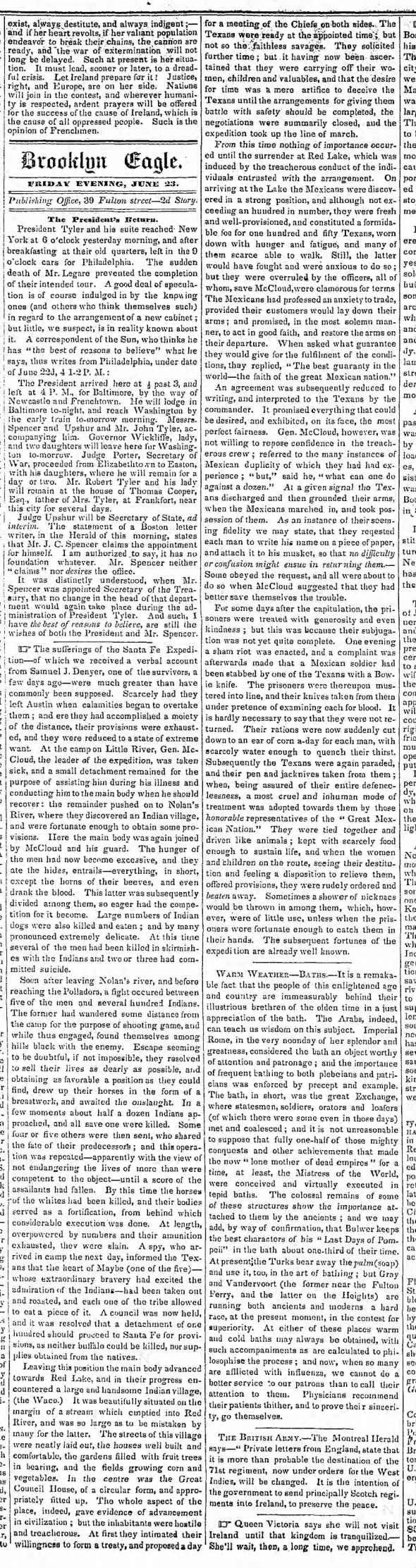
Santa Fe Expedition as told by Samuel J DenyerThe Brooklyn Daily Eagle 
Brooklyn, New York 
23 Jun 1843, Fri • Page 2

The sufferings of the Santa Fe Expedition — of which we received a verbal account from Samuel J. Denyer, one of the survivors, a few days ago — were much greater than have commonly been supposed. Scarcely had they left Austin when calamities began to overtake them ; and ere they had accomplished a moiety of the distance, their provisions were exhausted, and they were reduced to a state of extreme want. At the camp on Little River, Gen. McCloud, the leader of the expedition, was taken sick, and a small detachment remained for the purpose of assisting him during his illness and conducting him to the main body when he should recover: the remainder pushed onto Nolan's River, where they discovered an Indian village, and were fortunate enough to obtain some provisions. Here the main body was again joined by McCloud and his guard. The hunger of the men had now become excessive, and they ate the hides, entrails everything, in short, except the horns of their beeves, and even drank the blood. This latter was subsequently divided among them, so eager had the competition for it become. Large numbers of Indian dogs were also killed and eaten : and by many pronounced extremely delicate. At this time several of the men had been killed in skirmishes with the Indians and two or three had committed suicide.

Soon after leaving Nolan's river, and before reaching the Polladora, a fight occurred between five of the men and several hundred Indians. The former had wandered some distance from the camp for the purpose of shooting game, and while thus engaged, found themselves among hills black with the enemy. Escape seeming to be doubtful, if not impossible, they resolved to sell their lives as dearly as possible, and obtaining as favorable a position as they could find, drew up their horses in the form of a breastwork, and awaited the onslaught. In a few moments about half a dozen Indians approached, and all save one were killed. Some four or five others were then sent, who shared the fate of their predecessors ; and this operation was repeated apparently with the view of not endangering the lives of more than were competent to the object until a score of the assailants had fallen. By this time the horses of the whites had been killed, and their bodies served as a fortification, from behind which considerable execution was done. At length, overpowered by numbers and their ammunition exhausted, they were slain. A spy, who arrived in camp the next day, informed the Texans that the heart of Maybe (one of the five) whose extraordinary bravery had excited the admiration of the Indians hid been taken out and roasted, and each one of the tribe allowed to eat a piece of it. A council was now held, and it was resolved that a detachment of one hundred should proceed to Santa Fe for provisions, as neither buffalo could be killed, or supplies obtained from the natives.

Leaving this position the main body advanced towards Red Lake, and in their progress encountered a large and handsome Indian village, (the Waco.) It was beautifully situated on the margin of a stream which emptied into Red River, and was so large as to be mistaken by many for the latter. The streets of this village were neatly laid out, the houses well built and comfortable, the gardens filled with fruit trees in bearing, and the fields growing corn and vegetables. In the centre was the Great Council House, of a circular form, and appropriately fitted up. Tho whole aspect of the place, indeed, gave evidence of advancement in civilization ; but the inhabitants were hostile and treacherous. At first they intimated their willingness to form a treaty, and proposed a day for a meeting of the Chiefs on both sides. The Texans were ready at the appointed time, but not so the faithless savages. They solicited further time ; but it having now been ascertained that they were carrying off their women, children and valuables, and that the desire for time was a mere artifice to deceive the Texans until the arrangements for giving them battle with safety should be completed, the negotiations were summarily closed, and the expedition took up the line of march.

From this time nothing of importance occurred until the surrender at Red Lake, which was induced by the treacherous conduct of the individuals entrusted with the arrangement. On arriving at the Lake the Mexicans were discovered in a strong position, and although not exceeding an hundred in number, they were fresh and well-provisioned, and constituted a formidable foe for one hundred and fifty Texans, worn down with hunger and fatigue, and many of them scarce able to walk. Still, the latter would have fought and were anxious to do so ; but they were overruled by the officers, all of whom, save McCloud, were clamorous for terms. The Mexicans had professed an anxiety to trade, provided their customers would lay down their arms; and promised, in the most solemn manner, to act in good faith, and restore the arms on their departure. When asked what guarantee they would give for the fulfillment of the conditions, they replied, "The best guaranty in the world the faith of the great Mexican nation."

An agreement was subsequently reduced to writing, and interpreted to the Texans by the commander. It promised everything that could be desired, and exhibited, on its face, the most perfect fairness. Gen. McCloud, however, was not willing to repose confidence in the treacherous crew ; referred to the many instances of Mexican duplicity of which they had had experience ; " but," said he, "what can one do against a dozen." At a given signal the Texans discharged and then grounded their arms, when the Mexicans marched in, and took possession of them. As an instance of their seeming fidelity we may state, that they requested each man to write his name on a piece of paper, and attach it to his musket, so that no difficulty or confusion might ensue in returning them. Some obeyed the request, and all were about to do so when McCloud suggested that they had better save themselves the trouble.

For some days after the capitulation, the prisoners were treated with generosity and even kindness ; but this was because their subjugation was not yet quite complete. One evening a sham riot was enacted, and a complaint was afterwards made that a Mexican soldier had been stabbed by one of the Texans with a Bowie knife. The prisoners were thereupon mustered into line, and their knives taken from them under pretense of examining each for blood. It is hardly necessary to say that they were not returned. Their rations were now suddenly cut down to an ear of corn a-day for each man, with scarcely water enough to quench their thirst. Subsequently the Texans were again paraded, and their pen and jacknives taken from them; when, being assured of their entire defenselessness, a most cruel and inhuman mode of treatment was adopted towards them by those honorable representatives of the " Great Mexican Nation." They were tied together and driven like animals ; kept with scarcely food enough to sustain life, and when the women and children on the route, seeing their destitution and feeling a disposition to relieve them, offered provisions, they were rudely ordered and beaten away. Sometimes a shower of nicknacs would be thrown in among them, which, however, were of little use, unless when the prisoners were fortunate enough to catch them in their hands. The subsequent fortunes of the expedition are already well known.


Notes:

1) My third great grandfather, William Denyer, the father of Samuel Denyer and his brother, my second great grandfather, Ebenezer Denyer, was born in England and immigrated to the US in the early 1820s. Samuel was born in Baltimore, Maryland in 1822 and Ebenezer in Bucks County, Pennsylvania in 1828. It's not clear exactly when the family headed south to the Republic of Texas, but at least Samuel was clearly there before Texas became a State in 1845, and likely the rest of the family as well. William died in Louisiana in 1848, and was likely a resident of three countries during his lifetime. Samuel Denyer was killed by an "Indian" April 30,1861.

Monday, June 4, 2018

Amanuensis Monday: Ebenezer Denyer's Muster Roll Index Cards

Amanuensis: A person employed to write what another dictates or to copy what has been written by another.

I continue my project to transcribe family letters, journals, newspaper articles, audiotapes, and other historical artifacts. Not only do the documents contain genealogical information, the words breathe life into kin - some I never met - others I see a time in their life before I knew them.

The service record of Ebenezer Denyer, my second great grandfather, is described in A Brief History of John and Christian Fretz, Rev. A.J. Fretz, 1890.

"Mr. Denyer served in the Mexican War of 1848, with Captain Henry McCohlogh, and was with the Ohio Rangers for several years. About 1858, he moved to Onion Creek, Hays County, Texas, where he remained until the breaking out of the Civil War, when, after moving his wife to her mother's home in Eastern Texas, he joined the 2nd, Texas Company Volunteers, mustered at Marcos, Hays County, in the summer of 1861, and served throughout the war in the Confederate service. He was taken prisoner at Vicksburgh, Mississippi, was exchanged, and laid in the hospital at Galveston until the close of the war."

My grandmother wrote to the Department of Interior in 1933, providing what she knew from the above family history, and requesting confirmation of her grandfather's war service. She was seeking membership in the Daughters of the Confederacy, and her nephew was seeking a scholarship. She received responses from both the Department of War and the Texas Library and Historical Commission State Library.

Several years ago I found his muster roll records at Fold3.

Recently I found  his name in the Texas Muster Roll Index Cards database at Ancestry. There wasn't any new information, which isn't surprising. They're index cards for the muster rolls I had already found. But in addition to providing a summary of his activities, there was a surprise waiting for me on the last index card below.

Ancestry Database: Texas, Muster Roll Index Cards, 1838-1900

Source information:Ancestry.com. Texas, Muster Roll Index Cards, 1838-1900 [database on-line]. Provo, UT, USA: Ancestry.com Operations, Inc., 2011.

Original data: Civil War Muster Rolls index Cards (both Confederate and Union). Also Texas State Rangers. Austin, Texas: Texas State Library and Archives Commission.
Name: Ebenezer U. Denyer
Rank: Private
Com. off: Capt. Henry E. McCulloch
Organ: Texas Vols.
Date enlist: Oct 25, 1848
Date disch: Dec. 8, 1848
Age: 20
Remarks: 1 month. 13 days service. Ranger Muster Rolls.
Name & Rank: Denyer, Ebinezer, Pvt.,
Comm. Off: Collins, Thos. B. 2nd Lieut.,
Organ: Co. "E", 2nd Tex. Vol. Inf., Col. Ashbel Smith, CSA.
Enlist: June 12-62 in Hays Cty. for the war.
Disch: Served 3 months at $11 per month
Remarks: R&F 61; Roll dated Dec. 31-62 to Feb 28-63; En.Off. Randall; Last paid D.1-62; Am't of Pay $33; Bal. Paid $33; Transferred from conscript.camp June 11-63; Detached service as Teamster Ja.17-63; Stationed at Camp Maury, Miss.; Disc. Instr., Arms,
(over)
Accoutr. & Clothing good; Military appearance fine; Co. moved to Yazoo City Feb. 10th; N.L. McGinnis Insp. & Mus. Off.;
Name & Rank: Denyer, Ebenizar, O[phan], Pvt.,
Comm. Off: Holder, Wm., Capt.,
Organ: Co. E, 2nd Regt., TVI, Col. Ashbel Smith Comdg., CSA
Enlist: Je.12-62 in Hays City. for the war
Descrip: R&F 62; En.Off. Randall; Mus.Off. Col.Ashbel Smith; Last Paid Ja.12-'63; Disc.,Instr.Mil.App.&Cloth.good; Arms & Accoutr, in good order; Change of sts.F26-63 from Camp Maury near Yazoo City to Ft. Pemberton; from Ft. Pemberton Ap.11-64 to Camp Timmons near 
(over)
Vicksburg; Sta. in the field in Miss. Ap.30-63. Detached service as teamster Ja.17-63; [Married Sarah Ann Hartly. This information received from his granddaughter, Miss Myrtle Van Every, St. Louis, MO.]

Notes:

1) The information on the last index card above clearly matches the information the Texas Library and Historical Commission State Library gave my grandmother in 1933. I love that they added to their record some of the information she had given them, and cited her as the source. I'm certain that the bracketed part of Ebenezer Denyer's middle name also came from my grandmother.

Monday, May 9, 2016

Amanuensis Monday: Minnie Van Every Visits Her Uncle - June 1898

Amanuensis: A person employed to write what another dictates or to copy what has been written by another.

I continue my project to transcribe family letters, journals, newspaper articles, audiotapes, and other historical artifacts. Not only do the documents contain genealogical information, the words breathe life into kin - some I never met - others I see a time in their life before I knew them.

I transcribed several letters back in 2010 which my great-aunt, Minnie Van Every, wrote to the Houston Post's Children's Section 1897-1902. I discovered a handful of other letters at ChroniclingAmerica which hadn't turned up in my earlier searches. (They still don't, if I only search for her surname. But each letter's byline had the town along with the name, and searching for the towns I knew she lived in, I uncovered  the additional letters.)

From the earlier letters, I knew the Van Every family had left Maxwell, Texas in November of 1897 for Ganado, Texas, and was back in Maxwell by May 1899. These new letters narrow that gap down.

June 19, 1898, Houston Daily Post

CAUGHT PLENTY OF FISH
Maxwell Texas 

Dear Happyhanmers: After an absence ever since February, I will endeavor to wrlte to our growing band. Last April about Easter time, papa, my brother, and 1 went to my uncle's. I intended to tell
the Haps of our trip down here but as space is precious I will just tell about going fishing on Green lake while we were there.

My uncle and family and ourselves went on Easter Monday We got there by dinner. We fished until nearly sundown and by that time had caught one fish weighing about two pounds and another about twenty-five pounds. Then my aunt and I set our hooks and went to get supper. Papa and Uncle Willlie were busy taking care of the hooks. By bedtime we had five fish weighing about twenty pounds each and five more which weighed about five pounds each. I saw some alligators but
would not go near them.

Haps, I have the sweetest little brother you ever saw. 1 think we will name him Melvin Theodore.

Guy Fagen's death is surely a blow to the club for he was loved by all. His name was
mentioned so much in the letters that papa asked me If he wasn't the leader ouf our band.
I agree with Mrs. Lewls about putting a monument over his grave. I now contribute 10 cents to help pay for n monument. A true and faithful Hap. 

Minnie Van Every


Notes:

1. It's not completely clear whether Minnie means April 1898 or April 1897 by her phrase "Last April." Regardless, the family is back in Maxwell by June of 1898. I know from the Dawes Testimony filed by Minnie's father that Minnie's grandmother, Sarah Hartley Denyer Foster, died in 1898 while she was living with her daughter and grandchildren. My conclusion that they were in Ganado when she died is put into question since I don't know the month of her death.

So, I now know that they left Maxwell for Ganado in November of 1897, were still there in February of 1898 (due to another letter), and were back in Maxwell by June of 1898. Possibly spending April of 1898 near Green Lake in Calhoun County.

2. Minnie's "Uncle Willie" would be Samuel William Denyer, the brother of her mother Margaret Denyer Van Every. While it seems she went with her father on the trip, her father had no brothers named William who survived infancy.

3) Melvin Theodore died in 1899.

Monday, October 26, 2015

Amanuensis Monday: Samuel Jennings Denyer - School Master

Amanuensis: A person employed to write what another dictates or to copy what has been written by another.

I continue my project to transcribe family letters, journals, newspaper articles, audiotapes, and other historical artifacts. Not only do the documents contain genealogical information, the words breathe life into kin - some I never met - others I see a time in their life before I knew them.

This week I look at a newspaper article that references Samuel Jennings Denyer, the brother of my second great grandfather, Ebenezer Denyer. (Click on the image to enlarge.)


The Bucks County Gazette
Bristol, Bucks County, PA.
Friday April 23, 1909
Page 1

MINES AND MASTERS

Becoming reminiscent last week, Samuel Geil, aged 85 years, imparted to the Gazette correspondent some interesting information which has probably never been published before.

Most interesting was the story of how the lead deposits at New Galena were discovered many years ago as the result of a farmer’s curiosity being aroused by the fact that some of the rocks he picked up were so much heavier than the ordinary ones. Remarking upon it to Jesse Moore, then a blacksmith in the vicinity, he was told to bring several of the rocks to the smith, and when he did Moore succeeded in some way in smelting the ore in the furnace. He found it very rich with the metal, but it was not until many years later that the mining of the ore was taken up.

Mr. Geil also talked of some of the old school masters he had known before the public schools were known, and among others mentioned Christian Burkholder, Samuel Jennings Denyer, Thomas J. Clark and Henry Bertel. All of these men, he said, were German Mennonites, for it was among this sect that the best educated men were to be found in those days. Burkholder was the inventor of a peculiar spelling machine.

Notes:

1. Samuel Jennings Denyer, the older brother of my second great grandfather, Ebenezer, became his legal guardian upon their father, William's death. The probate documents identify him as the 'tutor' for his younger siblings, which simply meant 'legal guardian' at the time. But apparently he had experience as a teacher.

2. Samuel Geil, born in 1825, was a first cousin of William Denyer's wife, Elizabeth Sliver Denyer. William and Elizabeth's son, Samuel Jennings, was born in 1822, and died in 1861 at the age of 38. My ancestor, Ebenezer Denyer, was born in 1828 and died in 1872 at the age of 43. So Samuel Geil outlived his cousin's children by a large degree. (Samuel died in August of 1909, only a few months after this newspaper article.)

3. I find it interesting that Samuel Geil lists Samuel Jennings Denyer as a teacher, since he was only three years younger. But it's possible.

4. Samuel Jennings' mother was of German Mennonite descent, but his father, William, was from England, and was a minister in the Methodist Episcopal church. Some sources indicate Samuel had attended an M.E. seminary, and was preparing for a ministry himself at the time of his death. As cousins it's likely Samuel Geil knew the Denyer family weren't Mennonites, but the memories of an aging individual aren't always the most reliable.

Monday, October 5, 2015

Amanuensis Monday: The Estate of William Denyer - Part 2

Amanuensis: A person employed to write what another dictates or to copy what has been written by another.

I continue my project to transcribe family letters, journals, newspaper articles, audiotapes, and other historical artifacts. Not only do the documents contain genealogical information, the words breathe life into kin - some I never met - others I see a time in their life before I knew them.

This week I look at another document from the probate folder for my third great grandfather, William Denyer (1794-1848). (Click on the image to enlarge.)


July 11, 1848
State of Louisiana
Parish of St. Martin

Be it known that on this Eleventh day of July, Anno Domini Eighteen hundred and forty eight and between the hours of 10 o’clock a.m. and 4 o’clock p.m. of said day, I Simon W. Walsh, Notary Public in and for the Parish of St. Martin aforesaid, duly sworn and commissioned did in virtue of an order from the Honorable Fourteenth District Court of the aforesaid Parish, and to me directed under date of the 7th of June 1848, cause to come before me Harry Hopkins, Viel D’Arby, Jerome Mudd, John S. Richardson, Gustave Sonsoulin (?), all of the aforesaid Parish, and friends of the Minor heirs and family of the late William Denyer deceased of said Parish, at my office in New Iberia to compose a family meeting to advise and recommend such measures as to them would seem conducive to the interest of said minors and family; when, after said members composing said – Family Meeting had been duly sworn, they proceeded to appoint a Tutor to said Minors – and after due deliberation they appointed Samuel J Denyer as Tutor – as he furnished his bond in the sum of

With John G Richardson as his security and which said Family Meeting accepted.

(signatures)
Harry Hopkins
Viel D’arby
Jerome Mudd
J. S. Richardson
Gustave F Sonsoulin (?)

I as undertutor of said minors do hereby approve of the foregoing proceedings

A. Duperier (?)

S. W. Walsh
Notary Public

Notes:

1) I believe the individuals listed as either friends or family of the estate are most if not all friends. William Denyer's family being in England, and the family of his late wife, Elizabeth Sliver Denyer (1798-1840) in Pennsylvania. However, I will research the names here to make certain.

2) While in general this document is easier to read than the one from last week, there are a few names of which I'm not completely certain I have transcribed correctly.

Monday, September 28, 2015

Amanuensis Monday: The Estate of William Denyer - 1848

Amanuensis: A person employed to write what another dictates or to copy what has been written by another.

I continue my project to transcribe family letters, journals, newspaper articles, audiotapes, and other historical artifacts. Not only do the documents contain genealogical information, the words breathe life into kin - some I never met - others I see a time in their life before I knew them.

Like many genealogists, I have delved into Ancestry.com's recently released database of wills and probate records. One probate folder I have found is that of my third great grandfather, William Denyer (1794-1848). Below I look at one page. (Click on the image to enlarge.)

June 7, 1848

To the honorable Cornelius...judge of the fourteenth judicial district court of the State of Louisiana, holding sessions…and for the parish of St. Martin.

The person of Samuel Jennings Denyer, of the Parish of St. Martin, most respectfully showeth:

That his father William Denyer, late of the Parish of St. Martin, departed this life, leaving some property in community between himself and the following named sisters and brothers, to wit: Elizabeth Ann Denyer, wife of John Pratt, both absent from the State of Louisiana, and the three minors Abenyser Upham Denyer, Jane Goldfinch Denyer, William Sliver Denyer, to whom it becomes necessary that a tutor and under tutor be appointed, according to law.

Your parishioner begs leave to state that being one of the brothers of the aforesaid minors he ought to be appointed to their tutorship…..

Your parishioner further suggests the propriety of appointing a counsel to Elizabeth Ann Denyer, wife of John Pratt, one of the heirs of William Denyer deceased, and who is absent from and not represented in the State of Louisiana.

Notes:

1) I use ellipses where I have difficulty deciphering the handwriting, and I stop prior to the bottom paragraph. The document continues on to the next page, and there are 47 separate pages in the folder. It's going to take some work to decipher it all. While I am somewhat interested in the details, this page is sufficient to confirm that it is my ancestor, as well as provide a more exact location for his death than I had previously.

2) In one family genealogy the bio for William Denyer states:

He was born in the county of Southampton, Hampshire, England, November 22, 1794; died in Louisiana, March 14, 1848. In early life he was a cabinet maker in Baltimore, Maryland. After marriage he was a farmer in Bucks County, Pennsylvania, later he burned lime from oyster shells, in Philadelphia, was in ice business, rafted lumber down the Schuylkill river, boated on the Schuylkill canal, run saw and grist mill in Lycoming County, Pennsylvania, and engaged in whip-sawing at New Albany, Indiana. While there he was taken sick, and went to Louisiana for his health. In 1839 he settled with his family near Brazoria, Texas. In 1840 he moved to Gonzales County, Texas, and in 1841 to Louisiana, and traveled as an itinerant minister of the Methodist Episcopal church, until his death. 

[A Brief History of John and Christian Fretz and a Complete Genealogical Family Register With Biographies of their Descendants from the Earliest Available Records to the Present Time – by Rev A.J. Fretz of Milton N.J. copyright 1890. Mennonite Publishing Co. Elkhart, Indiana. pp. 326-333.]

This document confirms his death in Louisiana in 1848, and provides a parish.

3) I have maintained the unusual spelling of the name of my second great grandfather, Ebenezer Denyer. His middle name is elsewhere, Ophan, which seems less likely than Upham, but is a religious term that might not be unfamiliar to an itinerant minister.

4) According to the above cited family genealogy, Ebenezer Denyer was born in 1828, Jane Goldfinch Denyer in 1831, and William Sliver Denyer in 1834, so they were 20, 17, and 14 in 1848. Some of the documents in the probate folder are dated as late as 1856, when none of the children were minors any longer. [It appears by 1856, the youngest child, William Sliver, was the administrator of the estate.]

5) Due to its French and Spanish history, Louisiana is a Civil Law state, and not a Common Law state. The word 'Tutor' is used instead of 'Guardian.'

Friday, April 4, 2014

Raising Relatives and non-Relatives

As I mentioned a month ago, my wife and I are in the process of adopting twin boys, so I've wondered a little bit about other adopted children in my genealogy database, and how easy it is when looking at census records to confuse parent-child relationships.

One instance is the Denyer family in 1870. 

Samuel and Zerelda (Singleton) Denyer - Children: Amanda, Robert, Albert and Ida
Ebenezer and Sarah (Hartley) Denyer - Children: William and Margaret

Samuel Denyer died in 1861, and Zerelda died in 1867, so by the time of the 1870 census, their children were orphans. It is common for a relative to assume guardianship of orphaned children, and that is what happened.

According to the 1870 census, Amanda, Robert, Albert, and Ida Denyer were living with their uncle's family - my second great grandparents Ebenezer and Sarah (Hartley) Denyer, and their two children William and Margaret.

Another instance is the Feinstein family in 1930

Harry and Dora (Servinsky) Feinstein - Children: Sidney, Adeline, Alvin, Willard, Seymour
Herman and Annie (Blatt) Feinstein - Children: Bernard, Belle, Seymour

Dora Feinstein died in 1920. Harry remarried in 1928. According to the 1930 census, he was employed as an insurance agent. However, his children were no longer living with him and his second wife. (By 1930, all but their youngest was over the age of 18, but Seymour was only 15 years old.)

In 1930 Adeline and Alvin are living with my great grandparents Herman and Annie Feinstein, and their children. Sidney Feinstein is a lodger in a hotel, and Seymour was a resident of the Jewish Orphan Home. I have been unable to find Willard in the census.

If Harry was alive and employed, why was Seymour placed in an orphan home? I'm unable to answer this question. It's possible he was placed in the home prior to his father's remarriage.

A third instance is my wife's 2nd great grandfather, Louis Pleas Gober

In the 1880 census, Louis is living with the (unrelated, to my knowledge) Kinder family in Cape Girardeau, MO. I know his father died in 1876, but I am unsure what happened to his mother.

I recently came across these statistics:

In 2010, in the State of Missouri, "there were 10,174 children in the custody of the Children’s Division."
Only "3,427 of youth placed in the foster care system live in the homes of relative and kinship providers."
I suspect the numbers in other states are similar.

Wednesday, June 19, 2013

Lifespan Statistics Revisited, Again

Using my genealogy software, I first generated a lifespan report from six different family databases back in 2008 - Age is Relative, There is a lot of different data contained in the report, as can be seen in the original post, however for this post I am going to focus on average lifespan.

2008 Statistics

Note: The numbers of individuals given are for the entire database, and includes those for whom both birth and death aren't known. The average lifespans are calculated on a smaller number of individuals.
Full Database
695 males: Avg lifespan: 61
603 females: Avg lifespan: 62

"Direct Ancestors" Only
71 males: Avg lifespan: 67
58 females: Avg lifespan: 68

Descendants of Israel David Neimark  (died approx 1890)
55 males: Avg lifespan: 66
53 females: Avg lifespan: 74

Descendants of Me’er Kruvant (born before 1795)
116 males: Avg lifespan: 68
110 females: Avg lifespan: 70

Descendants of William Denyer (1794-1848)
121 males: Avg lifespan: 53
103 females: Avg lifespan: 61

Descendants of Andrew Van Every (1798-1873)
93 males: Avg lifespan: 49
82 females: Avg lifespan: 48
For each of the last four databases, the forebear is a 3rd great grandfather, so they are roughly equivalent in generation. I wondered at the causes of the apparent lower lifespans for my Denyer and Van Every lines. One possible cause included rural vs urban living. Another possible cause included sampling size. Did I just not have enough data? Perhaps, over time, as the database grew, the average lifespans for the different family branches would even out.

2009 Statistics

In 2009, my database had grown, so I generated some updated statistics in Database Size and Lifespan Revisited for the full database, and for one family in particular.
Full Database
1030 males: Avg lifespan: 60
921 females: Avg lifespan: 62

Kruvant Descendants (Me'er and his two brothers)
368 males: Avg lifespan: 58
367 females: Avg lifespan: 62
I discussed the dramatic drop in lifespan for the Kruvant family. It wasn't unsuspected, as I had just entered a large Register I had received from a cousin researcher including many Lithuanian cousins who 'died' in rather graphic ways between 1939-1942. Though one might point out that while the lifespan for that family dropped significantly, the result was pretty close to the full database. Was this really due entirely to the Holocaust, or did the simple growth of data play a role?

Current Statistics

I didn't consider this possibility back in 2009, but as my database has grown even more since then, I thought I would return to this topic, and I realized I needed to address it.

The only way to do that was to generate a separate Kruvant database, run the statistics report, remove from that database every victim of the Holocaust, and then run the statistics report again. While I was just deleting records, and in a database I had generated only for this purpose, the process was a little disturbing, as I clicked on names, and the software asked if I was sure I wanted to delete the individuals.
Full Kruvant Line
380 males: Avg lifespan: 58
374 females: Avg lifespan: 63

Edited Kruvant Line
355 males: Avg lifespan: 63
351 females: Avg lifespan: 69
It appears the Holocaust accounted for almost all of the drop in the lifespan for Kruvant females, but it was only part of the equation for the males.

Below are the current results for several other databases.
Full Database:
1471 males: Avg lifespan: 61
1341 females: Avg lifespan: 63

Ancestors:
79 males: Avg lifespan: 67
78 female: Avg lifespan: 67

Deutsch Line:
95 males: Avg lifespan: 66
80 females: Avg lifespan: 75

Denyer Line:
188 males: Avg lifespan: 57
180 females: Avg lifespan: 62

Van Every Line:
158 males: Avg lifespan: 53
134 females: Avg lifespan: 53

Newmark Line
114 males: Avg lifespan: 69
129 female: Avg lifespan: 73

Dudelczak Line
152 males: Avg lifespan: 63
146 females: Avg lifespan: 73
The average male lifespan for the Denyer descendants has improved with added data, whereas the average female lifespan hasn't by much. The averages for my Van Every line have also improved, but only slightly. While the data so far is sparse, my mother's paternal Deutsch family appears to be among the longer-lived in my tree.

Some people might wonder at why my full database hasn't grown more in six years of research.  My database could be huge, especially on my maternal line, if I added everything I found from Ancestry's Public Trees, WorldConnect, etc. Early on in my research I found at WorldConnect a 6795 individual database containing every individual from the genealogy: A Genealogical Record of the Descendants of Henry Rosenberger of Franconia, Montgomery Co., Pa, Rev. A.J. Fretz, 1906. I downloaded the database, but I didn't merge it with my own. (Even if I trust Fretz's research, I have no way to know if the person who entered the data copied the data correctly from the book.) It would certainly have impacted my statistics greatly if I had:

Rosenberger Descent
3435 male: Avg lifespan: 33
3360 female: Avg lifespan: 32

I believe the low figures are due mostly to a very high infant mortality rate.

For some perspective I looked at two more databases.

First, I looked at my wife's database. I've only begun researching, and haven't entered all the data from a Register someone else produced. However, so far, it seems the women have a significantly higher lifespan than the men in her family.

Jen’s family
175 males: Avg lifespan: 59
165 females: Avg lifespan: 67

For another perspective, I looked at the Royal database provided with my genealogical software program, iFamily. The data goes back to the middle ages on some lines, so one would expect a lower average lifespan, which is the case.

Royal Database
1686 males: Avg lifespan: 49
1322 females: Avg lifespan: 52

In summary

Regardless of the reasons, whether they may be based on geography, time, genetics, or something else, different families have different average lifespans. The women in my separate family databases seem to have longer lifespans, which is what I have been told is the case in general. However, in my full database, the gender difference is much less. This makes me wonder if there are some branches of my family where the stats are reversed.

Database
Size (M/F)
Lifespan (M/F)
Full
695/603
1030/921
1471/1341
61/62
62/63
61/63
Ancestors
71/58
79/78
67/68
67/67
Newmark
55/53
114/129
66/74
69/73
Kruvant
116/110
368/367
380/374
355/351*
68/70
58/62
58/63
63/69*
Dudelczak
152/146
63/73
Deutsch
95/80
66/75
Denyer
121/103
188/180
53/61
57/62
Van Every
93/82
158/134
49/48
53/53
Jen’s Family
175/165
59/67
Rosenberger
3435/3360
33/32
Royal
1686/1322
49/52

Saturday, June 1, 2013

My Denyer Ancestors

I've blogged about my research on my Denyer ancestry before, but I thought I would create a summary post of what I have found so far.

Third Great Grandparents

Information on which I am fairly certain ends with my third great grandparents, William Denyer and Elizabeth Sliver. My third great grandather, William, was the immigrant, and he married Elizabeth Sliver in America. Most of my information about the two of them comes from the work of Rev. Abraham J. Fretz, in A Brief History of John and Christian Fretz and a Complete Genealogical Family Register, 1890. And the extent of the information provided about William was "He was born in the county of Southampton, Hampshire, England, November 22, 1794."

Fourth Great Grandparents

Most of my research and 'conclusions' on prior generations could be critiqued as "Cinderella Genealogy" - a term I created for a common fallacy among some family historians. If the shoe fits, the fairy tale Prince's reasoning went, it must belong Cinderella. Because, clearly, no one else in the kingdom wore the exact same size shoe. However, keeping my mind open to other alternatives, these look like the best matches.

Here's what I suspect is the marriage allegation for my fourth great grandparents, William and Jane Denyer.  According to Fretz, my second great grandfather, Ebenezer Denyer, had a sister named Jane Goldfinch, so a connection to the Goldfinch surname is likely. Farlington and Portsea are also both located in Hampshire.


Here are a list of baptisms from the Farlington Parish records. The parents for all of them, except Barnard Goldfinch Denyer, are listed as William and Jane. Barnard's parents are listed as William and Ann. I'm unsure if this is a clerical error or not. I suspect the William baptized in 1795 is my 3rd great grandfather, the immigrant. Baptisms several months after a birth aren't uncommon. FindMyPast indicates John Henry was baptized in 1796, which makes more sense, for if William and John Henry were twins, they likely would have been baptized together. All the public family trees on Ancestry.com that include William and Jane (Goldfinch) Denyer, include these children as theirs, so I am not alone in making this connection.

Absent documentation that the William Denyer who married Elizabeth Sliver was born in Farlington, and not elsewhere in Hampshire, this is supposition.

Fifth Great Grandparents

Here's a baptism record (from FindMyPast) for a William Denyer born in 1763, child of Richard and Elizabeth. 1763 is an unlikely birth year for the William Denyer who married Jane Goldfinch in 1791, as he was supposed to be 21 at the time of the marriage allegation. However, the text of the marriage allegation is a transcription. Someone born in 1763 could have been 27 in 1791, and a 27 could be mis-transcribed easily as a 21.

Here's a 1771 baptism transcription for a William Denyer, illegitiamate son of a William Denyer and Elizabeth Fyfield. This is a more likely possibility, if the marriage allegation is correctly transcribed.

The Farlington Parish burial records include three Denyers (Robert, Ann, and William - with William indicated as their son, and born in 1763) in April of 1807. Most of the public family trees at Ancestry indicate this William as Jane Goldfinch's husband. I haven't found a 1763 baptism for a William, son of Robert and Ann. None of the public family trees cite such a source. It's possible someone somewhere has found birth information for this William, perhaps from his death records, however, without any documentary evidence, I am uncertain this is the same William who married Jane Goldfinch.

It is entirely reasonable to believe there may have been two William Denyers of similar age living in Farlington at the same time. It's a fairly common name.

Onto Jane's parents

Here's a transcription of a 1766 baptism for a Jane Goldfinch, daughter of George and Jane. This is unlikely due to the year, since Jane was also supposed to be 21 in 1791, and neither 24 nor 25 are likely to be mis-transcribed as 21. Many online family trees identify Jane's parents as George and Jane, without any documentary evidence that it is the correct match. Goldfinch is another somewhat common surname.

I haven't found a baptism closer to 1770 for a Jane Goldfinch. However, I have found a Barnard Goldfinch of Portsea, who died in 1789, and whose will indicated he had an unmarried daughter named Jane. The marriage allegation above indicated Jane was from Portsea, not Widley.

One avenue of research I have considered is to try to research the history of ownership of the plot of land that is described in the will, and assigned to Jane. If I'm correct, it should have transferred from the Goldfinch to the Denyer family after William and Jane were married in 1791. Of course, it appears that William and Jane Goldfinch Denyer settled in Farlington, and not Portsea. So even if it was this Jane who inherited Barnard Goldfinch's land, it may not have been kept by her after the marriage. I have done a search for all the Denyers living in Portsea in the 1841 Census. There are a handful.

Saturday, January 19, 2013

Identifying William

When I first saw these postcards in my grandmother's boxes, I didn't scan them in, as there wasn't much on them, and what was there wasn't very legible. But going through the collection of letters and postcards recently to see if I had missed anything, I saw them, and realized I didn't know for certain who they were from.


They're birthday cards sent to my great grandmother, Margaret Jane (Denyer) Vanevery. I know this primarily because I can read the postmark date, I know her date of birth, and I can read "many happy returns." One is signed "Wm" and the other "Bro Wm." Neither Margaret nor her husband, Melvin, had a brother with the given name, William. Margaret did have an uncle, William. William Sliver Denyer was born in 1834, and it's possible he was still alive in 1914 or 1917. However, he'd sign the card Uncle William, wouldn't he?

You may have noticed that I said neither Margaret nor Melvin had a brother with the given name, William. I said nothing about middle names. She had one brother, Samuel William Denyer, and one half-brother, George William Foster, Jr.

When her brother testified in front of The Dawes Commission in 1900 he identified himself only by his first name. However, the Dawes packet does make reference to him by his initials, SW Denyer, in a few places. And the packet contains a letter he wrote to the Commission.

I believe the handwriting matches.

So, while the postcards themselves don't have a lot of information on them, they do tell me that Samuel Denyer at least on occasion referred to himself by his middle name.

The 1914 postcard also indicates my great grandmother was living in Berclair, TX in September of 1914. This doesn't come as a surprise, as my great grandfather opened a cheese manufactory in Berclair in November of 1914. However, I believe they kept their farm in the San Marcos/Maxwell area until they moved to El Paso in 1917.

In the collection of postcards my great grandmother saved, there are several from her husband's siblings. However, there are none from her half-siblings. There is no evidence that they kept in touch. There is, of course, also no evidence that they didn't.