Showing posts with label Amanuensis Monday. Show all posts

Monday, January 12, 2026

Sale of 1122 North Eighth - 1895

Amanuensis: A person employed to write what another dictates or to copy what has been written by another. 

I continue my project to transcribe family letters, journals, newspaper articles, audiotapes, and other historical artifacts. Not only do the documents contain genealogical information, the words breathe life into kin - some I never met - others I see a time in their life before I knew them.

I've written before of the "Eighth Street Yard" - located at 1122 North Eighth Street in the City of St. Louis's third district. According to the 1900 census, my second great grandfather, Selig Feinstein, was the owner. I wondered when he purchased the building, and have finally located a newspaper article describing the sale. Written in 1895, the article is filled with racist language and purple prose that one would not find in today's papers.


Sale of 1122 North Eighth to Selig Feinstein and Max Wieselman

Article from Jun 28, 1895 St. Louis Globe-Democrat (St. Louis, Missouri)

 PASSING OF A CRIME CENTER. 

The "Eighth Street Yard" to Be Made the Home of Peace. 

Warfare and Wassail No Longer Prevail in the Place that Made the Third District Notorious -- "Little Jerusalem" Will Absorb It. 

"Ichabod" is written in dull, dead letters all over the "Eighth Street Yards," and their somber hues have spread over all the Third Police District, enveloping it in a haze of gloom. Silence and somnolence reign in the place of rum, ruin and riot, and the queen of Castle. Thunder, the Liliuokalani of North St. Louis, has been deposed. The vigilant guardian of the public peace now walks his beat in solitude, and hears not the sound of the growler as it moveth in the alley, and starts no more at the ripping sound of the knife as It plows its way through Ethiopian cuticle. The echo of the bulldog revolver has died away; the pickaninnies and their progenitors have gone hence. The Eighth Street Yards are deserted, and Capt. Peter Joyce and his vigilantes mourn because of their desolation and refuse to be comforted. Has not the "Bloody Third" become the abode of peace? There is nothing left but to mourn. 

The Eighth Street Yards, the scene of more bloodshed and crime than any other spot in St. Louis, have been notorious for a quarter of a century. They are located at 1116-1122 North Eighth street, extending back to the alley which runs through the square from Carr to Biddle street. The houses facing on Eighth street are located 10 feet above the level of the street, and are reached by means of winding steps. Between the street and the alley, bounded on the north and south by tenement houses, is a clear area about 40 feet square which has been soaked with human blood ten times over. The houses are all brick structures, scarcely fit for habitation by human beings, yet within their dingy walls for more than a score of years negro roustabouts and other offscourings of the race have met for revel and battle. Years ago the place became notorious, and did much toward winning for the district the sobriquet of the "Bloody Third." The yards are only half a square from the police station. Immediately at the north, in the alley between Seventh and Eighth and Biddle and O'Fallon streets, is the equally notorious "Wild-Cat Chute," while just east of the station, between Sixth and Seventh, Wash and Carr streets, is "Clabber Alley,' whose euphonious title has long: been familiar to the crime-reading public. This trio of rallying places for the infamous made life in the "Bloody Third" a hideous nightmare for many, and Capt. Peter Joyce, a graduate of West Point, a veteran of the civil war and a fighter of the redman, found it impossible to subdue their inmates, not being allowed the use of cavalry and cannon in his crusade against crime. 

But what the police failed to do a peaceful transaction has accomplished, and the Eighth Street Yards have gone "glimmering through the gleam of things that were." The houses have been sold to Max Wissellman and S. Feinstein, of 1108 North Eighth street, and they will be remodeled and refurnished and rented to Jewish families. The work of reconstruction has already commenced, and a boys' school is temporarily in operation in one of the rooms adjoining Castle Thunder. The "yards" will soon be an addition to "Little Jerusalem." 

The passing of the Eighth Street Yards recalls many tales which have long since become incorporated in the unwritten history of the place. The gleam of the razor, the echo of the revolver, the rattle of the patrol wagon, the shouts of hate and derision and the vigorous thump of the policeman's club all come back as plain as yesterday. In the background along with others who come. trooping at memory's call, is the herculean frame of "Big-Lip Lou," King of the Eighth Street Yards. Years ago he took up his abode in Castle Thunder, and his prowess in attempting to extend the power of his razor and his big right arm into the confines of Wild-Cat Chute and Clabber alley won for him the title of king. Lou was one of the biggest roustabouts that ever "run the river." His word was law to his scores of black subjects, and many a charge he led against the denizens of the two settlements which aspired to be more bloody than his own. For months and years he reigned with absolute tyranny, but dissensions finally arose in the midst of his bailiwick, and he went down before the hand of one of his own subjects. 

There, too, is "Beggie," the Bacchanalian Queen, whose dynasty perished with her. Beggie had two sons, both well-to-do, but she foreswore their love protection for that of John Barleycorn, and many a night she spent in his company in Castle Thunder, where she finally died amid the turbulency of her surroundings. The negroes regarded her with admiration, and the power which she wielded over them was second only to that of a cannibal queen. 

Capt. Joyce regards with apprehension the decline his domain, and Patrolmen Simcox, Knollhoff, Mader, and Taylor sigh disconsolately as they muse upon the fall of the empire which each of them invaded many times, and oft with results more than once deadly and disastrous. Patrolman Mader, now of the Fifth District, once went into the yards to arrest a negro, and was shot in the groin. The negro attempted to escape amid the confusion, but a bullet from the officer's revolver killed him instantly, and the policeman, who had gone in single-handed, was glad to escape with his life. Patrolman Simcox, they say, is more melancholy than all the others, and often twangs his club viciously on the sidewalk at the dead of night, as though all joy had been taken out of the police business and there were no further use of living. In the meantime the desk sergeant at the station smiles, the turnkey is happy, and at police headquarters there is a general feeling of relief.

Notes:

1) The article spells my ancestor's partner's name as Max Wisselman, but I know it is Max Wieselman, with whom he filed a patent in 1898. I was unaware he was a partner in the real estate purchase as well.

2) It appears the Jewish School at 1122 North Eighth in the 1909 Sanborn Maps was created in 1895, when my second great grandfather purchased the building, so it is likely my great grandfather attended the school.

Monday, March 4, 2024

Amanuensis Monday: Biography of Martin Deutsch - 1963

Amanuensis: A person employed to write what another dictates or to copy what has been written by another. 

After a long hiatus, I continue my project to transcribe family letters, journals, newspaper articles, audiotapes, and other historical artifacts. Not only do the documents contain genealogical information, the words breathe life into kin - some I never met - others I see a time in their life before I knew them.

Below I transcribe an article found at Newspapers.com providing a nice biography of my maternal grandfather, late in his career.


Martin Deutsch, bio

Article from Apr 18, 1963 The Crane Chronicle (Crane, Missouri)
Meanwhile, for the local postal dedication, the Postmaster announced that the principal speaker will be Mr. Martin J Deutsch, Director, Engineering and Facilities Division. St Louis Regional Office. 

Mr. Deutsch was raised in Chicago where he attended the public schools, including a technical High School and Junior College. He received a LLB from DePaul University and is a member of the Illinois Bar. He has been with the Postal Service during his entire adult life, starting out as a postal clerk in the Chicago Post Office in 1925. He was a Postal Inspector (St. Louis Division) for about 25 years, specializing in buildings and facilities in Missouri, Iowa, and Arkansas. Subsequently, he was re-assigned as Real Estate Officer in the St. Louis Region. He has occupied his present position as Director Engineering and Facilities Division, St Louis Region, since establishment of the office in late 1962. 

Mr. Deutsch served in Africa and the Caribbean Area with the Air Transport Command during World War II. He has two married daughters _______, Pt Washington, New York, and _______ Lincoln, Nebraska.
 
Notes

1) I continue my practice of leaving out the names of living relatives. However I will note that in both instances the individuals were residing in locations they were only in briefly, so it was a well-timed newspaper article.

2) I am fascinated by the detail the newspaper article went into the career and family of my grandfather when he was simply a speaker at a building dedication.

3) This does suggest he maintained his membership with the Illinois Bar Association even though he never practiced as a lawyer.

Monday, January 9, 2023

Amanuensis Monday: 1925 Trip of Myrtle Van Every

Amanuensis: A person employed to write what another dictates or to copy what has been written by another. 

I continue my project to transcribe family letters, journals, newspaper articles, audiotapes, and other historical artifacts. Not only do the documents contain genealogical information, the words breathe life into kin - some I never met - others I see a time in their life before I knew them.

Below I transcribe an article found at Newspapers.com mentioning my maternal grandmother. It's very brief, but corroborates some photographs I have in my collection.


El Paso, Texas
28 Jun 1925, Sun
Page 13

Myrtle Van Every, formerly of El Paso and now of St Louis, is visiting her aunt Mrs. A.A.. Benold, of 908 Octavia street Last week Miss Van Every visited her sister at Fort Hancock. She will leave soon for California, stopping at the Grand Canyon. She will also go over the Canadian Rockies while she is away


Notes

1) Mrs. A. A. Benold (Minnie) was my grandmother's sister. Not her aunt. There were 16 years separating them in age. There were eight years separating my grandmother from her sister, Eva, who lived in Fort Hancock. 

2) I have some photographs from the Grand Canyon. I do not know who her companion was.


3) I also have a photograph I believe is from California. While I suspected she was in Hollywood from the caption, the article confirms she went to California as part of the same trip. I don't know her companions here, either. However, I do know she had first cousins living in California, and there is a good chance these may have been them. (Her father was one of over 20 siblings. While not all lived to adulthood, she had a lot of cousins.)


Monday, October 31, 2022

Amanuensis Monday: 1804 Origin of the Kruvand Surname

Amanuensis: A person employed to write what another dictates or to copy what has been written by another. 

I continue my project to transcribe family letters, journals, newspaper articles, audiotapes, and other historical artifacts. Not only do the documents contain genealogical information, the words breathe life into kin - some I never met - others I see a time in their life before I knew them.

Below I transcribe an article found in The Historical Jewish Press archives at the National Library of Israel.


Print Date: 29 October 2022. Source: Page 9, Indiana Jewish Post & Opinion, 15 October 1976 *** "Historical Jewish Press", The National Library of Israel and Tel Aviv University

Your Name
By NORBERT PEARLROTH

Dear Mr. Pearlroth: I would like to know the meaning of, and whatever information you can give me on the following: KROOVAND - Father born in Lithuania. Very sincerely, William H. Kroovand.

Kroovand is a family name of geographical origin. It is derived from the name of the district of Kruwonda located near Kovno in Lithuania. Kroovand is apparently an anglicized version of the geographical name. The district contained no villages or towns. It embraced 15 landed estates belonging to 15 land owning families. Your ancestor who adopted the name in 1804 was probably an employee of one of those landowners. 

Notes

1) Norbert Pearlroth (1893-1983) was the primary researcher for Ripley's Believe it or Not, 1923-1975, and wrote the weekly Your Name column for the Jewish Post of New York, researching origins of Jewish surnames.

2) William H. Kroovand (1915-1987) was my second cousin twice removed. His father, Clarence, was indeed born in Lithuania in 1885 according to my records. The ancestor who adopted the surname in 1804 was either my 4rh great grandfather, Me'er Kruvand, who we only know was born before 1790, or his father, whose name we do not know.

3) I wondered as to Pearlroth's source for the surname adoption in 1804, as well as the information on the number of estates. Pearlroth seems to imply the 15 estates existed around the time of the surname adoption. Though this is not clear. My ancestors left in the 1880s.

The 1804 date turns out to almost certainly be based on Czar Alexander I's Edict of 1804, which

required all Jews living in the Pale of Settlement (the territory where Jews were permitted to live in the Russian Empire, encompassing modern Poland, Lithuania, Belarus, Ukraine and Moldova) to adopt permanent surnames.

Using the spelling of the town Pearlroth uses, which appears to be a Polish spelling, I found a source for the 15 landowners: Słownik geograficzny Królestwa Polskiego i innych krajów słowiańskich. T. 4, Warszawa : nakł. Filipa Sulimierskiego i Władysława Walewskiego, 1880-1914 (Geographical Dictionary of the Kingdom of Poland and other Slavic countries. T. 4, Warsaw: nakł. Filip Sulimierski and Władysław Walewski, 1880-1914)

Computer translation of 2 entries:
  • Kruwonda, n. , the left tributary of the Łazdona, which flows into Dubissa, near her sink with the Nemunas. 
  • Kruwondy, the area of ​​gentry, on the riverside Kruwonda, poviat, Kaunas, parish Czekiszki, it has a wooden chapel, 15 owners, a loamy, fertile ground
This may actually have been Pearlroth’s source, as bios say he knew multiple languages. If Polish was one of them, this is a likely book to be on his shelf if he’s going to write this weekly column. It's still not clear what year(s) the 15 owners references, but it seems to suggest it was true in the 1880s when my ancestors left. This adds to some information I learned about the town a few years ago.

Monday, February 7, 2022

Amanuensis Monday: 1910 Tax Assessment for Selig & Annie Feinstein

Amanuensis: A person employed to write what another dictates or to copy what has been written by another. 

I continue my project to transcribe family letters, journals, newspaper articles, audiotapes, and other historical artifacts. Not only do the documents contain genealogical information, the words breathe life into kin - some I never met - others I see a time in their life before I knew them.

Today I share the Tax Assessment for my second great grandparents, Selig and Anna Feinstein. A Tax Assessment being the total value of the property owned upon which property tax is calculated. The local newspaper in 1910 listed the tax assessments for every individual or company above $5,000. (Over 12,000 people.) While theoretically property value is still public information, one would not expect a list like this to appear in a newspaper today.

As I mentioned in some recent posts, Selig and Annie were living in the tenement section in 1900, though according to the census, they owned the tenement. I have not been able to verify this yet by finding the deed, though I have looked in microfilm for it. They went into the real estate business between 1900 and 1910. Family lore has said that Selig was moderately successful, but somehow lost a lot of his money.


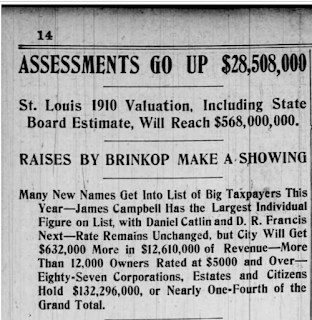
St. Louis Globe-Democrat, St. Louis, Missouri, 23 May 1910, Page 14

ASSESSMENTS GO UP $28,508,000 

St. Louis 1910 Valuation, Including State Board Estimate, Will Reach $568,000,000 

RAISES BY BRINKOP MAKE A SHOWING 

Many New Names Get Into List of Big Taxpayers This Year — James Campbell Has the Largest Individual Figure on List, with Daniel Catlin and D.R. Francis Next — Rate Remains Unchanged, but City Will Get $632,000 More in $12,610,000 of Revenue — More Than 12,000 Owners Rated at $5,000 and Over — Eighty-Seven Corporations, Estates and Citizens Hold $132,296,000, or Nearly One-Fourth of the Grand Total.

Combining the individual assessment for my second great grandfather, with the joint assessment with his wife, the total is $29,860. 
Notes

1) The CPI Inflation Calculator begins with January 1913. $29,860 in January of 1913 is equivalent to $849,492.62 in December of 2021. I do not know how many pieces of property they owned, or the difference between the property Selig owned individually, and what they owned jointly. 

Monday, August 2, 2021

Amanuensis Monday: Declaration of Intention for Philip Jacobs (1889-1954)

Amanuensis: A person employed to write what another dictates or to copy what has been written by another. I continue my project to transcribe family letters, journals, newspaper articles, audiotapes, and other historical artifacts. Not only do the documents contain genealogical information, the words breathe life into kin - some I never met - others I see a time in their life before I knew them.

Today I share the Declaration of Intention to Naturalize for Phillip Jacobs, the husband of my great grandfather's sister, Kate Newmark Jacobs. 

UNITED STATES OF AMERICA

DECLARATION OF INTENTION

UNITED STATES OF AMERICA

NORTHERN ILLINOIS DISTRICT OF ILLINOIS

My full, true, and correct name is PHILLIP JACOBS, formerly known as PHILLIP PINONZEIG

My present place of residence is 5808 N. Kenmore Avenue

My occupation is Tailor

I am 51 years old

I was born on Dec 10, 1889 in Lomza, Poland

My personal description is as follows: Sex male, color white, complexion fair, color of eyes blue, color of hair brown, height 5 feet 4 inches, weight 160 pounds, visible distinctive marks mole on left arm, race White, present nationality Polish.

I am married; the name of my wife or husband is Katie; we were married on 2-6-1913 at St. Louis, Mo. he or she was born at London, England Sept 19, 1896; and entered the United States at New York on about 1910 for permanent residence in the United States, and now resides at with me.

I have two children; and the name, sex, date and place of birth, and present place of residence of each of said children who is living, are as follows:

Nettie, F, born Dec 15, 1914

Harold, M., born July 27, 1916; both born and reside in Chicago, Ill.

My last place of foreign residence was Lomza, Poland.

I emigrated to the United States from Bremen, Germany

My lawful entry for permanent residence in the United States was New York under the name of Dzeikops (Jacobs) Philip on Dec 4, 1911 on the SS Prinz Frederich Wilhelm

Since my lawful entry for permanent residence I have not been absent from the United States, for a period or periods of 6 months or longer, as follows:

I shave not heretofore made declarations of intention.

Philip Jacobs (Signature)

Subscribed and sworn to (affirmed) before me in the form of oath shown above in the office of the Clerk of said Court, at Chicago, Illinois the 17th day of June, anno Domini 1941. I hereby certify that certificate No. 11-283115 from the Commissioner of Immigration and Naturalization showing the lawful entry for permanent residence of the declarant above named on the date stated in this declaration of intention has been received by me, and that the photograph affixed to the duplicate and triplicate hereof is a likeness to the declared.

Hoyt King

Clerk of the US District Court

(Illegible Signature) Deputy Clerk

Notes

1) I have seen surnames spelled in interesting and unusual ways. Dzeikops for Jacobs might take a prize, but it makes sense. The is no J sound in the Hebrew or Yiddish alphabet. Biblical names that normally begin with J in English (like Joseph, Jacob, Jonathan) actually start with the Y sound in Hebrew. For someone to try to spell Jacobs phonetically without a J, Dzeikops is fairly accurate. 

2) As I indicated last week, the date of birth for Kate is incorrect. Philip had the year of birth for their daughter Nettie/Natalie off by a year. It appears that after Philip filled out his forms, Kate's forms were "corrected" to match his on both Natalie's birth and their marriage year. Even though Kate likely was correct on both counts.

Monday, July 26, 2021

Amanuensis Monday: Declaration of Intention for Kate Newmark Jacobs (1894-1960)

Amanuensis: A person employed to write what another dictates or to copy what has been written by another. I continue my project to transcribe family letters, journals, newspaper articles, audiotapes, and other historical artifacts. Not only do the documents contain genealogical information, the words breathe life into kin - some I never met - others I see a time in their life before I knew them.

Today I share the Declaration of Intention to Naturalize for my great grandfather's sister, Kate Newmark Jacobs. She is the only female kin for whom I have naturalization papers. All other women who were immigrants either received derivative citizenship through their husbands, prior to 1922, or didn't become citizens. Kate and Phillip married early enough to have gone through the process prior to 1922, but for some reason didn't become citizens until 1941. Once women received the right to vote, legislation was passed requiring them to go through the process of naturalization on their own.

UNITED STATES OF AMERICA

DECLARATION OF INTENTION

UNITED STATES OF AMERICA

NORTHERN DISTRICT OF ILLINOIS

My full, true, and correct name is KATE JACOBS 

My present place of residence is 5608 Kenmore Avenue

My occupation is Housewife

I am 45 years old

I was born on Sept 1896 in London, England

My personal description is as follows: Sex female, color white, complexion fair, color of eyes brown, color of hair black, height 5 feet 2 inches, weight 195 pounds, visible distinctive marks none, race White, present nationality Polish.

I am married; the name of my wife or husband is Phillip; we were married on 2-6-1912 (1913) at St. Louis, Mo.; he was born at Lomya, Poland on Dec 1889; and entered the United States at New York on about 1910 for permanent residence in the United States, and now resides at with me.

I have two children; and the name, sex, date and place of birth, and present location of each of said children who is living, are as follows:

Natalie, F., Dec 16, 1913 (1914)

Harold, M., July 27, 1916 both born and reside in Chicago, Ill.

My last place of foreign residence was London, England

I emigrated to the United States from Liverpool, England.

My lawful entry for permanent residence in the United States was at New York under the name of Newmark, Kate on March 21, 1909 on the SS Campania.

Since my lawful entry for permanent residence I have not been absent from the United States for a period or periods of 6 months or longer, as follows:

I have not heretofore made declaration of intention

[...]

Katie Jacobs (Signature)

Subscribed and sworn to (affirmed) before me in the form of oath shown above in the office of the Clerk of said Court, at Chicago, Ill. this 26th day of September anno Domini 1941 hereby certify that Certification No. 11-318136 from the Commissioner of Immigration and Naturalization, showing the lawful entry for permanent residence of the declarant above named on the date stated in this declaration of intention has been received by me, and that the photograph affixed to the duplicate and triplicate hereof is a likeness of the declarant.

Hoyt King, Clerk of the US District Couret

By (illegible signature) Deputy Clerk

Notes

1) Contrary to what she states in this document, she was born on November 27, 1894, according to her birth certificate. Fibbing about the year of birth isn’t an uncommon occurrence, but I’m not sure the cause of the month/date variation.

2) It's not clear from this document why 1914 is written over the year of her daughter, Natalie's birth. Natalie's birth certificate confirms 1913 is correct. This leads me to believe that 1912 is also correct for their marriage, though I have not yet found their marriage records. I will share the naturalization form for Kate's husband next week. It appears he provided the inaccurate years, and after he filled out his forms, Kate's were 'corrected.' There are no marks on his forms to indicate alternate years. 

Monday, May 24, 2021

Amanuensis Monday - The Death of Joseph Blatt (1894-1895)

 Amanuensis: A person employed to write what another dictates or to copy what has been written by another. I continue my project to transcribe family letters, journals, newspaper articles, audiotapes, and other historical artifacts. Not only do the documents contain genealogical information, the words breathe life into kin - some I never met - others I see a time in their life before I knew them.

Today I share a newspaper account and death certificate for Joseph Blatt, the infant half-brother of my great grandmother, Anna Blatt. The newspaper account is in German, but I took an OCR (optical character recognition) transcript and input it into Google Translate. The translation is likely not exact, but close.

Morris Blatt, who lives in house 2312 Franklin Ave, visited family friends who lived in house 1213 North 7th St. yesterday afternoon with his 18 month old son Joseph Blatt. While the child looked out of the window, he lost his balance and fell deep into the courtyard. He hit his head and suffered a broken skull and a concussion. Dr. Friedman, 809 Carr Str. And Dr. Frumson, 905 North Broadway were called, but could do nothing more for the child, who died about an hour later from the injuries suffered.

Anzeiger des Westens (Scoreboard of the West)
St. Louis, Missouri
20 Sep 1895, Fri - Page 8


City of St. Louis
Health Department
Certificate of Death

This Certificate must be fully and accurately filled out in ink as provided by Section 392 Revised Ordinance, 1893

Name of Deceased: Joseph Blast
Age 1 Years 6 months
Male, White, Single
Place of Birth St. Louis
Residence in St. Louis 2312 Franklin Ave
Place of Death: 1233 N. 7th Street
Exact Locality of Death
Ward No. 4
Date of Death Sept 19 / 95
Cause of Death: Fracture of Skull, Account of Fall (Accident)

I Certify that the person above named died of the disease stated on the dat above named.
(Illegible)

Burial Permit
Office of Health Department
St. Louis Sept 20, 1895

I CERTIFY that the intended place of burial for the body of the above named person is Chesed Shel Emeth Cemetery - D. Goldberg


Notes

1) The newspaper says the house the Blatts were visiting was 1213 North 7th Street. The Death Certificate states 1233 North 7th Street. Without any other evidence I would go with the death certificate, but either could be wrong. I will try to figure out who was living at both residences and see if I recognize the names. Of course, if the child falls off a balcony and dies in a courtyard, the courtyard could be for both addresses. 

2) I have retrieved the exact plot location for the burial from the cemetery. There was no marker, and the child was buried in a charity section for infants. I will try to locate the plot on my next visit to the cemetery.  David Feinstein (1895-1896), the infant brother of my great grandfather, Herman Feinstein, is buried nearby in another unmarked grave. He died of pneumonia.

3) I am reminded of this news story from October 1904. Pearl Cruvand, the wife of my great grandmother's first cousin, witnessed a 6 year old fall off a balcony and rushed the child to a hospital.

Monday, May 17, 2021

Amanuensis Monday: Passport Application of Mala Blatt - May 1898

Amanuensis: A person employed to write what another dictates or to copy what has been written by another. I continue my project to transcribe family letters, journals, newspaper articles, audiotapes, and other historical artifacts. Not only do the documents contain genealogical information, the words breathe life into kin - some I never met - others I see a time in their life before I knew them.

Today I share the passport application for Mala (Mollie) Kellner Katz Blatt the second wife of my second great grandfather, Morris Blatt. She claimed citizenship based on his naturalization. 

FORM FOR PERSON CLAIMING CITIZENSHIP THROUGH NATURALIZATION OF HUSBAND OR PARENT

UNITED STATES OF AMERICA
MAY 18, 1898
STATE OF Missouri
CITY OF St. Louis

I, Mala Blatt, a NATURALIZED AND LOYAL CITIZEN OF THE UNITED STATES, hereby apply to the Department of State, at Washington, for a passport for myself.

I solemnly swear that I was born at [Wisniewitz?]. Russia on or about the 10 day of March 1864; that my husband emigrated to the United States, sailing on board the Steamer [Marsala?] from Hamburg on or about the 12th day of June 1888; that he resided 10 years, uninterrupted, in the United States, from 1888 to 1898, at St. Louis, Mo; that he was naturalized as a citizen of the United States before the St. Louis Court of Criminal Correction at St. Louis on the 14th day of May 1898, as shown by the accompanying Certificate of Naturalization; that I am the wife of the person described in said Certificate; that I have resided in the United States, uninterrupted, for 11 years, from 1887 to 1898, at St. Louis, Mo; that I am domiciled in the United States, my permanent residence being at St. Louis in the State of Missouri, where I follow the occupation of none; that I am about to go abroad temporarily; and that I intend to return to the United States within one year with the purpose of residing and performing the duties of citizenship therein.

Oath of Allegiance

Further, I do solemnly swear that I will support and defend the Constitution of the United States against all enemies foreign and domestic; that I will bear true faith and allegiance to the same; and that I take the obligation freely, without any mental reservation or purpose of evasion; SO HELP ME GOD

Sworn to before me this 14th day of May 1898
[Signature - Mala Blatt]
[Illegible Signature of Notary Public]

DESCRIPTION OF APPLICANT
Age: 34 Years
Stature: 5 feet, 6 inches, Eng.
Forehead: low
Eyes: Brown
Nose: Small
Mouth: Small
Chin: Oval
Hair: Dark Blonde
Complexion: Fair
Face: Oval

Identification:

I hereby certify that I know the above named Mala Blatt personal, and know her to be the wife of the person referred to in the within-described Certificate of Naturalization, and that the facts stated in her affidavit are true to the best of my knowledge and belief.

A. Jacob, 526 Pine St., St. Louis, Mo


Notes:

1) I do not know why she intended to leave the country, and for how long besides it being less than a year. She gave birth to a son 6 months later. It might be possible she wasn’t aware yet that she was pregnant and postponed/canceled the trip. 

2) This record does indicate my second great grandfather was naturalized, and provides the details necessary to obtain a copy of his records. Since it predates the 1906 statutes standardizing the process, it is unlikely the record contains much more than a signature, date, and origin country. But I have located it in a Missouri Archives database, and will request a copy.

It also provides a date for when he immigrated. I had not been able to find his ship information yet, and it is difficult to read the name of the ship provided on this application, It looks like Marsala. There was an SS Marsala that made the trip from Hamburg to NY on May 2 of 1888, which seems like a good match since he might have arrived in New York about June 12 - the average crossing was 43 days, so it's spot on. I have not found him in any passenger manifests at Ancestry.com. I will try to get creative with the spelling in the search index since I am pretty certain I have zeroed in on the ship.

Monday, April 5, 2021

Amanuensis Monday - Heirlooms Taken July 31, 1969

Amanuensis: A person employed to write what another dictates or to copy what has been written by another. I continue my project to transcribe family letters, journals, newspaper articles, audiotapes, and other historical artifacts. Not only do the documents contain genealogical information, the words breathe life into kin - some I never met - others I see a time in their life before I knew them.

Today I share a memo my grandfather wrote on July 31, 1969 and saved in his files.


From Melvin L. Newmark

Heirlooms taken from residence of Melvin L. Newmark, 701 Payson, Olivette, Mo. on 7/31/69, 7:00 to 10:00 P.M.

Gold locket about size of silver dollar - initials B.N. on one side and B/C on the other side in old English script on gold necklace chain.

Gold watch presented to Herman Feinstein by Flint Laundry 1937 on double strand antique necklace c hain.

Love bird charm on gold necklace chain - 50th Anniversary - Herman & Annie Feinstein.

Gold charm bracelet with 7 gold charms - one says SIS - 50th Birthday - one has pictures of ___, Steve, __ & Mel in little gold book, others commemorate special occasions.

[I edit out names of living individuals]


Notes:

1) My assumption is that there was a burglary while my grandparents were out, as opposed to a burglary while they were home. It was a Thursday night. The heirlooms taken were a gold locket belonging to his parents (my great grandparents) Barney Newmark and Bertha Cruvant Newmark; a gold watch belonging to my grandmother's father, Herman Feinstein; A love bird charm, possibly belonging to my grandmother's mother, Annie Feinstein; and I assume my grandmother's gold charm bracelet, with a charm I'm guessing my grandfather gave to her on her 50th birthday (1964), and with pictures of my grandfather and their kids.

I don't believe these heirlooms were ever found. While it's painful to consider what was lost, we treasure what remains.

Monday, February 22, 2021

Amanuensis Monday - Affidavit of a Nickname - Belle Sissie Newmark

Amanuensis: A person employed to write what another dictates or to copy what has been written by another. I continue my project to transcribe family letters, journals, newspaper articles, audiotapes, and other historical artifacts. Not only do the documents contain genealogical information, the words breathe life into kin - some I never met - others I see a time in their life before I knew them.

Today I share an Affidavit my paternal grandmother signed in front of a notary to prove that her nickname, that everyone knew her by, belonged to her. And that the name that appeared on all government documents was hers too. I am not sure what prompted the affidavit - what agency, business, person first questioned her identity. I also do not know how often she had to present the affidavit.


AFFIDAVIT

I, Sissie Newmark, being duly sworn on her oath says that she was born in St. Louis, Missouri on August 14, 1914, and that she was given the name of "Belle" by her parents Herman and Anna Feinstein. They registered her birth under the name "Belle" and she attended school in Clayton, Missouri under the name of "Belle."

Affiant further states that she was known by all of her class mates, friends and family members as "Sissie" and has continued to this date to use the name "Sissie". Belle and Sissie Newmark are one and the same person.

_______

Affiant

Subscribed and sworn to before me this __ day of October 1986.

____________

Notary Public

My commission expires: 


Notes:

1) This unsigned copy was saved by my paternal grandfather in his archive folders. I am sure my grandmother retained the signed copy

2) Letters indicate she spelled her nickname Sissy early on, but at some point changed the spelling. Many friends abbreviated the nickname to Sis, which of course is the etymology of the name her older brother gave to her. Her younger brother ended up with the nickname "Babe."


Monday, February 8, 2021

Amanuensis Monday: Letter from Melvin Newmark July 28, 1943

Amanuensis: A person employed to write what another dictates or to copy what has been written by another. I continue my project to transcribe family letters, journals, newspaper articles, audiotapes, and other historical artifacts. Not only do the documents contain genealogical information, the words breathe life into kin - some I never met - others I see a time in their life before I knew them.

Today I share part of a letter my grandfather wrote in 1943. I’m not sure to whom he was writing, nor am I positive the letter got sent. I assume it did and my grandfather felt it important enough to keep an unsigned copy of his letter. I do have a copy of the letter referenced in the first line, but there is no surname on the letter. 


Dear Micky:

Glad to hear from you.

[…]

Sissy and I are going away on a little vacation. We are leaving St. Louis Friday and will probably be gone about ten days. We are going up to Elkhart Lake, Wisc. to try to cool off.

I have an opportunity to go across for the American Red Cross as a field director and I am having a very difficult time trying to make up my mind. I am hopeful that during my vacation I will be able to think the thing out and reach a decision. I don’t know whether you are familiar with the job or not. It pays $275.00 per month. While I would not be considered part of the military, I would wear an officer’s uniform and live with the officers. If I went in I would probably leave the country in about four weeks. I wish I had your faculty for reaching a decision.

Apparently you do not like your present assignment. All of the fellow that I know have griped about the training and you have the consolation that that will be through soon.

Your thoughts about the law practice are pretty much the way I feel. If I do not take the Red Cross job, however, and if I am not drafted, I will probably never have the nerve to quit it. More power to you.

[…]

I understand Stella and the Baby are with you. Give her my best.

Sis and the Kids are fine. Sissy is very set against my going into service and if I don’t go in it will probably be because of her wishes.

Good luck, Micky, and let me hear from you soon.

Sincerely,


Notes:

1) My grandfather took the job with the Red Cross. When he returned after the war, he returned to the law practice.  I’m not positive what his issues were. Micky’s letter is handwritten and difficult for me to read, but I’m going to work at it.

2) Both of my grandmothers weren’t initially supportive of my grandfathers serving. A letter I’ve previously shared indicates my maternal grandmother was upset about my grandfather’s decision without her consent.

3) Sissy was the nickname of my grandmother given to her as a child by her brother. Later she would spell it Sissie.  

Monday, January 25, 2021

Amanuensis Monday: Melvin Newmark's Speech to the Samaritan Methodist Church 1946

Amanuensis: A person employed to write what another dictates or to copy what has been written by another. I continue my project to transcribe family letters, journals, newspaper articles, audiotapes, and other historical artifacts. Not only do the documents contain genealogical information, the words breathe life into kin - some I never met - others I see a time in their life before I knew them.

Today I share a speech my grandfather gave to the Samaritan Methodist Church of St. Louis in October of 1946. He would have been 34 years old at the time. My grandfather was active in interfaith organizations such as the National Conference of Christians and Jews. He had spoken at the church in February, probably in connection with National Brotherhood Week, and was invited back in October by the pastor, so apparently had made a good impression.

October 10, 1946

Rev G.F. Tipton [Samaritan Methodist Church]
4118 Cook Ave
St. Louis, Missouri

Dear Rev. Tipton:

It was certainly good to hear from you and to receive your kind invitation to be with you at your vesper services on October 27.

I shall certainly do everything in my power to be with you that evening. If there is any particular subject that you would like me to choose, I would appreciate your advising me.

Thanks again for your invitation, and be assured that I am looking forward to being with you and your congregation on October 27.

Sincerely yours,

Melvin L. Newmark

***

Recently I received one of the nicest compliments ever paid me — Rev. Tipton’s kind invitation to meet again with you good people — having stood on this pulpit only eight months ago, I was at first reluctant to accept for fear I would, “so to speak”, “Wear out my welcome”— but the happy prospect of enjoying your friendliness was too much to resist — so in spite of the qualms that are inherent in repetition I came again to enjoy one of your most inspirational services — perhaps too, my return is the result of coincidental timing. Some time ago my office, and in particular my senior associate, Victor Packman, was retained with Henry Espy to represent a group of negro train porters — very likely the case is familiar to all or most of you — the issue involved is heart-rending; it is typical of the sort of problem we are encountering, but it stands out because of the inhumane boldness of the Brotherhood of Railroad Trainmen — a lily-white organization. For years the Frisco railroad has employed negroes in the dual capacity of brakemen and porters. But only so with the reluctant approval of the Brotherhood.. This year when the time came to renegotiate the various labor contracts involved, the brotherhood decreed that hereafter negroes would no longer be permitted to engage in that capacity, and in accordance with the agreement made, the Railroad served notice on the negro employees involved that they would be fired — fired outright, mind you, in spite of the fact that most of these men had 15, 20, 25 years of valuable seniority with the company. Our job was to get the Federal Court here in St. Louis to enjoin the railroad from firing those negro employees who were fired only — and for no other reason than — that they were Negroes. We won the first round with the aid of the Lord, and a temporary injunction was issued. Round two came up a few weeks ago and a decision is expected shortly after the first of the year. If necessary we will continue fighting until the United States Supreme Court itself has had the opportunity to pass on it. But that case itself is not the basis for my discussion this evening, though well it might be.

Since it is a matter that at this very moment is pending before the court, propriety prevents me from discussing it in any greater detail than I already have. But it was the occasion of this case pending in my office, and the pitiful things I learned, and the tearful experiences encountered in working on the case that made me welcome so much the opportunity to talk to you again, as I did eight months ago on the unholiness and evilness of prejudice, hatred and bigotry.

How many times, since the end of the war, has each of you asked — either to yourself or to others — did we really win what we were fighting for? Is the war really over—Is Fascism really ended? On the occasion of the hanging of the 10 Nazi leaders a few weeks back, those questions were especially in everyone’s mind. The two great newspapers in St. Louis had a good deal to say about those questions — Let me read a few lines from each of the editorials that were printed.

“The gallows at Nuremberg ended a regime; It could not kill the ghastly, corrupt and inhuman impulses which created the regime. Hitler, Goering and the rest have returned to the dust, but the things they stood for live everywhere in the minds of other men, and the world must be on guard lest Fascism — once supreme in Germany, Italy and Japan — should again become triumphant.”

And a few days before the Post said that, the Star-Times on Friday October 18, said:

“Naziism was the repudiation of liberty, of equality of fraternity. You do not kill that philosophy when you have done no more than hang a few men or watch a few others gurgle their way to an ignominious death. Nazism lives in every man who denies democracy. It lives in every man who would erect barriers of economic or social, or racial or credal caste in the nation. It lives in every sword-rattling jingo, every war-mongering nationalist. Sometimes it is called the Ku Klux Klan, and sometimes it is called the Order of the Silver Shirts, and sometimes it is called by more respectable names. But always it is the same, and always it is a dread threat to man’s dignity — IT STILL LIVES.”

Yes, unfortunately, the newspapers are right — Fascism is not dead — not yet are we able to say — we won the war — we won what we were fighting for — we can not say we won the war if the Frisco Railroad can fire those trusted employees only because they were negroes — nor when Gerald KKK Smith is afforded the dignity of our great municipal auditorium to spread his nasty lies of hate — Nor when a situation can develop like that at Columbia, Tennessee. Now when — after working in my office Mr. Espy and Mr. Houston (Mr. Houston is a negro lawyer from Wash. D.C., who came here to help us on the Howard cause — perhaps some of you know him — he happens to be one of the leading members of the American Bar — White or Colored — the former dean of Howard University, a graduate of Amherst, Howard and Columbia, a citizen all America can and should be proud of—) As I started to say — you can not say we won the war when after working in my office with those two men we can not find a restaurant downtown where we can even have lunch together!!

We can not say the we have won the war when a certain US Senator — you know who I mean — can write this letter,

“If Jews of your type don’t quit sponsoring and fraternizing with the negro race you are going to arouse so much opposition to all of you that they will get a very strong invitation to pack up and resettle in Palestine, the homeland of the Jews, just as we propose to provide for the voluntary resettlement of the American Negro in West Africa, their fatherland” —

Except for the signature I would swear that Hitler himself wrote that letter — and not a US Senator — let me read you a passage from Hitler’s “Mein Kampf” and you’ll see what I mean.

“From time to time it is demonstrated to the German that for the first time here or there a Negro has become a lawyer, teacher, clergy, or even a leading opera tenor or something of that kind. It is a sin against the will of the eternal Creator to let his most talented beings degenerate while Hottentots are trained for intellectual vocations. The Jew knows very slyly how to construe from this a new proof of the correctness of his theory of the equality of men which he means to instill into the nations.”

But the question in our minds is — What can we do about it? The answer is — Plenty — as long as we live in a democracy.

First of all, we must learn — and re-learn — what Democracy is. What does it mean? What is its value? Some of you may be thinking — we know what Democracy is — but do you? Does Mr. American Citizen know what Democracy is? How many of you know what the Bill of Rights is? Its contents? If you are average, 79% of you will have to admit that you don’t know. The National Opinion Research Center of the University of Denver recently completed a nationwide survey on that very question. Only 21% had a reasonably accurate idea of the Bill of Rights contents.

In other words, only one person out of five knows that the American Bill of Rights consists of the first 10 amendments to the Federal Constitution. Only one person out of five knows that these amendments protect the basic liberties of the individual citizen from encroachment by the government. Only one person out of five can identify the very heart and center — the well-spring of American Democracy.  Let me urge you first then to learn what Democracy is.

Secondly, you must learn what Fascism is — and how to recognize it. Here too, you might say — We know what Fascism is. But do you? And even more important, do you know how to recognize Fascism when you see it? Can you see behind its sugar coatings and its false fronts? Do you recognize Jim Crow, and anti-Semitisms and discriminations against foreign born — discrimination against all minorities — as tools of fascism. Our general knowledge of Fascism is weak — we need to be informed. The Library of Congress is now preparing a report for the American people to the end that they may recognize Fascism and be armed against it. When that report comes out, study it; Knowledge is your only weapon.

Thirdly, by actual participation in our government, if you fail to vote in a primary or election or if you use your vote carelessly, you are doing yourself a grave injustice. The most valuable right that you have is your right to vote; don’t waste it or squander it. And don’t just stop with voting. If a candidate is running who has proven by his past record that he is worthy of support, get out and work for him — let him know it — and when he gets elected let him know how you feel on important issues. Yes, influence him if you will, on those issues that spell success for democracy. And at this point I wonder if it would bee all fright for me to say something in my heart — I happen to know Congressman John Sullivan personally — I can tell you honestly that he is your friend — but you don’t need me to tell it to you — his wonderful record speaks for itself — I think you owe it to yourself and your children to see that he is reelected —

But actual participation in government means more than voting — it means democracy in action — it means taking advantage of every law and statute — and instituting legal action where necessary — to protect and maintain your freedom — Legal action is one of your finest weapons — and under our system your surest guaranty of freedom. Court action is not only a means of testing a statute or enforcing it — it can also build community sentiment, get the people aroused, not exclusively on the particular case at issue, but on broad principles. So that even if the case itself is lost, the principle involved becomes important and.later legislation may be proposed that will put into the statute books the issue that was lost in the courtroom. Legal action of this sort is most important. The suits that have been filed to eliminate restrictions in deeds is a good example, as is the case against the railroad I talked about earlier and others that you are all familiar with —

These things can be done — and many others — so take hope in the future. The will to live a better life for ourselves and our children lies in our own hands. With an unswerving faith in God we will not fail.


Notes:

1) Genealogically there is little here except that my grandfather was involved with NCCJ, which is confirmed by some letters back and forth that were retained with the speech text. But having a written document containing my grandfather’s thoughts on Fascism, racism, and bigotry as a young man following his participation in WW2 is marvelous. Especially since they are thoughts I can unequivocally be proud about.

2) My grandfather stated his law firm was ready to take the court case he mentioned all the way to the Supreme Court if necessary. It was. They won in 1952.

3) The US Senator who wrote the horrific letter described was Mississippi Senator Theodore Bilbo. Pete Seeger recorded the song, Listen, Mr. Bilbo in the same year that my grandfather gave this speech.

4) A next step a historian might take might be to find the editorials that are quoted in part within the speech to see what they said in whole. They might be found in online newspaper archives. However, that is unnecessary as my grandfather retained clippings of the sources for his speeches in the same folder.

5) My grandfather’s speech folder doesn’t contain a copy of the speech he gave in February 1946, but it does have a short summary. I suspect he didn’t save a copy, and perhaps wrote the summary in October from memory. There aren’t a lot of speeches in the folder, so he was selective. I believe this is the earliest speech of his that he saved, but there are some undated ones. A speech he gave 12 years later in connection with National Brotherhood Week is also in the folder, and I will share it next week. National Brotherhood Week was the third week of February, though it ceased being observed in the 1980s. Perhaps we need its return. 

Monday, January 18, 2021

Amanuensis Monday: Samuel J. Denyer and the Santa Fe Expedition

Amanuensis: A person employed to write what another dictates or to copy what has been written by another.I continue my project to transcribe family letters, journals, newspaper articles, audiotapes, and other historical artifacts. Not only do the documents contain genealogical information, the words breathe life into kin - some I never met - others I see a time in their life before I knew them.

Today I share a news article containing a narration of some of the events of the Texan Santa Fe Expedition by Samuel J. Denyer, the brother of my second great grandfather, Ebenezer Denyer. I do not know how closely this narration resembles what other survivors said. or how it compares to the historical record. Reading it from the perspective of our own times, it is easy to see a markedly different narration of events could be written by other participants.

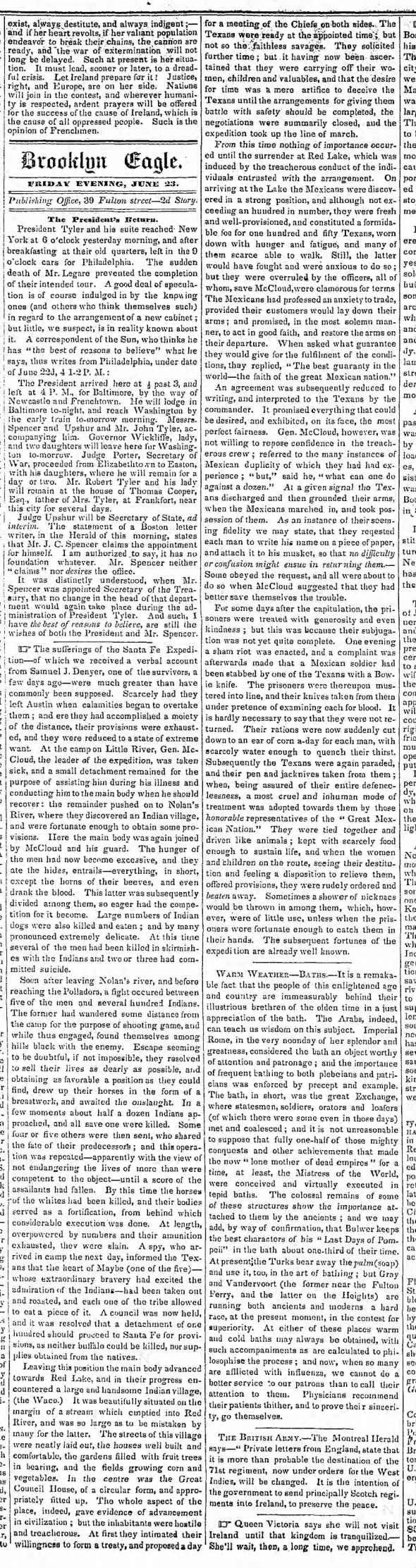
Santa Fe Expedition as told by Samuel J DenyerThe Brooklyn Daily Eagle 
Brooklyn, New York 
23 Jun 1843, Fri • Page 2

The sufferings of the Santa Fe Expedition — of which we received a verbal account from Samuel J. Denyer, one of the survivors, a few days ago — were much greater than have commonly been supposed. Scarcely had they left Austin when calamities began to overtake them ; and ere they had accomplished a moiety of the distance, their provisions were exhausted, and they were reduced to a state of extreme want. At the camp on Little River, Gen. McCloud, the leader of the expedition, was taken sick, and a small detachment remained for the purpose of assisting him during his illness and conducting him to the main body when he should recover: the remainder pushed onto Nolan's River, where they discovered an Indian village, and were fortunate enough to obtain some provisions. Here the main body was again joined by McCloud and his guard. The hunger of the men had now become excessive, and they ate the hides, entrails everything, in short, except the horns of their beeves, and even drank the blood. This latter was subsequently divided among them, so eager had the competition for it become. Large numbers of Indian dogs were also killed and eaten : and by many pronounced extremely delicate. At this time several of the men had been killed in skirmishes with the Indians and two or three had committed suicide.

Soon after leaving Nolan's river, and before reaching the Polladora, a fight occurred between five of the men and several hundred Indians. The former had wandered some distance from the camp for the purpose of shooting game, and while thus engaged, found themselves among hills black with the enemy. Escape seeming to be doubtful, if not impossible, they resolved to sell their lives as dearly as possible, and obtaining as favorable a position as they could find, drew up their horses in the form of a breastwork, and awaited the onslaught. In a few moments about half a dozen Indians approached, and all save one were killed. Some four or five others were then sent, who shared the fate of their predecessors ; and this operation was repeated apparently with the view of not endangering the lives of more than were competent to the object until a score of the assailants had fallen. By this time the horses of the whites had been killed, and their bodies served as a fortification, from behind which considerable execution was done. At length, overpowered by numbers and their ammunition exhausted, they were slain. A spy, who arrived in camp the next day, informed the Texans that the heart of Maybe (one of the five) whose extraordinary bravery had excited the admiration of the Indians hid been taken out and roasted, and each one of the tribe allowed to eat a piece of it. A council was now held, and it was resolved that a detachment of one hundred should proceed to Santa Fe for provisions, as neither buffalo could be killed, or supplies obtained from the natives.

Leaving this position the main body advanced towards Red Lake, and in their progress encountered a large and handsome Indian village, (the Waco.) It was beautifully situated on the margin of a stream which emptied into Red River, and was so large as to be mistaken by many for the latter. The streets of this village were neatly laid out, the houses well built and comfortable, the gardens filled with fruit trees in bearing, and the fields growing corn and vegetables. In the centre was the Great Council House, of a circular form, and appropriately fitted up. Tho whole aspect of the place, indeed, gave evidence of advancement in civilization ; but the inhabitants were hostile and treacherous. At first they intimated their willingness to form a treaty, and proposed a day for a meeting of the Chiefs on both sides. The Texans were ready at the appointed time, but not so the faithless savages. They solicited further time ; but it having now been ascertained that they were carrying off their women, children and valuables, and that the desire for time was a mere artifice to deceive the Texans until the arrangements for giving them battle with safety should be completed, the negotiations were summarily closed, and the expedition took up the line of march.

From this time nothing of importance occurred until the surrender at Red Lake, which was induced by the treacherous conduct of the individuals entrusted with the arrangement. On arriving at the Lake the Mexicans were discovered in a strong position, and although not exceeding an hundred in number, they were fresh and well-provisioned, and constituted a formidable foe for one hundred and fifty Texans, worn down with hunger and fatigue, and many of them scarce able to walk. Still, the latter would have fought and were anxious to do so ; but they were overruled by the officers, all of whom, save McCloud, were clamorous for terms. The Mexicans had professed an anxiety to trade, provided their customers would lay down their arms; and promised, in the most solemn manner, to act in good faith, and restore the arms on their departure. When asked what guarantee they would give for the fulfillment of the conditions, they replied, "The best guaranty in the world the faith of the great Mexican nation."

An agreement was subsequently reduced to writing, and interpreted to the Texans by the commander. It promised everything that could be desired, and exhibited, on its face, the most perfect fairness. Gen. McCloud, however, was not willing to repose confidence in the treacherous crew ; referred to the many instances of Mexican duplicity of which they had had experience ; " but," said he, "what can one do against a dozen." At a given signal the Texans discharged and then grounded their arms, when the Mexicans marched in, and took possession of them. As an instance of their seeming fidelity we may state, that they requested each man to write his name on a piece of paper, and attach it to his musket, so that no difficulty or confusion might ensue in returning them. Some obeyed the request, and all were about to do so when McCloud suggested that they had better save themselves the trouble.

For some days after the capitulation, the prisoners were treated with generosity and even kindness ; but this was because their subjugation was not yet quite complete. One evening a sham riot was enacted, and a complaint was afterwards made that a Mexican soldier had been stabbed by one of the Texans with a Bowie knife. The prisoners were thereupon mustered into line, and their knives taken from them under pretense of examining each for blood. It is hardly necessary to say that they were not returned. Their rations were now suddenly cut down to an ear of corn a-day for each man, with scarcely water enough to quench their thirst. Subsequently the Texans were again paraded, and their pen and jacknives taken from them; when, being assured of their entire defenselessness, a most cruel and inhuman mode of treatment was adopted towards them by those honorable representatives of the " Great Mexican Nation." They were tied together and driven like animals ; kept with scarcely food enough to sustain life, and when the women and children on the route, seeing their destitution and feeling a disposition to relieve them, offered provisions, they were rudely ordered and beaten away. Sometimes a shower of nicknacs would be thrown in among them, which, however, were of little use, unless when the prisoners were fortunate enough to catch them in their hands. The subsequent fortunes of the expedition are already well known.


Notes:

1) My third great grandfather, William Denyer, the father of Samuel Denyer and his brother, my second great grandfather, Ebenezer Denyer, was born in England and immigrated to the US in the early 1820s. Samuel was born in Baltimore, Maryland in 1822 and Ebenezer in Bucks County, Pennsylvania in 1828. It's not clear exactly when the family headed south to the Republic of Texas, but at least Samuel was clearly there before Texas became a State in 1845, and likely the rest of the family as well. William died in Louisiana in 1848, and was likely a resident of three countries during his lifetime. Samuel Denyer was killed by an "Indian" April 30,1861.

Monday, January 11, 2021

Amanuensis Monday: Selig Feinstein and the Progressive Order of the West - Unity Lodge 104

Amanuensis: A person employed to write what another dictates or to copy what has been written by another.

I continue my project to transcribe family letters, journals, newspaper articles, audiotapes, and other historical artifacts. Not only do the documents contain genealogical information, the words breathe life into kin - some I never met - others I see a time in their life before I knew them.

Today I’m sharing lists of names of delegates to several annual conventions of the Progressive Order of the West - a Jewish fraternal organization that was founded in 1896 and headquartered in St. Louis Missouri. My maternal great grandfather, Samuel Deutsch, was buried in the Progressive Order of the West section of Waldheim Cemetery in Chicago in 1938. I knew my second great grandfather, Selig Feinstein, was a member of a fraternal order from his son's wedding announcement,  however I didn't know which ones, until finding his name in these lists. While there may have been multiple lodges in the St. Louis area, since I don't know the locations for all of the lodges, I am going to focus on just the lodge Selig was a member of: Unity, 104.

Progressive Order of the West 7th Annual Convention Delegates
The Jewish Voice, Jan 24, 1902, page 3

Unity, 104
A. Rosentreter, Dr. M.I. DeVorkin, H. Elbert, Jos. Lehr, S. Feinstein, H. German, H. Maizner

Progressive Order of the West 9th Annual Convention Delegates
The Jewish Voice, Jan 29, 1904, page 6.

"Unity" 104

Delegates:

Dr. M.I. DeVarkin
Rev. A. Rosentreter
H. Elbert
J. Lehr
S. Feinstein
M. Zuckerman
A. German
J. Becker
H. Bearken
W. Schwartz
M. Pearl
M. Laski
A. Kristel

Alternates:
M. Weiselman
D. Roodman
H. Hirsch
L. Roodman
S. Cohen
I. Reifler
S. Honeck
A. Rosenfeld
W. Grassblatt
J. Davis
G. Elbert
I. Rosen
J. Sheffer

Grand Lodge Officers - 1913
The Jewish Voice, July 25, 1913, page 8


Following is the list of Grand Lodge Officers for the past term: 
B. Frank, Grand Master. 
H. L. Brody, 1st Deputy Grand Master. 
Abe Levy, 2nd Deputy Grand Master. 
J. Zuckerman, 3rd Deputy Grand Mas. 
N. Koffman, 4th, Deputy Grand Mas. 
Michael Sack, 5th Deputy Grand Mas. 
Morris Shapiro, Grand Secretary. 
Jacob Lasky, Grand Treasurer. 
Sam Kranzberg, Beneficiary Treas. 
Ben. E. Cohen, Grand Counsellor. 
Dr. M. I. DeVorkin. Grand Med. Ex. 
Chas. Schneider, Grand Chaplain. 
D. Reichman, Beneficiary Chairman. 
Adolph Cohen, Chairman of Finance. 
Harry Specter, Committee on Finance. 
Mike Novack, Committee on Finance. 
Ed. Lasky, Chairman on Supplies. 
Max Levy, Chairman of Appeals. 
M. Rubin, Chairman on Reserve Fund. 
Chas. I. Mahler, Chair. State of Order. 
B. Stein, Chairman on Propaganda. 
M. Lowenstine, Chairman of Rituals. 
Philip Fishman, Chair on Disability. 
S. Goldman, First Trustee. 
S. Feinstein, Second Trustee. 
J. Guttmann, Third Trustee. 
J. Jacobson, Grand Sentry.


Notes

The above indicates my second great grandfather was at least a member from 1902-1913. Selig died in 1915, and was likely a member at his death. M(ax) Weiselman, who was an alternate delegate in 1904, was Selig's business partner. Max was from Zhitomir, Volhynia, and I know the Feinsteins were from Volhynia as well. I do not know if the Weiselmans and Feinsteins knew each other in the Old Country.

Monday, January 4, 2021

Amanuensis Monday: Mabel Fulkerson is Hit by a Car - November 1961

Amanuensis: A person employed to write what another dictates or to copy what has been written by another.

I continue my project to transcribe family letters, journals, newspaper articles, audiotapes, and other historical artifacts. Not only do the documents contain genealogical information, the words breathe life into kin - some I never met - others I see a time in their life before I knew them.

Today I’m sharing the transcription of three newspaper articles concerning my wife's great grandmother, Mabel (Fulkerson) Gober (1901-1991). In November of 1961 she was hit by a car, and she remained in the hospital until February of 1962.


WOMAN HURT WHEN STRUCK BY AUTO IN FRONT OF HOME 
St. Louis Post Dispatch, 26 Nov 1961, Page 12 

Mrs. Robert L Gober, 60 years old, suffered fractures of the jaw, ribs and right hip last night when she was struck by an automobile in front of her home, 4111 Jennings Road, Pine Lawn. 

The driver of the automobile, Harry B. Frye, 9834 Colony drive, Bellefontaine Neighbors, said he was driving south in Jennings road when Mrs. Gober stepped into the path of his car from between two cars which were stoped in the northbound lane. She was taken to St. Louis County Hospital. 


from NEWS IN BRIEF 
Daily Standard, Sikeston, Missouri, 07 Dec 1961, page 3 

Word was received Wednesday from Mrs. Mabel Gober, a patient in St. Luke’s Hospital, St. Louis, that she is still on the Improving List. Mrs. Gober’s room number is 5109. She is a sister of Mrs. Ellis Alcorn, Sikeston; Mrs. Virgie Williams of Sikeston, who is spending the winter in Memphis; and Mrs. John Healy of Dexter. 


from NEWS IN BRIEF 
Daily Standard, Sikeston, Missouri, 08 Feb 1962, page 6 

Mrs. Ellis Acorn reports that her sister, Mrs. Mabel Gober of St. Louis who was struck by a car in St. Louis, November 25, was released from the St. Luke Hospital, this past Sunday. Mrs. Gober is now able to be around in a walker and wishes to thank all friends and relatives who were so kind and thoughtful doing her stay in the hospital.


Notes

I was already aware of the names of Mabel's brothers-in-law so the traditional naming format wasn't particularly frustrating. If I hadn't been, identifying which sister married which man could be my next challenge. Julia Fulkerson married Virgil Williams, Wrista Lou Fulkerson married Ellis Alcorn. Bertha Priscilla Fulkerson married John Healy.

I doubt a newspaper today would print the hospital room someone was staying in. It appears after being taken to St. Louis County Hospital (a 200-bed facility that opened in 1929 and closed in 1986), she was later transferred to St. Luke's Hospital for her recuperation.

Monday, December 28, 2020

Amanuensis Monday: The Separation of Ben and Goldie Cruvant

Amanuensis: A person employed to write what another dictates or to copy what has been written by another.

I continue my project to transcribe family letters, journals, newspaper articles, audiotapes, and other historical artifacts. Not only do the documents contain genealogical information, the words breathe life into kin - some I never met - others I see a time in their life before I knew them.

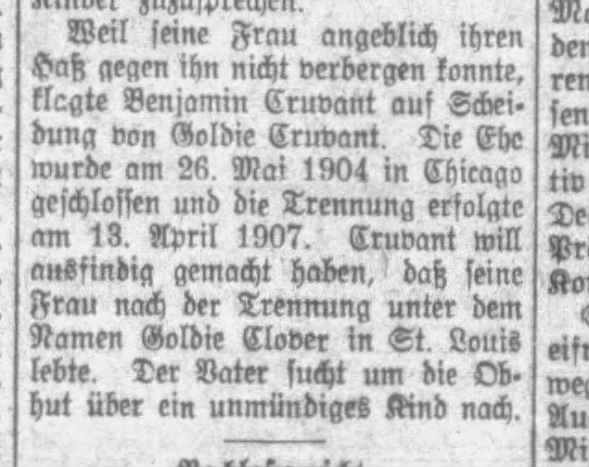
Today I’m sharing a newspaper article from a local German newspaper and Google’s translation of an OCR transcript. While not exact, I am hopeful that it is close. It concerns the separation of a great grandmother’s brother from his first wife. 

Sat, Apr 18, 1908 – 5 · Westliche Post (St. Louis, Missouri) · Newspapers.com Because his wife allegedly could not hide her hatred of him, Benjamin Cruvant sued Goldie Cruvant for the injuries. The marriage was concluded on May 26, 1904 in Chicago and the separation took place on April 13, 1907. Cruvant claims to have found that his wife lived under the name Goldie Clover in St. Louis after the separation. The father is looking for the custody of an underage child.

Notes:

1. A June 1907 article describes the disappearance of Ben on April 19 implying it was due to the objections of his parents to their marriage based on Goldie not being Jewish. I had found record of their divorce being filed in 1908, but hadn’t yet uncovered the details of what had been claimed. This article provides a different reason for the breakup, but Ben likely had legal reasons to claim injuries and blame Goldie. This article suggests he sought custody of one of the two children. Both children were residing with the mother in the 1910 census. Goldie’s maiden name was White and it’s unclear why she used the Surname Clover, if that claim is accurate.  

Monday, March 30, 2020

Amanuensis Monday: Declaration of Intent for Jacob Perlik

Amanuensis: A person employed to write what another dictates or to copy what has been written by another.

I continue my project to transcribe family letters, journals, newspaper articles, audiotapes, and other historical artifacts. Not only do the documents contain genealogical information, the words breathe life into kin - some I never met - others I see a time in their life before I knew them.

Today I transcribe a Declaration of Intention completed by Jacob Perlik, a brother of my second great grandmother, Annie Perlik Feinstein.

No. 86276 
US DEPARTMENT OF LABOR NATURALIZATION SERVICE
UNITED STATES OF AMERICA
DECLARATION OF INTENTION

Invalid for all purposes seven years after the date hereof

State of Illinois County of Cook In the Circuit Court of Cook County

I, Jacob Perlik, aged 41 years, occupation Carpenter do declare on oath that my person description is: Color white, complexion Ruddy, height 5 feet 9 inches, weight 176 pounds, color of hair Black, color of eyes Brown, other visible distinctive marks None.

I was born in Zdobietzen, Russia on the 12th day of April, anno Domini 1879. I now reside at 1438 So. Turner Ave, Chicago, Ill.

I emigrated to the United States of America from Quebec, Canada on the Canadian Pacific R.R.; my last foreign residence was Russia; I am married; the name of my wife is Bessie; she was born at Russia and now resides at With me.

It is my bona fide intention to renounce forever all allegiance and fidelity to any foreign prince, potentate, state, or sovereignty, and particularly to THE PRESENT GOVERNMENT OF RUSSIA, of whom I am now a subject; I arrived at the port of Detroit, in the State of Michigan, on or about the 12 day of May, anno Domini 1905.

I am not an anarchist; I am not a polygamist nor a believer in the practice of polygamy; and it is my intention in good faith to become a citizen of the United States of America and to permanently reside therein; SO HELP ME GOD.

Jacob Perlik

Subscribed and sworn before me in the office of the Clerk of said Court At Chicago, Ill, this 10 day of April anno Domini 1918

August W Miller Clerk of the Circuit Court
By G, Sienneschen, Deputy Clerk


Notes:

1) You may note that while I underlined all handwritten text, 'White' after 'Color" is not underlined. That is because if you look at the image, it is not handwritten. It is part of the typed form. Non-whites could naturalize after the Naturalization Act of 1870, so Non-white individuals declaring their intention to become naturalized either received a different form, or had to cross White out.

2) We're not exactly sure what town in Russia Jacob came from. There is no town named Zdobietzen. But it could be Dobryzn or Szczebrzeszyn.

Monday, February 24, 2020

Amanuensis Monday: The Petition for Naturalization of Herman Deutsch - 1927

Amanuensis: A person employed to write what another dictates or to copy what has been written by another.

I continue my project to transcribe family letters, journals, newspaper articles, audiotapes, and other historical artifacts. Not only do the documents contain genealogical information, the words breathe life into kin - some I never met - others I see a time in their life before I knew them.

Today I transcribe a Petition for Naturalization completed by Herman Deutsch, a first cousin of my maternal grandfather, Martin Deutsch.

United States of America
PETITION FOR NATURALIZATION

To the Honorable the District Court of the United States, Northern District of Illinois:

The petition of Herman Deutsch, hereby filed, respectfully showeth:

First: My place of residence is 1251 Irving Ave., Chicago, Illinois.

Second: My occupation is Upholsterer.

Third. I was born on the 7th day of April, anno Domini 1895, at Bucium, Roumania.

Fourth. I emigrated to the United States from Liverpool, England, on or about the 1st day of March
anno Domini 1921, and arrived in the United States at the port of New York, on the 11th day of March anno Domini 1921 on the vessel Imperator.

Fifth. I declared my intention to become a citizen of the United States on the 29th day of May, anno Domini 1922 at Chicago, Ill. In the Superior Court of Cook County.

Sixth. I am married. My wife’s name is Dora; she was born on the 1st day of May, anno Domini 1893 At Roumania, and now resides at with me, Chicago, Illinois. I have 5 children, and the name, date and place of birth, and place of residence of each of said children is as follows:

Sarah, born 29th July 1914 in Roumania
Sollie, born 22nd June 1916 “
Pearl, born 2nd June 1921 Chicago
Albert, born 31st December 1922 “
Lillian, born 21st May 1924 “
Reside in Chicago, Ill

Seventh. ….. renounce absolutely and forever all allegiance and fidelity to any foreign prince, potentate, state, or sovereignty, and particularly to Ferdinand I, King of Roumania, of whom at this time I am a subject, and it is my intention to reside permanently in the United States

Eighth. I am able to speak the English language

Ninth. I have resided continuously in the United States of America for the term of five years at least immediately preceding the date of this petition, to wit, since the 11th day of March, anno Domini, 1921, and in the State of Illinois, continuously next preceding the date of this petition, since the 13 day of March, anno Domini 1921, being a residence within this State of at least one year next preceding the date of this petition.

Tenth. I have not heretofore made petition for citizenship at any court.

Signature – Herman Deutsch

Declaration of Intention # 14316 and Certificate of Arrival from Department of Labor filed this 21st day of April, 1927.

Affidavits of Petitioner and Witnesses

Witnesses:
Abraham Glick, occupation Tailor, resideing at 1452 Western Ave., Chicago Illinois
And Joseph Schwartzman, occupation Unemployed, residing at 1215 Irving Ave., Chicago Illinois

Subscribed and sworn to before me by the above named petitioner and witnesses in the offices of the Clerk of said Court at Chicago, Ill, this 21st day of April, anno Domini 1927


Notes:

1. Starting in 1922 women had to start filling for Naturalization separately from the husbands, so there is a corresponding petition filled out for Dora (Diamant) Deutsch dated in 1929.

2. The passenger manifest indicates Herman's brother, Joseph, as the contact in America to which they were headed. Until finding the manifest, I wasn't positive Herman was Joseph's brother. I knew he was related, and my grandfather and siblings recalled him as the brother of Joseph in a tape recording they made in the 1970s, but memories of family relationships can be imprecise at times. But due to the petition and manifest I can definitively place him in the tree.

3. Bucium is also the birthplace of my great grandfather, Samuel Deutsch. Though it was part of Hungary at the time of the births for both Samuel and Herman. The border-changing is part of the reason I stick with "Transylvanian" when describing that part of my ancestry.

4. For some reason Sollie is listed on the Passenger Manifest as Bela, and identified as a daughter. I suspect it was a clerical error in reading the information from their Passport Book. I have the passport book my great grandfather's family traveled under in 1913, and I'm sure it was similar. I suspect they would show the book to the ship authorities, who would then transcribe the information.

5. I do not yet know if the witnesses are relatives or friends.