Showing posts with label Surname: Feinstein. Show all posts

Monday, January 12, 2026

Sale of 1122 North Eighth - 1895

Amanuensis: A person employed to write what another dictates or to copy what has been written by another. 

I continue my project to transcribe family letters, journals, newspaper articles, audiotapes, and other historical artifacts. Not only do the documents contain genealogical information, the words breathe life into kin - some I never met - others I see a time in their life before I knew them.

I've written before of the "Eighth Street Yard" - located at 1122 North Eighth Street in the City of St. Louis's third district. According to the 1900 census, my second great grandfather, Selig Feinstein, was the owner. I wondered when he purchased the building, and have finally located a newspaper article describing the sale. Written in 1895, the article is filled with racist language and purple prose that one would not find in today's papers.


Sale of 1122 North Eighth to Selig Feinstein and Max Wieselman

Article from Jun 28, 1895 St. Louis Globe-Democrat (St. Louis, Missouri)

 PASSING OF A CRIME CENTER. 

The "Eighth Street Yard" to Be Made the Home of Peace. 

Warfare and Wassail No Longer Prevail in the Place that Made the Third District Notorious -- "Little Jerusalem" Will Absorb It. 

"Ichabod" is written in dull, dead letters all over the "Eighth Street Yards," and their somber hues have spread over all the Third Police District, enveloping it in a haze of gloom. Silence and somnolence reign in the place of rum, ruin and riot, and the queen of Castle. Thunder, the Liliuokalani of North St. Louis, has been deposed. The vigilant guardian of the public peace now walks his beat in solitude, and hears not the sound of the growler as it moveth in the alley, and starts no more at the ripping sound of the knife as It plows its way through Ethiopian cuticle. The echo of the bulldog revolver has died away; the pickaninnies and their progenitors have gone hence. The Eighth Street Yards are deserted, and Capt. Peter Joyce and his vigilantes mourn because of their desolation and refuse to be comforted. Has not the "Bloody Third" become the abode of peace? There is nothing left but to mourn. 

The Eighth Street Yards, the scene of more bloodshed and crime than any other spot in St. Louis, have been notorious for a quarter of a century. They are located at 1116-1122 North Eighth street, extending back to the alley which runs through the square from Carr to Biddle street. The houses facing on Eighth street are located 10 feet above the level of the street, and are reached by means of winding steps. Between the street and the alley, bounded on the north and south by tenement houses, is a clear area about 40 feet square which has been soaked with human blood ten times over. The houses are all brick structures, scarcely fit for habitation by human beings, yet within their dingy walls for more than a score of years negro roustabouts and other offscourings of the race have met for revel and battle. Years ago the place became notorious, and did much toward winning for the district the sobriquet of the "Bloody Third." The yards are only half a square from the police station. Immediately at the north, in the alley between Seventh and Eighth and Biddle and O'Fallon streets, is the equally notorious "Wild-Cat Chute," while just east of the station, between Sixth and Seventh, Wash and Carr streets, is "Clabber Alley,' whose euphonious title has long: been familiar to the crime-reading public. This trio of rallying places for the infamous made life in the "Bloody Third" a hideous nightmare for many, and Capt. Peter Joyce, a graduate of West Point, a veteran of the civil war and a fighter of the redman, found it impossible to subdue their inmates, not being allowed the use of cavalry and cannon in his crusade against crime. 

But what the police failed to do a peaceful transaction has accomplished, and the Eighth Street Yards have gone "glimmering through the gleam of things that were." The houses have been sold to Max Wissellman and S. Feinstein, of 1108 North Eighth street, and they will be remodeled and refurnished and rented to Jewish families. The work of reconstruction has already commenced, and a boys' school is temporarily in operation in one of the rooms adjoining Castle Thunder. The "yards" will soon be an addition to "Little Jerusalem." 

The passing of the Eighth Street Yards recalls many tales which have long since become incorporated in the unwritten history of the place. The gleam of the razor, the echo of the revolver, the rattle of the patrol wagon, the shouts of hate and derision and the vigorous thump of the policeman's club all come back as plain as yesterday. In the background along with others who come. trooping at memory's call, is the herculean frame of "Big-Lip Lou," King of the Eighth Street Yards. Years ago he took up his abode in Castle Thunder, and his prowess in attempting to extend the power of his razor and his big right arm into the confines of Wild-Cat Chute and Clabber alley won for him the title of king. Lou was one of the biggest roustabouts that ever "run the river." His word was law to his scores of black subjects, and many a charge he led against the denizens of the two settlements which aspired to be more bloody than his own. For months and years he reigned with absolute tyranny, but dissensions finally arose in the midst of his bailiwick, and he went down before the hand of one of his own subjects. 

There, too, is "Beggie," the Bacchanalian Queen, whose dynasty perished with her. Beggie had two sons, both well-to-do, but she foreswore their love protection for that of John Barleycorn, and many a night she spent in his company in Castle Thunder, where she finally died amid the turbulency of her surroundings. The negroes regarded her with admiration, and the power which she wielded over them was second only to that of a cannibal queen. 

Capt. Joyce regards with apprehension the decline his domain, and Patrolmen Simcox, Knollhoff, Mader, and Taylor sigh disconsolately as they muse upon the fall of the empire which each of them invaded many times, and oft with results more than once deadly and disastrous. Patrolman Mader, now of the Fifth District, once went into the yards to arrest a negro, and was shot in the groin. The negro attempted to escape amid the confusion, but a bullet from the officer's revolver killed him instantly, and the policeman, who had gone in single-handed, was glad to escape with his life. Patrolman Simcox, they say, is more melancholy than all the others, and often twangs his club viciously on the sidewalk at the dead of night, as though all joy had been taken out of the police business and there were no further use of living. In the meantime the desk sergeant at the station smiles, the turnkey is happy, and at police headquarters there is a general feeling of relief.

Notes:

1) The article spells my ancestor's partner's name as Max Wisselman, but I know it is Max Wieselman, with whom he filed a patent in 1898. I was unaware he was a partner in the real estate purchase as well.

2) It appears the Jewish School at 1122 North Eighth in the 1909 Sanborn Maps was created in 1895, when my second great grandfather purchased the building, so it is likely my great grandfather attended the school.

Thursday, February 27, 2025

A Unique Family Heirloom

 Below is a picture of a wishbone from a turkey.

A turkey my grandmother baked for her parents’ 50th Wedding Anniversary in 1962


I think I can safely say the wishbone is at least 63 years old. 

I do not know the age of the turkey when it was slaughtered.

Some might question why I have it.

1) My mother only found the wishbone and note in her items a month or so ago. Obviously, she knew what to do with it. She called me.

2) If anything else was going to be done with the wishbone, it had to have been done 63 years ago. At this point, it would be a crime not to see how many more generations it can be passed down.

3) There have been discussions involving appropriate preservation and display options.

4) I did take a photograph. Just in case it mysteriously disappears.

Here is a photograph of my great grandparents - Herman and Annie (Blatt) Feinstein from May of 1962.

I know the date of the photograph due to a black and white version which appeared in their community newsletter congratulating them on their anniversary.


Tuesday, February 18, 2025

A Place of Many Names - Eighth Street Yard, Castle Thunder, Wild Cat Chute

When researching the neighborhoods your ancestors lived in, it's important to know all the names the area was known by. Sometimes there were many.

My second great-grandfather, Selig Feinstein, resided in the city of St. Louis, Missouri at 1122 North Eighth Street in 1900 with his family. (Including his mother, wife, and seven children). According to the census he was the owner of the building, and in addition to his 10-member family, 26 other individuals lived at the same address. Two of those 26 were Selig's sister, Rebecca, and her husband, Reuben Portnoy. The other 24 were, to my knowledge, unrelated, but all immigrated to America from Russia. They lived in the tenement district. The 1908 Civic League of St. Louis Report - Housing Conditions in St. Louis - provides a detailed description of the neighborhood.

A couple years ago I discovered that the block where the Feinstein family lived was also known as the Eighth Street Yard, and was well-known for criminal activity in the 1880s and 1890s. Newspaper stories about the address stop prior to 1900.

The Eighth Street Yard isn't the only term reporters used for the area. It took me a while to realize this, but the reporters occasionally wrote in the residents' dialect, so I found a few news stories by searching for "Ate Street Yard."

Another colorful phrase they used, as the article below points out, was "Wild Cat Chute."

De Ate Street Yard (8th Street Yard)

Article from Jul 31, 1892 St. Louis Post-Dispatch (St. Louis, Missouri)

The building next door, comprising 1124, 1126, and 1128 North Eighth Street, was known as Castle Thunder. (Named after a Confederate prison in Virginia.). The 1882 article below provides its entire history, from when it was built, and through a series of owners.

History of St. Louis's Castle Thunder

Article from Jul 20, 1882 St. Louis Globe-Democrat (St. Louis, Missouri)

 The below article provides some sketches of the inside of "Castle Thunder," and some vivid descriptions. While the article is from 1884, a good fifteen years before my ancestors may have moved in, and the Castle Thunder building was next door to the one Selig Feinstein and his family lived in, from the 1908 Housing Report on the tenements, I suspect the conditions were similar.

Sketches and Description of Castle Thunder

Article from Dec 6, 1884 St. Louis Post-Dispatch (St. Louis, Missouri)

The 1909 Sanborn Fire Insurance map provides the layout of the block. I believe the pink buildings are made of stone or brick, while the yellow are wood frame. The map shows how 1124, 1126, and 1128 are all one building. That's Castle Thunder. The empty space between the tenements is the Eighth Street Yard. By the 1910 census my second great-grandfather is no longer living at 1122, however, his sister Shprintze (Sylvia) Babchick and her family is. 

I've written past posts on the conditions in the tenements

It's disturbing to think about the squalor my ancestors lived in. However, I am proud of and thankful for their ability to climb their way out of those conditions.

Friday, March 4, 2022

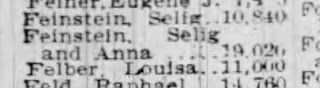
More Tax Assessments for Selig and Anna Feinstein - And Fun with OCR

A month ago I found the 1910 Tax Assessment for my second great grandparents Selig and Annie Feinstein published in the St. Louis Globe Democrat 

I had been searching Newspapers.com on his name and it came up. It was the only year it came up for, and I didn't dig much deeper.

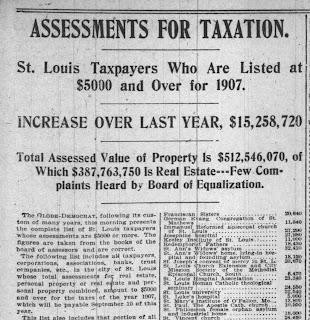
This past week I was searching for his business partner, fellow blacksmith, Max Wieselman. A tax assessment list for 1907 came up:

I scrolled back a few pages and found my second great grandfather.


One nice thing about Newspapers.com is you can view the Optical Character Recognition (OCR) text. Since I knew that it wasn't reading it as, "Feinstein," I was curious what it was reading it as. Felnatein. Reading an "i" as an 'l' isn't surprising. Neither is reading an 's' as an 'a.' So I started conducting more searches with various character replacements.

Then I went to the header on the first page. I wanted to find the list for as many years as possible. The opening sentence in the body of the article says "The Globe-Democrat, following its custom of many years, presents the complete list of St. Louis Taxpayers whose assessments are $5000 or more." How long was this custom?
Searching for "Assessments for Taxation" yielded no lists.
Searching for "St. Louis Taxpayers Who Are Listed" yielded none of the lists.
So I wondered - what was being indexed for the clipping above?


It looks like headline-size text is not read very well - which is the opposite of what I would expect. I searched for "Increase over last year" without much success. 

So far I have only uncovered 1902, 1907, 1909 and 1910 listings in my search from 1900-1915. I have found references to the listing in other years saying something to the effect "this list appears in today's paper," but the list isn't there. I think some years it may have been published in a separate pull-out section that didn't get scanned when the microfilm was made, and thus didn't get digitized. Though it is possible there are some years that have been digitized, but I just haven't had any luck finding the listings yet.

1902

                                            Selig and Anna Feinstein didn't make the 1902 list

1907

1909

1910

Selig's assessment dropped a little from 1907-1909, but a joint assessment with his wife appeared. From 1909 to 1910 the individual assessment remained the same, but the joint assessment grew. So far, this is all I know about the financial success of his real estate business.

Monday, February 7, 2022

Amanuensis Monday: 1910 Tax Assessment for Selig & Annie Feinstein

Amanuensis: A person employed to write what another dictates or to copy what has been written by another. 

I continue my project to transcribe family letters, journals, newspaper articles, audiotapes, and other historical artifacts. Not only do the documents contain genealogical information, the words breathe life into kin - some I never met - others I see a time in their life before I knew them.

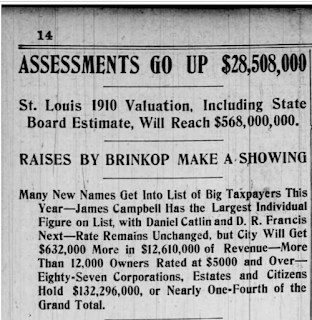
Today I share the Tax Assessment for my second great grandparents, Selig and Anna Feinstein. A Tax Assessment being the total value of the property owned upon which property tax is calculated. The local newspaper in 1910 listed the tax assessments for every individual or company above $5,000. (Over 12,000 people.) While theoretically property value is still public information, one would not expect a list like this to appear in a newspaper today.

As I mentioned in some recent posts, Selig and Annie were living in the tenement section in 1900, though according to the census, they owned the tenement. I have not been able to verify this yet by finding the deed, though I have looked in microfilm for it. They went into the real estate business between 1900 and 1910. Family lore has said that Selig was moderately successful, but somehow lost a lot of his money.


St. Louis Globe-Democrat, St. Louis, Missouri, 23 May 1910, Page 14

ASSESSMENTS GO UP $28,508,000 

St. Louis 1910 Valuation, Including State Board Estimate, Will Reach $568,000,000 

RAISES BY BRINKOP MAKE A SHOWING 

Many New Names Get Into List of Big Taxpayers This Year — James Campbell Has the Largest Individual Figure on List, with Daniel Catlin and D.R. Francis Next — Rate Remains Unchanged, but City Will Get $632,000 More in $12,610,000 of Revenue — More Than 12,000 Owners Rated at $5,000 and Over — Eighty-Seven Corporations, Estates and Citizens Hold $132,296,000, or Nearly One-Fourth of the Grand Total.

Combining the individual assessment for my second great grandfather, with the joint assessment with his wife, the total is $29,860. 
Notes

1) The CPI Inflation Calculator begins with January 1913. $29,860 in January of 1913 is equivalent to $849,492.62 in December of 2021. I do not know how many pieces of property they owned, or the difference between the property Selig owned individually, and what they owned jointly. 

Saturday, January 29, 2022

Timeline for Selig Dudelczak Feinstein (1858-1915)

I've decided to create some timelines for my ancestors to organize the information I have on their lives.

Here is a timeline I have created for my second great grandfather, Selig Dudelczak Feinstein 

  • 1858-1862 Simcha Zelig (Selig) Dudelczak is born, likely somewhere in Volhynia, Ukraine.
    • Simcha means "Gladness" or "Joy" in Hebrew. Zelig means "Blessed" in Yiddish.
  • 1858 Brother, Yidel (Julius) born (Possible Twin)
  • 1860 Sister, Zlata (Lottie) born (Possible Twin)
  • 1868 Sister, Toba (Tillie) born
  • 1871 Sister, Bella (Rebecca) born
  • 1874 Sister Shprintze (Sylvia) born
  • 1883 Selig marries Nechama (Anna) Perlik (Source: 1900 census)
  • 1885 Son Shmuel Zvi (Harry Samuel) born. 
  • 1886 Son Chaim (Herman Max)  born 
  • 1888 Son Benjamin born 
  • 1889 Immigrates to US by self (Port of arrival: Castle Garden)
  • 1890 Wife, Children & Mother immigrate under the surname Feinstein 
  • 1890 Daughter, Pearl, born (Descendants share DNA with descendants of Selig’s siblings, so paternity is likely)
  • 1892 First appears in St Louis City Directory as a Shoer
  • 1893 Son, Morris, born
  • 1895 Son, David, born
  • 1896 Son, David, died 
  • 1898 Son, Aaron, born
  • 1898 Patents an improvement to fire hydrants with business partner Max Wieselman (who also immigrated from Volhynia)
  • 1899 Appears in City Directory as both Grocer and Blacksmith 
  • 1899 Son, Joseph, born
  • 1899 Vice President of new Tpheris Israel congregation
  • 1900 Blacksmith, residing at 1122 North Eighth Street, and according to the census, owner,
  • 1901 Opens Western Junk Shop - lasts until 1905
  • 1901 Daughter, Rose, born. Son, Joseph, died.
  • 1902-1913 Member of Progressive Order of the West fraternal organization
  • 1906 Mother, Gitel (Gertrude) died. 
  • 1906 Selig on Chesed Shel Emeth Society committee to build an Old Folks Home
  • 1906 Moves to 5600 Garfield. 
  • 1907 Sells property on Garfield to brother Julius Odelsohn
  • 1908 Opens real estate business with Son, Harry
  • 1910 Lives at 1941 Burd Ave
  • 1911 Selig & Anna purchase lot of Carr Primary School
  • 1911 Opens Central Laundry business with Son, Herman
  • 1912 Incorporates Famous Laundry
  • 1912 Charged with violating "Anti-Smoke Ordinances" at Central Laundry. (Coal smoke) 
  • 1914 Opens another laundry business with daughter, Pearl
  • 1915 Selig Feinstein died. 
  • 1915 Selig is recorded as donating $6 to Jewish Charitable & Educational Union
Notes
  1. I have yet to uncover a document with his date of birth. Years on documents vary. 
  2. No European vital records have been found so dates which appear on later records are less certain. 
  3. Between 1860-1868 it is likely other siblings were born. Family history suggests at least one named Gershon survived childhood and remained in the Ukraine as an adult. What happened to him is unknown.
  4. I do not know for certain where Selig (and his family) were between 1889-1892. They may not have moved to St. Louis until after everyone had immigrated.
  5. I have searched through deed indexes on microfilm, but have been unable to uncover the deed indicating Selig purchased 1122 North Eighth Street as the 1900 census suggests.  The vast majority of neighbors are listed as renters, and few addresses in the neighborhood have owners listed. Most owners of the tenements likely lived in other neighborhoods. Being a resident owner would have been unusual, but Selig's later interest in real estate might have started earlier. 
  6. He was possibly a member of the Progressive Order of the West fraternal organization prior to 1902, but that was the first year he appeared in the newspaper as a delegate to their annual convention. Similarly, he likely remained a member until his death.
  7. I have not uncovered Selig’s will so I don’t know if the donation was part of it or given before he died. A list of donations appeared in the newspaper. 
  8. I’ve found six occupations so far. Shoer, Blacksmith, Grocer, Junk Dealer, Real Estate Management, Laundry Management. 

Saturday, January 8, 2022

Who Cleaned Up The Eighth Street Yard?

What was the Eighth Street Yard? 

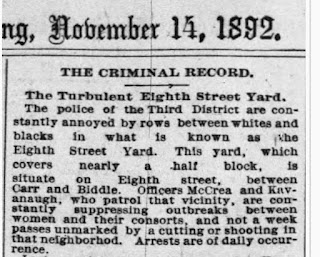
St. Louis Globe Democrat, November 14, 1892

The police of the Third District are constantly annoyed by rows between whites and blacks in what is known as the Eighth Street Yard. This yard,  which covers nearly a half block, is situate on Eighth street, between Carr and Biddle.

St Louis Post Dispatch, January 6, 1895

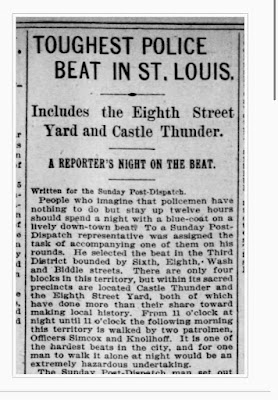
There are only four blocks in this territory, but within its sacred precincts are located Castle Thunder and the Eighth Street Yard, both of which have done more than their share toward making local history...It is one of the hardest beats in the city, and for one man to walk it alone at night would be an extremely hazardous undertaking.

Where exactly was the Eighth Street Yard? The first clipping above says it covered half a block on Eighth Street between Carr and Biddle. The clipping below provides an address.

St. Louis Globe-Democrat, March 6, 1893


1122 North Eighth. The tenement my 2nd great grandfather, Selig Feinstein, lived in, and owned, according to the 1900 census. The Eighth Street Yard appears a lot in the news between 1890-1895. Then it disappears. 

When and how was the 8th Street Yard, one of the toughest police beats, cleaned up? When did Selig Feinstein purchase the address? What was his role? In the early 1890s he is listed in city directories as residing on Seventh Street, but working as a shoer/blacksmith at 1106 North Eighth. So he would naturally have had an incentive to move to the same block he worked. Once he owned the property, did he just kick out the rowdy residents and recruit new ones?

I hoped to get to the library this weekend to research deeds on microfilm, to pinpoint the exact year he purchased the property, and whether he purchased any other property in the area. There is some family lore that he may have.  I do know that he went into the Real Estate business with his children starting in 1905, but he may have been a landlord of multiple properties before then. It doesn't look like I will get to the library this weekend due to weather and other factors. Maybe next weekend. 

Sunday, January 2, 2022

1122 North Eighth Street, 1900

In the 1900 Census my second great grandparents Selig and Annie (Perlik) Feinstein, their seven children, and Selig's mother Gertie were living at 1122 North Eighth Street in St. Louis, Missouri. They were in the front section, and are listed in the census as the owners. In the rear were several families: The Finkelsteins, Buchmans, Portnoys, and Shparbergs.  There were also several individuals - Sarah Freeman, Samuel Feingold, Morris Klingermann, Charles Mutsnick, and Wolf Simon. In total, there were 36 people residing at 1122 North 8th. 10 in the front, 26 in the rear. The country of origin for all adults was Russia.

Over the years I've written several entries on the Carr Square Neighborhood, and on the subsection called Little Jerusalem. Over the last week I decided to start with the families at 1122, and see what I could find out about their descendants. The term FAN Principle (Friends, Associates, Neighbors), credited to Elizabeth Shown Mills, is somewhat applicable. However, my primary intent wasn't to find out more about my ancestors through researching their neighbors. I was genuinely interested in what happened to the families living with my ancestors in the tenement.

Most of the single boarders are difficult to trace. I already knew that Rebecca Portnoy was Selig's sister, and she and her husband were childless. My new database after a week of researching Ancestry Hints is up to 275. A good proportion are the descendants of my second great grandparents, but unrelated surnames include Bernhardt, Buchman, Finkelstein, Friedman, Green, Kanefield, Klayman, Safron, Shcolnik, and Sparberg.

I'm ready to move on to the next address. I will probably move next door on the census, but I might make a detour to North Seventh Street where Selig's brother, Julius, was residing. Why am I interested? Having lived in St. Louis for my whole life I do expect to run across surnames that while not related to me, are still familiar. I'm also interested in fleshing out this community of Little Jerusalem where all of my paternal second great grandparents lived at one time. My Newmark ancestors arrived in 1909 and settled perhaps a block or two outside of the boundaries. The Cruvants, Blatts & Feinsteins all resided within the boundaries at some point.

I have created a secondary blog - Little Jerusalem 1900 to write about discoveries that aren't directly related to my family history. Today I posted a transcription of a news article about a War Between Candy Shops. It's a humorous story about competing businesses, and is a refreshing counterpoint to the disturbing descriptions of the tenement conditions I have read elsewhere. It also suggests that Candy Apples were introduced in St. Louis in 1900, 8 years prior to when they are said to have been invented in New Jersey. Some people might question how these two candy apples compared. Certainly many people confuse Caramel Apples with Candy Apples. But Caramel Apples are said to have been invented by Kraft Foods in the 1950s. It's not clear what was introduced in St. Louis in 1900 and how it may differ from what was introduced in 1908, but the description given in the newspaper article appears to resemble what we know today as Candy Apples. The origin story of the confection may need to be rewritten if Candy Apples were being sold by two candy shops in St. Louis in 1900.

Monday, February 22, 2021

Amanuensis Monday - Affidavit of a Nickname - Belle Sissie Newmark

Amanuensis: A person employed to write what another dictates or to copy what has been written by another. I continue my project to transcribe family letters, journals, newspaper articles, audiotapes, and other historical artifacts. Not only do the documents contain genealogical information, the words breathe life into kin - some I never met - others I see a time in their life before I knew them.

Today I share an Affidavit my paternal grandmother signed in front of a notary to prove that her nickname, that everyone knew her by, belonged to her. And that the name that appeared on all government documents was hers too. I am not sure what prompted the affidavit - what agency, business, person first questioned her identity. I also do not know how often she had to present the affidavit.


AFFIDAVIT

I, Sissie Newmark, being duly sworn on her oath says that she was born in St. Louis, Missouri on August 14, 1914, and that she was given the name of "Belle" by her parents Herman and Anna Feinstein. They registered her birth under the name "Belle" and she attended school in Clayton, Missouri under the name of "Belle."

Affiant further states that she was known by all of her class mates, friends and family members as "Sissie" and has continued to this date to use the name "Sissie". Belle and Sissie Newmark are one and the same person.

_______

Affiant

Subscribed and sworn to before me this __ day of October 1986.

____________

Notary Public

My commission expires: 


Notes:

1) This unsigned copy was saved by my paternal grandfather in his archive folders. I am sure my grandmother retained the signed copy

2) Letters indicate she spelled her nickname Sissy early on, but at some point changed the spelling. Many friends abbreviated the nickname to Sis, which of course is the etymology of the name her older brother gave to her. Her younger brother ended up with the nickname "Babe."


Monday, January 11, 2021

Amanuensis Monday: Selig Feinstein and the Progressive Order of the West - Unity Lodge 104

Amanuensis: A person employed to write what another dictates or to copy what has been written by another.

I continue my project to transcribe family letters, journals, newspaper articles, audiotapes, and other historical artifacts. Not only do the documents contain genealogical information, the words breathe life into kin - some I never met - others I see a time in their life before I knew them.

Today I’m sharing lists of names of delegates to several annual conventions of the Progressive Order of the West - a Jewish fraternal organization that was founded in 1896 and headquartered in St. Louis Missouri. My maternal great grandfather, Samuel Deutsch, was buried in the Progressive Order of the West section of Waldheim Cemetery in Chicago in 1938. I knew my second great grandfather, Selig Feinstein, was a member of a fraternal order from his son's wedding announcement,  however I didn't know which ones, until finding his name in these lists. While there may have been multiple lodges in the St. Louis area, since I don't know the locations for all of the lodges, I am going to focus on just the lodge Selig was a member of: Unity, 104.

Progressive Order of the West 7th Annual Convention Delegates
The Jewish Voice, Jan 24, 1902, page 3

Unity, 104
A. Rosentreter, Dr. M.I. DeVorkin, H. Elbert, Jos. Lehr, S. Feinstein, H. German, H. Maizner

Progressive Order of the West 9th Annual Convention Delegates
The Jewish Voice, Jan 29, 1904, page 6.

"Unity" 104

Delegates:

Dr. M.I. DeVarkin
Rev. A. Rosentreter
H. Elbert
J. Lehr
S. Feinstein
M. Zuckerman
A. German
J. Becker
H. Bearken
W. Schwartz
M. Pearl
M. Laski
A. Kristel

Alternates:
M. Weiselman
D. Roodman
H. Hirsch
L. Roodman
S. Cohen
I. Reifler
S. Honeck
A. Rosenfeld
W. Grassblatt
J. Davis
G. Elbert
I. Rosen
J. Sheffer

Grand Lodge Officers - 1913
The Jewish Voice, July 25, 1913, page 8


Following is the list of Grand Lodge Officers for the past term: 
B. Frank, Grand Master. 
H. L. Brody, 1st Deputy Grand Master. 
Abe Levy, 2nd Deputy Grand Master. 
J. Zuckerman, 3rd Deputy Grand Mas. 
N. Koffman, 4th, Deputy Grand Mas. 
Michael Sack, 5th Deputy Grand Mas. 
Morris Shapiro, Grand Secretary. 
Jacob Lasky, Grand Treasurer. 
Sam Kranzberg, Beneficiary Treas. 
Ben. E. Cohen, Grand Counsellor. 
Dr. M. I. DeVorkin. Grand Med. Ex. 
Chas. Schneider, Grand Chaplain. 
D. Reichman, Beneficiary Chairman. 
Adolph Cohen, Chairman of Finance. 
Harry Specter, Committee on Finance. 
Mike Novack, Committee on Finance. 
Ed. Lasky, Chairman on Supplies. 
Max Levy, Chairman of Appeals. 
M. Rubin, Chairman on Reserve Fund. 
Chas. I. Mahler, Chair. State of Order. 
B. Stein, Chairman on Propaganda. 
M. Lowenstine, Chairman of Rituals. 
Philip Fishman, Chair on Disability. 
S. Goldman, First Trustee. 
S. Feinstein, Second Trustee. 
J. Guttmann, Third Trustee. 
J. Jacobson, Grand Sentry.


Notes

The above indicates my second great grandfather was at least a member from 1902-1913. Selig died in 1915, and was likely a member at his death. M(ax) Weiselman, who was an alternate delegate in 1904, was Selig's business partner. Max was from Zhitomir, Volhynia, and I know the Feinsteins were from Volhynia as well. I do not know if the Weiselmans and Feinsteins knew each other in the Old Country.

Wednesday, January 22, 2020

Wordless Wednesday: Advertising Slogans

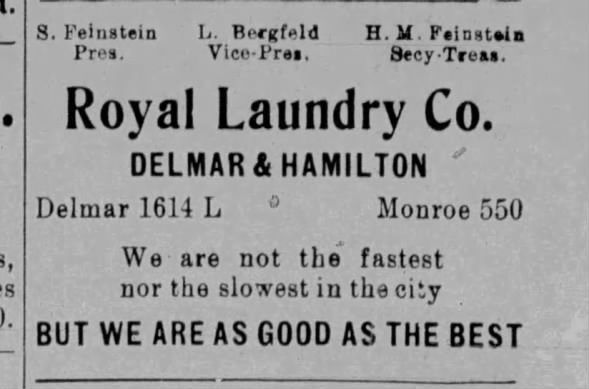
My second great grandfather, Selig Feinstein, and my great grandfather, Herman M Feinstein, may not have been the best at coming up with advertising slogans for their laundry.

Royal Laundry AdvertisementRoyal Laundry Advertisement Fri, Aug 26, 1910 – 1 · The Jewish Voice (St. Louis, Missouri) · Newspapers.com

Monday, July 15, 2019

Amanuensis Monday: The Education of Herman Feinstein

Amanuensis: A person employed to write what another dictates or to copy what has been written by another.

I continue my project to transcribe family letters, journals, newspaper articles, audiotapes, and other historical artifacts. Not only do the documents contain genealogical information, the words breathe life into kin - some I never met - others I see a time in their life before I knew them.

Today I transcribe a newspaper clipping mentioning a great grandfather's schooling. The St. Louis Globe-Democrat has recently been added to the digitized holdings at Newspapers.com. Born in 1886, my great grandfather Herman Feinstein was 15 years old in 1901.

St. Louis Globe-Democrat, 17 April 1901, page 9. 
JEWISH ALLIANCE SCHOOL
Closing Exercises Held Last Night at Jefferson Building.

The closing exercises of the Jewish Alliance night schools, at the Jefferson school building, at Ninth and Wash streets, were held last night under the direction of Prof. Emil Mayer, the principal. An attractive program was presented. It was opened by a song, “The Flag of the Free,” sung by the school. Recitations were presented by Ida Gellman, Louis Lambrakis, Ralph Goldman, Simon Shipper, Fannie Brenholz, Beckie Herman, Jacob Frelich, Annie Hall, Ike Stern and Mary Fridkin; orations by Sam Shor and Sam Shipper; dialogue by Esther Sherman, Sadie Greenspan, Carrie Dubinsky, Jenny Mason, Herman Feinstein and Jacob Rosenblatt; debate on “Resolved, That education should be compulsory,” by Emil Goldstein on the affirmative and Simon Ludwig on the negative; a song, “The Linden Tree,” by Fannie Brenholz, Rose Alberstein, Jennie Mason and Sam Shor; essay by Harry Singman, and the song, “Good Night,” by the school. A number of prizes were distributed by Rabbi Samuel Sale, and short addresses were made by Rabbis H. J. Messing and Moritz Spitz.

The enrollment for the term, which began in October, was about 350. Six assistant teachers were employed, Misses Sophie Barron, Rose and Minnie Kahn and Fishell, Isaacs and Goldberg. The school is maintained by the Associated Jewish Charities for purpose of affording opportunities for acquiring an education to the younger Jewish element of that locality who are employed in the daytime. It is under the management of a board of directors, the officers of which are Elias Michael, president; Louis Bry, Vice President; Albert Loth, secretary, and Isaac Schwab, treasurer. The next term of the school will begin in the new building that is being erected by the Jewish Charitable and Educational Association at Ninth and Carr streets. The new building is a three-story structure, 150x50 feet in area, and will cost upward of $40,000.

Notes:

1) Closing exercises doesn't necessarily mean graduation. From the description it appears all students at the night school participated, and there is no indication which students would be returning the following term. From this article I know my great grandfather in 1901 at age 15 had a job during the day and was receiving the equivalent of a secondary education at night. I also have insight into the type of education he was receiving.

2) I wonder if the presentation category of "Dialogue" was similar to the "Dramatic Interpretation" or "Duo Interpretation" categories in modern Speech and Debate competitions.

Monday, April 30, 2018

Amanuensis Monday: The Wedding of Harry Feinstein and Dora Serwinsky

Amanuensis: A person employed to write what another dictates or to copy what has been written by another.

I continue my project to transcribe family letters, journals, newspaper articles, audiotapes, and other historical artifacts. Not only do the documents contain genealogical information, the words breathe life into kin - some I never met - others I see a time in their life before I knew them.

Below I transcribe an article on the wedding of my great grandfather's brother, found at Newspapers.com

St. Louis Republic, 16 Aug 1905, page 4.

ONE THOUSAND GUESTS AT ORTHODOX WEDDING

Harry S Feinstein Weds Miss Dora Serwinsky With Elaborate Ritual, at Westminster Hall Last Night.

Gayety characterized the wedding of Miss Dora Serwinsky of No. 826 Carr street and Harry S. Feinstein of No. 1122 North Eighth street, who were married last night at 8 o’clock at Westminster Hall, No. 3906 Olive street.

Rabbis Z. Rosenfeld and S. Rosenberg of Tpherish Israel Temple, Ninth and Wash streets, jointly performed the ceremony. More than 1,000 guests were present.

One hundred candles were burned during the ceremony, in accordance with the orthodox custom.

The hall was decorated for the event. Weil’s orchestra furnished the music and rendered the wedding march. The attendants were H.M. Feinstein, brother of the groom, best man; Miss Lillian Serwinsky, sister of the bride, maid of honor; the Misses Sarah Raskas, Jennie Masta and Anna Seigel, bridesmaids; M. L. Serwinsky, Louis Kaufman of Elizabeth, N.J., and Mose Kaufman, groomsmen.

After the wedding a reception and banquet were tendered to the bridal party at Westminster Hall, followed by dancing. In the festivities the entire membership of Tpherish Israel Congregation participated.

Miss Serwinsky is a daughter of A. Serwinsky and is an elocutionist. Mr. Feinstein is a young business man.

The couple were the recipients of many presents and several hundred telegrams. A present of $250 was given to them by the various lodges of which the groom’s father is a member. Among the guests were officials of the Franklin Bank and teachers from the faculty of the Jefferson and Shields schools. Mr. and Mrs. Feinstein departed at 2 a.m. for the East on their wedding trip. They will live at No. 5606 Garfield avenue.

Notes:

1. The photograph above is from the wedding. Some family members had identified the five men as the five Feinstein brothers. I've known for awhile this isn't the case as the youngest Feinstein brother would have only been 7 years old in 1905. The Bridal Party was a complete unknown.

But now I have a list of the Groomsmen and Bridal Party. Harry Feinstein, the groom, is most likely in the center, behind his bride, Dora Serwinsky. I believe Herman Max Feinstein, my great grandfather, and Harry's best man, is to Harry's right (our left). The other three men are M.L Serwinsky, and Louis and Mose Kaufman. My suspicion is that Dora's sister, Lillian, the bridesmaid, is to her right. The other three women being Sarah Raskas, Jennie Masta, and Anna Sigel. The two young girls aren't identified in the news article.

2. "Weil's Orchestra" refers to an orchestra conducted by William Weil. There are references to the orchestra performing at the St. Louis World's Fair in 1904, as well as being the house orchestra for the St. Louis Browns baseball team in the late 1890s.

3. My second great grandfather, Selig Feinstein, father of the groom, was elected President of the Tpheris Israel congregation in 1903, which could explain why the entire congregation showed up at his son's wedding. Or it's possible the entire congregation showed up at the wedding of every congregant.

4. "Elocutionist," is a surprising, and impressive job for the daughter of an immigrant family. Dora was born in Poland in 1884, but was only three when the family immigrated.

5. I was unaware that my second great grandfather was a member of any fraternal lodges. I will need to see if I can find out which ones, and check if there are any records. My great-grandfather's application for the Moolah Shrine Temple in 1927 is where I discovered his alleged birthplace. The most likely fraternal organizations for Selig Feinstein are B'nai B'rith (which still exists), Order of B'rith Abraham, and Progressive Order of the West.  Progressive Order of the West was headquartered in St. Louis.

6. Harry's address is given as 1122 North Eighth. The Feinsteins hadn't yet moved out of the tenements in the Carr Square/Little Jerusalem neighborhood. 826 Carr, the address of the bride, is also in the same neighborhood.

Monday, November 20, 2017

Amanuensis Monday: The "Engagement" of Belle Feinstein and Melvin Newmark

Amanuensis: A person employed to write what another dictates or to copy what has been written by another.

I continue my project to transcribe family letters, journals, newspaper articles, audiotapes, and other historical artifacts. Not only do the documents contain genealogical information, the words breathe life into kin - some I never met - others I see a time in their life before I knew them.

Below I transcribe two December 1936 clippings from The Modern Voice, a St. Louis Jewish weekly newspaper. The second one appeared a week after the first, reporting the same event, but with a few corrections.

Dec 6, 1936 - page 14

Newmark-Feinstein

Mr. and Mrs. H.M. Feinstein of 6422 San Sonita Ave., have announced the engagement of their daughter, Miss Belle Feinstein, and Melvin I. Newmark, son of Mr. and Mrs. Barney Newmark, of Kingsbury Avenue. Mr. Newmark attended Washington University and is a graduate of the school of law of that institution. The wedding date has been set for June 10
Dec 10, 1936 - page 24

Newmark-Feinstein

Miss Belle Feinstein, daughter of Mr.and Mrs. H.M. Feinstein, of 6422 San Bonita Ave., has chosen January 10 as the date of her marriage to Melvin L. Newmark, son of Mr. and Mrs. Barney Newmark, of Kingsbury. Mr. Newmark is a graduate of the Washington University school of law.

Notes:

1) My grandparents, Melvin Newmark and Belle Feinstein, were married in Waterloo, Illinois on May 10, 1936, in the middle of the night, and told no one. In an interview in the 1980s my grandfather explained they were unwilling to wait. My grandmother's older brother was married on November 1, 1936, so I suspect they felt they had to wait until after that to announce their intentions to their families. May 10th, 1936 was one month prior to my grandfather receiving his diploma from Washington University law school.

2) It's unclear whether the June 10th in the first clipping was a mistake on the part of the newspaper, that was corrected the following week, along with a couple spelling errors, or whether my great-grandparents thought the date was June 10th, and my grandmother corrected them. It occurs to me to wonder what my great-grandparents thought when my grandmother told them she wanted to get married in a month. They had been a couple for several years, so it's a good chance everyone knew they were simply waiting, first for my grandfather to have his degree, and second for the older sibling to be married first, but still, a one-month engagement may have raised a few eyebrows. Their first child wouldn't arrive until 1938.

Wednesday, November 15, 2017

Wordful Wednesday: Oxenhandler Funeral Home advertisement - with photographs


December 1937 advertisement. From The Modern View, a local community newspaper.

Edward Louis Oxenhandler was the brother-in-law of my great-grandfather, Herman Feinstein. Willard Z. Oxenhandler was Edward and Pearl (Feinstein) Oxenhandler's son. Aaron was another sibling of my great-grandfather.

Note: An agreement between the Chauffeur and Undertaker unions abolished Sunday funerals in St. Louis in 1928. In 1930 the Oxenhandlers created a non-union Orthodox Jewish funeral home.

Monday, May 15, 2017

Amanuensis Monday: Harry and Grace Feinstein, 1930-1935

Amanuensis: A person employed to write what another dictates or to copy what has been written by another.

I continue my project to transcribe family letters, journals, newspaper articles, audiotapes, and other historical artifacts. Not only do the documents contain genealogical information, the words breathe life into kin - some I never met - others I see a time in their life before I knew them.

This week I look at some newspaper articles related to the second wife of my second great-uncle, Harry Feinstein. (All newspaper articles were found at Newspapers.com)

Washington Citizen (Washington, Missouri) · Fri, Mar 28, 1930 · Page 8

Marriage Licenses
Dan Ledbetter … St. Clair
Anna Lewis … St. Clair
Tecumseh J. Teuscher … Rock Island, Ill
Martha L Schenk … Rock Island, Ill
Harry S. Feinstein … St. Louis
Grace Miller …. Springfield
Tony Copeland … Union
Betty Nappier … Union

 The 1930 census indicated Grace was 26 years old, and was 24 at the time of her first marriage.  When I first looked at the 1930 census, near the beginning of my research several years ago, I wrote down that Grace and Harry were married in 1928. Well, I’ll give myself the benefit of the doubt and say I knew at the time that was an educated guess. It *appears* she was married previously, and Miller *may* not have been her maiden name.

[Looking at the online Missouri marriage record databases, there are three Graces who married Millers in 1927 or 1928, though all couples are accounted for in the 1930 census.]

I’ve mentioned that Harry’s children from his first marriage were not living with him and Grace at the time of the 1930 census. Several were living with his brother (my great grandfather) Herman, and one was in an orphanage. I wondered, if Harry was still around, why he was not raising them – and what was Grace’s role. The 1930 census was enumerated on April 5th. The question asked by the census taker was who was living where on April 1. The marriage license was obtained less than a week prior. (And...if it weren’t for the orphanage....I might guess that the kids were only living with their cousins to give their new parents a short honeymoon.)

Harry passed away in 1933.

The Sunday News and Tribune (Jefferson City, Missouri) · Sun, Apr 14, 1935 · Page 1

A marriage license was issued yesterday from the county recorder’s office to Thompson Lusby, of Dalton, Mo., and Clarice Shockley, of Vienna. The couple was married by the Rev. H.W. Gadd. A license was also issued late Friday to Earl Hunter and Grace Feinstein, of Camdenton, Mo.

There is, of course, no evidence that it is the same “Grace Feinstein,” but there was only one in the State of Missouri in 1930. Only two in the United States in 1930 who would have been of marrying age in 1935. (The other in New York)

I have been unable to figure out what happened to Earl and Grace (?/Miller/Feinstein) Hunter after 1935.

Friday, January 6, 2017

Selig Feinstein - Donation to Jewish Charitable and Educational Union

I had a chance to conduct some more microfilm research recently at the local library. I am slowly going through archives for The Modern View - a St. Louis weekly Jewish newspaper from the early teens to the 1940s. I can go through about six months of issues before my eyes get too tired. I'm mostly scanning for surnames, but items of historical note tend to slow me down.

So far, my ancestors don't appear often in the social notes; in the early part of the timespan, they were still climbing their way out of the tenements. However, they do appear in lists. For example, The Modern View published annually a list of youth being confirmed by local synagogues. In 1915, they published a list of people who had given money to the Jewish Charitable and Educational Union, along with dollar amounts. My second great grandfather, Selig Feinstein, appears on the list for $6.

This may not have been a simple annual donation, though. Selig passed away in March of 1915. (A competing newspaper, The Jewish Voice, had an obituary.)  I have had difficulty tracking down a will so far. He resided in the city of St. Louis, but there is an online index for city wills, and he doesn't appear in it.  I've searched the St. Louis County index on microfilm without success. It's also possible the money was given by family after his death, but in his name.

Despite the timing of the listing, it could be a simple donation. Selig was very active in the community. He helped start a Free School for Jewish children, was active in the Chesed Shel Emeth Society, and was one of the founders of Tpheris Israel Congregation,


Monday, April 25, 2016

Amanuensis Monday: Arson at 1106 North Eighth Street - 1892

Amanuensis: A person employed to write what another dictates or to copy what has been written by another.

I continue my project to transcribe family letters, journals, newspaper articles, audiotapes, and other historical artifacts. Not only do the documents contain genealogical information, the words breathe life into kin - some I never met - others I see a time in their life before I knew them.

My second great grandfather, Selig Feinstein, first appears in the St. Louis City Directories in 1892. He is recorded as a Shoer, working at 1106 North Eighth Street.

He arrived in America in 1890, but his wife and children didn't arrive until October of 1891. It's possible they migrated to St. Louis after that. When did they arrive? When did he start working at 1106 North Eighth? The 1892 directory was published in April of 1892.

The below newspaper article, dated Feb 11, 1892, describes a fire at 1106 North Eighth Street.


ACCUSED OF ARSON
Two Men Charged With Burning Stable and Horses
WARRANTS ISSUED AGAINST SAM BANKS AND HENRY STERNS
They Are Alleged to Have Set Fire to the Place of Rival Junk Dealers – Both Men Assert Their Innocence – An Insane Butcher’s Deed – Other Police News of the Day

Six horses perished in a stable in the rear of 1106 North Eighth street which was destroyed by fire early this morning and Henry Sterns and Sam Banks are locked up at the Four Courts accused of setting fire to the place. Sam Banks, who has been arrested before on charges of arson, is a junk dealer, in business at 616 Lucas avenue, formerly Christy avenue, and lives with his wife and several children in a suite of rooms over his shop. His is about 80 year of age and has been in the junk business about eight years. He was taught the business by Wm. Welsman, whose stable was burned and who owns another junk shop in partnership with William Larner at 607 Lucas avenue, a few doors further east on the same street. Harry Sterns is about 2? Years of age, in the employ of Banks, and lives with his parents at Seventh and Wash streets. There is an intense business rivalry between Banks, his man Stern and Welsman and Larner, but Banks claims it was only business rivalry and not prejudice or unfriendly feelings.

Welsman and Larner kept six horses, their harness, feed and other belongings in a stable in the rear of 1108 North Eighth street. Every morning very early Moses Welsman and Charles Slinsky in the employ of Welsman and Larner, go to the stables to groom and feed the horses and prepare for the day’s work. When they reached the stable this morning they saw flames breaking out of the structure in several places and at the same time noticed two men sneaking away. They chased the men some distance, but the fellows were more fleet on foot than their pursuers and escaped.. Slinsky ran to the engine house on Eighth street and gave the alarm. When the firemen arrived the stable was one great flame in which the fire was too hot for the firemen to attempt any rescue, and they saw the horses fall one by one before the water thrown on the fire had any perceptible effect on the flames. The stable and outhouses were completely destroyed, causing a loss of $100 to the structure and $400 to the horses, harness and feed. There was no insurance on either the building or contents.

Notes:

1) There is more to the news story, but I haven't transcribed it all, since my ancestor isn't mentioned. According to a later news article, Sam Banks was acquitted of the charge. I do not know about Henry Sterns. What interests me is that we know there was a stable, and horses, which might mean there were shoers employed as well as groomers.

2) In 1900, when Selig finished his career as a shoer/blacksmith, he entered into the junk store business himself.

Monday, April 18, 2016

Amanuensis Monday: Selig Feinstein Elected President of Tpheris Israel Congregation

Amanuensis: A person employed to write what another dictates or to copy what has been written by another.

I continue my project to transcribe family letters, journals, newspaper articles, audiotapes, and other historical artifacts. Not only do the documents contain genealogical information, the words breathe life into kin - some I never met - others I see a time in their life before I knew them.

This week I look at the newspaper article concerning the congregation my second great grandfather helped found in 1899. In 1899 he was the initial vice president.

November 22, 1903, St. Louis Post-Dispatch

Israel Congregation Elections

At the fifth annual election of the Tpheris Israel congregation, Ninth and Wash streets, the following officers were elected for the ensuing year: S. Feinstein, president; F. Yedlin, first vice-president; D. Yavitz, second vice-president; M. Rich, secretary; S. Weisberg, financial secretary; J. Ellman, treasurer; L. Kaupman, M. Rubenstein, S. Siegel, trustees; D. Goldberg sexton; M. Shapiro, first gabi; H. Spector, second gabi; S. Rosenberg, reverend.

Notes:

1) This is another instance where searching for a surname is unhelpful, because the search engine at Newspapers.com returns no matches for 'Feinstein' on this page. Why not? Probably another instance of Optical Character Recognition failure. But I knew my ancestor helped found the congregation, so I conducted a search on 'Tpheris."

2) It is still difficult for me to get used to seeing Rabbis referred to as 'reverend,' as apparently it was a custom at the time. 'Gabi' is likely an alternate spelling for 'gabbai', which may have performed multiple roles.

Monday, February 29, 2016

Amanuensis Monday: Selig Feinstein and Tpheris Israel Congregation

Amanuensis: A person employed to write what another dictates or to copy what has been written by another.

I continue my project to transcribe family letters, journals, newspaper articles, audiotapes, and other historical artifacts. Not only do the documents contain genealogical information, the words breathe life into kin - some I never met - others I see a time in their life before I knew them.

This week I look at a newspaper article from the St. Louis Post-Dispatch, which mentions my second great grandfather, Selig Feinstein.

St. Louis Post Dispatch, July 24, 1899, page 8.

New Congregation

Judge Flitcraft granted a pro forma decree of incorporation to the congregation of Ipheris Israel Monday. The officers are Dr. M. DeVorkin, President; S. Feinstein, Vice-President; J. Louis, Secretary, and Louis Blank, Treasurer.

Notes:

1) In 1959 Tpheris Israel merged with another congregation, Chevra Kadisha. Tpheris Israel Chevra Kadisha still exists today. (Chevra Kadisha was the elder of the two, so I can't technically claim my ancestor was a founding father of the current congregation.)

2) While this only provides the first initial, there were only two Feinstein families in the St. Louis area in the 1900 census. The other head of  household was named Aaron. So this is most likely my second great grandfather, Selig Feinstein.

3) I previously knew that he had been active in the Chesed Shel Emeth Society, but I didn't know what synagogue he attended, much less that he was one of the founding officers. According to Zion in the Valley, Volume 2, Tpheris Israel was a merger of several early St. Louis minyans. (A 'minyan' defined simply as a gathering of at least ten Jewish adult males for worship.)