Showing posts with label Carr Square. Show all posts

Monday, February 24, 2025

St. Louis's Lung Block - Carr Square

I wrote about the neighborhood my second great-grandfather Selig Feinstein lived in, which was known by several colorful names due to a reputation for criminal activity - Eighth Street Yard, Castle Thunder, and Wild Cat Chute.

He is not the only ancestor who lived in a locally well-known neighborhood. My second great grandparents Sam and Rose Newmark, and their family lived in the 1600 block of Wash Street in the 1910 census, and the 1500 block in 1920. (I have marked in blue where they lived.)

The 1908 Housing Report ended at 14th Street, on the other side of Carr Square, but I have a feeling their conditions may have only been slightly better, if at all. The neighborhood became known as The Lung Block. (A term possibly borrowed from New York City.)

From Rediscovering St. Louis's Lung Block

In early 1940s, well before the infamous Pruitt-Igoe housing complex would be built and destroyed just a few blocks south-east, another North Central St. Louis neighborhood stood condemned. Carr Square was known by its nickname “the lung block” for its high rates of tuberculosis deaths, and had been designated a blighted neighborhood to be torn down in one of the first slum-clearing projects in St. Louis made possible by the federal New Deal.

The article states that the reputation for high levels of tuberculosis in the neighborhood date back to the early 1900s. The below WPA map from the article visually illustrates the concentration of tuberculosis deaths in the city in the early 1930s.


Tuesday, February 18, 2025

A Place of Many Names - Eighth Street Yard, Castle Thunder, Wild Cat Chute

When researching the neighborhoods your ancestors lived in, it's important to know all the names the area was known by. Sometimes there were many.

My second great-grandfather, Selig Feinstein, resided in the city of St. Louis, Missouri at 1122 North Eighth Street in 1900 with his family. (Including his mother, wife, and seven children). According to the census he was the owner of the building, and in addition to his 10-member family, 26 other individuals lived at the same address. Two of those 26 were Selig's sister, Rebecca, and her husband, Reuben Portnoy. The other 24 were, to my knowledge, unrelated, but all immigrated to America from Russia. They lived in the tenement district. The 1908 Civic League of St. Louis Report - Housing Conditions in St. Louis - provides a detailed description of the neighborhood.

A couple years ago I discovered that the block where the Feinstein family lived was also known as the Eighth Street Yard, and was well-known for criminal activity in the 1880s and 1890s. Newspaper stories about the address stop prior to 1900.

The Eighth Street Yard isn't the only term reporters used for the area. It took me a while to realize this, but the reporters occasionally wrote in the residents' dialect, so I found a few news stories by searching for "Ate Street Yard."

Another colorful phrase they used, as the article below points out, was "Wild Cat Chute."

De Ate Street Yard (8th Street Yard)

Article from Jul 31, 1892 St. Louis Post-Dispatch (St. Louis, Missouri)

The building next door, comprising 1124, 1126, and 1128 North Eighth Street, was known as Castle Thunder. (Named after a Confederate prison in Virginia.). The 1882 article below provides its entire history, from when it was built, and through a series of owners.

History of St. Louis's Castle Thunder

Article from Jul 20, 1882 St. Louis Globe-Democrat (St. Louis, Missouri)

 The below article provides some sketches of the inside of "Castle Thunder," and some vivid descriptions. While the article is from 1884, a good fifteen years before my ancestors may have moved in, and the Castle Thunder building was next door to the one Selig Feinstein and his family lived in, from the 1908 Housing Report on the tenements, I suspect the conditions were similar.

Sketches and Description of Castle Thunder

Article from Dec 6, 1884 St. Louis Post-Dispatch (St. Louis, Missouri)

The 1909 Sanborn Fire Insurance map provides the layout of the block. I believe the pink buildings are made of stone or brick, while the yellow are wood frame. The map shows how 1124, 1126, and 1128 are all one building. That's Castle Thunder. The empty space between the tenements is the Eighth Street Yard. By the 1910 census my second great-grandfather is no longer living at 1122, however, his sister Shprintze (Sylvia) Babchick and her family is. 

I've written past posts on the conditions in the tenements

It's disturbing to think about the squalor my ancestors lived in. However, I am proud of and thankful for their ability to climb their way out of those conditions.

Saturday, January 8, 2022

Who Cleaned Up The Eighth Street Yard?

What was the Eighth Street Yard? 

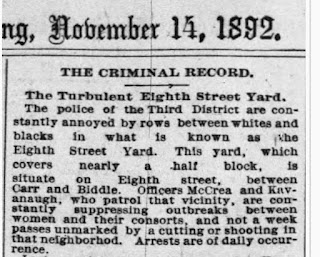
St. Louis Globe Democrat, November 14, 1892

The police of the Third District are constantly annoyed by rows between whites and blacks in what is known as the Eighth Street Yard. This yard,  which covers nearly a half block, is situate on Eighth street, between Carr and Biddle.

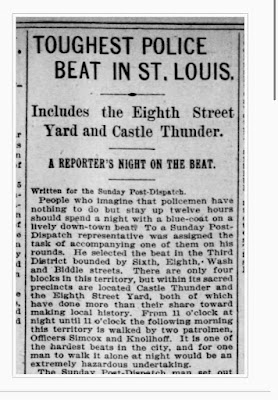
St Louis Post Dispatch, January 6, 1895

There are only four blocks in this territory, but within its sacred precincts are located Castle Thunder and the Eighth Street Yard, both of which have done more than their share toward making local history...It is one of the hardest beats in the city, and for one man to walk it alone at night would be an extremely hazardous undertaking.

Where exactly was the Eighth Street Yard? The first clipping above says it covered half a block on Eighth Street between Carr and Biddle. The clipping below provides an address.

St. Louis Globe-Democrat, March 6, 1893


1122 North Eighth. The tenement my 2nd great grandfather, Selig Feinstein, lived in, and owned, according to the 1900 census. The Eighth Street Yard appears a lot in the news between 1890-1895. Then it disappears. 

When and how was the 8th Street Yard, one of the toughest police beats, cleaned up? When did Selig Feinstein purchase the address? What was his role? In the early 1890s he is listed in city directories as residing on Seventh Street, but working as a shoer/blacksmith at 1106 North Eighth. So he would naturally have had an incentive to move to the same block he worked. Once he owned the property, did he just kick out the rowdy residents and recruit new ones?

I hoped to get to the library this weekend to research deeds on microfilm, to pinpoint the exact year he purchased the property, and whether he purchased any other property in the area. There is some family lore that he may have.  I do know that he went into the Real Estate business with his children starting in 1905, but he may have been a landlord of multiple properties before then. It doesn't look like I will get to the library this weekend due to weather and other factors. Maybe next weekend. 

Sunday, January 2, 2022

1122 North Eighth Street, 1900

In the 1900 Census my second great grandparents Selig and Annie (Perlik) Feinstein, their seven children, and Selig's mother Gertie were living at 1122 North Eighth Street in St. Louis, Missouri. They were in the front section, and are listed in the census as the owners. In the rear were several families: The Finkelsteins, Buchmans, Portnoys, and Shparbergs.  There were also several individuals - Sarah Freeman, Samuel Feingold, Morris Klingermann, Charles Mutsnick, and Wolf Simon. In total, there were 36 people residing at 1122 North 8th. 10 in the front, 26 in the rear. The country of origin for all adults was Russia.

Over the years I've written several entries on the Carr Square Neighborhood, and on the subsection called Little Jerusalem. Over the last week I decided to start with the families at 1122, and see what I could find out about their descendants. The term FAN Principle (Friends, Associates, Neighbors), credited to Elizabeth Shown Mills, is somewhat applicable. However, my primary intent wasn't to find out more about my ancestors through researching their neighbors. I was genuinely interested in what happened to the families living with my ancestors in the tenement.

Most of the single boarders are difficult to trace. I already knew that Rebecca Portnoy was Selig's sister, and she and her husband were childless. My new database after a week of researching Ancestry Hints is up to 275. A good proportion are the descendants of my second great grandparents, but unrelated surnames include Bernhardt, Buchman, Finkelstein, Friedman, Green, Kanefield, Klayman, Safron, Shcolnik, and Sparberg.

I'm ready to move on to the next address. I will probably move next door on the census, but I might make a detour to North Seventh Street where Selig's brother, Julius, was residing. Why am I interested? Having lived in St. Louis for my whole life I do expect to run across surnames that while not related to me, are still familiar. I'm also interested in fleshing out this community of Little Jerusalem where all of my paternal second great grandparents lived at one time. My Newmark ancestors arrived in 1909 and settled perhaps a block or two outside of the boundaries. The Cruvants, Blatts & Feinsteins all resided within the boundaries at some point.

I have created a secondary blog - Little Jerusalem 1900 to write about discoveries that aren't directly related to my family history. Today I posted a transcription of a news article about a War Between Candy Shops. It's a humorous story about competing businesses, and is a refreshing counterpoint to the disturbing descriptions of the tenement conditions I have read elsewhere. It also suggests that Candy Apples were introduced in St. Louis in 1900, 8 years prior to when they are said to have been invented in New Jersey. Some people might question how these two candy apples compared. Certainly many people confuse Caramel Apples with Candy Apples. But Caramel Apples are said to have been invented by Kraft Foods in the 1950s. It's not clear what was introduced in St. Louis in 1900 and how it may differ from what was introduced in 1908, but the description given in the newspaper article appears to resemble what we know today as Candy Apples. The origin story of the confection may need to be rewritten if Candy Apples were being sold by two candy shops in St. Louis in 1900.

Monday, July 1, 2013

Amanuensis Monday: A Concert in Carr Park - August 10, 1902

Amanuensis: A person employed to write what another dictates or to copy what has been written by another.

I continue my project to transcribe family letters, journals, newspaper articles, audiotapes, and other historical artifacts. Not only do the documents contain genealogical information, the words breathe life into kin - some I never met - others I see a time in their life before I knew them.

I began this project back on February 16, 2009.  Since I began, many others have joined in on the meme. I am thrilled that this meme I started has inspired so many to transcribe their family history documents. Why do we transcribe? I provide my three reasons in the linked post. You may find others.

This week I look at another newspaper article found at ChroniclingAmerica about the Carr Square neighborhood of St. Louis City from the early 1900s, where several of my paternal ancestors lived. If these articles are representative, the language of the news was a lot more 'colorful' back then.

Monday, June 24, 2013

Amanuensis Monday: An August Night in the Slums - 1896 - St. Louis

Amanuensis: A person employed to write what another dictates or to copy what has been written by another.

I continue my project to transcribe family letters, journals, newspaper articles, audiotapes, and other historical artifacts. Not only do the documents contain genealogical information, the words breathe life into kin - some I never met - others I see a time in their life before I knew them.

I began this project back on February 16, 2009.  Since I began, many others have joined in on the meme. I am thrilled that this meme I started has inspired so many to transcribe their family history documents. Why do we transcribe? I provide my three reasons in the linked post. You may find others.

This week I share a transcription of a newspaper article I found at NewspaperArchive. No relatives are mentioned, but the setting is a neighborhood I've written about in the past, and in which several of my paternal ancestors lived at the turn of the 19th century. Finding out how the neighbors of my ancestors lived gives me an idea how my ancestors might have lived. Those who have read my earlier posts on the neighborhood know, it's not a pretty picture.

Monday, November 19, 2012

The Mystery of the Secondhand Shop

I'm not always adept at adding or subtracting years from a face and judging whether two photos are a possible match. However, since composing this morning's Amanuensis Monday, I've been looking back and forth between the photograph of the secondhand shop, and some photographs I have of members of the Cruvant family. As I mentioned in my notes, while I'd like the photograph to be of Selig Feinstein and his family, for whom I don't have photographs to compare, my second great grandfather Moshe Leyb Cruvant also owned a secondhand shop in 1900.


On the top left is the secondhand shop from the news article.

On the right is my second great grandmother, Minnie (Mojsabovski) Cruvant, and my great grandmother, Bertha (Cruvant) Newmark. To the immediate left of this text is my second great grandfather, Moshe Leyb Cruvant.

In 1900, Bertha would have been about 13. Her older brother, Ben, would have been 15. And her younger brother, Sol, would have been 7.  I do see vague facial similarities between the photos I have of Bertha, Minnie and Moshe Leyb and the individuals in the photograph from the St. Louis Republic. I don't believe I have any photos of Sol.

I don't know when the photograph of Moshe Leyb was taken, but he passed away in 1911, so if we assume ten years had passed, he would still have had to age significantly. However, he would have been 43 in the 1900 photo, which looks about right. He only lived to age 54 - he looks older in that photograph by today's standards than he really is.

Their shop on Morgan Street was within the boundaries of Little Jerusalem as defined in the article, though not as close to the location on Seventh street as the Feinstein shop.

If this is the Cruvant family, the baby is a complete mystery.  Sol is the youngest child of Moshe Leyb and Minnie we know about. However, Moshe Leyb had some kin in St. Louis, and perhaps that's a nephew or niece that happened to show up in a photo.

The facial resemblances are tantalizing, but I really need a known photograph of one of them from much closer to 1900 to make a comparison.

Update


This photograph of my great grandmother, Bertha, I believe comes from a few years prior to the one above. She is on the right. (It is her sister, Stella, on the left.) I think the resemblance remains, though the girl in the newspaper's photo isn't looking straight at the camera, and is partially hiding her face with her hand, making it difficult.

This is the earliest photograph I can find of Sol, dated 1930.

I have looked at the known Cruvant births in St. Louis, and none of Moshe Leyb's kin had babies who would be under a year old in August of 1900. The closest was born in October of 1898. The presence of that baby throws the greatest wringer in the theory of a match.

Amanuensis Monday: Little Jerusalem - St. Louis - 1900

Amanuensis: A person employed to write what another dictates or to copy what has been written by another.

I continue my project to transcribe family letters, journals, newspaper articles, audiotapes, and other historical artifacts. Not only do the documents contain genealogical information, the words breathe life into kin - some I never met - others I see a time in their life before I knew them.

I began this project back on February 16, 2009.  Since I began, many others have joined in on the meme. I am thrilled that this meme I started has inspired so many to transcribe their family history documents. Why do we transcribe? I provide my three reasons in the linked post. You may find others.

***
This week we return to "Little Jerusalem" - an area of St. Louis mentioned in last Monday's entry - for an extensive feature story on the town. I discovered this article at ChroniclingAmerica as well.

Monday, November 12, 2012

Amanuensis Monday: Nightshirt Parade in Little Jerusalem - 1900


Amanuensis: A person employed to write what another dictates or to copy what has been written by another.

I continue my project to transcribe family letters, journals, newspaper articles, audiotapes, and other historical artifacts. Not only do the documents contain genealogical information, the words breathe life into kin - some I never met - others I see a time in their life before I knew them.

I began this project back on February 16, 2009.  Since I began, many others have joined in on the meme. I am thrilled that this meme I started has inspired so many to transcribe their family history documents. Why do we transcribe? I provide my three reasons in the linked post. You may find others.

***

I discovered the following news story at ChroniclingAmerica, a digital collection of newspapers belonging to the Library of Congress. It makes reference to Julius Odelsohn, the brother of my second great grandfather, Selig Feinstein. They both changed their surname from the original Dudelczak upon arriving in America.

Monday, March 5, 2012

Amanuensis Monday: Local reaction to 1908 report on local tenements by St. Louis Civic League

Amanuensis: A person employed to write what another dictates or to copy what has been written by another.

I continue my project to transcribe family letters, journals, newspaper articles, audiotapes, and other historical artifacts. Not only do the documents contain genealogical information, the words breathe life into kin - some I never met - others I see a time in their life before I knew them.

I began this project three years ago, back on February 16, 2009.  Since I began, many others have joined in on the meme. I am thrilled that this meme I started has inspired so many to transcribe their family history documents. Why do we transcribe? I provide my three reasons in the linked post. You may find others.

***
In July and October of 2008 I wrote two blog posts concerning the 1908 conditions of tenements in St. Louis as found in an 84 page report published by the Civic League of St. Louis. Several of my paternal ancestors lived in the vicinity around that time period.

It occurred to me recently to ask, "What was the reaction to this report in 1908?"  Through my local library card I have access to ProQuest's Historical Database for the St. Louis Post Dispatch (1879-1922), so I conducted a search and found the below two news articles which provide a nice summary of the report as well as some of the ideas the League had for correcting the situation.

Monday, June 7, 2010

Amanuensis Monday: Interview with Melvin Lester Newmark - Part 3

Amanuensis: A person employed to write what another dictates or to copy what has been written by another.

I continue my project to transcribe family letters, journals, audiotapes, and other historical artifacts. Not only do the documents contain genealogical information, the words breathe life into kin - some I never met - others I see a time in their life before I knew them. If you choose to join me in Amanuensis Monday and post your transcriptions, feel free to add a link to your post in the comments.

This week I continue the transcription of an interview conducted with my grandfather, Melvin Newmark, in December of 1987. My grandfather has begun talking about his mother, Bertha (Cruvant) Newmark.

Wednesday, December 2, 2009

Wordless Wednesday - Wash Street - St. Louis - 1908

Yard of Lodging House on Wash St. in Which Forty-Five Persons Occupy Nine Rooms.

If you want to know more, read this post from October of 2008.

Wednesday, October 15, 2008

Returning to St. Louis City - 1908


Today, October 15, is Blog Action Day. "Blog Action Day is an annual nonprofit event that aims to unite the world’s bloggers, podcasters and videocasters, to post about the same issue on the same day. Our aim is to raise awareness and trigger a global discussion." The theme for 2008 is Poverty.

I thought I would return to a post I wrote back in July. St. Louis City Housing Conditions in 1908. I wrote about the disturbing conditions I had discovered that my ancestors had lived in from a report given by the Civic League of St. Louis. It was an 88-page report, though, and I only quoted a few paragraphs. I will try to give a fuller picture of what life was like for those who lived in this area bordered by 7th and 14th streets, and Lucas Avenue and OFallon Street. (1908 and 2008 maps provided in July post.)

I am going to "copy and paste" several clippings from the report straight into this post as it is certainly easier than transcribing or rephrasing, and the images should be readable.

Let's start with a chart of the number of bathtubs found in the neighborhood


As the report states, "It is useless to try to add anything to the force of such figures as these." As one might expect, the majority of tubs were in the apartments of the building owners.

A lot of space is given in the report to the conditions of the Yard Vaults, since toilets were a new innovation and rare.


Another factor the report considered was the overcrowding situation. They compared the neighborhood to a similar report Chicago had conducted.


Housing conditions in St. Louis City have improved greatly in the past 100 years. However, I have heard people over the years, when comparing the situation in today's inner cities to the situation in the tenements, to focus a lot on crime. There is a sense that things are different today.


The differences that exist, I suspect are due mostly to technology, and greater access to a different class of weapons, and less to do with the individuals involved. The authors of the report back in 1908 knew that there was a connection between crime and poverty that was unrelated to race, nationality or ethnicity. As Victor Hugo wrote, "If the soul is left in darkness, sins will be committed. The guilty one is not he who commits the sin, but he who causes the darkness." (Les Miserables, p. 14)

---
Understandably, many of the posts for Blog Action Day will focus on what it means to be poor today. Author, John Scalzi, had an excellent blog post three years ago on that topic: Being Poor. The Blog Action Day site had a list of resources for those interested in fact sheets, statistics, and suggestions on what can be done to alleviate poverty around the world.

Thursday, July 31, 2008

St. Louis City - 1908

For the 53rd edition of the Carnival of Genealogy, which is a carousel edition, I thought I would go back to the theme for the 47th edition, in which I didn't participate. I couldn't decide what to write about at the time. The theme was "A Place Called Home." We were to describe a place where our ancestors lived. I know a few names of European towns where my immigrant ancestors came from, but little more than that, and I didn't have the time to do the research. Many of the immigrants settled in St. Louis, which is where I have spent all but a few of my college years so I didn't think about it as an ancestral home.

However, a couple months ago I found the St. Louis 1909 Sanborn Maps online, and since I knew street addresses for where my great-great grandparents were living at the time, mostly gleaned from city directories and the Census, I downloaded the specific maps for their neighborhoods.

A week ago I started doing some research on the neighborhood for the Newmark family.

(click any image on this page to enlarge it.)

The Newmarks immigrated in 1909, and in the 1910 and 1920 census Samuel and Rose Newmark, my great-great grandparents, were living on Wash Street, a block or two West of Carr Square Park. The blue writing on the image is where I have marked their 1910 and 1920 addresses. Wash Street is now Cole Street as can be seen on this map - courtesy of Google.

The park still exists. I've actually driven by several times. The United Way of Greater St. Louis is located at 11th Street and Cole. The quickest route to business meetings I've attended there takes me straight down Cole.
"In 1908, the Civic League of St. Louis conducted a study of a slum neighborhood. Known as Carr Square, one area contained as many as 1900 residents per acre. The average living space was 16.9 square feet per person. There was an average of one bathtub and four toilets for 2479 people. The average rent was $1 a week. Human waste and garbage accumulated in the few open spaces. And in these ill-ventilated, foul-smelling shacks and cellars were found saloons, bakeries, groceterias and laundries."
Souce: "Beyond the Orphanage", Peggy Thomsan Greenwood, 1991

The article above didn't provide the boundaries of the Carr Square neighborhood that was studied by the Civic League. I realized it may not have included the tenements my great great grandparents lived in, but since they lived near the park with the same name, I knew it was likely close.

I searched online through some local library catalogs looking for this report. I had no luck, and broadened my search, and struck paydirt - I found a report online - at Harvard, of all places.

Housing Conditions in St. Louis, Report of the Housing Committee of the Civic League of St. Louis, 1908

I downloaded it. In my glance through the 90 pages I am unable to find a reference to the Carr Square neighborhood, so I'm not positive it is the report referenced in the article on orphanages. It's possible Carr Square was mentioned in an associated report. However there are almost 90 pages on a section of St. Louis City that lay a couple blocks East of where Sam and Rose Newmark lived. The study says the area is representative, though of other sections of the city.

Here's the map of the area the study did cover:


7th and 14th Streets are the East/West borders. While Sam and Rose were outside the boundaries, within the boundaries is the corner of 8th Street and Biddle where my other great-great-grandparents, Selig and Annie Feinstein, lived between 1896 and 1906. (It's a little hard to read, but Biddle Street is the second street from the right on the map) My great-great grandparents Morris and Minnie Cruvant lived at 7th and Biddle in 1897. And the last set of my paternal great-great grandparents, Morris and Mollie Blatt, lived at 10th and Biddle in 1896. It's possible the conditions were different ten years prior to the study when the Blatts and Cruvants lived there. I doubt they were very different for the Feinsteins two years prior to the study.

The disturbing image of a shared wall between a privy and a bakery oven, which I posted on Wednesday, came from this report. There are other equally disturbing images, and descriptions. It's difficult to imagine living under these conditions, but it is clear half of my ancestors at least did so in the early 1900s.

As a historical note -- if you look at the Google Maps image above, you will notice the area west of 20th Street bordered today by Cass and MLK Jr. Drive, there is a lot of land unbroken by roads. In the 1950s the buildings there were torn down and an infamous housing project was built by the same architect who would later build the World Trade Center -- Pruitt-Igoe.

Note: Further reading of the report indicates the statistics in the report match up with those in the paragraph quoted from "Beyond the Orphanage" - therefore the "Carr Square" neighborhood references the entire neighborhood covered by the 1908 report.