Amanuensis: A person employed to write what another dictates or to copy what has been written by another.
I continue my project to transcribe family letters, journals, newspaper articles, audiotapes, and other historical artifacts. Not only do the documents contain genealogical information, the words breathe life into kin - some I never met - others I see a time in their life before I knew them.
Today I transcribe a newspaper clipping mentioning a great grandfather's schooling. The St. Louis Globe-Democrat has recently been added to the digitized holdings at Newspapers.com. Born in 1886, my great grandfather Herman Feinstein was 15 years old in 1901.
St. Louis Globe-Democrat, 17 April 1901, page 9.
JEWISH ALLIANCE SCHOOL
Closing Exercises Held Last Night at Jefferson Building.
The closing exercises of the Jewish Alliance night schools, at the Jefferson school building, at Ninth and Wash streets, were held last night under the direction of Prof. Emil Mayer, the principal. An attractive program was presented. It was opened by a song, “The Flag of the Free,” sung by the school. Recitations were presented by Ida Gellman, Louis Lambrakis, Ralph Goldman, Simon Shipper, Fannie Brenholz, Beckie Herman, Jacob Frelich, Annie Hall, Ike Stern and Mary Fridkin; orations by Sam Shor and Sam Shipper; dialogue by Esther Sherman, Sadie Greenspan, Carrie Dubinsky, Jenny Mason, Herman Feinstein and Jacob Rosenblatt; debate on “Resolved, That education should be compulsory,” by Emil Goldstein on the affirmative and Simon Ludwig on the negative; a song, “The Linden Tree,” by Fannie Brenholz, Rose Alberstein, Jennie Mason and Sam Shor; essay by Harry Singman, and the song, “Good Night,” by the school. A number of prizes were distributed by Rabbi Samuel Sale, and short addresses were made by Rabbis H. J. Messing and Moritz Spitz.
The enrollment for the term, which began in October, was about 350. Six assistant teachers were employed, Misses Sophie Barron, Rose and Minnie Kahn and Fishell, Isaacs and Goldberg. The school is maintained by the Associated Jewish Charities for purpose of affording opportunities for acquiring an education to the younger Jewish element of that locality who are employed in the daytime. It is under the management of a board of directors, the officers of which are Elias Michael, president; Louis Bry, Vice President; Albert Loth, secretary, and Isaac Schwab, treasurer. The next term of the school will begin in the new building that is being erected by the Jewish Charitable and Educational Association at Ninth and Carr streets. The new building is a three-story structure, 150x50 feet in area, and will cost upward of $40,000.
Notes:
1) Closing exercises doesn't necessarily mean graduation. From the description it appears all students at the night school participated, and there is no indication which students would be returning the following term. From this article I know my great grandfather in 1901 at age 15 had a job during the day and was receiving the equivalent of a secondary education at night. I also have insight into the type of education he was receiving.
2) I wonder if the presentation category of "Dialogue" was similar to the "Dramatic Interpretation" or "Duo Interpretation" categories in modern Speech and Debate competitions.
Showing posts with label Jewish. Show all posts
Showing posts with label Jewish. Show all posts
Monday, July 15, 2019

Tuesday, November 20, 2018
Happy Hanuka!
Hanuka isn’t going to be celebrated for a couple weeks. It begins on the evening of December 2nd, this year. However, tomorrow is the day Hanuka would fall on if instead of the Hebrew calendar, we used the Gregorian calendar. The 25th day of the Hebrew month of Kislev in 164 BCE fell on November 21.
Of course, Pope Gregory hadn’t been born yet in 164 BCE. Jesus hadn’t been born yet. Not only was there no such thing as the Gregorian calendar, Julius Caesar hadn’t been born, so there was no Julian Calendar.
Moreover, the Hebrew calendar wasn’t standardized yet. Each Hebrew month began after two people declared they saw the crescent moon. So two different communities could be slightly off from one another, but each month there was a reboot.
So November 21 is an estimate.
The 25th of Kislev is an estimate too.
Happy Hanuka!
Of course, Pope Gregory hadn’t been born yet in 164 BCE. Jesus hadn’t been born yet. Not only was there no such thing as the Gregorian calendar, Julius Caesar hadn’t been born, so there was no Julian Calendar.
Moreover, the Hebrew calendar wasn’t standardized yet. Each Hebrew month began after two people declared they saw the crescent moon. So two different communities could be slightly off from one another, but each month there was a reboot.
So November 21 is an estimate.
The 25th of Kislev is an estimate too.
Happy Hanuka!
Wednesday, September 19, 2018
Ahoy Vey! -- Jewish Pirates
Repost with slight changes
 Today is International Talk Like a Pirate Day. As well as the Jewish holiday of Yom Kippur.
What would be an appropriate topic, albeit perhaps a little afield from the subject of genealogy, for a blog post combining the two?
How about Jean Lafitte, the possibly Jewish Pirate?
 Today is International Talk Like a Pirate Day. As well as the Jewish holiday of Yom Kippur.
What would be an appropriate topic, albeit perhaps a little afield from the subject of genealogy, for a blog post combining the two?
How about Jean Lafitte, the possibly Jewish Pirate?
[image - late 19th century artist's conception. [source]
As a St. Louisan, this last definitely interests me. Though I have been unable to determine where John Lafflin (whether or not in reality Jean Lafitte) is supposed to be buried. Mysteries tend to surround pirates, don't they?
The facts of his origins, and those of his demise as well, depend upon whether you believe the "Journal of Jean Lafitte" is a forgery or not. Discovered in the possession of a claimed descendant.
"My grandmother was a Spanish-Israelite. ... Grandmother told me repeatedly of the trials and tribulations her ancestors had endured at the time of the Spanish Inquisition. ... Grandmother's teachings ... inspired in me a hatred of the Spanish Crown and all the persecutions for which it was responsible -- not only against Jews." [source]
According to one account, Jean Lafitte was killed upon the General Santander, an armed private vessel in the service of Columbia, on Feb. 5, 1823, at the age of 41. In the Gulf of Honduras, the General Santander encountered two Spanish privateers or warships, and was mortally wounded in a brief battle with the vessels and buried at sea ...
According to Lafitte's Journal ( which many believe to be a hoax, claimed to have been found by a great grand son of Lafitte) written by Lafitte himself in 1851, he took the name John Lafflin and died in St. Louis in his 70s. [source]
However, while the origins of Jean Lafitte are controversial, in Jewish Pirates of the Caribbean, author Edward Kritzler makes the claim for several others. Some of the earlier ones are said to have gone into the piracy business as revenge against the inquisition.
One such pirate was Moses Cohen Henriques, who helped plan one of history's largest heists against Spain. In 1628, Henriques set sail with Dutch West India Co. Admiral Piet Hein, whose own hatred of Spain was fueled by four years spent as a galley slave aboard a Spanish ship. Henriques and Hein boarded Spanish ships off Cuba and seized shipments of New World gold and silver worth in today's dollars about the same as Disney's total box office for "Dead Man's Chest." [source]Of course, pirates tend to break a few commandments in their daily routine. Ends rarely justify the means, and revenge isn't generally considered a morally appropriate explanation for deeds. One wonders if the above Jewish pirates recited the Al Chet (confession of sins) yearly on Yom Kippur.
Friday, July 27, 2018
Days of Love - Religious and Personal
Tu b'Av is a relatively obscure Jewish holiday that falls on the fifteenth day of the month of Av (sundown Thursday, July 26 to sundown Friday, July 27 this year).
The fifteenth day of each month on the Hebrew calendar falls on a full moon, and the holiday was observed as a sort of fertility festival during the period of the Second Temple. After the destruction of the Second Temple, it was forgotten for the most part in the Diaspora, only to be revived in modern times as a Jewish alternative to St. Valentine's Day.
To some, St. Valentine's Day, or Tu B'Av, may feel manufactured for greeting card companies, florists, and chocolatiers. However, most couples have their own personal "Days of Love." Whether the annual date commemorates a first date, an engagement, a marriage, or another anniversary, it's significant only to the individual couple.The memories connected with these dates are often stronger than the ones associated with the annual religious or societal holidays. Still, any reason for two people to celebrate their love for one another is a good reason.
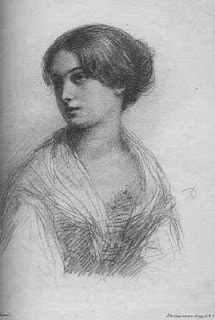 To A Lady
by Victor Hugo,
From Les Feuilles D'Automne
Child, were I king, I'd yield my royal rule,
My chariot, sceptre, vassal-service due,
My crown, my porphyry-basined waters cool,
My fleets, whereto the sea is but a pool,
For a glance from you!
Love, were I God, the earth and its heaving airs,
Angels, the demons abject under me,
Vast chaos with its teeming womby lairs,
Time, space, all would I give--aye, upper spheres,
For a kiss from thee!
translation by Thomas Hardy
photogravure by Goupil et Cie, from a drawing by Deveria, appears in a collection of Hugo's poetry published by Estes and Lauriat in the late 1800s.
The fifteenth day of each month on the Hebrew calendar falls on a full moon, and the holiday was observed as a sort of fertility festival during the period of the Second Temple. After the destruction of the Second Temple, it was forgotten for the most part in the Diaspora, only to be revived in modern times as a Jewish alternative to St. Valentine's Day.
To some, St. Valentine's Day, or Tu B'Av, may feel manufactured for greeting card companies, florists, and chocolatiers. However, most couples have their own personal "Days of Love." Whether the annual date commemorates a first date, an engagement, a marriage, or another anniversary, it's significant only to the individual couple.The memories connected with these dates are often stronger than the ones associated with the annual religious or societal holidays. Still, any reason for two people to celebrate their love for one another is a good reason.
 To A Lady
by Victor Hugo,
From Les Feuilles D'Automne
Child, were I king, I'd yield my royal rule,
My chariot, sceptre, vassal-service due,
My crown, my porphyry-basined waters cool,
My fleets, whereto the sea is but a pool,
For a glance from you!
Love, were I God, the earth and its heaving airs,
Angels, the demons abject under me,
Vast chaos with its teeming womby lairs,
Time, space, all would I give--aye, upper spheres,
For a kiss from thee!
translation by Thomas Hardy
photogravure by Goupil et Cie, from a drawing by Deveria, appears in a collection of Hugo's poetry published by Estes and Lauriat in the late 1800s.
Tuesday, May 29, 2018
JRI-Poland Record Indexing and Morris Blatt
JRI-Poland.org (Jewish Records Indexing - Poland) is a must for anyone researching their Polish Jewish roots. Four of my 16 second great grandparents came from Poland - Samuel Newmark, Rose Cantkert, Morris Blatt, and his wife, Belle.
Not only have they indexed a lot of records, and are slowly digitizing those records and linking to the images from the index, they provide a summary of the records that are available from each town, and the status of the indexing.
As can be seen below, while they aren't done, they've done a great job indexing the available records from Losice, where my Blatt ancestors came from. Unfortunately, my great grandmother, Anna Blatt, was born in 1888, and her older sister, Blanche, in 1886. Neither year is available. I interpret that to mean that the records from those years haven't survived. If so, no amount of waiting will make them magically appear online.

1) Anna's father was Morris (Moshe) Blatt, son of Jacob or Yankiel Blatt. (Source: tombstone)
2) Moshe Blatyta, son of Yankiel Blatyta married Chaia Beila Boksern in 1885. (record indexed, and digitally available online). Chaia Beila was 16 and Moshe Blatya 22. It was the first marriage for both of them. Many other individuals with the Blatyta surname shortened it to Blatt.
3) Anna's daughter, Belle, and Blanche's daughter, Belle, were both named after their grandmother (Family history).
Family history indicated Moshe Blatt's wife was named Belle Wyman. Jokes were made because their daughter, Blanche married a Wyman. While their mother died in Poland, there wasn't enough of a generational gap to yield too much confusion. However, Chaia Beila Boksern could have had a Wyman ancestor in her family tree, which could have been conflated to mean that it was her maiden name.
4) Moshe Blatyta was born in 1862 (Record indexed). According to his death certificate, Morris Blatt was born in 1864. Both 1862 and 1864 birth records have been indexed. That doesn't mean there weren't birth records from 1864 that have been lost.
There could have been two Moshes son of Yankiel born two years apart. But absent contrary evidence, I'm leaning towards accepting that there was only one. I admit that the availability of the birth records for both Moshe and his father, Yankiel Blatyta (though not yet digitized) is an influencing factor. I'm also slightly influenced by the fact that if the relationship is correct, according to the research of another genealogist, my grandmother was second cousins with Jay Black (David Blatt) of Jay and The Americans.
Monday, April 30, 2018
Amanuensis Monday: The Wedding of Harry Feinstein and Dora Serwinsky
Amanuensis: A person employed to write what another dictates or to copy what has been written by another.
I continue my project to transcribe family letters, journals, newspaper articles, audiotapes, and other historical artifacts. Not only do the documents contain genealogical information, the words breathe life into kin - some I never met - others I see a time in their life before I knew them.
Below I transcribe an article on the wedding of my great grandfather's brother, found at Newspapers.com
St. Louis Republic, 16 Aug 1905, page 4.
ONE THOUSAND GUESTS AT ORTHODOX WEDDING
Harry S Feinstein Weds Miss Dora Serwinsky With Elaborate Ritual, at Westminster Hall Last Night.
Gayety characterized the wedding of Miss Dora Serwinsky of No. 826 Carr street and Harry S. Feinstein of No. 1122 North Eighth street, who were married last night at 8 o’clock at Westminster Hall, No. 3906 Olive street.
Rabbis Z. Rosenfeld and S. Rosenberg of Tpherish Israel Temple, Ninth and Wash streets, jointly performed the ceremony. More than 1,000 guests were present.
One hundred candles were burned during the ceremony, in accordance with the orthodox custom.
The hall was decorated for the event. Weil’s orchestra furnished the music and rendered the wedding march. The attendants were H.M. Feinstein, brother of the groom, best man; Miss Lillian Serwinsky, sister of the bride, maid of honor; the Misses Sarah Raskas, Jennie Masta and Anna Seigel, bridesmaids; M. L. Serwinsky, Louis Kaufman of Elizabeth, N.J., and Mose Kaufman, groomsmen.
After the wedding a reception and banquet were tendered to the bridal party at Westminster Hall, followed by dancing. In the festivities the entire membership of Tpherish Israel Congregation participated.
Miss Serwinsky is a daughter of A. Serwinsky and is an elocutionist. Mr. Feinstein is a young business man.
The couple were the recipients of many presents and several hundred telegrams. A present of $250 was given to them by the various lodges of which the groom’s father is a member. Among the guests were officials of the Franklin Bank and teachers from the faculty of the Jefferson and Shields schools. Mr. and Mrs. Feinstein departed at 2 a.m. for the East on their wedding trip. They will live at No. 5606 Garfield avenue.
Notes:
 1. The photograph above is from the wedding. Some family members had identified the five men as the five Feinstein brothers. I've known for awhile this isn't the case as the youngest Feinstein brother would have only been 7 years old in 1905. The Bridal Party was a complete unknown.
But now I have a list of the Groomsmen and Bridal Party. Harry Feinstein, the groom, is most likely in the center, behind his bride, Dora Serwinsky. I believe Herman Max Feinstein, my great grandfather, and Harry's best man, is to Harry's right (our left). The other three men are M.L Serwinsky, and Louis and Mose Kaufman. My suspicion is that Dora's sister, Lillian, the bridesmaid, is to her right. The other three women being Sarah Raskas, Jennie Masta, and Anna Sigel. The two young girls aren't identified in the news article.
2. "Weil's Orchestra" refers to an orchestra conducted by William Weil. There are references to the orchestra performing at the St. Louis World's Fair in 1904, as well as being the house orchestra for the St. Louis Browns baseball team in the late 1890s.
3. My second great grandfather, Selig Feinstein, father of the groom, was elected President of the Tpheris Israel congregation in 1903, which could explain why the entire congregation showed up at his son's wedding. Or it's possible the entire congregation showed up at the wedding of every congregant.
4. "Elocutionist," is a surprising, and impressive job for the daughter of an immigrant family. Dora was born in Poland in 1884, but was only three when the family immigrated.
5. I was unaware that my second great grandfather was a member of any fraternal lodges. I will need to see if I can find out which ones, and check if there are any records. My great-grandfather's application for the Moolah Shrine Temple in 1927 is where I discovered his alleged birthplace. The most likely fraternal organizations for Selig Feinstein are B'nai B'rith (which still exists), Order of B'rith Abraham, and Progressive Order of the West. Progressive Order of the West was headquartered in St. Louis.
6. Harry's address is given as 1122 North Eighth. The Feinsteins hadn't yet moved out of the tenements in the Carr Square/Little Jerusalem neighborhood. 826 Carr, the address of the bride, is also in the same neighborhood.
I continue my project to transcribe family letters, journals, newspaper articles, audiotapes, and other historical artifacts. Not only do the documents contain genealogical information, the words breathe life into kin - some I never met - others I see a time in their life before I knew them.
Below I transcribe an article on the wedding of my great grandfather's brother, found at Newspapers.com
ONE THOUSAND GUESTS AT ORTHODOX WEDDING
Harry S Feinstein Weds Miss Dora Serwinsky With Elaborate Ritual, at Westminster Hall Last Night.
Gayety characterized the wedding of Miss Dora Serwinsky of No. 826 Carr street and Harry S. Feinstein of No. 1122 North Eighth street, who were married last night at 8 o’clock at Westminster Hall, No. 3906 Olive street.
Rabbis Z. Rosenfeld and S. Rosenberg of Tpherish Israel Temple, Ninth and Wash streets, jointly performed the ceremony. More than 1,000 guests were present.
One hundred candles were burned during the ceremony, in accordance with the orthodox custom.
The hall was decorated for the event. Weil’s orchestra furnished the music and rendered the wedding march. The attendants were H.M. Feinstein, brother of the groom, best man; Miss Lillian Serwinsky, sister of the bride, maid of honor; the Misses Sarah Raskas, Jennie Masta and Anna Seigel, bridesmaids; M. L. Serwinsky, Louis Kaufman of Elizabeth, N.J., and Mose Kaufman, groomsmen.
After the wedding a reception and banquet were tendered to the bridal party at Westminster Hall, followed by dancing. In the festivities the entire membership of Tpherish Israel Congregation participated.
Miss Serwinsky is a daughter of A. Serwinsky and is an elocutionist. Mr. Feinstein is a young business man.
The couple were the recipients of many presents and several hundred telegrams. A present of $250 was given to them by the various lodges of which the groom’s father is a member. Among the guests were officials of the Franklin Bank and teachers from the faculty of the Jefferson and Shields schools. Mr. and Mrs. Feinstein departed at 2 a.m. for the East on their wedding trip. They will live at No. 5606 Garfield avenue.
Notes:

But now I have a list of the Groomsmen and Bridal Party. Harry Feinstein, the groom, is most likely in the center, behind his bride, Dora Serwinsky. I believe Herman Max Feinstein, my great grandfather, and Harry's best man, is to Harry's right (our left). The other three men are M.L Serwinsky, and Louis and Mose Kaufman. My suspicion is that Dora's sister, Lillian, the bridesmaid, is to her right. The other three women being Sarah Raskas, Jennie Masta, and Anna Sigel. The two young girls aren't identified in the news article.
2. "Weil's Orchestra" refers to an orchestra conducted by William Weil. There are references to the orchestra performing at the St. Louis World's Fair in 1904, as well as being the house orchestra for the St. Louis Browns baseball team in the late 1890s.
3. My second great grandfather, Selig Feinstein, father of the groom, was elected President of the Tpheris Israel congregation in 1903, which could explain why the entire congregation showed up at his son's wedding. Or it's possible the entire congregation showed up at the wedding of every congregant.
4. "Elocutionist," is a surprising, and impressive job for the daughter of an immigrant family. Dora was born in Poland in 1884, but was only three when the family immigrated.
5. I was unaware that my second great grandfather was a member of any fraternal lodges. I will need to see if I can find out which ones, and check if there are any records. My great-grandfather's application for the Moolah Shrine Temple in 1927 is where I discovered his alleged birthplace. The most likely fraternal organizations for Selig Feinstein are B'nai B'rith (which still exists), Order of B'rith Abraham, and Progressive Order of the West. Progressive Order of the West was headquartered in St. Louis.
6. Harry's address is given as 1122 North Eighth. The Feinsteins hadn't yet moved out of the tenements in the Carr Square/Little Jerusalem neighborhood. 826 Carr, the address of the bride, is also in the same neighborhood.
Wednesday, November 15, 2017
Wordful Wednesday: Oxenhandler Funeral Home advertisement - with photographs

Edward Louis Oxenhandler was the brother-in-law of my great-grandfather, Herman Feinstein. Willard Z. Oxenhandler was Edward and Pearl (Feinstein) Oxenhandler's son. Aaron was another sibling of my great-grandfather.
Note: An agreement between the Chauffeur and Undertaker unions abolished Sunday funerals in St. Louis in 1928. In 1930 the Oxenhandlers created a non-union Orthodox Jewish funeral home.
Tuesday, September 19, 2017
Jewish Pirates: Ahoy Vey!
Repost with slight changes
Today is International Talk Like a Pirate Day. The Jewish New Year begins tomorrow night at sundown.
What would be an appropriate topic, albeit perhaps a little afield from the subject of genealogy, for a blog post combining the two?
How about Jean Lafitte, the possibly Jewish Pirate?
Today is International Talk Like a Pirate Day. The Jewish New Year begins tomorrow night at sundown.What would be an appropriate topic, albeit perhaps a little afield from the subject of genealogy, for a blog post combining the two?
How about Jean Lafitte, the possibly Jewish Pirate?
[image - late 19th century artist's conception. [source]
As a St. Louisan, this last definitely interests me. Though I have been unable to determine where John Lafflin (whether or not in reality Jean Lafitte) is supposed to be buried. Mysteries tend to surround pirates, don't they?
The facts of his origins, and those of his demise as well, depend upon whether you believe the "Journal of Jean Lafitte" is a forgery or not. Discovered in the possession of a claimed descendant.
"My grandmother was a Spanish-Israelite. ... Grandmother told me repeatedly of the trials and tribulations her ancestors had endured at the time of the Spanish Inquisition. ... Grandmother's teachings ... inspired in me a hatred of the Spanish Crown and all the persecutions for which it was responsible -- not only against Jews." [source]
According to one account, Jean Lafitte was killed upon the General Santander, an armed private vessel in the service of Columbia, on Feb. 5, 1823, at the age of 41. In the Gulf of Honduras, the General Santander encountered two Spanish privateers or warships, and was mortally wounded in a brief battle with the vessels and buried at sea ...
According to Lafitte's Journal ( which many believe to be a hoax, claimed to have been found by a great grand son of Lafitte) written by Lafitte himself in 1851, he took the name John Lafflin and died in St. Louis in his 70s. [source]
However, while the origins of Jean Lafitte are controversial, in Jewish Pirates of the Caribbean, author Edward Kritzler makes the claim for several others. Some of the earlier ones are said to have gone into the piracy business as revenge against the inquisition.
One such pirate was Moses Cohen Henriques, who helped plan one of history's largest heists against Spain. In 1628, Henriques set sail with Dutch West India Co. Admiral Piet Hein, whose own hatred of Spain was fueled by four years spent as a galley slave aboard a Spanish ship. Henriques and Hein boarded Spanish ships off Cuba and seized shipments of New World gold and silver worth in today's dollars about the same as Disney's total box office for "Dead Man's Chest." [source]Of course, pirates tend to break a few commandments in their daily routine. Ends rarely justify the means, and revenge isn't generally considered a morally appropriate explanation for deeds. One wonders if the above Jewish pirates recited the Al Chet (confession of sins) yearly on Yom Kippur.
Friday, January 6, 2017
Selig Feinstein - Donation to Jewish Charitable and Educational Union
I had a chance to conduct some more microfilm research recently at the local library. I am slowly going through archives for The Modern View - a St. Louis weekly Jewish newspaper from the early teens to the 1940s. I can go through about six months of issues before my eyes get too tired. I'm mostly scanning for surnames, but items of historical note tend to slow me down.
So far, my ancestors don't appear often in the social notes; in the early part of the timespan, they were still climbing their way out of the tenements. However, they do appear in lists. For example, The Modern View published annually a list of youth being confirmed by local synagogues. In 1915, they published a list of people who had given money to the Jewish Charitable and Educational Union, along with dollar amounts. My second great grandfather, Selig Feinstein, appears on the list for $6.
This may not have been a simple annual donation, though. Selig passed away in March of 1915. (A competing newspaper, The Jewish Voice, had an obituary.) I have had difficulty tracking down a will so far. He resided in the city of St. Louis, but there is an online index for city wills, and he doesn't appear in it. I've searched the St. Louis County index on microfilm without success. It's also possible the money was given by family after his death, but in his name.
Despite the timing of the listing, it could be a simple donation. Selig was very active in the community. He helped start a Free School for Jewish children, was active in the Chesed Shel Emeth Society, and was one of the founders of Tpheris Israel Congregation,
So far, my ancestors don't appear often in the social notes; in the early part of the timespan, they were still climbing their way out of the tenements. However, they do appear in lists. For example, The Modern View published annually a list of youth being confirmed by local synagogues. In 1915, they published a list of people who had given money to the Jewish Charitable and Educational Union, along with dollar amounts. My second great grandfather, Selig Feinstein, appears on the list for $6.
This may not have been a simple annual donation, though. Selig passed away in March of 1915. (A competing newspaper, The Jewish Voice, had an obituary.) I have had difficulty tracking down a will so far. He resided in the city of St. Louis, but there is an online index for city wills, and he doesn't appear in it. I've searched the St. Louis County index on microfilm without success. It's also possible the money was given by family after his death, but in his name.
Despite the timing of the listing, it could be a simple donation. Selig was very active in the community. He helped start a Free School for Jewish children, was active in the Chesed Shel Emeth Society, and was one of the founders of Tpheris Israel Congregation,
Thursday, December 22, 2016
Hanuka Songs
As a kid I believe I knew four Hanuka songs:
Who can retell the things that befell us?
Who can count them?
In every age, a hero or sage
came to our aid.
Hark!
In days of yore in Israel’s ancient land
Brave Maccabeus led the faithful band
But now all Israel must as one arise
Redeem itself through deed and sacrifice.
Short, simple, and extremely serious for a childhood favorite. Looking back as a parent, I like the emphasis that it is possible to come to the world's aid through wisdom and learning, as well as heroics.
I believe the first Hanuka song I heard outside of these four was Peter, Paul and Mary's Light One Candle. The second was probably Tom Lehrer's Hanukah in Santa Monica. (Though, despite the title, the song mentions several Jewish holidays, and several locations, so it is appropriate for year-round play.)
In recent years, it seems, the pace of new Jewish holiday songs has been increasing exponentially. Especially in the overlapping genres of humor and song parodies. I love humor, but I prefer even the lighthearted song to take the holiday at least somewhat seriously. Adam Sandler now has four versions of his Hanukah Song listing Jewish celebrities "just like you and me." (In my opinion, the sequels seem very redundant after the original. Beating a one-joke horse.)
Following are 8 videos of some of my current favorites
Here's a long list of songs updated annually for the past several years
- Maoz Tzur (Rock of Ages)
- Who Can Retell
- Oh Hanukah, Oh Hanukah
- The Dreidel Song
Who can retell the things that befell us?
Who can count them?
In every age, a hero or sage
came to our aid.
Hark!
In days of yore in Israel’s ancient land
Brave Maccabeus led the faithful band
But now all Israel must as one arise
Redeem itself through deed and sacrifice.
Short, simple, and extremely serious for a childhood favorite. Looking back as a parent, I like the emphasis that it is possible to come to the world's aid through wisdom and learning, as well as heroics.
I believe the first Hanuka song I heard outside of these four was Peter, Paul and Mary's Light One Candle. The second was probably Tom Lehrer's Hanukah in Santa Monica. (Though, despite the title, the song mentions several Jewish holidays, and several locations, so it is appropriate for year-round play.)
In recent years, it seems, the pace of new Jewish holiday songs has been increasing exponentially. Especially in the overlapping genres of humor and song parodies. I love humor, but I prefer even the lighthearted song to take the holiday at least somewhat seriously. Adam Sandler now has four versions of his Hanukah Song listing Jewish celebrities "just like you and me." (In my opinion, the sequels seem very redundant after the original. Beating a one-joke horse.)
Following are 8 videos of some of my current favorites
Here's a long list of songs updated annually for the past several years
Wednesday, November 30, 2016
Wordless Wednesday: Statement from German Ambassador in 1915
Was at the library in the microfilm section browsing issues of the St. Louis Modern View from 1915 and saw this cover page. I figured no comment was necessary.

Thursday, August 18, 2016
Days of Love - Religious and Personal
Tu b'Av is a relatively obscure Jewish holiday that falls on the fifteenth day of the month of Av (sundown Thursday, August 18 to sundown Friday, August 19 this year).
The fifteenth day of each month on the Hebrew calendar falls on a full moon, and the holiday was observed as a sort of fertility festival during the period of the Second Temple. After the destruction of the Second Temple, it was forgotten for the most part in the Diaspora, only to be revived in modern times as a Jewish alternative to St. Valentine's Day.
To some, St. Valentine's Day, or Tu B'Av, may feel manufactured for greeting card companies, florists, and chocolatiers. However, most couples have their own personal "Days of Love." Whether the annual date commemorates a first date, an engagement, a marriage, or another anniversary, it's significant only to the individual couple.The memories connected with these dates are often stronger than the ones associated with the annual religious or societal holidays. Still, any reason for two people to celebrate their love for one another is a good reason.
To A Lady
by Victor Hugo,
From Les Feuilles D'Automne
Child, were I king, I'd yield my royal rule,
My chariot, sceptre, vassal-service due,
My crown, my porphyry-basined waters cool,
My fleets, whereto the sea is but a pool,
For a glance from you!
Love, were I God, the earth and its heaving airs,
Angels, the demons abject under me,
Vast chaos with its teeming womby lairs,
Time, space, all would I give--aye, upper spheres,
For a kiss from thee!
translation by Thomas Hardy
photogravure by Goupil et Cie, from a drawing by Deveria, appears in a collection of Hugo's poetry published by Estes and Lauriat in the late 1800s.
The fifteenth day of each month on the Hebrew calendar falls on a full moon, and the holiday was observed as a sort of fertility festival during the period of the Second Temple. After the destruction of the Second Temple, it was forgotten for the most part in the Diaspora, only to be revived in modern times as a Jewish alternative to St. Valentine's Day.
To some, St. Valentine's Day, or Tu B'Av, may feel manufactured for greeting card companies, florists, and chocolatiers. However, most couples have their own personal "Days of Love." Whether the annual date commemorates a first date, an engagement, a marriage, or another anniversary, it's significant only to the individual couple.The memories connected with these dates are often stronger than the ones associated with the annual religious or societal holidays. Still, any reason for two people to celebrate their love for one another is a good reason.
To A Ladyby Victor Hugo,
From Les Feuilles D'Automne
Child, were I king, I'd yield my royal rule,
My chariot, sceptre, vassal-service due,
My crown, my porphyry-basined waters cool,
My fleets, whereto the sea is but a pool,
For a glance from you!
Love, were I God, the earth and its heaving airs,
Angels, the demons abject under me,
Vast chaos with its teeming womby lairs,
Time, space, all would I give--aye, upper spheres,
For a kiss from thee!
translation by Thomas Hardy
photogravure by Goupil et Cie, from a drawing by Deveria, appears in a collection of Hugo's poetry published by Estes and Lauriat in the late 1800s.
Saturday, August 13, 2016
DNA Cousin Matching
Below is the AncestryDNA summary for my wife's DNA matches

188 4th-6th cousin matches
Below is the AncestryDNA summary for my DNA matches
Below is the AncestryDNA summary for my DNA matches

1025 4th-6th cousin matches
I suspect a number of readers who have had their DNA tested will look at my wife's numbers, and feel they are similar to their own. And then look at mine and be surprised. "You're so lucky!" they'll think.
Except...I'm sure there's a large number of false positive matches. Back in 2014 Ancestry changed their formula to reduce the number of false positives in general, but I think it's still high for Ashkenazic Jews. It's definitely still high for me.
- I have 437 pages of matches, 50 matches each, or a total of 21,850 matches. This obviously includes a lot of ancestors Ancestry categorizes as "Distant" or 5th-8th cousins.
- My wife has 163 pages, or 8,150 matches
So if I assume the number of matches everyone gets, in a purely random environment, should be approximately similar...It's possible between 4/5 and 5/6 of my "4th Cousins or closer" matches are wrong.
So if the match doesn't have a family tree, and their Ethnicity information suggests we connect on my Jewish ancestry, why should I bother emailing them, when there's over an 80% chance of a false positive? [Unfortunately, even those with family trees don't include generations beyond the 'immigrant ancestor' which would be necessary to make a connection.]
Another situation I have -- several years ago, I came into contact with another researcher on one of my paternal lines who had done a lot of research in Polish archives, and his research took back that surname for me a couple generations providing many cousins. Yay! However, the name he had for my second great grandmother was wrong, the date of birth for my second great grandfather didn't match family records, and the birth record for my great-grandmother hasn't been discovered yet, leading me to wonder if there wasn't a second person with my second great grandfather's name. Well, this person has been declared a cousin of mine by FamilyTreeDNA, and the distance corresponds to the research I was given. However, is this proof?
Well, no. I can assume that I am related to all people of that surname from that Polish town. In some manner. However, the DNA match in no way confirms what generation we really have a shared ancestor. And the less accurate the matching is, the more this is the case. [But it is still nice to see his name pop up in my matches at FamilyTreeDNA.]
Monday, August 8, 2016
Amanuensis Monday: St. Louis Synagogue Confirmation Classes of 1926
Amanuensis: A person employed to write what another dictates or to copy what has been written by another.
I continue my project to transcribe family letters, journals, newspaper articles, audiotapes, and other historical artifacts. Not only do the documents contain genealogical information, the words breathe life into kin - some I never met - others I see a time in their life before I knew them.
Below I transcribe a list of Confirmation classes from St. Louis area synagogues in 1926, found in the May 14, 1926 issue of The Modern View.
 5686 – St. Louis Confirmants – Shevuos – 1926
B’NAI EL CONGREGATION
CONFIRMATION CLASS
FEIGENBAUM, Joseph D.
1262 Isadora Ave., St. Louis Co.
MORRIS, Sidney
4119a Shaw Ave.
SAGER, Harry
733 Heman Ave., University City.
FERMAN, Annetta
2620 Margaret Ave., Maplewood, Mo.
GOLDSTEIN, Ruth
719a Westgate, University City
FUDEMBERG, Sylvia
3751 South Jefferson Ave.
HASTERLIK, Elise K.
3024 Glasgow Place
NEWMARK, Melvin
4906 Aldine Place
FISCHER, Morris
7209 South Broadway
BLATH, Sigma F.
5740 Kingsbury Place
BENSINGER, Murial
4216 Lafayette Ave.
MAYER, Joe
3311 Osage
HERSKOWITZ, Edward W.
1286a Goodfellow Ave.
TEMERLIN, Jeanette
3645 McRee Avenue
NADLER, Harry T.
2236 Tower Grove Ave.
ECKER, Lucille S.
3236 Walter Ave., Maplewood, Mo.
JOSEPH, Joe
4158a Lafayette Ave.
KAHN, Leona
8770 Manchester Rd., Brentwood
KORACH, Jeannette
6301 Clemons Avenue
LEVY, Lillian
804 Eastgate
PETER, Anna R.
3729 Hydraulic Ave.
SCHIFFMAN, Adeline
4123 Lafayette Ave.
KLEIN, Bernice B.
3205 Meramec Street
SHAARE EMETH
CONFIRMATION CLASS
ABERSON, Leo
1217 Blackstone Ave.
BAUMAN, Robert
775 Belt Ave.
BLUMBERG, Louis
2208 Franklin Ave.
BROWN, Margaret
227 Westgate Ave.
EDMONDS, Henry
4563 Forest Park Blvd.
GOGEL, Edith
5788 Westminster Place
JACOBSON, Fannie
3527 Cass Ave.
JACOBSON, Nettie
445 Wilmington Ave.
KORNBLUM, Genevieve
754 Leland Ave.
LANDAU, Morris
3623 Commonwealth, Maplewood
MAYER, Carleen
739 Westgate Ave.
MARCUS, Blanche
5789 Westminster Place
NUSSBAUM, Robert
6965 Alamo Ave.
SHERMAN, Irvin
3611 Wyoming Ave.
SCHARFF, Arthur
5771 Waterman Ave.
WITT, Myron
4905 Argyle Place
WOLFF, Morris
5644a Etzel Ave.
YAWITZ, Corinne
5579 Waterman Ave.
LASERSOHN, Robert
900 DeMun Ave.
PERES, Clarice
5537 Pershing Ave.
SALE, Francis
5632 Cabanne Ave.
GREENFIELD, Milton
5139 Westminster Place
HIRSCH, Markus
5601 Waterman Ave.
POLLOCK, Ida
5223 Enright Ave.
LANDAU, Homer
5277 Waterman Ave.
1926 CONFIRMATION CLASS
OF TEMPLE ISRAEL
BAUM, A.W.
5906 Plymouth
BRASCH, Norvell
4464 Washington
EPSTEIN, Leon
5656 Waterman
FRIEDMAN, Harry
5755 McPherson
GROLLNEK, Julian
5725 De Giverville
MEYER, Richard
5917 Washington
MOSKOVITS, Stanley
7069 Delmar
SHAPIRO, Jacob
4020a DeTonty
SINGER, James
5744 Theodosia
RICHMAN, Stanley
6227 Northwood
OLIAN, Ralph
5656 Waterman
BERLINER, Sophie
5656 Cote Brilliante
FORCHEIMER, Jacquelyne
5657 Waterman
GILLERMAN, Gertrude
5168 Raymond
GOSSMAN, Leah
6952 Waterman
GRAM, Myra
22 Cornell Ave.
HORWITZ, Sylvia
5700 Etzel
JACOBS, Libbie
6193 Westminster
KOHNER, Melba
6124 Westminster
KOPLAR, Estelle
1241 Hamilton
LANDAU, Evelyn
5752 Westminster
NATHAN, Clara
5037 Waterman
ROCKLING, Lucille
4137 Manchester
ROSENFELD, Lucille
5728 Westminster
ROSENHEIM, Ellen
4611 McPherson
ROSENTHAL, Ruth
5786 Westminster
SHMOOKLER, Eleanor
3234 Audubon (E. St. Louis)
STEINER, Ruth
5746 Kingsbury
THALER, Dorothy
5101 Delmar
WOLFORT, Erma Louise
6145 McPherson
SORKIN, Mary
1374 Shawmut
HORWITZ, Regina
5768 Kingsbury
UNITED HEBREW CONGREGATION
CONFIRMATION CLASS
ALBERT, Harry
5790 Kingsbury Blvd.
APPELMAN, Beulah
6320 Northwood Ave.
BRANDT, Irvin
2945 Dayton St.
BRANDT, Isabel
5467 Delmar Blvd.
COHEN, Anna
5249 Cabanne Ave.
COHEN, Louise
6678 Washington Ave.
FADEM, Julius
4962 Labadie Ave.
FAINSOD, Harriet
5193 Enright Ave.
FERER, Ruth
6665 Washington Ave.
FINE, Pauline
5932 Ridge Ave.
FIXEL, Ruth
6274 Cates Ave.
FIXMAN, Clarabelle
4009 Evans Ave.
FRANKEL, Frances
704 Leland Ave.
FRELICH, Lillian
808 Washington Ave.
GARFINKEL, Paul
7007 Pershing Ave.
GASTING, Paul
5477 St. Louis Ave.
GLICKSBERG, Frances
6627a University Drive
GOLDSTEIN, Leonard
1150 Hamilton Ave.
GROSSMAN, Edwin
5389 Pershing Ave.
HIRSHFIELD, Ben
5445a Easton Ave.
KOPOLOW, Gertrude
6274 Cates Ave.
KUSMER, Lucille
5233 Garfield Ave.
LEONARD, Paula May
5732 McPherson Ave.
MENDLE, Milton
7029 Westmoreland
PRICE, Cecila
5795 Waterman Ave.
PRIWER, Esther
5062 Maple Ave.
REINFELD, Marvin
5764 Westminster Place
ROSEN, Melvin
5593 Waterman Ave.
ROSENFELD, Stanley
6963 Waterman Ave.
SEGELBOHM, Beulah
5860 DeGiverville Ave.
SERKES, Charlotte
1347 Blackstone Ave.
SHANKEN, Leah
740 Eastgate Ave.
SILVERSTEIN, Alice
7280 Forsythe Blvd.
SOLOMON, Rosalie
5126 Waterman Ave.
STEINBERG, Edna
5134 Cates Ave.
SUSMAN, Bernice
7200 Westmoreland Ave.
TYNER, Rosetta
5584 Page Ave.
WISE, Milton
6429 Cates Ave.
WOLFF, Albert
5350a Wells Ave.
WOLFF, Frances
418 Clara Ave.
WALKOWITZ, Maury
1171 Hamilton Ave.
YAWITZ, Paula
19 Columbia
ZIMMERMAN, Cecilia
4327 DeTonty St.
Notes:
1. Here's a photograph of the B'nai El class, which I have shared previously. My grandfather has the thin white rectangle outline in the lower right. Somewhere else in the photograph is his first cousin, Sylvia Fudemberg. Melvin was 13 in the photograph. He would turn 14 in August of 1926. Sylvia had just turned 14 in April. 10th grade, when the youth are 15 or 16, is a more common age for confirmation ceremonies today.

I continue my project to transcribe family letters, journals, newspaper articles, audiotapes, and other historical artifacts. Not only do the documents contain genealogical information, the words breathe life into kin - some I never met - others I see a time in their life before I knew them.
Below I transcribe a list of Confirmation classes from St. Louis area synagogues in 1926, found in the May 14, 1926 issue of The Modern View.

B’NAI EL CONGREGATION
CONFIRMATION CLASS
FEIGENBAUM, Joseph D.
1262 Isadora Ave., St. Louis Co.
MORRIS, Sidney
4119a Shaw Ave.
SAGER, Harry
733 Heman Ave., University City.
FERMAN, Annetta
2620 Margaret Ave., Maplewood, Mo.
GOLDSTEIN, Ruth
719a Westgate, University City
FUDEMBERG, Sylvia
3751 South Jefferson Ave.
HASTERLIK, Elise K.
3024 Glasgow Place
NEWMARK, Melvin
4906 Aldine Place
FISCHER, Morris
7209 South Broadway
BLATH, Sigma F.
5740 Kingsbury Place
BENSINGER, Murial
4216 Lafayette Ave.
MAYER, Joe
3311 Osage
HERSKOWITZ, Edward W.
1286a Goodfellow Ave.
TEMERLIN, Jeanette
3645 McRee Avenue
NADLER, Harry T.
2236 Tower Grove Ave.
ECKER, Lucille S.
3236 Walter Ave., Maplewood, Mo.
JOSEPH, Joe
4158a Lafayette Ave.
KAHN, Leona
8770 Manchester Rd., Brentwood
KORACH, Jeannette
6301 Clemons Avenue
LEVY, Lillian
804 Eastgate
PETER, Anna R.
3729 Hydraulic Ave.
SCHIFFMAN, Adeline
4123 Lafayette Ave.
KLEIN, Bernice B.
3205 Meramec Street
SHAARE EMETH
CONFIRMATION CLASS
ABERSON, Leo
1217 Blackstone Ave.
BAUMAN, Robert
775 Belt Ave.
BLUMBERG, Louis
2208 Franklin Ave.
BROWN, Margaret
227 Westgate Ave.
EDMONDS, Henry
4563 Forest Park Blvd.
GOGEL, Edith
5788 Westminster Place
JACOBSON, Fannie
3527 Cass Ave.
JACOBSON, Nettie
445 Wilmington Ave.
KORNBLUM, Genevieve
754 Leland Ave.
LANDAU, Morris
3623 Commonwealth, Maplewood
MAYER, Carleen
739 Westgate Ave.
MARCUS, Blanche
5789 Westminster Place
NUSSBAUM, Robert
6965 Alamo Ave.
SHERMAN, Irvin
3611 Wyoming Ave.
SCHARFF, Arthur
5771 Waterman Ave.
WITT, Myron
4905 Argyle Place
WOLFF, Morris
5644a Etzel Ave.
YAWITZ, Corinne
5579 Waterman Ave.
LASERSOHN, Robert
900 DeMun Ave.
PERES, Clarice
5537 Pershing Ave.
SALE, Francis
5632 Cabanne Ave.
GREENFIELD, Milton
5139 Westminster Place
HIRSCH, Markus
5601 Waterman Ave.
POLLOCK, Ida
5223 Enright Ave.
LANDAU, Homer
5277 Waterman Ave.
1926 CONFIRMATION CLASS
OF TEMPLE ISRAEL
BAUM, A.W.
5906 Plymouth
BRASCH, Norvell
4464 Washington
EPSTEIN, Leon
5656 Waterman
FRIEDMAN, Harry
5755 McPherson
GROLLNEK, Julian
5725 De Giverville
MEYER, Richard
5917 Washington
MOSKOVITS, Stanley
7069 Delmar
SHAPIRO, Jacob
4020a DeTonty
SINGER, James
5744 Theodosia
RICHMAN, Stanley
6227 Northwood
OLIAN, Ralph
5656 Waterman
BERLINER, Sophie
5656 Cote Brilliante
FORCHEIMER, Jacquelyne
5657 Waterman
GILLERMAN, Gertrude
5168 Raymond
GOSSMAN, Leah
6952 Waterman
GRAM, Myra
22 Cornell Ave.
HORWITZ, Sylvia
5700 Etzel
JACOBS, Libbie
6193 Westminster
KOHNER, Melba
6124 Westminster
KOPLAR, Estelle
1241 Hamilton
LANDAU, Evelyn
5752 Westminster
NATHAN, Clara
5037 Waterman
ROCKLING, Lucille
4137 Manchester
ROSENFELD, Lucille
5728 Westminster
ROSENHEIM, Ellen
4611 McPherson
ROSENTHAL, Ruth
5786 Westminster
SHMOOKLER, Eleanor
3234 Audubon (E. St. Louis)
STEINER, Ruth
5746 Kingsbury
THALER, Dorothy
5101 Delmar
WOLFORT, Erma Louise
6145 McPherson
SORKIN, Mary
1374 Shawmut
HORWITZ, Regina
5768 Kingsbury
UNITED HEBREW CONGREGATION
CONFIRMATION CLASS
ALBERT, Harry
5790 Kingsbury Blvd.
APPELMAN, Beulah
6320 Northwood Ave.
BRANDT, Irvin
2945 Dayton St.
BRANDT, Isabel
5467 Delmar Blvd.
COHEN, Anna
5249 Cabanne Ave.
COHEN, Louise
6678 Washington Ave.
FADEM, Julius
4962 Labadie Ave.
FAINSOD, Harriet
5193 Enright Ave.
FERER, Ruth
6665 Washington Ave.
FINE, Pauline
5932 Ridge Ave.
FIXEL, Ruth
6274 Cates Ave.
FIXMAN, Clarabelle
4009 Evans Ave.
FRANKEL, Frances
704 Leland Ave.
FRELICH, Lillian
808 Washington Ave.
GARFINKEL, Paul
7007 Pershing Ave.
GASTING, Paul
5477 St. Louis Ave.
GLICKSBERG, Frances
6627a University Drive
GOLDSTEIN, Leonard
1150 Hamilton Ave.
GROSSMAN, Edwin
5389 Pershing Ave.
HIRSHFIELD, Ben
5445a Easton Ave.
KOPOLOW, Gertrude
6274 Cates Ave.
KUSMER, Lucille
5233 Garfield Ave.
LEONARD, Paula May
5732 McPherson Ave.
MENDLE, Milton
7029 Westmoreland
PRICE, Cecila
5795 Waterman Ave.
PRIWER, Esther
5062 Maple Ave.
REINFELD, Marvin
5764 Westminster Place
ROSEN, Melvin
5593 Waterman Ave.
ROSENFELD, Stanley
6963 Waterman Ave.
SEGELBOHM, Beulah
5860 DeGiverville Ave.
SERKES, Charlotte
1347 Blackstone Ave.
SHANKEN, Leah
740 Eastgate Ave.
SILVERSTEIN, Alice
7280 Forsythe Blvd.
SOLOMON, Rosalie
5126 Waterman Ave.
STEINBERG, Edna
5134 Cates Ave.
SUSMAN, Bernice
7200 Westmoreland Ave.
TYNER, Rosetta
5584 Page Ave.
WISE, Milton
6429 Cates Ave.
WOLFF, Albert
5350a Wells Ave.
WOLFF, Frances
418 Clara Ave.
WALKOWITZ, Maury
1171 Hamilton Ave.
YAWITZ, Paula
19 Columbia
ZIMMERMAN, Cecilia
4327 DeTonty St.
Notes:
1. Here's a photograph of the B'nai El class, which I have shared previously. My grandfather has the thin white rectangle outline in the lower right. Somewhere else in the photograph is his first cousin, Sylvia Fudemberg. Melvin was 13 in the photograph. He would turn 14 in August of 1926. Sylvia had just turned 14 in April. 10th grade, when the youth are 15 or 16, is a more common age for confirmation ceremonies today.

Thursday, May 12, 2016
The Amen Stone - by Yehuda Amichai
In honor of Israeli Independence Day and Jewish Heritage Month, here is part of a poem by Yehuda Amichai (1924-2000) - considered by many to be one of Israel's greatest modern poets.
The Amen Stone
By Yehuda Amichai
Translated by Chana Bloch
On my desk there is a stone with the word “Amen” on it,
a triangular fragment of stone from a Jewish graveyard destroyed
many generations ago. The other fragments, hundreds upon hundreds,
were scattered helter-skelter, and a great yearning,
a longing without end, fills them all:
first name in search of family name, date of death seeks
dead man’s birthplace, son’s name wishes to locate
name of father, date of birth seeks reunion with soul
that wishes to rest in peace. And until they have found
one another, they will not find a perfect rest.
Only this stone lies calmly on my desk and says “Amen.”
The rest of the poem
The Amen Stone
By Yehuda Amichai
Translated by Chana Bloch
On my desk there is a stone with the word “Amen” on it,
a triangular fragment of stone from a Jewish graveyard destroyed
many generations ago. The other fragments, hundreds upon hundreds,
were scattered helter-skelter, and a great yearning,
a longing without end, fills them all:
first name in search of family name, date of death seeks
dead man’s birthplace, son’s name wishes to locate
name of father, date of birth seeks reunion with soul
that wishes to rest in peace. And until they have found
one another, they will not find a perfect rest.
Only this stone lies calmly on my desk and says “Amen.”
The rest of the poem
Monday, February 29, 2016
Amanuensis Monday: Selig Feinstein and Tpheris Israel Congregation
Amanuensis: A person employed to write what another dictates or to copy what has been written by another.
I continue my project to transcribe family letters, journals, newspaper articles, audiotapes, and other historical artifacts. Not only do the documents contain genealogical information, the words breathe life into kin - some I never met - others I see a time in their life before I knew them.
This week I look at a newspaper article from the St. Louis Post-Dispatch, which mentions my second great grandfather, Selig Feinstein.
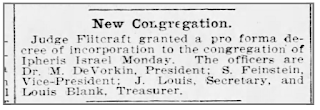 St. Louis Post Dispatch, July 24, 1899, page 8.
New Congregation
Judge Flitcraft granted a pro forma decree of incorporation to the congregation of Ipheris Israel Monday. The officers are Dr. M. DeVorkin, President; S. Feinstein, Vice-President; J. Louis, Secretary, and Louis Blank, Treasurer.
Notes:
1) In 1959 Tpheris Israel merged with another congregation, Chevra Kadisha. Tpheris Israel Chevra Kadisha still exists today. (Chevra Kadisha was the elder of the two, so I can't technically claim my ancestor was a founding father of the current congregation.)
2) While this only provides the first initial, there were only two Feinstein families in the St. Louis area in the 1900 census. The other head of household was named Aaron. So this is most likely my second great grandfather, Selig Feinstein.
3) I previously knew that he had been active in the Chesed Shel Emeth Society, but I didn't know what synagogue he attended, much less that he was one of the founding officers. According to Zion in the Valley, Volume 2, Tpheris Israel was a merger of several early St. Louis minyans. (A 'minyan' defined simply as a gathering of at least ten Jewish adult males for worship.)
I continue my project to transcribe family letters, journals, newspaper articles, audiotapes, and other historical artifacts. Not only do the documents contain genealogical information, the words breathe life into kin - some I never met - others I see a time in their life before I knew them.
This week I look at a newspaper article from the St. Louis Post-Dispatch, which mentions my second great grandfather, Selig Feinstein.

New Congregation
Judge Flitcraft granted a pro forma decree of incorporation to the congregation of Ipheris Israel Monday. The officers are Dr. M. DeVorkin, President; S. Feinstein, Vice-President; J. Louis, Secretary, and Louis Blank, Treasurer.
Notes:
1) In 1959 Tpheris Israel merged with another congregation, Chevra Kadisha. Tpheris Israel Chevra Kadisha still exists today. (Chevra Kadisha was the elder of the two, so I can't technically claim my ancestor was a founding father of the current congregation.)
2) While this only provides the first initial, there were only two Feinstein families in the St. Louis area in the 1900 census. The other head of household was named Aaron. So this is most likely my second great grandfather, Selig Feinstein.
3) I previously knew that he had been active in the Chesed Shel Emeth Society, but I didn't know what synagogue he attended, much less that he was one of the founding officers. According to Zion in the Valley, Volume 2, Tpheris Israel was a merger of several early St. Louis minyans. (A 'minyan' defined simply as a gathering of at least ten Jewish adult males for worship.)
Friday, February 5, 2016
Riots and Rebellions: When is Violence the Answer?
Violence is never the answer to anything. - millions of people
- The June Rebellion, also known as the Paris Uprising of 1832, was a failure. But without it, we wouldn't have one of the greatest novels and one of the greatest musicals of all-time. (Les Miserables)
- The Warsaw Ghetto Uprising of 1943 was crushed. However, I'm not going to be the one to say that the Jewish community should have willingly and peacefully gone to their deaths.
- There was a rebellion in the late 18th century in America that was quite successful, and another in the mid 19th century which wasn't.
- Violent protests in the late 19th century led to the 40-hour work week, child labor laws, and safer working conditions for all.
Have any of your ancestors or relatives participated in riots, rebellions, or revolutions?
Here's a list of "incidents of civil unrest" in the United States and another list from Colonial America.
Here's a worldwide list of riots and another worldwide list of revolutions and rebellions.
The difference between a riot and a rebellion can sometimes be a matter of who is writing the history. Some people argue riots are more spontaneous and don't have a unified purpose. However, participants in what society decides to call a 'riot' might argue with whether the event was spontaneous or without a cause.
Do I have kin who participated in civil unrest?
I will ignore late 20th century and more recent unrest, as I may or may not have relatives who participated, but if I did, they, or their close families, are still alive.
I've blogged before about my great grandmother's brother, who appears in some news reports related to the East St. Louis Race Riot of 1917. He wasn't a participant, but testified about the whereabouts of an employee who may have been.
An Elisha Horton is listed among the participants of the Boston Tea Party. He may or may not be related to my Horton ancestors.
Warsaw Ghetto, 1940-1943
When I discovered the Warsaw Ghetto Database, I knew I had to search for my Newmark surname. My Newmark ancestors left the Warsaw area in the 1880s, but were any of these ghetto residents related? If so, what were their roles in the uprising? The closest relation they could be to me would be second cousins to my grandfather (assuming that my second great grandfather, Samuel Newmark, may have had some brothers in Warsaw.)
Entries for four Neumarks and three Najmarks appear, though there may be some duplicated individuals within them. The database provides details taken from various sources - some lengthy; some short. Some of the Polish has been translated into English already; some hasn't. I went in search of more information on some of the events mentioned. The information wasn't necessarily what I was hoping for - but the decisions ghetto residents had to make certainly weren't easy ones.
- Lejbus Najmark - Judenrat
- Stanislaw Najmark
- Polish: starszy syn autorki , zastrzelony w związku ze sprawą Kotta
- English: author's elder son, shot in connection with Kott's affair
- Najmarkowa - [basically: Mrs. Najmark. -owa indicates a married woman]
- Polish: żona jednego z dyrektorów Zakładu Zaopatrywania; w getcie warszawskim działała społecznie - organizacja koncertów; w czasie akcji straciła matkę, jeden syn zginął w związku ze sprawą Kotta, drugi na wschodzie, mąż w czasie akcji styczniowej; przeszła na stronę aryjską po I akcji, ukrywała się na Saskiej Kępie; autorka relacji
- English: wife of one of directors' of the Supply Section; in the Warsaw ghetto she was active socially - organised concerts; during an action she lost mother; one son died in connection with Kott's case, the other one in the East, husband during the January action; she crossed to the 'Aryan side' after the First Action, she hid in Saska Kepa; author of testimony.
- Juliana (?) Neumark [This appears to be the same woman as Najmarkowa, providing a possible first name, and reinforcing that despite the different spelling, these are matching surnames. The Warsaw Ghetto Database doesn't yet have an English translation, but Google Translate provides a clumsy translation]
- Polish: żona Juliana; miała dwóch synów: jeden z synów zginął w styczniu 1940 roku w związku z aferą Kotta, a drugi syn w lutym 1940 roku przepadł podczas przechodzenia granicy sowiecko-niemieckiej pod Bełżcem; pracowała m.in. wraz z aktorem Turkowem w dziale oświaty; jako Elżbieta Kucharska schroniła się po stronie aryjskiej dzięki pomocy Gerarda Gadeyskiego, przedwojennego dyrektora programowego Polskiego Radia, który po wojnie został jej mężem; do niedawna pracowała w Towarzystwie im. Fryderyka Szopena; obecnie mieszka na Saskiej Kępie i jest na emeryturze."
- English (Google Translate): wife, Juliana; had two sons: one of the sons died in January 1940 in connection with the scandal Kott, a second son in February 1940 was lost when passing the border of the Soviet-German at Belzec; she worked along with actor Turkow in the department of education; as Elizabeth Kucharska refuge on the Aryan side with the help of Gerard Gadeyskiego pre-war Polish Radio program director, who after the war became her husband; Until recently, she worked in the Society of them. Frederic Chopin; now lives in Saska Kepa and is retired.
- Is it possible instead of Juliana, the Polish actually means: Wife of Julian?
- Julian Neumark (Intelligentsia)
- Polish: serdeczny przyjaciel Jana Kucińskiego; naczelnik działu w Zakładzie Zaopatrywania Dzielnicy Żydowskiej; zginął w styczniu 1943 roku; miał dwóch synów: jeden z synów zginął w styczniu 1940 roku w związku z aferą Kotta, a drugi syn w lutym 1940 roku przepadł podczas przechodzenia granicy sowiecko-niemieckiej pod Bełżcem.
- English (Google Translate): good friend John Kuciński; Head of department at the Department of Procurement Jewish Quarter; He died in January 1943; He had two sons: one of the sons died in January 1940 in connection with the scandal Kott, a second son in February 1940 was lost when passing the border of the Soviet-German at Belzec.
- Regina Neumark - Activist; Collaborator of the CKI (Central Commission for Entertainments)
- [source] "Finally, more resourceful musicians, supported by the Head of the Community, Adam Czerniaków, and his wife Dr Felicja Czerniaków, and Central Commission for Entertainments operating in the ghetto, decided to found the Jewish Symphonic Orchestra (ŻOS). It also had a moral aspect: it kept appearances of "normality”, met the spiritual needs of a vast number of music lovers, gave musicians a chance not only to get minimal resources, but also to remain in good musical condition. Many historians believe that the cultural activity was one of the forms of civil resistance, an activity in the teeth of the extermination actions of the occupier. It is, however, worth mentioning that from mid 1942 the people in ghettos had no idea of the planned extermination in the death camps (apparently they were being transferred to "work camps”) and they still had faith in the intervention of the allies and quick ending of the war."
- The CKI set up concerts. The entry for Najmarkowa indicates she organized concerts. It's possible these are the same individuals. With the database information coming from multiple sources of testimony lots of redundancy is likely.
- Wera Neumark - Artists/Writers; A pianist, plays in a concert in 'Gospoda' on 18 March 1942 - represents the old piano school.
Some activists; Some Judenrat. (Some Judenrat-connected activists) The Judenrat (or Jewish council) was set up by the Germans to administer the ghettos.
On the one hand, many viewed these councils as a form of collaboration with the enemy. Others saw these councils as a necessary evil, which would permit Jewish leadership a forum to negotiate for better treatment. In the many cases where Jewish leaders refused to volunteer to serve on the Judenrat, the Germans appointed Jews to serve on a random basis. Some Jews who had no prior history of leadership agreed to serve, hoping that it would improve their chances of survival. Many who served in the Judenrat were arrested, taken to labor camps, or hanged.This timeline provides some details on the events mentioned above.
January 1940 ["Kott Affair"]
1 - a decree comes into force forbidding Jews to change their place of residence without special permission.July 1942 ["First Action"]
14-25 - after the arrest of Andrzej Kott (who was of Jewish origin) belonging to the underground group PLAN and his escape from the gestapo, particular repressive measures are taken against the Jewish intelligentsia in Warsaw (255 Jews arrested).
22 - the beginning of the great deportation action in the Warsaw ghetto; transports leave from the Umschlagplatz for the gas chambers of Treblinka.January 1943 ["January Action"]
9 - Himmler arrived for an inspection of the Warsaw ghetto; he ordered the deportation of 8,000 Jews and the evacuation of German enterprises to the Lublin area.More on the Kott Affair. [The Holocaust: A History of the Jews of Europe During the Second World War, Martin Gilbert, Macmillan, 1987.]
18-21 - the second deportation action in the Warsaw ghetto. The first armed resistance. The Germans deported c. 5,000 people. In January, just after the second deportation action, Józef Szeryński, the commander of the Jewish police, committed suicide.
Sunday, January 17, 2016
Further Coincidence?
Last January I blogged about a mathematical coincidence. For three Jewish kin, there are records claiming alternate birth dates approximately 20 days apart. Adjusting for the 12 days conversion between Julian and Gregorian calendars, this leaves approximately 8 days - which could be explained if one of the dates is actually the date of their Brit Milah. (Covenant of Circumcision).
I didn't mention it last week in the Amanuensis Monday notes, but Max Kruvand's Petition for Naturalization states he was born on August 22, 1897, and his record of birth in Lithuanian records states August 3. So it's now four kin. (Three from Lithuania, one from Poland.)
I am unaware of a religious tradition of observing the anniversary of a brit milah (Outside of Christian tradition - of course, the Feast of the Circumcision could have Jewish roots.) I know that celebrating birthdays was not considered appropriate in traditional European Jewish households. There was the superstition that it was tempting the 'evil eye'. Celebrating any anniversary connected to birth would likely be seen similarly. However, it is conceivable that the date of birth wasn't recorded in some family records, but the Brit Milah would have been, due to its religious significance.
I didn't mention it last week in the Amanuensis Monday notes, but Max Kruvand's Petition for Naturalization states he was born on August 22, 1897, and his record of birth in Lithuanian records states August 3. So it's now four kin. (Three from Lithuania, one from Poland.)
I am unaware of a religious tradition of observing the anniversary of a brit milah (Outside of Christian tradition - of course, the Feast of the Circumcision could have Jewish roots.) I know that celebrating birthdays was not considered appropriate in traditional European Jewish households. There was the superstition that it was tempting the 'evil eye'. Celebrating any anniversary connected to birth would likely be seen similarly. However, it is conceivable that the date of birth wasn't recorded in some family records, but the Brit Milah would have been, due to its religious significance.
Saturday, January 17, 2015
MyHeritage Family Tree Builder - Date and Language functions
MyHeritage announced they had a free Mac version of their Family Tree Builder database software, so I decided to download it and give it a try. Not only because it was free, but I was hopeful it would handle something better than my current program. Hebrew calendar dates. I had good reason to be hopeful, MyHeritage is headquartered in Israel. I wasn't disappointed.
MyHeritage allows you to enter all dates in one of three calendars - Standard (Gregorian), Hebrew, and French Revolutionary Calendar. (The last surprised me at first. However, MyHeritage may have a sizable French user base, as the software appears to be written to appeal to an international audience.) It also provides easy conversion between these systems. I am somewhat disappointed that they haven't added the Julian calendar to this component, but perhaps they will at some point.
After I imported my database, this is what my second great grandmother's entry looked like at first:

I clicked on Edit in the lower right.
[Note: I know her death place, cause of death, and burial location. This information is in the Notes section. I haven't always entered it into the separate fields.]

I clicked on the calendar icon next to the deceased date on the right side.

I clicked the convert button. (The very first time I had to use the pull down menu to select "Standard to Hebrew." After that it defaults to the last used option.)

After clicking OK this is how her entry looks, with the Hebrew date in brackets:

It would seem nice if there was a way to automatically convert every date in the database with one click, instead of going through and doing it individually. However, it would be wrong for the software to encourage the genealogist to do this since the conversion depends on whether each event was before or after sunset. (The Hebrew calendar date starts at sunset.)
It is also possible to add a secondary language for entering data. In the "Tools" menu, select Languages.

You will see this menu:
 Select the checkbox indicating you want a secondary language, and click OK
You will be given a list of 40 languages!

I chose Hebrew, and this is now how my second great grandmother's "Edit Details" screen appears:
 The order of information in the Hebrew language date is unusual. It reads: February 1924 , 8 Adar A 5684 13. I am unsure why the Hebrew date is embedded within the Standard date in this manner.
If I click on "Names" I am given several fields, including "Religious Name," which will be useful for me, as well as both a "Maiden Name" and "Former Last Name." The latter would be useful for those who have multiple marriages.

Visually, I don't find the software's interface as appealing as my current software. However, its features could win me over. Currently I find it annoying that every time I load the software it asks me if I want to sync it with my "own family site" on MyHeritage. I don't have a family site on MyHeritage, and I don't want one right now. If anybody knows how to turn this pop-up off, let me know.
The software is free, though, so it's hard to get too upset.
MyHeritage allows you to enter all dates in one of three calendars - Standard (Gregorian), Hebrew, and French Revolutionary Calendar. (The last surprised me at first. However, MyHeritage may have a sizable French user base, as the software appears to be written to appeal to an international audience.) It also provides easy conversion between these systems. I am somewhat disappointed that they haven't added the Julian calendar to this component, but perhaps they will at some point.
After I imported my database, this is what my second great grandmother's entry looked like at first:
I clicked on Edit in the lower right.
[Note: I know her death place, cause of death, and burial location. This information is in the Notes section. I haven't always entered it into the separate fields.]
I clicked on the calendar icon next to the deceased date on the right side.
I clicked the convert button. (The very first time I had to use the pull down menu to select "Standard to Hebrew." After that it defaults to the last used option.)
After clicking OK this is how her entry looks, with the Hebrew date in brackets:
It would seem nice if there was a way to automatically convert every date in the database with one click, instead of going through and doing it individually. However, it would be wrong for the software to encourage the genealogist to do this since the conversion depends on whether each event was before or after sunset. (The Hebrew calendar date starts at sunset.)
It is also possible to add a secondary language for entering data. In the "Tools" menu, select Languages.
You will see this menu:
You will be given a list of 40 languages!
I chose Hebrew, and this is now how my second great grandmother's "Edit Details" screen appears:
If I click on "Names" I am given several fields, including "Religious Name," which will be useful for me, as well as both a "Maiden Name" and "Former Last Name." The latter would be useful for those who have multiple marriages.
Visually, I don't find the software's interface as appealing as my current software. However, its features could win me over. Currently I find it annoying that every time I load the software it asks me if I want to sync it with my "own family site" on MyHeritage. I don't have a family site on MyHeritage, and I don't want one right now. If anybody knows how to turn this pop-up off, let me know.
The software is free, though, so it's hard to get too upset.
Wednesday, January 7, 2015
Mathematical Curiosity - Coincidence?

His St. Louis, Missouri death certificate states he was born on July 1. A difference of 19 days.
Family researchers have always figured that it was close enough that the individual in the Lithuanian records had to be the same. However, is it possible to explain the difference by the fact that he was born in Lithuania between 1800-1918? (See my post Saturday on Julian and Gregorian dates in the Polish-Lithuanian Commonwealth under the Russian Empire)
Julian to Gregorian conversion covers only 12 of those days - leaving 7 days to explain.
*
My great grandfather, Barney Newmark, said he was born on March 25th, 1886 on his Petition of Naturalization, and said April 14th on his Draft Registration.
He was born in Warka, Poland - during the time of Russian control of the area.
There are 20 days between March 25 and April 14 - leaving 8 days to explain after calendar conversion.
 *
*Moshe Leyb's son, Arkan-Ber was born on Dec 11, 1882 according to Lithuanian records.
Moshe Leyb's son Benjamin, according to St. Louis records, was born on January 3, 1883. A difference of 22 days. 10 Days after conversion.
Family researchers have figured these are the same individuals as well. The Yiddish name Ber (meaning 'Bear') commonly got changed to Benjamin in America. Furthermore, his tombstone says his Hebrew name was Ahron Dov. Dov is Hebrew for Bear, so this is a match. As far as I can tell, Arkan isn't a Hebrew name, but Ahron (Aaron) most definitely is.
*
The 7, 8 and 10 day differences are pretty close to each other. We'd have to assume this was a coincidence, unless there was something that happened around 7-10 days after a child was born that could possibly be observed annually.
Since all three individuals were Jewish boys, there is - a Brit Milah. Though I've never heard of a tradition of observing this anniversary, like a baptismal date for those of the Christian faith, it is a date that might be recorded by the family.
According to Jewish Law, a Brit Milah can't occur before 8 days have elapsed, so this isn't a perfect explanation for Moshe Leyb Cruvant. But being off one day could be attributed to mathematical error in conversion, clerical error in the Lithuanian records, or several other factors.
Brit Milahs are supposed to occur on the 8th day, and not be postponed, even for Shabbat or any other holiday. However, they can be postponed for health reasons, or in order to find an appropriate Mohel (the Hebrew word for the person who performs the circumcision.) Either of these may have been the case for Arkan-Ber/Benjamin Cruvant.
 *
*Or, of course, this could all be coincidence. Slight differences in birth dates between records isn't uncommon. Just because the difference falls roughly the same for all three of these kin doesn't mean it's for the same reason. But still, it's a very intriguing possibility.
*
I'll also note that my great grandfather, Barney, celebrated his birthday on March 17th. (He also claimed at times to have been born in Ireland, instead of Poland. There was a significant Irish community in St. Louis, and he may have thought it to be more advantageous to be Irish and born on St. Patrick's Day than Polish.) To my knowledge, he never wrote this date down on an official document, though. Which suggests to me he knew that it wasn't his official date of birth. However, some family members have grown attached emotionally to the date and seek evidence that it might be the correct date.
If we ignore the Draft Registration, and note that Poland seems to have used both calendars simultaneously while under Russian control, so Julian-Gregorian conversion might not have been necessary - there are 8 days between March 17th and March 25th.
*
Finally - an old joke:
Jacob's watch broke while traveling in a small Eastern European town. He saw a shop with watches and clocks hanging in the window, so he opened the door.
"Can I help you?" asked the man behind the counter.
"My watch is broken, can you fix it?" Jacob asked, relieved the guy spoke some English.
"No, sorry, we don't fix watches," the proprietor responded.
"Do you sell watches?" Jacob asked.
"No."
"Clocks! You must sell clocks!"
"No, we don't sell clocks."
Jacob was getting confused. "You don't sell watches, and you don't sell clocks?"
"No, I’m a mohel," replied the man.
"But the clocks and watches in your window?"
"If you were a mohel, tell me, what would you put in your window?"
[Note: The watch and clocks in this post are from Prague. You can read more about them here and here.]
Subscribe to:
Posts (Atom)


 Posts
Posts