I started making plans for tomorrow while I was still at work today.
That was when it began to snow. And 8 inches at least are expected overnight. Whether or not I hear at 5:30 in the morning on the radio that the building is closed, I may decide I don't want to get in my car and drive to work. If the building's open, that means using up a vacation day, but I might consider it. I don't like driving in snow, and by the time I got home tonight, I'd had enough.
I recently signed up to participate in the February ScanFest, but there's more than enough scanning for me to do; I can do some now, and still have enough then. Scanning is a perfect activity for a snow day. I'd prefer to go to the library, and do some more microfilm research, but that would involve getting in a car. I'm likely going to the library Saturday morning anyway for the St. Louis Genealogical Society meeting, and I'll do a little research afterwards. The snow should have stopped by then, and the streets should be cleared.
I think I've picked out a photo album. It's only 26 years old, but most of the photos were taken by a professional photographer, and I'm in almost all of them. The day was Feb 6th, 1982, if I remember correctly, one week after a major snowstorm in the St. Louis area. (Total accumulation exceeding 20 inches. I like how the link explains that despite the accumulation, it wasn't a blizzard.) I don't think we will get as much snow tonight. (I hope not!)
Of course, now that I'm posting this, we will get only a light dusting, and I will feel obligated to go in to work tomorrow.
Update *sigh* It wasn't a light dusting, but I couldn't bring myself to use up a vacation day. At least I have my next scanning project picked out.
Thursday, January 31, 2008

Genealogy can save your life
- GGG-grandfather William Denyer – 1794-1848 (age 54 – cause unknown)
- GGG-grandmother Elizabeth (Sliver) Denyer – 1798-1840 (age 42 - unknown)
- GG-grandfather Ebenezer Denyer –1828-1872 (age 44 - unknown)
- G-Grandmother Margaret (Denyer) Van Every– 1868 – 1923 (age 55 – Chronic Interstitial Nephritis - a kidney ailment)
- Grandmother Myrtle (Van Every) Deutsch – 1900 – 1951 (age 51 – intestinal cancer)
A close look at these names and dates reveals a frightening pattern for anyone. It's true that in the 19th century early deaths weren't exactly uncommon, so it isn't conclusive. But it's enough to be concerned. I will note that my mother is in fine health, and was surpassing her ancestors' ages back when Reagan and Bush Sr were in office.
That's my mother's side. On my father's side, I have two more grandparents who had colon cancer, though they lived into their 80s. A close relative, in their early 40s, had their first colonoscopy done last year – benign polyps were discovered and removed. So I just turned 39 a week ago, and while the magic year for those with my risk factors is 40, I'm not waiting a year on ceremony. My doctor agrees, and we're in the process of scheduling a date.
Do you know if you have any genetic risk factors? Someday maybe a DNA test will tell us, but for now, we need to know when our ancestors died, and what they died from. Genealogy can, literally, save lives.
(I knew about my grandparents prior to beginning my research, which was more than enough to get tested. And I haven't been tested yet, so I don't know what the results will be. So while I can't say my particular research saved my life, it did uncover an even scarier picture in my mother's line. But if you don't know what killed your ancestors, finding out could save yours.)
Wednesday, January 30, 2008
Email Backup
About a week ago, Charter Communications accidentally deleted several thousand customer email accounts - content irretreviable. Sally Jacobs of The Practical Archivist posted a reminder to back-up your emails.
Back in 2004, when Google's Gmail was still in its 'invite' stage, I managed to snag what was then a rare invite. I fell in love with it. Being able to access my email from anywhere is extremely useful, and Gmail was a lot more user friendly than other webmails I had tried in the past. Soon I had all my email addresses (I have a few) forwarded to my Gmail account, and I haven't stored emails on my home computer since.
While almost everyone backs up their photographs, and other important documents, how many people actually make a backup to Data CD, Data DVD, or an external hard drive of their email? What happens when your computer crashes? (Not if. Computers are expensive, and lots of people use a computer until the day it irrevocably crashes.) You may feel less safe since you're not in control, but I still feel email saved on an external server is safer than on a home computer.
Pop3
That will save a copy of all incoming mail on Google's servers. To save a copy of outgoing mail, if you send it via gmail and not from your home computer's application, you'd have to cc or blind cc yourself so that you receive it as incoming mail.
Setting up IMap makes your home computer's email and your Gmail account appear to be synched mirrors of each other. When you do something at one, it happens at the other. Move a message to a folder, receive a message, doesn't matter. Works with other email devices too.
I set it up with my Apple Mail program, and here's what the window looks like:

If you have labels in your Gmail account, they will appear as separate folders. If an email message has multiple labels, it will appear in multiple folders.
I tried to do this. In Apple Mail I went to the "All Mail" and deleted a message. It looked like it disappeared. I went to a different folder, returned to "All Mail" and the accounts resynched and the email appeared again. I had to move the mail I wanted to delete to the "Bin" folder for it to stay. Logging into my Gmail account the deleted msg is in the trash bin. Another message I had just clicked "delete" while in "All Mail", is still in the inbox, but has the label "deleted message" indicating that I had tried to do so. Once in the bin (on Apple Mail, or WebGmail) clicking 'delete' permanently deletes. But there are enough steps here that it isn't going to happen accidentally.
What would happen with a personal computer crash/Google crash?
This is why I used the phrase 'appear to be synched mirrors of each other' above. What's really happening is that the mail is being stored on Google's servers, and your home computer is accessing that. With constant DSL/Cable connections this works. But its not on your computer -- unless you manually move emails you want to save to your hard drive to a non-Imapped folder. Which is what the "Saved Messages" folder is for in the image above.
If you know you want a copy of every email on your home computer, you probably will want to use Pop3. (Including every spam, every joke Cousin Fred sends, etc etc). Imap makes it easy though to move individual emails you want to save to your home folders.
You can combine the two. Receive all email at home through Pop3 on your Mail application. Make sure a copy is stored in your Gmail account. If the account is also IMapped, you can view all the messages in your online sent folder. If you aren't ccing yourself when you send messages from gmail, they won't be on your computer, but that limits the number of messages you need to manually move to a saved folder.
Hopefully this isn't too confusing. Everything in this post has assumed you are using Gmail and Apple Mail. However, Gmail help menus have instructions for setting up Pop3 and IMap for several email applications, and it should probably work similarly. If you are using Hotmail, Yahoo, or another web-based email service they probably have help menus as well.
My rationalization was that my email is actually safer on Google's servers than my own. Despite whether or not what happened at Charter could happen at Google I still believe this to be the case. (There may be more backup protocols at Google now than there were at Charter, as this did happen at Google a year ago on a much smaller scale - 60 accounts were lost. But for those 60 people, it was just as much of a loss as it was for the 14,000 Charter customers.) Computer crashes on personal home computers happen more often than major email providers accidentally delete accounts.
While almost everyone backs up their photographs, and other important documents, how many people actually make a backup to Data CD, Data DVD, or an external hard drive of their email? What happens when your computer crashes? (Not if. Computers are expensive, and lots of people use a computer until the day it irrevocably crashes.) You may feel less safe since you're not in control, but I still feel email saved on an external server is safer than on a home computer.
But...better yet...would be having it stored *both* places. At home and on a webserver somewhere. Can this be accomplished easily? Yes. Why am I not doing it? Sally's post has led me to question that, and it may change soon. How is it done? There are two rather easy methods available at Gmail, and at least one of them is usually available on other webmail systems. Pop3 and IMAP. (Pop3 being the more common.)
Pop3
Those who are downloading their email to their computer are already familiar with Pop3. It's how you set up your Outlook, Netscape, Apple Mail, Eudora, or whatever email client you use. In Gmail's settings you can set it up so that you download your email like you have been. But you can check a box that says 'keep a copy on Gmail.' (see below - click to enlarge)


That will save a copy of all incoming mail on Google's servers. To save a copy of outgoing mail, if you send it via gmail and not from your home computer's application, you'd have to cc or blind cc yourself so that you receive it as incoming mail.
Everything you are doing now by receiving mail at home on your home computer wouldn't change. You'd just have a stored copy on the web you could access at any time.
IMap
Setting up IMap makes your home computer's email and your Gmail account appear to be synched mirrors of each other. When you do something at one, it happens at the other. Move a message to a folder, receive a message, doesn't matter. Works with other email devices too.
I set it up with my Apple Mail program, and here's what the window looks like:

If you have labels in your Gmail account, they will appear as separate folders. If an email message has multiple labels, it will appear in multiple folders.
So what about deleting messages? What happens if you delete a message at home accidentally?
I tried to do this. In Apple Mail I went to the "All Mail" and deleted a message. It looked like it disappeared. I went to a different folder, returned to "All Mail" and the accounts resynched and the email appeared again. I had to move the mail I wanted to delete to the "Bin" folder for it to stay. Logging into my Gmail account the deleted msg is in the trash bin. Another message I had just clicked "delete" while in "All Mail", is still in the inbox, but has the label "deleted message" indicating that I had tried to do so. Once in the bin (on Apple Mail, or WebGmail) clicking 'delete' permanently deletes. But there are enough steps here that it isn't going to happen accidentally.
What would happen with a personal computer crash/Google crash?
This is why I used the phrase 'appear to be synched mirrors of each other' above. What's really happening is that the mail is being stored on Google's servers, and your home computer is accessing that. With constant DSL/Cable connections this works. But its not on your computer -- unless you manually move emails you want to save to your hard drive to a non-Imapped folder. Which is what the "Saved Messages" folder is for in the image above.
If you know you want a copy of every email on your home computer, you probably will want to use Pop3. (Including every spam, every joke Cousin Fred sends, etc etc). Imap makes it easy though to move individual emails you want to save to your home folders.
You can combine the two. Receive all email at home through Pop3 on your Mail application. Make sure a copy is stored in your Gmail account. If the account is also IMapped, you can view all the messages in your online sent folder. If you aren't ccing yourself when you send messages from gmail, they won't be on your computer, but that limits the number of messages you need to manually move to a saved folder.
Hopefully this isn't too confusing. Everything in this post has assumed you are using Gmail and Apple Mail. However, Gmail help menus have instructions for setting up Pop3 and IMap for several email applications, and it should probably work similarly. If you are using Hotmail, Yahoo, or another web-based email service they probably have help menus as well.
Tuesday, January 29, 2008
It's not Friday yet, but...
Orlando sports columnists asks, "have you ever met anyone named Defeat?"
According to Ancestry.com's 1900 census database, in 1899, Defeat Keels was born in Hope, South Carolina. That's the only appearance of defeat in the US census through 1930. There is a "Defeat Hurtz" in the Public Records section. I question whether that is a 'real name' or someone having fun with the phonebook. (I know people who have listed their phone number under the cat's name. Makes it easy to screen calls.)
Comparatively, there are significantly more Lucifers in the census than there are Defeats. That says something.
According to Ancestry.com's 1900 census database, in 1899, Defeat Keels was born in Hope, South Carolina. That's the only appearance of defeat in the US census through 1930. There is a "Defeat Hurtz" in the Public Records section. I question whether that is a 'real name' or someone having fun with the phonebook. (I know people who have listed their phone number under the cat's name. Makes it easy to screen calls.)
Comparatively, there are significantly more Lucifers in the census than there are Defeats. That says something.
Monday, January 28, 2008
Dinner Party for Five * 2
I am hosting a dinner party. This shouldn't come as a surprise, since it's the theme for the 41st Carnival of Genealogy. I am allowed four guests from my collection of ancestors.
As a long-time fan of the science fiction television show Star Trek, I am also familiar with the term Kobayashi Maru - the no-win situation. Like the fictional character, James T Kirk, who reprogrammed the simulation so he could win, I am going to reprogram the rules of this carnival, by actually scheduling two separate dinner parties - one for my maternal ancestors, and one for my paternal ancestors. I will still limit myself to four guests in each. I am doing this since limiting myself to one dinner party presented too great of a challenge -- a no-win scenario -- and what I would like to discuss with my paternal ancestors is different than what I would like to discuss with my maternal ancestors.
Dinner Party #1: Maternal Ancestors
Who:
1) Myrtle Van Every – my maternal grandmother. She was born in 1900, and came of age as women gained the right to vote. I never knew her, as she passed away in 1951, 18 years before I was born.
2) David Van Every – Myrtle's 2rd great grandfather. Born in 1757, he was a member of the Butler's Rangers, and fled to Canada after the Revolution.
3) Ebenezer Denyer – Born in 1828, he was Myrtle's grandfather, though they never met. He died in 1872, 28 years before she was born. He fought for the Confederacy, though he married Sarah Hartley, who claimed to be 1/8 Native American.
4) Samuel Deutsch – Born in 1861, he was Myrtle's father-in-law, though he died in 1938, only a year and a month after she married his son. He was born in the Transylvanian region of Hungary, and immigrated to America.
5) Myself
(This will actually be part of an all day event. I know my mother is going to want to meet her ancestors, and see her mother again, and I can't deny her that.)
I’ve set this dinner party up to go square against Miss Manners’ rules for topics to avoid during dinner. I love talking about politics, and I hope my ancestors do too. Loyalist, Confederate, Modern Liberal, and 1920's Feminist. (I actually don't know exactly where Myrtle stood on Women's Rights, but there are indications she wouldn't listen to a man who told her what she could or couldn't do.) I don’t know Samuel’s politics, but I am also hopeful my second favorite topic will be raised. Religion. (Miss Manners would likely send regrets to any dinner party I hosted.) Orthodox Judaism, Reform Judaism, Methodist Episcopal, and a couple unknown divisions of Christianity will be represented. I am hopeful the five of us can discuss our differences of opinion in politics and religion without raised voices.
Food: Dinner will be catered in by a local catering company. My home isn't kosher, and the dinner will have to be for my great-grandfather.
Dinner Party #2: Paternal Ancestors
1) Rose Cantkert (wife of Samuel Newmark)
2) Moshe Leyb Kruvant
3) Belle Wyman (wife of Morris Blatt)
4) Selig Dudelsack/Feinstein
5) Myself
(This dinner party will also be part of an all-day affair for the sake of my father.)
All four of my dinner guests are 2nd great grandparents, representing my four paternal lines. Three out of the four are immigrant patriarchs or matriarchs. Belle Wyman died in Poland. Three out of the four lived in the border-area of Russia and Poland. Moshe Leyb came from Lithuania. They will have a lot in common. But I want to tape record their memories of their lives in the Old Country, as well as their tales of immigration. I will need an interpreter, though likely only one. All four of them should be fluent in Yiddish.
I think for this meal I will hire the catering company again, but I would also like to combine it with a little pot-luck and ask each to bring a family dish. Hopefully, I won't get four different recipes for Borscht.
As a long-time fan of the science fiction television show Star Trek, I am also familiar with the term Kobayashi Maru - the no-win situation. Like the fictional character, James T Kirk, who reprogrammed the simulation so he could win, I am going to reprogram the rules of this carnival, by actually scheduling two separate dinner parties - one for my maternal ancestors, and one for my paternal ancestors. I will still limit myself to four guests in each. I am doing this since limiting myself to one dinner party presented too great of a challenge -- a no-win scenario -- and what I would like to discuss with my paternal ancestors is different than what I would like to discuss with my maternal ancestors.
Dinner Party #1: Maternal Ancestors
Who:
1) Myrtle Van Every – my maternal grandmother. She was born in 1900, and came of age as women gained the right to vote. I never knew her, as she passed away in 1951, 18 years before I was born.
2) David Van Every – Myrtle's 2rd great grandfather. Born in 1757, he was a member of the Butler's Rangers, and fled to Canada after the Revolution.
3) Ebenezer Denyer – Born in 1828, he was Myrtle's grandfather, though they never met. He died in 1872, 28 years before she was born. He fought for the Confederacy, though he married Sarah Hartley, who claimed to be 1/8 Native American.
4) Samuel Deutsch – Born in 1861, he was Myrtle's father-in-law, though he died in 1938, only a year and a month after she married his son. He was born in the Transylvanian region of Hungary, and immigrated to America.
5) Myself
(This will actually be part of an all day event. I know my mother is going to want to meet her ancestors, and see her mother again, and I can't deny her that.)
I’ve set this dinner party up to go square against Miss Manners’ rules for topics to avoid during dinner. I love talking about politics, and I hope my ancestors do too. Loyalist, Confederate, Modern Liberal, and 1920's Feminist. (I actually don't know exactly where Myrtle stood on Women's Rights, but there are indications she wouldn't listen to a man who told her what she could or couldn't do.) I don’t know Samuel’s politics, but I am also hopeful my second favorite topic will be raised. Religion. (Miss Manners would likely send regrets to any dinner party I hosted.) Orthodox Judaism, Reform Judaism, Methodist Episcopal, and a couple unknown divisions of Christianity will be represented. I am hopeful the five of us can discuss our differences of opinion in politics and religion without raised voices.
Food: Dinner will be catered in by a local catering company. My home isn't kosher, and the dinner will have to be for my great-grandfather.
Dinner Party #2: Paternal Ancestors
1) Rose Cantkert (wife of Samuel Newmark)
2) Moshe Leyb Kruvant
3) Belle Wyman (wife of Morris Blatt)
4) Selig Dudelsack/Feinstein
5) Myself
(This dinner party will also be part of an all-day affair for the sake of my father.)
All four of my dinner guests are 2nd great grandparents, representing my four paternal lines. Three out of the four are immigrant patriarchs or matriarchs. Belle Wyman died in Poland. Three out of the four lived in the border-area of Russia and Poland. Moshe Leyb came from Lithuania. They will have a lot in common. But I want to tape record their memories of their lives in the Old Country, as well as their tales of immigration. I will need an interpreter, though likely only one. All four of them should be fluent in Yiddish.
I think for this meal I will hire the catering company again, but I would also like to combine it with a little pot-luck and ask each to bring a family dish. Hopefully, I won't get four different recipes for Borscht.
Sunday, January 27, 2008
City Directories
City directories are a wonderful resource, if your ancestors lived in a city that had them. Most of them aren't online, so you have to get out of your pajamas, into some clothes, and head to a local library, or whatever location has them on microfilm, or possibly still has paper copies. Some City Directories are available online. If you put "City Directory" and your city of choice into Google, you may find a few.
For example
Footnote has a good primer on the usage of city directories. They provide a list of common abbreviations, but note that some directories have their own unique abbreviations, so it is important to check their key. This is true, for example, 'r.', according to Footnote is commonly used to reference the rear of a building. However, the St. Louis City guide uses it to mean 'resides', to indicate it is the home address.
Yesterday I spent 3.5 hours looking at 15 years worth of microfilm That's a little over 4 rolls an hour, and a roll every 14 minutes. Considering I am looking up five surnames, I think this is pretty good. I noted back in August that I am mechanically disinclined, and my first attempt to use the microfilm machines was somewhat embarrassing. But I learned quickly.
I covered 1888-1902. There's older film, but my family began to arrive at about that time. I will cover post-1920 on future trips, and I will also have to go through the St. Louis County directories as well, since they're separate. It's going to take several trips, but the information is worth it.
For example, when I mentioned a week ago about the patent for improvements to hydrants my ancestor, Selig Feinstein, filed, I said he was into real estate and laundry, and I wasn't sure how he knew about hydrants. He first appears in the 1892 directory, and by 1902 hasn't gone into either industry. From 1892-1898 he is a 'shoer', and from 1899-1900 a 'blacksmith' with his business partner (and co-patenter) Max Weiselman. Horse Shoeing and Blacksmithing are, of course, related fields, as this Guide to Modern Blacksmithing from 1904 illustrates. Since the profession involves use of fire, close proximity to, and knowledge of how to use a hydrant was probably crucial.
In 1901 Selig left his partnership with Weiselman, and became a dealer of junk with his own store, The Western Junk Shop. He's still there in 1902, and his son Harry appears as the bookkeeper. It will be interesting to discover on my future trips to the library how long that business lasted, and what else he did.
Meanwhile, I'm creating an excel spreadsheet:

I've set it up so that I will be easily able to sort by year, surname, and street name (to see if different families actually lived/worked near each other.)
(*) If I had done this Google search before my trip to the library, I probably wouldn't have looked at the 1889 and 1890 rolls of microfilm. This would have been a mistake. Because despite Ancestry's claims, I question that they have both directories there. I have two surnames with family members who were in both directories. I wrote down exactly how their names were spelled in each. In both cases, when I conduct the search, I am given the entries for 1890, but not 1889.
For example, a search on Blatt, yields Charles and Reinhold. The addresses Ancestry provides both come from the 1890 directory. Reinhold and Charles were residing at a different location in 1889. I trust my notes. And even if they were at the same location, the 1889 entry should be displayed as well.
(Note: I'm not sure I'm related to either. My Blatt ancestor shows up a few years later. However, many immigrant families had a reason for heading for a particular city, and family members already being there was one of the common ones, so I am recording their addresses in case I discover later on that they are related.)
For example
- The 1821 St. Louis city directory is at DistantCousin, and at University of Missouri
- The 1860 St. Louis city directory is available on a genealogist's website. (it appears complete)
- Ancestry.com claims to have the 1889-1890 St. Louis city directories (*)
- The 1916, 1922, 1924 & 1925 St. Louis Social Registers are also at University of Missouri (not exactly the same thing, but also useful if your ancestors were prominent members of the community.)
Footnote has a good primer on the usage of city directories. They provide a list of common abbreviations, but note that some directories have their own unique abbreviations, so it is important to check their key. This is true, for example, 'r.', according to Footnote is commonly used to reference the rear of a building. However, the St. Louis City guide uses it to mean 'resides', to indicate it is the home address.
Yesterday I spent 3.5 hours looking at 15 years worth of microfilm That's a little over 4 rolls an hour, and a roll every 14 minutes. Considering I am looking up five surnames, I think this is pretty good. I noted back in August that I am mechanically disinclined, and my first attempt to use the microfilm machines was somewhat embarrassing. But I learned quickly.
I covered 1888-1902. There's older film, but my family began to arrive at about that time. I will cover post-1920 on future trips, and I will also have to go through the St. Louis County directories as well, since they're separate. It's going to take several trips, but the information is worth it.
For example, when I mentioned a week ago about the patent for improvements to hydrants my ancestor, Selig Feinstein, filed, I said he was into real estate and laundry, and I wasn't sure how he knew about hydrants. He first appears in the 1892 directory, and by 1902 hasn't gone into either industry. From 1892-1898 he is a 'shoer', and from 1899-1900 a 'blacksmith' with his business partner (and co-patenter) Max Weiselman. Horse Shoeing and Blacksmithing are, of course, related fields, as this Guide to Modern Blacksmithing from 1904 illustrates. Since the profession involves use of fire, close proximity to, and knowledge of how to use a hydrant was probably crucial.
In 1901 Selig left his partnership with Weiselman, and became a dealer of junk with his own store, The Western Junk Shop. He's still there in 1902, and his son Harry appears as the bookkeeper. It will be interesting to discover on my future trips to the library how long that business lasted, and what else he did.
Meanwhile, I'm creating an excel spreadsheet:

I've set it up so that I will be easily able to sort by year, surname, and street name (to see if different families actually lived/worked near each other.)
(*) If I had done this Google search before my trip to the library, I probably wouldn't have looked at the 1889 and 1890 rolls of microfilm. This would have been a mistake. Because despite Ancestry's claims, I question that they have both directories there. I have two surnames with family members who were in both directories. I wrote down exactly how their names were spelled in each. In both cases, when I conduct the search, I am given the entries for 1890, but not 1889.
For example, a search on Blatt, yields Charles and Reinhold. The addresses Ancestry provides both come from the 1890 directory. Reinhold and Charles were residing at a different location in 1889. I trust my notes. And even if they were at the same location, the 1889 entry should be displayed as well.
(Note: I'm not sure I'm related to either. My Blatt ancestor shows up a few years later. However, many immigrant families had a reason for heading for a particular city, and family members already being there was one of the common ones, so I am recording their addresses in case I discover later on that they are related.)
Saturday, January 26, 2008
There's a bright side to absolutely everything
The Missouri State Genealogy Association Messenger proves today that there is a bright side to absolutely everything. Don't believe it? How about Police States? You probably think Police States are bad. No, they're actually quite good. If you're a genealogist.
Wednesday, January 23, 2008
Time Machine
Earlier this month there was a meme going around about where our ancestors were in 1908.
Donna, at What's Past is Prologue asks the obvious next question:
where were our ancestors in 1808?
I know less details about 1808. On my father's side, I know I had Cruvant ancestors in Cekiske, Lithuania, and Blatt ancestors in Losice, Poland. I know names and dates for some of them, but nothing more. My guess is that the Newmarks were in Poland or Russia, as were my other paternal ancestors, but I'm not certain exactly where.
On my mother's side, the Deutsch family was most likely in the Transylvania region. The earliest birthdate I have in that line is 1861, for my great grandfather, Samuel Deutsch, but I believe I know his grandfather's name, and that probably gets me close to 1808.
My Loyalist ancestors, the Van Everys, were still in Ontario, Canada, where they had fled after the Revolutionary War didn't go the way they had bet upon. Andrew Van Every was born in 1798 in Ontario, and he died there in 1873. His son, Samuel, is the same Samuel Van Every I once blogged about, who had 22 children. Samuel was born in Ontario in 1820, and he's the one who moved the family South, stopping for several years in Michigan, but heading further south until he couldn't go much further - in Texas.
Johanna Swayze and Elihu Stuart, parents of Abigail Stuart, Samuel Van Every's second wife, were also in Canada in 1808.
William Denyer was probably still in Hampshire, England. It's not certain when he immigrated. However he was born in 1794, so he would only have been 14, and there is no evidence he came as a child. However, he was in the US by 1821, when he married. His wife, Elizabeth Sliver, was a ten year old in Bucks County, Pennsylvania in 1808. Her great-grandfather, Henry Rosenberger, would be alive for one more year.
***
I'm going to pre-empt the next questions, and take this as far as I can now:
Where were my ancestors in 1708?
I'm going to guess my Cruvant ancestors at this point are in Kruvandai, Lithuania. It is thought that that is where their surname comes from.
Here's a picture of current day Kruvandai:

(found on photogalaxy, which allows personal usage in exchange for a link.)
I have no clue about any other paternal ancestors. On my mother's side I have more information.
Judge Samuel Swayze is on Long Island, NY, and his soon-to-be wife, Penelope Horton may still be in Cutchogue, NY, or perhaps Long Island, where they will raise a family.
Martin Van Iveren, born in 1685 in Kingston, NY, is probably still there. His son, McGregor Van Every, would be born in 1723 in Orange, NY.
***
Where were my ancestors in 1608?
Myndert Fredericksen was born in Everinghe, Holland in 1636, the son of Frederick Van Iveren. So it's a good guess Frederick, or Frederick's parents were in Everinghe in 1608.
John Swasey, born in 1600, was still in England, probably Suffolk where his son, John, would be born in 1619. Both would immigrate to Long Island.
Barnabas Horton, born in 1600, was also still in England, probably Mowsley.
***
Where were my ancestors in 1508?
Ancestry's OneWorldTree can give me some answers, but I have no reason to believe, or not to believe them. So we'll stop here.
Donna, at What's Past is Prologue asks the obvious next question:
where were our ancestors in 1808?
I know less details about 1808. On my father's side, I know I had Cruvant ancestors in Cekiske, Lithuania, and Blatt ancestors in Losice, Poland. I know names and dates for some of them, but nothing more. My guess is that the Newmarks were in Poland or Russia, as were my other paternal ancestors, but I'm not certain exactly where.
On my mother's side, the Deutsch family was most likely in the Transylvania region. The earliest birthdate I have in that line is 1861, for my great grandfather, Samuel Deutsch, but I believe I know his grandfather's name, and that probably gets me close to 1808.
My Loyalist ancestors, the Van Everys, were still in Ontario, Canada, where they had fled after the Revolutionary War didn't go the way they had bet upon. Andrew Van Every was born in 1798 in Ontario, and he died there in 1873. His son, Samuel, is the same Samuel Van Every I once blogged about, who had 22 children. Samuel was born in Ontario in 1820, and he's the one who moved the family South, stopping for several years in Michigan, but heading further south until he couldn't go much further - in Texas.
Johanna Swayze and Elihu Stuart, parents of Abigail Stuart, Samuel Van Every's second wife, were also in Canada in 1808.
William Denyer was probably still in Hampshire, England. It's not certain when he immigrated. However he was born in 1794, so he would only have been 14, and there is no evidence he came as a child. However, he was in the US by 1821, when he married. His wife, Elizabeth Sliver, was a ten year old in Bucks County, Pennsylvania in 1808. Her great-grandfather, Henry Rosenberger, would be alive for one more year.
***
I'm going to pre-empt the next questions, and take this as far as I can now:
Where were my ancestors in 1708?
I'm going to guess my Cruvant ancestors at this point are in Kruvandai, Lithuania. It is thought that that is where their surname comes from.
Here's a picture of current day Kruvandai:

(found on photogalaxy, which allows personal usage in exchange for a link.)
I have no clue about any other paternal ancestors. On my mother's side I have more information.
Judge Samuel Swayze is on Long Island, NY, and his soon-to-be wife, Penelope Horton may still be in Cutchogue, NY, or perhaps Long Island, where they will raise a family.
Martin Van Iveren, born in 1685 in Kingston, NY, is probably still there. His son, McGregor Van Every, would be born in 1723 in Orange, NY.
***
Where were my ancestors in 1608?
Myndert Fredericksen was born in Everinghe, Holland in 1636, the son of Frederick Van Iveren. So it's a good guess Frederick, or Frederick's parents were in Everinghe in 1608.
John Swasey, born in 1600, was still in England, probably Suffolk where his son, John, would be born in 1619. Both would immigrate to Long Island.
Barnabas Horton, born in 1600, was also still in England, probably Mowsley.
***
Where were my ancestors in 1508?
Ancestry's OneWorldTree can give me some answers, but I have no reason to believe, or not to believe them. So we'll stop here.
Baby Names
Here are the Most Popular US Baby Names for 2006 (2007 won't be released for a few more months.)
Non-Geneablogger Slacktivist notes that biblical names are more popular for boys, and suggests seven women in the bible parents might wish to honor - and seven they might not.
I think his advice is pretty good.
Non-Geneablogger Slacktivist notes that biblical names are more popular for boys, and suggests seven women in the bible parents might wish to honor - and seven they might not.
I think his advice is pretty good.
Monday, January 21, 2008
Service to the Community
"Dr. Martin Luther King, Jr. sought to forge the common ground on which people from all walks of life could join together to address important community issues. On January 21st, 2008, millions of Americans across the country will once again honor his legacy by taking part in a wide range of service projects—conducting food drives, painting schools and community centers, recruiting mentors for needy youth, and bringing meals to homebound neighbors, to name but a few." -- MLKday.govIt's also appropriate perhaps to honor the community service activities of our ancestors.
Tuesday night I made a discovery about my second great grandfather, Selig Feinstein. Apparently he was active in the Chesed Shel Emeth Society.
The Society was originally founded by Russian Orthodox Jews in St. Louis to provide free burial services to the entire Jewish Community. By not charging anyone, the needy didn't have to prove a level of need at a time of mourning. Once the cemetery was established, they moved on to other things, like establishing an Old Folks Home.
Selig’s name is mentioned in Zion in the Valley: The Jewish Community of St. Louis. This book was published in 1997, and is searchable at Google Books, which is where I found the information.
Those efforts reached a climax in the early 1900s. On February 15, 1906, at a banquet given by the Chesed Shel Emeth Society, some of its members proposed "to establish a home for old and infirm Jews and Jewesses where they shall be enabled to spend their remaining days in peace and comfort without being compelled to deny themselves their religious inclinations." With an overwhelming approval of those present, Society President John Ellman appointed a committee of Meyer Shapiro, Hyman Albert, and Selig Feinstein to consider further action. The committee in turn convened a mass meeting chaired by Rabbi Adolph Rosentreter to test reaction from more of the Jewish community. Both turnout and financial pledges at the gathering far surpassed even the most optimistic of expectations.Selig's mother would die six months later in August of 1906, and it's possible he had some first-hand experience with the problems caring for an aging parent which may have been part of the reason he was assigned to the committee.
In the footnote, the book cited four issues of a newspaper I had never heard of - The St. Louis Jewish Voice. It was a newspaper of the local Jewish community from 1884-1920. A quick search turned up microfilm at the local library. Yesterday I spent an hour reading old news stories, and I could have spent more, as I had difficulty remaining focused on just looking up the four issues. It was a weekly newspaper, and each issue was only 8 pages long, so it wouldn’t be difficult to scan through them for names. If I could train myself not to stop and read.
Unfortunately, the four issues didn’t contain any additional information on Selig. His name was mentioned in the May 31, 1912 issue, and the article was a 5-year recollection of the founding of the home, so the sentence he appeared in was almost identical to the one in the book.
The Chesed Shel Emeth Society still exists, but they are focused on the cemetery. Selig is buried there along with seven other Feinsteins, including his mother, wife, three sons, and two grandsons. I am going to have to find out if the society has any archives of minutes, or any other information on Selig’s activities.
Friday, January 18, 2008
40th Carnival of Genealogy posted
Jasia at CreativeGene has posted the 40th Carnival of Genealogy. There are a lot of good entries on making connections with cousins and other kin -- several from newcomers to the carnival.
I also learned a lesson. I don't think I will post my submission to a carnival in the morning again, as it seems while I wrote it, and posted it, I neglected to go to the submission page, and submit it. I checked my mail archives for the automatic email receipt one gets when submitting an entry, and realized I don't have one for this carnival, meaning it was most definitely my error.
The topic for Carnival 41 (deadline Feb 1) sounds fun.
I also learned a lesson. I don't think I will post my submission to a carnival in the morning again, as it seems while I wrote it, and posted it, I neglected to go to the submission page, and submit it. I checked my mail archives for the automatic email receipt one gets when submitting an entry, and realized I don't have one for this carnival, meaning it was most definitely my error.
The topic for Carnival 41 (deadline Feb 1) sounds fun.
If you could have dinner with four of your ancestors who would they be and why? Here's a chance to exercise your imagination... Would you have dinner in the present day or in one of their eras? Would you dine out or opt for a home cooked meal? What would you discuss at the dinner table? What would you most like to share with them about your life?Limiting it to four might be difficult. I may have to schedule two dinner parties.
Friday Five
This is another Friday Five where the names from various census databases at Ancestry actually spell out a hidden message about something that's coming up. (This case it is both upcoming, and already past, depending upon perspective.) See if you can decode it.
1920 - Civil Turner – F - age 2 – Geneva Alabama
1870 – Rights Southern – M – age 8 – Henry, Georgia
1910 – Leader Underwood – F – age 6 – Mobile, Alabama
1930 – Martin L King, Jr – M – age 1 – Fulton, Georgia (*)
1900 – Birthday Thompson – F – age 6 – Choctaw Nation, Indian Territory
Small Curiosity: According to the Texas Birth Index on Ancestry, between 1963 and 1978 there were five Martin Luther Kings born in Texas, and between 1988 and 1993 four children were born to a father with the name. I’m surprised it’s that low.
(*)Originally indexed under "Marvin L King Jr" two people have added 'alternate names' of Martin L, and Martin Luther. MLK's mother was Alberta, and he was born in Fulton in 1929, there's no question it's him, but the indexer did their job, since that job is to enter what is there, not what they think should be there. And the census taker either wrote down 'Marvin', or forgot to cross his 't'. Comparing the 't' in his mother's name, I'd say the former.

1920 - Civil Turner – F - age 2 – Geneva Alabama
1870 – Rights Southern – M – age 8 – Henry, Georgia
1910 – Leader Underwood – F – age 6 – Mobile, Alabama
1930 – Martin L King, Jr – M – age 1 – Fulton, Georgia (*)
1900 – Birthday Thompson – F – age 6 – Choctaw Nation, Indian Territory
Small Curiosity: According to the Texas Birth Index on Ancestry, between 1963 and 1978 there were five Martin Luther Kings born in Texas, and between 1988 and 1993 four children were born to a father with the name. I’m surprised it’s that low.
(*)Originally indexed under "Marvin L King Jr" two people have added 'alternate names' of Martin L, and Martin Luther. MLK's mother was Alberta, and he was born in Fulton in 1929, there's no question it's him, but the indexer did their job, since that job is to enter what is there, not what they think should be there. And the census taker either wrote down 'Marvin', or forgot to cross his 't'. Comparing the 't' in his mother's name, I'd say the former.

Thursday, January 17, 2008
Local Blogs, for Local People
Denise Olson of Family Matters challenged bloggers to spotlight local history or genealogy blogs, and Jasia at CreativeGene followed up. Now it's my turn.
I was unaware this morning of any other genealogy blogs in the area of St. Louis. Truly. But I started searching to see if I could find one or two to mention.
Society Blogs
1) Ozarks Genealogical Society Computer Special Interest Group
There I learned about a James' Brothers archive project, preserving documents relating to Frank and Jesse.
2) Missouri State Genealogical Society
Only blogging since November, they are averaging five posts a day. My daily reading is certainly going to increase. Today's posts include a list of upcoming shows on The History Channel that might be of interest to genealogists, events in St. Clair and Madison County, Illinois, new databases at Ancestry, and a Civil War Virtual Cemetery.
Personal Blogs
1) OakvilleBlackWalnut
My guess is the author, David, lives in Oakville, MO - it's part of St. Louis County. (I was wrong with my guess) David's been blogging since 2005. Before I continue, let me say that I don't watch the local news. I don't watch the national news. I read newspapers online. It works well for most things, but sometimes things happen a block or two away from me that I wish I had known.
For example, a week ago, there were Used Headstones Free in St. Louis. I had no clue. If I watched television news, I would likely have known. If I read David's blog, I know I would have.
2) T-Mom is wading through the genealogical swamp of "West Central Illinois."
I don't know exactly where that is, but I found a link to her site at the Missouri State Genealogical Society blog. She has some enjoyable posts on her own family research.
And for fans of British television who understood the humor in the subject line: Welcome to Royston Vasey, You'll Never Leave!
I was unaware this morning of any other genealogy blogs in the area of St. Louis. Truly. But I started searching to see if I could find one or two to mention.
Society Blogs
1) Ozarks Genealogical Society Computer Special Interest Group
There I learned about a James' Brothers archive project, preserving documents relating to Frank and Jesse.
2) Missouri State Genealogical Society
Only blogging since November, they are averaging five posts a day. My daily reading is certainly going to increase. Today's posts include a list of upcoming shows on The History Channel that might be of interest to genealogists, events in St. Clair and Madison County, Illinois, new databases at Ancestry, and a Civil War Virtual Cemetery.
Personal Blogs
1) OakvilleBlackWalnut
My guess is the author, David, lives in Oakville, MO - it's part of St. Louis County. (I was wrong with my guess) David's been blogging since 2005. Before I continue, let me say that I don't watch the local news. I don't watch the national news. I read newspapers online. It works well for most things, but sometimes things happen a block or two away from me that I wish I had known.
For example, a week ago, there were Used Headstones Free in St. Louis. I had no clue. If I watched television news, I would likely have known. If I read David's blog, I know I would have.
2) T-Mom is wading through the genealogical swamp of "West Central Illinois."
I don't know exactly where that is, but I found a link to her site at the Missouri State Genealogical Society blog. She has some enjoyable posts on her own family research.
And for fans of British television who understood the humor in the subject line: Welcome to Royston Vasey, You'll Never Leave!
Wednesday, January 16, 2008
Photographs from the Library of Congress
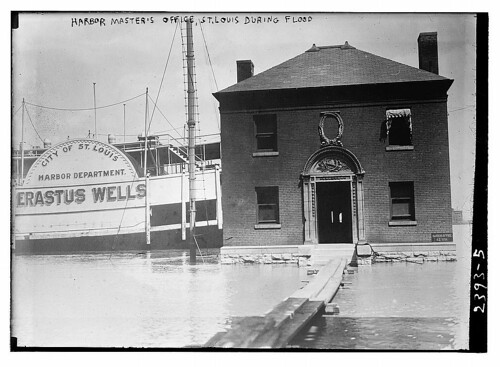 The Library of Congress has a Flickr page where they've currently uploaded 3115 photographs from their historical collection. There are two sets: News in the 1910s (1500 photos) and 1930s-40s in Color (1615 photos). The photo on the left is obviously from the 1910s set. It's a photo taken during a flood of St. Louis.
Patently Amazing

Today I learned my second-great grandfather Selig patented some improvements to fire hydrants back in 1898.
I wouldn't normally have searched the patent database for his name, because I wouldn't expect to see anything. I've put some of my more uncommon surnames through it, but I didn't bother with "Feinstein" as I'm not related to most of them. However, today I checked "Google Scholar" for Selig specifically - don't ask me why - and it includes the patent database.
His professions during his life included real estate and laundry. Apparently he knew something about fire hydrants, too. A renaissance man.
So don't assume your relative didn't patent something. You never know.
Monday, January 14, 2008
With a Little Help From my Kin
There is absolutely no question in my mind where I would be in my genealogy research if I were alone, and hadn’t yet been in contact with any relatives. I’d have made a handful of discoveries, but they would pale in comparison to what I now know. I’ve found relatives, and relatives have found me in a variety of fashions.
[All names of people in "s are fictitious]
Ancestry/Rootsweb Messageboards
One of the first things I did upon discovering Ancestry & Rootsweb was to browse their Surname message boards. I found several posts that seemed to connect with my surnames – most of them five years old, or older. I responded, hoping the people would still have accounts. Not all did.
However, I did see a post by a “David” mentioning an ancestor, Jacob. I recognized the name of the ancestor as the brother of Selig DUDELSACK's wife. So I responded – is this the Jacob who had a sister named Anna?
I’ll admit I was somewhat paranoid when initially posting. I figured there could be crazy people, or lonely people out there who will read the queries, and then respond, “We’re cousins!” pretty much repeating back what you put in your post, perhaps doing a little research and coming up with some additional information. So I made my reply as simple as possible, and waited for the response.
My profile did indicate I am in St. Louis, and "David" posted back that Jacob indeed had a sister named Anna who settled in St. Louis, but he provided some other collateral surnames he knew about but was unclear how they connected. I knew. Since then we have exchanged emails and have carried on an extensive conversation, filling in the descendants of Jacob and Anna for each other. He is in Chicago, and there may be a Cubs-Cards game/Family Reunion in the future.
I've also posted a few queries myself. I haven't heard back, but I might have to wait five years.
Blog
I haven’t had my blog long, but I’ve already gotten a few emails from people curious about my surnames. The first person to respond was “Mike”, a DUDELSACK/FEINSTEIN cousin. I’ve posted enough on the Dudelsack surname, it isn’t a surprise. He wasn’t a previously unknown cousin, and not very distant – our grandparents were siblings - but he doesn’t live in the Midwest, and it was good “speaking” with him. He said he would be following my blog, so, “Hi, “Mike”!”
In this past week, while I’ve been pondering this post, I have received two emails from my blog. One concerning my BLATT surname, and another concerning my SLUPSKY. (The latter arriving today) It’s not clear if either are related to me, but the former email came from someone doing research for a friend, and in the process, I have gained some information. He sent me the death certificates for two great-grandparents. They both died post 1956, so they weren’t online at the Missouri government website. I knew I could order them from the state, or possibly the local courthouse. I hadn’t yet done the research to figure out how to get them as other things had higher priority. My contact had received them from the funeral home. This wasn’t an option I had considered. I knew I could obtain funeral home records, but I didn’t know those records contained copies of the death certificates. Additionally, the funeral home included a copy of the obituary – saving me the trouble of researching the newspaper's microfilm archives at the local library. The obituary mentioned my great-grandfather, Herman FEINSTEIN, was a mason, just like my great-grandfather Barney NEWMARK, but was also a member of the Moolah Shrine.
Family Networking
“"Agnes", my son, John is doing some genealogy research, didn’t you tell me your brother, "Rupert" was doing some a few years ago?”
Two windfalls have come from this method. The biggest is from a cousin who has spent the past twenty years researching the CRUVANT surname, in all directions possible. The Register is approximately 300 pages long. I've tried to help her with a few details here and there. I have also received some information from a BLATT cousin extending that line back a few generations. The latter is somewhat questionable. The information from Poland is highly researched with citations from birth and marriage registers, but the missing link connecting these people to my known relatives is weak, and there are some surnames that don’t match family lore, leading me to wonder if we might actually have two different families. It will take some additional research on my end to decipher this.
Family Associations
I have written an email to one Family Association – The FRETZ Family Association. They have published four volumes of family genealogy. I was able to find Volume 1 at the local library - and later learned that photocopies of the pertinent pages were actually already in my parents' genealogy files, given to them by my mother's aunt probably decades ago. I emailed to ask them how much information they had in volumes 2-4 on the descendants of Ebenezer Opham DENYER. They were kind enough to tell me that they had very little. Knowing full well they had probably lost the sale of three books – but they exist for the benefit of the families, not to make a profit. They even sent me what information they did have. I mean to send them a descendant chart to fill in the gaps that I can in their database, but I haven’t yet done that.
Blind Letters
As I mentioned a couple days ago, I have mailed off two partially-blind letters to people that I was 90% sure are cousins. Neither know me from "Adam", though. I have still only heard back from one of them. The one in Texas could be composing a letter to send back to me. I did include a phone number and an email address, but they might not want to make a long distance call, and they might not have access to a computer. (It’s possible.)
[All names of people in "s are fictitious]
Ancestry/Rootsweb Messageboards
One of the first things I did upon discovering Ancestry & Rootsweb was to browse their Surname message boards. I found several posts that seemed to connect with my surnames – most of them five years old, or older. I responded, hoping the people would still have accounts. Not all did.
However, I did see a post by a “David” mentioning an ancestor, Jacob. I recognized the name of the ancestor as the brother of Selig DUDELSACK's wife. So I responded – is this the Jacob who had a sister named Anna?
I’ll admit I was somewhat paranoid when initially posting. I figured there could be crazy people, or lonely people out there who will read the queries, and then respond, “We’re cousins!” pretty much repeating back what you put in your post, perhaps doing a little research and coming up with some additional information. So I made my reply as simple as possible, and waited for the response.
My profile did indicate I am in St. Louis, and "David" posted back that Jacob indeed had a sister named Anna who settled in St. Louis, but he provided some other collateral surnames he knew about but was unclear how they connected. I knew. Since then we have exchanged emails and have carried on an extensive conversation, filling in the descendants of Jacob and Anna for each other. He is in Chicago, and there may be a Cubs-Cards game/Family Reunion in the future.
I've also posted a few queries myself. I haven't heard back, but I might have to wait five years.
Blog
I haven’t had my blog long, but I’ve already gotten a few emails from people curious about my surnames. The first person to respond was “Mike”, a DUDELSACK/FEINSTEIN cousin. I’ve posted enough on the Dudelsack surname, it isn’t a surprise. He wasn’t a previously unknown cousin, and not very distant – our grandparents were siblings - but he doesn’t live in the Midwest, and it was good “speaking” with him. He said he would be following my blog, so, “Hi, “Mike”!”
In this past week, while I’ve been pondering this post, I have received two emails from my blog. One concerning my BLATT surname, and another concerning my SLUPSKY. (The latter arriving today) It’s not clear if either are related to me, but the former email came from someone doing research for a friend, and in the process, I have gained some information. He sent me the death certificates for two great-grandparents. They both died post 1956, so they weren’t online at the Missouri government website. I knew I could order them from the state, or possibly the local courthouse. I hadn’t yet done the research to figure out how to get them as other things had higher priority. My contact had received them from the funeral home. This wasn’t an option I had considered. I knew I could obtain funeral home records, but I didn’t know those records contained copies of the death certificates. Additionally, the funeral home included a copy of the obituary – saving me the trouble of researching the newspaper's microfilm archives at the local library. The obituary mentioned my great-grandfather, Herman FEINSTEIN, was a mason, just like my great-grandfather Barney NEWMARK, but was also a member of the Moolah Shrine.
Family Networking
“"Agnes", my son, John is doing some genealogy research, didn’t you tell me your brother, "Rupert" was doing some a few years ago?”
Two windfalls have come from this method. The biggest is from a cousin who has spent the past twenty years researching the CRUVANT surname, in all directions possible. The Register is approximately 300 pages long. I've tried to help her with a few details here and there. I have also received some information from a BLATT cousin extending that line back a few generations. The latter is somewhat questionable. The information from Poland is highly researched with citations from birth and marriage registers, but the missing link connecting these people to my known relatives is weak, and there are some surnames that don’t match family lore, leading me to wonder if we might actually have two different families. It will take some additional research on my end to decipher this.
Family Associations
I have written an email to one Family Association – The FRETZ Family Association. They have published four volumes of family genealogy. I was able to find Volume 1 at the local library - and later learned that photocopies of the pertinent pages were actually already in my parents' genealogy files, given to them by my mother's aunt probably decades ago. I emailed to ask them how much information they had in volumes 2-4 on the descendants of Ebenezer Opham DENYER. They were kind enough to tell me that they had very little. Knowing full well they had probably lost the sale of three books – but they exist for the benefit of the families, not to make a profit. They even sent me what information they did have. I mean to send them a descendant chart to fill in the gaps that I can in their database, but I haven’t yet done that.
Blind Letters
As I mentioned a couple days ago, I have mailed off two partially-blind letters to people that I was 90% sure are cousins. Neither know me from "Adam", though. I have still only heard back from one of them. The one in Texas could be composing a letter to send back to me. I did include a phone number and an email address, but they might not want to make a long distance call, and they might not have access to a computer. (It’s possible.)
Dilemma of National Proportions
If in November, the US election is between Obama and McCain all American descendants of William the Lion will be emotionally torn: which cousin will they vote for?.
If this genealogy is correct, William I was a descendant of Charlemagne. There are some who claim I am too. I don't necessarily believe these claims, but for the sake of this post, I will count myself a cousin of Obama and McCain.
I suspect if I really do go back to Charlemagne, I'm related to a few other important historical figures. Some have argued, that mathematically, everyone in the Western World is descended from Charlemagne *and* Muhammad. Of course, statistically speaking, there are 0 people in the US with the surname Barrymore. Comes as a surprise, doesn't it?
So if we hypothesize that the statistical calculations that went into computing the likelihood of the Barrymore Surname failed in that case, can we also hypothesize that the statistical calculations that computed everyone in the Western world are descended from Charlemagne and Muhammad are also possibly in error?
If this genealogy is correct, William I was a descendant of Charlemagne. There are some who claim I am too. I don't necessarily believe these claims, but for the sake of this post, I will count myself a cousin of Obama and McCain.
I suspect if I really do go back to Charlemagne, I'm related to a few other important historical figures. Some have argued, that mathematically, everyone in the Western World is descended from Charlemagne *and* Muhammad. Of course, statistically speaking, there are 0 people in the US with the surname Barrymore. Comes as a surprise, doesn't it?
So if we hypothesize that the statistical calculations that went into computing the likelihood of the Barrymore Surname failed in that case, can we also hypothesize that the statistical calculations that computed everyone in the Western world are descended from Charlemagne and Muhammad are also possibly in error?
Saturday, January 12, 2008
Massive cemetery desecration in NJ
four teenagers over two nights, toppled 500 tombstones in a New Brunswick, NJ Jewish cemetery.
I don't know of any relatives buried in the cemetery, but the photographs, and video are heartrending. The police haven't yet found evidence of it being a hate-based crime, but I just can't comprehend why the teens would have done this. There was a lot of hatred against society in general at least to compel them to go through the physical labor of that level of destruction.
A cemetery restoration fund has been established by the local community.
I don't know of any relatives buried in the cemetery, but the photographs, and video are heartrending. The police haven't yet found evidence of it being a hate-based crime, but I just can't comprehend why the teens would have done this. There was a lot of hatred against society in general at least to compel them to go through the physical labor of that level of destruction.
A cemetery restoration fund has been established by the local community.
Friday, January 11, 2008
My Surnames
At the beginning of every meeting of the St. Louis Genealogical Society the attendees are asked, "Is there anybody here for the first time?" If there is they are asked to introduce themselves, and tell everyone the surnames they're researching. The latter makes a lot of sense at a local society since it's not completely unlikely you might run into a distant or not-so distant relative you were previously unaware of.
But it's also a small world, sometimes, and I don't think I've done that yet. I've introduced myself in several ways over the past few months, and mentioned surnames here and there in various posts, but I haven't created a single post that lists all my surnames. A complete surname list could get rather lengthy. But if I limit it to surnames of direct ancestors, it's more manageable.
There are several ways I could organize these names. I decided to alphabetize them, but group them by how many generations they are away from me.
Some may notice there are 17 names in the first list, when some might expect only 16. That's because there was a surname change. There are a couple surname changes in the earlier generations as well.
1-4 generations
ADLER, BLATT, BOKSERN, CANTKERT, CRUVANT, DENYER, DEUTSCH, DUDELSACK, FEINSTEIN , HARTLEY, LICHTMAN, MOJSABOVSKI, NEWMARK, PERLIK, STUART, VAN EVERY, WEISS
5-8 generations
BEASLEY, BLATYTA, COLEMAN, FRETZ , GOLDFINCH, GOLDSTEIN, HOLMES, HORTON, KIPERSZTOK, LIPMAN, LUCELLAS, OBERHOLTZER, ROSENBERGER, SHOWERS, SLIVER, SLUPSKY, SWAYZE, VAN IVEREN, WILCOX
9-12 generations
BETTS, BURGER, CHAMBERLAIN, FREDERICKSEN, HAYNE, KINGE, LANGTON, MEYER, SCHUYLER, WINES
I am going to link to this post from my sidebar, and I will update it as I have names to add (or change).
But it's also a small world, sometimes, and I don't think I've done that yet. I've introduced myself in several ways over the past few months, and mentioned surnames here and there in various posts, but I haven't created a single post that lists all my surnames. A complete surname list could get rather lengthy. But if I limit it to surnames of direct ancestors, it's more manageable.
There are several ways I could organize these names. I decided to alphabetize them, but group them by how many generations they are away from me.
Some may notice there are 17 names in the first list, when some might expect only 16. That's because there was a surname change. There are a couple surname changes in the earlier generations as well.
1-4 generations
ADLER, BLATT, BOKSERN, CANTKERT, CRUVANT, DENYER, DEUTSCH, DUDELSACK, FEINSTEIN , HARTLEY, LICHTMAN, MOJSABOVSKI, NEWMARK, PERLIK, STUART, VAN EVERY, WEISS
5-8 generations
BEASLEY, BLATYTA, COLEMAN, FRETZ , GOLDFINCH, GOLDSTEIN, HOLMES, HORTON, KIPERSZTOK, LIPMAN, LUCELLAS, OBERHOLTZER, ROSENBERGER, SHOWERS, SLIVER, SLUPSKY, SWAYZE, VAN IVEREN, WILCOX
9-12 generations
BETTS, BURGER, CHAMBERLAIN, FREDERICKSEN, HAYNE, KINGE, LANGTON, MEYER, SCHUYLER, WINES
I am going to link to this post from my sidebar, and I will update it as I have names to add (or change).
Friday Five
The five names below were found in the referenced US census, as indexed at Ancestry.com:
Broccoli Adele – 1930 – age 46 – Plymouth, MA – Female
Carrot Resh – 1850 – age 6 – Hall, IN – Male
Strawberry Savage – 1920 – age 10 – Detroit, MI – Female
Banana Nixon – 1900 – age 1 – Houston, Georgia – Female
Apple Pie – 1870 – age 40 – Memphis, TN – Male
One of my resolutions this year was to go on a diet. Could you tell?
Broccoli Adele – 1930 – age 46 – Plymouth, MA – Female
Carrot Resh – 1850 – age 6 – Hall, IN – Male
Strawberry Savage – 1920 – age 10 – Detroit, MI – Female
Banana Nixon – 1900 – age 1 – Houston, Georgia – Female
Apple Pie – 1870 – age 40 – Memphis, TN – Male
One of my resolutions this year was to go on a diet. Could you tell?
Subscribe to:
Posts (Atom)


 Posts
Posts