Amanuensis: A person employed to write what another dictates or to copy what has been written by another.
I continue my project to transcribe family letters, journals, newspaper articles, audiotapes, and other historical artifacts. Not only do the documents contain genealogical information, the words breathe life into kin - some I never met - others I see a time in their life before I knew them.
I began this project back in February of 2009, and since then, many others have joined in on the meme. Why do we transcribe? I provide my three reasons in the linked post. You may find others. If you participate, feel free to leave a link to your post in the comments.
***
This week I transcribe the London birth record of my great grandfather's brother, Israel David Newmark (1903-2004)
Monday, December 26, 2011

Wednesday, December 21, 2011

Tuesday, December 20, 2011
Happy Khanike!
Hanuka began at sundown tonight. It's an 8-day celebration starting on the 25th day of the first month of Winter on the Hebrew calendar, marking the Maccabean revolt in 166 BCE.
There are only two ways to properly spell the name of the holiday: חנוכה or חנכה (The one on the left being more common today according to Wikipedia)
If you use any other alphabet, it is entirely phonetic, resulting in many options, none of them being more 'correct' than the other. However, the YIVO Institute for Jewish Research did decide that 'Khanike' most closely approximates the pronunciation. Their spelling is one of the least used in America, though, even if it has the most academia behind it.
There are more videos in my post from 2009 at this time.
There are only two ways to properly spell the name of the holiday: חנוכה or חנכה (The one on the left being more common today according to Wikipedia)
If you use any other alphabet, it is entirely phonetic, resulting in many options, none of them being more 'correct' than the other. However, the YIVO Institute for Jewish Research did decide that 'Khanike' most closely approximates the pronunciation. Their spelling is one of the least used in America, though, even if it has the most academia behind it.
There are more videos in my post from 2009 at this time.
Monday, December 19, 2011
Amanuensis Monday: The Birth of Cecile Newmark - 1896
Amanuensis: A person employed to write what another dictates or to copy what has been written by another.
I continue my project to transcribe family letters, journals, newspaper articles, audiotapes, and other historical artifacts. Not only do the documents contain genealogical information, the words breathe life into kin - some I never met - others I see a time in their life before I knew them.
I began this project back in February of 2009, and since then, many others have joined in on the meme. Why do we transcribe? I provide my three reasons in the linked post. You may find others. If you participate, feel free to leave a link to your post in the comments.
***
This week I transcribe the London birth record of my great grandfather's sister, Cecile (Cissie) Newmark (1896-1973)
I continue my project to transcribe family letters, journals, newspaper articles, audiotapes, and other historical artifacts. Not only do the documents contain genealogical information, the words breathe life into kin - some I never met - others I see a time in their life before I knew them.
I began this project back in February of 2009, and since then, many others have joined in on the meme. Why do we transcribe? I provide my three reasons in the linked post. You may find others. If you participate, feel free to leave a link to your post in the comments.
***
This week I transcribe the London birth record of my great grandfather's sister, Cecile (Cissie) Newmark (1896-1973)
Monday, December 12, 2011
Amanuensis Monday: Baby Pines for Lost DaDa - 1907
Amanuensis: A person employed to write what another dictates or to copy what has been written by another.
I continue my project to transcribe family letters, journals, newspaper articles, audiotapes, and other historical artifacts. Not only do the documents contain genealogical information, the words breathe life into kin - some I never met - others I see a time in their life before I knew them.
I began this project back in February of 2009, and since then, many others have joined in on the meme. Why do we transcribe? I provide my three reasons in the linked post. You may find others. If you participate, feel free to leave a link to your post in the comments.
***
This week I transcribe a news story that appeared in the 1907 St. Louis Post Dispatch. Goldie Cruvant, who I mentioned last week, had just returned to East St. Louis from Chicago, with husband, Benjamin, and their two children. And Ben's parents weren't happy about the relationship.
I continue my project to transcribe family letters, journals, newspaper articles, audiotapes, and other historical artifacts. Not only do the documents contain genealogical information, the words breathe life into kin - some I never met - others I see a time in their life before I knew them.
I began this project back in February of 2009, and since then, many others have joined in on the meme. Why do we transcribe? I provide my three reasons in the linked post. You may find others. If you participate, feel free to leave a link to your post in the comments.
***
This week I transcribe a news story that appeared in the 1907 St. Louis Post Dispatch. Goldie Cruvant, who I mentioned last week, had just returned to East St. Louis from Chicago, with husband, Benjamin, and their two children. And Ben's parents weren't happy about the relationship.
Sunday, December 11, 2011
Week In Review
Below are some highlights from news stories and blog posts I have read in the past week that deal with my overlapping interests in Genealogy, History, Heritage, and Technology.
Genealogy Resources
Other Weekly Link Lists
I will be taking a vacation from Week in Review through the end of the month. I have scheduled several Amanuensis Monday posts. Otherwise, any blogging will be light.
Genealogy Resources
- The MoSGA Messenger this week has linked to or discussed several sources for digitized newspapers, including: Irish Newspaper Archive, International Coalition on Newspapers, Chronicling America, the University of Pennsylvania's list of Historical Newspapers Online, Wikipedia's list of Online Newspaper Archives, and Google News Archives.
- James Tanner at Genealogy's Star describes The National Reporter System and why it is a good genealogical resource. He follows up with a clarification on what is meant by Courts of Record.
- The Library of Congress has created a new blog, Copyright Matters. Their goal is to make the Pre-1978 Copyright Office Records more Accessible. "Through this blog we hope to receive your thoughts and ideas so that we can present the records online in a way that will best suit your needs."
- Jill Hurst-Wahl at Digitization 101 asks, is every librarian a digital librarian?
- Dick Eastman at Eastman's Online Genealogy Newsletter asks, Is the Personal Computer Dead?
- Leland Meitzler at GenealogyBlog reported that book vendors were not being invited to sell their wares this year at the annual RootsTech conference. DearMyrtle, Genealogy's Star, Anglo-Celtic Connections, Smoky Mountain Family Historian, and others have commented.
- Menorahs are becoming popular in Ireland, even though the Jewish population is small.
- The 112th edition of the Carnival of Genealogy has been released. The topic for the next issue is A Charles Dickens Christmas. Instructions can be read at CreativeGene.
Other Weekly Link Lists
- Randy Seaver's Best of the Genea-Blogs at Genea-Musings
- Ruth Blair's Ruth's Recommendations at The Passionate Genealogist
- Julie Cahill Tarr's Friday Finds at GenBlog
- Deb Ruth's Follow Friday Gems at Adventures in Genealogy
- Megan Smolenyak Smolenyak's Genealogy Round Up at MSS's Roots World
I will be taking a vacation from Week in Review through the end of the month. I have scheduled several Amanuensis Monday posts. Otherwise, any blogging will be light.
Monday, December 5, 2011
Amanuensis Monday: Goldie Cruvant - in Denver Colorado - 1914
Amanuensis: A person employed to write what another dictates or to copy what has been written by another.
I continue my project to transcribe family letters, journals, newspaper articles, audiotapes, and other historical artifacts. Not only do the documents contain genealogical information, the words breathe life into kin - some I never met - others I see a time in their life before I knew them.
I began this project back in February of 2009, and since then, many others have joined in on the meme. Why do we transcribe? I provide my three reasons in the linked post. You may find others. If you participate, feel free to leave a link to your post in the comments.
***
This week I transcribe a short excerpt from an issue of The Typographical Journal, which appears to mention Goldie (White) Cruvant, the first wife to Benjamin Cruvant, the brother of my great grandmother, Bertha (Cruvant) Newmark. (Found on Google Books)
I continue my project to transcribe family letters, journals, newspaper articles, audiotapes, and other historical artifacts. Not only do the documents contain genealogical information, the words breathe life into kin - some I never met - others I see a time in their life before I knew them.
I began this project back in February of 2009, and since then, many others have joined in on the meme. Why do we transcribe? I provide my three reasons in the linked post. You may find others. If you participate, feel free to leave a link to your post in the comments.
***
This week I transcribe a short excerpt from an issue of The Typographical Journal, which appears to mention Goldie (White) Cruvant, the first wife to Benjamin Cruvant, the brother of my great grandmother, Bertha (Cruvant) Newmark. (Found on Google Books)
Sunday, December 4, 2011
Week In Review
Below are some highlights from news stories and blog posts I have read in the past week that deal with my overlapping interests in Genealogy, History, Heritage, and Technology.
Other Weekly Link Lists
- Meg Biallas at Capital Comment provides tips on How to Master the National Archives for the amateur researcher.
- Bruce Smith of the Associated Press writes that The Charleston Library Society (the oldest library in the South) "announced Friday a multi-year effort to catalog and restore thousands of rare books."
- Professional historian, Lisa Jardine, discusses how her opinions regarding genealogy and family history have changed. (BBC)
- Who won the War of 1812? At least one historian says Canada won.
- Jim Edwards at Business Insider writes that The Death of Television May Be Just Five Years Away
- Richard Byrne at Free Technology for Teachers suggests Settings Every Blogger Should Know
- Dee at Ancestrally Challenged provides us with 100 Signs You're Addicted to Genealogy
- Courtesy of Ancestry.com's YouTube Channel: Behind the Scenes with Santa Claus
Other Weekly Link Lists
- Randy Seaver's Best of the Genea-Blogs at Genea-Musings
- Ruth Blair's Ruth's Recommendations at The Passionate Genealogist
- Julie Cahill Tarr's Friday Finds at GenBlog
- Deb Ruth's Follow Friday Gems at Adventures in Genealogy
- Donna Pointkouski's Donna's Picks, Link Love, and More at What's Past is Prologue
- Dianne Haddad's Genealogy News Corral at Genealogy Insider
- Megan Smolenyak Smolenyak's Genealogy Round Up at MSS's Roots World
- Liz Haigney Lynch's Quick Links at Ancestral Archaeologist
Friday, December 2, 2011
Julie Andrews and Gene Kelly sing about their family trees
I shared this back in 2007, but there are probably one or two current readers who missed it, and others might enjoy listening to this again. This is probably from The Julie Andrews Show (1965).
Part I
Part II
On a personal note, back in 2007, I recall wondering whether I was going to end up like Gene's "Uncle Jim." Happily, that isn't the case; my fiancée last weekend was #1 on my list of things to be thankful for. For the second year running.
Part I
Part II
On a personal note, back in 2007, I recall wondering whether I was going to end up like Gene's "Uncle Jim." Happily, that isn't the case; my fiancée last weekend was #1 on my list of things to be thankful for. For the second year running.
Monday, November 28, 2011
Amanuensis Monday: The Birth of Kate Newmark - 1894
Amanuensis: A person employed to write what another dictates or to copy what has been written by another.
I continue my project to transcribe family letters, journals, newspaper articles, audiotapes, and other historical artifacts. Not only do the documents contain genealogical information, the words breathe life into kin - some I never met - others I see a time in their life before I knew them.
I began this project back in February of 2009, and since then, many others have joined in on the meme. Why do we transcribe? I provide my three reasons in the linked post. You may find others. If you participate, feel free to leave a link to your post in the comments.
***
This week I transcribe the London birth record of my great grandfather's sister, Kate Newmark
I continue my project to transcribe family letters, journals, newspaper articles, audiotapes, and other historical artifacts. Not only do the documents contain genealogical information, the words breathe life into kin - some I never met - others I see a time in their life before I knew them.
I began this project back in February of 2009, and since then, many others have joined in on the meme. Why do we transcribe? I provide my three reasons in the linked post. You may find others. If you participate, feel free to leave a link to your post in the comments.
***
This week I transcribe the London birth record of my great grandfather's sister, Kate Newmark
Sunday, November 27, 2011
Genealogy Research - a poem
Genealogy Research
I was kneeling in front of the gravestone
Wearing a faded pair of jeans
I had forgotten to bring my digital camera
But had remembered the charcoal and paper
I rubbed the grave, and read the results
November 11 1819
November 13 1820
The child would have been
One year, two days old when he died
The stone had to be wrong
This was the grave of my ancestor
I looked at the death certificate
I had found on the state website
And brought with me to the cemetery
1820 should be 1870
I stood up
And walked over
To my computer desk
Which was incomprehensibly situated
Between two nearby stones
I entered the data
Into my family tree
And then entered
My ancestor’s name
Into a database
The name of which I don’t recall
But I knew I had never seen it before
There was one result
And following the link
I was reading the diary
Of my fourth great grandma
Where she mentioned the name
Of the ship on which the family traversed
The Pacific ocean
I had thought they came from Europe
But apparently
They came by a more
Circuitous route
I entered the name of the ship
Into Google
And learned the passengers
Were ex-convicts
Exiled to Australia
Who commandeered a boat
And sailed to America
By way of Argentina
I returned to the diary
Of my fourth great grandmother
Only to discover
Someone had deleted it
From the database
And I hadn’t yet downloaded it
To my desktop
I woke up, clichéd sweat
Covered my forehead
I grabbed pen and paper
And wrote down everything I’d learned
Fully aware my dream
Was as reliable a source
As most of what I find
On the Internet
My only concern
I didn’t know the proper
Citation format
© John Newmark, 2011
Some prior attempts at poetry
I was kneeling in front of the gravestone
Wearing a faded pair of jeans
I had forgotten to bring my digital camera
But had remembered the charcoal and paper
I rubbed the grave, and read the results
November 11 1819
November 13 1820
The child would have been
One year, two days old when he died
The stone had to be wrong
This was the grave of my ancestor
I looked at the death certificate
I had found on the state website
And brought with me to the cemetery
1820 should be 1870
I stood up
And walked over
To my computer desk
Which was incomprehensibly situated
Between two nearby stones
I entered the data
Into my family tree
And then entered
My ancestor’s name
Into a database
The name of which I don’t recall
But I knew I had never seen it before
There was one result
And following the link
I was reading the diary
Of my fourth great grandma
Where she mentioned the name
Of the ship on which the family traversed
The Pacific ocean
I had thought they came from Europe
But apparently
They came by a more
Circuitous route
I entered the name of the ship
Into Google
And learned the passengers
Were ex-convicts
Exiled to Australia
Who commandeered a boat
And sailed to America
By way of Argentina
I returned to the diary
Of my fourth great grandmother
Only to discover
Someone had deleted it
From the database
And I hadn’t yet downloaded it
To my desktop
I woke up, clichéd sweat
Covered my forehead
I grabbed pen and paper
And wrote down everything I’d learned
Fully aware my dream
Was as reliable a source
As most of what I find
On the Internet
My only concern
I didn’t know the proper
Citation format
© John Newmark, 2011
Some prior attempts at poetry
Week In Review
Below are some highlights from news stories and blog posts I have read in the past week that deal with my overlapping interests in Genealogy, History, Heritage, and Technology.
Other Weekly Link Lists
- James Tanner at Genealogy's Star discusses Why you have to pay for free government documents
- Dear Myrtle asks us, regarding the sources we cite in our research: Did You View it Personally?
- Dick Eastman at Eastman's Online Genealogy Newsletter shares a rather unique gift idea: Creative Coffins
- Bill West at West in New England releases The Third Annual Great Genealogy Poetry Challenge
- The US Holocaust Memorial Museum and Ancestry.com announced earlier this month that information on 30,000 victims of the Holocaust and Nazi persecution is now available online at Ancestry.com and can be searched at no cost. (hat/tip: Upfront with NGS)
- MyHeritage Acquired FamilyLink.com and WorldVitalRecords.com (GeneaPress)
- Archives.Com Partners with FamilyTreeDNA to offer DNA testing (GeneaPress)
Other Weekly Link Lists
- Randy Seaver's Best of the Genea-Blogs at Genea-Musings
- Ruth Blair's Ruth's Recommendations at The Passionate Genealogist
- Julie Cahill Tarr's Friday Finds at GenBlog
Saturday, November 26, 2011
The Internet Wayback Machine - and Blogspot
There are occasionally discussions regarding whether or not a blogger should host their blog for free at Blogspot, Wordpress, etc - or buy their own domain name.
One factor I haven't heard mentioned in these discussions is: How Often Will the Internet Wayback Machine at Archive.org 'crawl' your site?
Archive.org has been preserving webpages for over a decade. This can be very useful. Bloggers may wonder what will happen to their blog posts if their blog disappears -- but if it's being archived somewhere else, survival isn't completely dependent upon the blogger's backup regimen.
I recently discovered that:
1) This blog, which currently has over 200 subscribers according to Google Reader, has been 'crawled' by the archival spiders at the IWM a grand total of 2 times, both in 2008, and a total of 67 pages have been preserved.
2) A blog I have maintained since 2002 on my personal domain, and which currently has 6 subscribers according to Google Reader, has been 'crawled' 52 times since 2006, and a total of 5359 pages have been preserved. (Note: This is a Wordpress blog, and has separate 'pages' for comments, trackbacks, and rss feeds, so the number is probably closer to an equivalent of 1000 pages.)
3) I decided to look at the results for some other blogs. I've decided not to name them. Those who are curious about their own blogs, can follow the links above, and replace the URLs for my own blogs with any other site they wish to test.
I looked at three other popular genealogy blogs maintained on Blogspot, all with more subscribers than I have through Google Reader. Two blogging since 2008, and one blogging since 2006. The former two have been crawled twice each, with 15 and 23 pages preserved. The one blogging since 2006 has been crawled 7 times, and has 346 pages preserved.
Then I looked at two popular geneabloggers, both blogging since 2006, who switched to a personal domain back in 2008. Their Blogspot blogs were crawled 2 and 7 times, with 60 and 783 pages preserved respectively. Their personal domains have been crawled 37 and 40 times since 2008, with 427 and 2118 pages preserved respectively. While the numbers are different, moving to a personal domain clearly benefited both on this measurement.
Following some links on the archived pages results in this error:
 From what I have found researching so far, Google added the robots.txt files to Blogger blogs in 2007. (Explaining perhaps why those blogging since 2006 were crawled a little more) This file, which cannot be changed, is preventing search 'robots' from following certain links on the blog. I'm not entirely certain which links are blocked, and which ones aren't. It's certainly not stopping Google from indexing their blogs. Google has owned Blogger and Blogspot since 2003, and certainly wouldn't do that. But it appears to have an impact on how other robots crawl the site.
Some references to the Blogspot Robots.txt suggest its primary purpose is to prevent the 'duplicate' pages that otherwise might result, as exemplified by the 5000 pages the Internet Wayback Machine has preserved for my Wordpress blog. But it appears to be having a larger impact than that.
The Robots.txt file is on the Custom Domains as well, so it's not the entire explanation. The Internet Wayback Machine might treat Blogspot, in general, differently.
Why did I originally set my genealogy blog up on Blogspot?
I didn't at first. For the first few months all my genealogy-related posts were a subset of the personal blog referenced in (2) above. But as I grew more obsessed with genealogy, I knew I needed a separate space devoted to the one topic. So many other geneabloggers were using Blogspot, and it was easy to use, so that's the direction I went.
It wasn't a mistake, per se. Blogspot has been a fine home. But I've considered moving the blog back 'home' before, and this was just the proverbial straw for me.
All of this explains why as of this post, this blog is no longer located at http://transylvaniandutch.blogspot.com - but is now at http://blog.transylvaniandutch.com
All links to the former Blogspot version should forward automatically to the new page.
One factor I haven't heard mentioned in these discussions is: How Often Will the Internet Wayback Machine at Archive.org 'crawl' your site?
Archive.org has been preserving webpages for over a decade. This can be very useful. Bloggers may wonder what will happen to their blog posts if their blog disappears -- but if it's being archived somewhere else, survival isn't completely dependent upon the blogger's backup regimen.
I recently discovered that:
1) This blog, which currently has over 200 subscribers according to Google Reader, has been 'crawled' by the archival spiders at the IWM a grand total of 2 times, both in 2008, and a total of 67 pages have been preserved.
2) A blog I have maintained since 2002 on my personal domain, and which currently has 6 subscribers according to Google Reader, has been 'crawled' 52 times since 2006, and a total of 5359 pages have been preserved. (Note: This is a Wordpress blog, and has separate 'pages' for comments, trackbacks, and rss feeds, so the number is probably closer to an equivalent of 1000 pages.)
3) I decided to look at the results for some other blogs. I've decided not to name them. Those who are curious about their own blogs, can follow the links above, and replace the URLs for my own blogs with any other site they wish to test.
I looked at three other popular genealogy blogs maintained on Blogspot, all with more subscribers than I have through Google Reader. Two blogging since 2008, and one blogging since 2006. The former two have been crawled twice each, with 15 and 23 pages preserved. The one blogging since 2006 has been crawled 7 times, and has 346 pages preserved.
Then I looked at two popular geneabloggers, both blogging since 2006, who switched to a personal domain back in 2008. Their Blogspot blogs were crawled 2 and 7 times, with 60 and 783 pages preserved respectively. Their personal domains have been crawled 37 and 40 times since 2008, with 427 and 2118 pages preserved respectively. While the numbers are different, moving to a personal domain clearly benefited both on this measurement.
Following some links on the archived pages results in this error:

Some references to the Blogspot Robots.txt suggest its primary purpose is to prevent the 'duplicate' pages that otherwise might result, as exemplified by the 5000 pages the Internet Wayback Machine has preserved for my Wordpress blog. But it appears to be having a larger impact than that.
The Robots.txt file is on the Custom Domains as well, so it's not the entire explanation. The Internet Wayback Machine might treat Blogspot, in general, differently.
Why did I originally set my genealogy blog up on Blogspot?
I didn't at first. For the first few months all my genealogy-related posts were a subset of the personal blog referenced in (2) above. But as I grew more obsessed with genealogy, I knew I needed a separate space devoted to the one topic. So many other geneabloggers were using Blogspot, and it was easy to use, so that's the direction I went.
It wasn't a mistake, per se. Blogspot has been a fine home. But I've considered moving the blog back 'home' before, and this was just the proverbial straw for me.
All of this explains why as of this post, this blog is no longer located at http://transylvaniandutch.blogspot.com - but is now at http://blog.transylvaniandutch.com
All links to the former Blogspot version should forward automatically to the new page.
Thursday, November 24, 2011

Wednesday, November 23, 2011
Thanksgiving Poetry
Below are several poems I have posted here on past Thanksgivings, all gathered together in one post.
I am posting them a day early in case someone is inspired to include any of them in their festivities tomorrow.
GRATITUDE - by Edgar A. Guest (©1917)
Be grateful for the kindly friends that walk along your way;
Be grateful for the skies of blue that smile from day to day;
Be grateful for the health you own, the work you find to do,
For round about you there are men less fortunate than you.
Be grateful for the growing trees, the roses soon to bloom,
The tenderness of kindly hearts that shared your days of gloom;
Be grateful for the morning dew, the grass beneath your feet,
The soft caresses of your babes and all their laughter sweet.
Acquire the grateful habit, learn to see how blest you are,
How much there is to gladden life, how little life to mar!
And what if rain shall fall to-day and you with grief are sad;
Be grateful that you can recall the joys that you have had.
Thanksgiving - by Edgar A. Guest (©1917)
Gettin' together to smile an' rejoice,
An' eatin' an' laughin' with folks of your choice;
An' kissin' the girls an' declarin' that they
Are growin' more beautiful day after day;
Chattin' an' braggin' a bit with the men,
Buildin' the old family circle again;
Livin' the wholesome an' old-fashioned cheer,
Just for awhile at the end of the year.
Greetings fly fast as we crowd through the door
And under the old roof we gather once more
Just as we did when the youngsters were small;
Mother's a little bit grayer, that's all.
Father's a little bit older, but still
Ready to romp an' to laugh with a will.
Here we are back at the table again
Tellin' our stories as women an' men.
Bowed are our heads for a moment in prayer;
Oh, but we're grateful an' glad to be there.
Home from the east land an' home from the west,
Home with the folks that are dearest an' best.
Out of the sham of the cities afar
We've come for a time to be just what we are.
Here we can talk of ourselves an' be frank,
Forgettin' position an' station an' rank.
Give me the end of the year an' its fun
When most of the plannin' an' toilin' is done;
Bring all the wanderers home to the nest,
Let me sit down with the ones I love best,
Hear the old voices still ringin' with song,
See the old faces unblemished by wrong,
See the old table with all of its chairs
An' I'll put soul in my Thanksgivin' prayers.
Looking Back - by Edgar Guest (©1921)
I might have been rich if I'd wanted the gold instead of the friendships I've made.
I might have had fame if I'd sought for renown in the hours when I purposely played.
Now I'm standing to-day on the far edge of life, and I'm just looking backward to see
What I've done with the years and the days that were mine, and all that has happened to me.
I haven't built much of a fortune to leave to those who shall carry my name,
And nothing I've done shall entitle me now to a place on the tablets of fame.
But I've loved the great sky and its spaces of blue; I've lived with the birds and the trees;
I've turned from the splendor of silver and gold to share in such pleasures as these.
I've given my time to the children who came; together we've romped and we've played,
And I wouldn't exchange the glad hours spent with them for the money that I might have made.
I chose to be known and be loved by the few, and was deaf to the plaudits of men;
And I'd make the same choice should the chance come to me to live my life over again.
I've lived with my friends and I've shared in their joys, known sorrow with all of its tears;
I have harvested much from my acres of life, though some say I've squandered my years.
For much that is fine has been mine to enjoy, and I think I have lived to my best,
And I have no regret, as I'm nearing the end, for the gold that I might have possessed.
A Song of Thanks - by Edward Smyth Jones (©1922)
FOR the sun that shone at the dawn of spring,
For the flowers which bloom and the birds that sing,
For the verdant robe of the gray old earth,
For her coffers filled with their countless worth,
For the flocks which feed on a thousand hills,
For the rippling streams which turn the mills,
For the lowing herds in the lovely vale,
For the songs of gladness on the gale,—
From the Gulf and the Lakes to the Oceans’ banks,—
Lord God of Hosts, we give Thee thanks!
For the farmer reaping his whitened fields,
For the bounty which the rich soil yields,
For the cooling dews and refreshing rains,
For the sun which ripens the golden grains,
For the bearded wheat and the fattened swine,
For the stalled ox and the fruitful vine,
For the tubers large and cotton white,
For the kid and the lambkin frisk and blithe,
For the swan which floats near the river-banks,—
Lord God of Hosts, we give Thee thanks
For the pumpkin sweet and the yellow yam,
For the corn and beans and the sugared ham,
For the plum and the peach and the apple red,
For the dear old press where the wine is tread,
For the cock which crows at the breaking dawn,
And the proud old “turk” of the farmer’s barn,
For the fish which swim in the babbling brooks,
For the game which hide in the shady nooks,—
From the Gulf and the Lakes to the Oceans’ banks—
Lord God of Hosts, we give Thee thanks!
For the sturdy oaks and the stately pines,
For the lead and the coal from the deep,
dark mines, For the silver ores of a thousand fold,
For the diamond bright and the yellow gold,
For the river boat and the flying train,
For the fleecy sail of the rolling main,
For the velvet sponge and the glossy pearl,
For the flag of peace which we now unfurl,—
From the Gulf and the Lakes to the Oceans’ banks,—
Lord God of Hosts, we give Thee thanks!
For the lowly cot and the mansion fair,
For the peace and plenty together share,
For the Hand which guides us from above,
For Thy tender mercies, abiding love,
For the blessed home with its children gay,
For returnings of Thanksgiving Day,
For the bearing toils and the sharing cares,
We lift up our hearts in our songs and our prayers,—
From the Gulf and the Lakes to the Oceans’ banks,—
Lord God of Hosts, we give Thee thanks!
I am posting them a day early in case someone is inspired to include any of them in their festivities tomorrow.
GRATITUDE - by Edgar A. Guest (©1917)
Be grateful for the kindly friends that walk along your way;
Be grateful for the skies of blue that smile from day to day;
Be grateful for the health you own, the work you find to do,
For round about you there are men less fortunate than you.
Be grateful for the growing trees, the roses soon to bloom,
The tenderness of kindly hearts that shared your days of gloom;
Be grateful for the morning dew, the grass beneath your feet,
The soft caresses of your babes and all their laughter sweet.
Acquire the grateful habit, learn to see how blest you are,
How much there is to gladden life, how little life to mar!
And what if rain shall fall to-day and you with grief are sad;
Be grateful that you can recall the joys that you have had.
Thanksgiving - by Edgar A. Guest (©1917)
Gettin' together to smile an' rejoice,
An' eatin' an' laughin' with folks of your choice;
An' kissin' the girls an' declarin' that they
Are growin' more beautiful day after day;
Chattin' an' braggin' a bit with the men,
Buildin' the old family circle again;
Livin' the wholesome an' old-fashioned cheer,
Just for awhile at the end of the year.
Greetings fly fast as we crowd through the door
And under the old roof we gather once more
Just as we did when the youngsters were small;
Mother's a little bit grayer, that's all.
Father's a little bit older, but still
Ready to romp an' to laugh with a will.
Here we are back at the table again
Tellin' our stories as women an' men.
Bowed are our heads for a moment in prayer;
Oh, but we're grateful an' glad to be there.
Home from the east land an' home from the west,
Home with the folks that are dearest an' best.
Out of the sham of the cities afar
We've come for a time to be just what we are.
Here we can talk of ourselves an' be frank,
Forgettin' position an' station an' rank.
Give me the end of the year an' its fun
When most of the plannin' an' toilin' is done;
Bring all the wanderers home to the nest,
Let me sit down with the ones I love best,
Hear the old voices still ringin' with song,
See the old faces unblemished by wrong,
See the old table with all of its chairs
An' I'll put soul in my Thanksgivin' prayers.
Looking Back - by Edgar Guest (©1921)
I might have been rich if I'd wanted the gold instead of the friendships I've made.
I might have had fame if I'd sought for renown in the hours when I purposely played.
Now I'm standing to-day on the far edge of life, and I'm just looking backward to see
What I've done with the years and the days that were mine, and all that has happened to me.
I haven't built much of a fortune to leave to those who shall carry my name,
And nothing I've done shall entitle me now to a place on the tablets of fame.
But I've loved the great sky and its spaces of blue; I've lived with the birds and the trees;
I've turned from the splendor of silver and gold to share in such pleasures as these.
I've given my time to the children who came; together we've romped and we've played,
And I wouldn't exchange the glad hours spent with them for the money that I might have made.
I chose to be known and be loved by the few, and was deaf to the plaudits of men;
And I'd make the same choice should the chance come to me to live my life over again.
I've lived with my friends and I've shared in their joys, known sorrow with all of its tears;
I have harvested much from my acres of life, though some say I've squandered my years.
For much that is fine has been mine to enjoy, and I think I have lived to my best,
And I have no regret, as I'm nearing the end, for the gold that I might have possessed.
A Song of Thanks - by Edward Smyth Jones (©1922)
FOR the sun that shone at the dawn of spring,
For the flowers which bloom and the birds that sing,
For the verdant robe of the gray old earth,
For her coffers filled with their countless worth,
For the flocks which feed on a thousand hills,
For the rippling streams which turn the mills,
For the lowing herds in the lovely vale,
For the songs of gladness on the gale,—
From the Gulf and the Lakes to the Oceans’ banks,—
Lord God of Hosts, we give Thee thanks!
For the farmer reaping his whitened fields,
For the bounty which the rich soil yields,
For the cooling dews and refreshing rains,
For the sun which ripens the golden grains,
For the bearded wheat and the fattened swine,
For the stalled ox and the fruitful vine,
For the tubers large and cotton white,
For the kid and the lambkin frisk and blithe,
For the swan which floats near the river-banks,—
Lord God of Hosts, we give Thee thanks
For the pumpkin sweet and the yellow yam,
For the corn and beans and the sugared ham,
For the plum and the peach and the apple red,
For the dear old press where the wine is tread,
For the cock which crows at the breaking dawn,
And the proud old “turk” of the farmer’s barn,
For the fish which swim in the babbling brooks,
For the game which hide in the shady nooks,—
From the Gulf and the Lakes to the Oceans’ banks—
Lord God of Hosts, we give Thee thanks!
For the sturdy oaks and the stately pines,
For the lead and the coal from the deep,
dark mines, For the silver ores of a thousand fold,
For the diamond bright and the yellow gold,
For the river boat and the flying train,
For the fleecy sail of the rolling main,
For the velvet sponge and the glossy pearl,
For the flag of peace which we now unfurl,—
From the Gulf and the Lakes to the Oceans’ banks,—
Lord God of Hosts, we give Thee thanks!
For the lowly cot and the mansion fair,
For the peace and plenty together share,
For the Hand which guides us from above,
For Thy tender mercies, abiding love,
For the blessed home with its children gay,
For returnings of Thanksgiving Day,
For the bearing toils and the sharing cares,
We lift up our hearts in our songs and our prayers,—
From the Gulf and the Lakes to the Oceans’ banks,—
Lord God of Hosts, we give Thee thanks!
Tuesday, November 22, 2011
Conflicting Emotions
Reposted from 2008
I want to talk about a holiday filled with conflicting emotions.
This is a holiday that remembers our ancestors’ religious persecution.
This is a holiday that commemorates freedom and hope.
Celebration of this holiday involves food, prayer, games, and family gathered.
This holiday requires us to close our eyes, temporarily, to the facts.
This holiday requires us to forget, for the moment, what happened afterward, in the following generations.
We focus on the freedom, the hope, the opportunity, with the albatross of that same opportunity squandered hanging over our heads, but not welcome at the holiday table filled with food, family, and festivities.
I probably should wait to talk about this holiday, since it doesn’t begin for another 3.5 weeks.
Hanuka begins on the evening of December 20 this year.
However, in the year 164 BCE, when Mattathias, his sons, and their followers fought back against religious persecution, the month on the Roman calendar was November. Kislev 25 fell on November 21st, to be exact.
As Rabbi Joseph Telushkin in Jewish Literacy, writes, “One of the sadder ironies of Jewish history is that the Maccabees led a successful revolt against King Antiochus’ anti-semitic oppressors only to turn into oppressors of the Jews themselves. (p. 112)”
On Hanuka we will focus on the freedom, the hope, and the opportunity, just as we as Americans do on Thanksgiving. We need to teach our children what happened next, so they aren’t blind to the forces of history, but that can be done on a different day. It doesn’t need to weigh us down on a holiday meant for celebration.
Related newspaper column: Chanukah's History: Challenging but Full of Meaning
I want to talk about a holiday filled with conflicting emotions.
This is a holiday that remembers our ancestors’ religious persecution.
This is a holiday that commemorates freedom and hope.
Celebration of this holiday involves food, prayer, games, and family gathered.
This holiday requires us to close our eyes, temporarily, to the facts.
This holiday requires us to forget, for the moment, what happened afterward, in the following generations.
We focus on the freedom, the hope, the opportunity, with the albatross of that same opportunity squandered hanging over our heads, but not welcome at the holiday table filled with food, family, and festivities.
I probably should wait to talk about this holiday, since it doesn’t begin for another 3.5 weeks.
Hanuka begins on the evening of December 20 this year.
However, in the year 164 BCE, when Mattathias, his sons, and their followers fought back against religious persecution, the month on the Roman calendar was November. Kislev 25 fell on November 21st, to be exact.
As Rabbi Joseph Telushkin in Jewish Literacy, writes, “One of the sadder ironies of Jewish history is that the Maccabees led a successful revolt against King Antiochus’ anti-semitic oppressors only to turn into oppressors of the Jews themselves. (p. 112)”
On Hanuka we will focus on the freedom, the hope, and the opportunity, just as we as Americans do on Thanksgiving. We need to teach our children what happened next, so they aren’t blind to the forces of history, but that can be done on a different day. It doesn’t need to weigh us down on a holiday meant for celebration.
Related newspaper column: Chanukah's History: Challenging but Full of Meaning
Monday, November 21, 2011
Amanuensis Monday: How to Pack Bees - 1910
Amanuensis: A person employed to write what another dictates or to copy what has been written by another.
I continue my project to transcribe family letters, journals, newspaper articles, audiotapes, and other historical artifacts. Not only do the documents contain genealogical information, the words breathe life into kin - some I never met - others I see a time in their life before I knew them.
I began this project back in February of 2009, and since then, many others have joined in on the meme. Why do we transcribe? I provide my three reasons in the linked post. You may find others. If you participate, feel free to leave a link to your post in the comments.
***
This week I transcribe a letter my great grandfather, Melvin Van Every, wrote in 1910 to the editors of Gleanings in Bee Culture.
I continue my project to transcribe family letters, journals, newspaper articles, audiotapes, and other historical artifacts. Not only do the documents contain genealogical information, the words breathe life into kin - some I never met - others I see a time in their life before I knew them.
I began this project back in February of 2009, and since then, many others have joined in on the meme. Why do we transcribe? I provide my three reasons in the linked post. You may find others. If you participate, feel free to leave a link to your post in the comments.
***
This week I transcribe a letter my great grandfather, Melvin Van Every, wrote in 1910 to the editors of Gleanings in Bee Culture.
Sunday, November 20, 2011
Week In Review
Below are some highlights from news stories and blog posts I have read in the past week that deal with my overlapping interests in Genealogy, History, Heritage, and Technology.
And a comic with which I identified.
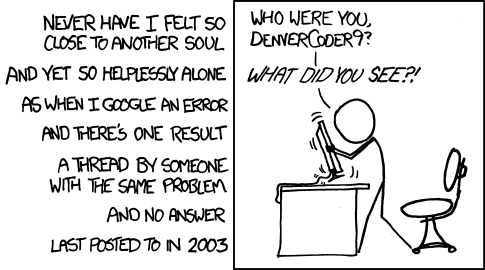
I saw the above XKCD comic, and thought about changing the text to: "Never have I felt so close to another soul and yet so helplessly alone as when I Google an ancestor and there's one result: a thread by someone with the same brick wall and no answer. Last posted to in 2003. Who where you, GeneaResearcher9? What have you learned?!"
Other Weekly Link Lists
- Megan Smolenyak Smolenyak at MSS Roots World has learned that the Social Security Administration has extended the FOIA restriction to 100 years.
- Chris Staats at Staat's Place compares microfilm images Scanned vs Printed
- Deb Ruth at Adventures in Genealogy shares how she has Connected on Find a Grave
- Rabbi Rachel Barenblat, The Velveteen Rabbi, recently wrote a Spiritual Will which may resonate with some family historians.
- James Tanner at Genealogy's Star in Can I Conserve My Own Pile of Documents?s?
- Lorine McGinnis Schulze at the Olive Tree Genealogy Blog in What Will You Do With Your Genealogy Research?
- Randy Seaver at Genea-Musings in Dear Randy: What are you going to do with your Genealogy-Stuff?
- National Archives to Release 1940 Census Free Online on April 2, 2012 (National Archives Press Releases)
- Digital Preservation Europe has released a series of humorous videos (hat/tip: UpFront with the NGS)
And a comic with which I identified.
I saw the above XKCD comic, and thought about changing the text to: "Never have I felt so close to another soul and yet so helplessly alone as when I Google an ancestor and there's one result: a thread by someone with the same brick wall and no answer. Last posted to in 2003. Who where you, GeneaResearcher9? What have you learned?!"
Other Weekly Link Lists
- Randy Seaver's Best of the Genea-Blogs at Genea-Musings
- Deb Ruth's Follow Friday Gems at Adventures in Genealogy
- Ruth Blair's Ruth's Recommendations at The Passionate Genealogist
- Julie Cahill Tarr's Friday Finds at GenBlog
- Megan Smolenyak Smolenyak's Genealogy Round Up at MSS's RootsWorld
Monday, November 14, 2011
Amanuensis Monday: Marriage License for Melvin Newmark and Belle Feinstein - May 1936
Amanuensis: A person employed to write what another dictates or to copy what has been written by another.
I continue my project to transcribe family letters, journals, newspaper articles, audiotapes, and other historical artifacts. Not only do the documents contain genealogical information, the words breathe life into kin - some I never met - others I see a time in their life before I knew them.
I began this project back in February of 2009, and since then, many others have joined in on the meme. Why do we transcribe? I provide my three reasons in the linked post. You may find others. If you participate, feel free to leave a link to your post in the comments.
***
This week I am transcribing the marriage license of my grandparents, Melvin Newmark and Belle Feinstein on May 9-10, 1936.
I continue my project to transcribe family letters, journals, newspaper articles, audiotapes, and other historical artifacts. Not only do the documents contain genealogical information, the words breathe life into kin - some I never met - others I see a time in their life before I knew them.
I began this project back in February of 2009, and since then, many others have joined in on the meme. Why do we transcribe? I provide my three reasons in the linked post. You may find others. If you participate, feel free to leave a link to your post in the comments.
***
This week I am transcribing the marriage license of my grandparents, Melvin Newmark and Belle Feinstein on May 9-10, 1936.
Sunday, November 13, 2011
Week In Review
Below are some highlights from news stories and blog posts I have read in the past week that deal with my overlapping interests in Genealogy, History, Heritage, and Technology.
Other Weekly Link Lists
- The National Genealogical Society announces the release of a new video: Becoming a Genealogist: My Father's Journey (an interview with Janet A. Alpert, CG)
- Thomas MacEntee at Destination: Austin Family recommends the revival of an old meme: Names, Places, and Most Wanted Faces.
- Michael John Neill at RootDig, reshares an article he wrote 11 years ago: The Third Grader's 1850 Census. His attempt to distract his daughter so he could get some work done failed miserably in its primary goal, but his daughter learned a lot in the process.
- Elyse Doerflinger at Elyse's Genealogy Blog describes her experiences discussing family with a pre-school class.
- Next American City discusses What Remains at the site of the infamous Pruitt-Igoe housing project in St. Louis.
- Craig Manson at GeneaBlogie suggests we Don't Cry About the SSDI even though as of November 1, 2011, SSA will no longer include state records in the Death Master File.
- Michael Hait at Planting the Seeds asks Does a "reasonably exhaustive search" include Online Family Trees?
- James Tanner at Genealogy's Star attempts to answer the question, Can I Use a Smartphone or a Camera to digitize photos?
- Eviatar Zerubavel at Salon asks Why Do We Care About Our Ancestors?
Other Weekly Link Lists
- Randy Seaver's Best of the Genea-Blogs at Genea-Musings
- Deb Ruth's Follow Friday Gems at Adventures in Genealogy
- Ruth Blair's Ruth's Recommendations at The Passionate Genealogist
- Julie Cahill Tarr's Friday Finds at GenBlog
- Liz Haigney Lynch's Links at The Ancestral Archaeologis
- Diane Haddad's Genealogy News Corral at Genealogy Inside
- Megan Smolenyak Smolenyak's Genealogy Round Up at MSS's RootsWorld
Subscribe to:
Posts (Atom)


 Posts
Posts