Showing posts with label Poland. Show all posts

Saturday, November 18, 2023

Solving the Blatyta Wajman (Blatt Wyman) Conundrum

I’ve written before about a conundrum between records uncovered and family lore in my Blatyta/Blatt line. I’ve uncovered a possible explanation behind the conundrum.

Family lore:

  • Morris Blatt (Moshe son of Jacob) and Belle Wyman were married in Łosice, Poland.  
  • They had two daughters: Blanche and Annie. 
  • Belle died of a bee sting in Poland, but likely after Morris and Belle had separated/divorced. 
  • Morris, Blanche, and Annie immigrated to America (St. Louis, Missouri). 
  • Morris married Mollie Kellner in St. Louis, and they had two more children. 
  • Blanche married Joe Wyman, and there were family jokes about whether she married a cousin.

Earlier Research:

Early in my research, I received well-cited research done by a cousin stating a Moshe (son of Yankiel) Blatyta married Chaia Beila Boksern in Losice. Yankiel is a common nickname for Jacob. When I uncovered the actual marriage record, it confirmed that this was the first marriage for both individuals.

How could Chaia Beila’s daughters be confused about their mother’s maiden name to the point that a family joke developed? Perhaps there were Wymans in her family tree, but there seemed to be some certainty that Belle was a Wyman herself. Could there be two Moshe sons of Jacob? We did not have birth records for Blanche or Anna. The records for their years of assumed birth do not appear to have survived. Even for years that records survived, the records are likely not complete.

Morris arrived in America in September 1889. In 1900 he, Blanche, Anna, his second wife, and their one son, are all living in St. Louis. (Morris and Mollie’s second child, a daughter, would be born in 1903.) Additional records uncovered there was a son of Morris and Molile who died as an infant in the intervening years.

Of course, there's an 11-year gap between 1889 and 1900. The missing 1890 census rears its ugly head.

Recent Research:

Recently I uncovered the immigration records for Blanche and Annie – in 1899. Ten years after their father. They were traveling under the Hebrew names of Breine and Chana, with Esther Winterman and her children, Yankel (Jacob), Abram, and Masche (Mary).
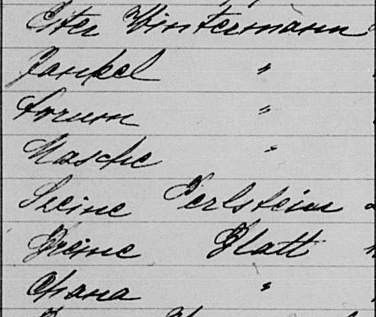

The manifest records them all as meeting a B. Winterman in St. Louis, with him identified as Esther’s husband, and the father of both the Winterman and Blatt children. In 1900 Esther and her children are living in St. Louis with Henry/Harry Winterman. (Confusion of first names isn’t impossible. Multiple names are common.)


We were familiar with the Winterman family. We knew them as some sort of Wyman cousins. We hadn’t yet identified how.

It’s possible if Morris and Belle really did separate as family lore suggests, the children remained with the mother. After Chaiia Bella died, it appears Blanche and Annie were raised by the Wintermans. So they could easily have viewed Esther as sort of a mother figure, even if they knew it wasn’t biological. 

According to her death certificate, Esther’s maiden name was Wyman. 
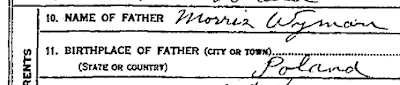

With the assistance of the cousin I mentioned in the first paragraph, we have uncovered Esther Wajman’s birth record in Polish archives, along with the birth records for two of her three children on the manifest. 

It isn’t difficult to hypothesize confusion – not on the maiden name of their mother – but a confusion of details between biological and adoptive mothers.

I still need to figure out how Esther Wyman Winterman and Chaia Beila Boksern Blatyta were related, if they were. But absent birth records for Blanche and Annie, I am more confident Chaia Beila was their mother. We may never be able to find those records, so we need to do the best we can with the records that have survived.

Sunday, August 22, 2021

Where my ancestors lived: Losice, Poland

I am writing a series of posts where I provide information about the towns where my ancestors lived. Geography is an essential part of genealogy and family history. We need to know where to look for records, and what we learn about the towns fills in information about how our ancestors may have lived.

My Blatt/Blatyta ancestors are from Losice. My second great grandfather, Morris Blatt, and his daughters Bryna/Blanche and Chana/Anna were likely born there.

Losice (Polish: Łosice; Russian: Lositsy; Yiddish: Loshits).

Province: Masovian Voivodeship / Lublin Voivodeship (before 1939)
GPS: 52.2113° N / 22.7185° E, 52°12'40" N / 22°43'6" E

Jews likely first settled in Losice at the end of the 17th century. On May 30, 1690 the Jewish cemetery was established - a privilege granted by King John III Sobieski. and also allowing Jews to settle in Łosice.

“In 1700, King August the Third [1696–1763] ordered the magistrates of Losice to carefully observe the dealings of Jewish merchants. The historical chronicler of the time reports that the magistrates aligned themselves with the Jews and did not bother them, but instead made things easier for them.”

The community numbered 654 (42% of the total population) in 1827, and 2,396 (71%) in 1897.

There is record of a pogrom in Losice in 1920. The community was liquidated 79 years ago on Aug. 22, 1942, when all the Jews of the town were deported to the Treblinka extermination camp.

Sources and Further Information:

1)Losice

2)Yizkor

3) Jewish Virtual Library

4) Shtetl.org.pl

5) IAJGS

6) Wikipedia

Wednesday, December 14, 2016

Moshe Blatt son of Jacob - Who did he marry?

The marriage document I shared last week was written in Old Russian. I received the below information from a translator:
  • Międzyrzec [Podlaski], Jul 25 1885, 6 p.m.
  • Witnesses: Sucher Rozencwejg (Isokher Rosenzweig), 57 yo, and Izrail (Isroel) Pizmanter, 36 yo, both Międzyrzec dwellers
  • religious ceremony was at 5 p.m., same day
  • groom: Moszko Jankiel (Moyshe Yakev) Blatyta, Łosice dweller, bachelor, 22 yo, son of Jankiel and Perla alive, spouses Blatyta who live in Łosice
  • bride: Chaja Bejla (Khaye Beyle) Boksern, Międzyrzec dweller, maiden, 16 yo, daughter of Chaim Erma (Khayem Irmye) and Ruchla Leja (Rokhl Leye) alive, spouses Boksern, she's living with her parents
***
  • So, are these my second great grandparents? A very good question.
I do know (from his tombstone) that my second great grandfather, Moshe (Morris) Blatt, was the son of a Yacov Blatt. (Yankiel is a Yiddish diminutive for Jacob). He is said to have been from Łosice.  Family lore also stated my second great grandmother was named Belle (or Bela) Wyman. When another Blatt/Blatyta researcher sent me their research several years ago, all I knew was what was in the Polish archives index, which didn't include the details above. One of Moshe Blatt's granddaughters recalled being told that her grandmother had a prior marriage. So it was reasonable to conclude that Belle Wyman could have married a Boksern before marrying my second great grandfather. But the details of the marriage document specify Chaia Beila Boksern was a 16 year old, and not previously married.
  • So could family lore be wrong about her surname?
My second great grandmother died in Poland. One of my second great grandfather's daughters married someone with the surname Wyman. There were family jokes about the possibility of his relationship to his deceased mother-in-law. And there weren't enough generations lapsing inbetween for much confusion. Surely Morris would have told his daughters the correct surname of their deceased mother?
  • Might there have been two Moshe Blatts, sons of Yacov Blatt, who married a woman named Belle/Bela, living in Losice? Sure.
My second great grandfather's death certificate states his date of birth was Sept 9, 1864. Informant, his second wife. Polish archives states Moshe Blatt, son of Yankiel and Perla, was born on May 1, 1862.

This also raised questions previously, but dates of birth can move around. For example, I know that my great grandfather's sister, Nelly Newmark, has documented dates of birth for both March 1889, and December 25, 1886. Without a birth record, it's unclear which is accurate. (Though I lean towards the earlier school record of Dec 25, 1886)
  • DNA tells me that I am related to the Blatyta family. In some fashion. So if they are separate people, my Moshe Blatt was related to that Moszko Blatyta. But I don't know how.

Monday, December 12, 2016

Oops, make that Russian

I've written several times about converting calendar dates from Julian to Gregorian, and how part of Poland switched from Gregorian to Julian in the 19th century under Russian control. (example).

So, since I knew that the Poland where my ancestors lived was under Russian control at the time, you would think when I discovered a 19th century marriage record in a Polish database, it would occur to me that there were multiple languages it could be written in? And that perhaps the most likely was not Polish.

Well, anyway, I've been informed that I need to find a Russian translator.

Friday, February 5, 2016

Riots and Rebellions: When is Violence the Answer?

Violence is never the answer to anything. - millions of people
  • The June Rebellion, also known as the Paris Uprising of 1832, was a failure. But without it, we wouldn't have one of the greatest novels and one of the greatest musicals of all-time. (Les Miserables)
  • The Warsaw Ghetto Uprising of 1943 was crushed. However, I'm not going to be the one to say that the Jewish community should have willingly and peacefully gone to their deaths.
  • There was a rebellion in the late 18th century in America that was quite successful, and another in the mid 19th century which wasn't.
  • Violent protests in the late 19th century led to the 40-hour work week, child labor laws, and safer working conditions for all.
Sometimes, in the course of human events, violence becomes necessary. In my opinion, with a government or society that is willing to listen, non-violence tends to work better. The key question becomes - how long do you wait before you decide that society isn't really willing to listen to you? And who gets to make that decision?

Have any of your ancestors or relatives participated in riots, rebellions, or revolutions?

Here's a list of "incidents of civil unrest" in the United States and another list from Colonial America.
Here's a worldwide list of riots and another worldwide list of revolutions and rebellions.

The difference between a riot and a rebellion can sometimes be a matter of who is writing the history. Some people argue riots are more spontaneous and don't have a unified purpose. However, participants in what society decides to call a 'riot' might argue with whether the event was spontaneous or without a cause.

Do I have kin who participated in civil unrest?

I will ignore late 20th century and more recent unrest, as I may or may not have relatives who participated, but if I did, they, or their close families, are still alive.

I've blogged before about my great grandmother's brother, who appears in some news reports related to the East St. Louis Race Riot of 1917. He wasn't a participant, but testified about the whereabouts of an employee who may have been.

An Elisha Horton is listed among the participants of the Boston Tea Party. He may or may not be related to my Horton ancestors.

Warsaw Ghetto, 1940-1943

When I discovered the Warsaw Ghetto Database, I knew I had to search for my Newmark surname. My Newmark ancestors left the Warsaw area in the 1880s, but were any of these ghetto residents related? If so, what were their roles in the uprising? The closest relation they could  be to me would be second cousins to my grandfather (assuming that my second great grandfather, Samuel Newmark, may have had some brothers in Warsaw.)

Entries for four Neumarks and three Najmarks appear, though there may be some duplicated individuals within them. The database provides details taken from various sources - some lengthy; some short. Some of the Polish has been translated into English already; some hasn't. I went in search of more information on some of the events mentioned. The information wasn't necessarily what I was hoping for - but the decisions ghetto residents had to make certainly weren't easy ones.
  • Lejbus Najmark - Judenrat
  • Stanislaw Najmark
    • Polish: starszy syn autorki , zastrzelony w związku ze sprawą Kotta
    • English: author's elder son, shot in connection with Kott's affair
  • Najmarkowa - [basically: Mrs. Najmark. -owa indicates a married woman] 
    • Polish: żona jednego z dyrektorów Zakładu Zaopatrywania; w getcie warszawskim działała społecznie - organizacja koncertów; w czasie akcji straciła matkę, jeden syn zginął w związku ze sprawą Kotta, drugi na wschodzie, mąż w czasie akcji styczniowej; przeszła na stronę aryjską po I akcji, ukrywała się na Saskiej Kępie; autorka relacji
    • English: wife of one of directors' of the Supply Section; in the Warsaw ghetto she was active socially - organised concerts; during an action she lost mother; one son died in connection with Kott's case, the other one in the East, husband during the January action; she crossed to the 'Aryan side' after the First Action, she hid in Saska Kepa; author of testimony.
  • Juliana (?) Neumark [This appears to be the same woman as Najmarkowa, providing a possible first name, and reinforcing that despite the different spelling, these are matching surnames. The Warsaw Ghetto Database doesn't yet have an English translation, but Google Translate provides a clumsy translation] 
    • Polish: żona Juliana; miała dwóch synów: jeden z synów zginął w styczniu 1940 roku w związku z aferą Kotta, a drugi syn w lutym 1940 roku przepadł podczas przechodzenia granicy sowiecko-niemieckiej pod Bełżcem; pracowała m.in. wraz z aktorem Turkowem w dziale oświaty; jako Elżbieta Kucharska schroniła się po stronie aryjskiej dzięki pomocy Gerarda Gadeyskiego, przedwojennego dyrektora programowego Polskiego Radia, który po wojnie został jej mężem; do niedawna pracowała w Towarzystwie im. Fryderyka Szopena; obecnie mieszka na Saskiej Kępie i jest na emeryturze."
    • English (Google Translate): wife, Juliana; had two sons: one of the sons died in January 1940 in connection with the scandal Kott, a second son in February 1940 was lost when passing the border of the Soviet-German at Belzec; she worked along with actor Turkow in the department of education; as Elizabeth Kucharska refuge on the Aryan side with the help of Gerard Gadeyskiego pre-war Polish Radio program director, who after the war became her husband; Until recently, she worked in the Society of them. Frederic Chopin; now lives in Saska Kepa and is retired.
      • Is it possible instead of Juliana, the Polish actually means: Wife of Julian?
  • Julian Neumark (Intelligentsia)
    • Polish:  serdeczny przyjaciel Jana Kucińskiego; naczelnik działu w Zakładzie Zaopatrywania Dzielnicy Żydowskiej; zginął w styczniu 1943 roku; miał dwóch synów: jeden z synów zginął w styczniu 1940 roku w związku z aferą Kotta, a drugi syn w lutym 1940 roku przepadł podczas przechodzenia granicy sowiecko-niemieckiej pod Bełżcem.
    • English (Google Translate): good friend John Kuciński; Head of department at the Department of Procurement Jewish Quarter; He died in January 1943; He had two sons: one of the sons died in January 1940 in connection with the scandal Kott, a second son in February 1940 was lost when passing the border of the Soviet-German at Belzec.
  • Regina Neumark - Activist; Collaborator of the CKI (Central Commission for Entertainments)
    • [source] "Finally, more resourceful musicians, supported by the Head of the Community, Adam Czerniaków, and his wife Dr Felicja Czerniaków, and Central Commission for Entertainments operating in the ghetto, decided to found the Jewish Symphonic Orchestra (ŻOS). It also had a moral aspect: it kept appearances of "normality”, met the spiritual needs of a vast number of music lovers, gave musicians a chance not only to get minimal resources, but also to remain in good musical condition. Many historians believe that the cultural activity was one of the forms of civil resistance, an activity in the teeth of the extermination actions of the occupier. It is, however, worth mentioning that from mid 1942 the people in ghettos had no idea of the planned extermination in the death camps (apparently they were being transferred to "work camps”) and they still had faith in the intervention of the allies and quick ending of the war."
    • The CKI set up concerts. The entry for Najmarkowa indicates she organized concerts. It's possible these are the same individuals. With the database information coming from multiple sources of testimony lots of redundancy is likely.
  • Wera Neumark - Artists/Writers; A pianist, plays in a concert in 'Gospoda' on 18 March 1942 - represents the old piano school.
Some activists; Some Judenrat. (Some Judenrat-connected activists) The Judenrat (or Jewish council) was set up by the Germans to administer the ghettos.
On the one hand, many viewed these councils as a form of collaboration with the enemy. Others saw these councils as a necessary evil, which would permit Jewish leadership a forum to negotiate for better treatment. In the many cases where Jewish leaders refused to volunteer to serve on the Judenrat, the Germans appointed Jews to serve on a random basis. Some Jews who had no prior history of leadership agreed to serve, hoping that it would improve their chances of survival. Many who served in the Judenrat were arrested, taken to labor camps, or hanged. 
This timeline provides some details on the events mentioned above.

January 1940 ["Kott Affair"]
1 - a decree comes into force forbidding Jews to change their place of residence without special permission.
14-25 - after the arrest of Andrzej Kott (who was of Jewish origin) belonging to the underground group PLAN and his escape from the gestapo, particular repressive measures are taken against the Jewish intelligentsia in Warsaw (255 Jews arrested). 
July 1942 ["First Action"]
22 - the beginning of the great deportation action in the Warsaw ghetto; transports leave from the Umschlagplatz for the gas chambers of Treblinka.
January 1943 ["January Action"]
9  - Himmler arrived for an inspection of the Warsaw ghetto; he ordered the deportation of 8,000 Jews and the evacuation of German enterprises to the Lublin area.
18-21  - the second deportation action in the Warsaw ghetto. The first armed resistance. The Germans deported c. 5,000 people. In January, just after the second deportation action, Józef Szeryński, the commander of the Jewish police, committed suicide.
More on the Kott Affair. [The Holocaust: A History of the Jews of Europe During the Second World War, Martin Gilbert, Macmillan, 1987.]


Saturday, January 3, 2015

Which calendar?

In order to properly record a date from a document, you might need to know some geographical history.

My paternal immigrant ancestors came from four different towns in the late 19th century.
  • The Cruvants came from Cekiske, Lithuania (near Kruvandai)
  • The Dudelczaks likely came from either Alexandria or Zhitomir, Volhynia
  • The Newmarks came from Warka, Poland (near Warsaw)
  • The Blatts came from Losice, Poland
What do all these communities have in common?

All were part of the Polish-Lithuanian Commonwealth, however, by the late 19th century, at the time my ancestors left, they were all part of the Russian Empire.

This is a crucial piece of knowledge for a genealogist. Why?

The Polish-Lithuanian Commonwealth was an early 16th century adopter of the Gregorian Calendar, however, the Russian Empire didn't switch to the Gregorian Calendar until 1918. So when the territory was under Russian control, the Julian calendar was used for official record keeping, and likely for everyday use.

This means the civil calendar (non-religious calendar) all of my paternal immigrant ancestors were used to, prior to immigration, was likely the Julian Calendar. So, after arriving in America, when my great grandparents wrote down on a document what their date of birth was - were they using a Julian or Gregorian date?

Your guess is as good as mine. It's possible that they made the 12-day adjustment when they immigrated to America. Or perhaps they didn't. I have to record both possible dates of birth.

My maternal ancestors immigrated from Transylvania, Germany, Holland, and England. The first three areas adopted the Gregorian calendar in the 16th century, and Great Britain and her colonies adopted it in 1752. I have several maternal ancestors who immigrated to America prior to 1752, and when I see dates for them, if the source doesn't specify, I can't be sure if they're Julian or Gregorian.

Steve Morse's website, popular among genealogists, has a Julian-Gregorian converter, and provides years each nation changed. However, one has to be careful with his table of years. For example, he says Poland went to the Gregorian Calendar in the 16th century, which is accurate. However, once it became Congress Poland in 1815, it was under Russian control. Documents would often have Julian or both Julian and Gregorian dates (source). He says Lithuania changed to Gregorian in 1918, which is also true, but between 1586 and 1800, it was Gregorian as well. I'm unsure if the Polish-Lithuanian Commonwealth is the only example of territory which switched back and forth.

Saturday, April 19, 2014

Two Poems for April 19th (Repost)

The Midnight Ride of William Dawes - by Helen F Moore (1896)

I am a wandering, bitter shade,
Never of me was a hero made;
Poets have never sung my praise,
Nobody crowned my brow with bays;
And if you ask me the fatal cause,
I answer only, “My name was Dawes.”

‘Tis all very well for the children to hear
Of the midnight ride of Paul Revere;
But why should my name be quite forgot,
Who rode as boldly and well, God wot?
Why should I ask? The reason is clear –
My name was Dawes and his Revere.

When the lights from the old North Church flashed out,
Paul Revere was waiting about,
But I was already on my way.
The shadows of night fell cold and gray
As I rode, with never a break or a pause;
But what was the use, when my name was Dawes!

History rings with his silvery name;
Closed to me are the portals of fame.
Had he been Dawes and I Revere,
No one had heard of him, I fear.
No one has heard of me because
He was Revere and I was Dawes.

***

Excerpt from Campo dei Fiori, by Czeslaw Milosz (1943)

I thought of the Campo dei Fiori
In Warsaw by the sky-carousel
One clear spring evening
To the strains of a carnival tune.
The bright melody drowned
The salvos from the ghetto wall,
And couples were flying
High in the cloudless sky.

(full poem)

April 19th is filled with historical events.

Many Americans think of the Battles of Lexington and Concord.  (Some erroneously place it on April 18th, but it was a midnight ride. The battles took place the next day.)

But this is also the anniversary of the Warsaw Ghetto Uprising in 1943. Last year's April edition of Tablet Magazine was devoted to Warsaw, including a haunting look at repurposed gravestones.

Note: According to this source William Dawes, who rode with Revere, was related to Henry L Dawes, for whom The Dawes Act was named.

Friday, April 19, 2013

Two Poems for Today - April 19


The Midnight Ride of William Dawes - by Helen F Moore (1896)

I am a wandering, bitter shade,
Never of me was a hero made;
Poets have never sung my praise,
Nobody crowned my brow with bays;
And if you ask me the fatal cause,
I answer only, “My name was Dawes.”

‘Tis all very well for the children to hear
Of the midnight ride of Paul Revere;
But why should my name be quite forgot,
Who rode as boldly and well, God wot?
Why should I ask? The reason is clear –
My name was Dawes and his Revere.

When the lights from the old North Church flashed out,
Paul Revere was waiting about,
But I was already on my way.
The shadows of night fell cold and gray
As I rode, with never a break or a pause;
But what was the use, when my name was Dawes!

History rings with his silvery name;
Closed to me are the portals of fame.
Had he been Dawes and I Revere,
No one had heard of him, I fear.
No one has heard of me because
He was Revere and I was Dawes.

***
Excerpt from Campo dei Fiori, by Czeslaw Milosz (1943)

I thought of the Campo dei Fiori
In Warsaw by the sky-carousel
One clear spring evening
To the strains of a carnival tune.
The bright melody drowned
The salvos from the ghetto wall,
And couples were flying
High in the cloudless sky.

(full poem)

April 19th is filled with historical events. 

Many Americans think of the Battles of Lexington and Concord.  (Some erroneously place it on April 18th, but it was a midnight ride. The battles took place the next day.)

But this is also the anniversary of the Warsaw Ghetto Uprising in 1943. The most recent edition of Tablet Magazine was devoted to Warsaw, including a haunting look at repurposed gravestones.

Note: According to this source William Dawes, who rode with Revere, was related to Henry L Dawes, for whom The Dawes Act was named.

Monday, April 19, 2010

Two Poems for Today - April 19

The Midnight Ride of William Dawes - by Helen F Moore (1896)

I am a wandering, bitter shade,
Never of me was a hero made;
Poets have never sung my praise,
Nobody crowned my brow with bays;
And if you ask me the fatal cause,
I answer only, “My name was Dawes.”

‘Tis all very well for the children to hear
Of the midnight ride of Paul Revere;
But why should my name be quite forgot,
Who rode as boldly and well, God wot?
Why should I ask? The reason is clear –
My name was Dawes and his Revere.

When the lights from the old North Church flashed out,
Paul Revere was waiting about,
But I was already on my way.
The shadows of night fell cold and gray
As I rode, with never a break or a pause;
But what was the use, when my name was Dawes!

History rings with his silvery name;
Closed to me are the portals of fame.
Had he been Dawes and I Revere,
No one had heard of him, I fear.
No one has heard of me because
He was Revere and I was Dawes.

***
Excerpt from Campo dei Fiori, by Czeslaw Milosz (1943)

I thought of the Campo dei Fiori
In Warsaw by the sky-carousel
One clear spring evening
To the strains of a carnival tune.
The bright melody drowned
The salvos from the ghetto wall,
And couples were flying
High in the cloudless sky.

(full poem)

April 19th is filled with historical events.  Many Americans think of the Battles of Lexington and Concord.  But this is also the anniversary of the Warsaw Ghetto Uprising in 1943.

Note: According to this source William Dawes, who rode with Revere, was related to Henry L Dawes, for whom The Dawes Act was named.

Friday, November 6, 2009

Poetry: Julian Ursin Niemcewicz - America and General Washington

My third and final entry for the Great American Local Poem Genealogy Challenge

The challenge is to:
Find a poem by a local poet, famous or obscure, from the region one of your ancestors lived in. It can be about an historical event, a legend, a person, or even about some place (like a river) or a local animal. [follow link for complete rules]
To recap:
Half of my maternal ancestry is Hungarian. My goal was to find a final poem for this challenge to represent my Polish ancestors - 75% of my paternal ancestry. But I found a Polish poet who was born in Lithuania, capturing the remaining 25%. Furthermore, he spent some time in Germany, where a few of my maternal ancestors originated. And he spent some time in America as well.

JULIAN URSIN NIEMCEWICZ (1758-1841), Polish scholar, poet and statesman, was born in 1757 in Lithuania. In the earlier part of his life he acted as adjutant to Kosciusko, was taken prisoner with him at the fatal battle of Maciejowice (1794), and shared his captivity at St Petersburg. On his release he travelled for some time in America, where he married. After the Congress of Vienna he was secretary of state and president of the constitutional committee in Poland, but in 1830—1831 he was again driven into exile. He died in Paris on the 21st of April 1841. [Source: Encyclopedia Britannica, 1911 edition]

Niemcewicz, scion of a moderately well-to-do Polish noble family, graduated from the Warsaw Corps of Cadets.

He subsequently served as aide to Adam Kazimierz Czartoryski and visited France, England and Italy.

During the Great Sejm of 1788–92, Niemcewicz was a deputy and an active member of the Patriotic Party that pushed through the historic Constitution of May 3, 1791. He subsequently was a founder of the Zgromadzenie Przyjaciół Konstytucji Rządowej (Assembly of Friends of the Government Constitution), formed to help support and implement that progressive document.

After the victory of the Targowica Confederation in 1792 and the consequent overthrow of the May 3 Constitution, Niemcewicz, along with other Patriotic Party members, emigrated to Germany. [Wikipedia entry]

And here's the poem. (Despite the title, it's as much about Poland and the events that led to Niemcewicz's exile. His life reminds me of the poet, Victor Hugo, for whom I created a website back in 2000.)

AMERICA AND GENERAL WASHINGTON

With my wounded commander* compelled to depart
From thee, oppressed Poland, the pride of my heart;
An asylum I sought o'er the dark rolling sea,
In the land of the noble, the brave and the free;
But e'en there the sad thought of my country would rise,
And the tears of deep anguish would roll from my eyes.

In boundless savannas, where man never strayed,
Amid woods that ne'er echoed the axe's keen blade:
In the foaming abyss, where the clouds of bright steam
Round the falls of the roaring Niagara gleam;
And on the deep sea, when the white sails are spread,
Lo! the shade of my country, all gory and dead.

Full of bliss to my heart is the thought of that day
When to Washington's mansion I wended my way;
To visit the warrior, the hero and sage,
Whose name is the day-star to each coming age;
By his valor the new world rose happy and free,
And her glory his endless memento shall be.

His features are still on my memory defined,
With the fadeless and delicate colors of mind.
Full, noble, majestic, with a crown of swan-hair.
And a brow deeply writ with the finger of care:
Old Roman simplicity marked his fine face,
Expressive of dignity, grandeur and grace.

How oft on his accents with rapture I hung,
While wisdom and kindness distill'd from his tongue;
And whene'er the sad tale of our fall I'd relate —
How brilliant our struggle, yet awful our fate —
A sweet tear-drop of sympathy stole down his cheek —
Better pledge of affection than language could speak.

Precious tear! a rich proof of his sorrow for thee,
Loved home of my fathers! once peaceful and free.
And oh, could I that gem which so peerlessly grows,
In some costly and beautiful crystal enclose,
So priceless a treasure a witness I'd keep,
That o'er Poland's sad ruin a great man could weep.

* General Kosciuszko

Source for poem: Poets and Poetry of Poland: a Collection of Polish Verse, 1881, p. 165. [It's not clear if the translation was done by the editor of the collection, Paul Soboleski, or someone else.]


Note: Further research on this author indicates he wrote some rather polemical works including "The Year 3333" and "Levi and Sara, or, the Jewish lovers" - which lead me to compare him to my distant cousin, Chief Magistrate William Stoughton, who presided over the Salem Witch Trials. While he represents a region where some ancestors originated, he doesn't represent those ancestors. (Except in foreshadowing what would happen a century after his death.) But while I am less fond of the man, I can attempt to separate the poem from its author. The patriotic imagery in the poem above is still very moving.

Sunday, April 19, 2009

Week #15 Genealogy Blogging Prompt

Week 15. List some vital signs. Talk about specific birth, marriage and death certificates. Topics may include misspelled names, fudged dates, other anomalies that stand out in your records.

What was my second great grandmother, Rose Newmark's maiden name? I've blogged about this conundrum before, but I thought I would share with you some of the confusing documentation.

Three birth certificates of her youngest children Kate, Cecile (Cissie) and Israel David (Buddy). All three born in England, though the family had originated in the town of Warka, in the province of Warsaw. (If the Declaration of Intents filed upon their arrival in the US are accurate. I might doubt it if they had written down Warsaw, as it is common that immigrants wrote down the large cities nearest to their origin. But they didn't.)

On Kate's birth certificate, her mother's maiden name is listed as Sankad

On Cecile's birth certificate her maiden name is 'Sonka'
On Israel David's birth certificate it is 'Sandgart'
Her husband, Samuel, was the informant for both of the daughters. Rose was the informant for Israel. One might assume she pronounced her name more clearly than her husband, though that is uncertain. Both were illiterate in English, as both signed their names with an X.

On her death certificate her maiden name was listed as 'Sundberg', and the informant was her son, Barney (my great grandfather). Her father's name is listed as Hirsch.

A search of the JewishGen databases (now also available at Ancestry) reveals three individuals named Cantkert (pronounced Tsantkert) in the 1907 Duma Voter Lists in the town of Warka, one of them named Hersz. It is conceivable her father was still alive in 1907. If born 30 years before Rose, he would still have only been 72 in 1907. Unfortunately, all the voter lists indicate is that he was over 25. However, since this family was residing in the same town I know Rose and her husband Samuel came from, and the surname would have been pronounced close to what ended up on her children's birth certificates, it is my best lead.

Thursday, April 3, 2008

Polish Suburbs

Back on March 17th I joked about my great-grandfather Barney growing up in a suburb of Dublin, Ireland, known as Warsaw.

A few minutes ago someone left a comment on that post that yielded an interesting discovery. The commenter had a grandfather who insisted the family came from Scotland. It turned out his family came from Schotland, a suburb of Danzig (Gdansk) Poland.

My great-grandfather didn't merely say the family was 'from' Dublin, Ireland but claimed to have attended school there. So this possibility of generational geographical confusion isn't enough to explain away his fibbing. However, it might provide an interesting source for the idea of the fib. So I started looking through towns of Poland just for kicks.

And I discovered: Deblin, Poland, just over 100km from Warsaw.


View Larger Map

I will certainly have to keep this possibility in mind.