It's a frustrating experience going through old photographs that aren't labeled on the back. Sometimes you can tell who people are from what else is in the picture, or who they are with. Sometimes you can make educated guesses, but those guesses can turn out wrong.
For example: There is a photograph from the wedding of my great-grandfather's brother, Harry Feinstein.
Family identified the four men standing next to him as his brothers. However, I knew this couldn't be the case as the youngest brother would have been 7 at the time of the wedding. Ultimately I found a newspaper article listing all the groomsmen and bridesmaids. I still can't for certain identify which is which, but I have a list. The newspaper article didn't identify the flower girls.
So what do you do when you find an image of an alleged relative online? Do you trust that the photo was identified correctly? The two images below are identified as Andrew David Van Every (1795-1873) and his wife Nancy Lucinda Van Sellas Van Every (1803-1880). They were my third great-grandparents. They would be the only third great-grandparents I have photographs of.
Photography existed in the 1860s and 1870s. And the photographs look contemporary to that era. I've contacted the individuals who posted these images online to see if they have more information - such as what year they were taken. But knowing how easy it is to misidentify a photograph, I hesitate adding these photographs to my collection with any certainty.
The archives are across the United States and Canada. You can search or browse for communities, and then choose from one or more libraries nearby.
The number of participating libraries varies widely by location. Iowa has 247 libraries participating. Canada has 3. Texas has 57. Missouri has 2.
You are unable to do a sitewide search. You have to go to each community archive separately and search there. However, I have already found newspaper articles I had not found on other newspaper archive websites.
Including this little blurb by a newspaper's editor praising my great-grandfather's honey.
It's also interesting to see that in 1905 there were already enough people choosing to have some food items shipped to them that the newspaper would address them.
The Hays County Time. July 28, 1905
The finest honey on the market, so far as we have observed, is that shipped here by Mr M E Van Every, of Maxwell. Here is another pointer for those who would "live at home."
I am back again with their ties to another slave. A historical one, that many Canadian schoolchildren might have been able to tell me about ten years ago if they read my posts.
Who was Chloe Cooley?
Chloe Cooley was a young black woman held as a slave in Fort Erie and Queenston, Upper Canada in the late 1700s, as the area was being settled by Loyalists from the United States. Her owner forced her into a boat to sell her in 1793 across the Niagara River in the United States.
This incident was observed by several witnesses, who petitioned the Executive Council of Upper Canada. Although charges were dropped against Cooley's owner, the incident is believed to have led to passage of the Act Against Slavery, 1793, in Upper Canada. It prevented slaves from being imported into the province and provided for gradual abolition of slavery within a generation among those held there.
Who was the Loyalist owner? Adam Vrooman. (Some sources give his name as William)
Geo Vanevery is almost certainly McGregory. No known son or close kin of McGregory was named George. McGregory is listed as one of the original 1782 settlers in the First Census of Niagara, 25th of August, 1782.
In that census there was one male slave, belonging to Thomas McMicken. That slave had been incorrectly assigned to McGregory by some researchers, which I clarified in Following the Citations in 2012. Vrooman isn’t in the original census, so he arrived between 1782 and 1784.
Why would Adam Vrooman and McGregory Vanevery share a lot?
Good question. I have a couple possible answers.
1) They were cousins. Or at least the families were close.
Looking at my family tree, it suggested a Sara Meyndertse married a Jacob Vrooman in the early 1700s. There was no specific date, and no source. It's continually frustrating that I wasn't very good at citing sources in early research.
Sara appears to be the great-granddaughter of Myndert Fredericksen. McGregory was the great-grandson of Myndert, so second cousins with Sara. His children would have been third cousins with any children of Sara and Jacob.
Wikitree says Adam’s parents were Jacob Vrooman and Rachel Van Woert. And that Jacob and Rachel were married in 1743.
Wikitree has no definite spouse of Sara Meyndertse, but questions whether she married Jacob Vrooman. If you look at the entry, you will see I added her entry in 2011. Since then someone has questioned her spouse. Did I make a mistake?
FamilySearch agrees with me, as does Ancestry, and they both cite New York Marriages, 1686-1980 for a 1742 marriage. So I have now added that as a source.
So there is a possibility there was a brief marriage between Sara and Jacob Vrooman, and that Jacob's children, including Adam, were not actually DNA cousins with my ancestors, though the families may have remained close. There is also a possibility there were two Adam Vroomans, marrying separate women.
2) There are also suggestions that Abigail VanEvery, daughter of McGregory married either a Peter Vrooman or an Isaac Vrooman. There are also suggestions that this Vrooman spouse died in 1782 in New York. I am not certain what Abigail and a possible child did at that time, but joining her father in Niagara is certainly a possibility. Possibly along with some Vrooman kin.
Back to the events of 1793.
There was growing sentiment in Canada to free slaves, and owners were deciding to sell before being forced to free. Vrooman arranged a sale across the Niagara River in New York. Cooley fought back.
Vrooman beat Cooley, tied her up and forced her into a small boat, aided by two other men. (Wikipedia entry above)
Who were the two other men?
Adam’s brother, Isaac, and one of the sons of McGregory Van Every. (Canadian Encyclopedia)
[Another Isaac]
Which son of McGregory? Every source I can find refers to the third individual in the same format. I suspect there is no document that specifically identifies him
Records suggest, when Adam arrived in Niagara, he had another slave named Tom. Even if Adam was the owner, if the lot was a partnership with my ancestor, and they had familial ties, my ancestor likely directly benefitted, and likely approved. McGregory died in 1786, but at least one of his sons was close enough with Adam Vrooman ten years later to provide his assistance in what Canadians call the Chloe Cooley Incident.
Amanuensis: A person employed to write what another dictates or to copy what has been written by another.
I continue my project to transcribe family letters, journals, newspaper articles, audiotapes, and other historical artifacts. Not only do the documents contain genealogical information, the words breathe life into kin - some I never met - others I see a time in their life before I knew them.
Below I transcribe an article found at Newspapers.com mentioning my maternal grandmother. It's very brief, but corroborates some photographs I have in my collection.
El Paso, Texas
28 Jun 1925, Sun
Page 13
Myrtle Van Every, formerly of El Paso and now of St Louis, is visiting her aunt Mrs. A.A.. Benold, of 908 Octavia street Last week Miss Van Every visited her sister at Fort Hancock. She will leave soon for California, stopping at the Grand Canyon. She will also go over the Canadian Rockies while she is away
Notes
1) Mrs. A. A. Benold (Minnie) was my grandmother's sister. Not her aunt. There were 16 years separating them in age. There were eight years separating my grandmother from her sister, Eva, who lived in Fort Hancock.
2) I have some photographs from the Grand Canyon. I do not know who her companion was.
3) I also have a photograph I believe is from California. While I suspected she was in Hollywood from the caption, the article confirms she went to California as part of the same trip. I don't know her companions here, either. However, I do know she had first cousins living in California, and there is a good chance these may have been them. (Her father was one of over 20 siblings. While not all lived to adulthood, she had a lot of cousins.)
I have written before about keeping track of what calendar is being used with my Eastern European ancestors, since some territory went back and forth between Julian and Gregorian depending upon changing government borders.
I was not aware that there was even greater confusion in North America. In general, one is told that the British colonies adopted the Gregorian calendar in 1752. And that is that. Of course, Britain was not the only one to have colonies in North America. The Netherlands were an early adopter of the Gregorian Calendar.
My ancestor, Myndert Frederickse (and his brother Carsten) were among the founders of the First Lutheran Church of Albany. In a history of the church (Swan of Albany, Henry H. Heins, 1976) there is a discussion about the calendar changes for the Hudson Valley.
1664 - The British annex New Netherland
It is difficult to ascertain the exact date of the British annexation of New Netherland beyond “late summer, 1664,” because at that time there was a difference of ten days between the calendar used by the Dutch and that used by the English. The Netherlands had already switched from the Julian (Old Style) to the Gregorian (New Style) calendar in 1583, while the English would not do so until 1752. Thus in 1664, the Dutch settlers’ calendars were ten days ahead of the ones used by their new government.
With Peter Stuyvesant’s surrender, therefore, the calendar went back to Old Style in the Hudson Valley, and the dates of the previous week or two were relived for a second time by the Lutherans and everyone else who was already there. (P. 15)
1673 - The Dutch retake the colony.
Since the Dutch naturally retook the colony with every intention of holding on to it, the restoration of the Dutch calendar (New Style) quickly resulted. The ten days that were added in 1664 were taken away again: anyone in New Orange or Willemstadt who had a birthday during the changeover lost it in 1673. (P. 20)
1674 - Less than a year later, the Dutch lost the colony again.
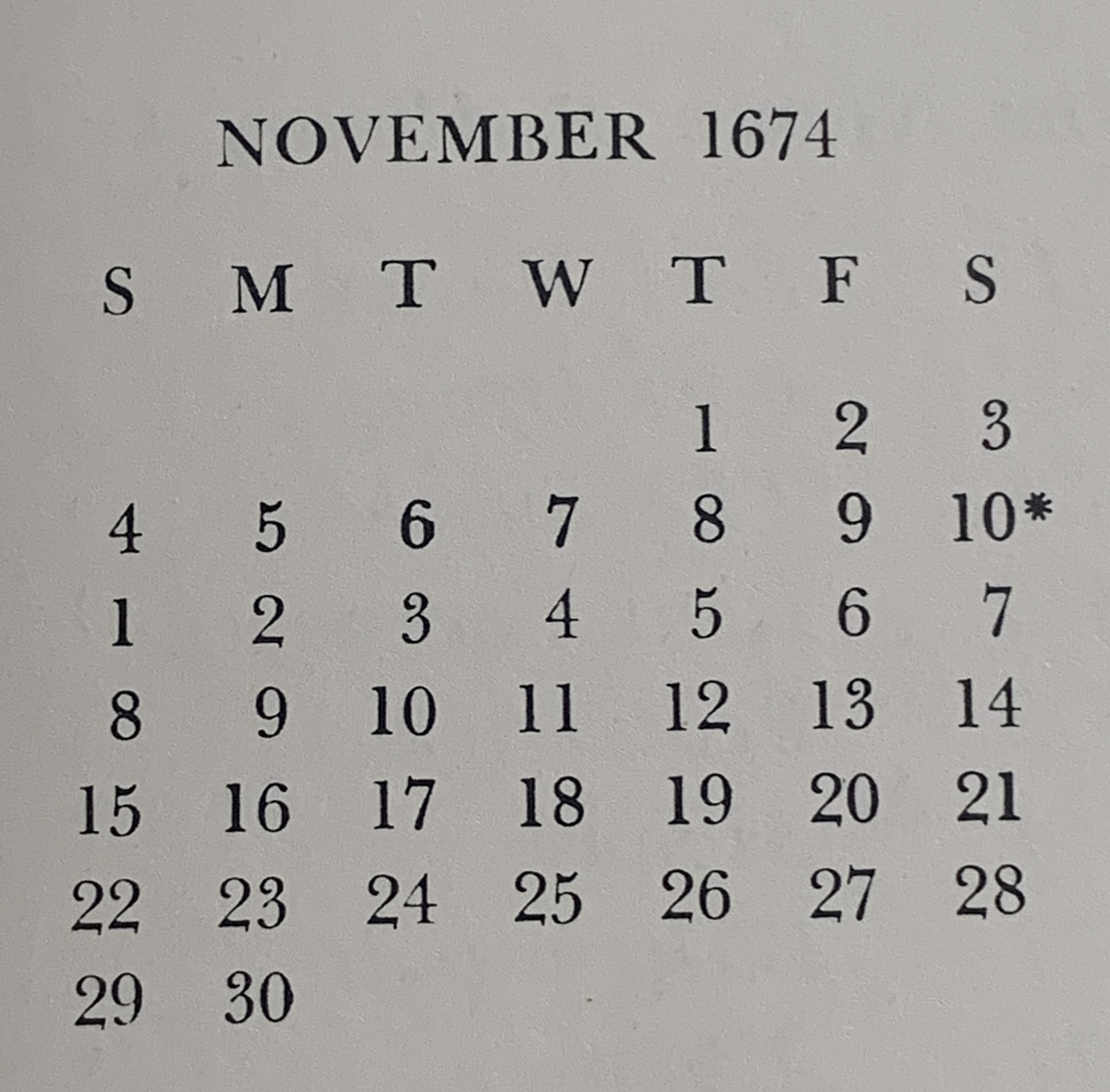
The days of the week were the same on both calendars, and the actual day of the changeover — October 31 (OS) November 10 (NS) was a Saturday. This made the transition easier, but it also meant, since the difference was not 14 but only 10 days, that the dates of the month which then had to be repeated fell on different days of the week than they had the first time around. Here is how the month of November was actually observed in the year 1674, as we have reconstructed the situation: (P. 21)
The author then explains that this was at the tail end of the Trinity season on the liturgical calendar. Apparently there are 27 readings for a potential 27 Sundays between Easter and Advent, though a 27th Sunday is rare. Unfortunately, Easter fell early in 1674, and a November with Six Sundays created a 28th Sunday before Advent. The author wonders whether the pastor preached the same sermon twice.
Any dates for events in this time period for the Dutch colonies need to be looked at carefully to ascertain what calendar is most likely being used.
My maternal grandmother, Myrtle Vanevery Deutsch, had her sister sign an affidavit of birth for her twice. In 1942, and again in 1945.
In 1942 my grandmother was living in Clayton, Missouri (part of St. Louis County). In 1945 she was in West Palm Beach, Florida. In 1945 my grandfather was returning to the states after serving in Africa and the Middle East during WWII. My grandmother took the kids to Florida to join him for the remainder of the war.
In 1942 my great aunt declared my grandmother was born on March 21, 1900. In 1945 she declared my grandmother was born on March 21, 1905. In both she states she was present at the birth. She provides several more details in 1942, such as the attending physician. In 1945 she simply states she was present. (I suspect she wasn't all too happy about filling out the affidavit in 1945, but was willing to do it for her sister. I suspect my grandmother was looking for a job and wanted to be five years younger.)
There is no question as to which is the correct affidavit. My grandmother is on the 1900 census, and is mentioned in the testimony given to the Dawes Commission in 1901 on the family's alleged Choctaw ancestry.
I have had a copy of the 1945 affidavit in my records for several years, having uncovered it in some folders at my parent's house over a decade ago. My parents gave me 20 boxes of family photos and documents this week, and in one I found the 1942 affidavit.
Update: I’ve been given another explanation for the second affidavit. My grandmother didn’t want anyone at the army base to know she was 7 years older than my grandfather.
St. George Baptist Cemetery, Brant County, Ontario
My third great grandfather
My only maternal Van Every ancestor who lived his entire life in Canada. His father, David Van Every, a United Empire Loyalist, fled the colonies after the Revolution. His son, Samuel Andrew Van Every, immigrated back to the United States.
A wife of his had written the following in July 1918
War Department Information Bureau Washington, DC Gentlemen: I was married to S.O Van Every, March 20, 1917 in Jacksonville Fla., my husband gave his age then as 28 but on June 5th of last year he very suddenly grew to be 32 he did not register for the draft ... Mr. Van Every deserted me last December in Little Rock Ark. when he went to Oroville Calif. and Martinez, Calif. and became engaged to another ... Mr. Van Every I learn has been married before he married me but had not a divorce. I would like to know where I stand...He is a native of Texas, his parents live in Fabens, Texas ... Before the war he was pro-German. Very Truly Mrs. SO Van Every
The FBI file also indicated that an agent visited the parents of my great uncle, and evidence was provided that Samuel was actually 32 years old. His wife had been the one lied to, and not the government, so the government was fine with that. The FBI apparently also wasn't interested in investigating the accusations of bigamy. (There was a war; their focus was elsewhere, perhaps.)
By 2010 I had answered most of my questions about the FBI file. With a few exceptions.
1) I had names, and dates of marriage for wife #1, and the author of the above letter, but no evidence of divorces
2) I had no name for the woman he allegedly became engaged to in 1918. And I didn't know if they actually got married. Half of that has changed.
Below is a timeline with the information I now have.
Jan 15, 1886 - Birth, San Marcos, Texas
Jan 22, 1906 - Marriage to Esther Dahlin, Travis, Texas
Aug 1, 1906 - Birth of Son, Everett Vanevery
June 1, 1910 - Divorce filed
1911-1916 - Marriage to Elsa/Elsie Diebel
1914-1917 - Death of Elsa/Elsie Diebel
Several un-sourced online family trees state the marriage occurred in 1916, and Elsa died in 1917.
There is a tombstone in Goliad, Texas, for an Elsa D. Vanevery, and it says she died on May 21, 1914.
Elsie's name appears in family history notes of one of Samuel's sisters, so I am sure she was at one time married to Samuel. I'm just not certain about the dates. If the tombstone is hers, the marriage obviously occurred prior to May 1914. My grandmother's first husband, Alfred "Jack" Connevey, was a boarder of the Diebels in the 1910 census, so I would like to find out more about Elsie.
March 20, 1917 - Marriage to Amy Johnston, Jacksonville, Duval, FL
April 14, 1918 - ex-wife Esther Dahlin marries Charles Haynie
June 4, 1918 - Engagement to Blanche Shuttler, Oroville, Texas (this is the newest information. Newspaper clippings below)
July 1918 - Amy Johnston writes to the War Department
Feb 1920 - Blanche Shuttler and "Mr. Van Every" are attendants at another wedding in Oakland, CA.
April 1, 1924 - son Everett drowns in Barton Creek, Travis, TX
1930 Census - Samuel is living in Kansas City, Missouri, and allegedly has a wife named, Myrtle. His sister, Myrtle (my grandmother) may have visited her brother enough that a landlord, or neighbor, may have provided inaccurate information.
Sept 18, 1933 - He is listed as a widow on his death certificate. The informant was my grandmother.
1) Enough time elapses between June of 1918 and Feb 1920 that it isn't clear if my great uncle married Blanche Shuttler, and then they divorced, or if they were never married. It is possible that the letter Amy Johnston Van Every wrote to the War Department stopped the marriage from happening. It does make me wonder whether Blanche and my great uncle remained friends, and how tense the situation was when they were both attendants at another wedding in 1920.
2) As to Amy Johnston Van Every’s charges of bigamy, if Elsa/Elsie Diebel died before Samuel married Amy, he appears to be exonerated. Which is the case, if the tombstone is for Elsa, which I suspect it is. Samuel was married twice before Amy; one marriage ended in divorce, and the other in death. The 1918 engagement doesn't appear to have been followed by a marriage. Unless there is yet another wife that I have not uncovered.
Amanuensis: A person employed to write what another dictates or to copy what has been written by another. I continue my project to transcribe family letters, journals, newspaper articles, audiotapes, and other historical artifacts. Not only do the documents contain genealogical information, the words breathe life into kin - some I never met - others I see a time in their life before I knew them. Today I transcribe two newspaper clippings. One my great grandfather's obituary from 1929, and a letter to the editor one of his daughters, Minnie Van Every Benold, wrote in 1965. Both discuss my great grandfather's role in growing cotton in the El Paso valley. El Paso Times, May 28, 1929, page 14
MELVIN E. VAN EVERY, 60, died at Garfield, N.M., Sunday. Services will be held at 4 o’clock this afternoon at the chapel of Kaster & Maxon the Rev. W. Angie Smith officiating. Burial will be in Evergreen cemetery.
Mr. Van Every was one of the pioneer residents of the lower valley and was engaged in cotton growing and ginning. He was the builder of the first cotton gin in the valley.
He is survived by his widow, Mrs. Josie Van Every, three daughters, Mrs. Minnie Benold and Mrs. I.T. Herrin, both of El Paso, and Miss Myrtle Van Every of Kansas City, Mo., also by one son, Dr. S.O. Van Every of Kansas City, Mo. Pallbearers will be selected from the W.O.W. of which he was a member.
El Paso Times, Feb 12, 1965, p.4.
Dear Mr. Hooten:
I have just read your request for information as to who raised the Valley’s first cotton. I think I know!
My father, M.E. Van Every “scouted” for good cotton land in 1917 from South Texas to California and bought land two miles below Fabens. There he cleared and ditched the land for irrigation in time to plant cotton for the spring of 1918.
Louis J. Ivey was his good friend and may have experimented before, but all had decided the summers were too short.
My father contended that some seasons were not and planted 11 acres, from which he harvested 14 bales, taking the cotton somewhere over in Texas for ginning. He then built a cotton gin in Fabens or Tornillo.
This set the Valley “on fire” and the farmers turned their alfalfa and wheat fields and orchards into cotton patches!
He sent letters and telegrams to us, begging us to move out, until we did in 1919 to take charge of my uncle’s farm who was to ill to farm.
This is the story of how our family came West.
That year we made enough on our cotton to buy a car and put $1,000 in the bank. Cotton was 39 cents a pound, the highest since the Civil War. I believe this to be the true story of cotton here.
Notes:
2) An obituary I previously transcribed from May 29th states he was 66. 66 is the correct age.
3) Minnie's letter clarifies that my great grandfather scouted out land in El Paso while his family remained in San Marcos, on the opposite side of Texas. Minnie, the eldest child, was 33 in 1917. His youngest child, my grandmother, Myrtle, was only 17 in 1917.
4) Minnie is the same great-aunt who wrote a series of letters to the Houston Post as a child for their HappyHammers children's section.
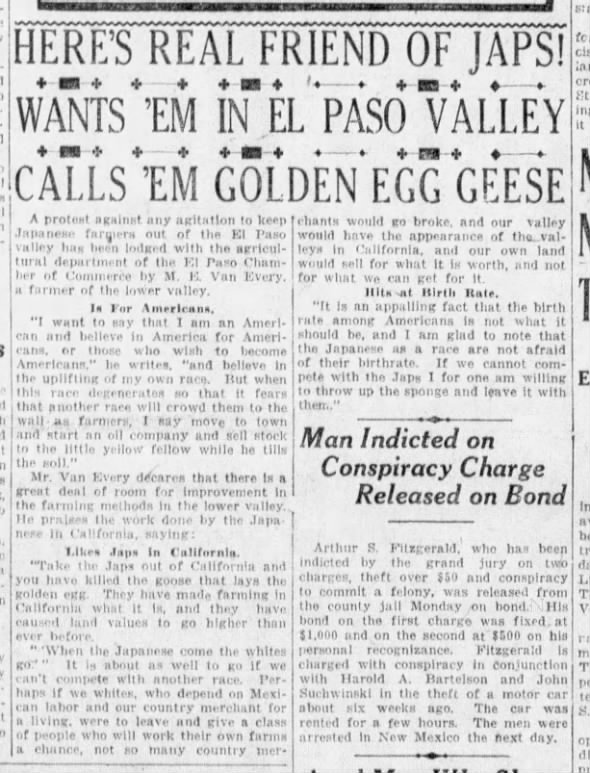
Amanuensis: A person employed to write what another dictates or to copy what has been written by another. I continue my project to transcribe family letters, journals, newspaper articles, audiotapes, and other historical artifacts. Not only do the documents contain genealogical information, the words breathe life into kin - some I never met - others I see a time in their life before I knew them. Today I transcribe a newspaper transcript of a protest my maternal grandmother's father lodged with the agricultural department of the El Paso Chamber of Commerce against any agitation to keep Japanese farmers out of the El Paso valley. It's not clear if the newspaper included the entire text of the protest. Some of the language makes me cringe, but giving some leeway for the year, I am glad my great grandfather didn't fall victim to the xenophobia of his times. Tue, Nov 18, 1919 – 8 · El Paso Times (El Paso, El Paso, Texas, United States of America) · Newspapers.com
HERE’S REAL FRIEND OF JAPS!
WANTS ‘EM IN EL PASO VALLEY
CALLS ‘EM GOLDEN EGG GEESE
A protest against any agitation to keep Japanese farmers out of the El Paso Valley has been lodged with the agricultural department of the El Paso Chamber of Commerce by M.E. Van Every, a farmer of the lower valley.
Is For Americans “I want to say that I am an American and believe in America for Americans, or those who wish to become Americans,” he writes, “and believe in the uplifting of my own race. But when this race degenerates so that it fears that another race will crowd them to the wall as farmers, I say move to town and start an oil company and sell stock to the little yellow fellow while he tills the soil.”
Mr. Van Every declares that there is a great deal of room for improvement in the farming methods in the lower valley. He praises the work done by the Japanese in California, saying:
Likes Japs in California
“Take the Japs out of California and you have killed the goose that lays the golden egg. They have made farming in California what it is, and they have caused land values to go higher than ever before.
“’When the Japanese come the whites go.’ It is about as well to go if we can’t compete with another race. Perhaps if we whites, who depend on Mexican labor and our country merchant for a living, were to leave and give a class of people who will work their own farms a chance, not so many country merchants would go broke, and our valley would have the appearance of the valleys in California, and our own land would sell for what it is worth, and not for what we can get for it.
Hits at Birth Rate.
“It is an appalling fact that the birth rate among Americans is not what it should be, and I am glad to note that the Japanese as a race are not afraid of their birthrate. If we cannot compete with the Japs I for one am willing to throw up the sponge and leave it with them.”
Amanuensis: A person employed to write what another dictates or to copy what has been written by another. I continue my project to transcribe family letters, journals, newspaper articles, audiotapes, and other historical artifacts. Not only do the documents contain genealogical information, the words breathe life into kin - some I never met - others I see a time in their life before I knew them. Today I transcribe a news article on the death of Everett Clarence VanEvery (1906-1924), the nephew of my maternal grandmother. Clipping found at Newspapers.com Wed, Apr 2, 1924 – Page 1 · The Austin American (Austin, Texas) · Newspapers.com
BOY DROWNS IN BARTON CREEK Everett VanEvery Victim Of Cramps Attack.
Everett VanEvery, 16, senior student in Austin high school, son of Mrs. Charles Haynie, 2108 Swisher street, met death by drowning Tuesday afternoon at 2 o'clock while swimming with comrades in Campbell's hole on Barton creek, about one mile above Barton Springs.
VanEvery was a member of a picnic party composed of senior high school students, which was being conducted at Barton Springs park.
Overcome by Cramps.
VanEvery and several companions went to Campbell's hole shortly after eating dinner and were in swimming when the unfortunate youth was overcome by cramps and sank to the bottom of a 15-foot hole. His companions made an effort to rescue him as he sank, but were unable to help him. They then hurried to Barton Springs for aid and after half an hour, VanEvery's body was brought to the surface by D. Hamilton, special officer at the municipal swimming resort, and M. C. Muckleroy and Abe Parks, high school students.
Lungmotor Fails.
An effort to revive VanEvery by means of a lungmotor rushed to the scene of the drowning by the Rosengren-Cook Undertaking establishment was made, but proved futile. Charles G. Haynie, barber, the youth's stepfather, made the call to the scene of the drowning with the Rosengren-Cook ambulance.
After efforts to revive the youth were abandoned, the body was carried to the home of his parents on Swisher street.
Funeral services will be held this afternoon at 3 o'clock at the home of young Van Every's grandmother, Mrs. A. M. Dahlin. 1703 Sabine street. At 3:30 o'clock services will be held at the Swedish Methodist church. The services will be conducted by Rev. K.G. Norberg.
Charles B. Cook will direct the funeral.
Active pallbearers are: Clifford Palmier, Joseph Rubenson, Louis Lindahl, Ernest Severine. Harold Laveen, Louis Sward.
Honorary pallbearers are: Henry McCallum, Dan Ward, William Deveraux. Albert Haynes. Gustave Watkins and Charles Lewis.
1) This goes into much greater detail of the incident than I have been able to uncover from his death certificate, previous newspaper articles, and family. There had been some question of whether he had drowned in Barton Creek, or in Deep Eddy Pool, which is in a community named after the creek. This article clarifies it was in the creek, or more specifically, Campbell's Hole.
2) I knew that Everett's mother had married Charles Haynie at some point before her death, since his name appears on her death certificate, but I didn't know it was before Everett's death.
Amanuensis: A person employed to write what another dictates or to copy what has been written by another. I continue my project to transcribe family letters, journals, newspaper articles, audiotapes, and other historical artifacts. Not only do the documents contain genealogical information, the words breathe life into kin - some I never met - others I see a time in their life before I knew them. Today I transcribe the obituary for my great grandfather, Melvin E. Van Every, which appeared in The El Paso Times, May 29, 1929. I found the obituary at Newspapers.com.
MELVIN E. VAN EVERY, 66, of Garfield, N.M. Funeral services were held from the chapel of Kaster and Maxon at 4 o'clock Tuesday afternoon with the Rev. W. Angie Smith officiating. Burial was in Evergreen cemetery. Pallbears were members of the W.O.W. Mr. Van Every is survived by his widow, three daughters, Mrs. Minnie Benold and Mrs. I.T. Herrin, both of El Paso, and Miss Myrtle Van Every of Kansas City, Mo., and one son, Dr. S.O. Van Every of Kansas City.
Notes:
1) I believe W.O.W. stands for Woodmen of the World, a fraternal benefit organization that provides life insurance for its members. From other sources I already knew my great grandfather was a Freemason.
2) My grandmother, Myrtle, appears in the St. Louis City directories every year between 1921 and 1930. It is possible, however, that she spent some time in Kansas City with her brother, as well. She appears in the St. Louis census in 1930, but her brother is listed as living with a woman named, Myrtle, in the Kansas City census. The woman is listed as a wife, but no record with her appearance after the census has been uncovered. I think it's possible my grandmother would occasionally visit her brother, and whoever provided the information for the census (a landlord perhaps) wasn't aware they were brother and sister.
Ockham's Razor is the problem-solving principle that, when presented with competing hypothetical answers to a problem, one should select the one that makes the fewest assumptions. The idea is attributed to William of Ockham (c. 1287–1347), who was an English Franciscan friar, scholastic philosopher, and theologian. (source)
Looking back, I know that I knew back then that Jack was a ubiquitous nickname that any man could use. I also knew back then that divorces take awhile between filing and finalization. How did I conclude there was another marriage in such a short span of time? My grandmother's marriage to Dale Bowlby Ridgely in 1927 only lasted three months, but her first marriage could have lasted longer.
I have found several pieces of evidence recently strongly suggesting Alfred Connevey was Jack.
From the 1919 El Paso City Directory. My grandmother is already using the address 'Miss,' even though she is still using the surname, Connevey. (It is interesting that Alfred Connevey is working at the same address, though for a different company. I am positive this is my grandmother, as she provided a letter of recommendation from China Palace to the St. Louis Post Office when she applied after her divorce was final in 1920.)
From the June 5, 1918 El Paso Herald - my grandmother is listed as Myrtle Connevey, and enrolling in the summer session of high school. She was 18 years old. I know from her application to the St. Louis Post Office that she had attended El Paso High School.
And the clincher: The 1910 Census record for a Jack Connevey residing as a boarder with a Diebel family. I am fairly certain Elsie Deibel was married to my grandmother's brother, Samuel O Van Every, for a period of time. I have not been able to find dates, however, an Elsa Diebel is listed as a wife in the family history notes left by one of my great grandfather's sisters.
This census record indicates that Jack Connevey was born in 1889. My grandmother was born in 1900. If they were married in 1918, he would have been 29, and my grandmother 18. There is a possibility the marriage may have been in 1917. If Jack was boarding with the Diebels in 1910, there is a question of the ages of him and my grandmother when they first met. My grandmother's brother, Samuel, was born in 1886.
Back in 2016 I blogged about the possibility of a Van Every Surname Non-Paternity Event. Several researchers have questioned the parentage of McGregor Van Every (1723-1786). One theory being Martin Van Iveren and an unnamed McGregor mother. One theory being a McGregor father and an unnamed Van Iveren/Vanevery mother.
Either way, there would be Van Every DNA in the descent, so the only way to prove the theories would be through a Y-surname test of a multitude of Van Every male descendants. Which I am not one.
Back in 2016 I noted that in all of my matches, I had 2nd cousins, 3rd cousins, 4th cousins, and 5th cousins, all sharing a Van Every common ancestor. Nothing higher than 5th cousins. All descendants of McGregor's son, David. If there was no Non-Paternity-Event, or even if there was, and one of the prevailing theories was true, one would expect more distant Van Every cousins.
A Shared Ancestor Hint popped up at AncestryDNA recently. (Excerpt below)
This provided a lot of excitement. Though I knew even with the two prevailing theories, I should have a match with someone descended from Martin Van Iveren. So even though our Family Trees matched up, it didn't prove anything. It was nice to see.
And then I checked the individual's Shared Matches.
As I said above, I have DNA matches who are 2nd through 5th cousins, all descended from David Van Every. Not one of them is a shared match with this individual.
Martin Van Iveren is in both of our online family trees. I think I am fairly sure that's not where our shared DNA resides. All of our shared matches have Eastern European Jewish DNA. That's the 75% of my ancestry that doesn't come from my maternal grandmother, Myrtle Van Every Deutsch. [It is fun to see a cousin from that 75% also has Van Iveren/Van Every ancestry.]
Which raises the question again. If neither I, nor any of my Van Every DNA cousins, share any Van Every DNA with this descendant of Martin Van Iveren...is it possible there was a Non-Paternity Event that completely broke the DNA trail. (Like an adoption?) It's certainly possible. Of course, the lack of evidence isn't proof of anything. It just continues to raise the question.
Several years ago I discovered the divorce complaint from my grandmother's second or third husband. The marriage lasted less than three months. I made the comment then that if my grandmother hadn't kept a copy of the complaint, it would never have occurred to me to look in California records for a marriage or divorce.
However, as records get digitized, such things matter less. The record to the left turned up for me on Ancestry this past week. It is the marriage license and certificate for my grandmother, Myrtle Vanevery, and her second husband, Dale Bowlby Ridgely.
It's a legible and quite detailed certificate, with names of parents for both bride and groom, as well as occupations for bride and groom.
I was most intrigued by the surname of the minister, and two witnesses. It matched my grandmother's. However, I was unfamiliar with these relatives.
Some quick research in Ancestry's family trees suggest that the minister, John M Vanevery, was the son of a John Vanevery and Louise Bartlett, and grandson of my third great grandparents, Andrew Vanevery and Nancy Lucinda Vansellas. (I'd have to do some research to truly verify the family trees, but it seems likely.) That would mean the minister was first cousins with the bride's father. The two witnesses were the minister's wife, Fanny, and their daughter, Irene.
I still suspect the marriage was in California primarily because the groom was stationed in the army in San Francisco, but my grandmother did have 'family' in the Bay Area. She returned to St. Louis after the marriage ended.
In an online family tree, I found two alleged photographs of my great grandfather, Melvin Van Every. I communicated with the owner of the tree, and the photographs came from his grandmother's collection, and she was a niece of my great-grandfather. I would normally consider that a good source of identification, but my great-grandfather had about twenty siblings. It would have been easy for a niece to get confused.
There are three photographs below. The one in the middle is a definite photograph of my great-grandfather, taken in 1900, shortly after the birth of his daughter, and my grandmother, Myrtle. (It was colorized in the 1940s, but I have the original photograph as well, which contained my grandmother as an infant.)
My inexpert opinion is that the individual in the oldest photograph isn't the same as the individual in the middle. The shape of the head is different. However, the ear, mouth, and nose look identical. If it were my great-grandfather, it would likely have been taken in 1883, at the time of his wedding, when he was 20.
I am much more willing to believe the man in the last picture is my great-grandfather. He lived until 1929, age 66. Visually, I'd guess the picture is from his final decade.
Amanuensis: A person employed to write what another dictates or to copy what has been written by another. I continue my project to transcribe family letters, journals, newspaper articles, audiotapes, and other historical artifacts. Not only do the documents contain genealogical information, the words breathe life into kin - some I never met - others I see a time in their life before I knew them. Below is a newspaper article mentioning my maternal great-grandfather, Melvin Van Every.
El Paso Herald – Nov 28, 1919, page 7. Cotton Growers Purchase Seed in Pecos Valley El Paso County Farmers Will Not Plant Seed Grown Here.
Farmers of El Paso County, who, according to reports from over the district and from implement men, are going to grow 10,000 acres of cotton next year, will not plant local seed. Instead, the 10,000 bushels of seed needed will be brought from the Pecos valley. The purchase will be financed by the State National bank, C.N. Bassett said Friday.
Local cotton seed will not be used, at the request of officials of the federal horticulture board. This request arises from the fact that the federal horticulture agents were unable to scout the field properly for pink boll worm. No evidence of pink boll worm has been found here, the agents say, but because of the proximity to the border, a source of infection, the farmers of the valley have agreed with the federal agents that no chances should be taken.
This year about 1500 acres of cotton were grown in the valley. About 1,500,000 pounds of seed was produced. This will be crushed by a local refinery. The farmers, in order to get the seed for the 8500 acres more which will be planted next year than this, will put up a guarantee of $1 or $1.50 a bushel an acre for what they will need. The committee will then buy the seed where it can, and sell it to the farmers at cost, making delivery within a few weeks. The probable cost of the seed will be $2 or more a bushel. The Lone Star variety will be bought.
L.J. Ivy and M.E. Van Every, of Tornillo, have been named on the committee of five to supervise the purchase and distribution of cotton seed. Roland Harwell, county farm agent, said Friday. A meeting will be held at Clint to discuss further plans for getting the seed. Three other members of the committee will be named within a few days.
The committee will leave next week to hunt the seed. Notes 1) Melvin and his family had moved to the El Paso area from San Marcos in 1917. It's nice to see references to the multiple businesses he had a hand in. Apparently, in addition to beekeeping, and a cheese creamery, my great grandfather grew cotton. (I'm sure he had other crops as well.)
Amanuensis: A person employed to write what another dictates or to copy what has been written by another. I continue my project to transcribe family letters, journals, newspaper articles, audiotapes, and other historical artifacts. Not only do the documents contain genealogical information, the words breathe life into kin - some I never met - others I see a time in their life before I knew them. This week I look at an article mentioning my maternal grandmother, Myrtle Van Every.
Mr. and Mrs. C.A. Dingley entertained the following in their home Sunday: Misses Kathryn Howerton and Myrtle Van Every of St. Louis, Britton Harridon of Marshalltown, Iowa and his boy friend, John Burch of Alton, Ill. On this event it happened to be Miss Myrtle’s birthday. At noon a sumptuous dinner was served to the guests and the afternoon was spent in a jolly good way. Here is wishing this young lady many more such happy occasions.
The Bland Courier, Bland, Gasconade County, Missouri, April 26, 1934, page 1.
Notes:
1. My grandmother was born on March 21, almost a month prior to this article being printed. March 21, 1934, was a Wednesday. It is certainly possible that my grandmother's birthday was being observed by her friends a few weeks late. Or the newspaper may have made a mistake, and it was Miss Kathryn who was celebrating. However, my best guess for the correct Miss Kathryn Howerton, a Kathryn Howerton Bogard (1906-1997), celebrated her birthday on Feb 14.
2. This is clearly a married couple hosting either two friends and their dates, or four single friends, in their home. However, the text would definitely be phrased a bit differently today. One has to be careful when reading old newspaper articles to interpret the language as it would have been interpreted then.
3. I do not know if my grandmother was 'with' Britton Harridon, or John Burch, or how long that association lasted. My maternal grandfather would transfer to the St. Louis Post Office Division Headquarters in June 1934, and Myrtle would transfer there in July 1935, and they would marry in December of 1936.
Amanuensis: A person employed to write what another dictates or to copy what has been written by another. I continue my project to transcribe family letters, journals, newspaper articles, audiotapes, and other historical artifacts. Not only do the documents contain genealogical information, the words breathe life into kin - some I never met - others I see a time in their life before I knew them.
This week I look at several reports in industry journals about my great grandfather's creamery business in Berclair, Texas - and a possible second location in Beeville.
Manufactured Milk Products Journal, Vol 5, 1914, p. 310
Berclair, Tex. – What perhaps is the only institution of the kind in Texas began operations here this week. Mr. M. E. Vanevery, one of the most extensive apiarists in the state, has completed the erection of a creamery for the manufacture of cheese and the product turned out compares favorably with that shipped in from the North. The plant is equipped with silos and the ensilage has proven a success as a milk producer. The plant is located about two miles from town and is attracting much attention.
The Milk Dealer, Volume 4, 1914, p. 47.
Berclair, Tex. – Mr. M. E. Vanevery has in view the erection of an ice cream factory in connection with his cheese factory.
The National Provisioner, Volume 52, April 17, 1915, p. 20
The erection of a cheese factory at Beeville, Tex., is planned by M.E. Vanevery, of Berclair, Tex.
Texas Trade Review and Industrial Record, Volume 20, April 15, 1915, p. 114
Beeville, Tex – M.E. Vanevery, Berclair, Tex., plans removing his creamery plant to this city and greatly enlarging it.
The American Produce Review, Volume 40, April 21, 1915, p. 25
Beeville, Texas – M.E. Vanevery, of Berclair, who is an experienced cheese manufacturer and who is now making and selling a first-class product in his small factory at Berclair, wants to locate in Beeville. Notes:
1. I found these clippings in a Google Books Search. The clipping from Manufactured Milk Products Journal is identical to what appeared in The Galveston Daily News on Nov 29, 1914. The other clippings concerning a second location in Beeville are a new discovery. It is unclear whether the plans came to fruition. My great-grandfather still had a beekeeping business in Berclair in 1916. They moved across the state to Fabens, Texas, near El Paso, in 1917, where he had a job as County Apiary Inspector.
The short novel (156 pages) concerns a woman, Marilee, who after retiring from a teaching career opens a Bed and Breakfast in Niagara with her husband. Marilee starts to have dreams, populated by ghosts, through which we learn what happened in the home during the early 19th century.
I discovered the book in a Google Books search for my Van Every ancestors, who happen to be the ghosts. (Actually, the ghosts aren't my ancestors, but close kin.)
Noticing that it was self-published, I decided to save a few dollars with the Kindle version. I knew I was buying a work of fiction. However, I was hoping to enjoy a story set in a time and location of interest, with some characters closely related to my ancestors. I wasn’t disappointed in that regard.
The initial pages where the protagonist is retiring from her career, and seeking to purchase a B&B, go by slowly. However, when the house is purchased, and Marilee starts to have the dreams, the pace picks up.
The point of view switches back and forth between Marilee and the ghosts in her dreams. I was most interested in the dreams, and the description of Marilee’s research into the history of the house. The sections of the novel where Marilee describes the day-to-day business of the bed and breakfast were of less interest, and I found myself skimming those paragraphs for more interesting material.
The author is a retired teacher, who operated a Bed and Breakfast for eight years in Niagara, and is now a realtor. While those sections of the novel are written from experience, perhaps the author put a little too much in. I'd rather she had focused on Niagaran history. However, someone with a passion for Beds and Breakfasts might feel different. There is a collection of recipes at the end of the book as well, which might interest some.
The author includes a short bibliography, for which I am grateful as well, indicating where she conducted her research on the family, time, and setting. Of the four sources listed, I've downloaded a free ebook of one, found a copy of another at a local library, and can purchase the third - though it is also searchable via Google Books. The fourth only appears to be available from the Canadian Archives.
While I enjoy reading historical fiction and have dabbled with writing fiction myself, the idea of fictionalizing the lives of my own ancestors troubles me. I don't think I could do it. I don't mind reading it, but I think I would be unable to write it.
Transylvania, Holland, Alsace, Poland, England, Germany, Lithuania and Texas all contain soil upon which ancestors dwelt; Farmers, beekeepers, shepherds, tailors, blacksmiths, salesmen, clergy, judges, and doctors.
As I research ancestral lines I discover some ancestors celebrated Hanuka, others Christmas, and still others the Green Corn Ceremony; Jewish, Methodist Episcopalian, Puritan, Christian Scientist, Mennonite, Choctaw, and Cherokee.
I shall never find the records for my distant ancestors who either came to this continent by crossing the Land Bridge, or originally emerged from the Nanih Waiya in Mississippi.
I delve through obituaries, microfilm depositories, internet databases; I interview relatives, and rummage through attics.
What I find doesn't alter who I am; It illuminates the divergent, yet still intersecting paths of my ancestors.






 Posts
Posts