Showing posts with label Carnival of Genealogy. Show all posts

Tuesday, January 31, 2012

Fifth Annual iGene Awards

The Carnival of Genealogy's Annual iGene Awards have returned - where Geneabloggers choose the Best of their Best posts from the past year in five categories: Best Comedy, Best Biography, Best Documentary, Best Screenplay, and Best Picture.

The TransylvanianDutch chapter of the Academy of Genealogy and Family History has participated in all prior years, and will do so again. For those who are nostalgic, here were our selections in 2011, 2010, 2009, and 2008 from the prior year's posts.

With no further ado, we will open the envelopes for 2012


Best Picture

For Best Picture, the winner is:  March 22nd, 2011 (which was posted on the 23rd)

The rules define this as a photograph, but a video is made up of a series of stills. And some videos this is more true of than others. We know the winning video has very little to do (directly) with our family history, past or future, however, other aspects of this post swayed us in our selection.

Runner Up:

Wordless Wednesday - Tel Aviv hotels, and postage stamps - 1944 was also nominated.   This post contained scanned images of several Tel Aviv business cards and postage stamps from the 1940s.  The war-time souvenirs were from my maternal grandfather's collection.

Best Screen Play (story you would make into a movie including the cast)

For Best Screen Play, the winner is: Dawes Commission Testimony

Readers may point out that some of these posts were prior to 2011, however, it seems appropriate that the series of posts win an award for the year of completion.  I've indicated the year of each post below, and five of them were in 2011.

Dawes Commission Testimony - Samuel T Hartley - Nov 21, 1900 (2009)
Dawes Commission Testimony - Robert Hartley - Nov 21, 1900 (2011)
Dawes Commission Testimony - Virginia Hartley Shultz - Nov 21, 1900 (2011)
Dawes Commission Testimony - Sophronia Hartley Cagle - Nov 21, 1900 (2011)
Dawes Commission Testimony - Melvin Elijah Van Every – Nov 21, 1900 (2009)
Dawes Commission Testimony - Samuel W Denyer - Nov 21, 1900   (2011)
Dawes Commission Testimony - Caroline Hartley Taylor - Nov 26, 1900 (2011)
Dawes Commission Testimony - Eliza Caroline Foster Reeves – Nov 26, 1900 (2009)
Dawes Commission Testimony - Georgia Hartley Phillips – June 17, 1902 (2009)
Dawes Commission Testimony - Samuel T Hartley – June 17, 1902 (2009)
The Dawes Commission Decision - July 11, 1902 (2010)

Casting: The Dawes Commission judges made a point that none of those testifying 'looked Choctaw."  However, I have no photographs of any of them, except my great grandfather, Melvin Elijah Van Every.

My first choice for casting Samuel T Hartley will be Morgan Freeman.  My second choice will be Leonard Nimoy.  My third choice will be Kirk Douglas.  None of them appear Choctaw, so they fit the requirements. (How Samuel T Hartley, who fought for the Confederacy, would feel about some of those casting suggestions doesn't matter to me.  He's not my ancestor.)

For Samuel's four daughters: Sophronia, Virginia, Georgia, and Caroline, I'd like to cast Drew Barrymore, Natalie Portman, Mayim Bialik, and Soleil Moon Frye.  Don't ask me why, but I think they'd make excellent sisters.

Perhaps Leo DiCaprio could play the role of my great grandfather, and Macaulay Culkin could be Robert Hartley.  Jewel Staite can complete the main cast members as Eliza Foster Reeves.

Best Documentary (investigative research)

For Best Documentary, the winner is: Civilian Occupation Codes: What's Going On?

This series of posts began with the discovery that Ancestry had changed the occupation for my great uncle on his Army Enlistment record, sometime after 2007 when I first obtained the record.  I conducted some research, and realized several other members of my family had had their occupations changed.  I identified the cause: Two different lists of Occupation Codes.  In my final post, I linked to the report from the National Archives indicating that the original Occupation Codes were in error.  It was dated in 2005, two years prior to when I initially obtained the records from Ancestry.  I still don't know when Ancestry updated their records.

Runner-up

Also receiving a nomination is: 1942 Tax Returns - a post where I looked at my grandparents' tax returns and calculated how salaries, and deductions compared to today.

Best Biography

The winner for Best Biography goes to: 

Judson Van Every - Manchester Journal - 1902 - 1910 and Judson Van Every - Manchester Journal - 1915-1917.

These two posts contained newspaper clippings from the Manchester Journal (OK) concerning my great grandfather's brother, Judson Van Every.  The clippings reveal a lot about the 15 years of his life. 

Best Comedy

The winner for Best Comedy is: Missouri Sheriff has a Mule Problem - the St. Louis Post Dispatch had a little fun at the expense of Sheriff Louis P. Gober of Scott County, Missouri (my fiancee's second great grandfather)

Runner-Up:

Also receiving a nomination was a poem I wrote: Genealogy Research
This ends the awards for the five main categories.  However, in 2010 and 2011 I added a category where  I present awards to show my gratitude to other Genea-Bloggers who commented upon, or in some other way responded to an entry, providing me with more information on my family.
Geneabloggers in a Supporting Role

This year this award goes to a blogger whose post spurred me to conduct some research for which I am grateful.

Philip of Blood and Frogs back in April posted a primer on finding and ordering US Naturalization Records.  While I already had the Declarations of Intent for most of my immigrant ancestors who arrived recently enough, I realized there were several other documents of which the National Archives might have copies.  The process led to the Naturalization Petition for Salomon Deutsch - my great grandfather - and the first name of his first daughter who remained in Transylvania, and likely died in the Holocaust.  The process also led to the Naturalization Petition for Barnet Newmark - another great grandfather - and a date for his arrival in St. Louis.

Thus concludes the Fifth Annual iGene Awards - TransylvanianDutch Chapter

Thursday, May 26, 2011

Carnival of Genealogy - 4th Annual Swimsuit Edition

It's time for 106th edition of the Carnival of Genealogy, and the theme is the 4th annual Swimsuit Edition.

I participated in 2008 and 2009, but missed participating last year.

This year I'm sharing a photograph of my grandfather, Melvin Newmark, about to jump off a dock.  The year is approximately 1930, and he's wearing a one-piece suit that was common for men in the era, but would be rare today.  The photograph comes from my grandmother's scrapbook, so I assume she was the photographer, though the photograph pre-dates their 1936 marriage.

I don't know the other individuals in the photograph.  The child in the background would be about the right age for my grandfather's younger brother, Mandell (born in 1923), though the kid in the picture appears to have slightly darker hair than other photos of Mandell I have at that age.  Though it could be a matter of lighting.


Friday, January 28, 2011

Fourth Annual TransylvanianDutch iGene Awards

The Carnival of Genealogy's Annual iGene Awards have returned - where geneabloggers choose the Best of their Best posts from the past year in five categories: Best Comedy, Best Biography, Best Documentary, Best Screenplay, and Best Picture. [It's just a coincidence that this theme occurs every year around the time the Academy of Motion Picture Arts and Sciences hands out its awards.]

The TransylvanianDutch chapter of the Academy of Genealogy and Family History has participated in all prior years, and will do so again. For those who are nostalgic, here were our selections in 2010, 2009, and 2008 from the prior year's posts.

Fourth Annual TransylvanianDutch iGene Awards

Best Comedy

Winner - Genealogy Shocker - Lucille Ball married Her Grandson

On April 1, 2010 I proved that Lucille Ball was the grandmother of her husband, Desi Arnaz by using Ancestry's OneWorldTree.  Which every genealogy researcher knows is extremely trustworthy. 

Other Nominees

The Chicago Key Puncher's Finish - A poem written by the prolific author, Anonymous, and discovered in my grandmother's collection.

When Traditional Methods Fail - I discovered someone online offering to conduct what could be described as slightly untraditional genealogical research.  It involves crystal spheres.


Best Biography

Winner - A Tale of Two Grandmas - I created a joint timeline for both of my grandmothers, allowing me to see similarities and differences in their life journeys.

Other Nominees

Ode to Sarah Hartley Denyer Foster - A poem I wrote concerning a great great grandmother.

The Labors of Hercules - a post concerning my discovery that my 8th great grandfather owned a slave, and the information I could find about that slave.

Best Screenplay 

Interview with Sissie Feinstein Newmark - December 1987

A transcription of an interview conducted with my paternal grandmother in 1987.  I divided it into ten minute segments, and there are seven posts in total.  I link to the first post above, and the rest can be found in my index of Amanuensis Monday posts.

Best Documentary

Interview with Melvin Lester Newmark - December 1987

A transcription of an interview conducted with my paternal grandfather in 1987.  I divided it into ten minute segments, and there are nine posts in total.  I link to the first post above, and the rest can be found in my index of Amanuensis Monday posts.

Did you really think I was going to choose one over the other for an award?

Best Picture

Winner

Van Every Children

A photograph taken circa 1894 of the four elder children of Melvin and Margaret (Denyer) Van Every.  Taken approximately six years prior to the birth of my maternal grandmother, Myrtle Van Every, it shows her older siblings Minnie, Sam, Willa and Evva.


Other Nominees

Ten Days Without Mail 

A postcard my maternal grandfather, Martin Deutsch, sent home during the war.  No one at his APO had received mail in ten days.  The artwork on the postcard illustrated how he felt.


Scrapbook Alternatives

In a post on alternatives to scrapbooking, I included this collage concerning the smoking habits of my paternal grandparents, and the result. In the comments it was suggested that this matches the intent of scrapbooking.  But there are no fancy backgrounds, and no need to cut up old photographs since it is all done with image editing software.

This ends the awards for the five main categories.  However, last year I came up with my own additional category. I plan to award it in any year there are nominees. 

Best Genea-Bloggers in a Supporting Role - I present awards to show my gratitude to other Genea-Bloggers who commented upon, or in some other way responded to an entry, providing me with more information on my family.


  • In February of 2010 I griped about my lack of success through RAOGK and  FindAGrave to obtain photographs of my great grandparents' tombstones.  John Frank of AncestryChronicles lived nearby the cemetery in Chicago and volunteered to take the photographs once the snow melted. 
  • In May of 2010 Sharon of KindredFootprints discovered some Van Everys in her family tree.  I was able to help her with some information on her cousin, and when she made a trip to Niagara, Ontario  she took some photographs of the Van Every plot at Warner Cemetery. 
  • In July of 2010 I discovered the will of Barnard Goldfinch at the UK National Archives.  I believed him to be my fifth great grandfather, but I was unable to decipher the will as the 18th century script was beyond my ken.  I did post the images though, and Martin Hollick of The Slovak Yankee, was able to transcribe the will using his experience with even earlier English script.

Wednesday, December 1, 2010

There's One in Every Family II: Home, sweet home!

Jasia needs more submissions for the 100th Carnival of Genealogy and another "One in Every Family" came to mind. There are more exceptions to this choice than the last, and at this time of year many churches, synagogues, schools, and fraternal organizations raise money and collect items for those families without. However, most families have a home.

I've shared photographs of several homes on this blog in the past.  Below is my great grandmother, Margaret (Denyer) Van Every in front of, I believe, the family home in Fabens, Texas (outside of El Paso). I'm fairly certain the year was between 1920-1923.


Below is my great uncle, Mandel Newmark, outside of his 'home' while serving during World War II.

However, I know from the war diary he kept he didn't consider that home.  Home was where he hoped to return, but never did.  Below is Mandel's mother, Bertha (Cruvant) Newmark, looking out the window of what I assume is the family home.  However, since I don't know the year, I don't know the address.


Several authors have attempted to define 'Home.'

"Home is the place where, when you have to go there, they have to take you in." -- Robert Frost wrote in "Death of a Hired Man"

Tess Slesinger wrote, "Home is where you hang your hat, and drop your skirt, my dear." (The Unpossessed, 1937) The proverbial "Home is where you hang your hat," may well date back further, but this is the earliest usage I have been able to find in an internet search.

Edgar Guest wrote:
It takes a heap o' livin' in a house t' make it home,
A heap o' sun an' shadder, an' ye sometimes have t' roam
Afore ye really 'preciate the things ye lef' behind,
An' hunger fer 'em somehow, with 'em allus on yer mind.
and John Howard Payne, in the opera "Clari, the Maid of Milan" (1823), wrote
MID PLEASURES and palaces though we may roam,
Be it ever so humble there's no place like home
A charm from the sky seems to hallow us there,
Which, seek through the world, is ne'er met with elsewhere.
Home! home! sweet, sweet home!
There 's no place like home!

Saturday, November 20, 2010

There's one in every family

"There's one in every family!" Bring your stories of colorful characters, unique heirlooms, mouth-watering recipes, most dearly beloved pets, whatever! Interpret as you like.
I knew I wanted to participate in this Carnival of Genealogy family reunion, but I pondered on what I would choose to write about. I don't like discussing living relatives, and while there are a handful of ancestors I could discuss under the topic of blacksheep, I'd rather not. However, the theme wasn't limited to people. Jasia specifically suggested family heirlooms, recipes, and other objects. I've discussed a couple of heirlooms before, and could think of a few more, but the topic didn't appeal greatly to me at this time. So I pondered some more. Something or someone every family has. After a few weeks of sorting through the possibilities, a new idea came to me. Something almost every family indeed does have. Most European nations began requiring them in the 18th and 19th centuries.

A family name (or surname)

Most of my personal experience with surnames comes from Western European culture, though I know other cultures handle surnames differently. The origins of surnames are sometimes sorted into five categories, which I have listed below, and provided examples from my ancestors. I looked up surname origins at both Ancestry  and the Surname Database.

1) Derived from a Given name (aka 'Patronymic')
  • My distant maternal ancestor, Myndert Fredericksen, and his brother, Carsten Fredericksen, were the sons of Frederick Van Iveren. (The children of Myndert and Carsten returned to the Van Iveren surname, or changed it to either Van Every or Van Avery.)
  • My paternal grandmother's original ancestral surname was Dudelczak. While the surname is possibly derived from the German bagpipe, Dudel is also Yiddish for "David." The odds are this surname was patronymic in origin.
2) Occupational Name
  • My maternal great grandmother's surname, Lichtman, is considered occupational for a chandler from the Yiddish 'likht' for 'candle.'
3) Location/Topographical
  • My surname, Newmark, likely is derived from the German/Polish area known as Newmarch.
  • My paternal great grandmother's surname, Cruvant, came from the Lithuanian town, Kruvandai.
  • My maternal grandmother's surname, Van Every, is likely derived from a Dutch or German town with a similar name -- though there is some debate over which town that is. (Possibilities include Everinghe, Holland and Jever, Germany.)
4) Nickname - names based on physical appearance, temperament, or personality
  • The surname Denyer is considered by many a nickname for a poor or insignificant man, from the name of a very small medieval coin, Middle English, Old French denier
  • The surname Lipman, as a Jewish surname, probably comes from the Yiddish for "Beloved man." (As a Dutch surname, it is thought to be a patronymic of the given name, Phillip.)
5) Ornamental Name - A name chosen by the family as an ornament.
  • My paternal grandmother's surname, Feinstein, means "fine stone." Selig Dudelczak adopted the surname upon his arrival in America.
  • My paternal great grandmother's surname "Blatt" is ornamental for most Jewish families, originating from the German and Yiddish word for "leaf." However, the non-Jewish German Blatt surname is considered to come from the German word "Blate" meaning a flat surface or plateau, and likely topographical.
  • My maternal great great grandmother's surname "Adler" means "Eagle." 

Thursday, November 4, 2010

The 99th Edition of the Carnival of Genealogy has been Released

with several discussions on how religious rites have impacted our family histories.

And not only has the theme for the 100th edition has been announced, CreativeGene has declared she wants at least 100 submissions from at least 100 past participants in the CoG. 
"There's one in every family!" Bring your stories of colorful characters, unique heirlooms, mouth-watering recipes, most dearly beloved pets, whatever! Interpret as you like. Every family has "special" individuals, you know, the ones with a green thumb, the black sheep, the lone wolf, the blue-ribbon cook, the story-teller, the geek! I know you have treasured recipes and amazing heirlooms you've yet to share! Tell us about them and become a part of history in the 100th edition of the Carnival of Genealogy! The deadline for submissions is December 1st.

Sunday, October 31, 2010

Religious Rites: Weddings

The topic for the 99th Carnival of Genealogy is:  
Religious Rites: Organized religion played a large part in many of our family histories. Virtually all religions have their rites/ceremonies. Has your family participated in any of these rites?
There were several things I considered discussing - or, in most cases, discussing again.  I've written a lot about how religion has intersected with my family history.  At the bottom of my blog's sidebar is a poem I wrote in 2008.  The second stanza:

As I research ancestral lines I discover
some ancestors celebrated Hanuka,
others Christmas, and still others
the Green Corn Ceremony;
Jewish, Methodist Episcopalian,
Puritan, Christian Scientist, Mennonite,
Choctaw, and Cherokee.

Weddings are perhaps the most joyous of all religious rites.  If my recollections are correct, across four decades I have attended twelve, including seven involving family members. I have had a role in several of them - I've read from a prayer book, been a chuppa (canopy) pole holder, witnessed a Ketubah (marriage contract), and was a groomsman more than once. The wedding location has usually been at a church or synagogue, but two have been held outdoors.  All twelve of the ceremonies reflected the religious beliefs of the bride and groom in some fashion.

As it is I suspect with most.  Perhaps, sometimes the ceremony reflects more the religious beliefs of the parents.  When there are differences, some will bow to the dictates of family harmony.  Most of my European Jewish immigrant ancestors were Orthodox in their faith, but their children moved towards Reform in the early 20th century.  For example, I know that my great grandparents Herman and Annie (Blatt) Feinstein were married by the Chief Orthodox Rabbi of St. Louis, but they raised their children at United Hebrew Temple, a Reform congregation.

My other paternal great grandparents, Barney and Bertha (Cruvant) Newmark raised their children in the Reform tradition as well, at B'nai El.  I haven't located their marriage certificate yet. (I believe they were married in East St. Louis)  However, I know the Cruvants were Orthodox, and I also know where Barney's older brother, Sol was married.

I wrote about his marriage to Sarah Nathan in a post three years ago. August 31, 1902. Sol and Sarah were married in the Great Synagogue of London, England.  Here's a copy of their marriage certificate, retrieved from the British General Register Office:

In the post I wrote three years ago I researched every name and other piece of information I could find on the certificate.  I won't detail everything I learned -- you can read the original post.

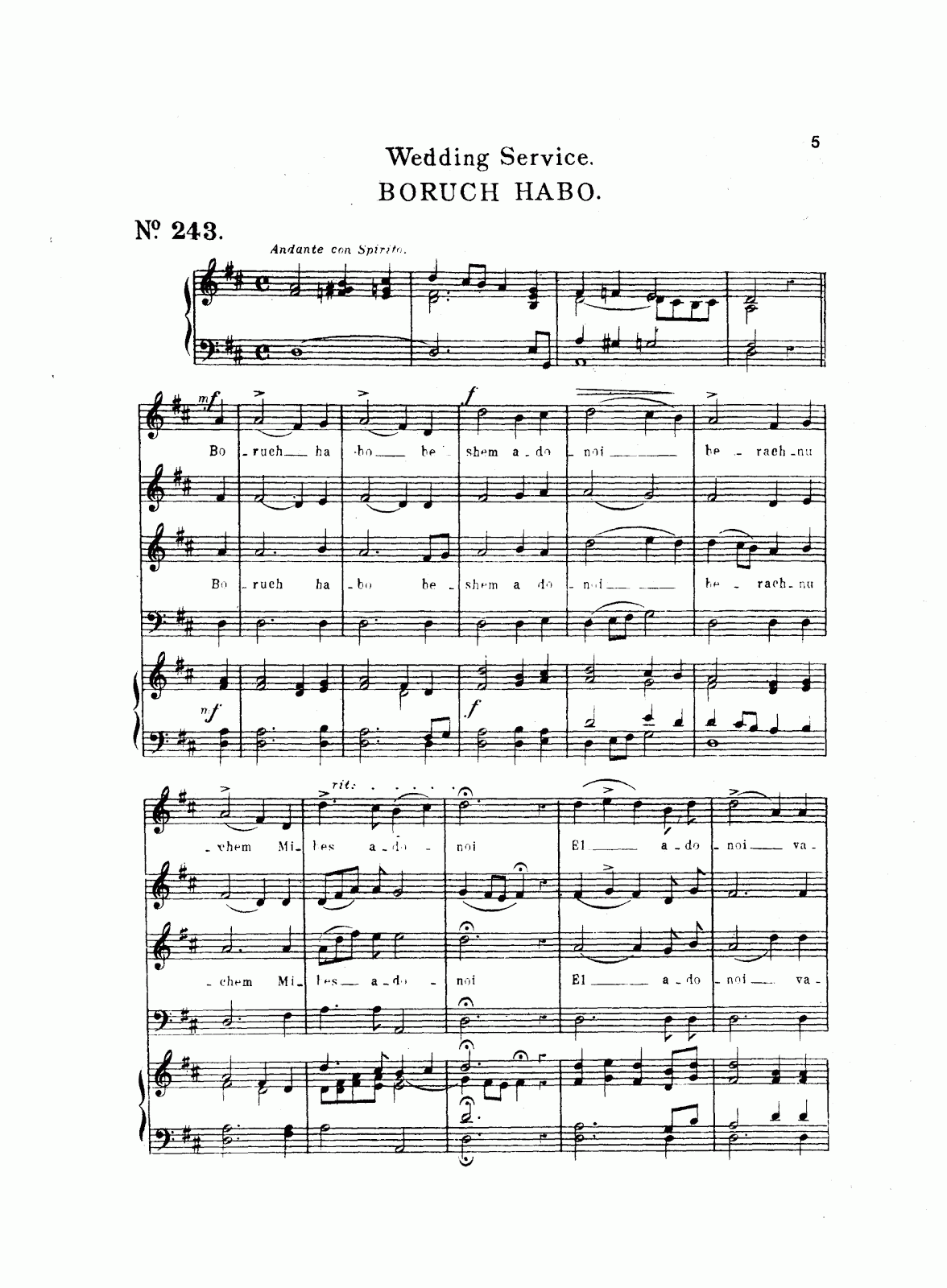
One of the signatures is that of the Cantor, or Hazzan, Marcus Hast.  He likely led the ceremony.  He was born in Warsaw, Poland, not far from where the Newmark family originated.  I believe Sol's parents may have been familiar with Hast while he was still in Poland.  In 2007 I wrote:
The scores of Hast's compositions are available for download, and there is a section devoted to wedding music, so the music that was likely played at the ceremony could be duplicated.
I provided the link, but the scores are in the public domain, so here they are for two traditional songs welcoming the bride and groom underneath the chuppa.


Translation of the lyrics for Mi Adir:

He who is mighty above all, He who is blessed above all, He who is great above all, He who is distingui​shed above all, may He bless the groom and the bride.

Monday, October 4, 2010

98th Carnival of Genealogy - Posted

The 98th Carnival of Genealogy has been posted by Jasia at CreativeGene.  Fourteen participants wrote about breaking down brick walls.

The theme for the 99th CoG will be: Religious Rites
Baptisms/Christenings, First Holy Communion, Confirmation, Bar/Bat Mitzvah, church weddings, anointings, ordinations, etc. Organized religion played a large part in many of our family histories. Virtually all religions have their rites/ceremonies. Has your family participated in any of these rites? Write about it and submit your article to the Carnival of Genealogy. The deadline for submissions will be November 1st. Thirty submissions will be accepted. 
More information at CreativeGene

Thursday, September 30, 2010

Breaking Down Brick Walls: Part Two

Part One

Two Mondays ago, I transcribed the decision letter written by The Dawes Commission concerning my Hartley ancestors.  This letter mentioned the parents of my second great grandmother, Sarah Hartley Denyer Foster, as provided in the testimony of her brother, Samuel:  George W Hartley and Eliza Beasley.  However, the letter also mentioned another possible mother - Ann Fisher.
It also appears that all of said applicants claim rights in the Choctaw lands under article fourteen of the treaty between the United States and the Choctaw Nation, concluded September twenty-seventh, eighteen hundred and thirty, by reason of being descendants of one George W. Hartley, and from Eliza Hartley (nee Beasley) (or Ann Hartley nee Fisher) who are alleged to have been three quarter blood Choctaw Indians and to have resided in Mississippi in eighteen hundred and thirty.
I said in my notes that followed the transcription I would devote a post to this conundrum.   I also said that Ann Fisher's name appears in only one other location in the documents I downloaded from Footnote for all eight related applications. A genealogy chart that appeared in Samuel T Hartley's application, but with no indication where/who it came from.  (click on the below images to see a larger version)


Samuel T. Hartley clearly states in his testimony that his mother was Eliza.

One assumption that could be made is that if there was a second mother for George Hartley's children, Ann Fisher was likely the mother of Sarah.  But that would be an assumption.  It's also possible Samuel may have said his mother was Eliza, but later admitted in some document I don't have, that his mother was actually Ann.  Or perhaps this chart was drawn up by the commission, and Ann's name got added there accidentally by some strange unknown series of events.

Is there any evidence that might support the theory that Sarah's mother was Ann?  Any evidence that might suggest otherwise?  Yes, and Yes.

1) Sarah's full name at birth, as far as family records are concerned, was Sarah Ann Hartley.  (circumstantial, but shouldn't be ignored.)
2) Sarah's second daughter was named Eliza.  (also circumstantial, but shouldn't be ignored either.)

3) One might ask who was the older child -- Samuel or Sarah -- and whether there is any evidence of which wife/mother came first.

Let's take a look at the evidence provided by the census.  The first census of any use is 1850.  (Prior to 1850, only the head of the household was named.)

1850  Census

In Houston County, Texas, there is an Eliza Hartley (32) living with two sons, Samuel (18)  and William (6).  They are in the same household as the family of  "Elijah and Margaret Wheeler."  Samuel claims in his testimony to have been born in 1830, so this isn't too far off.  However, there is no Sarah.

There is a Sarah Hartley (14), in another Houston County, Texas household.  Working as a farmhand for Hardey and Sarah Ware.  Her birth year would be 1836.

1854

Sarah Hartley married Ebenezer Denyer (I have a copy of the marriage certificate)  There are no ages given.

1860 Census

Sarah is recorded as age 32.  Her birth year would be 1828.  (Her brother Samuel is in the same household, and is recorded as age 26.  This is the only census where Samuel is recorded as a younger age than Sarah.)

1870 Census

Sarah is recorded as age 30.  Ten years later, and she's 2 years younger!  But because of her husband, I know she's the same woman.

1872: Ebenezer Denyer dies
1874: Sarah marries George W. Foster

1880 Census

Sarah is recorded as age 44, putting her birth year back to 1836.  Her daughter Eliza Caroline Foster Reeves testifies to the Dawes Commission that Sarah was 66 years old when she died in 1898, suggesting she was born in 1832.

While her exact birth year is open to question, I am fairly certain that Sarah was younger than her brother Samuel.  If that is their mother, Eliza (Beasley) Hartley in Houston County, Texas in 1850.  And if Ann Fisher and Eliza Beasley were both wives of George Hartley, that means Ann was the first wife.  Of course, either Ann or Eliza could have been a mistress.

So this conundrum isn't solved.  If Ann Fisher's appearance in the Dawes Commission documents isn't a mistake, she could be the mother of either Samuel or Sarah.  Since her name doesn't appear in any of the testimony, and I have no idea how her name got introduced into the documents, I have recorded Eliza Beasley as the mother of all three children (including the William who appears in the 1850 census), and relegated Ann Fisher to the notes section of my database until I learn more about her.

Breaking Down Brick Walls: Part One

The theme for the 98th Carnival of Genealogy is: "Document Analysis! Show us a document that helped you break down a brick wall on your family tree. Discuss the information that appears on the document and how it contributes to your family history."

The term "brick wall" can be used to define almost any barrier we arrive at in our research, but is often used in genealogy circles to describe those ancestors for whom we know nothing about their parents.  There might as well be a brick wall beyond this ancestor, because we can see nothing beyond them.  Since we don't know their parents, it usually means we also are uncertain about when they were born.

Every branch of every family tree reaches a brick wall ancestor.  (Note: I'm going to ignore any comments from people who claim to have traced a branch of their tree back to 'Adam.'  We likely have different standards of reliable 'evidence,' so there's no use even trying to have a discussion.)  As I said, every branch.  Every time a wall is broken down, we have two more brick walls, because everyone has two parents.  It's a hydra.  (Pedigree Collapse is the only thing that can decrease your number of brick wall ancestors.)

Using this definition of "brick wall," I, personally, have only managed to knock down parts of three on my family tree.  I have found the research of other genealogists online, and in libraries, that helped extend the generations my immediate family knew about.  However, I didn't break down these walls, someone else did before me; thankfully, they wrote the information down for me to find.  These walls are mostly on my maternal side, as my paternal brick walls mostly lay in countries where English is not the spoken language, and the online records are sparse.

One brick wall I may have knocked down half-way, is that of Jane Goldfinch.  As I blogged about in July, I found the will of a Barnard Goldfinch, who looks very likely to be Jane's father.  I still don't know her mother, though, so the wall isn't completely cleared away.

Here's what the will looks like:


And here's the transcription.

Another half-wall toppled does reside on my paternal branches.  My paternal great great grandfather Selig Dudelsack arrived in the US in 1890.  My family knew the name of his mother, Gertrude, or Gitel.  We believe her surname was, "Slupsky," though this hasn't been verified.

In this case, finding the name of Gitel's father was the most simple of my genealogical breakthroughs.  All it took was a trip to a cemetery.  Some documents are carved in stone.  It turned out Gitel made the trip to America with her son, and is buried next to him.


Translation of Hebrew: Gitel daughter of Reb Simcha Zelig died on the 16th of Av 5666. [August 6, 1906]

The tombstone doesn't provide a surname for the father.  The family came from Poland or Russia, and may not have had a surname until sometime between 1821 and 1844.  It's possible neither her father, nor Gitel, were born with one.

I did learn that Gitel named her son, Selig, after his grandfather. Selig's tombstone indicates his full Hebrew name was, "Simcha Zelig," too.


I will devote an entire post to the other wall I have chiseled away at.

Part Two

Thursday, February 18, 2010

The 90th Carnival of Genealogy is posted

Jasia has posted the 90th Carnival of Genealogy at CreativeGene.  Find out which posts participants chose for the Third Annual iGene Awards.

The theme for the 91st edition...
A Tribute to Women! March is women's history month and a great time to honor the women on our family trees.This is will be the 4th annual edition on this topic so we're going to change it up just a bit to keep it fresh... Write a biography about a woman on your family tree starting with a timeline of their life. The timeline can be a separate post that you link to from your biography (which can itself be a series of articles) but please just submit one post to the COG.
The deadline for submissions will be March 15th. Thirty submissions will be accepted.
 More information

Friday, February 5, 2010

Third Annual iGene Awards - TransylvanianDutch Chapter

The Third Annual iGene Awards, The Best of The Best! It's Academy awards time... time for the TransylvanianDutch Academy of Genealogy and Family History, aka AGFH, to honor our best blog posts of 2009 in the following 5 categories:
  • Best Picture - Best old family photo that appeared on our blog in 2009.
  • Best Screen Play - The family story we shared in 2009 which would make the best movie, along with suggested casting.
  • Best Documentary - Best informational article written about a place, thing, or event involving our family's history in 2009.
  • Best Biography - Best biographical article we wrote in 2009.
  • Best Comedy - Best funny story, poem, joke, photo, or video that we shared on our blog in 2009.

Best Picture

This was a difficult choice, but I picked Nellie and Barney Newmark in front of the London Dining Rooms. Barney was my great grandfather, and Nellie his sister. The Newmark family left London for America on two ships, the first in 1908 carried Barney, his brother Sol, and their father, Sam. The second in 1909 carried the rest of the family. This is the only photograph I have, so far, of my great grandfather prior to his arrival in the US. Along with this photo, I received a couple others of Nellie from one of her descendants.

Best Screenplay

Not only have I chosen the best screenplay, I already have part of the script. I am choosing my series of Amanuensis Monday posts transcribing the audiotape my grandfather, Martin Deutsch, and his siblings Ted and Berta created in 1977. The transcriptions start here.

I'm not familiar enough with the current child actors out there to pick any to play my grandfather or his siblings when they were young. Since the Deutsches were Hungarian, I'd like Theodore Bikel to play my grandfather in 1977, as he was the "Dialect Expert" in the musical "My Fair Lady." Eliza Doolittle referred to him as "The Hairy Hound from Budapest," in one of the musical numbers. He looks nothing like my grandfather, but accurate appearance isn't necessarily crucial.

Best Documentary

My choice for Best Documentary is July 2, 1917 - East St. Louis and the follow-up Return to the Race Riot. (The latter does cross the 2010 nominating line by 4 days, but it refers back to the original post.) -- These entries provide information on a deadly race riot that occurred in East St. Louis at a time when several of my Cruvant relatives were living in the area. One of them was peripherally involved.

Best Biography

For Best Biography I am choosing an entry I wrote about myself, under the theory that autobiographical memoir counts for this category. We're an Academy of One, anyway. I make the decisions.

The Meaning of Khanike -- I feel through this entry I reveal a little of the child I was at age eight, and a little of the adult I am now.

Best Comedy

Several good competitors in this category, however I chose my Xmas in July series of holiday postcards from the 1930s. Several individuals have commented to me that they were shocked at how risque they were. I think every generation believes they were the first to rebel against the 'moral standards' of society.

****

That wraps up the five main categories, but the TransylvanianDutch chapter of the Academy of Genealogy and Family History is adding one.

Best Genea-Blogger in a Supporting Role - I present an award to show my gratitude to another Genea-Blogger who commented upon, or in some other way responded to an entry, providing me with more information on my family.

And the award goes to Cynthia at ChicagoGenealogy who posted Chicago Births at Record Search: When the Index Doesn't Match the Record in response to my query What Was the Indexer Looking At? I noticed that the record index on FamilySearch had a different name than on the actual image of the birth certificate. Even stranger, I knew the index was correct -- and the birth certificate was wrong. Not only did she tell me that the missing document was a Certificate of Correction, she provided a copy of the certificate from the Family History Library microfilm.
My selections for the:

Saturday, January 30, 2010

Ode to Sarah Hartley Denyer Foster (1836-1898)

It's time for the 89th Carnival of Genealogy: Ode to My Family's History - Where we were challenged to compose a poem appropriate 'as an introduction for a book or video on your family history.'

Poetry is one of my passions, and I've posted a lot of poetry on this blog -- my own and others. Below are a few that pertain directly to my family history:
  • Ida (Denyer) Green wrote the poem Mother, about Zerelda Ann (Singleton) Denyer. Ida's father was the brother of my second great grandfather, Ebenezer Denyer. Ida spent some time living with her Uncle Ebenezer and Aunt Sarah (Hartley) Denyer after both her parents had died.
  • My maternal grandmother's sister, Willa Van Every, also wrote a poem called Mother, about my great grandmother, Margaret (Denyer) Van Every, and Willa also mentions several of her siblings.
  • I wrote Where I'm From - based on George Ella Lyon's Copy-Change template of the same name.
I've also written:
As soon as I heard the carnival theme, I knew I had to participate, even though any family history collections are likely a few years away from being written. I still have a lot of research to do. While I composed two odes, I am only going to share one of them. The other I am going to put aside for reasons of my own.

Ode to Sarah Hartley Denyer Foster (1836-1898)

she could tree a rabbit
catch a mess of fish
and raise a garden.

A granddaughter's description
of our shared ancestress,
a self-proclaimed Choctaw.

She married the son
of an itinerant minister
as the nation moved towards war.

Let's see if we too
can tree a few rabbits
as we pursue

the details of her life
and the lives of the children
she raised on her garden.

©2010 John C Newmark

Credits: Carnival Poster by footnoteMaven

Monday, January 18, 2010

88th Carnival of Genealogy Has Been Posted

Jasia at CreativeGene has posted the 88th Carnival of Genealogy . There were 17 submissions on the topic of Volunteerism.

The topic for the 89th Carnival was a pleasant surprise for me.
The topic for the next edition of the Carnival of Genealogy will be: Ode to My Family's History! This time around we'll be composing a poem that tells our family's history. It can be long or short, rhyme or not rhyme, funny or serious, illustrated or not... you choose, but make it appropriate as an introduction for a book or video on your family history. The challenge is on! The deadline for submissions is February 1st, 30 submissions accepted. [more info]
I could take the easy path, and post a poem I've already written. No one would know the difference (except for the few people who read this blog that are also members of my writer's group, and who might remember the poem I chose.)

However, I suspect even if this is a popular edition, I will have enough time to compose something new. Besides, the poem I've written that would best serve as an introduction for a book of family history has already been posted to this blog, and graces the sidebar if you scroll down far enough. It's time to write something new.

Thursday, January 7, 2010

Volunteerism

Volunteerism.

It’s something that ‘runs’ in the family for me. Especially where it merges with community service.

All four of my great grandfathers were members of fraternal organizations where community service was encouraged. Barney Newmark and Melvin Van Every were Masons, Herman Feinstein was also a Mason, but more specifically a Shriner, and Samuel Deutsch was a member of the Progressive Order of the West.

My great great grandfather, Selig Feinstein, was active in both the Chesed Shel Emeth Society and the Tiphereth Zion Talmud Torah Hebrew Free School. It appears he encouraged his children at young ages to help out – for example, his daughter Rose held lemonade stands to raise money for the Post Dispatch Pure Milk and Free Ice Fund.

I have been a member since 1992 of a local 'fraternal-type' organization active in community service. Not everyone looks at STARFLEET chapters the same as Masons or The Elks, but the activities are likely strikingly similar. I've answered phones at local telethons, donned clown makeup and walked for a local Children's charity, made sandwiches for a local homeless shelter, and participated in the Overseas Coupon Program, providing much needed assistance to service personnel overseas. Additionally my career is as a grant writer for a local non-profit. Though it’s no longer volunteerism when you get paid for it.

The upcoming edition of the Carnival of Genealogy is on Volunteerism with regard to Genealogy. In the spring and summer of 2008 I was briefly a volunteer at Random Acts of Genealogical Kindness. What is RAOGK? Why did I become involved? Why did I stop? Will I do it again? Excellent questions. Answers follow.

What is RAOGK?

Random Acts of Genealogical Kindness is a network of volunteers who have agreed to take photographs of tombstones, or look up obituaries or public records, charging only copy, and occasionally travel, fees. Often charging neither. The website divides all the volunteers by locality. In the United States, you first select a state, and then choose a county. (If you're looking for assistance with public records, don't neglect to look up the county where the state capitol is located. As someone might be willing to look up state records.)

Why Did I Become Involved?

After receiving some significant assistance through RAOGK, I naturally had the desire to return the favor. I looked at the St. Louis list of volunteers, and noticed that while there were several people offering to photograph tombstones, there was no one offering (at the time) to look up obituaries or public records. I submitted my name.

Why Did I Stop?

The requests came fast and furious. I was the only one, so everyone came to me. I had volunteered to look up not only obituaries, but also do simple searches in the extensive microfilm collection at the library. It wasn't long before I developed a backlog of requests. Swamped, I took my name down so I wouldn't get any more as I filled the ones I had. I didn't put my name back up.

Will I Do it Again?

Probably. I enjoyed doing it; it was just time consuming. Now that there are others doing it, I might be able to keep up with the requests. I might also restrict my services at first, perhaps only looking up obituaries, and see if the amount of requests I receive is manageable.

The St. Louis County Library staff will of course look up obituaries too (and other records)...and they charge only minimal fees.

Final Note

If you live in the St. Louis area, and are interested in joining the local chapter of STARFLEET, or would like more information, send me an email. Infinite Diversity in Infinite Combinations!

[Image is a modified World War I poster.]

Monday, January 4, 2010

87th Carnival of Genealogy has been posted

The 87th Carnival of Genealogy has been posted at CreativeGene with 65 submissions of New Year plans and resolutions. Jasia has also announced several changes to the structure of the carnival. I agree with her that the changes aren't major, and should actually improve the quality of the carnival.
The topic for the next edition of the Carnival of Genealogy is: Volunteerism! Here's a chance to toot your horn about whatever genealogy projects, organizations, or events you voluntarily give your time and efforts to. What do you get out of volunteering? How did you decide what to volunteer for? How much time each month do you spend volunteering for genealogy projects/organizations/events? Is there an organization or project you'd like to recommend to others? Tell us all about it! The deadline for submissions is January 15, 2010.
Visit CreativeGene for more information.

Thursday, December 31, 2009

2010 Genealogy Resolutions?


Image: HMS Resolution in a gale, by Willem van de Velde, the Younger, circa 1678
(source)
87th EDITION OF THE Carnival Of Genealogy
This year is almost over and a new decade is knocking on the door. This is the perfect time to make your New Year resolutions, goals, aims, declarations, intentions, aspirations, objectives, plans, targets, schemes, wishes, or whatever you want to call them!

This issue of the Carnival of Genealogy asks us for New Years Resolutions, or whatever we wish to call them. Do I have any?


I have no problem resolving to continue my pursuit of family history. At this point in the obsession, it's almost like resolving to continue to breathe. Though I have learned enough about this pursuit that I am unable to predict what I will achieve. So resolving to achieve some end is akin to setting myself up for failure. I will uncover information about ancestors near and far. Which ancestors those will be is not up to me.

At least not entirely. Setting research priorities tends to have an effect. If I'm not looking for something, it's less likely I will find it. (At least slightly.) Those priorities can, however, change depending upon what I uncover. They could change tomorrow. However, right now my highest priorities involve a handful of vital records that I know I *should* be able to find.

I similarly have no problem with resolving to continue to blog. I've been doing it steadily since 2002 and I see no signs of stoppage. If the internet crashes, I'm likely to find somewhere else to write down my thoughts. Though I enjoy sharing them with a wider audience, because I know I have been helped by suggestions I have read on other blogs, and hope to return in kind. So hopefully the internet won't crash.

What I will blog about is less certain. I definitely see my weekly Amanuensis Monday series continuing. My recent discovery of old newspaper articles has briefly sidetracked my transcription of audio tapes and my great uncle's war journal, but I have so much material, and have received a lot of positive feedback from relatives. Transcription is something entirely within my control, which is helpful when it comes to resolutions.

Sunday, December 13, 2009

Dear Genea-Santa

The below is written for the 86th Carnival of Genealogy

Dear Genea-Santa

You didn’t bring me anything I asked for last year. Not my great grandfather’s military uniform, not a bagpipe constructed or played by my Dudelsack ancestors, not my grandfather’s copy of Les Miserables, and none of the photographs I specified.

I thought I was a good boy, Santa. I remember sitting on your lap as a child and sharing my long lists with you. You always brought me at least one of those items.

Were you responsible for some of the things I did discover this year? If so, thanks!

What do I want this year? Well, I still want everything I asked for last year, but if that’s not possible here are a few more items:

1) There’s a lot of information I want to know. A lot of mysteries to solve. A lot of brick walls to break down. I was told last year to stick to material things, as opposed to clues to my family history. I wasn’t given that restriction this year. So if you could help me in just one of my quests, that would be much appreciated!

2) Now I've discovered photographs of my Newmark ancestors from when they were in London, I want more of them. So far I have my great grandfather Barney, and his sister Nellie. There were six other siblings, and two parents. I have photographs of the parents thirty years later, but I'd love to see them a bit younger. Maybe some photographs that were taken in 1902 at the wedding of Barney's brother, Sol?

3) The Van Every family bible. According to a letter my great grandfather, Melvin Van Every, wrote my grandmother, Myrtle, it was lost in 1925 during a move.

4) Finally, the computer I have is great, and the information on the internet is wonderful, but I want a computer system like Batman has. I think it might help me in my research. Thanks!

[Poster created by footnoteMaven]

Sunday, November 29, 2009

Orphans

The theme for the 85th issue of the Carnival of Genealogy: Orphans and Orphans
The first type of orphan refers to those ancestors or relatives who lost their parents when they were young. The second type of orphan would be those siblings or cousins of our ancestors whom we think of as “reverse orphans.” They are the relatives who, for whatever reason – death at a young age, never having married or had children, or having children who did not survive to provide descendants – have no direct descendants of their own, so it falls to us, their collateral relatives, to learn and write their story.
Orphans

When I think of orphans in my family tree, I think mainly about some Feinstein and some Denyer cousins.

1)

My great grandfather, Herman Feinstein, had a brother named Harry. Harry's wife, Dora (Servinsky) Feinstein, died in 1920, and Harry died in 1933. In 1933 their five children were ages 18, 22, 23, 25 and 27. Perhaps too old to be really considered orphans.

However, according to the 1930 census, three years earlier all five children were not living with their father, even though Harry was still alive. The three older siblings (Sidney, Adeline, and Alvin) were living in their Uncle Herman's home. With my grandmother and her two brothers there as well, the house may have been a bit crowded. Harry's youngest (Seymour) was in an orphanage. I haven't yet figured out where their fifth child, Willard, was residing in 1930.

Harry had four siblings with families of their own in 1930, besides my great grandfather (Ben, Pearl, Morris and Rose). Why none of them were able to take Seymour in, I'm not sure. Rose's children were age 1 and 3, and I can understand perhaps not being ready for a teenager. But the other three had children of the same or approximate age as Seymour.

A larger question is why all the children weren't living with their father. He had married a second wife, Grace, in 1928. I can make some assumptions from that, but I'd rather not. I realize we are talking about 1 year after the Crash of 1929, and the economy could explain why he was no longer able to care for his own children. It also could help explain why only one of his siblings felt able to help out.

2)

My great great grandfather, Ebenezer Denyer, had a brother named Samuel. Samuel Denyer died in 1861. His wife, Zarelda (Singleton) Denyer, died in 1867. In the 1870 census, four of their children (Amanda, Robert, Albert and Ida), ranging in age from 11 to 17, are living with their uncle Ebenezer. Ebenezer died in 1872, and while his wife, Sarah Ann (Hartley) Denyer, remarried in 1874, I'm not sure what happened to Samuel Denyer's children. The youngest child, Ida, wrote a poem about her mother.

Reverse Orphans

Here as well there are two instances which come immediately to mind. There are certainly many childless individuals in my family tree, however there are two for whom their life stories hold a greater interest. Both are great uncles -- siblings of grandparents.

1) Mandell Newmark

I've written several posts about the youngest brother of my grandfather, Melvin Newmark, and have recently posted some transcriptions from his war journal. I've long known he was killed in action during WWII, though I learned just this Thanksgiving that he died from friendly fire, or more accurately 'accidental discharge' from a war buddy's firearm. The second story of accidental discharge in my family tree -- though instead of children who discovered a gun when their father was away, this time we have a trained soldier.

2) Samuel (and Everett) Van Every

I've also written several posts about Uncle Sam, the brother of my maternal grandmother, Myrtle (Van Every) Deutsch. He had one son, Everett, who drowned at age 17.

Samuel was the only male child of my great grandfather, Melvin Van Every, to live past infancy. Though to say the family name died out is a stretch, as Melvin had 21 siblings, several of whom were male. And the Van Everys arrived in North America in the 1600s. There's a baseball player for the Boston Red Sox who I am certain I am related to in some fashion, as well as many others.

But there are no known descendants of my Uncle Sam and his son, Everett. I've recently learned some information from some relatives of Everett on his mother's side, which I will share in a future post.

The image in the upper left is from Eugene Delacroix's Young Orphan in the Cemetery (1824)

Saturday, November 14, 2009

Reflections on Being a Wheel in the CoG; or, The Wheel on the CoG goes Round and Round

I couldn’t decide which pun to use for my title, so I used both.

The theme for the 84th Carnival of Genealogy is: “What The CoG Means To Me”

Appearing twice a month, the 84th carnival marks 42 months, or 3.5 years. I first participated on June 29, 2007, for the 27th edition, What Independence Day Means to Me, with my post Independent Thinking. While I’d been blogging since 2002, I'd only been blogging for a few months on the topic of genealogy, and I was still using my all-purpose blog (which has experienced a sharp decline in usage over the past couple years.)

Since then, I have participated in 41 editions of the carnival. This will be my 42nd, so I will have participated in exactly half of them. Like many, I first started participating in the carnival so others would get to 'meet' me, and my blog. Along the way I have found that the assigned topics often lead me to discoveries I may not have otherwise made.

For example, for the 33rd Carnival theme of Weddings, I analyzed the marriage record I had received from the UK's General Register Office for my second great uncle Solomon Newmark and his wife Sarah Nathan - August 31, 1902. I researched every name I found on the record for the entry, though I suspect otherwise I may not have researched the witnesses to the same degree. I doubt I would have found the sheet music for the wedding liturgies created by the cantor, Marcus Hast, and likely sung at the time.

For the 52nd carnival, the theme was Age, and I was inspired for the first time to use my genealogy software to test a hunch -- that one branch of my family tree has had a lower life expectancy than the others. Age is Relative.

The 53rd carnival was a 'carousel' edition, where we could choose any topic. I went back to the theme of the 47th carnival, which I had missed, A Place Called Home. This was my first post researching St. Louis City in 1908. I started with some Sanborn maps I had discovered a few months earlier online. The maps showed my Newmark ancestors lived nearby Carr Sqaure Park. I searched for information on the park, and this led me to a disturbing report entitled, Housing Conditions in St. Louis, conducted by the Civic League of St. Louis in 1908. I revisited that report in October of 2008 for Blog Action Day.

I look forward to each issue of the Carnival. I don't participate each time; occasionally due to time considerations, occasionally the theme doesn't spark an idea. As I've mentioned before, I have the writer's curse. I will always write. I don't need the regular carnivals or the daily blogging themes to prod me. (They do encourage me to write about genealogy and family history, though.) Still, I always enjoy crafting my submissions to the carnival, and I enjoy reading the submissions of others.

I haven't yet hosted the carnival, but the next time Jasia at CreativeGene requests guest hosts, I believe I will volunteer, as I think it would be fun.

Links to all 41 of my previous CoG entries:
83 81 78 77 75 74 73 72 71 70 68 66 65 64 62 59 57 55 54 53 52 51 50 49 46 45 44 43 42 41 39 38 36 35 34 33 31 30 29 28 27

The ferris wheel used for the image is the original one designed by George Washington Gale Ferris for the 1893 World's Columbian Exposition in Chicago. Source: The Field Museum Library.