Showing posts with label Photographs. Show all posts

Sunday, March 23, 2025

Identifying Photographs

 It's a frustrating experience going through old photographs that aren't labeled on the back. Sometimes you can tell who people are from what else is in the picture, or who they are with. Sometimes you can make educated guesses, but those guesses can turn out wrong.

For example: There is a photograph from the wedding of my great-grandfather's brother, Harry Feinstein. 

Family identified the four men standing next to him as his brothers. However, I knew this couldn't be the case as the youngest brother would have been 7 at the time of the wedding. Ultimately I found a newspaper article listing all the groomsmen and bridesmaids. I still can't for certain identify which is which, but I have a list. The newspaper article didn't identify the flower girls.


So what do you do when you find an image of an alleged relative online? Do you trust that the photo was identified correctly? The two images below are identified as Andrew David Van Every (1795-1873) and his wife Nancy Lucinda Van Sellas Van Every (1803-1880). They were my third great-grandparents. They would be the only third great-grandparents I have photographs of. 

Photography existed in the 1860s and 1870s. And the photographs look contemporary to that era. I've contacted the individuals who posted these images online to see if they have more information - such as what year they were taken. But knowing how easy it is to misidentify a photograph, I hesitate adding these photographs to my collection with any certainty.


Friday, February 4, 2022

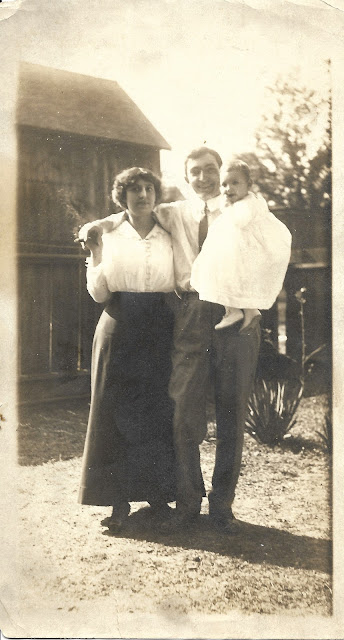
Melvin Newmark at age 1

Scanning a box of family photos. 

The back of the photograph reads, "Melvin, 1 Year 1912"
My grandfather, Melvin Newmark, was born on Aug 27, 1912
My great grandparents Bertha Cruvant and Barney Newmark were married on Aug 27, 1911

If that were a newborn child, I would assume the note was an indication of their 1 year anniversary. But that is no newborn. A year old looks about right, and the year would be 1913.

According to the St. Louis City Directories they lived at 6135A Plymouth Ave, which is in the current city of Wellston, in St. Louis County. (Unincorporated in 1913)That may be their yard in the photograph.


Sunday, September 20, 2020

Ancestral photographs

It's been a long while since I've been able to add a photograph to my ancestral montages below. It's exciting to be able to do so.


Left to Right: Grandfather, Melvin Newmark; Great Grandfather, Barney Newmark; Great Grandfather Herman Feinstein; Great Great Grandfather, Samuel Newmark; Great Great Grandfather, Moshe Leyb Cruvant; Great Great Grandfather, Morris Blatt; Grandfather, Martin Deutsch; Great Grandfather, Melvin Van Every; Great Grandfather, Samuel Deutsch; Great Great Grandfather, Samuel Van Every; Great Great Grandfather, Israel Lichtman [2 grandfathers, 4 great grandfathers, 5 great great grandfathers]

I have three un-photographed great great grandfathers. 

  1. Ebenezer Denyer died in 1872, so I doubt I will find a photo of him.
  2. I might have a photograph of Abraham Deutsch. This photograph was originally found in the same folder as the one of Israel and Sarah Lichtman. It would make logical sense if they were the other set of my maternal grandparents' parents. But there is no way I can make that assumption. 
  3. The remaining un-photographed great great grandfather is Selig Dudelczak Feinstein. He died in 1915, so it is conceivable that there is a photograph out there in some cousin's archives.


Left to Right: Grandmother, Myrtle Van Every Deutsch; Great Grandmother Margaret Denyer Van Every; Great Grandmother, Helen Lichtman Deutsch; Great Grandmother, Bertha Cruvant Newmark; Great Great Grandmother Minnie Mojsabovsky Cruvant; Great Great Grandmother, Rose Cantkert Newmark; Great Grandmother, Annie Blatt Feinstein; Grandmother Belle "Sissie" Feinstein Newmark [2 grandmothers, 4 great grandmothers, 2 great great grandmothers]

I have 6 un-photographed great great grandmothers. 
  1. Chaia Bela Boksern Blatt died in 1892 in Poland. 
  2. Sarah Weiss Deutsch may be in the same photograph I link to above which might contain Abraham Deutsch. 
  3. Israel Lichtman's first wife, Betty Adler, probably died in the early 1880s.
  4. Abigail Stuart Van Every died in 1866. 
  5. Sarah Hartley Denyer died in 1898. There is a photograph of her grandchildren from the 1890s, but I doubt I will find a photograph of her.
  6. Annie Perlik Feinstein died in 1932. If I am going to find another female ancestor's photograph, hers is the most likely. I feel a photograph has to be hiding somewhere in some cousin's archives. 
There are a handful of ancestors who might have had portraits done of them. So far I have not found any.

Thursday, September 17, 2020

Israel and Sarah Lichtman - 1915


I posted the below photo in 2009 as an Unidentified Family phOto. Going through some family folders, the image was used on a family reunion packet back in 1992, and the photo was identified as Israel and Sarah Lichtman, 1915, Austria-Hungary. 

Israel was my 2nd great grandfather, and Sarah Jonas Lichtman was his second wife. (My 2nd great grandmother was his first wife, Betty Adler.) I have no other photographs of Israel to compare, so I will just accept the identification from the family reunion packet. Especially since there was a date given, with no indication that it was an estimate, the information probably came from the back of the original.

My Great grandparents (Samuel and Helen Lichtman Deutsch) immigrated to the US in 1912 and 1913, so this photograph was apparently taken after they had left.

Sunday, May 31, 2020

1913 Benton Basketball Team - Robert Lee Gober - Genealogy and Algebra


Robert Lee Gober (1895-1971) is on the far left in the photograph below, holding the basketball. He is my wife's great grandfather. Benton is the County Seat for Scott County, in Southeastern Missouri. 

Born in 1895, Robert Lee Gober would have been 18 in 1913. We know as an adult he was 6'4" tall, though we do not know if he had stopped growing by the time of this photograph. I don't know the identities of any of the other young men, but I was curious how much they varied in height. Let's assume he was 6'4" tall. Can we estimate the height of the shortest teammate? Definitely. 

Examining the photograph in my photo-editor, RL Gober is 1,775 pixels in height, and the shortest teammate is 1,515. (I measured from the top of the head to the bottom of the foot, choosing the back foot for both individuals)

76 inches / 1775 pixels = X inches / 1,515 pixels
Solving for X, he is 64.87 inches tall. Or 5'5. Almost a full foot shorter than Robert.
Naturally, there is some room for error in how I calculated the pixels.

(You didn't realize algebra would come in handy for genealogy, did you?)

Wednesday, November 15, 2017

Wordful Wednesday: Oxenhandler Funeral Home advertisement - with photographs


December 1937 advertisement. From The Modern View, a local community newspaper.

Edward Louis Oxenhandler was the brother-in-law of my great-grandfather, Herman Feinstein. Willard Z. Oxenhandler was Edward and Pearl (Feinstein) Oxenhandler's son. Aaron was another sibling of my great-grandfather.

Note: An agreement between the Chauffeur and Undertaker unions abolished Sunday funerals in St. Louis in 1928. In 1930 the Oxenhandlers created a non-union Orthodox Jewish funeral home.

Tuesday, November 14, 2017

Alleged photographs of my great grandfather, Melvin Van Every

In an online family tree, I found two alleged photographs of my great grandfather, Melvin Van Every. I communicated with the owner of the tree, and the photographs came from his grandmother's collection, and she was a niece of my great-grandfather. I would normally consider that a good source of identification, but my great-grandfather had about twenty siblings. It would have been easy for a niece to get confused.

There are three photographs below. The one in the middle is a definite photograph of my great-grandfather, taken in 1900, shortly after the birth of his daughter, and my grandmother, Myrtle. (It was colorized in the 1940s, but I have the original photograph as well, which contained my grandmother as an infant.)

My inexpert opinion is that the individual in the oldest photograph isn't the same as the individual in the middle. The shape of the head is different. However, the ear, mouth, and nose look identical. If it were my great-grandfather, it would likely have been taken in 1883, at the time of his wedding, when he was 20.

I am much more willing to believe the man in the last picture is my great-grandfather. He lived until 1929, age 66. Visually, I'd guess the picture is from his final decade.


Sunday, November 13, 2016

Alas, A Different Secondhand Shop

I discovered the below photograph in a newspaper article about the community where my paternal ancestors lived. I wondered if it could be my second great grandfather, Moshe Leyb Cruvant and his children. He did own a secondhand shop at the time.

There were definitely some facial similarities with known photographs in my collection.

I decided I really needed to find a photograph of my great grandmother's brother, Sol, at a much younger age. (Or a photograph of my second great grandfather a little bit younger.)

Today I received several documents including this photograph. My second great grandmother, Minnie (Mojsabovsky) Cruvant, her three daughters Bertha, Stella and Flora, and two sons. That's either David or Ben at the top, and Sol at the bottom.


As much as I'd like it to be a match, the boys don't look the same.
And I don't think it's just a matter of adding a few years onto his age.

But I love this photograph.

Update: I've been reminded that we are only identifying individuals by their similarity in appearance to other known photos. The only faces that we are pretty certain about are in the top row: my second great grandmother, Minnie, and my great grandmother, Bertha, And in the middle row, right, Stella. My cousin who provided the photo doesn't think the other woman in the middle looks close enough to Flora, and she can't identify either of the males. Assuming it is a family photo and everyone should be a member of the family can lead to inaccurate conclusions.

Sunday, November 9, 2014

SNGF: Ancestors with Facial Hair

Randy Seaver at Genea-musings suggested for last night's Saturday Night Genealogy Fun to share photographs of ancestors with facial hair.

(All photographs below can be clicked on to view larger.)

I'll start off with my own photograph. I'm not my own ancestor, but facial hair isn't a relic of the past in my family. I'm wearing a hat that was bought for our 20 month-old twins, so it's a little small.
My grandfather, Melvin Newmark (1912-1992) was well-known for his well-groomed mustache. This photograph was taken in 1971.
My great grandfather, Samuel Deutsch (1861-1938)  I believe this photograph was taken in Hungary prior to immigration in 1914.

My great grandfather, Melvin Van Every (1863-1929). This photograph was taken in 1900.
My great great grandfather, Moshe Leyb Cruvant (1857-1911). This photograph was likely taken within the last few years of his life.
My great great grandfather, Morris Blatt (1862-1926). I am unsure when the photograph was taken. Perhaps at one of his children's weddings, which would place it in 1912, or early 1920s.
An unknown Lichtmann or Deutsch relative, likely taken in Hungary.


Friday, October 10, 2014

1919 Composite Photo

I think there may be some people who think composite photographs - photographs combining the features of multiple individuals - are a relatively new concept.

The below was created in 1919.

It probably was a more difficult process back then, than it is today.


Source: St. Louis Post Dispatch, April 15, 1919, Page 23

Friday, February 28, 2014

Social Media Policy for Parents

My wife and I are in the process of adopting twin boys.

Many questions have popped into my mind over the past few weeks, and one of them is what our social media policy should be.

I am a very public person. You can find out a lot of information about me on the internet. Some, perhaps, I might wish you couldn't. (Some I might attempt to see if I can remove before my sons-to-be are of internet surfing age.) However, almost everything I have put online about myself, I have made a conscious decision to do so. I have a policy on this blog of not sharing photographs of living relatives without being absolutely sure they will approve. The boys are only 1 year old, so they don't have the ability to consent, yet.

This blog is public, and indexed by search engines, which is one reason I refrain from sharing photographs of and stories about living relatives. My Facebook account is visible only to 'friends.' However, those Facebook friends include dozens of people I have never met - mostly fellow genealogists. A lot of them I feel like I know through their blogs, but I don't really know them. And there are a handful of other 'friends' I only know through the internet. Facebook does make it relatively easy to share posts with only a select group of friends, and I could divide my friend list between those people I have met, and those I haven't.

Then there is the question of whether I need to go through the process of removing geotags from photographs that I do choose to upload. This is an easier one for me to answer. The main concerns with geotags is that they can pinpoint the location the photograph was taken. So if you post a photograph when you are on vacation, someone might know you are on vacation. If you post a photograph of your kid at home, someone can figure out where you live. I don't post vacation photos until I am home. It's a common safety precaution whether one has kids or not. And whether or not I post photographs taken at home, it is very easy to find my home address on the internet. (A little more difficult since my wife and I dropped our landline, but still fairly easy.) Posting photographs with geotags will not lead to a decrease in privacy. At least not in my situation.

Lots of my friends post photographs of their children on Facebook, and while the boys haven't yet been placed into our home, that date is only days away, and I already am feeling the 'proud father' cravings to share my naches ('joy') with the world.

Input is welcomed.

Saturday, January 11, 2014

Sepia Saturday 210: Do You See What I See?

I haven't participated in SepiaSaturday since May, but I thought I would return to the meme. They provide a weekly prompt for bloggers to search through their files of old photographs.

Many of us will have experienced the joy of discovering a precious old photograph tucked away within the pages of a dusty old volume. Now is your opportunity to share such discoveries, or, if you prefer, share your photographic discoveries whether they were found in a bound volume of Shakespeare or in an old shoebox.


My mind returns to the photograph on the left. I didn't discover it in a 'dusty old volume.' I discovered it in a digitized newspaper article. The article doesn't identify the individuals beyond the neighborhood - Little Jerusalem, St. Louis, Missouri, 1900. I had two great-great grandfathers who owned a second hand store at that time. I wondered if it could be the Cruvant family. The few photographs I do have of the family aren't conclusive either way. But the facial similarities are intriguing. At the time, the presence of a baby made the identification less likely.

Since I last posted about this photograph, I have figured out who the baby could be, if it is the Cruvant family. Fannie Cruvand, the daughter of Ben and Pearl (Grossberg) Cruvand, was born July 1, 1900. Ben was the nephew of my second great grandfather. According to the census, they lived at 1125 North 12th street, whereas my second great grandfather lived at 1111 Morgan street. Looking at old maps they weren't far from each other. In that case, the mother in the photo could be Fannie's mother, Pearl, or my second great grandmother. Of course, they could still also be a completely different family. My mind could certainly be only seeing similarities it wants to see, and ignoring crucial differences.


To be more certain either way, I would need a known photograph of my second great grandfather closer to 1900. A childhood photograph of Sol could also be helpful.

Wednesday, July 31, 2013

The Fine Art of Record Destruction

If everything goes according to plan...and the puzzle pieces are coming together...my wife and I will be moving to a new home in a month.
It's been fifteen years since I last moved, and there has been a lot of accumulation. I have to decide what to keep and what not to keep. My wife isn't the pack-rat that I am, but she does appreciate nostalgia, and historical record keeping, so at least she isn't encouraging me to toss everything.

I don't think I need to save all my school papers. The collection of newspaper articles I wrote for a college newspaper, and a collection of English papers from my Senior year in high school should be sufficient. I don't want anyone reading anything earlier than that anyway. Except, perhaps, a poem I wrote when I was six, but since I scanned in the crumbling pages, I don't really need to save the original. (My handwriting has improved, a little, but not my artistic skills.)

I do wish I had a copy of several letters I've written over the years, but alas, that is the way things are with letters. The sender doesn't usually retain a copy. That is an advantage with email - if one doesn't delete them.

The photograph of some pigs I took at summer camp when I was 14 can be pitched, along with several other similar photographs. I'll try to follow the Practical Archivist's advice on what to keep, and what to toss.
I might scan some of those in, too. Scanning before pitching makes a lot of sense, however, if I do too much scanning, I'm less likely to complete the task in the month we have before closing...

Sunday, May 12, 2013

Myrtle Van Every Deutsch (1900-1951)

For Mother's Day I decided to honor my maternal grandmother, Myrtle Van Every Deutsch. I've written a lot about her on this blog, transcribed several letters she wrote, and shared several photographs, but not all of the ones below.


I don't know the dates for all of the photographs.

  • She was born in March of 1900, in Maxwell Texas, so the baby picture with her parents, Melvin and Margaret Denyer Van Every is fairly easy to estimate. 
  • The photograph in the upper right hand corner was taken at the Grand Canyon, likely in the early 1920s. 
  • The photograph with the horse, "Joe," was taken in the summer of 1919 - likely somewhere near El Paso, Texas.
  • She is nine years old in the center-left photo. 
  • The photograph center-right was also likely taken in the early 1920s. I think she was in Hollywood, as a caption indicated she was: looking for "the stars." 
  • In the photo in the lower-left she is on her honeymoon with my grandfather, Martin Deutsch. The year was 1937, and I believe they were in Mexico.
  • The photograph in the lower-right was taken in 1942, in St. Louis. 
  • The photograph with her sisters, Minnie and Evelyn, was taken in 1947, in Texas.

Friday, May 10, 2013

Collages

Several have left favorable comments about the collage on my recent Sepia Saturday post.

I originally included the collage in a 2010 post on Alternatives to Scrapbooking. I'm not fond of cutting photographs into weird shapes or finding cute backgrounds, however, I do enjoy making digital collages. A commenter in 2010 suggested that the collage is closer to the original idea of scrapbooking than what it has morphed into today.

I also made the argument back in 2010 that a blog could fit the OED defintion of a scrapbook, with a little flexibility for technology:

"A blank book in which pictures, newspaper cuttings, and the like are pasted for preservation.”

Here are a few other collages I've previously created for this blog.

1) Honoring my paternal grandmother, Belle "Sissie" (Feinstein) Newmark (1914-2002)

 
(clockwise around the baby picture in the center: with her older brother, Ben; with her younger brother, Seymour; with Seymour and their parents, Herman and Annie; a newspaper article announcing her engagement; a high school graduation photo; two photographs with her husband, Melvin; and the final photograph was taken in 1995 with me.) 
 
2) Honoring all the (deceased) female ancestors for whom I have photographs
 
 
(l to r: Myrtle Vanevery Deutsch, Margaret Denyer Vanevery, Helen Lichtman Deutsch, Bertha Cruvant Newmark, Minnie Mojsabovski Cruvant, Rose Cantkert Newmark, Annie Blatt Feinstein, Sissie Feinstein Newmark)
 
3) Honoring all the (deceased) male ancestors for whom I have photographs
 
 
(l to r: Melvin Newmark, Barney Newmark, Herman Feinstein, Samuel Newmark, Moshe Leyb Cruvant, Morris Blatt, Martin Deutsch, Melvin Vanevery, Samuel Deutsch, Samuel Vanevery)

Friday, February 22, 2013

Free Art for Your Blog

One way to enliven a blog entry is with photography or artwork. Many entries on a genealogy blog will obviously be illustrated by photographs from family collections. However, sometimes we write about things for which we don't have photographs. Some bloggers are handy with a camera, or the sketchpad, but others aren’t. Those of us who find our creativity restricted to the palette of words in the dictionary soon find ourselves wondering where we can find free photography and art.

Sure, you can go to Google Images, search for keywords, download, and then use the images you find. However, while possibly tempting, most bloggers realize there are legal issues with doing this. Furthermore, we don’t want people copying and pasting our words on their websites without our permission; therefore we should show the same respect to photographers and artists.

However, there is a lot available that is free (or almost free) of copyright restrictions. Below are five good resources; there are undoubtedly others. Those with suggestions should include them in a comment to the post.

I. Flickr

A. The Commons
Flickr, the photo-sharing website, has a section they call The Commons. The Commons began in January of 2008 when The Library of Congress released about 1500 photographs from their collection to display on Flickr. Since then, The Library of Congress Flickr collection has grown to over 17,000 photographs. Several other libraries and museums have added photographs from their collections. If you search The Commons any photographs you find will be completely free of copyright restrictions. If you follow a link to the museum’s full collection on Flickr, leaving The Commons, some of those photographs may have copyright restrictions. The description of the photograph should indicate whether or not there are any restrictions.

[Note: The 1860s image on the left of the
Jefferson Barracks military post just South of St. Louis, Missouri came from the New York Public Library collection at The Commons.]

B. Creative Commons

Flickr also has a section entitled Creative Commons

Anyone is able to contribute photographs to this section. These photographs aren’t completely free of copyright restrictions, but they fall into the “almost free” category. There are six groups, each with a different combination of four requirements

Attribution: The simplest, this means to use the photograph or artwork you must provide credit. An easy way to do this is to provide a link to the individual Flickr account from which the work came.

No Derivatives: You can display the artwork or photography exactly as it appears; you can’t make any changes. (Changing the size of the photograph, as well as trimming a ‘detail’ are both derivative works. Even copying the image in photo-editing software, pasting it into a new file, and adding a caption in whitespace underneath, is still a derivative work. The image you download from Flickr must be the exact same file you upload to your website.)

Non Commercial: – You can’t use the work for commercial purposes. (While many people will think ‘commercial’ means putting the photo on the cover of your CD, or on a tshirt you sell on CafePress – if your blog has advertisements from which you make money, a court could decide your blog is commercial. Since you probably don't wish to upset the artist, I would recommend asking permission from the owner – as they should be easily contactable from their Flickr accounts.)

ShareAlike: ShareAlike means if you make a derivative work, you must distribute it under a similar Creative Commons license

With those four definitions in mind, here are the six Creative Commons categories at Flickr, each of which can be searched individually:

1) Attribution License: Only attribution is required. You can make derivatives, use it for commercial purposes, etc. Once you make changes to the work, you can redistribute your derived work under a different set of requirements.

2) Attribution No Derivs License: You must give credit, and you aren’t allowed to make any derivatives. But as long as you don't make any changes to the work, you can still use it for commercial purposes.

3) Attribution – Non Commercial – No Derivs License: The most restrictive of the categories, the photographs are still free to use on a personal, non-commercial site.

4) Attribution – Non Commercial: Derivatives are allowed.

5) Attribution – NonCommercial – ShareAlike: If you make a derivative work, you must distribute it under a similar Creative Commons license

6) Attribution – ShareAlike: Same as #5, but you may use for commercial purposes.

II. LIFE Magazine

LIFE Magazine is sharing a large portion of their historical photo collection on Google Images .

They have the images organized by decade, and images from the 1880s through the 1910s are free of copyright restrictions. Those in the 1920 category and later are restricted to “Personal – non-commercial usage.”

III. The US Government

The US Government has an index of the images available on all their websites:
Most of these images and graphics are available for use in the public domain, and they may be used and reproduced without permission or fee. However, some images may be protected by license. We strongly recommend you thoroughly read the disclaimers on each site before use. For information about obtaining seals of Federal Agencies and the United States, please see the Government Printing Office website.

Images range from insects on the US Department of Agriculture website, photographs of the Grand Canyon on the National Park Service website, to images of the lunar surface on the NASA website.

IV. Classic works of art are a great way to illustrate your entries.

Art History Resources on the Web
is a handy index to websites where you can find classic works of art that are free of copyright restriction.

Note: While artwork might be in the ‘public domain’ the photographs of the artwork might not be. If the image is the painting only, and you don’t see the frame, or the museum wall behind it, one photograph is going to be nearly identical to any other photograph, so it can be safely assumed to be in the public domain. However, once the creativity of the photographer enters into the photograph, you are on rockier grounds. And if the work of art is a sculpture, the photographer will often matter.

V. Pixabay

Pixabay is a relatively new entry into sources for free photography and artwork, but they look extremely promising. Quoting from their Terms,
"Images on Pixabay are bound to Creative Commons Deed CC0. To the extent possible under law, uploaders of Pixabay have waived all copyright and related or neighboring rights to these Images. You are free to adapt and use the Images for commercial purposes without attributing the original author or source. Although absolutely not required, a link back to Pixabay would be nice."
There are a handful of limitations. For example: if there's a person in the image, you might need to get a 'model release' from that person to use it for commercial purposes. If there is a company trademark in the photo, you might need to get permission from that company for commercial usage. They also state you can't use the images for "unlawful or immoral purposes." The latter is somewhat difficult to define globally. What one person, locality, state, or country considers immoral, another might not. Though one immoral purpose specifically mentioned is pornography. There are other limitations mentioned in their terms, which should be read.

As one might expect, there are a lot of cat images at Pixabay
[source]
While they state you don't need to attribute your source, some bloggers may decide it is safer to do so. Anybody can set up an account at Pixabay, and start uploading photographs. Pixabay states that they attempt to screen the uploads, but there is no guarantee they are 100% successful. By linking to the image source on Pixabay, if the image was inappropriately uploaded, the original rights holder will know who to hold responsible. Here's Pixabay's recent response when asked what one should do if an original rights holder files a complaint.

Note: Pixabay has an agreement with Shutterstock. All search results will start with a handful of images that link to the Shutterstock website. Those images aren't free, but they are very easy to scroll past.

There are websites that will sell you the rights to photography, such as ShutterstockiStockPhoto, or Getty Images . However, since there are several places to find free images, unless there is a particular image at one of these sites that really strike your fancy, there is no need to use them.

With all these sources for free photography and artwork, when you don't have a photograph from your family collection for a blog entry, your entry doesn't need to be image-free.

This article is revised and updated from a 2009 post.

Monday, November 19, 2012

The Mystery of the Secondhand Shop

I'm not always adept at adding or subtracting years from a face and judging whether two photos are a possible match. However, since composing this morning's Amanuensis Monday, I've been looking back and forth between the photograph of the secondhand shop, and some photographs I have of members of the Cruvant family. As I mentioned in my notes, while I'd like the photograph to be of Selig Feinstein and his family, for whom I don't have photographs to compare, my second great grandfather Moshe Leyb Cruvant also owned a secondhand shop in 1900.


On the top left is the secondhand shop from the news article.

On the right is my second great grandmother, Minnie (Mojsabovski) Cruvant, and my great grandmother, Bertha (Cruvant) Newmark. To the immediate left of this text is my second great grandfather, Moshe Leyb Cruvant.

In 1900, Bertha would have been about 13. Her older brother, Ben, would have been 15. And her younger brother, Sol, would have been 7.  I do see vague facial similarities between the photos I have of Bertha, Minnie and Moshe Leyb and the individuals in the photograph from the St. Louis Republic. I don't believe I have any photos of Sol.

I don't know when the photograph of Moshe Leyb was taken, but he passed away in 1911, so if we assume ten years had passed, he would still have had to age significantly. However, he would have been 43 in the 1900 photo, which looks about right. He only lived to age 54 - he looks older in that photograph by today's standards than he really is.

Their shop on Morgan Street was within the boundaries of Little Jerusalem as defined in the article, though not as close to the location on Seventh street as the Feinstein shop.

If this is the Cruvant family, the baby is a complete mystery.  Sol is the youngest child of Moshe Leyb and Minnie we know about. However, Moshe Leyb had some kin in St. Louis, and perhaps that's a nephew or niece that happened to show up in a photo.

The facial resemblances are tantalizing, but I really need a known photograph of one of them from much closer to 1900 to make a comparison.

Update


This photograph of my great grandmother, Bertha, I believe comes from a few years prior to the one above. She is on the right. (It is her sister, Stella, on the left.) I think the resemblance remains, though the girl in the newspaper's photo isn't looking straight at the camera, and is partially hiding her face with her hand, making it difficult.

This is the earliest photograph I can find of Sol, dated 1930.

I have looked at the known Cruvant births in St. Louis, and none of Moshe Leyb's kin had babies who would be under a year old in August of 1900. The closest was born in October of 1898. The presence of that baby throws the greatest wringer in the theory of a match.

Friday, May 28, 2010

Follow Friday: The Commons

The Commons

Flickr, the photo-sharing website, has a section they call The Commons. The Commons began in January of 2008 when The Library of Congress released about 1500 photographs from their collection to display on Flickr. Since then, The Library of Congress Flickr collection has grown to almost 9000 photographs. Several other libraries and museums have added photographs from their collections. If you search The Commons any photographs you find will be completely free of copyright restrictions. If you follow a link to the museum’s full collection on Flickr, leaving The Commons, some of those photographs may have copyright restrictions. The description of the photograph should indicate whether or not there are any restrictions.

[Note: The 1860s image of the
Jefferson Barracks military post just South of St. Louis, Missouri came from the New York Public Library collection at The Commons.]

For those seeking Civil War photos for Memorial Day - A search for the words "Civil War" produces over 1100 results.

Saturday, March 27, 2010

Scrap-book Alternatives

Scrap-book: “A blank book in which pictures, newspaper cuttings, and the like are pasted for preservation.” – Oxford English Dictionary
Whenever a scrap-book evangelist asks you if you are scrap-booking your family photos, if you have anything that meets the OED’s definition, you can say, ‘yes.’ A photo album is a scrap-book. Don’t let anyone tell you any different. Who are they that their definition outweighs the OED?

But please…don’t use what The Practical Archivist refers to as a Chemical Sandwich of Doom. There are now photo albums that don’t destroy the photos.

That said, as someone without much artistic ability, I’d like to provide some ideas of other things you can do with photographs. Things that don’t involve designing cute or fancy backgrounds, or cropping the photographs into weird shapes.

1) Photo-travelogues

Using a 4*6 photo album with the sleeves that fit one photograph, alternate between photograph and a written (or typed) description of the people, places, and events. This works great for creating a gift to give children or grandchildren to commemorate family trips. (Inspiration: My mother has done this for her grandchildren.)

2) Poetry

Perhaps you don’t consider yourself an artist, but you do enjoy writing poetry. You can write poems to accompany photographs.

I composed the below prior to composing the Tombstone Tuesday entry earlier this week.


Hands

I look at the hands
On the tombstone
Of my great grandfather
And wonder
If he was descended
From Vulcans
Or Aaron, brother of Moses.

I suspect the latter,
Keeping one foot in reality
At all times, but either
Would be new information,

And both descents
Equally difficult
To trace.

3) Collage

This alternative comes closest to the traditional idea of scrap-booking, though it doesn’t involve background art. Combining photographs and document clippings that complement one another. My example below illustrates my initial reaction upon seeing my paternal grandparents’ honeymoon photo. (There are other photographs from the honeymoon that don't elicit the same response.)


(In creating this collage, I went to my grandmother's scrapbook, looking for a saved matchbook cover to scan; she saved several. I was 'gobsmacked' by what I discovered - a 79 year-old cigarette, preserved. I believe she received it for her 17th birthday.)

4) A blog

Every blog entry begins as a blank page. They contain pictures and text. If you want, you could print them out, and bind them. If you are a family history blogger, you are creating a digital scrapbook with every blog entry you compose.