Monday, March 28, 2016

Amanuensis Monday: Max Newmark Killed by Robbers - 1931

Amanuensis: A person employed to write what another dictates or to copy what has been written by another.

I continue my project to transcribe family letters, journals, newspaper articles, audiotapes, and other historical artifacts. Not only do the documents contain genealogical information, the words breathe life into kin - some I never met - others I see a time in their life before I knew them.

This week I look at a newspaper artcile from the St. Louis Post-Dispatch mentioning the murder of my great great uncle, Max Newmark - brother of my great grandfather, Barney Newmark. (I previously transcribed the St. Louis Globe Democrat's report, but this provides additional information.)

St. Louis Post Dispatch, Feb 1, 1931, page 2

EAST SIDE GROCER SHOT BY ROBBERS DIES OF WOUNDS

Max Newmark and a Customer Fired on in Store When Dog Tries to Defend Its Master.

Max Newmark, East St. Louis grocer, died late yesterday afternoon of bullet wounds suffered early yesterday in a holdup, when three Negroes opened fire after a small dog attacked one of the robbers.

Newmark, who was 38 years old and lived over his store at 512 South Twentieth street, was shot in the right side, right shoulder and abdomen. A Negro customer, Walter Hurnton, 26, 1927 Piggott avenue, who was shot in the right breast, is in serious condition at St. Mary's Hospital, where Newmark died.

Newmark armed with a revolver in a holster at his side, opened the store at 6 a.m. and was walking from the rear with a cigar box containing about $60 when the robbers entered with drawn revolvers.

At the command "Stick 'em up," Newmark placed the box on the counter and raised his hands. At the same moment, his dog, Peggie, darted from behind the counter, barking viciously at the leader of the robbers.

The robber kicked the dog away and fired two shots as it advanced again. One bullet grazed the dog's shoulder and it fled to the rear of the store.

Hurnton walked into the store as the leader, with his back to the door, fired three shots at Newmark, who was standing with hands raised. A second robber fired two shots at Hurnton, one of which struck him, while the third robber fired one shot in the direction of Newmark.

The leader seized the money box and snatched Newmark's revolver from its holster. Hurnton ran outside and collapsed on the sidewalk, followed by the robbers who fled south in Twentieth street on foot.

Newmark's wife and two sons, sleeping upstairs, were awakened by the shots and heard the grocer crying for them to call an ambulance.

Notes:

1) Max and Dora's sons Nelson and Harold were 16 and 12 at the time.

2) Compared to the Globe Democrat article, this report provides greater detail of the sequence of events, and indicates the family's residence was above the store -  his wife and sons awakened by the shots. It also consistently gets the spelling of the surname correct.

Saturday, March 26, 2016

My Ancestral Location Chart

Lots of genealogy bloggers are posting ancestral birth charts illustrating where their ancestors were born through five generations. I figured it would be an interesting thing to do, so I borrowed a template that Judy G. Russell, the Legal Genealogist offered. I decided to add the locations of death for my grandparents and earlier generations. (My parents, and I, are living.) I thought it would better illustrate the migration. The colors represent location of birth.

I don't have birth certificates for most of my ancestors in the fourth and fifth generation, but the locations are likely accurate.

My paternal grandfather was on vacation when he died, but otherwise the location of death matches where the ancestor lived at the time.


Monday, March 21, 2016

Amanuensis Monday: Morris Blatt Burglarized Three Times - 1897

Amanuensis: A person employed to write what another dictates or to copy what has been written by another.

I continue my project to transcribe family letters, journals, newspaper articles, audiotapes, and other historical artifacts. Not only do the documents contain genealogical information, the words breathe life into kin - some I never met - others I see a time in their life before I knew them.

This week I look at a newspaper artcile from the St. Louis Post-Dispatch mentioning my second great grandfather, Morris Blatt.


St. Louis Post Dispatch, May 17, 1897, page 2

THEY LIKE HIM

Burglars Have Thrice Visited Morris Blatt's Store.

Morris Blatt, a dry goods dealer at 800 Carr street, has been made a mark for burglars, according to the story he told at the Four Courts Monday.

Blatt says that his place was entered Sunday night by burglars and $200 worth of goods carried away. He said there were four dozen skirts and a number of silk waists taken. The thieves gained entrance be breaking the windows on the Eighth street side.

Three weeks ago, Blatt said, burglars visited his place and using the same method to gain entrance, took forty-one yards of velvetine and a lot of laces and ribbons, the total value of which is $50. Another time thieves broke the windows, but were frightened away before they entered.

Blatt's store is in the building formerly occupied by Harry M. Sheolink, who is now serving a jail sentence for receiving property stolen from the Malinckrodt Chemical Works.

Notes:

1) According to the 1897 City Directory, my 2nd great grandfather had a tailor shop at 1401 North 7th Street, which is about 3 blocks north of Carr. There is only one Morris Blatt in Missouri in the 1900 census. (None near St. Louis in Illinois, either.) Could he have had two businesses?

Thursday, March 17, 2016

Corned Beef on Rye (repost)

Corned Beef and Cabbage on Rye

To the left is a bio my great-grandfather Barney Newmark submitted to the North St. Louis Businessman's Association for their 1925 publication.

Are such bios trustworthy sources? Let's take a look.

Proprietor of a tailor shop, 1520 St. Louis avenue;
Yes.

Native of Dublin, Ireland;
Attended public schools in Ireland;
Not quite. While we don't have a birth certificate, all evidence suggests he was born in what I like to call a suburb of Dublin, known as Warka, Poland. Google Maps will provide driving directions, and it will only take you 23 hours. (With the help of some ferries.)

Student at Oxford;
Barney doesn't say "Oxford University" or "Oxford College". During the 14 years spent in London, England, he lived within walking distance of Oxford Street, and the Oxford Circus Railway Station. He was a student of life. Perhaps there was even a local school on Oxford Street.

Learned the tailoring trade at the London Polytechnic, London, England;

For a while it was assumed this was also a stretch of his imagination. But research revealed that the London Polytechnic was short for The London Polytechnic Young Men's Christian Institute, and like some branches of its American cousin, they provided skills training to local youth. Certainly, Barney learned the tailoring trade from his father, who was also a tailor. However, he may have had instruction at the local Y as well.

***

Everything after that is also true. So the only outright fib was his country of origin. There was a large Irish community in St. Louis, and my suspicion is that since "Barney" isn't an uncommon Irish name, many of his customers would ask him if he were Irish, and he finally decided to say "yes." (With his fourteen years in England as an explanation of the absence of the accent.)

He also would say that his birthday was March 17th. His birthday appears as March 25th and April 14th on a few documents. The Gregorian and Julian calendars might partially account for the different dates. He also said the year was 1886, so this is (or it will soon be) his 130th birthday.

Nine years ago, after I discussed my great grandfather's 'blarney', a friend sent me a link to an online census document. I had always been interested in my ancestry, but had no clue what was available online. The rest, as they say, is family history.

Happy St. Patrick's Day


Past St. Patrick's Day posts

March 17, 2015: Corned Beef on Rye
March 16, 2014: Happy St. Patrick's Day 2014
March 16, 2013: Happy St. Patrick's Day
March 17, 2012: Happy 126th Birthday to my Great Grandfather
March 17, 2011: Happy St. Patrick's Day
March 17, 2010: Barney's Birthday and Birthplace
March 17, 2009: On St. Patrick's Day Everyone is Irish
March 17, 2008: My 'Irish' Great Grandfather
March 15, 2007: Corned Beef and Cabbage on Rye

Monday, March 14, 2016

Amanuensis Monday: Barney Newmark Denies Knowledge of Stench Activity

Amanuensis: A person employed to write what another dictates or to copy what has been written by another.

I continue my project to transcribe family letters, journals, newspaper articles, audiotapes, and other historical artifacts. Not only do the documents contain genealogical information, the words breathe life into kin - some I never met - others I see a time in their life before I knew them.

This week I look at a newspaper article from the St. Louis Post-Dispatch, which mentions my great grandfather, Barney Newmark.


St. Louis Post Dispatch, December 1, 1937, page 3.

STENCH FLUID SPRAYED INTO CLEANER'S SHOP

Owner Says Two Men Previously Tore Down Notice of Cut Prices, Threatened Him.

Police discovered early today that stench fluid had been sprayed into the shop of the Best Cleaners, 2825 North Vandeventer avenue.

A hold had been broken in the glass in a rear door and stench liquid introduced into the shop with a sprayer, officers reported. Members of the bombing squad said this was an effective means of saturating clothing with the offensive odor.

Tony Christopher, owner of the shop, told police that two weeks ago he cut prices. Subsequently two men visited his shop, tore down signs advertising the reduced prices and threatened to blow up the place, Christopher said.

Barney Newmark, 5946 Kingsbury avenue, business agent for the Local Union 27, Cleaners & Dyers, was taken into custody at his home for questioning. The union affiliated with the A. F. of L. is an organization of small cleaning shop owners. Newmark denied knowledge of the stench activity at the Best Cleaners.

[Deleted paragraph] ... Both men were released after questioning.

Notes:

1) From this news article I have recorded the 1937 address for my great grandfather, and that he was a business agent for Local Union 27, Cleaners & Dyers.

He denied any knowledge of the 'stench activity,' and was released after questioning. I have found no other news articles concerning this case.

2) Barney celebrated his birthday on March 17th, and claimed to have been born in 1886. Thus, Thursday would be his 130th birthday. (There is some question as to the exact date of his birth; three different dates appear on separate documents. But with lack of a birth certificate, the day he chose to celebrate with family is as good as either of the other two.)

Wednesday, March 9, 2016

Wordless Wednesday: Myrtle Deutsch at the YWCA - 1947


St. Louis Post-Dispatch, February 7, 1947, page 1D
(Position the mouse over the photo for additional information.)

Monday, March 7, 2016

Amanuensis Monday: Melvin Newmark's Mustache and Sideburns

Amanuensis: A person employed to write what another dictates or to copy what has been written by another.

I continue my project to transcribe family letters, journals, newspaper articles, audiotapes, and other historical artifacts. Not only do the documents contain genealogical information, the words breathe life into kin - some I never met - others I see a time in their life before I knew them.

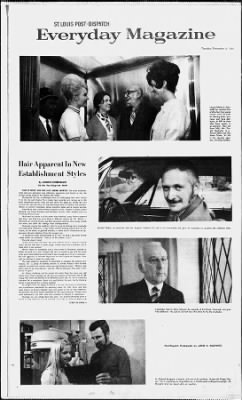
This week I look at a newspaper article from the St. Louis Post-Dispatch, which not only mentions my grandfather, Melvin L. Newmark, but provides a photograph, as well.

St. Louis Post Dispatch, November 6, 1969, p. 71

Top Photo Caption: Lawyer Melvin L. Newmark has received lots of attention from young women since he grew his flowing silver mustache and long sideburns. At left he chats with three women in an elevator. They are (from left): Mrs. Ronald Oestreich, Mrs. Robert Miller and Miss Karen Scherr. At left is the elevator operator, Van Dyke Johnson.

Hair Apparent In New Establishment Styles
By Connie Rosenbaum
Of the Post-Dispatch Staff

Hair is here and not just among hippies. The most Establishment men are sprouting long sideburns, mustaches and beards to join the current young swing to the sensual and tactile.

Throughout the city, middle-aged men are challenging their sons’ claims to be far out and freaky. As a result, fuzzy growths are turning up in the most unexpected places. They are still above the upper lip,  beside the ears or over the chin but they are now decorating faces in doctors’ and dentists’ offices, in lawyers’ chambers, behind executive desks and in funeral parlors.

Inspired by such varied figures as Gen. Ulysses S. Grant, Luther Burbank, the Smith Brothers and Abraham Lincoln, older modern men are imitating famous faces.

Motivated by fashion and fun rather than rebellion, many fathers reported that their new look has given them a different outlook on life. Melvin L. Newmark, an over-50 lawyer, said that increased attention from young women has more than offset the ribbings from contemporaries.

Newmark reports that suddenly, after he grew his flowing silver mustache and long bushy sideburns, young women started flocking around him. In elevators, on the street, in gasoline stations, in stores and in restaurants his appearance attracts attention from the younger set.

“I was never really noticed before in my life,” he said, a big smile clearly visible below his mustache. “Now all of a sudden, I am.”

His wife doesn’t mind.

“Life is much more fun now,” she said. “Melvin loves to shop for colored shirts and we both like to dress young. People tease him sometimes, but I think they’re just jealous.”

Notes:

1) I was born in 1969 and never knew my grandfather before he grew his mustache and sideburns. He kept them after the fashion subsided. It was fun reading about his decision to grow them.


Monday, February 29, 2016

Amanuensis Monday: Selig Feinstein and Tpheris Israel Congregation

Amanuensis: A person employed to write what another dictates or to copy what has been written by another.

I continue my project to transcribe family letters, journals, newspaper articles, audiotapes, and other historical artifacts. Not only do the documents contain genealogical information, the words breathe life into kin - some I never met - others I see a time in their life before I knew them.

This week I look at a newspaper article from the St. Louis Post-Dispatch, which mentions my second great grandfather, Selig Feinstein.

St. Louis Post Dispatch, July 24, 1899, page 8.

New Congregation

Judge Flitcraft granted a pro forma decree of incorporation to the congregation of Ipheris Israel Monday. The officers are Dr. M. DeVorkin, President; S. Feinstein, Vice-President; J. Louis, Secretary, and Louis Blank, Treasurer.

Notes:

1) In 1959 Tpheris Israel merged with another congregation, Chevra Kadisha. Tpheris Israel Chevra Kadisha still exists today. (Chevra Kadisha was the elder of the two, so I can't technically claim my ancestor was a founding father of the current congregation.)

2) While this only provides the first initial, there were only two Feinstein families in the St. Louis area in the 1900 census. The other head of  household was named Aaron. So this is most likely my second great grandfather, Selig Feinstein.

3) I previously knew that he had been active in the Chesed Shel Emeth Society, but I didn't know what synagogue he attended, much less that he was one of the founding officers. According to Zion in the Valley, Volume 2, Tpheris Israel was a merger of several early St. Louis minyans. (A 'minyan' defined simply as a gathering of at least ten Jewish adult males for worship.)


Sunday, February 28, 2016

St. Louis Post Dispatch Archives Searchable Back to 1874

A week ago, the St. Louis Post Dispatch announced that their archives back to 1874 were now searchable. They are being hosted by Newspapers.com. (It's not part of the Newspapers.com Basic subscription you receive through Ancestry's "All Access" pass. It has to be purchased separately, or through their Publishers+ subscription, which allows you access to other newspaper archives they are hosting.)

I was previously able to access 1874-1922 and 1988-current through ProQuest databases at St. Louis County Library, and my library card. However, this opened 66 additional years of articles. All of my paternal second great grandparents arrived in St. Louis between 1880 and 1910, and my maternal grandparents arrived in the 1920s, so this opened a potential goldmine. Additionally, no digital search yields complete results due to fading newsprint. I have already found at least one pre-1922 article on the Newspapers.com database that hadn't turned up in my ProQuest searches. (The article is in the ProQuest archive; using a different search term I have retrieved it.)

Can I share here the post-1922 articles that I find?

Everything pre-1923 is in the public domain. With more recent material, one needs permission from the source. Here's what the St. Louis Post Dispatch now says on their archives page:

"You can save or print clippings or entire pages and share what you find on social media."

Despite all my years of education, I am going to interpret 'can' to mean 'may.' This appears to be a blanket permission statement, as long as one keeps it to social media, which should include personal blogs like my own. [However, I am not going to apply the permission to articles from the Associated Press or other syndicates. I fully realize the Post Dispatch doesn't have the authority to grant permission for those. They aren't the source of the articles. I have previously requested permission from the AP on some news stories, and found their fees to be too high for my liking. Fortunately, it is the local stories that I am most interested in.]

Note: They are advertising that the dates available are up to 30 days ago. Currently, I can only find articles up through 2003. That will hopefully change. However, I still have access to current articles through the St. Louis County Library ProQuest database.

Friday, February 5, 2016

Riots and Rebellions: When is Violence the Answer?

Violence is never the answer to anything. - millions of people
  • The June Rebellion, also known as the Paris Uprising of 1832, was a failure. But without it, we wouldn't have one of the greatest novels and one of the greatest musicals of all-time. (Les Miserables)
  • The Warsaw Ghetto Uprising of 1943 was crushed. However, I'm not going to be the one to say that the Jewish community should have willingly and peacefully gone to their deaths.
  • There was a rebellion in the late 18th century in America that was quite successful, and another in the mid 19th century which wasn't.
  • Violent protests in the late 19th century led to the 40-hour work week, child labor laws, and safer working conditions for all.
Sometimes, in the course of human events, violence becomes necessary. In my opinion, with a government or society that is willing to listen, non-violence tends to work better. The key question becomes - how long do you wait before you decide that society isn't really willing to listen to you? And who gets to make that decision?

Have any of your ancestors or relatives participated in riots, rebellions, or revolutions?

Here's a list of "incidents of civil unrest" in the United States and another list from Colonial America.
Here's a worldwide list of riots and another worldwide list of revolutions and rebellions.

The difference between a riot and a rebellion can sometimes be a matter of who is writing the history. Some people argue riots are more spontaneous and don't have a unified purpose. However, participants in what society decides to call a 'riot' might argue with whether the event was spontaneous or without a cause.

Do I have kin who participated in civil unrest?

I will ignore late 20th century and more recent unrest, as I may or may not have relatives who participated, but if I did, they, or their close families, are still alive.

I've blogged before about my great grandmother's brother, who appears in some news reports related to the East St. Louis Race Riot of 1917. He wasn't a participant, but testified about the whereabouts of an employee who may have been.

An Elisha Horton is listed among the participants of the Boston Tea Party. He may or may not be related to my Horton ancestors.

Warsaw Ghetto, 1940-1943

When I discovered the Warsaw Ghetto Database, I knew I had to search for my Newmark surname. My Newmark ancestors left the Warsaw area in the 1880s, but were any of these ghetto residents related? If so, what were their roles in the uprising? The closest relation they could  be to me would be second cousins to my grandfather (assuming that my second great grandfather, Samuel Newmark, may have had some brothers in Warsaw.)

Entries for four Neumarks and three Najmarks appear, though there may be some duplicated individuals within them. The database provides details taken from various sources - some lengthy; some short. Some of the Polish has been translated into English already; some hasn't. I went in search of more information on some of the events mentioned. The information wasn't necessarily what I was hoping for - but the decisions ghetto residents had to make certainly weren't easy ones.
  • Lejbus Najmark - Judenrat
  • Stanislaw Najmark
    • Polish: starszy syn autorki , zastrzelony w zwiÄ…zku ze sprawÄ… Kotta
    • English: author's elder son, shot in connection with Kott's affair
  • Najmarkowa - [basically: Mrs. Najmark. -owa indicates a married woman] 
    • Polish: żona jednego z dyrektorów ZakÅ‚adu Zaopatrywania; w getcie warszawskim dziaÅ‚aÅ‚a spoÅ‚ecznie - organizacja koncertów; w czasie akcji straciÅ‚a matkÄ™, jeden syn zginÄ…Å‚ w zwiÄ…zku ze sprawÄ… Kotta, drugi na wschodzie, mąż w czasie akcji styczniowej; przeszÅ‚a na stronÄ™ aryjskÄ… po I akcji, ukrywaÅ‚a siÄ™ na Saskiej KÄ™pie; autorka relacji
    • English: wife of one of directors' of the Supply Section; in the Warsaw ghetto she was active socially - organised concerts; during an action she lost mother; one son died in connection with Kott's case, the other one in the East, husband during the January action; she crossed to the 'Aryan side' after the First Action, she hid in Saska Kepa; author of testimony.
  • Juliana (?) Neumark [This appears to be the same woman as Najmarkowa, providing a possible first name, and reinforcing that despite the different spelling, these are matching surnames. The Warsaw Ghetto Database doesn't yet have an English translation, but Google Translate provides a clumsy translation] 
    • Polish: żona Juliana; miaÅ‚a dwóch synów: jeden z synów zginÄ…Å‚ w styczniu 1940 roku w zwiÄ…zku z aferÄ… Kotta, a drugi syn w lutym 1940 roku przepadÅ‚ podczas przechodzenia granicy sowiecko-niemieckiej pod Bełżcem; pracowaÅ‚a m.in. wraz z aktorem Turkowem w dziale oÅ›wiaty; jako Elżbieta Kucharska schroniÅ‚a siÄ™ po stronie aryjskiej dziÄ™ki pomocy Gerarda Gadeyskiego, przedwojennego dyrektora programowego Polskiego Radia, który po wojnie zostaÅ‚ jej mężem; do niedawna pracowaÅ‚a w Towarzystwie im. Fryderyka Szopena; obecnie mieszka na Saskiej KÄ™pie i jest na emeryturze."
    • English (Google Translate): wife, Juliana; had two sons: one of the sons died in January 1940 in connection with the scandal Kott, a second son in February 1940 was lost when passing the border of the Soviet-German at Belzec; she worked along with actor Turkow in the department of education; as Elizabeth Kucharska refuge on the Aryan side with the help of Gerard Gadeyskiego pre-war Polish Radio program director, who after the war became her husband; Until recently, she worked in the Society of them. Frederic Chopin; now lives in Saska Kepa and is retired.
      • Is it possible instead of Juliana, the Polish actually means: Wife of Julian?
  • Julian Neumark (Intelligentsia)
    • Polish:  serdeczny przyjaciel Jana KuciÅ„skiego; naczelnik dziaÅ‚u w ZakÅ‚adzie Zaopatrywania Dzielnicy Å»ydowskiej; zginÄ…Å‚ w styczniu 1943 roku; miaÅ‚ dwóch synów: jeden z synów zginÄ…Å‚ w styczniu 1940 roku w zwiÄ…zku z aferÄ… Kotta, a drugi syn w lutym 1940 roku przepadÅ‚ podczas przechodzenia granicy sowiecko-niemieckiej pod Bełżcem.
    • English (Google Translate): good friend John KuciÅ„ski; Head of department at the Department of Procurement Jewish Quarter; He died in January 1943; He had two sons: one of the sons died in January 1940 in connection with the scandal Kott, a second son in February 1940 was lost when passing the border of the Soviet-German at Belzec.
  • Regina Neumark - Activist; Collaborator of the CKI (Central Commission for Entertainments)
    • [source] "Finally, more resourceful musicians, supported by the Head of the Community, Adam Czerniaków, and his wife Dr Felicja Czerniaków, and Central Commission for Entertainments operating in the ghetto, decided to found the Jewish Symphonic Orchestra (Å»OS). It also had a moral aspect: it kept appearances of "normality”, met the spiritual needs of a vast number of music lovers, gave musicians a chance not only to get minimal resources, but also to remain in good musical condition. Many historians believe that the cultural activity was one of the forms of civil resistance, an activity in the teeth of the extermination actions of the occupier. It is, however, worth mentioning that from mid 1942 the people in ghettos had no idea of the planned extermination in the death camps (apparently they were being transferred to "work camps”) and they still had faith in the intervention of the allies and quick ending of the war."
    • The CKI set up concerts. The entry for Najmarkowa indicates she organized concerts. It's possible these are the same individuals. With the database information coming from multiple sources of testimony lots of redundancy is likely.
  • Wera Neumark - Artists/Writers; A pianist, plays in a concert in 'Gospoda' on 18 March 1942 - represents the old piano school.
Some activists; Some Judenrat. (Some Judenrat-connected activists) The Judenrat (or Jewish council) was set up by the Germans to administer the ghettos.
On the one hand, many viewed these councils as a form of collaboration with the enemy. Others saw these councils as a necessary evil, which would permit Jewish leadership a forum to negotiate for better treatment. In the many cases where Jewish leaders refused to volunteer to serve on the Judenrat, the Germans appointed Jews to serve on a random basis. Some Jews who had no prior history of leadership agreed to serve, hoping that it would improve their chances of survival. Many who served in the Judenrat were arrested, taken to labor camps, or hanged. 
This timeline provides some details on the events mentioned above.

January 1940 ["Kott Affair"]
1 - a decree comes into force forbidding Jews to change their place of residence without special permission.
14-25 - after the arrest of Andrzej Kott (who was of Jewish origin) belonging to the underground group PLAN and his escape from the gestapo, particular repressive measures are taken against the Jewish intelligentsia in Warsaw (255 Jews arrested). 
July 1942 ["First Action"]
22 - the beginning of the great deportation action in the Warsaw ghetto; transports leave from the Umschlagplatz for the gas chambers of Treblinka.
January 1943 ["January Action"]
9  - Himmler arrived for an inspection of the Warsaw ghetto; he ordered the deportation of 8,000 Jews and the evacuation of German enterprises to the Lublin area.
18-21  - the second deportation action in the Warsaw ghetto. The first armed resistance. The Germans deported c. 5,000 people. In January, just after the second deportation action, Józef SzeryÅ„ski, the commander of the Jewish police, committed suicide.
More on the Kott Affair. [The Holocaust: A History of the Jews of Europe During the Second World War, Martin Gilbert, Macmillan, 1987.]


Tuesday, February 2, 2016

Let it Gleam, Let it Glimmer

Phil didn't see his shadow this morning. The first day of spring will be March 20th. (These two sentences are independent of each other.)

It hasn't always been groundhogs.
One day, in the course of that winter, the sun had come out for a while in the afternoon, but it was the second of February, that ancient Candlmas-day whose treacherous sun, the precursor of six weeks of cold, inspired Matthew Laensberg with the two lines, which have deservedly become classic:

Let it gleam or let it glimmer 
The bear returns into his cave.
(Victor Hugo, Les Miserables, 1862, p. 730)
Bears and groundhogs are both hibernating animals.  I suspect it's a little safer to use groundhogs as official prognosticators. By the time Hugo published Les Miserables, it had already been uncovered that the name of the author of the Almanac of Liege was in doubt.
THE LIEGE ALMANAC

The celebrated almanac of "Francis Moore, physician," to whose predictions thousands are accustomed to look with implicit confidence and veneration, is rivalled, on the continent, by the almanac of Liege, by "Matthew Laensberg," who there enjoys an equal degree of celebrity.

Whether the name of Laensberg is a real or an assumed nаme is a matter of great doubt...The earliest of these almanacs known to exist is of the year 1636. It bears the name of Matthew Lansbert, mathematician, and not Laensberg, as it is now written.

-- The Table Book, W. Tegg, 1827, p. 138


 More on the Candlemas origins of the holiday.

Monday, February 1, 2016

Amanuensis Monday: Myndert Frederickse and Hercules

Amanuensis: A person employed to write what another dictates or to copy what has been written by another.

I continue my project to transcribe family letters, journals, newspaper articles, audiotapes, and other historical artifacts. Not only do the documents contain genealogical information, the words breathe life into kin - some I never met - others I see a time in their life before I knew them.

This week I look at records concerning my 8th great grandfather, Myndert Frederickse(n), and his slave, Hercules. I discussed these records several years ago, but haven't posted the transcriptions.

Source: Albany Chronicles: A History of the City Arranged Chronologically, from the Earliest Settlement to the Present Time; Illustrated with Many Historical Pictures of Rarity and Reproductions of the Robert C. Pruyn Collection of the Mayors of Albany, Owned by the Albany Institute and Historical and Art Society. J. B. Lyon Company, printers, 1906 - Albany (N.Y.), p. 112.

1686…August

Mayor Pieter Schuyler and Common Council hold first session, among the minutes recorded appearing the following transaction: “The court of (the) mayor and aldermen having considered ye case of ye negroe of Myndert Frederikse called Hercules, who hath stole a chest of wampum belonging to ye poor of ye Lutheran parich out of ye house of his master, where he went in at night throw ye window, all which he confesseth, and considering how evil consequence it is and how bad example it is for ye negers, the court have ordered ye sd neger Hercules to be whipt throw ye towne att ye cart tale by ye hands of ye hangman forthwith, for an example to oyrs, and his master to pay ye costs.”

Source: Bi-centennial History of Albany: History of the County of Albany, N.Y., from 1609 to 1886, Volume 2, WW Munsell & Company, 1886, p. 463.

The Mayor’s Court, as it was called, possessed the powers and duties of a Court of Probate of Wills, and those now held by Surrogates. They also decided the time and place of holding elections. The first meeting, or Court, of the Mayor and Aldermen was held at City Hall in Albany, August 31, 1686. It was both a Court of Justice and a meeting of the Mayor and Aldermen for the transaction of municipal business.

Among the legal cases was one of a negro, Hercules, charged by Myndert Frederickse with stealing wampum out of his house, belonging to the churchwarden of the Lutheran Church. The negro, having confessed the theft, was sentenced “to be whipped through ye town at ye carte tale by ye hangman, for an example to others.” His master was ordered to pay the costs.

Source: The Manual of the First Lutheran Church in the City of Albany, First Lutheran Church (Albany, N.Y.)., Samuel P. Sprecher, Thomas Spencer Lloyd, J. Munsell, 1871 - Albany (N.Y.) - p. 102.

Among the early records of the common council we find the following curious entry:
Att a Court of Mayor and Aldermen held for ye Citty of Albany, ye 17th day of August, 1686. Present Peter Schuyler, Jan Jans Bleeker, Johannes Wandel, Dirck Wessels, Adrian Gerritse, Levinus Van Schaik. Hercules, ye negro of Myndert Frederickse being brought before ye Court by warrant of ye Mayr to answer ye fellonious taking out of his master’s house a small chest wherein some bags of wampum was contained, belonging to ye Poor of ye Lutheran Church, and being examined doth confess ye fact yt upon Thursday night last he came to his master’s house, and finding ye window of ye chamber open, went in and stole away ye small chest wherein ye money of ye poor of ye Lutheran Church was kept, and broke ye chest open without ye gate, at ye water side with an axe. Ordered, yt ys sd Negro be committed and secured in ye Common Goale till ye next Court of Sessions, when he is to be brought to his tryall. – Albany Records, III, 4.
Source: Swan of Albany: a history of the oldest congregation of the Lutheran Church in America, Henry Hardy Heins, First Lutheran Church, 1976 - pp 34-35.

It had been hoped by many in both congregations that the new pastor would be able to make it to Albany in time to minister to the venerable Myndert Frederickse in his last illness. He was the sole remaining elder of the Albany congregation, and we have encountered him already in the 1680 accounts of the courtroom scene and the church deed. Old Myndert was a blacksmith from Oldenburg, widely celebrated up and down the river for his craftsmanship, and in addition to his regular business he had been given the post of armorer at Fort Frederick. His home and shop in Albany were on the approximate site of the present office building at 41 State Street. He had an assistant named Hercules, who was once hailed into court (1686) on a charge of stealing the Lutheran Church’s poor box, containing some bags of wampum, from the elder’s home and breaking into it with an axe.

But unfortunately, events conspired to keep Pastor Falckner in New York City until mid-spring…They reached Albany too late, and found that the old blacksmith was dead. Among the treasured possessions in his will, the loyal old churchman had specifically mentioned, “my church book with the silver chain and clasps.”

Notes:

1) The 1871 transcription appears to be an attempt at a faithful transcription of the original court record, down to spelling and abbreviations. The case appears to have been noted in several historical collections because the verdict of the trial was announced at the first meeting of The Mayor's Court on August 31, 1686. However, it appears the case had been previously discussed and sent to trial at a meeting on August 17th, of a court under a different name. Albany was officially chartered as a municipality on July 22, 1686. [source]

2) When I last discussed this, I hadn't found a copy of Swan of Albany, but only had access to snippets of a preview from Google Books. I found a copy not too long after. This isn't the only section of the book with information on Myndert and I will share some other selections later. I assume the amount of text I will quote will be minimal enough to not crossover fair-use guidelines.

3) Swan of Albany uses the word 'assistant' to describe Hercules at Myndert's death. Is that a euphemism or does it indicate my ancestor ultimately freed his slave? I have seen a transcription of Myndert's will, and Hercules isn't mentioned in it. Even if he were to be freed upon Myndert's death, I think that would be stated in the will, suggesting it may well have happened prior.

Sunday, January 17, 2016

Further Coincidence?

Last January I blogged about a mathematical coincidence. For three Jewish kin, there are records claiming alternate birth dates approximately 20 days apart. Adjusting for the 12 days conversion between Julian and Gregorian calendars, this leaves approximately 8 days - which could be explained if one of the dates is actually the date of their Brit Milah. (Covenant of Circumcision).

I didn't mention it last week in the Amanuensis Monday notes, but Max Kruvand's Petition for Naturalization states he was born on August 22, 1897, and his record of birth in Lithuanian records states August 3. So it's now four kin. (Three from Lithuania, one from Poland.)

I am unaware of a religious tradition of observing the anniversary of a brit milah (Outside of Christian tradition - of course, the Feast of the Circumcision could have Jewish roots.) I know that celebrating birthdays was not considered appropriate in traditional European Jewish households. There was the superstition that it was tempting the 'evil eye'. Celebrating any anniversary connected to birth would likely be seen similarly. However, it is conceivable that the date of birth wasn't recorded in some family records, but the Brit Milah would have been, due to its religious significance.

Monday, January 11, 2016

Amanuensis Monday: Petition for Naturalization of Max Kruvand - October 21, 1948

Amanuensis: A person employed to write what another dictates or to copy what has been written by another.

I continue my project to transcribe family letters, journals, newspaper articles, audiotapes, and other historical artifacts. Not only do the documents contain genealogical information, the words breathe life into kin - some I never met - others I see a time in their life before I knew them.

This week I look at the Petition for Naturalization of my grandfather's second cousin, Max Kruvand. This is the first Naturalization petition I have seen where the petition is dependent upon the previous naturalization of a spouse.

UNITED STATES OF AMERICA
PETITION FOR NATURALIZATION NO. 5867
[Of a Married Person, under Sec. 310(a) or (b), 311, or 312, of the Nationality Act of 1940 (54 Stat. 1144-1145)

To the Honorable the District Court of the United States at Jacksonville, Florida. This petition for naturalization, hereby made and filed pursuant to Section 310(a) or (b), or Section 311 or 312, of the Nationality Act of 1940, respectfully shows:

1) My full, true, and correct name is Max Kruvand
2) My present place of residence is 1608 Felch Ave., Jacksonville, Duval, Florida
3) My occupation is Merchant
4) I am 50 years old.
5) I was born on August 22, 1897 in Kovno, Lithuania
6) My personal description is as follows: Sex M; Color W, complexion Fair, color of eyes Blue, color of hair Brown, height 5 feet 8 inches, weight 206 pounds; visible distinctive marks None; race White; present nationality Lithuanian
7) I am married; the name of my wife or husband is Molly Schwartz Kruvand, we were married on August 30, 1940 at Elkton, Maryland; he or she was born at Kovno, Lithuania, on January 1, 1900 entered the United States at New York, N.Y on August 23, 1923 for permanent residence in the United States and now resides at 1608 Felch Ave., Jacksonville, Florida and was naturalized on November 14, 1933 in Brooklyn, New York. Certificate No. 3735613
8) I have two children; and the name, sex, date and place of birth, and present place of residence of each of said children who is living, are as follows: Frances, Female, b. 1920 at Kovno, Lithuania, now resides at Miami, Florida; Mark, Male, b. 1923 at St. Louis, Missouri, now resides New Haven, Conn.
9) My last place of foreign residence was Kovno, Lithuania
10) I emigrated to the United States from Vera Cruz, Mexico
11) My lawful entry for permanent residence in the United States was at El Paso, Texas under the name of Max Kruvand on April 20, 1921 on the Automobile as shown by the certificate of my arrival attached to the petition.

Petition filed under Section 311

12) Since my lawful entry for permanent residence I have not been absent from the United States for a period or periods of 6 months or longer, as follows:
13) (Declaration of intention not required)
14) It is my intention in good faith to become a citizen of the United States and to renounce absolutely and forever all allegiance and fidelity to any foreign prince, potentate, state, or sovereignty of whom or which at this time I am a subject or citizen, and it is my intention to reside permanently in the United States
15) I am not, and have not been for the period of at least 10 years immediately preceding the date of this petition, an anarchist; nor a believer in the unlawful damage, injury, or destruction of property, or sabotage; nor a disbeliever in or opposed to organized government; nor a member of or affiliated with any organization or body of persons teaching disbelief in or opposition to organized government.
16) I am able to speak the English language (unless physically unable to do so.)
17) I am, and have been during all of the periods required by law, attached to the principles of the Constitution of the United States and well disposed to the good order and happiness of the United States
18) I have resided continuously in the United States of America for the term of two years at least immediately preceding the date of this petition, to wit; since April 20, 1921
19) I have not heretofore made petition for naturalization
20) Attached hereto and made a part of this, my petition for naturalization, are a certificate of arrival from the Immigration and Naturalization Service of my said lawful entry into the United States for permanent residence (if such certificate of arrival be required by the naturalization law), and the affidavits of at least two verifying witnesses required by law.
21) Wherefore, I, your petitioner for naturalization, pray that I may be admitted a citizen of the United States of America, and that my name be changed to No Change of Name
22) I , aforesaid petitioner, do swear (affirm) that I know the contents of this petition for naturalization subscribed by me, that the same are true to the best of my knowledge, except to matters therein stated to be alleged upon information and belief, and that as to those matters I believe them to be true, and that this petition is signed by me with my full, true name: SO HELP ME GOD.
[Signature]

Notes:

1) Max and Molly were both born in Kovno (Kaunas), Lithuania. Max entered the US two years prior to Molly - it is unclear whether the two of them knew each other prior to immigration.

2) This is the first relative I have found that entered the US by automobile. It is unclear how much time Max spent in Mexico.  He indicates the last place of foreign residence was Lithuania, so it is also possible that the didn't actually reside there for any significant portion of time.  However, he also states that he emigrated from Vera Cruz, Mexico, which is a good 1300 miles from the El Paso border. (Max did have cousins who lived in Rosebud, Texas at the time, and they may have provided some assistance in the immigration process.)

3) Max divorced his first wife, Eva, in 1940. The Florida divorce records on Ancestry.com don't provide an exact date.


Thursday, November 12, 2015

Not All Sources Are What They Seem

The source information Ancestry.com provides on some indexes might be misleading. Extremely misleading.

Take for example this one:

England, Select Births and Christenings, 1538-1975


Reading all the above, without following the link to the FamilySearch website, one would likely assume that all the entries originally came from official birth and christening records. It’s an index, so there could be transcription errors. It’s a secondary source. But it is still a transcription from a primary source, right? Or at least a transcription of a transcription since sometimes those vital records get transcribed by churches and governments. Thinking carefully, we may not know how many transcriptions there have been, but somewhere in the distant past there was a primary record. Right?

Let’s go to FamilySearch
“Vital Records Index” seems self explanatory, and sounds like what we expect. But what is the International Genealogical Index?
The IGI contains individual records of birth or christening, marriage, and death or burial for people all over the world. The IGI was first published in 1973 by the Church of Jesus Christ of Latter-day Saints; it was then closed in 2008, which means that no more information can be added to the index. The IGI was created from two unique sources: first the entries from the IGI were abstracted and indexed from original vital records by volunteers. The second was community contributed, which means that individuals would add in their own personal family names, which are not always the most accurate.
Nice use of understatement at the end of the description there. Yes, the database at Ancestry which implies that it comes from vital records includes family tree information provided by individuals with no fact checking and no indication of where the information truly came from.

Here’s an Ancestry record from that database for a great-aunt of mine. I don’t have her birth certificate, but I guarantee you that she was not born in England. Those are her parents’ names though, so it’s not an issue of two people with the same name. This is clearly an example of “community contributed” information to the IGI.

Going to Family Search and actually looking up the Film Number, you can find two entries for Minnie Ray. The Alston, Cumberland, England birth, and a San Marcos, Hays, Texas birth. As I said above, I don’t have a birth certificate. And while both entries are likely “community contributed” only one can possibly be correct. Theoretically, both could be wrong in some fashion. However, the San Marcos, Hays, Texas record, even if not 100% correct, puts you closer by a few miles. (Another use of understatement.)


I would be curious how the community contributor made the mistake. My suspicion is that their notes got jumbled and a place of birth for one person got swapped in by mistake. An easy human error to make. The existence of two entries with the same Indexing Project Number and Film Number suggests they may have come from the same contributor, and maybe they were confused about her birth for some reason and had two entries, and they both got submitted to the IGI.

While I was able to find both of these entries at FamilySearch, I believe Ancestry has only used these FamilySearch databases for non-US data. So the Texas entry didn't come up in my search.

Summary:

Not all sources are what they seem. The Ancestry.com international indexes of Select Births and Christenings, Select Births and Baptisms, Select Deaths and Burials, and Select Marriages that cite back to FamilySearch as their original source? Don’t assume the information in these indexes all come from vital records. How much of the data is based on vital records, and how much was community contributed is unclear.

Wednesday, November 11, 2015

Veterans Day / Remembrance Day 2015


Caption for photo to left: Human Statue of Liberty. 18,000 Officers and Men at Camp Dodge, Des Moines, Iowa. Colonel William Newman, Commanding. Colonel Rush S. Wells, Directing. Mole & Thomas, 09/1918. (source)

November 11 is Veterans Day in the US, and Remembrance Day in the UK, Canada, Australia, France and Belgium. In Poland it is celebrated as National Independence Day.

Below are the names of ancestors, and their siblings, who I know served their nation's military, either in a time of war, or in a time of peace. I am including my Loyalist ancestors; their nation was Great Britain. Canada became their country after the war. I am including my Confederate ancestors too, despite their desire to form a separate nation. I am also including a Conscientious Objector ancestor since the DAR counts him as a Patriot.

Fifth Great Grandfathers
McGregory Van Every (1723-1786) Loyalist/Butler's Rangers
Michael Showers (1733-1796) Loyalist/Butler's Rangers
Mark Fretz (1750-1840) Patriot (Inactive Duty) Pennsylvania militia

Fourth Great Grandfather
David Van Every (1757-1820) Loyalist/Butler's Rangers (served briefly as a Patriot in the NY militia)

Fifth Great Uncle
Benjamin Van Every (1759-1795) Loyalist/Butler's Rangers (served briefly as a Patriot in the NY militia)
William Van Every (1765-1832) Loyalist/Butler's Rangers
Peter Van Every (1771-bef 1816) Loyalist/Fifth Lincoln and Second York regiments (War of 1812)

Fourth Great Uncles
David Van Every Jr. (1782-1847) Loyalist/Second York regiment (War of 1812)
Michael Van Every (1790-?) Loyalist/Fifth Lincoln and Second York regiments (War of 1812)

Second Great Grandfather
Ebenezer Denyer (1828-1872) (Mexican-American War) (Confederate Army)

Third Great Uncles
Samuel Jennings Denyer (1822-1861) (Gonzales County Minute Men - Republic of Texas -1841)
Samuel T Hartley (1830-1920) (Confederate Army)

Great Grandfather
Samuel Deutsch (1861-1938) (Franz Josef's Austro-Hungarian Army)

Grandfathers
Melvin L Newmark (1912-1992), WWII
Martin J Deutsch (1907-1991), WWII

Great Uncles
Jerry Deutsch (1909-1950), WWII
Allen Deutsch (1914-1988), WWII
Harold Newmark (1915-2003), WWII
Mandell Newmark (1923-1945), WWII (DOI)
Bernard Feinstin (1913-1968), WWII
Seymour Feinstein (1917-1999), WWII

Uncle
Stevan J Newmark (1942-1997) Army Reserves

Photographs of those who served in World War II

My grandfathers Melvin Newmark (1912-1992) and Martin Deutsch (1907-1991)


Allen Deutsch (1914-1988) and Maurice "Jerry" Deutsch (1909-1950).


Harold Newmark (1915-2003) and Mandell Newmark (1923-1945).


Bernard "Benny" Feinstein (1913-1968) and Seymour "Babe" Feinstein (1917-1999)

Wordless Wednesday: William Edgar Geil (1865-1925)

Second cousin of my second great grandfather, Ebenezer Denyer.
 Son of Samuel Geil, whose reminiscences I transcribed a couple weeks ago.
(Move the cursor over the image to read more information [source])
Below is the report of his death:

Monday, November 9, 2015

How many trips across the ocean did my ancestor make?

Today I found this record at Ancestry:


Sam Newmark - arriving in Quebec on Nov 14, 1903 on the "Parisian" steamship crossed the border at Niagara Falls on November 30th. He was born in the Radom Province of Russia, and his last residence was in England. He was headed towards Rochester, New York to look for work.

While the place of birth isn't very clear on this card (and the Ancestry indexer went with "Edom") the matching manifest clearly says Radom, and Radom is an actual Polish Gubernia, which includes Warsaw, where I believe my Newmark ancestor was born. He's the last entry on the manifest:

From the age on the manifest, it puts him within one year of my ancestor's birth on other documents. And the manifest indicates he was a tailor, which is also correct. It's difficult to imagine a second Samuel Newmark with all the matching criteria, but coincidences happen.

From other manifests I know Samuel and his son, Barnet, travelled to the US in 1907, returned to England in 1908, and the whole family made the final voyage in 1909. But if this is my ancestor, it appears Samuel made an earlier voyage in 1903, a few months after his final son, Israel David, was born in April. His eldest, Sol, was married in 1902, and likely was the primary wage earner for the family while these trips were made.

I also note that there is a Morris Stone, also from the Radom Province, also a tailor, and also headed to Rochester. It may be a coincidence, but they may also have been travelling together.

Monday, October 26, 2015

Amanuensis Monday: Samuel Jennings Denyer - School Master

Amanuensis: A person employed to write what another dictates or to copy what has been written by another.

I continue my project to transcribe family letters, journals, newspaper articles, audiotapes, and other historical artifacts. Not only do the documents contain genealogical information, the words breathe life into kin - some I never met - others I see a time in their life before I knew them.

This week I look at a newspaper article that references Samuel Jennings Denyer, the brother of my second great grandfather, Ebenezer Denyer. (Click on the image to enlarge.)


The Bucks County Gazette
Bristol, Bucks County, PA.
Friday April 23, 1909
Page 1

MINES AND MASTERS

Becoming reminiscent last week, Samuel Geil, aged 85 years, imparted to the Gazette correspondent some interesting information which has probably never been published before.

Most interesting was the story of how the lead deposits at New Galena were discovered many years ago as the result of a farmer’s curiosity being aroused by the fact that some of the rocks he picked up were so much heavier than the ordinary ones. Remarking upon it to Jesse Moore, then a blacksmith in the vicinity, he was told to bring several of the rocks to the smith, and when he did Moore succeeded in some way in smelting the ore in the furnace. He found it very rich with the metal, but it was not until many years later that the mining of the ore was taken up.

Mr. Geil also talked of some of the old school masters he had known before the public schools were known, and among others mentioned Christian Burkholder, Samuel Jennings Denyer, Thomas J. Clark and Henry Bertel. All of these men, he said, were German Mennonites, for it was among this sect that the best educated men were to be found in those days. Burkholder was the inventor of a peculiar spelling machine.

Notes:

1. Samuel Jennings Denyer, the older brother of my second great grandfather, Ebenezer, became his legal guardian upon their father, William's death. The probate documents identify him as the 'tutor' for his younger siblings, which simply meant 'legal guardian' at the time. But apparently he had experience as a teacher.

2. Samuel Geil, born in 1825, was a first cousin of William Denyer's wife, Elizabeth Sliver Denyer. William and Elizabeth's son, Samuel Jennings, was born in 1822, and died in 1861 at the age of 38. My ancestor, Ebenezer Denyer, was born in 1828 and died in 1872 at the age of 43. So Samuel Geil outlived his cousin's children by a large degree. (Samuel died in August of 1909, only a few months after this newspaper article.)

3. I find it interesting that Samuel Geil lists Samuel Jennings Denyer as a teacher, since he was only three years younger. But it's possible.

4. Samuel Jennings' mother was of German Mennonite descent, but his father, William, was from England, and was a minister in the Methodist Episcopal church. Some sources indicate Samuel had attended an M.E. seminary, and was preparing for a ministry himself at the time of his death. As cousins it's likely Samuel Geil knew the Denyer family weren't Mennonites, but the memories of an aging individual aren't always the most reliable.

Friday, October 9, 2015

Sepia Saturday 300: Images of the Deceased

Sepia Saturday - A weekly meme providing a visual prompt for participants to share their own photographs. (I'm going to share some poetry as well.)

It is thought that this image may be an example of a Post-Mortem photograph, where at least one of the individuals is deceased. An appropriate image as we are in the month of October and Halloween. The boy and man both look as if this might be the case.

I don't have any post-mortem photographs, but the feeling one gets seeing images of the dead reminds me of the images I saw in French Children of the Holocaust, by Serge Klarsfeld, 1996. (The book can be viewed online.)

A publication of Jewish children deported from France (very many of which were not French nationals, but earlier refugees from elsewhere in Europe). The book includes alphabetical lists of children by convoy, indicating surname, forename, birthdate, birthplace, assembly center, convoy number, deportation date, and last address in France, followed by a photographic section featuring portraits and other information on many of the children. There are two indexes, a general name index to the deportation lists and an name index to the photograph section.

Ida CANTKERT was born on October 14, 1927, in Paris (12th arr.). She lived at 20 rue Basfroi (11th arr.). She was deported on convoy 68 of February 10, 1944, with her sisters Frida, age 4, and Suzanne, 8, and her brother Paul, 10.

***

It is possible that I am related distantly to Ida and her siblings. My second great grandmother, Rose Cantkert Newmark, came from Warka, Poland, on the outskirts of Warsaw. The deportation lists indicate that Ida and her siblings were born in Paris. But there is no indication of where her parents were born.

Excerpt from: Mid-Term Break - by Seamus Heaney (1939-2013)

I sat all morning in the college sick bay
Counting bells knelling classes to a close.
At two o'clock our neighbours drove me home.

In the porch I met my father crying—
He had always taken funerals in his stride—
And Big Jim Evans saying it was a hard blow.

The baby cooed and laughed and rocked the pram
When I came in, and I was embarrassed
By old men standing up to shake my hand

And tell me they were 'sorry for my trouble'.
Whispers informed strangers I was the eldest,
Away at school, as my mother held my hand

[full poem]

Monday, October 5, 2015

Amanuensis Monday: The Estate of William Denyer - Part 2

Amanuensis: A person employed to write what another dictates or to copy what has been written by another.

I continue my project to transcribe family letters, journals, newspaper articles, audiotapes, and other historical artifacts. Not only do the documents contain genealogical information, the words breathe life into kin - some I never met - others I see a time in their life before I knew them.

This week I look at another document from the probate folder for my third great grandfather, William Denyer (1794-1848). (Click on the image to enlarge.)


July 11, 1848
State of Louisiana
Parish of St. Martin

Be it known that on this Eleventh day of July, Anno Domini Eighteen hundred and forty eight and between the hours of 10 o’clock a.m. and 4 o’clock p.m. of said day, I Simon W. Walsh, Notary Public in and for the Parish of St. Martin aforesaid, duly sworn and commissioned did in virtue of an order from the Honorable Fourteenth District Court of the aforesaid Parish, and to me directed under date of the 7th of June 1848, cause to come before me Harry Hopkins, Viel D’Arby, Jerome Mudd, John S. Richardson, Gustave Sonsoulin (?), all of the aforesaid Parish, and friends of the Minor heirs and family of the late William Denyer deceased of said Parish, at my office in New Iberia to compose a family meeting to advise and recommend such measures as to them would seem conducive to the interest of said minors and family; when, after said members composing said – Family Meeting had been duly sworn, they proceeded to appoint a Tutor to said Minors – and after due deliberation they appointed Samuel J Denyer as Tutor – as he furnished his bond in the sum of

With John G Richardson as his security and which said Family Meeting accepted.

(signatures)
Harry Hopkins
Viel D’arby
Jerome Mudd
J. S. Richardson
Gustave F Sonsoulin (?)

I as undertutor of said minors do hereby approve of the foregoing proceedings

A. Duperier (?)

S. W. Walsh
Notary Public

Notes:

1) I believe the individuals listed as either friends or family of the estate are most if not all friends. William Denyer's family being in England, and the family of his late wife, Elizabeth Sliver Denyer (1798-1840) in Pennsylvania. However, I will research the names here to make certain.

2) While in general this document is easier to read than the one from last week, there are a few names of which I'm not completely certain I have transcribed correctly.

Friday, October 2, 2015

Sepia Saturday 299: Candy is Dandy

Sepia Saturday - A weekly meme providing a visual prompt for participants to share their own photographs. (I'm going to share some poetry as well.)

Excerpt from: Reflections on Ice-Breaking, by Ogden Nash (1902-1971)

Candy
Is Dandy...

Everyone is familiar with the last two lines, right? If not, follow the link.

This week's image prompt is an advertisement for Wampole's Preparation, which was marketed as a tastier way to deliver cod liver oil. (Cod liver oil has a high vitamin-D content, which is useful in preventing Rickets.) In addition to the cod liver oil, the 'preparation' contained 12% alcohol.

Today's parents might receive a visit from Social Services if they regularly gave their child alcohol-based tonics.

Today, October 2nd, marks one year since my wife and I sat in a courtroom and promised a judge that we would continue to love and care for our two twin boys, always and forever. They had been living with us many months, but it was on this date that the judge finally removed the adjective 'foster' from our relationship, and we legally became their parents, and they became our sons.

Here are a few photographs. I promise they are drinking apple juice in the first one. One thing the images illustrate is how my wife and I like to dress them in 'coordinating, but not matching' outfits. It helps to be able to tell them apart.


A Flight Shot, by Maurice Thompson (1844-1901)

We were twin brothers, tall and hale,
Glad wanderers over hill and dale.

We stood within the twilight shade
Of pines that rimmed a Southern glade.

He said: “Let’s settle, if we can,
Which of us is the stronger man.

“We’ll try a flight shot, high and good,
Across the green glade toward the wood.”

And so we bent in sheer delight
Our old yew bows with all our might.

Our long keen shafts, drawn to the head,
Were poised a moment ere they sped.

As we leaned back a breath of air
Mingled the brown locks of our hair.

We loosed. As one our bow-cords rang,      
As one away our arrows sprang.

Away they sprang; the wind of June
Thrilled to their softly whistled tune.

We watched their flight, and saw them strike
Deep in the ground slantwise alike,      

So far away that they might pass
For two thin straws of broom-sedge grass!

Then arm in arm we doubting went
To find whose shaft was farthest sent,

Each fearing in his loving heart      
That brother’s shaft had fallen short.

But who could tell by such a plan
Which of us was the stronger man?

There at the margin of the wood,
Side by side our arrows stood,      

Their red cock-feathers wing and wing,
Their amber nocks still quivering,

Their points deep-planted where they fell
An inch apart and parallel!

We clasped each other’s hands; said he,      
“Twin champions of the world are we!”