Showing posts with label Research Tips. Show all posts

Thursday, April 27, 2023

National Library Week: Usefulness of a Library Card

 April 23-29 is National Library Week in the United States

In 2010, 20122015, and 2019 I looked at the value of my St. Louis County Library Card with respect to genealogy research. I thought I would do that again.

Here are 30 databases I can use to research genealogy courtesy of my library card. For most of them I can access the database at home, though a few are in-library only. Unfortunately, I don't get to the library very often, as the location closest to me is under construction.

1. A to Z Maps Online
2. A to Z the USA
3. AAS Historical Periodicals Collection
4. Academic Search Elite [EBSCO]
5. Access World News
6. African American History Online
7. African American Newspapers: 19th Century
8. American Ancestors (In Library Only)
9. American Indian History Online
10. Ancestry Library Edition (In Library Only) - Ancestry provided remote access for the first couple years of the pandemic, but they have stopped doing so.
11. Archion (vital records for Protestant churches in Germany)
12. Civil War: A Newspaper Perspective
13. eBooks on EBSCOhost
14. Ethnic NewsWatch [ProQuest]
15. Factiva
16. FindMyPast (In Library Only)
17. Fire Insurance Maps Online (Missouri and Illinois)
18. Fold3
19. HeritageHub (Formerly America’s Obituaries and Death Notices)
20. HeritageQuest Online
21. Historical New York Times (ProQuest)
22. Historical Newspapers US Major Dailies (ProQuest)
23. Historical St Louis Post Dispatch (ProQuest)
24. History Vault: Southern Life, Slavery, and the Civil War 1 & 2
25. MyHeritage Library Edition
26. NewsBank
27. NewspaperArchive
28. Newspapers.com
29. Nineteenth Century US Newspapers
30. ProQuest Digital Microfilm (NYTimes, St. Louis Post Dispatch)

AmericanAncestors, Ancestry, FindMyPast, Fold3, MyHeritage, and Newspapers.com are all major subscription genealogy websites. Having free access to even basic/library versions is excellent.

However - the St. Louis County Library system card is not the only library card I have.

Six months ago I started employment at a local university. 
So now I have access to their databases as well. Here's a selection:

1. Academic Search Complete (1975-present)
2. Adams Papers Digital Edition (Rotunda) (John Adams' papers)
3. African Americans, Communists, and the National Negro Congress (Archives Unbound)
4. African American Newspapers (ProQuest)
5. African American Newspapers: 19th Century
6. Al-Ahram Digital Newspaper Archive (Egyptian newspaper)
7. Amateur Newspapers from the American Antiquarian Society (Archives Unbound)
8. America in Protest: Records of Anti-Vietnam War Organizations, The Vietnam Veterans Against the War (Archives Unbound)
9. America’s Historical Imprints
10. American Civil War: Letters and Diaries
11. American Hebrew and Hebrew Messenger 1867-1922 (New York newspaper weekly)
12. American Historical Periodicals from the American Antiquarian Society
13. American Israelite 1854-2000 (Cincinnati newspaper weekly)
14. American National Biography
15. American Periodicals 1740-1940
16. American Religion: Denominational Newspapers
17. Ancestry Library Edition (Still has Remote Access)
18. Associated Press Collections Online
19. Atlanta Constitution 1868-1945
20. Atlanta Daily World 1931-2000
21. Australian Dictionary of Biography

And that's just a selection of resources starting with the letter A!

The larger someone's family database is, the more it is true:
you never know where someone's name will appear. 
The university has over 1,100 online databases.
I'm finding a lot of interesting things, even though I haven't been writing about them.


Monday, October 17, 2016

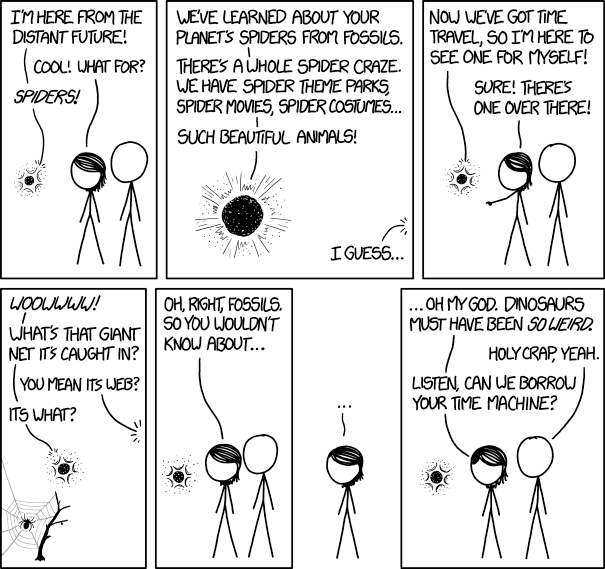
Fossils and Genealogy

Today's webcomic from XKCD


Just like fossil evidence might give scientists of the future an incomplete picture of spiders, genealogists have to remember to ask ourselves what's missing, when looking at documents we find in archives. There could be important information about our ancestors (such as spider webs) that hasn't been preserved.

Thursday, March 31, 2016

Searching Digital Newspaper Archives: Don't stop with the names

My great grandfather's name is Barney Newmark, with a 'W.' How do you think I found the below article in my search of the St. Louis Post-Dispatch archives at Newspapers.com?

 Not by being creative with surname spellings. As you can see below, a search on the page yields no results for 'Neumark' (or, for that matter, 'Noumark'). Why not? I'm not sure. The search engine does just fine ignoring commas in places such as obituaries. I suspect it's just that Optical Character Recognition can be finicky, and will at times miss stuff.
Because of this, it's important to search for more than just an ancestor's name. If you know it, search for their address as well. The article above doesn't reveal much about my ancestor, but the classified below, from the August 10, 1952 edition, tells me when my great-great uncle, David Cruvant, put his pawnshop up for sale before moving to Louisiana, an approximate date for when the shop opened (I don't trust that it was exactly 1920), and it tells me his move was for health reasons.
Classified ads from 1954 also tell me that the business that bought the location and moved in was Veterans Linoleum and Tile, which became Becky's when the next generation of the family-owned business took over. Becky's Carpet and Tile closed in 2012, but had become an extremely well-known local business, so knowing that their first store was in the same store front as my great-great uncle's pawnshop means something to me. (And I'm looking for a photograph of Veterans Linoleum's Collinsville Avenue location to compare it to this 1920s-1930s photo.)
Also search for business names. The classified ad below, from May 4, 1902, doesn't say much, but it is the only appearance I've found other than in the City Directories of my second great grandfather, Selig Feinstein's, junk store, which he operated 1901-1902.
Maybe you know a relative was an officer of a local organization, and there is a newspaper article that mentions them by title and  not by name?

Finally, a search for names of neighborhoods can also yield important information. My research on the neighborhoods of Little Jerusalem and Carr Square has uncovered descriptions of the conditions my paternal ancestors lived in during the late 19th early 20th century. I even discovered a photograph which could be of family, though it isn't definite.

In short, search for everything you can think of connected with your ancestor. You don't know when your ancestor may be referred to, or even photographed, but not named. And you can't control mistakes made by faulty Optical Character Recognition.

Thursday, November 12, 2015

Not All Sources Are What They Seem

The source information Ancestry.com provides on some indexes might be misleading. Extremely misleading.

Take for example this one:

England, Select Births and Christenings, 1538-1975


Reading all the above, without following the link to the FamilySearch website, one would likely assume that all the entries originally came from official birth and christening records. It’s an index, so there could be transcription errors. It’s a secondary source. But it is still a transcription from a primary source, right? Or at least a transcription of a transcription since sometimes those vital records get transcribed by churches and governments. Thinking carefully, we may not know how many transcriptions there have been, but somewhere in the distant past there was a primary record. Right?

Let’s go to FamilySearch
“Vital Records Index” seems self explanatory, and sounds like what we expect. But what is the International Genealogical Index?
The IGI contains individual records of birth or christening, marriage, and death or burial for people all over the world. The IGI was first published in 1973 by the Church of Jesus Christ of Latter-day Saints; it was then closed in 2008, which means that no more information can be added to the index. The IGI was created from two unique sources: first the entries from the IGI were abstracted and indexed from original vital records by volunteers. The second was community contributed, which means that individuals would add in their own personal family names, which are not always the most accurate.
Nice use of understatement at the end of the description there. Yes, the database at Ancestry which implies that it comes from vital records includes family tree information provided by individuals with no fact checking and no indication of where the information truly came from.

Here’s an Ancestry record from that database for a great-aunt of mine. I don’t have her birth certificate, but I guarantee you that she was not born in England. Those are her parents’ names though, so it’s not an issue of two people with the same name. This is clearly an example of “community contributed” information to the IGI.

Going to Family Search and actually looking up the Film Number, you can find two entries for Minnie Ray. The Alston, Cumberland, England birth, and a San Marcos, Hays, Texas birth. As I said above, I don’t have a birth certificate. And while both entries are likely “community contributed” only one can possibly be correct. Theoretically, both could be wrong in some fashion. However, the San Marcos, Hays, Texas record, even if not 100% correct, puts you closer by a few miles. (Another use of understatement.)


I would be curious how the community contributor made the mistake. My suspicion is that their notes got jumbled and a place of birth for one person got swapped in by mistake. An easy human error to make. The existence of two entries with the same Indexing Project Number and Film Number suggests they may have come from the same contributor, and maybe they were confused about her birth for some reason and had two entries, and they both got submitted to the IGI.

While I was able to find both of these entries at FamilySearch, I believe Ancestry has only used these FamilySearch databases for non-US data. So the Texas entry didn't come up in my search.

Summary:

Not all sources are what they seem. The Ancestry.com international indexes of Select Births and Christenings, Select Births and Baptisms, Select Deaths and Burials, and Select Marriages that cite back to FamilySearch as their original source? Don’t assume the information in these indexes all come from vital records. How much of the data is based on vital records, and how much was community contributed is unclear.

Tuesday, February 24, 2015

Research All Names

When a family historian is looking at ancestral documents it is important to give consideration to the other names one finds in the document. Friends, Business Associates, Witnesses - conducting at least minimal research on these individuals is advisable. Not doing so may lead to missing out on some major discoveries.

Examples from my own research:
(Links are to past entries where I discuss these instances in greater detail)

1) Max Wieselman - Selig Feinstein's business partner

My second great grandfather, Selig Feinstein, set up a business with Max Wieselman as horse shoers during the 1890s in St. Louis. (They also filed a patent together.) It wasn't until I conducted some research on Max and his wife that I realized Max was likely born in the same Ukranian town as Selig. This **could** be a coincidence. Coincidences happen. But there could also be a relationship. Unfortunately, the records I need aren't online. Barring localized research in the Ukraine, which may be beyond my abilities, my best shot is to find a descendant of Max and ask them to take a DNA test. If they're related, that wouldn't tell me *how*, but a DNA test should tell me one way or another whether more research is necessary.


2) Michael Flynn, County Clerk for Clifford Cruvant's name correction

The digital copy of Clifford Cruvant's name correction doesn't have a date. (Whoever did the scanning didn't get the whole document.) However, by researching the County Clerk's name, I was able to narrow down the possible years. I could order the document from the current County Clerk, but for now knowing that it was after 1930 is enough information. I haven't been able to find either Clifford or his mother in the 1920 or 1930 census, but I know they were alive, somewhere.


3) Marcus Hast, cantor at the marriage of Sol Newmark and Sarah Nathan

If I hadn't conducted research on Marcus Hast, the cantor who performed the wedding for my great grandfather's brother, Sol Newmark, and his wife Sarah Nathan, I would never have realized he was from Warsaw, Poland, not far from where the Newmark family was living before immigrating to England. I also wouldn't have discovered the scores for the wedding music that he had composed. It's not definite that it is the same music that was played at the Newmark-Nathan wedding, but there is a strong likelihood.


4) Bessie and Iva, friends of Mabel Fulkerson, and fellow heroines

When I discovered the news story about my wife's great grandmother's efforts as a girl of 14 to prevent a train wreck, I was amazed at the presence of mind and the physical effort put forth by her and her two friends. However, if I hadn't researched the names of the other two, I wouldn't have realized they were her nieces. (Due to the age difference between her and her two oldest sisters, she was actually younger than her two nieces.)

Tuesday, February 17, 2015

Error Free Genealogy

I’ve mentioned before that error-free genealogy is impossible, no matter how careful one is. But with care, we can limit our mistakes.

Tracing a family backwards in time through census reports is something almost every genealogist does, but it is very easy to take a wrong turn if one isn’t careful. One problem is census reports only provide a snapshot every ten years, and lots can happen in ten years. Another problem is that census takers didn’t always have great handwriting, so the online indexers can easily garble a name.

Perhaps the easiest way to make a wrong turn is if you find what you’re looking for immediately.

For example:

Let’s say you find someone in the 1920 US census. They are married to the person you expect them to be married to, with the correct young child. You are certain it is the correct person, but you have no idea who his parents are. The 1920 census indicates an approximate birth year, and the place of birth (State or Country)

So you conduct a search for the person in the 1910 census, using their name, state of birth, and year of birth +- 2. And you find exactly one result – a child with two parents. How do you react? It’s very tempting to be relieved that it was so easy, to write down the information on the parents, and see if you can go further back.

However:

What would you do if you found more than one result?
You’d have to conduct some research to see which family is the correct one.

And what would you do if you found no results?
Probably you’d add some wildcards into the search, and see if the person you’re searching for got indexed with a strange spelling.

Back to the one result…Do you see the problem?
If all you are going on is year of birth, state of birth, and name, it is possible, is it not, that this isn’t the correct person? The person you are searching for could be hiding under a poorly written, or poorly transcribed name. Or it is possible they don’t even appear in the census. The census reports are by no means complete. The more common the surname and given name, the more likely this is possible. Additionally, given names frequently change from childhood to adulthood.

I've made my share of research mistakes, and there are likely some I have made which I don't yet know about. What I feel is important is that I always keep an open mind to the possibility that any conclusions that I make from my research have a potential of being wrong.

Saturday, October 4, 2014

Assumptions: The Name of the Father Part II

Fourth in a series of posts.

A discussion of assumptions one might be tempted to make. With examples taken from my own research.

Assumption: The name of the father on the birth certificate is the father of the child

You find the birth certificate for John Robert Green II, and the father's name on the certificate is John Robert Green. You decide your previous guess has been confirmed.

But wait!

Absent DNA tests you might have no way to confirm the veracity, but be aware, only the mother needs to be present at the birth. (Arguably, this is no longer the case with surrogacy.)

A 9 month period is a significant length of time, and a woman who changes partners might decide to put the new partner on the certificate, and to name the child accordingly.

For privacy reasons I will not indicate the example from my own research.

[Sure. In your database entry for "John Robert Green" change the source citation to the birth certificate. You now have more to go by than the name of the child. Finding a marriage certificate might help increase the odds, but there are many births outside of marriage. Genealogy is not an exact science; just because something is written down on a government-issued document doesn't mean it is indisputable fact. This is why source citations are so gosh important.]

Saturday, September 27, 2014

Assumptions: The Name of the Father

Third in a series of posts.

A discussion of assumptions one might be tempted to make. With examples taken from my own research.

Assumption: The name of a child indicates the name of the parent.

Example:

Question: You run across a person named John Robert Green II. What is his father's name?
Answer: You can not assume it is John Robert Green.

Sure, there is a strong likelihood. But there is no law, in the United States at least, that sets rules on how to name a child.

Sometimes a child can be named the II where an Uncle or other relative was the first.

Or you can have parents with a strange sense of humor.

You can have a John Robert Green II who is the son of David Alexander Green, with no John Robert in sight.

I wouldn't be surprised if somewhere in our country there exists a Leonard Part VI.

For privacy reasons I will not indicate the example from my own research.

[Sure. In your database enter "John Robert Green" for the father, and in the notes indicate that you are guessing that is his name from the name of the son. But always remember it is a guess, until you find confirming documentation.]

Saturday, September 20, 2014

Assumptions: Documents are a Snapshot in Time

Second in a series of posts.

A discussion of assumptions one might be tempted to make. With examples taken from my own research.

Assumption: Documentation that an individual lived somewhere in time indicates they lived there before or after that moment in time.

Every document is a snapshot in time. Except in rare occasions, they don't tell you what happened before or after that snapshot.

Below are entries from the St. Louis City Directory for my grandmother, Myrtle Van Every

•1921 - Astor Hotel
•1921 - 4528a Enright
•1922 - Westgate Hotel
•1922 - 4123 Westminster
•1923 - 4515 Washington
•1924 - 5630 Delmar
•1925 - 5540 Pershing
•1926 - 4506 Forest Park
•1927 - 4545 Washington
•1928 - 5707 McPherson apt 111
•1928 - 5656 Kingsbury apt 203
•1930 - Georgiana Court Apartments, 5660 Kingsbury, apt 203, St. Louis, MO (census - ED 169 - Sheet 1B)

She moved around a lot, but she remained in St. Louis. She doesn't appear in the 1929 directory, but not appearing in a particular directory isn't uncommon. I can imagine many genealogists, of varying experience levels, stating as fact that she lived in St. Louis continually from 1921 to 1930, citing the St. Louis City Directories and the 1930 census as evidence.

And there's nothing wrong with that, except for using the word 'fact.'

In April of 1927 my grandmother married in Oakland, California. In October of 1927 she divorced her husband, and returned to St. Louis. She didn't miss appearing in the 1927 directory. She appeared in the 1928 directory under her maiden name, and her married name. She did appear in the 1929 directory, but only under her married name. She returned to her maiden name by the census in 1930.

Remember: Every document is a snapshot in time. Be open to learning something important happened between two snapshots.

Saturday, September 13, 2014

Assumptions: Government Documents Are Always Reliable

First in a series of posts.

A discussion of assumptions one might be tempted to make. With examples taken from my own research.

Assumption: Government Documents are Always Reliable

While one might say, "of course they aren't, no one would make that mistake," this is what makes me cringe most often when watching Who Do You Think You Are. The researcher finds the grandmother in a household in a census, and tells the celebrity the parents in the household are their great grandparents. Perhaps their great grandparents are dead, and these are actually the grandmother's uncle and aunt? I assume (hope) the researcher has conducted additional research to verify the information, but they don't mention it on television, leading some viewers perhaps not to ask that question in their own research.


I have distant relatives who have looked at the above US census record from 1870 for the Denyer family, and recorded in online databases Amanda, Sherwood, and Ida as children of Ebenezer and Sarah, despite them being a decade older than William and McAlpin. They are actually the children of Ebenezer's brother, Samuel Denyer, who died in 1861, and his wife Zarelda, who died in 1867. (As a side note, several of the names in this record are actually middle names. McAlpin, for example, is my great grandmother, Margaret Jane McAlpin (Denyer) Vanevery.


Above is a marriage record from the UK General Register Office. The marriage occurred in London in 1902. If I asked you to tell me the name of the Father of the Bride, your answer would be "Nathan Nathan." I'm pretty certain I know what happened. The clerk asked the bride for her maiden name, and then asked only for her father's given name. Unfortunately, it appears Sarah followed the Jewish custom of using her father's first name as her last. Perhaps as an affectation, since it was no longer common in the 1900's. The 1901 UK census indicates the family name was Sandler, and Sandler appears on some documents as Sarah's maiden name.

Just because there is a government stamp on a document doesn't mean the information is necessarily correct. Record the information in your database, and cite your source, but always be open to discovering new, conflicting information.

Sunday, May 18, 2014

Caution is needed with obituaries

Obituaries can be great resources for filling in both recent and past generations of branches of your family tree, but one has to be very careful about the assumptions one makes when reading them.

[All names below have been altered.]

I read the below obituary of a distant cousin

SCHWINN, ROBIN (nee Goldstein) … dear mother of Penny Ann (Edward) Molloy, Ethan J. (Marcia) Johnson and the late Alice First; dear grandmother of Lana (Louis) Spalding, George W., Jack C., Rachel A. Johnson and Melissa Steinway; dear great grandmother of Matthew and Michael Spalding...

From this obituary I entered three children for Robin Goldstein and __ Schwinn
  • Penny Ann Schwinn – (married Edward Molloy)
  • Marcia Schwinn – (married Ethan J. Johnson) (daughter Rachel)
  • Alice Schwinn – (married ___ First)
I was unable to assign the other grandchildren to their parents without further information. I suspect there are a number of genealogists who would fill in the blanks as I did, carefully noting where they got the information, naturally.

Then I found Alice Schwinn’s obit

...Mrs. Schwinn…She is survived by her father, Ethan Johnson; mother, Robin Schwinn; sister, Penny Molloy; brother, John Johnson; grandmother, Opal Johnson; and close friend, Patricia Marie.

I knew something was wrong somewhere. There was no way Alice's father was her sister’s husband. And here was a brother not mentioned in the first obituary.

After a little thought I redrew the tree.

Robin Goldstein (Spouse 1: Ethan John Johnson) (Spouse 2: ___ Schwinn)
Children:
  • Penny Ann ___ (married Edward Molloy)
  • Ethan John Johnson, Jr. (married Marcia ___) (daughter Rachel)
  • Alice Johnson (married ___ First)
This information fits both obituaries, but contains some new assumptions. In order to confirm these, I could make a trip to the library and look up some marriage records in the microfilm. Or I could try to contact the cousins.

It is common for individuals to be better known by their middle name than their first, especially when they share a name with a parent. It is also common for half-siblings and step parents to be referenced without the modifiers. This leads to ambiguity that sometimes doesn't appear ambiguous.

Saturday, December 1, 2012

Show Me the Newspapers

Ancestry announced on Thursday a new website: Newspapers.com. Subscription rates are $80/year or $40/year for those who are already subscribing to Ancestry or Fold3. [Note: I rounded up 5 cents from the advertised prices.]

This inspired me to compare the newspaper selections at five major newspaper archival sites. I decided to focus on one state, fully realizing that the comparison was likely to differ somewhat depending upon which state I chose. However, I do not have the time to do this for every state. I chose the state I, personally, was most interested in. Missouri. My ancestors first moved to this state in the 1880s, and my wife's ancestors moved here a bit earlier.

I looked at the newspaper collections at Newspapers (N), Ancestry (A), NewspaperArchive (NA), GenealogyBank (GB), and ChroniclingAmerica (CA).  Of these five, Chronicling America is the only free offering, since it is a product of the Library of Congress. I have free access to NewspaperArchive through my library card. I also can access Ancestry's newspapers at my local library, but I can't access them from home without maintaining my subscription.

Utilizing the abbreviations above, I have noted where a title has shared coverage at a different site. If only a portion of the years are duplicated, I have indicated which years the other site has.  I've separated the titles each site has exclusively.

Note: There are some titles that look similar, but if a site listed them as separate, I assumed they were.

Newspapers.com (22 titles, 9 exclusive, 9 also at NewspaperArchive, 9 also at Ancestry, 5 at all three)

Exclusive
  • Mexico Ledger (Mexico, Missouri)
    • 1947 – 1977 (52,521 pages )
  • Moberly Democrat (Moberly, Missouri)
    • 1899 – 1922 (2,883 pages)
  • Moberly Evening Democrat (Moberly, Missouri)
    • 1899 – 1923 (13,901 pages)
  • Moberly Morning Monitor (Moberly, Missouri)
    • 1910 – 1916 (2,235 pages)
  • Moberly Weekly Democrat (Moberly, Missouri)
    • 1906 – 1909 (2,182 pages)
  • Neosho News (Neosho, Missouri)
    • 1953 – 1976 (7,194 pages)
  • The Neosho Daily News (Neosho, Missouri)
    • 1913 – 1976 (49,781 pages)
  • The Neosho Times (Neosho, Missouri)
    • 1913 – 1938 (10,553 pages)
Shared
  • The Chillicothe Constitution-Tribune (Chillicothe, Missouri) [A 1920-1988]
    • 1901 – 1988 (141,823 pages)
  • Cole County Democrat (Jefferson City, Missouri) [NA]
    • 1904 – 1905 (8 pages)
  • The Daily Capital News (Jefferson City, Missouri) [A] [NA]
    • 1937 – 1977 (52,108 pages)
  • Daily Capital News and Jefferson City Post-Tribune (Jefferson City, Missouri) [NA]
    • 1931 – 1933 (276 pages)
  • Jefferson City Post-Tribune (Jefferson City, Missouri) [A] [NA]
    • 1932 – 1967 (8,715 pages)
  • Jefferson City Tribune-Post (Jefferson City, Missouri) [NA]
    • 1927 – 1927 (333 pages)
  • Joplin Globe (Joplin, Missouri) [NA] 
    • 1921 – 1929 (27,082 pages)
  • Magic City Free Press (Moberly, Missouri) [A] [NA]
    • 1970 – 1974 (1,618 pages)
  • Moberly Monitor-Index (Moberly, Missouri) [A]
    • 1922 – 1964 (38,057 pages)
  • Moberly Weekly Monitor (Moberly, Missouri) [A]
    • 1929 – 1929 (552 pages)
  • The News and Tribune (Jefferson City, Missouri) [A] [NA]
    • 1933 – 1976 (6,729 pages)
  • Sedalia Daily Democrat (Sedalia, Missouri) [A] [NA]
    • 1871 – 1925 (4,698 pages)
  • The Sedalia Democrat (Sedalia, Missouri) [A]
    • 1949 – 1950 (6,455 pages )
  • The Sikeston Herald (Sikeston, Missouri) [A]
    • 1936 – 1960 (12,270 pages)
Ancestry.com (17 titles, 5 exclusive, 9 also at Newspapers, 6 also at NewspaperArchive, 5 at all three)

Exclusive
  • Chillicothe Morning Constitution (Chillicothe, Missouri)
    • 1889-1985
  • The Chillicothe Constitution (Chillicothe, Missouri)
    • 1901-1928
  • The Constitution Tribune (Chillicothe, Missouri)
    • 1985-1988
  • Stars and Stripes Newspaper, WWI Edition, 1918-1919
    • 1918-1919
  • U.S., "Happy Days" Newspaper of the Civilian Conservation Corps, 1933-1940
    • 1933-1940
[Note: I believe Ancestry lists these last two for every state.]

Shared
  • Daily Capital News (Jefferson City, Missouri) [N] [NA]
    • 1937-1977
  • Sedalia Daily Democrat (Sedalia, Missouri) [N]
    • 1871-1925
  • Sedalia Democrat, The (Sedalia, Missouri) [N] [NA]
    • 1949-1950
  • Jefferson City Post-Tribune (Jefferson City, Missouri) [N 1932-1967] [NA]
    • 1929-1974
  • Joplin Globe (Joplin, Missouri) [NA]
    • 1944-1958
  • Magic City Free Press (Moberly, Missouri) [N] [NA]
    • 1970-1974
  • Moberly Monitor-Index (Moberly, Missouri) [N 1922-1964]
    • 1922-1977
  • Moberly Weekly Monitor (Moberly, Missouri) [N 1929]
    • 1929-1932
  • News and Tribune (Jefferson City, Missouri) [N 1933-1976] [NA]
    • 1933-1977
  • The Chillicothe Constitution Tribune (Chillicothe, Missouri) [N]
    • 1920-1988
  • The Maryville Daily Forum (Maryville, Missouri) [NA]
    • 1940-1955
  • The Sikeston Herald (Sikeston, Missouri) [N]
    • 1936-1960
NewspaperArchive (31 titles, 21 exclusive, 9 also at Newspapers, 6 also at Ancestry, 6 at all three)

Exclusive
  • Capital Daily News (1970)
    • Jefferson City, Missouri
  • Chillicothe Weekly Constitution (1902 - 1920)
    • Chillicothe, Missouri
  • Daily Capital News and Post Tribune (1931 - 1933)
    • Jefferson City, Missouri
  • Daily Democrat Tribune (1910 - 1924)
    • Jefferson City, Missouri
  • Daily Saint Charles Cosmos Monitor (1921 - 1953)
    • Saint Charles, Missouri
  • Democrat Tribune (1920 - 1922)
    • Jefferson City, Missouri
  • Jefferson City Daily Capital News (1918 - 1972)
    • Jefferson City, Missouri
  • Jefferson City Daily Tribune (1909)
    • Jefferson City, Missouri
  • Jefferson City Democrat Tribune (1915 - 1920)
    • Jefferson City, Missouri
  • Jefferson City Tribune (1909 - 1927)
    • Jefferson City, Missouri
  • Jefferson City Weekly Tribune (1909)
    • Jefferson City, Missouri
  • Joplin Daily Globe (1898 - 2012)
    • Joplin, Missouri
  • Joplin News Herald (1921 - 1970)
    • Joplin, Missouri
  • Joplin Sunday Globe (2010 - 2012)
    • Joplin, Missouri
  • Mexico School News Roundup (1954)
    • Mexico, Missouri
  • Missouri Gazette Public Advertiser (1822)
    • St Louis, Missouri
  • Missouri Republican (1823 - 1824)
    • St Louis, Missouri
  • St Louis Star Times (1945)
    • St Louis, Missouri
  • St Louis Weekly Globe Democrat (1896 - 1901)
    • St Louis, Missouri
  • St Louis World Fair (1904)
    • St Louis, Missouri
  • Weekly Democrat Tribune (1911 - 1914)
    • Jefferson City, Missouri
Shared
  • Cole County Democrat (1904 - 1909) [N]
    • Jefferson City, Missouri
  • Daily Capital News (1920 - 1977) [A 1930-1977] [N 1930-1977]
    • Jefferson City, Missouri
  • Daily Capital News and Jefferson City Post Tribune (1931 - 1933) [N]
    • Jefferson City, Missouri
  • Daily Democrat (1871 - 1999) [N 1871-1925] [A 1871-1925]
    • Sedalia, Missouri
  • Jefferson City News and Tribune (1933 - 1978) [N 1933-1976] [A 1933-1977]
    • Jefferson City, Missouri
  • Jefferson City Post Tribune (1927 - 1978) [A 1929-1974] [N 1932-1967]
    • Jefferson City, Missouri
  • Jefferson City Tribune Post (1927) [N]
    • Jefferson City, Missouri
  • Joplin Globe (1915 - 2012) [A 1944-1958] [N 1921-1929]
    • Joplin, Missouri
  • Magic City Free Press (1970 - 1974) [A] [N]
    • Moberly, Missouri
  • Maryville Daily Forum (1940 - 1955) [A]
    • Maryville, Missouri
GenealogyBank (15 titles, 15 exclusive)
  • Hannibal - Missouri Courier
    • 1/18/1849 – 12/28/1854
  • Kansas City - Kansas City Star
    • 9/18/1880 – 12/31/1941
  • Kansas City - Kansas City Times
    • 5/1/1884 – 1/31/1896
  • Kansas City - Rising Son
    • 1/16/1903 – 12/28/1907
  • Kansas City - Cosmopolitan
    • 8/22/1914 – 11/15/1919
  • Sedalia - Sedalia Times
    • 8/31/1901 – 12/19/1903
  • St. Louis - St. Louis Republic
    • 5/1/1888 – 10/31/1900
  • St. Louis - Daily Missouri Republican
    • 3/1/1841 – 4/1/1888
  • St. Louis - St. Louis Palladium
    • 1/10/1903 – 10/5/1907
  • St. Louis - Daily Commercial Bulletin
    • 5/18/1835 – 12/31/1838
  • St. Louis - Weekly St. Louis Pilot
    • 1/6/1855 – 11/15/1856
  • St. Louis - Missouri Gazette and Public Advertiser
    • 3/23/1808 – 9/18/1818
  • St. Louis - St. Louis Enquirer
    • 3/17/1819 – 12/18/1824
  • St. Louis - St. Louis Clarion
    • 12/18/1920 – 4/2/1921
  • Washington - Die Washingtoner Post
    • 11/17/1870 – 11/14/1878
Chronicling America (57 titles, 57 exclusive)
  • The Professional world.
    • Columbia, Mo., 1901-1903
  • The Cape weekly tribune.
    • Cape Girardeau, Mo., 1914-1914
  • Fair play.
    • Ste. Genevieve [Mo.], 1872-1921
  • The Jasper news.
    • Jasper, Mo., 1901-1922
  • The Holt County sentinel.
    • Oregon, Mo., 1865-1880
  • The Hayti herald.
    • Hayti, Mo., 1909-1922
  • The state republican.
    • Jefferson City, Mo., 1890-1896
  • The Missouri herald.
    • Hayti, Mo., 1922
  • The Cape County herald.
    • Cape Girardeau, Mo., 1911-1914
  • The Montgomery tribune.
    • Montgomery City, Mo., 1900-1910
  • The St. Joseph observer.
    • St. Joseph, Mo., 1915-1922
  • The Lincoln County herald.
    • Troy, Lincoln County, Mo., 1866-1873
  • The state journal.
    • Jefferson City, Mo., 1872-1878
  • The Kansas City sun.
    • Kansas City, Mo., 1914-1920
  • Boon's Lick times.
    • Fayette, Mo., 1840-1848
  • The Cape Girardeau Democrat.
    • Cape Girardeau, Mo., 1891-1901
  • Hannibal journal.
    • Hannibal, Mo., 1853-1853
  • The County paper.
    • Oregon, Mo., 1881-1883
  • The Holt County sentinel.
    • Oregon, Mo., 1883-1921
  • Osage Valley banner.
    • Tuscumbia, Miller County, Mo., 1879-1881
  • The Weekly tribune and the Cape County herald.
    • Cape Girardeau, Mo., 1914-1918
  • Monroe City Democrat.
    • Monroe City, Mo., 1898-1919
  • Kansas City journal.
    • Kansas City, Mo., 1890-1899
  • Glasgow weekly times.
    • Glasgow, Mo., 1848-1861
  • Western union.
    • City of Hannibal, Mo., 1850-1851
  • Hannibal journal.
    • Hannibal, Mo., 1852-1853
  • University Missourian.
    • Columbia, Mo., 1908-1916
  • The Saline republican.
    • Marshall, Mo., 1898-1899
  • Morgan County democrat.
    • Versailles, Mo., 1903-1906
  • Morgan County republican.
    • Versailles, Mo., 1906-1914
  • The Rich Hill tribune.
    • Rich Hill, Mo., 1903-1910
  • The tribune.
    • Rich Hill, Mo., 1901-1902
  • Mexico Missouri message.
    • Mexico, Audrain County, Mo., 1899-1918
  • The Jackson herald.
    • Jackson, Mo., 1901-1910
  • Glasgow weekly times.
    • Glasgow, Howard County, Mo., 1866-1869
  • The Howard union.
    • Glasgow, Mo., 1865-1865
  • The news boy.
    • Benton, Scott County, Mo., 1894-1897
  • Scott County kicker.
    • Benton, Mo., 1901-1917
  • The daily Missourian.
    • Columbia, Mo., 1916-1917
  • The Evening Missourian.
    • Columbia, Mo., 1917-1920
  • The Columbia evening Missourian.
    • Columbia, Mo., 1920-1922
  • Saturday morning visitor.
    • City of Warsaw, Mo., 1848-1849
  • The Sedalia weekly bazoo.
    • Sedalia, Mo., 1877-1893
  • Weekly graphic.
    • Kirksville, Adair Co., Mo., 1880-896
  • The Troy herald.
    • Troy, Mo., 1873-1878
  • Salt River journal.
    • Bowling Green, Mo., 1839-1841
  • The radical.
    • Bowling Green [Mo., 1841-1845
  • The St. Louis Republic.
    • St. Louis, Mo., 1900-1906
  • Kansas City daily journal.
    • Kansas City, Mo., 1895-1897
  • Sedalia weekly conservator.
    • Sedalia, Mo., 1903-1908
  • Democratic banner.
    • Bowling Green, Pike County, Mo., 1845-1851
  • Hannibal journal and western union.
    • Hannibal, Mo., 1851-1852
  • Richmond democrat.
    • Richmond, Ray County, Mo., 1879-1888
  • The Rising son.
    • Kansas City, Mo., 1903-1907
  • The Andrew County Republican.
    • Savannah, Mo., 1871-1876
  • The weekly tribune.
    • Cape Girardeau, Mo., 1918-1919
  • The Marshall republican.
    • Marshall, Saline County, Mo., 1899-1914
Conclusions

1) Newspapers.com is definitely not merely a duplicate of the selection at Ancestry. Nor is it a duplicate of the selection at NewspaperArchive. There is overlap, but all three have unique coverage.

2) GenealogyBank and Ancestry are essentially tied with 15 titles in Missouri, not counting the two national titles at Ancestry. However, GenealogyBank's titles are all exclusive. And they have coverage in St. Louis and Kansas City the other sites don't have. I don't know if it holds up in other states, but in Missouri GenealogyBank seems to have an urban focus, while the other sites focus rurally.

3) If a researcher isn't utilizing ChroniclingAmerica - they are missing out on an excellent free resource.

4) Personally, I don't see a strong need to subscribe to Newspapers.com.  However, this choice is going to depend entirely on the newspapers of interest for each individual researcher.

Saturday, October 27, 2012

Error Free Genealogy


In the past five years of research, one thing I've learned is that Error-free Genealogy isn't possible. I don't know about you, but I'm definitely human, as I seem to make a lot of mistakes.

For awhile I was sure my great great grandfather, Samuel, and my great grandfather, Barney, were in Canada from May 1904 to July 1907. I don't think I'd be the only person to make that assumption after reading the below border crossing document. It wasn't until I found the May 1907 passenger manifest that I realized they were in Canada only two months. I still am somewhat surprised that the same hand could write two 7s so differently a few inches away from each other. That is the same hand, isn't it?


Then there are the oversights I don't have anything to blame but myself - such as when the year I type into my database isn't what appears on the document. Even the most careful individual occasionally makes typographical errors. Hopefully they aren't as embarrassing as the tattoo above.

I've learned to keep this in mind when looking at the work of others. It doesn't matter if it is a family tree at Ancestry, Genealogy, Wikitree, or FamilySearch. It doesn't matter if it's a printed genealogy that contains sources, or doesn't contain sources. Sources only provide an easier way for me to check to see if mistakes were made; they don't provide me a reason not to check. I recently followed the citations listed in a family genealogy and came to a different conclusion than the author.

One thing I haven't decided upon is whether or not to go back through old posts and fix errors, or provide updated information. In general, I think I should, as I don't want to unintentionally spread bad information. But I lean towards providing updates, as opposed to covering up my initial error. (Except for typographical mistakes; I always fix those when I discover them.)

Saturday, September 29, 2012

Fifteen Favorites

James Tanner at Genealogy's Star listed his Top Ten Can't Miss Websites, focusing on non-Genealogy websites, but including archives that aren't specifically for genealogy. His rationale was that we as genealogy bloggers sometimes focus so much on discussing genealogy websites, we don't discuss other websites that are useful for other interests.

In that vein, I came up with two lists (neither of the lists are in any particular order):

Top Ten Archival Sites

1) The Internet Archive

The Internet Archive is home to several useful databases.  The Wayback Machine has been archiving the internet since 1996.  Often you will find a link in an old blog post (or elsewhere) that no longer works, because the website has disappeared, or that particular page has been removed.  The page may exist on The Wayback Machine.

The Internet Archive also has several archives of text, audio, and video.

2) Making of America (Michigan) (Cornell)

"Making of America is a digital library of primary sources in American social history from the antebellum period through reconstruction."  It is a collaboration between University of Michigan and Cornell University, and each site has separate documents, so you need to search at both.

Cornell has 907,750 pages of material, and Michigan has 3,818,757.

3) Missouri Digital Heritage

There are several databases of use to genealogists, such as birth and death records, naturalization records, coroner records, and land records. However, the website has a lot more on it as well, including:
4) NewspaperArchive

A collection of over 2000 newspaper titles with archives going back to the 1600s. There is a subscription fee, which some might be able to avoid if their local library or genealogy society provides access.

5) ChroniclingAmerica

Another collection of newspapers, this is freely accessible as a product of the Library of Congress. Covers the years 1836-1922. It also contains a directory of US Newspapers from 1690-present, providing useful information on each, including libraries that have copies.

6) St. Louis Post Dispatch Historical Archive

Covering the years 1874-1922 this database is a product of ProQuest and can be accessed at some libraries, including the St. Louis County library and the St. Louis City library.

7) 19th Century US Newspapers

Another collection of newspapers, a product of Gale-Cengage, and also available at some libraries, including the St. Louis County library.  There are newspapers from all over the US in the collection. Local newspapers covered include the Daily Commercial Bulletin (1835-1838), Missouri Republican (1822-1888), St. Louis Enquirer (1819-1824), and St. Louis Globe Democrat (1875-1888)

8) The National Archives (NARA)

I don't think I need to provide much of a description. This is the website for the US Government National Archives and Records Administration.

9) Flickr (The Commons)

Flickr, the website many people use to upload and share photos, has a section they call The Commons. This section contains photographs contributed by a long list of libraries and archives around the world. All participating institutions are required to share only images with "No known copyright restrictions."

10) Google Books

While everyone is familiar with searching Google, not everyone is familiar with searching Google Books. I believe I use it most often to track down the real origins of quotes I see spread on the social networks.  I've collected some of these on my Pinterest boards of Misattributed Quotes, and Verified Quotes (with citations)


Top Five Websites - Non-Genealogy Non-Archives

1) Amazon

I know Amazon is responsible for the financial struggles of many local bookstores.  I also know technology has been changing the way society conducts business for over a century. We are now moving towards a world where we do most of our shopping online. That may mean less local bookstores. It doesn't mean the death of books.

I have purchased many things on Amazon: Books, Clothing, Computers.

2) Google News

This is how I get my news. I subscribe to only one local print newspaper, and it's a specialized weekly, not the local daily. I read news stories from many newspapers on the topics I have selected as my defaults, or those I search for specifically.

3) Google Maps

This is how I travel. (I recently updated my iPhone to OS 6.0.  But I can still use Google Maps, because I downloaded the Web App.)

4) Wikipedia

This is where I often begin my research on many topics. I was taught in school (I won't say how many years ago) that an encyclopedia is a great starting point for research, but it should never be the ending point. That advice still applies today, for Encyclopedia Britannica as well as for Wikipedia.  I have discussed Using Wikipedia for Research before.

5) Wikisource 

Wikisource is an online library of free content. The English language site currently contains 264,721 texts.

Saturday, July 28, 2012

Finding My Past - Part Three: Hampshire Baptisms

Exploring FindMyPast with my new subscription, I decided to look up some Denyer baptisms. This is another instance where I have already conducted the research, but I wanted to see if FindMyPast had the same information.

Farlington Parish has transcriptions of their Baptism Records from 1654-2005 (with some gaps) online. I had already looked up the records for the eight children of my fourth great grandparents William and Jane (Goldfinch) Denyer.

Source: Farlington Parish Baptismal Records
(the only additional information on the full records are the given names of the parents.)


For the set between 1766 and 1812, Farlington Parish provides the following source information: Reproduced by kind permission of the Portsmouth Record Office. From a transcription of the original Register done by the Rev John Burrough Rector of Farlington Parish, in 1794. [This obviously references the entries from 1766-1794. The website displays a document written by Rev. Burrough and dated 1794 explaining that the original registers had been damaged due to dampness and the transcription was done to prevent loss of the information. The website doesn't indicate from where the information for the records 1794-1812 come, beyond the Portsmouth Record Office.]

At FindMyPast I conducted a search for all Denyers in the United Kingdom with the Optional Keyword 'Farlington' and specifically selected the Hampshire Baptisms record set.  There were only ten results.  The first two below may well be related in some fashion, but I haven't yet figured out how. The following eight match up with those found on Farlington's website.

Source: FindMyPast (used with permission)

At least all of the names, and six of the dates. John Henry was baptized in either 1795 or 1796, according to Farlington Parish or FindMyPast respectively. Charles was baptized in either 1802 or 1801, according to Farlington Parish or FindMyPast respectively.  The months and dates are identically transcribed.


Source: FindMyPast - (used with permission)

FindMyPast doesn't indicate where their transcribed records came from. I suspect if they transcribed from any original records themselves there would be images. Since all FindMyPast has is a transcription, my assumption is that they transcribed from a transcription - possibly the same transcription Farlington Parish transcribed from. But in both cases it's a transcription of a transcription. There is nothing in either to give greater credence.

However - in the case of John Henry - I suspect FindMyPast is more likely correct. It's very unlikely that John Henry was baptized in March of 1795 if my 3rd great grandfather, William, was baptized in July of 1795. (Especially since family records suggest William was born in November of 1794. Waiting several months between birth and baptism was common, but if William and John Henry were twins, they would likely have been baptized together.)

FindMyPast does appear to fall into the same trap that I've noticed elsewhere in referring to baptismal year as birth year in the transcription. They're not the same thing.

Another baptism I searched for is that of my fourth great grandfather, William - the father of the eight children above. Many family trees posted online indicate he was born in 1763, and his father was named Richard.
Source: FindMyPast - (used with permission)
However, the Hampshire Marriage Allegation for William Denyer and Jane Goldfinch asserts they were both 21 in 1791. It is very unlikely in my mind that this William Denyer was my fourth great grandfather.

FindMyPast was able to uncover a much more likelier answer. While some descendants might cringe at part of the transcription, I'm not bothered.

William (Fyfield or Denyer) - baptized in Headley Parish in December of 1771 - the illegitimate son of a William Denyer and Elizabeth Fyfield.

Source: FindMyPast - (used with permission)
All I have to support this theory is a baptismal date that comes within a year after the assumed birth year from the marriage allegation.  There might well be another William Denyer born at the right time whose baptismal record hasn't either survived or for some other reason doesn't appear in these databases. But for now I think these are the most likely candidates for my fifth great grandparents.

Update February 2013 - I have been contacted by one of the joint administrators of the Farlington Parish, and he has clarified that their transcriptions are from the original registers that are kept at the Portsmouth Record Office. He also mentioned that the transcription continues and more records continue to be added.

Finding My Past - Part Two: Census Records

Readers of Part One, where I looked at FindMyPast's marriage records, may have enlarged the image of the search results and noticed the check marks by the two view icons. This indicates that the transcription and the image had already been viewed.  I didn't take screen captures as I was conducting the research, I went back later and repeated my steps.

These check marks are a nice addition, letting the researcher know: You've already been here. 


Source: FindMyPast (used with permission)
Instead of repeating my original research steps exactly, I'm going to go another route to the same records.

First, I am going to click "Search" on the opening screen without entering any data whatsoever:

Source: FindMyPast (used with permission)
This takes me to a screen with 1,232,970,358 results. I guess that's the number of records they currently have. I will then narrow down the results dramatically by entering a last name, specifying the United Kingdom, and using the Optional Keyword "Tailor".  There are 15 results, and I show the first four below.

I'm unsure who Harry Newmark is. There are several Newmark families in England and the US. From discussions on Surname message boards, it seems many of them trace their roots to a similar geographical area. Whether there is a common ancestor might only be determinable through Y-Surname DNA.

Source: FindMyPast (used with permission)
Barnet is my great grandfather, Solomon his brother, and Samuel their father. There is one tailor in their household, however, who appears on the 1901 census, but doesn't appear in these search results. Unless one searches for "Tailor*" or "Tailoress". My great grandfather's sister, Nelly.

Source: FindMyPast (used with permission)
I was actually unaware that Nelly was listed on the census as a Tailoress.  I originally viewed the 1901 English Census back in April of 2007. (I know this because of the date on the image file I downloaded.) This tells me that there is a 99% probability I downloaded it from Ancestry.com. That said, I clearly wasn't looking at documents very carefully back then.
Database Source: The National Archives (published by permission)
Despite the X marks (and I am unsure why they are there) the professions for Solomon, Barnet, and Nelly are quite clear.

This page of census results only lists the children of the household. Obviously, the parents were at the bottom of the preceding page. There seems to be no way to move back or forward a page in the census results.  However, I can return to the transcription.

Source: FindMyPast (used with permission)
And at the top of the "Other Household Members" are the parents, and I can select the view options from there.  (You might notice that on the transcription page, previously viewed transcriptions or images aren't checked off like they are on the search results page.)

I like how FindMyPast appears to transcribe every or almost every possible field on the record. This allows one to search on those fields using the "optional keyword," and helps the novice researcher not overlook some fields on the image.

One might complain that even though one can find other family members on the transcription, not being able to move back and forth on the pages prevents you from looking up neighbors. Not so. The Registration District and Street Name appear in the transcription.

Using the Optional Keywords: Marylebone "Wells Street" - and narrowing the results to the 1901 census, produces 462 results - likely everyone recorded on Wells Street in the 1901 census.

Source: FindMyPast (used with permission)

Another feature I like is their "Research Profile". This can be selected from the home page, or any transcription or image page:


Source: FindMyPast (used with permission)

It provides you a list of every single entry you have looked at, and whether you have viewed the image, transcription, or both. 

Source: FindMyPast (used with permission)
It also provides you with the # of credits it would cost if you were purchasing the documents "As you Go" instead of using a monthly or annual package.  Currently you can buy 100 credits for $13.95, and you have 90 days to spend them.  This will help a lot in a year when I have to decide if I wish to renew, and what package to choose.

So far I have 'spent' 95 credits, and I have focused mostly on my Newmark relatives. I've viewed one Goldfinch record, no Denyers, and none of my wife's British surnames. There's a lot of fun research ahead for me.

Friday, July 27, 2012

Finding My Past - Part One: England and Wales Marriages

FindMyPast - the British genealogy website, is expanding to America.

They currently have a deeply discounted World Subscription rate, and since my Ancestry subscription is US-only, I decided to give it a try. My first search involved the brother of my great grandfather, Sol Newmark. I knew he had gotten married in London.  I actually already have a copy of his marriage certificate, but I was curious what FindMyPast would turn up.

1) On the opening screen I entered his name under Who. I selected 'name variants' for the given name, but not the surname.

Source: FindMyPast (used with permission)
[Note: any image in this entry can be clicked upon to make larger]

2) These were the the first two results:

Source: FindMyPast (used with permission)
The first result was his marriage. And there were two spouses listed - one of them completely unfamiliar to me. My initial assumption was that either

A) Something no one told me about happened
B) What we have here is a page of a document with multiple marriages and the FindMyPast transcribers were unable to differentiate the marriages for some reason, so they include all of the surnames.

So I viewed the transcription (There are two icons in green next to the word "View" - a camera, and a piece of paper. The piece of paper is the transcription.) I also conducted a search on both spouses, and the additional groom who turned up, pretty much confirming hypothesis B. Here are the four transcriptions:


Source: FindMyPast (used with permission)

If you enlarge the images, you will notice that all four indicate a Page # of 110.  They all have the same "Image Quarter" (3). I was unable to fit the entire transcription in the images, but there is also a row that indicates they all have identical Volume #s (1C)  All other rows with data in them are in the images above.


I decided I wanted to view the image of Page 110. So from Solomon's transcription I clicked on the View Image button.


Database Source: The National Archives (published by permission)
Above I show the top of the page, so you can see the header, and the bottom of the page where Solomon's entry was located (in the middle column).  You can see that isn't page 110.  The images for Sarah Nathan, Eva Belosky, and Morris Rudowsky are all on different pages.


It's clear why the transcribers didn't know which spouse was which.  They entered the volume and page number for each person, and then saw who matched up. I believe '3rd Quarter' represents the months of the year - since each year appears to have been divided into 3-month segments. The image doesn't really contain any information that isn't on the transcription.

This is all supposition. I could probably do some research on the England and Wales Marriages (1837-2008) database  - but this information isn't on the FindMyPast website that I could tell. I'd have to find it on a different website with the same database. They also provide no information on how to take this information and order the actual certificate - which would be nice.

As Randy at Genea-Musings noted there isn't enough information for a proper citation. If I don't care about the academic quality of the citation (which in general I don't) I have enough information to suffice for my own needs.


FindMyPast does have an article in their "Learn More" section on the importance of citations.

Source: FindMyPast (used with permission)
In Part Two I will look at the Census results, as well as a couple other FindMyPast features. (Some of which I am quite fond.)

Note: As Randy points out in the comments, FreeBMD does have the information about these records that FindMyPast doesn't.  I'm unsure where I retrieved the Volume and Page # for my great great uncle back in 2007 (no source notes were written down in my database), but wherever it was, they didn't provide me with multiple spouses.  They probably just provided me with the volume and page number for Solomon, which was enough for me to order the certificate from the General Register Office. While the multiple spouses listed might not confuse British researchers, now that they are trying to attract American researchers, it would likely behoove them to provide a little bit of explanation.

Further Note: Here's the Certificate ordering information that FindMyPast provides on their British website.  They haven't yet moved it over to their American site.