Thursday, November 24, 2011

Wednesday, November 23, 2011
Thanksgiving Poetry
Below are several poems I have posted here on past Thanksgivings, all gathered together in one post.
I am posting them a day early in case someone is inspired to include any of them in their festivities tomorrow.
GRATITUDE - by Edgar A. Guest (©1917)
Be grateful for the kindly friends that walk along your way;
Be grateful for the skies of blue that smile from day to day;
Be grateful for the health you own, the work you find to do,
For round about you there are men less fortunate than you.
Be grateful for the growing trees, the roses soon to bloom,
The tenderness of kindly hearts that shared your days of gloom;
Be grateful for the morning dew, the grass beneath your feet,
The soft caresses of your babes and all their laughter sweet.
Acquire the grateful habit, learn to see how blest you are,
How much there is to gladden life, how little life to mar!
And what if rain shall fall to-day and you with grief are sad;
Be grateful that you can recall the joys that you have had.
Thanksgiving - by Edgar A. Guest (©1917)
Gettin' together to smile an' rejoice,
An' eatin' an' laughin' with folks of your choice;
An' kissin' the girls an' declarin' that they
Are growin' more beautiful day after day;
Chattin' an' braggin' a bit with the men,
Buildin' the old family circle again;
Livin' the wholesome an' old-fashioned cheer,
Just for awhile at the end of the year.
Greetings fly fast as we crowd through the door
And under the old roof we gather once more
Just as we did when the youngsters were small;
Mother's a little bit grayer, that's all.
Father's a little bit older, but still
Ready to romp an' to laugh with a will.
Here we are back at the table again
Tellin' our stories as women an' men.
Bowed are our heads for a moment in prayer;
Oh, but we're grateful an' glad to be there.
Home from the east land an' home from the west,
Home with the folks that are dearest an' best.
Out of the sham of the cities afar
We've come for a time to be just what we are.
Here we can talk of ourselves an' be frank,
Forgettin' position an' station an' rank.
Give me the end of the year an' its fun
When most of the plannin' an' toilin' is done;
Bring all the wanderers home to the nest,
Let me sit down with the ones I love best,
Hear the old voices still ringin' with song,
See the old faces unblemished by wrong,
See the old table with all of its chairs
An' I'll put soul in my Thanksgivin' prayers.
Looking Back - by Edgar Guest (©1921)
I might have been rich if I'd wanted the gold instead of the friendships I've made.
I might have had fame if I'd sought for renown in the hours when I purposely played.
Now I'm standing to-day on the far edge of life, and I'm just looking backward to see
What I've done with the years and the days that were mine, and all that has happened to me.
I haven't built much of a fortune to leave to those who shall carry my name,
And nothing I've done shall entitle me now to a place on the tablets of fame.
But I've loved the great sky and its spaces of blue; I've lived with the birds and the trees;
I've turned from the splendor of silver and gold to share in such pleasures as these.
I've given my time to the children who came; together we've romped and we've played,
And I wouldn't exchange the glad hours spent with them for the money that I might have made.
I chose to be known and be loved by the few, and was deaf to the plaudits of men;
And I'd make the same choice should the chance come to me to live my life over again.
I've lived with my friends and I've shared in their joys, known sorrow with all of its tears;
I have harvested much from my acres of life, though some say I've squandered my years.
For much that is fine has been mine to enjoy, and I think I have lived to my best,
And I have no regret, as I'm nearing the end, for the gold that I might have possessed.
A Song of Thanks - by Edward Smyth Jones (©1922)
FOR the sun that shone at the dawn of spring,
For the flowers which bloom and the birds that sing,
For the verdant robe of the gray old earth,
For her coffers filled with their countless worth,
For the flocks which feed on a thousand hills,
For the rippling streams which turn the mills,
For the lowing herds in the lovely vale,
For the songs of gladness on the gale,—
From the Gulf and the Lakes to the Oceans’ banks,—
Lord God of Hosts, we give Thee thanks!
For the farmer reaping his whitened fields,
For the bounty which the rich soil yields,
For the cooling dews and refreshing rains,
For the sun which ripens the golden grains,
For the bearded wheat and the fattened swine,
For the stalled ox and the fruitful vine,
For the tubers large and cotton white,
For the kid and the lambkin frisk and blithe,
For the swan which floats near the river-banks,—
Lord God of Hosts, we give Thee thanks
For the pumpkin sweet and the yellow yam,
For the corn and beans and the sugared ham,
For the plum and the peach and the apple red,
For the dear old press where the wine is tread,
For the cock which crows at the breaking dawn,
And the proud old “turk” of the farmer’s barn,
For the fish which swim in the babbling brooks,
For the game which hide in the shady nooks,—
From the Gulf and the Lakes to the Oceans’ banks—
Lord God of Hosts, we give Thee thanks!
For the sturdy oaks and the stately pines,
For the lead and the coal from the deep,
dark mines, For the silver ores of a thousand fold,
For the diamond bright and the yellow gold,
For the river boat and the flying train,
For the fleecy sail of the rolling main,
For the velvet sponge and the glossy pearl,
For the flag of peace which we now unfurl,—
From the Gulf and the Lakes to the Oceans’ banks,—
Lord God of Hosts, we give Thee thanks!
For the lowly cot and the mansion fair,
For the peace and plenty together share,
For the Hand which guides us from above,
For Thy tender mercies, abiding love,
For the blessed home with its children gay,
For returnings of Thanksgiving Day,
For the bearing toils and the sharing cares,
We lift up our hearts in our songs and our prayers,—
From the Gulf and the Lakes to the Oceans’ banks,—
Lord God of Hosts, we give Thee thanks!
I am posting them a day early in case someone is inspired to include any of them in their festivities tomorrow.
GRATITUDE - by Edgar A. Guest (©1917)
Be grateful for the kindly friends that walk along your way;
Be grateful for the skies of blue that smile from day to day;
Be grateful for the health you own, the work you find to do,
For round about you there are men less fortunate than you.
Be grateful for the growing trees, the roses soon to bloom,
The tenderness of kindly hearts that shared your days of gloom;
Be grateful for the morning dew, the grass beneath your feet,
The soft caresses of your babes and all their laughter sweet.
Acquire the grateful habit, learn to see how blest you are,
How much there is to gladden life, how little life to mar!
And what if rain shall fall to-day and you with grief are sad;
Be grateful that you can recall the joys that you have had.
Thanksgiving - by Edgar A. Guest (©1917)
Gettin' together to smile an' rejoice,
An' eatin' an' laughin' with folks of your choice;
An' kissin' the girls an' declarin' that they
Are growin' more beautiful day after day;
Chattin' an' braggin' a bit with the men,
Buildin' the old family circle again;
Livin' the wholesome an' old-fashioned cheer,
Just for awhile at the end of the year.
Greetings fly fast as we crowd through the door
And under the old roof we gather once more
Just as we did when the youngsters were small;
Mother's a little bit grayer, that's all.
Father's a little bit older, but still
Ready to romp an' to laugh with a will.
Here we are back at the table again
Tellin' our stories as women an' men.
Bowed are our heads for a moment in prayer;
Oh, but we're grateful an' glad to be there.
Home from the east land an' home from the west,
Home with the folks that are dearest an' best.
Out of the sham of the cities afar
We've come for a time to be just what we are.
Here we can talk of ourselves an' be frank,
Forgettin' position an' station an' rank.
Give me the end of the year an' its fun
When most of the plannin' an' toilin' is done;
Bring all the wanderers home to the nest,
Let me sit down with the ones I love best,
Hear the old voices still ringin' with song,
See the old faces unblemished by wrong,
See the old table with all of its chairs
An' I'll put soul in my Thanksgivin' prayers.
Looking Back - by Edgar Guest (©1921)
I might have been rich if I'd wanted the gold instead of the friendships I've made.
I might have had fame if I'd sought for renown in the hours when I purposely played.
Now I'm standing to-day on the far edge of life, and I'm just looking backward to see
What I've done with the years and the days that were mine, and all that has happened to me.
I haven't built much of a fortune to leave to those who shall carry my name,
And nothing I've done shall entitle me now to a place on the tablets of fame.
But I've loved the great sky and its spaces of blue; I've lived with the birds and the trees;
I've turned from the splendor of silver and gold to share in such pleasures as these.
I've given my time to the children who came; together we've romped and we've played,
And I wouldn't exchange the glad hours spent with them for the money that I might have made.
I chose to be known and be loved by the few, and was deaf to the plaudits of men;
And I'd make the same choice should the chance come to me to live my life over again.
I've lived with my friends and I've shared in their joys, known sorrow with all of its tears;
I have harvested much from my acres of life, though some say I've squandered my years.
For much that is fine has been mine to enjoy, and I think I have lived to my best,
And I have no regret, as I'm nearing the end, for the gold that I might have possessed.
A Song of Thanks - by Edward Smyth Jones (©1922)
FOR the sun that shone at the dawn of spring,
For the flowers which bloom and the birds that sing,
For the verdant robe of the gray old earth,
For her coffers filled with their countless worth,
For the flocks which feed on a thousand hills,
For the rippling streams which turn the mills,
For the lowing herds in the lovely vale,
For the songs of gladness on the gale,—
From the Gulf and the Lakes to the Oceans’ banks,—
Lord God of Hosts, we give Thee thanks!
For the farmer reaping his whitened fields,
For the bounty which the rich soil yields,
For the cooling dews and refreshing rains,
For the sun which ripens the golden grains,
For the bearded wheat and the fattened swine,
For the stalled ox and the fruitful vine,
For the tubers large and cotton white,
For the kid and the lambkin frisk and blithe,
For the swan which floats near the river-banks,—
Lord God of Hosts, we give Thee thanks
For the pumpkin sweet and the yellow yam,
For the corn and beans and the sugared ham,
For the plum and the peach and the apple red,
For the dear old press where the wine is tread,
For the cock which crows at the breaking dawn,
And the proud old “turk” of the farmer’s barn,
For the fish which swim in the babbling brooks,
For the game which hide in the shady nooks,—
From the Gulf and the Lakes to the Oceans’ banks—
Lord God of Hosts, we give Thee thanks!
For the sturdy oaks and the stately pines,
For the lead and the coal from the deep,
dark mines, For the silver ores of a thousand fold,
For the diamond bright and the yellow gold,
For the river boat and the flying train,
For the fleecy sail of the rolling main,
For the velvet sponge and the glossy pearl,
For the flag of peace which we now unfurl,—
From the Gulf and the Lakes to the Oceans’ banks,—
Lord God of Hosts, we give Thee thanks!
For the lowly cot and the mansion fair,
For the peace and plenty together share,
For the Hand which guides us from above,
For Thy tender mercies, abiding love,
For the blessed home with its children gay,
For returnings of Thanksgiving Day,
For the bearing toils and the sharing cares,
We lift up our hearts in our songs and our prayers,—
From the Gulf and the Lakes to the Oceans’ banks,—
Lord God of Hosts, we give Thee thanks!
Tuesday, November 22, 2011
Conflicting Emotions
Reposted from 2008
I want to talk about a holiday filled with conflicting emotions.
This is a holiday that remembers our ancestors’ religious persecution.
This is a holiday that commemorates freedom and hope.
Celebration of this holiday involves food, prayer, games, and family gathered.
This holiday requires us to close our eyes, temporarily, to the facts.
This holiday requires us to forget, for the moment, what happened afterward, in the following generations.
We focus on the freedom, the hope, the opportunity, with the albatross of that same opportunity squandered hanging over our heads, but not welcome at the holiday table filled with food, family, and festivities.
I probably should wait to talk about this holiday, since it doesn’t begin for another 3.5 weeks.
Hanuka begins on the evening of December 20 this year.
However, in the year 164 BCE, when Mattathias, his sons, and their followers fought back against religious persecution, the month on the Roman calendar was November. Kislev 25 fell on November 21st, to be exact.
As Rabbi Joseph Telushkin in Jewish Literacy, writes, “One of the sadder ironies of Jewish history is that the Maccabees led a successful revolt against King Antiochus’ anti-semitic oppressors only to turn into oppressors of the Jews themselves. (p. 112)”
On Hanuka we will focus on the freedom, the hope, and the opportunity, just as we as Americans do on Thanksgiving. We need to teach our children what happened next, so they aren’t blind to the forces of history, but that can be done on a different day. It doesn’t need to weigh us down on a holiday meant for celebration.
Related newspaper column: Chanukah's History: Challenging but Full of Meaning
I want to talk about a holiday filled with conflicting emotions.
This is a holiday that remembers our ancestors’ religious persecution.
This is a holiday that commemorates freedom and hope.
Celebration of this holiday involves food, prayer, games, and family gathered.
This holiday requires us to close our eyes, temporarily, to the facts.
This holiday requires us to forget, for the moment, what happened afterward, in the following generations.
We focus on the freedom, the hope, the opportunity, with the albatross of that same opportunity squandered hanging over our heads, but not welcome at the holiday table filled with food, family, and festivities.
I probably should wait to talk about this holiday, since it doesn’t begin for another 3.5 weeks.
Hanuka begins on the evening of December 20 this year.
However, in the year 164 BCE, when Mattathias, his sons, and their followers fought back against religious persecution, the month on the Roman calendar was November. Kislev 25 fell on November 21st, to be exact.
As Rabbi Joseph Telushkin in Jewish Literacy, writes, “One of the sadder ironies of Jewish history is that the Maccabees led a successful revolt against King Antiochus’ anti-semitic oppressors only to turn into oppressors of the Jews themselves. (p. 112)”
On Hanuka we will focus on the freedom, the hope, and the opportunity, just as we as Americans do on Thanksgiving. We need to teach our children what happened next, so they aren’t blind to the forces of history, but that can be done on a different day. It doesn’t need to weigh us down on a holiday meant for celebration.
Related newspaper column: Chanukah's History: Challenging but Full of Meaning
Monday, November 21, 2011
Amanuensis Monday: How to Pack Bees - 1910
Amanuensis: A person employed to write what another dictates or to copy what has been written by another.
I continue my project to transcribe family letters, journals, newspaper articles, audiotapes, and other historical artifacts. Not only do the documents contain genealogical information, the words breathe life into kin - some I never met - others I see a time in their life before I knew them.
I began this project back in February of 2009, and since then, many others have joined in on the meme. Why do we transcribe? I provide my three reasons in the linked post. You may find others. If you participate, feel free to leave a link to your post in the comments.
***
This week I transcribe a letter my great grandfather, Melvin Van Every, wrote in 1910 to the editors of Gleanings in Bee Culture.
I continue my project to transcribe family letters, journals, newspaper articles, audiotapes, and other historical artifacts. Not only do the documents contain genealogical information, the words breathe life into kin - some I never met - others I see a time in their life before I knew them.
I began this project back in February of 2009, and since then, many others have joined in on the meme. Why do we transcribe? I provide my three reasons in the linked post. You may find others. If you participate, feel free to leave a link to your post in the comments.
***
This week I transcribe a letter my great grandfather, Melvin Van Every, wrote in 1910 to the editors of Gleanings in Bee Culture.
Sunday, November 20, 2011
Week In Review
Below are some highlights from news stories and blog posts I have read in the past week that deal with my overlapping interests in Genealogy, History, Heritage, and Technology.
And a comic with which I identified.
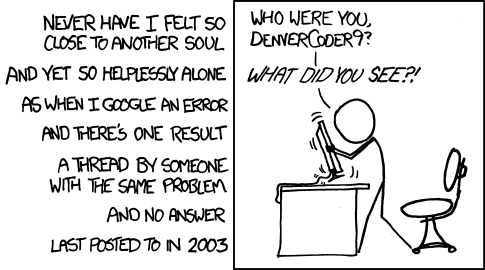
I saw the above XKCD comic, and thought about changing the text to: "Never have I felt so close to another soul and yet so helplessly alone as when I Google an ancestor and there's one result: a thread by someone with the same brick wall and no answer. Last posted to in 2003. Who where you, GeneaResearcher9? What have you learned?!"
Other Weekly Link Lists
- Megan Smolenyak Smolenyak at MSS Roots World has learned that the Social Security Administration has extended the FOIA restriction to 100 years.
- Chris Staats at Staat's Place compares microfilm images Scanned vs Printed
- Deb Ruth at Adventures in Genealogy shares how she has Connected on Find a Grave
- Rabbi Rachel Barenblat, The Velveteen Rabbi, recently wrote a Spiritual Will which may resonate with some family historians.
- James Tanner at Genealogy's Star in Can I Conserve My Own Pile of Documents?s?
- Lorine McGinnis Schulze at the Olive Tree Genealogy Blog in What Will You Do With Your Genealogy Research?
- Randy Seaver at Genea-Musings in Dear Randy: What are you going to do with your Genealogy-Stuff?
- National Archives to Release 1940 Census Free Online on April 2, 2012 (National Archives Press Releases)
- Digital Preservation Europe has released a series of humorous videos (hat/tip: UpFront with the NGS)
And a comic with which I identified.
I saw the above XKCD comic, and thought about changing the text to: "Never have I felt so close to another soul and yet so helplessly alone as when I Google an ancestor and there's one result: a thread by someone with the same brick wall and no answer. Last posted to in 2003. Who where you, GeneaResearcher9? What have you learned?!"
Other Weekly Link Lists
- Randy Seaver's Best of the Genea-Blogs at Genea-Musings
- Deb Ruth's Follow Friday Gems at Adventures in Genealogy
- Ruth Blair's Ruth's Recommendations at The Passionate Genealogist
- Julie Cahill Tarr's Friday Finds at GenBlog
- Megan Smolenyak Smolenyak's Genealogy Round Up at MSS's RootsWorld
Monday, November 14, 2011
Amanuensis Monday: Marriage License for Melvin Newmark and Belle Feinstein - May 1936
Amanuensis: A person employed to write what another dictates or to copy what has been written by another.
I continue my project to transcribe family letters, journals, newspaper articles, audiotapes, and other historical artifacts. Not only do the documents contain genealogical information, the words breathe life into kin - some I never met - others I see a time in their life before I knew them.
I began this project back in February of 2009, and since then, many others have joined in on the meme. Why do we transcribe? I provide my three reasons in the linked post. You may find others. If you participate, feel free to leave a link to your post in the comments.
***
This week I am transcribing the marriage license of my grandparents, Melvin Newmark and Belle Feinstein on May 9-10, 1936.
I continue my project to transcribe family letters, journals, newspaper articles, audiotapes, and other historical artifacts. Not only do the documents contain genealogical information, the words breathe life into kin - some I never met - others I see a time in their life before I knew them.
I began this project back in February of 2009, and since then, many others have joined in on the meme. Why do we transcribe? I provide my three reasons in the linked post. You may find others. If you participate, feel free to leave a link to your post in the comments.
***
This week I am transcribing the marriage license of my grandparents, Melvin Newmark and Belle Feinstein on May 9-10, 1936.
Sunday, November 13, 2011
Week In Review
Below are some highlights from news stories and blog posts I have read in the past week that deal with my overlapping interests in Genealogy, History, Heritage, and Technology.
Other Weekly Link Lists
- The National Genealogical Society announces the release of a new video: Becoming a Genealogist: My Father's Journey (an interview with Janet A. Alpert, CG)
- Thomas MacEntee at Destination: Austin Family recommends the revival of an old meme: Names, Places, and Most Wanted Faces.
- Michael John Neill at RootDig, reshares an article he wrote 11 years ago: The Third Grader's 1850 Census. His attempt to distract his daughter so he could get some work done failed miserably in its primary goal, but his daughter learned a lot in the process.
- Elyse Doerflinger at Elyse's Genealogy Blog describes her experiences discussing family with a pre-school class.
- Next American City discusses What Remains at the site of the infamous Pruitt-Igoe housing project in St. Louis.
- Craig Manson at GeneaBlogie suggests we Don't Cry About the SSDI even though as of November 1, 2011, SSA will no longer include state records in the Death Master File.
- Michael Hait at Planting the Seeds asks Does a "reasonably exhaustive search" include Online Family Trees?
- James Tanner at Genealogy's Star attempts to answer the question, Can I Use a Smartphone or a Camera to digitize photos?
- Eviatar Zerubavel at Salon asks Why Do We Care About Our Ancestors?
Other Weekly Link Lists
- Randy Seaver's Best of the Genea-Blogs at Genea-Musings
- Deb Ruth's Follow Friday Gems at Adventures in Genealogy
- Ruth Blair's Ruth's Recommendations at The Passionate Genealogist
- Julie Cahill Tarr's Friday Finds at GenBlog
- Liz Haigney Lynch's Links at The Ancestral Archaeologis
- Diane Haddad's Genealogy News Corral at Genealogy Inside
- Megan Smolenyak Smolenyak's Genealogy Round Up at MSS's RootsWorld
Friday, November 11, 2011
Veterans Day, 2011

In honor of Veterans Day and Remembrance Day, below are the names of ancestors, and their siblings, who I know served their nation's military, either in a time of war, or in a time of peace.
I am including my Loyalist ancestors; their nation was Great Britain. I am including my Confederate ancestors too, despite their desire to form a separate nation.
Fifth Great Grandfathers
McGregory Van Every (1723-1786) Loyalist/Butler's Rangers
Michael Showers (1733-1796) Loyalist/Butler's Rangers
Fourth Great Grandfather
David Van Every (1757-1820) Loyalist/Butler's Rangers (served briefly as a Patriot in the NY militia)
Fifth Great Uncle
Benjamin Van Every (1759-1795) Loyalist/Butler's Rangers(served briefly as a Patriot in the NY militia)
William Van Every (1765-1832) Loyalist/Butler's Rangers
Peter Van Every (1771-bef 1816) Loyalist/Fifth Lincoln and Second York regiments (War of 1812)
Fourth Great Uncles
David Van Every Jr. (1782-1847) Loyalist/Second York regiment (War of 1812)
Michael Van Every (1790-?) Loyalist/Fifth Lincoln and Second York regiments (War of 1812)
Second Great Grandfather
Ebenezer Denyer (1828-1872) (Confederate Army)
Third Great Uncles
Samuel Jennings Denyer (1822-1861) (Gonzales County Minute Men - Republic of Texas -1841)
Samuel T Hartley (1830-1920) (Confederate Army)
Great Grandfather
Samuel Deutsch (1861-1938) (Franz Josef's Austro-Hungarian Army)
Grandfathers
Melvin L Newmark (1912-1992), WWII
Martin J Deutsch (1907-1991), WWII
Great Uncles
Jerry Deutsch (1909-1950), WWII
Allen Deutsch (1914-1988), WWII
Harold Newmark (1915-2003), WWII
Mandell Newmark (1923-1945), WWII (Killed in Action)
Bernard Feinstin (1913-1968), WWII
Seymour Feinstein (1917-1999), WWII
Uncle
Stevan J Newmark (1942-1997) Army Reserves
Photographs of those who served in World War II


My grandfathers Melvin Newmark (1912-1992) and Martin Deutsch (1907-1991)


Allen Deutsch (1914-1988) and Maurice "Jerry" Deutsch (1909-1950).


Harold Newmark (1915-2003) and Mandell Newmark (1923-1945).


Bernard "Benny" Feinstein (1913-1968) and Seymour "Babe" Feinstein (1917-1999)
Wednesday, November 9, 2011
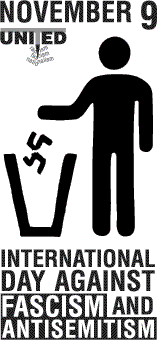
November 9th - The International Day Against Fascism - A Day of Fate
November 9th is sometimes referred to as "The European 9/11" since most European countries write their dates with the number for the month second. Schicksalstag, German for "Day of Fate," is also used for the day.
 Schicksalstag was first used for November 9th by some German historians after WWII, but it picked up in popularity after 1989. There are several major events in German history that occurred on this date, with conflicting emotional baggage. However, when you look at a list of events for November 9, you realize this Day of Fate doesn’t stop at Germany’s borders.
Here’s a partial list:
Schicksalstag was first used for November 9th by some German historians after WWII, but it picked up in popularity after 1989. There are several major events in German history that occurred on this date, with conflicting emotional baggage. However, when you look at a list of events for November 9, you realize this Day of Fate doesn’t stop at Germany’s borders.Here’s a partial list:
694 – Egica, a king of the Visigoths of Hispania, accuses Jews of aiding Muslims, sentencing all Jews to slavery.
1494 - Medicis assume rule of Florence, Italy
1799 - Napoleon overthrew the French government in the coup d’etat of 18 Brumaire
1918 - Kaiser Wilhelm steps down, and Germany’s Republic begins
1923 - Hitler’s failed Beer Hall Putsch
1938 - Kristallnacht/Pogromnacht - German pogrom viewed as the symbolic start of the Holocaust
1953 - Cambodia declares its independence
1989 - Berlin wall comes down
1494 - Medicis assume rule of Florence, Italy
1799 - Napoleon overthrew the French government in the coup d’etat of 18 Brumaire
1918 - Kaiser Wilhelm steps down, and Germany’s Republic begins
1923 - Hitler’s failed Beer Hall Putsch
1938 - Kristallnacht/Pogromnacht - German pogrom viewed as the symbolic start of the Holocaust
1953 - Cambodia declares its independence
1989 - Berlin wall comes down
The International Day Against Fascism and Antisemitism is a European campaign, but it has a worldwide message.
Tuesday, November 8, 2011
Third Annual Great Genealogy Poetry Challenge
Bill West at West in New England is hosting his Third Annual Great Genealogy Poetry Challenge***
Find a poem by a local poet, famous or obscure, from the region one of your ancestors lived in. It can be about an historical event, a legend, a person, or even about some place (like a river)or a local animal. It can even be a poem you or one of your ancestors have written! Or if you prefer, post the lyrics of a song or a link to a video of someone performing the song.The deadline for submission is November 20th. The rest of the details can be read on his blog.
I have participated in the first two editions of this contest, but between last year and now I have come to the conclusion my Feinstein/Dudelsack ancestors arrived from Volhynia, Russia. So I decided to find a Volhynian poet. It wasn't difficult, and I was pleasantly surprised, as he turned out to already be one of my favorite poets.

Bialik is considered by many to be the "father of Modern Hebrew poetry," and it is great to see he was raised in the same town (Zhitomir) my great great grandfather's brother, Julius, put down as his town of origin on his immigration papers. Selig and Julius Dudelsack left Russia in the 1890s, a decade before Bialik began publishing poetry - but did the Dudelsack family know Bialik's grandfather?
Bialik's poetry (in Hebrew) can be found here.
I share an excerpt below of an English translation. with a link to another site where the entire poem can be read. (While the original Hebrew was written in 1904, the translation is still under copyright.) The poem below was read in 2003 at the Memorial for the fallen Columbia astronauts.
***
After My Death
Say this when you mourn for me:
There was a man – and look, he is no more.
He died before his time.
The music of his life suddenly stopped.
A pity! There was another song in him.
Now it is lost
forever.
(Read the rest of the poem)
***
Bialik is also known for his gathering and editing of the Sefer Ha-gaddah (Legends from Talmud and Midrash)
***
Note for the curious - actress Mayim Bialik has indicated she is descended from a sibling of Bialik's.
Monday, November 7, 2011
Amanuensis Monday: Marriage License for Herman Feinstein and Annie Blatt
Amanuensis: A person employed to write what another dictates or to copy what has been written by another.
I continue my project to transcribe family letters, journals, newspaper articles, audiotapes, and other historical artifacts. Not only do the documents contain genealogical information, the words breathe life into kin - some I never met - others I see a time in their life before I knew them.
I began this project back in February of 2009, and since then, many others have joined in on the meme. Why do we transcribe? I provide my three reasons in the linked post. You may find others. If you participate, feel free to leave a link to your post in the comments.
***
Last week I transcribed the Application for a Marriage License filed by my great grandparents Herman Feinstein and Annie Blatt. This week, I transcribe the actual marriage license.
I continue my project to transcribe family letters, journals, newspaper articles, audiotapes, and other historical artifacts. Not only do the documents contain genealogical information, the words breathe life into kin - some I never met - others I see a time in their life before I knew them.
I began this project back in February of 2009, and since then, many others have joined in on the meme. Why do we transcribe? I provide my three reasons in the linked post. You may find others. If you participate, feel free to leave a link to your post in the comments.
***
Last week I transcribed the Application for a Marriage License filed by my great grandparents Herman Feinstein and Annie Blatt. This week, I transcribe the actual marriage license.
Sunday, November 6, 2011
Week In Review
Below are some highlights from news stories and blog posts I have read in the past week that deal with my overlapping interests in Genealogy, History, Heritage, and Technology.
Other Weekly Link Lists
- Jasia releases The 111th edition of the Carnival of Genealogy at CreativeGene. This edition's theme was Autumn Weddings
- Greta Koehl at Greta's Genealogy Bog explains why she Wants to Remain an Amateur
- Michael John Neill at RootDig republishes a piece he wrote back in 2000, which was definitely worth resharing. Have You...I Wonder.
- Philip Trauring at Blood and Frogs discusses Perceptions of Relationship and how much DNA (on average) we share with particular relations.
- Ginger Smith at Genealogy by Ginger illustrates How to Use Google Images to Find Your Ancestors.
- The World Vital Records blog writes about The Dark Side of Family History Research, and its Uses
- Those with Dutch ancestry, and familiar with the Dutch language, may be interested in two new websites released by Municipal Archive Amsterdam and discussed by Tamura Jones at Modern Software Experience in Dutch Militia Registers and Many Hands.
- Michael Hait at Planting the Seeds shares some tips on Managing your Blog
- For the 125th Birthday of the Statue of Liberty, NextBook Press has published an Interactive New Colossus. The New Colossus is the poem, by Emma Lazarus, which adorns the base of the statue; this interactive version contains several multimedia annotations. (hat/tip: Jewish Publication Society)
- Google announces that they have altered their search formula to increase the importance of recency.
- Ancestry Press Release: Ancestry.com and United States Holocaust Memorial Museum Release First Searchable Online Records Collections From World Memory Project. (GenealogyBlog)
- UK Daily Mail: An engaged couple in South Africa discovered they were siblings just before the wedding.
- In Halloween is More Funny than Scary in St. Louis - NPR reports on the unique St. Louis Halloween tradition of forcing kids to come up with riddles and jokes. (Personally, I think other cities should adopt this tradition. But I was born and grew up in St. Louis.)
- Heather Wilkinson Rojo at Nutfield Genealogy wrote on Witches, Halloween, and Genealogy providing suggestions for those with Essex County (Salem) ancestry.
- For All Saints Day, the multiple authors behind The Catholic Gene each discuss their favorite saint in - For All The Saints.
Other Weekly Link Lists
- Randy Seaver's Best of the Genea-Blogs at Genea-Musings
- Deb Ruth's Follow Friday Gems at Adventures in Genealogy
- Ruth Blair's Ruth's Recommendations at The Passionate Genealogist
- Julie Cahill Tarr's Friday Finds at GenBlog
Thursday, November 3, 2011
Yankel and the Holding Cell
Found this in a drafts folder. I wrote this a couple years ago to post, but I never did. Nothing's changed.
We’ve placed a relative in a holding cell. We didn’t know where else to put him. But somewhat similar to Schrödinger’s infamous cat, who is half-alive and half-dead, he’s in two different holding cells simultaneously, depending upon whether you ask me, or my cousin.
Yankel, son of Meier, was born in an Eastern European shtetl about 1839. This we know from census records. A Meier was born in 1795. I consider him the ‘father’ of the line, though we do know the name of a brother. Meier would have been 44 in 1839. Not too old to be a father.
My cousin, who’s been researching the family for twenty years, has created a Meier son of Meier to be the father of Yankel, because he fits better in the next generation. When I remind her that this goes against European Jewish tradition, she reminds me that most Jews had multiple Jewish names, and the birth records only have one written down. One could have been Meier Zev, and the other Meier Leyb. Or for that matter, one could have been Zev Meier and the other Leyb Meier. Still, I feel uncomfortable creating the appearance of a ‘junior’ unless there is proof that a ‘junior’ existed.
The superstition was that the Angel of Death could get confused and take the infant instead of the father/grandfather. Superstitions like that only fade away when infant mortality begins to drop, and parents stop asking G-d, ‘why did you take our child?’ In the 20th century it’s just a tradition, one that gets broken on occasion, but in the 19th century I suspect the superstition still held.
Still, for both of us, it’s a holding cell. A guess. We are almost certain he is a member of the family and fits in somewhere, along with all of his descendants. (Which could be tested with a DNA surname study.) I’m more comfortable with my holding cell; she is more comfortable with hers. The important thing is that we make notes that it is a holding cell. She has been extremely careful to cite all sources and explain all logic to the point that I occasionally think she’s gone a little overboard in her notes. But it’s a good practice I need to learn.
Hopefully, someday, Yankel will be free.
We’ve placed a relative in a holding cell. We didn’t know where else to put him. But somewhat similar to Schrödinger’s infamous cat, who is half-alive and half-dead, he’s in two different holding cells simultaneously, depending upon whether you ask me, or my cousin.
Yankel, son of Meier, was born in an Eastern European shtetl about 1839. This we know from census records. A Meier was born in 1795. I consider him the ‘father’ of the line, though we do know the name of a brother. Meier would have been 44 in 1839. Not too old to be a father.
My cousin, who’s been researching the family for twenty years, has created a Meier son of Meier to be the father of Yankel, because he fits better in the next generation. When I remind her that this goes against European Jewish tradition, she reminds me that most Jews had multiple Jewish names, and the birth records only have one written down. One could have been Meier Zev, and the other Meier Leyb. Or for that matter, one could have been Zev Meier and the other Leyb Meier. Still, I feel uncomfortable creating the appearance of a ‘junior’ unless there is proof that a ‘junior’ existed.
The superstition was that the Angel of Death could get confused and take the infant instead of the father/grandfather. Superstitions like that only fade away when infant mortality begins to drop, and parents stop asking G-d, ‘why did you take our child?’ In the 20th century it’s just a tradition, one that gets broken on occasion, but in the 19th century I suspect the superstition still held.
Still, for both of us, it’s a holding cell. A guess. We are almost certain he is a member of the family and fits in somewhere, along with all of his descendants. (Which could be tested with a DNA surname study.) I’m more comfortable with my holding cell; she is more comfortable with hers. The important thing is that we make notes that it is a holding cell. She has been extremely careful to cite all sources and explain all logic to the point that I occasionally think she’s gone a little overboard in her notes. But it’s a good practice I need to learn.
Hopefully, someday, Yankel will be free.
Tuesday, November 1, 2011
Reading a Passenger Manifest: Is it a Match?

The question I asked myself back in 2007 when I first discovered it was: Is this my great great grandmother, Anna (Perlik) Feinstein, her mother-in-law, and her several children.
In the below table I show the information I had for each family member from Family Records(FR): name, approximate birth year - and the matching information from the Passenger Manifest (PM). In no cases do I have birth records from their ancestral Russian village.
(For the passenger manifest, I'm using the spelling of names as indexed, even where I'm pretty certain it's wrong.)
| FR: Name | FR: Birth Year | PM: Name | PM: Birth Year |
| Anna | 1868 | Mechame | 1866 |
| Gitel | 1840 | Gitel | 1856 |
| Harry | 1884 | Hersch | 1885 |
| Herman | 1886 | Chaim | 1887 |
| Ben | 1888 | Berl | 1890 |
| Pearl | 1890 | Pirl | 1891 |
| ??????? | ??????? | Jette | 1873 |
1) Anna: Anna's Hebrew name was Nechama. It means, 'comfort,' and was often Americanized to Channa or Anna.
I didn't know her Hebrew name when I first found the Passenger Manifest, as I hadn't yet visited her tombstone. But I asked someone familiar with possible Hebrew names, and they suggested Nechama, which turned out to be correct.
2) Gitel: The name matches, the birth year is a complete mismatch. But do I discard the record because of that? I don't think so. Could she have lied about her age? Could a 51 year old woman pass for 35? There are stories of families getting the necessary immigration papers through less than direct methods where the information on the records might not always match exactly.
3) Harry's Hebrew name was Zvi, which means 'Deer.' The Yiddish variant is, 'Hirsch.' 'Harry' was a common Americanization of Zvi/Hirsch.
4) 'Herman' is a common Americanization of the Hebrew name, Chaim, meaning, 'life.' There are no documents with my great grandfather's Hebrew name on it, however, he does appear in the 1900 census as "Hyman" which shows the progression from Chaim to Herman as a name.
5) The Hebrew name 'Berel/Beryl', meaning either a gemstone, or 'bear,' was often Americanized to 'Ben.' I have no documents, however, with Ben's Hebrew name.
6) Perl is also a Hebrew name, and means 'Fruit.' 'Pearl' would have been an obvious choice for an American name.
***
Anna's husband, Selig, made the journey alone in 1890. It makes sense his wife, mother, and children would make the trip not long after. And 1891 is recorded as their year of immigration on the 1910 census. (The 1900, 1920 and 1930 census say 1890 for everyone.)
The coincidence of names, and close approximations of most of the birth years, makes this a very likely match. However, there is certainly the possibility that there was another family out there with similar names and birth years. I think the number of matches lowers the odds. I wish the passenger manifest said they were headed to St. Louis. Unfortunately, it says New York. However, the destination on Selig's Passenger Manifest was also New York, and I haven't found evidence the Feinstein family was in St. Louis until 1892. It's possible they weren't.
There is also the issue of Jette (or, more likely, Yetta) Feinstein. I have no record of any relative who would have been traveling with them with that name. I've tried to research the name, and haven't been able to find out what happened to this person.
Feinstein was not my ancestors' original surname. Selig immigrated under his original name of Selig Dudelsack. He changed his surname to Feinstein soon after arrival in the US. The reasons aren't clear, and the family had been told the traditional story of his name being changed at Ellis Island (or in Selig's case, Castle Garden.) It's actually possible that it was Selig's wife and mother who adopted the Feinstein surname in their immigration process. It's conceivable they may have been 'traveling with' Yetta Feinstein, but weren't actually related to her.
Monday, October 31, 2011
Amanuensis Monday: Application for Marriage - Herman Feinstein and Annie Blatt - 1912
Amanuensis: A person employed to write what another dictates or to copy what has been written by another.
I continue my project to transcribe family letters, journals, newspaper articles, audiotapes, and other historical artifacts. Not only do the documents contain genealogical information, the words breathe life into kin - some I never met - others I see a time in their life before I knew them.
I began this project back in February of 2009, and since then, many others have joined in on the meme. Why do we transcribe? I provide my three reasons in the linked post. You may find others. If you participate, feel free to leave a link to your post in the comments.
***
This week, I transcribe the application for marriage for two of my paternal great grandparents, Herman Max Feinstein, and Annie Blatt.
I continue my project to transcribe family letters, journals, newspaper articles, audiotapes, and other historical artifacts. Not only do the documents contain genealogical information, the words breathe life into kin - some I never met - others I see a time in their life before I knew them.
I began this project back in February of 2009, and since then, many others have joined in on the meme. Why do we transcribe? I provide my three reasons in the linked post. You may find others. If you participate, feel free to leave a link to your post in the comments.
***
This week, I transcribe the application for marriage for two of my paternal great grandparents, Herman Max Feinstein, and Annie Blatt.
Sunday, October 30, 2011
Week In Review
Below are some highlights from news stories and blog posts I have read in the past week that deal with my overlapping interests in Genealogy, History, Heritage, and Technology.
Around the Blogs
Other Weekly Link Lists
Around the Blogs
- Michael Hait of Planting the Seeds has been conducting online research on a particular case for over a year. This week he wrapped up that research, discussing The limits of online genealogy research.
- James Tanner At Genealogy's Star argues for A Systems Approach to Genealogical Research
- Michael John Neill at RootDig illustrates how Ancestry.com Still Confuses Last Benefit with Death Place on the SSDI. The last place someone received a Social Security benefit check is often not the place where they died.
- Some YouTube videos inspire Lee Drew at Family History with the Lineage Keeper to suggest a method for Recording Family History With A Flair
- Bill West at West in New England shares a poem, The Citation, or a Genealogy Horror Poem
- Those using both Google+ and Blogger may be interested in knowing that Google is now allowing you to use your Google+ Profile as your Blogger Profile.
Other Weekly Link Lists
- Randy Seaver's Best of the Genea-Blogs at Genea-Musings
- Diane Haddad's Genealogy News Corral at Genealogy Insider
- Deb Ruth's Follow Friday Gems at Adventures in Genealogy
- Ruth Blair's Ruth's Recommendations at The Passionate Genealogist
Monday, October 24, 2011
Amanuensis Monday: Everett Van Every - April 2, 1924
Amanuensis: A person employed to write what another dictates or to copy what has been written by another.
I continue my project to transcribe family letters, journals, newspaper articles, audiotapes, and other historical artifacts. Not only do the documents contain genealogical information, the words breathe life into kin - some I never met - others I see a time in their life before I knew them.
I began this project back in February of 2009, and since then, many others have joined in on the meme. Why do we transcribe? I provide my three reasons in the linked post. You may find others. If you participate, feel free to leave a link to your post in the comments.
***
This week, I transcribe an article for the April 2nd, 1924 edition of the San Antonio Express. The article is very brief, but confirms what I have learned from other sources regarding the death of my maternal grandmother's nephew, Everett Van Every.
I continue my project to transcribe family letters, journals, newspaper articles, audiotapes, and other historical artifacts. Not only do the documents contain genealogical information, the words breathe life into kin - some I never met - others I see a time in their life before I knew them.
I began this project back in February of 2009, and since then, many others have joined in on the meme. Why do we transcribe? I provide my three reasons in the linked post. You may find others. If you participate, feel free to leave a link to your post in the comments.
***
This week, I transcribe an article for the April 2nd, 1924 edition of the San Antonio Express. The article is very brief, but confirms what I have learned from other sources regarding the death of my maternal grandmother's nephew, Everett Van Every.
Sunday, October 23, 2011
Week In Review
Below are some highlights from news stories and blog posts I have read in the past week that deal with my overlapping interests in Genealogy, History, Heritage, and Technology.
Around the Blogs
Other Weekly Link Lists
Around the Blogs
- Elyse Doerflinger at Elyse's Genealogy Blog explains Why You Should Consider Your Source.
- Kathryn Doyle at CaliforniaAncestors shares a video on Dead People, Greed, and Real Estate in San Francisco
- James Tanner at Genealogy's Star discusses Using Your Smart Phone to Take Pictures, and whether or not camera phones have advanced enough to compete with the best cameras.
- Crista Cowan on the Ancestry.com blog talked about the recent additions of several birth, marriage and death databases at Ancestry. These additions are great, but it's worth noting that several include data from local indexes around the web, such as the St. Louis Post Dispatch Obituary Index at the St. Louis Public Library.
Ancestry called its version of the database: Web: St. Louis Post Dispatch Obituary Index: 1880-2009. I like that they are clearly labeling these differently from their other databases, however, this is slightly misleading. Ancestry has a habit, I've noticed, of listing the date of the earliest record, and the most recent record, and implying the database is complete. The St. Louis Public Library is more honest with the contents of the database. The database currently covers: 1880-1930, 1942-1945, 1960-1969, and 1992-2010.
- Michael John Neill at RootDig offers some good advice When Searching Digital Newspapers.
- Jessie at The National Archives announced that they have released some digitization tools on the social coding platform, GitHub. "Over the last year and a half, our Digitization Services Branch has developed a number of software applications to facilitate digitization workflows. These applications have significantly increased our productivity and improved the accuracy and completeness of our digitization work...We have made two digitization applications, “File Analyzer and Metadata Harvester” and “Video Frame Analyzer” available on GitHub, and they are now available for use by other institutions and the public."
- Thomas MacEntee at Geneabloggers discusses Genealogy's Need for Curators
- Tamura Jones at Modern Software Experience welcomes us to a Brave New World as he discusses genetic testing.
- Mashable: Can There Every Really Be Privacy in the Cloud
- The Boston Globe: Are Genealogies Just Social Constructs
- Huffington Post: 10 Things You Didn't Know about Josh Groban's Family Tree
Other Weekly Link Lists
- Randy Seaver's Best of the Genea-Blogs at Genea-Musings
- Julie Cahill Tarr's Friday Finds at GenBlog
- Diane Haddad's Genealogy News Corral at Genealogy Insider
- Deb Ruth's Follow Friday Gems at Adventures in Genealogy
- Liz Haigney Lynch's Links at The Ancestral Archaeologist
- Ruth Blair's Ruth's Recommendations at The Passionate Genealogist
Wednesday, October 19, 2011
Ancestry Can Be Quick to Fix an Error
Michael John Neill at RootDig wrote a post entitled, Ancestry.com - There is More To Illinois than Cook County
Ancestry's Illinois, Deaths and Stillbirths Index (1916-1947) provided the following source information:
Below is an image of my Great Great Uncle, Max Newmark's record copied a few minutes ago:
 No longer does the description indicate that it is only Cook County Records. Which is a good thing, as my great great uncle died in East St. Louis, Illinois - a fair distance from Chicago/Cook County.
Something else I'll note -- this is another good example of the issues with record transcriptions without accompanying images. While the transcription comes originally from FamilySearch, they too don't have the image. Though with the microfilm number, I can obtain a copy if I wish.
Max's wife's name should be Dora, not Iona.
The cemetery's name is B'nai Amoona, not Bnar Amoona.
I'm sure the informant said he was born in England, even though I'm pretty certain that isn't the case. The Newmark family moved to England shortly after his birth.
I transcribed the newspaper account of his death back in February of 2010.
Ancestry's Illinois, Deaths and Stillbirths Index (1916-1947) provided the following source information:
But the description indicated that the records were extracted from the Cook County records. This wasn't accurate as there were records in the database from all over Illinois. I use the past tense, as while his post was this morning, and he has a screen print of a record, someone from Ancestry must have read his post, because they have already corrected the error.Ancestry.com. Illinois, Deaths and Stillbirths Index, 1916-1947 [database on-line]. Provo, UT, USA: Ancestry.com Operations, Inc., 2011.Original data: "Illinois Deaths and Stillbirths, 1916–1947." Index. FamilySearch, Salt Lake City, Utah, 2010. Illinois Department of Health records. "Certificates of Death." Division of Vital Records, Springfield, Illinois.
Below is an image of my Great Great Uncle, Max Newmark's record copied a few minutes ago:

Something else I'll note -- this is another good example of the issues with record transcriptions without accompanying images. While the transcription comes originally from FamilySearch, they too don't have the image. Though with the microfilm number, I can obtain a copy if I wish.
Max's wife's name should be Dora, not Iona.
The cemetery's name is B'nai Amoona, not Bnar Amoona.
I'm sure the informant said he was born in England, even though I'm pretty certain that isn't the case. The Newmark family moved to England shortly after his birth.
I transcribed the newspaper account of his death back in February of 2010.
Monday, October 17, 2011
Week In Review
Set this to post on Sunday morning and somehow Blogger failed me.
Below are some highlights from news stories and blog posts I have read in the past week that deal with my overlapping interests in Genealogy, History, Heritage, and Technology.
Other Weekly Link Lists
Below are some highlights from news stories and blog posts I have read in the past week that deal with my overlapping interests in Genealogy, History, Heritage, and Technology.
- Ruth Blair at The Passionate Genealogist suggests National Novel Writing Month (November) as a possible impetus to write family history stories. I've participated a few times in NaNoWriMo over the past five years, but not with family history.
- Cyndi Howells at Cyndi's List discusses The Age of Fraternal Organizations
- Bill West at West in New England announces The Third Annual Great Genealogy Poetry Challenge
- October is Polish American Heritage Month, and Donna Pointkouski at What's Past is Prologue provides a Top Ten Ways to Celebrate (for anyone, whether Polish or not, genealogist or not), as well as Ten More Ways for a Genealogist to Celebrate. Let me add an 11th method to the latter, and suggest visiting JewishGen's Polish Databases.
- Tom Kemp at GenealogyBank's Offical Blog suggests newspapers as a source for finding out about your ancestor's legal name changes.
- Randy Seaver at Graveyard Rabbit Online Journal explains the embalming process.
- Lee Drew at Family History with the Lineagekeeper discovered he could read some family tombstones via Google Street View.
- The National Archives has released a special issue of their quarterly magazine, Prologue, dedicated to their new location in St. Louis, Missouri. (PDF)
- Google Translate - Conversation Mode for Android phones has expanded to 14 languages. This app allows someone to speak into a phone in one language, and the phone responds in another. Acting as a personal interpreter between two people. The current languages: English, Spanish, Brazilian Portuguese, Czech, Dutch, French, German, Italian, Japanese, Korean, Mandarin Chinese, Polish, Russian and Turkish.
- Jane Wakefield, for BBC News, considers how we will bequeath digital assets.
Other Weekly Link Lists
- Randy Seaver's Best of the Genea-Blogs at Genea-Musings
- Elizabeth O'Neal's Best Bytes at Little Bytes of Life
- Julie Cahill Tarr's Friday Finds at GenBlog
- Diane Haddad's Genealogy News Corral at Genealogy Insider
- Deb Ruth's Follow Friday Gems at Adventures in Genealogy
Subscribe to:
Posts (Atom)


 Posts
Posts