Thursday, August 18, 2011

Re-viewing Documents

The word, "reviewing" literally means "seeing again."

A while back I contacted the local Moolah Shrine Temple for any information they had on my Great Grandfather, Herman Feinstein's membership.  (The Moolah Temple is a masonic organization)  They sent me the application he filled out in 1927.

One piece of information on the document stood out: his birthplace.  This was the first document I found which narrowed down the origin of this branch of the family to anything smaller than "Russia."  Neither Herman's Social Security Application, nor his father's naturalization document, had been more specific than that.

However, a search for shtetls with names close to Alexandria in the Russian Empire at JewishGen yielded nine.  And I had some cause to be suspicious, since my limited understanding of Masonic organizations suggest they incorporate Egyptian symbolism, so my great grandfather could have creatively selected a town in Russia with an Egyptian counterpart.

The document was sent to me via email, and I downloaded it to a documents folder when I received it; I even emailed a cousin interested in the origin of Herman's mother's family about the contents, but I forgot completely about it.

**

I was on Ancestry this week searching on the name of Herman's father - Selig Dudelsack. (Selig changed the family surname to Feinstein.) And I viewed again the Hamburg Passenger Manifest.  There, in the column "Bisheriger Wohnort" (Former Residence) it said "Wolinsky, Russland."

How did I miss that?  The document is in German, and I suspect I focused mainly on the information I could readily read, like the names, and date.  I had the English arrival manifest from Castle Garden. So I went into my email to contact my cousin with this information, and searched for the last email I sent him.  And I rediscovered the document above.  One of the 9 Alexandrias is in the Volhynia district, aka Wolyn, aka Wolinskie.

I then re-viewed the Hamburg manifest of Selig's brother, Judal (Julius).  It said Scitomir (Zhytomyr), which I quickly learned is a major city in Volhynia, about 250 km west of what is currently known as Oleksandriia. Near the eastern boundary of Volhynia, it's actually close to Kiev.  (The balloon on the map below is Oleksandriia.) 

This is of note, since one relative recalls being told Herman was born in Kiev.  The family immigrated when Herman was age 4-5.  It's possible the family lived in both towns during those years. Herman could have also still been creative with his choice of birthplaces on the Moolah Shrine Temple petition.  However, research at JewishGen shows there was a family of Dudelzaks in the Aleksandriiya Yizkor book. (The Yizkor Books are memorial books for those who were murdered in the Holocaust.)


 I don't know if they're related, but some of the names match names in my tree, which raises the odds.  (Though some names are common enough, perhaps not by much.)  "Shmuel" (Samuel) matches the name of Selig's father.  And on the passenger manifest, the name for Herman's brother who was known as "Ben" in America, looks a lot like "Berl."  I thought it was sloppy handwriting, but 'Berel/Beryl' as a Hebrew name isn't completely unheard of.

Also, according to Familysearch, I may also have a lead on some potential cousins who made it to America:

Srul (age 17) and Schmarje (age 45) Dudelzak arrived at Ellis Island in March of 1906, and their last residence was Alexandrie.   (However, it doesn't state specifically Alexandrie, Volhynia.  It could be one of the other 8 towns.)

Wednesday, August 17, 2011

Workday Wednesday: Occupations of Selig Feinstein

Recently Denise Spurlock of Denise's Life in the Past Lane began a new meme: Workday Wednesday.  She writes:
Sometimes it seems like all my ancestors were farmers, but the records tell me differently. Some of the occupations I've found: shoemaker, milliner, wheelwright, mine worker, preacher, and sawmill owner. My dad was a sheet metal worker; I have several photos of him at work. I will be using the "Workday Wednesday" theme for sharing photos, stories, and records related to my ancestors' work lives. If you like, join me in posting on your own blog, or as a comment here, how your ancestors spent "Workday Wednesday!"
I like this idea. I, too, have been surprised by both the unique, and often repeated occupations of my ancestors. Most of what I have learned about recent ancestors hasn't been 'news' to my family, though I have uncovered documentation, and some extra details. Perhaps the biggest revelation has been in the case of my second great grandfather, Selig Feinstein.  The paternal grandfather of my paternal grandmother, Selig arrived in America in 1890.  The family remembered him as being active in both real estate and in the laundry business.

My research uncovered he had been in the US for 16 years when he entered the real estate business in 1906 (at the earliest).  It may have been 1911 before he opened his first laundry. His trade in the 'old country' is unknown, though he is listed as a 'laborer' on the arriving passenger manifest, and 'schlosser' on the German departing manifest, which translates to either 'locksmith' or 'metalworker.'

Occupations and Business Partners of Selig Feinstein (1860-1915)
(Unless otherwise indicated - Source: St. Louis City Directories)
  • 1892-1898 - Feinstein and Wieselman - Shoers 
  • 1898 - Feinstein and Wieselman - Inventors (source: patent database)
  • 1899-1900 - Feinstein and Wieselman - Blacksmiths
  • 1901-1902 - mgr The Western Junk Shop
  • 1903 - Feinstein and Schriber, Junk
  • 1904-1905 - Junk
  • 1908 - Feinstein and Broude - Real Estate - Selig Feinstein, (his son) Harry Feinstein, and Sergius Broude
  • 1909 - Feinstein Real Estate Co - Selig and Harry
  • 1911 - Royal Laundry Co - Selig and (his son) Herman (Selig: Pres., Herman: Mgr) 
  • 1912 - Central Laundry Co. (source: newspaper clipping)
  • 1914 - Famous Laundry Co - Annie Feinstein (wife), Pearl Feinstein (daughter), Selig Feinstein incorporators 
    My interpretation of these facts is that following the successful patent of improvements to fire hydrants, shoers Feinstein and Wieselman promoted themselves to blacksmiths and experienced enough success that Feinstein opened his own junk store. Then, at the age of 46, Selig left the junk store business.

    Selig seems to have entered the Real Estate and Laundry industries just as his children were starting out in these industries themselves.  This leads to questions concerning his role in these ventures. His participation may have been a means of passing on his business management experience to his children.

    Monday, August 15, 2011

    Tu b'Av - Day of Love

    Tu b'Av is a relatively obscure Jewish holiday that falls on the fifteenth day of the month of Av (sundown Sunday, August 14 to sundown Monday, August 15 this year).

    The fifteenth day of each month on the Hebrew calendar falls on a full moon, and the holiday was observed as a sort of fertility festival during the period of the Second Temple.  After the destruction of the Second Temple, it was forgotten for the most part in the Diaspora, only to be revived in modern times as a Jewish alternative to Valentine's Day.

    To A Lady
    by Victor Hugo,
    From Les Feuilles D'Automne


    Child, were I king, I'd yield my royal rule,
         My chariot, sceptre, vassal-service due,
    My crown, my porphyry-basined waters cool,
    My fleets, whereto the sea is but a pool,
         For a glance from you!

    Love, were I God, the earth and its heaving airs,
         Angels, the demons abject under me,
    Vast chaos with its teeming womby lairs,
    Time, space, all would I give--aye, upper spheres,
         For a kiss from thee!


    translation by Thomas Hardy
    photogravure by Goupil et Cie, from a drawing by Deveria, appears in a collection of Hugo's poetry published by Estes and Lauriat in the late 1800s.

    Amanuensis Monday: Declaration of Intent for Charles Cohen - 1910

    Amanuensis: A person employed to write what another dictates or to copy what has been written by another.

    I continue my project to transcribe family letters, journals, newspaper articles, audiotapes, and other historical artifacts. Not only do the documents contain genealogical information, the words breathe life into kin - some I never met - others I see a time in their life before I knew them.

    I began this project back in February of 2009, and since then, many others have joined in on the meme.  Why do we transcribe?  I provide my three reasons in the linked post.  You may find others.  If you participate, feel free to leave a link to your post in the comments.

    ***

    This week, I look at the Declaration of Intent for Charles Cohen (1884-1965).  He married Bella Newmark, who was the sister of my great grandfather, Barney.

    Sunday, August 14, 2011

    Password Security

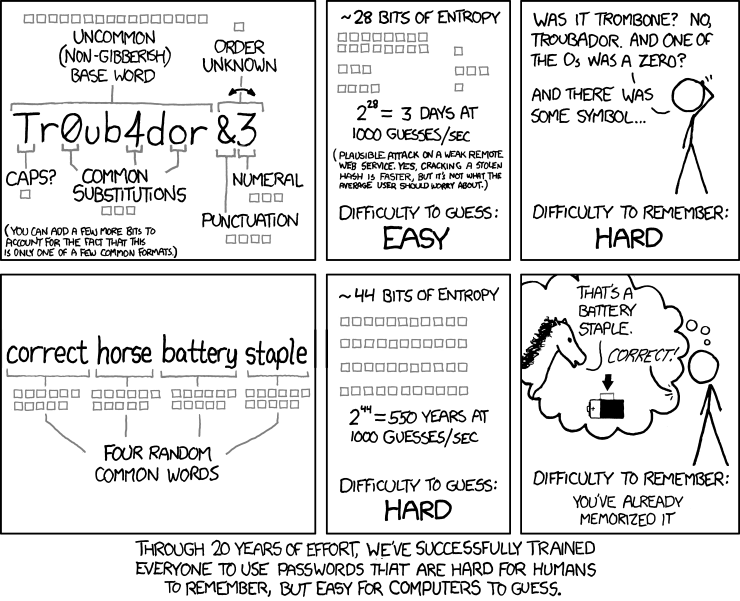
    The below XKCD comic has led me (and others) to consider Password Security the past week.  The webcartoonist defends his math here, though it should be noted, very few are arguing the underlying message.


    First, since this is a Genealogy-focused blog, let me tie Password Security to Genealogy. It's rather simple. As a Genealogist you probably have an account for at least one of the following:
    If you are into social networking you may have an account at
    • Facebook
    • Google
    • Twitter 
    If you buy stuff online you may have an account at
    • Amazon
    • Apple
    And of course, if you pay bills online
    • Your Bank
    • Paypal
    Not everyone realizes this, but it is recommended that your password be different on every website.  That way, if a website is hacked and your password there is discovered, it's not easy for the hackers to sign in to your other accounts.

    This is why some suggest The Only Secure Password is the One You Can't Remember.

    Using software such as LastPass, KeePass, or 1Password, you can let the software remember all but one of your passwords.  Each time you log into an account, the sofware will ask you for the master password, and then enter that particular website's password for you.

    This seems to be a great solution, if you have one computer.  All your passwords are stored encrypted on that one machine.

    But I have:
    • A computer at home
    • One at work
    • A BlackBerry
    • An iPod.  
    • I occasionally house-sit for members of my family, and I may log into one of my accounts from their computers.  
    • When I'm at the library I may log on to one of their computers, because while I could use one of my mobile devices, I like the larger screen.
    • I have been known to check my email on my friend's computers, though those days may be behind me now with the mobile devices.
    Some suggest a workaround for some of the above is Dropbox, LiveMesh, SpiderOak, SugarSync, or Wuala. (The link compares the software for each.) Each of these allow you to sync files across multiple computers.  However, the most popular of these, Dropbox, recently had a security issue.  The most secure of these five programs are SpiderOak and Wuala, because they allow you to encrypt your data locally before sending it to their website. "Your data encryption key is only saved on your computer."  Unfortunately, for me, neither SpiderOak nor Wuala works on a BlackBerry.

    And, of course, none of these help you with computers that aren't synched -- those at the home of a family member, a friend, or at the library.

    Is it safe to write down all your passwords on a piece of paper?

    I'm not an expert, but I think it depends upon who you think you are hiding the information from, and how it is written down.

    If I had a piece of paper that looked like this:

    A/R - Password1
    FN - Password2
    GB - Password3
    GS - Passord4
    F - Password5
    T - Password6
    G - Password7
    AZ - Password8
    A - Password9
    B - Password10
    P - Password11

    I could record the passwords for all of the sites I listed above.  I wouldn't put my name on it. I wouldn't include my usernames. If the piece of paper was left behind on the seat of a taxi, or at the library, and someone picked it up, what good would it do them?  Even if a fellow genealogist picked it up, and figured out the code, without knowing whose it was it wouldn't be useful.

    If your spouse, or kid picked it up -- yes, they could figure it out. So if you have an issue of trust with someone in your household, this might not be a solution.

    One possible compromise.

    Use one of the Password Management systems for any website you are willing to limit your use to one computer (or more if you are willing to trust the synching software.)  For the handful of websites you feel you need to be able to access on other computers, you can write those down on a piece of paper.

    For example, I know the only websites that I access from my Blackberry are my email, and social networking accounts.  So I could set up a LastPass, KeePass, or 1Password account using Wuala or SpiderSync for everything else, and still feel pretty secure.


    So,whether you are creating one master password to control all your other passwords, or you are creating multiple passwords you will write down on a piece of paper, we are back to asking which passwords are the most secure.  Not from your spouse or kid who might be able to guess that your password is G3n34l0gy!  But from a computer hacker who knows nothing about you.  Because unless you are somebody important, no one is going to be trying to hack your accounts specifically.  You're only at risk if your password is one of the 'low hanging fruit' passwords the hackers find before they're satisfied.

    Randall Munroe, webcartoonist for XKCD, isn't the first to suggest that Multi-Word Phrases are More Secure than Incomprehensible Gibberish.

    Once the hacker has to resort to "brute strength" - that is, trying every possible combination of letters, numbers, and symbols - the length of the password matters more than anything else.  Even if the characters are a series of periods, dashes, or spaces.

    How Big is Your Haystack helps you compute the strength of a password.

    A password such as:
    D0g.......... (10 periods), according to this calculator, would take at least 100 centuries to crack using brute strength.  (However, since How Big is Your Haystack mentions the D0g.......... password, it's advisable to use something else.  You want your password to be unique.)


    It is important to remember that some longer passwords might be tried before brute strength.  If multiple word passwords become common, you can expect hackers to feed movie and book quotes into their databases. So the following passwords likely will not be secure:
    • Help me, Obi-Wan Kenobi. You're my only hope.
    • To be, or not to be, that is the question.
    • Hello. My name is Inigo Montoya. You killed my father. Prepare to die. 
    • As you sow, so shall you reap.

    Week in Review

    Below are some noteworthy news stories and blog posts I have read in the past week that deal with my overlapping interests in Genealogy, History, Heritage, and Technology.

    Genealogy and History
    Technology and Social Media
    • James Tanner at Genealogy's Star discusses the Ethics of Photo Restoration or Editing.  Should we use Photoshop to add someone to a photo, take someone away, or clear up teenage blemishes? His post reminded me of something I wrote in 1987 for a college newspaper, and I blogged about back in 2003. I suspect in 10 years, or earlier, we may be having similar questions concerning video editing.
    • Some using the Blogger platform may be interested in Google Scribe, which suggests words and phrases as you type.
    Other Weekly Link Lists

      Monday, August 8, 2011

      Amanuensis Monday: Ezra Pound and the Bollingen Prize

      Amanuensis: A person employed to write what another dictates or to copy what has been written by another.

      I continue my project to transcribe family letters, journals, newspaper articles, audiotapes, and other historical artifacts. Not only do the documents contain genealogical information, the words breathe life into kin - some I never met - others I see a time in their life before I knew them.

      I began this project back in February of 2009, and since then, many others have joined in on the meme.  Why do we transcribe?  I provide my three reasons in the linked post.  You may find others.  If you participate, feel free to leave a link to your post in the comments.

      ***

      This week, I look at a newspaper article from March of 1949 concerning the controversy over Ezra Pound winning the Bollingen Prize for Literature after escaping a lifetime prison sentence for treason on the insanity plea. What does this have to do with my family history? A cousin was a psychiatrist on staff at the asylum, and is mentioned briefly at the end of the article. [The article was found in a search of Google News' archives.]

      Sunday, August 7, 2011

      Week in Review

      Below are some noteworthy news stories and blog posts I have read in the past week that deal with my overlapping interests in Genealogy, History, Heritage, and Technology.
      •  "Besides ending nearly 3,000 lives, destroying planes and reducing buildings to tons of rubble and ash, the Sept. 11, 2001, attacks destroyed tens of thousands of records, irreplaceable historical documents and art." (full article) (hat/tip GenealogyBlog)
      • The granddaughter of author Shalom Aleichem (Solomon Rabinovich) recently turned 100.  She was interviewed by the New York PBS. (hat/tip: Jewcy)

      Watch the full episode. See more Metrofocus.
      • A documentary about a guy, Jim Killeen, who Googled himself and then went all over the world meeting others with his name. (DNA testing was involved) (Video is 96 minutes)


      Other Weekly Link Lists

      Monday, August 1, 2011

      Amanuensis Monday: Obituary for Selig Feinstein - March 12, 1915

      Amanuensis: A person employed to write what another dictates or to copy what has been written by another.

      I continue my project to transcribe family letters, journals, newspaper articles, audiotapes, and other historical artifacts. Not only do the documents contain genealogical information, the words breathe life into kin - some I never met - others I see a time in their life before I knew them.

      I began this project back in February of 2009, and since then, many others have joined in on the meme.  Why do we transcribe?  I provide my three reasons in the linked post.  You may find others.  If you participate, feel free to leave a link to your post in the comments.

      ***

      This week, I look at the obituary for my second great grandfather, Selig Feinstein. The obituary appeared in the March 12th, 1915 edition of The St. Louis Jewish Voice.

      Sunday, July 31, 2011

      Week in Review

      Below are some noteworthy news stories and blog posts I have read in the past week that deal with my overlapping interests in Genealogy, History, Heritage, and Technology.
      On the Lighter Side
        •  Some may feel that Arthur C. Clarke came pretty close to predicting the future in 1964.


        Other Weekly Link Lists

        Wednesday, July 27, 2011

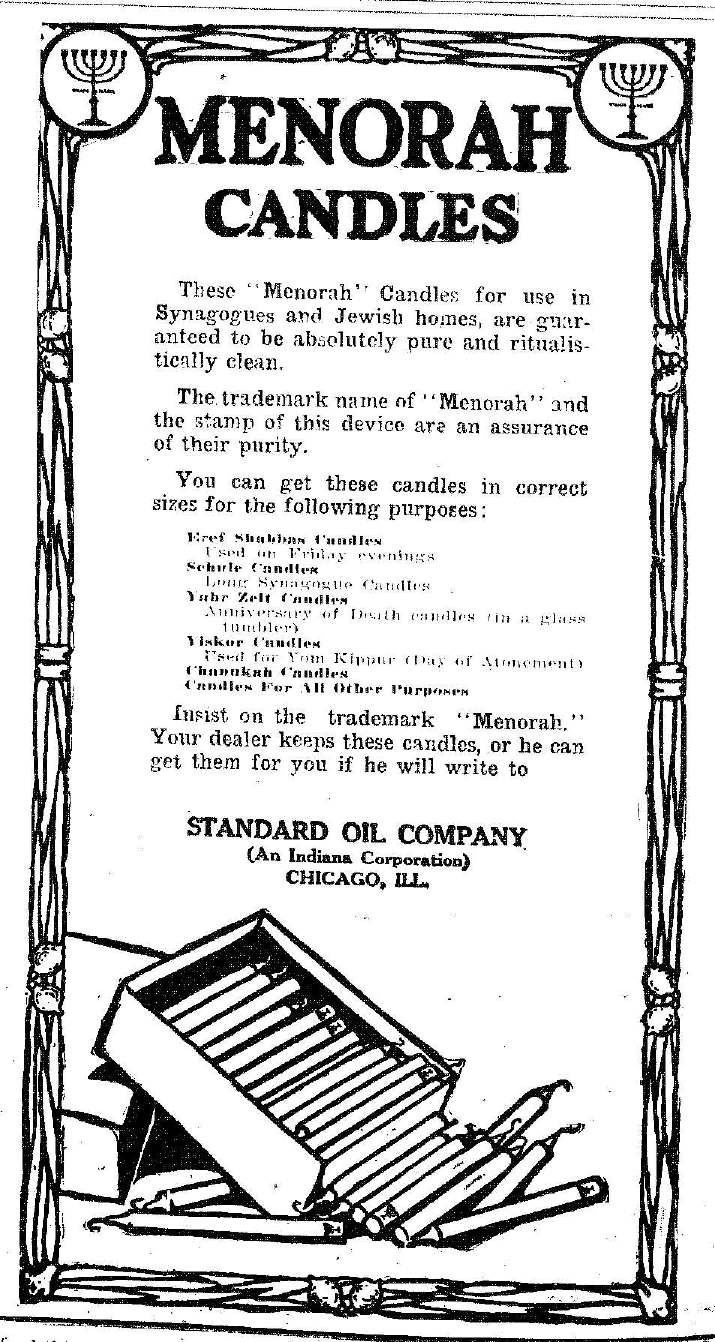
        Wordless Wednesday: Standard Oil Advertisement - 1915

        On a recent trip to the microfilm archives at the local library, I found the below advertisement:

        A 1915 advertisement for Standard Oil Company-made Menorah Candles from the St. Louis Jewish Voice
        Move mouse over image for additional information, or click image to enlarge.
        Sources: (1) (2)

        Monday, July 25, 2011

        Amanuensis Monday: Naturalization Petition for Salomon Deutsch - 1921

        Amanuensis: A person employed to write what another dictates or to copy what has been written by another.

        I continue my project to transcribe family letters, journals, newspaper articles, audiotapes, and other historical artifacts. Not only do the documents contain genealogical information, the words breathe life into kin - some I never met - others I see a time in their life before I knew them.

        I began this project back in February of 2009, and since then, many others have joined in on the meme.  Why do we transcribe?  I provide my three reasons in the linked post.  You may find others.  If you participate, feel free to leave a link to your post in the comments.

        ***

        This week, I look at the Petition for Naturalization my great grandfather, Salomon Deutsch, filled out in 1921.  When I looked at the petition for my other great grandfather, Barney Newmark, back in May, I knew I had to retrieve Salomon's from the Chicago courts.  I realized there was a very good chance it could help solve a family mystery.  I said nothing to anyone as I applied, because I didn't want to get the hopes up for any family members reading the blog.  My hopes were only partially answered, and in some ways, I'm no closer to any answers than before.

        Sunday, July 24, 2011

        SNGF: Where I'm From

        Randy at Genea-Musings suggestion yesterday for Saturday Night Genealogy Fun was to create a poem based on the Where I'm From template, created from the poem by poet, George Ella Lyon.  An excellent suggestion.

        You can find her original poem, along with audio of her reading it, on her official site, GeorgeEllaLyon.com (Her poem can be found many other places across the web, as it has become quite popular.)

        I shared my version back in 2009.
        Here it is again

        Where I’m From
        by John Newmark ©2009
        based on Copy-Change Template by George Ella Lyon

        I am from books --
        from hostess ding dongs and lemonade stands.
        I am from a three bedroom, finished basement, with a backyard fence our crazy dog was able to jump over.
        I am from the dandelions I refused to accept were weeds,
        and the tree that was planted in Israel in my name when I turned thirteen.

        I’m from Sunday Dinners and talking politics at the table --
        Sam and Rose --
        fiftieth wedding anniversaries --
        and watching Must See TV every Thursday night with my cousins at Grandma’s.

        I’m from ‘pick up your clothes’ to ‘make your bed.’
        I’m from Christmas Trees and Bar Mitzvah lessons.
        I’m from St. Louis, Transylvania, Poland, and Texas --
        Chopped liver, corned beef, bagels and gefilte fish.

        I’m from a grandfather, who in the 1930s jumped a train with his friends and rode to California
        to a grandmother, age 7, on a beebox in her father’s Texas apiary -
        she stands in the center
        of a photo at my parents’ house
        inside a box next to other boxes
        filled with books,
        pictures,
        high school mementos,
        my grandfather’s Cavalry sword from the 1920s, Star of David on the hilt,
        and the WWII diary of a great-uncle who never returned.

        Week in Review

        Below are some noteworthy news stories and blog posts I have read in the past week that deal with my overlapping interests in Genealogy, History, Heritage, and Technology.


        Should the children of sperm donors be notified of genetic diseases they might carry? (hat/tip: EOGN)

        Good Morning Silicon Valley discusses how the new social network, Google+, has deleted corporate accounts, telling businesses to wait for them to create accounts designed for them.

        Greenman Tim at Walking the Berkshires has had several posts regarding a reenactment of the Revolutionary Battle of Wyoming.  Part 1 and Part 2.

        It's common sense that as genealogists, if we have access to the original, we shouldn't be satisfied with looking at a copy.  However, Michael John Neill at Genealogy Tip of the Day suggests the reverse can be true, as well.  If you have access to a copy, you shouldn't be satisfied with the original.

        Stephanie Lincecum at Graveyard Rabbit Online Journal has an article on Jewish Cemetery Symbolism.

        Recently during a baseball rain delay, St. Louis radio station, KMOX re-aired a 1960 interview of Jackie Robinson by sportscaster, Jack Buck.  The whole interview isn't online yet, but some of it can be heard in this Riverfront Times article.

        How to Turn Slides and Negatives into Digital Photos.  (hat/tip: Sally Jacobs)
         
        Other Weekly Link Lists

        Monday, July 18, 2011

        Amanuensis Monday: Dawes Commission - Caroline Taylor

        Amanuensis: A person employed to write what another dictates or to copy what has been written by another.

        I continue my project to transcribe family letters, journals, newspaper articles, audiotapes, and other historical artifacts. Not only do the documents contain genealogical information, the words breathe life into kin - some I never met - others I see a time in their life before I knew them.

        I began this project back in February of 2009, and since then, many others have joined in on the meme.  Why do we transcribe?  I provide my three reasons in the linked post.  You may find others.  If you participate, feel free to leave a link to your post in the comments.

        ***

        This week, I continue with the application my maternal grandmother's aunts, uncles, and cousins made in 1900 to the Dawes Commission to be accepted as Mississippi Choctaws. (The numbers below are the numbers of their case files, and likely indicate the order in which they provided the testimony.) Previously I have transcribed the testimony given by
        1. MCR 1050 - Samuel T Hartley – Nov 21, 1900 (Brother of my great great grandmother, Sarah Hartley Denyer Foster)
        2. MCR 1051 - Robert Hartley - Nov 21, 1900 (Son of Samuel T Hartley) 
        3. MCR 1052 - Virginia Shultz - Nov 21, 1900 (Daughter of Samuel T Hartley)
        4. MCR 1053 - Sophronia Hartley Cagle - Nov 21, 1900 (Daughter of Samuel T Hartley) 
        5. MCR 1054 - Melvin Elijah Van Every – Nov 21, 1900 (My great grandfather)
        6. MCR 1055 - Samuel W Denyer - Nov 21, 1900 (Brother of my great grandmother, Margaret Denyer Van Every)
        7. MCR 1069 - Eliza Caroline Foster Reeves – Nov 26, 1900 (Half-sister of my great grandmother)
        8. MCR 5842 - Georgia Hartley Phillips – June 17, 1902 (Daughter of Samuel T Hartley)
        9. MCR 5842 - Samuel T Hartley – June 17, 1902 
        and the ultimate decision - July 11, 1902  (A rejection.)

        Below is the testimony given by Caroline Taylor, a daughter of Samuel T Hartley, and a first cousin to my great grandmother, Margaret (Denyer) Van Every.  This concludes the testimony provided by my great grandfather, and his wife's family.

        Sunday, July 17, 2011

        Week in Review

        Below are some noteworthy news stories and blog posts I have read in the past week that deal with my overlapping interests in Genealogy, History, Heritage, and Technology.
        • A new study suggests internet use negatively impacts our memory. Or, from a different perspective, our brains are becoming more efficient. If we know where we can look up the information, the brain doesn't waste its resources storing it. 
        •  It appears Microsoft may soon be entering the Social Networking fray as well.  (Personally, I think my Mac would revolt against me if I created a profile on a Microsoft social network, so if they do enter the fray, I will not be testing it out.)
        Other Weekly Link Lists

        Tuesday, July 12, 2011

        Who Will Google Kill This Time?

        Disclaimer:
        Back in June of 2009 I predicted, "Google Wave is Coming; It's Undertow will Claim at least One Victim."
        My record on predictions has historically been pretty lousy.

        ***

        I've been playing on Google's new social network, Google Plus (or Google+ or G+), for 4 days now.  Lots of people are talking about what it will replace.  And since we like violent imagery, the word 'killer' gets bandied about.

        Twitter-Killer?

        Certainly a lot of the same chat that goes on with Twitter I see at Google+.  Currently there isn't anything to compare with Twitter's hashtags. Without something of this nature, Twitter survives.  As someone who has been on Twitter for awhile, and uses it, one of the cool things about Twitter is the ability to use hashtags to find other people talking about the same topics.

        Google+'s Sparks could be a replacement for hashtags, if they turned it inward, and allowed you to search for public posts.  Currently, however, Sparks is only focused outward, yielding Google search results for specific terms.

        Of course, Google is the "King of Search" and Google+ is currently only in "Field-Test" mode.  Many have predicted that they will integrate search within the network and allow us to find posts by keyword.  At that point, I do wonder what distinguishes Twitter to allow it to coexist.  Especially since I feel a large percentage of Twitter users are the type of individual who are likely to sign up for Google+.

        It's possible people will keep posting to Twitter, posting the same status updates to both places, as they post them to Facebook and Twitter now.  As soon as Google releases the G+ API, there will be apps to make this simple.  But I see myself already losing interest in Twitter, and the only thing keeping me there is the hashtags.

        Tumblr-Killer?

        For those unfamiliar with Tumblr, it is a blogging platform excelling at the sharing, and resharing, of media (images, video, and audio).  G+ definitely does this very well.

        However, like Twitter, Tumblr thrives on hashtags.  So until Google+ integrates an internal search engine, it's safe.  However, once it does, I suspect use of Tumblr will drop as users realize their posts will get more views on Google+.

        Facebook-Killer?

        So far I have found only two things Facebook can do that Google+ can't.

        1) Games.  [Many will see this as a plus in favor of Google]
        2) Event managing

        While many people use Facebook to schedule events, and invite their friends, you can't do that YET with Google+.  However, all signs indicate that Google intends to integrate Google+ with as many of its products as possible.  And Google Calendar is one of its products.  I don't know when it's coming, but I think it's a safe bet that they will release some sort of event management function.

        However, regardless of whether Social Network A and B can do the same things, and regardless of which one does it better, a Social Network must contain one essential thing.  The People With Whom You Wish to Network.

        The First Adopters of Google+ are highly extolling its virtues.  But if we can't convince our less techy friends, and family members to join us, we will need to maintain both a Facebook and a Google+ account.  At least we will if we feel the need to continue to 'network' with both groups.

        I ask myself the crucial question: When will I delete my Facebook account?

        After less than a week, still in Field-Test invite only stage, almost all the fellow Genealogists who I networked with on Facebook are on G+.  I have 95 'friends' on Facebook who are in my 'Genealogy' list.  I have 71 individuals in my Genealogy circle on Google+.

        Along with:
        • A handful of close friends
        • No family (excepting my fiancee)
        • No fellow high school or college alums.
        I need to hand out gold stars to the Genealogy community.  Especially when the stereotype doesn't fall within the 18-40 male geek demographic one expects to be "First Adopters" of new technology.  Of course, online genealogists are used to 'trying out' new database websites for their research.  Just because a large number of us are anxious to see what's going on, doesn't mean we'll all stay.

        One member of the genealogy community has gotten a fair amount of press for his G+ activity.  Paul Allen, founder of Ancestry.com.  Using Ancestry's census statistics, and surname counts on G+, he estimated G+ would surpass 10,000,000 users today.  Google has neither confirmed nor denied his estimates.

        I find myself asking other crucial questions:  
        Why did I join Facebook originally? 
        What purpose does a social network fill for me?

        If my family wants to talk to me, they either pick up a phone, or send me an email.
        If my close friends wish to talk to me, they either pick up a phone, or send me an email.

        What Facebook has done for me is get me in touch with people I had lost track of from earlier periods in my life (school, former jobs, etc).

        I see the following progression of events for me:
        1) I will stop posting new status posts on Facebook.  I predict that happens now. I'm not including occasional posts to Facebook reminding people - hey, if you want to see what's going on with me, look at my public G+ posts, or join up, and I'll add you to my circles.
        2) I will only use Facebook to read (and comment) on other posts.
        3) I will delete everyone on Facebook that has a Google+ account, and is clearly using it.
        4) I will monitor my usage of Facebook.

        I predict, before the first snowfall this winter, I will delete my Facebook account.

        However, I foresee Google+ and Facebook coexisting.  There will be more then enough people who prefer each network. Some people will feel the need to be on both.  Others will make their choices.

        Monday, July 11, 2011

        Amanuensis Monday: Dawes Commission - Virigina Shultz

        Amanuensis: A person employed to write what another dictates or to copy what has been written by another.

        I continue my project to transcribe family letters, journals, newspaper articles, audiotapes, and other historical artifacts. Not only do the documents contain genealogical information, the words breathe life into kin - some I never met - others I see a time in their life before I knew them.

        I began this project back in February of 2009, and since then, many others have joined in on the meme.  Why do we transcribe?  I provide my three reasons in the linked post.  You may find others.  If you participate, feel free to leave a link to your post in the comments.

        ***

        This week, I continue with the application my maternal grandmother's aunts, uncles, and cousins made in 1900 to the Dawes Commission to be accepted as Mississippi Choctaws. (The numbers below are the numbers of their case files, and likely indicate the order in which they provided the testimony.) Previously I have transcribed the testimony given by
        1. MCR 1050 - Samuel T Hartley – Nov 21, 1900 (Brother of my great great grandmother, Sarah Hartley Denyer Foster)
        2. MCR 1051 - Robert Hartley - Nov 21, 1900 (Son of Samuel T Hartley)
        3. MCR 1053 - Sophronia Hartley Cagle - Nov 21, 1900 (Daughter of Samuel T Hartley) 
        4. MCR 1054 - Melvin Elijah Van Every – Nov 21, 1900 (My great grandfather)
        5. MCR 1055 - Samuel W Denyer - Nov 21, 1900 (Brother of my great grandmother, Margaret Denyer Van Every)
        6. MCR 1069 - Eliza Caroline Foster Reeves – Nov 26, 1900 (Half-sister of my great grandmother)
        7. MCR 5842 - Georgia Hartley Phillips – June 17, 1902 (Daughter of Samuel T Hartley)
        8. MCR 5842 - Samuel T Hartley – June 17, 1902 
        and the ultimate decision - July 11, 1902  (A rejection.)

        Below is the testimony given by Virginia Shultz, a daughter of Samuel T Hartley, and a first cousin to my great grandmother, Margaret (Denyer) Van Every

        Sunday, July 10, 2011

        Week in Review

        Below are some noteworthy news stories and blog posts I have read in the past week that deal with my overlapping interests in Genealogy, History, Heritage, and Technology.

        Genealogy Research
        • Michael John Neill at RootDig discusses Percents and Genealogy, and how overall statistics are irrelevant when dealing with specific cases. Agreed. I could probably find some statistic saying that 90%, or higher, of Ashkenazic Jewish families didn't name a child after a living relative between Year X and Year Y. But that doesn't mean Sol X's grandfather, Sol, had to be dead when Sol was born. There are always exceptions.
        History
        Photographs
        • Thanks to footnoteMaven's post, I discovered the DearPhotograph tumblr site this week. Open to submissions, the idea of the site is to take old photographs to their original location, and take a photograph of the photograph, held up so that the old background merges with the new background, and then to write a brief letter to the photograph.  Visit the site to understand what I am saying. 
        Technology / Social Networking
          •  As Google+ catches on, some are looking at it as a possible blogging tool.  Digg founder, Kevin Rose, has forwarded his personal domain KevinRose.com to his Goggle+ page. If you aren't on Google+ yet, you can view his posts, and all the comments, but can't participate.  Science Fiction editor, Patrick Nielsen Hayden has a few issues with using it as a blog replacment.  And if your blog readers aren't among the early adopters, they're not going to be happy about not being able to comment.
          A few Google+ pages for those who want to see what's going on:
            Carnivals
            Animals have genealogy, too!
            Other Weekly Link Lists

            Wednesday, July 6, 2011

            The Immigrants: 1600s

            Over the Fourth of July holiday a family member was in Plymouth, MA, and I was asked if any ancestors came over on the Mayflower.  My response was an, "I don't know of any."  However, this inspired me to catalog as many early Immigrants I could for my family.  ["Early" as in those who didn't cross via the Land Bridge.]  I indicate my web-based sources, though for most I am relying on the poorly cited research of others.

            1) The Betts and the Stoughtons

            My eighth great grandparents, Richard Betts and Joanna Chamberlain were married in Ipswich, Massachusetts Bay Colony - in 1648.  It is thought Joanna arrived by 1635, and Richard mid-1640s. [source source].  Joanna Chamberlain was the daughter of Elizabeth Stoughton and Richard Chamberlain, and the granddaughter of Rev Thomas and Katherine Stoughton.

            2) Hortons and Langtons

            9th great grandparents, Barnabas Horton and Mary Langton are said to have immigrated c. 1630 on the ship "Swallow." [source] - Living in Massachusetts and Connecticut prior to settling in Southold, Long Island.

            3) Hallocks

            Barnabas Horton's son, Caleb, married Abigail Hallock.  Abigail's father, William Hallock, likely arrived in Southold, Long Island ca. 1640. [source]

            4) Van Everys

            Brothers Myndert and Carsten Frederickse (sons of Frederick Van Iveren) likely immigrated to New Amsterdam in the 1640s or 1650s, with Myndert marrying Catharina Burger (Burghart) in New Amsterdam in 1656. [source].  Most of the descendants of Myndert and Carsten took the surname of either Van Every or Van Avery.  Myndert was my 8th great grandfather. 

            5) Swayzes and Kinges 

            John Sweezey [Swayze], another eighth great grandfather, immigrated prior to 1650. [source].  He married Catherine Kinge in 1650 in Salem, Essex, Massachusetts.  He settled in Suffolk, Long Island.

            Catherine emigrated with her father, William, prior to 1635 
            They settled at Salem, Massachusetts. He was admitted a freeman there May 25, 1636. He had grants of land of forty acres on Jeffrey's Creek, now Manchester-by-the-Sea; thirty acres at Royal-side at the head of Bass river, now Beverly, and he located his homestead there. He was a grand juror in 1637. He was a member of the First church at Salem, but in 1637 joined the Antinomians and came under the ban of the Salem authorities. He was requested to sever his connection with the new church or have his arms taken away from him. He remained with the new faith and gave up his gun to Lieutenant Danforth. Later he was banished for a time for sheltering the persecuted Quakers. [source]

            Monday, July 4, 2011

            Amanuensis Monday: NY Militia Rolls for David Van Every - 1775, 1777

            Amanuensis: A person employed to write what another dictates or to copy what has been written by another.

            I continue my project to transcribe family letters, journals, newspaper  articles, audiotapes, and other historical artifacts. Not only do the  documents contain genealogical information, the words breathe life into  kin - some I never met - others I see a time in their life before I knew  them.

            I began this project back in February of 2009, and since then, many others have joined in on the meme.  Why do we transcribe?  I provide my three reasons in the linked post.  You may find others.  If you participate, feel free to leave a link to your post in the comments.

            ***

            This week, in honor of the holiday, I transcribe the NY Militia Service Records for my 4th great grandfather, David Van Every, son of McGregory Van Every.

            Sunday, July 3, 2011

            Week in Review

            Genealogy and Technology
            Genealogy and Social Networking
            The big news this week
            Discussion and Viewpoints
            "Whether at this point it’s still worth it as a writer to own one’s own domain, i.e., in the age of everyone being on Facebook, setting up one’s online shingle elsewhere is like opening a business on a dusty street a mile away from Main Street."
            His response is timely, and appropriate for any professional hanging out their shingle, including genealogists.
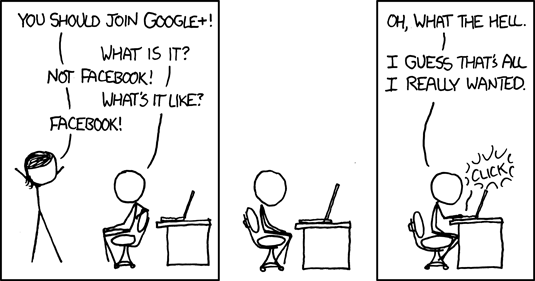
            Cartoonist, Randall Munroe, adds some visual commentary (click image to go to original site):


            Press Releases:
            Other Weekly Link Lists

              Friday, July 1, 2011

              A Toast to the First and the Fourth

              A Toast to the First and the Fourth of July
              for David Van Every (1757-1820)
              ©July 2009 - John Newmark

              For two years my fourth great fought
              for the creation of our nation
              then in seventeen seventy seven
              he deemed his disloyalty a disservice
              and joined the other side.
              Finally, he and his family fled to Canada.

              His motivations are unrecorded.
              Beyond his appearance on muster rolls,
              a few brief mentions elsewhere,
              we have nothing. No inkling
              of the wherefores behind his decision
              either in seventy five, or seventy seven.

              In July’s opening barrage
              of national celebrations
              I honor both of his decisions -
              whatever the reasons, and his willingness
              to fight for what he believed
              even when those beliefs changed.

              ***
              July 1 is Canada Day
              July 4 is Independence Day

              This poem was based on information I'd found on the web, citing The Records of the Van Every Family, by Mary Blackadar Piersol, 1947.  After writing this poem, I discovered the muster rolls for David Van Every on Footnote that put the information somewhat in doubt.

              The muster rolls suggest he enlisted on July 4, 1775, and deserted on Sept 12 (or Sept / 2) 1775. And re-enlisted on May 23, 1777, and redeserted in June of 1777. So in total it would have been for three months, not two years.

              Also, since writing the poem, I obtained a copy of The Records of the Van Every Family, by Mary Blackadar Piersol. She only mentions David joining and deserting in 1777. So she didn't know about the 1775 muster roll. Somebody else must have found documentation that he joined in 1775, and an incorrect interpretation was made that he remained in service between 1775 and 1777.

              It's impossible to assign motivation to the enlistments and desertions. David was 18 and 20 years old in 1775 and 1777. He may have just been a very confused young man.

              While McGregory Van Every and his children ultimately joined the Loyalist camp, and fled to Canada, there were many Van Everys who fought as Patriots throughout the war.  They just aren't my ancestors.  As one researcher notes concerning David and his brother, Benjamin:
              David and Benjamin Van Every perhaps had decided to join the New York Militia, as it was in this Regiment that the cousins of their father, McGregory Van Every had been serving: Martin as a Lieutenant, Cornelius (1730 - 1815) as an Ensign and later as a Lieutenant, and Rynier as a Captain. However, soon after deserting from the New York Militia, both David and Benjamin transferred themselves to Butler's Rangers, within which they fought for the duration of the American Revolution, David as a Sergeant and Benjamin as a regular soldier.

              ---
              "Warner Cemetery: an important piece of Canada's heritage worth preserving," Robert Collins McBride, The Loyalist Gazette, March 22, 2000. 

              Monday, June 27, 2011

              Amanuensis Monday: Dawes Commission - Robert Hartley

              Amanuensis: A person employed to write what another dictates or to copy what has been written by another.

              I continue my project to transcribe family letters, journals, newspaper articles, audiotapes, and other historical artifacts. Not only do the documents contain genealogical information, the words breathe life into kin - some I never met - others I see a time in their life before I knew them.

              I began this project back in February of 2009, and since then, many others have joined in on the meme.  Why do we transcribe?  I provide my three reasons in the linked post.  You may find others.  If you participate, feel free to leave a link to your post in the comments.

              ***

              This week, I continue with the application my maternal grandmother's aunts, uncles, and cousins made in 1900 to the Dawes Commission to be accepted as Mississippi Choctaws. Previously I have transcribed the testimony given by
              1. MCR 1050 - Samuel T Hartley – Nov 21, 1900 (Brother of my great great grandmother, Sarah Hartley Denyer Foster)
              2. MCR 1053 - Sophronia Hartley Cagle - Nov 21, 1900 (Daughter of Samuel T Hartley) 
              3. MCR 1054 - Melvin Elijah Van Every – Nov 21, 1900 (My great grandfather)
              4. MCR 1055 - Samuel W Denyer - Nov 21, 1900 (Brother of my great grandmother, Margaret Denyer Van Every)
              5. MCR 1069 - Eliza Caroline Foster Reeves – Nov 26, 1900 (Half-sister of my great grandmother)
              6. MCR 5842 - Georgia Hartley Phillips – June 17, 1902 (Daughter of Samuel T Hartley)
              7. MCR 5842 - Samuel T Hartley – June 17, 1902 
              and the ultimate decision - July 11, 1902  (A rejection.)

              Below is the testimony given by Robert Hartley, a son of Samuel T Hartley, and a first cousin to my great grandmother, Margaret (Denyer) Van Every

              Sunday, June 26, 2011

              Week in Review

              It's been eight months, and I am unsure whether or not I will be returning to doing this regularly.  But below are some noteworthy news stories and blog posts I have read in the past week that deal with my overlapping interests in Genealogy, History, Heritage, and Technology.

              Genealogy Research
              • James Tanner at Genealogy's Star begins to address the topic of Evidence and Proof from the perspective of a lawyer, and continues by discussing the difference between probative and non-probative facts in Digging into Evidence.  The connections to genealogy research are clear.
              Poetry
                Digital Archives 
                  • Meredith D. at NARAtions announced the addition of Tagging for he National Archives "Online Public Access Prototype" 
                  Recent uploads to the National Archives Flickr set
                    • Executive Order 9981 in which President Harry S. Truman bans the segregation of the Armed Forces., 07/26/1948, Page 1/2, Page 2/2
                    Technoloy/Internet
                    •  ICANN announced that they will begin accepting applications for unlimited new Top Level Domains in January of next year. Currently TLDs include .com, .net, .org, etc  If there is interest from more than one source for a TLD it will be auctioned.  (Do you think Ancestry.com or FamilySearch will bid highest for .genealogy ?  Will anyone bid for the misspelled .geneology ?)  One of the interesting features of this announcement I've noticed, is that they will allow different language sets.  So there could be a TLD using Hebrew or Chinese characters.
                    •  Dick Eastman reviews  the ABBYY TextGrabber app for iPod/iPad2/iPhones. While the application looks useful, and I may test it out myself, the review is also a great illustration of the weaknesses of Optical Character Recognition (OCR).

                      Monday, June 20, 2011

                      Amanuensis Monday: Dawes Commission - Sophronia Cagle

                      Amanuensis: A person employed to write what another dictates or to copy what has been written by another.

                      I continue my project to transcribe family letters, journals, newspaper articles, audiotapes, and other historical artifacts. Not only do the documents contain genealogical information, the words breathe life into kin - some I never met - others I see a time in their life before I knew them.

                      I began this project back in February of 2009, and since then, many others have joined in on the meme.  Why do we transcribe?  I provide my three reasons in the linked post.  You may find others.  If you participate, feel free to leave a link to your post in the comments.

                      ***

                      This week, I continue with the application my maternal grandmother's aunts, uncles, and cousins made in 1900 to the Dawes Commission to be accepted as Mississippi Choctaws. Previously I have transcribed the testimony given by
                      1. Samuel T Hartley – Nov 21, 1900 (Brother of my great great grandmother, Sarah Hartley Denyer Foster)
                      2. Melvin Elijah Van Every – Nov 21, 1900 (My great grandfather)
                      3. Samuel W Denyer - Nov 21, 1900 (Brother of my great grandmother, Margaret Denyer Van Every)
                      4. Eliza Caroline Foster Reeves – Nov 26, 1900 (Half-sister of my great grandmother)
                      5. Georgia Hartley Phillips – June 17, 1902 (Daughter of Samuel T Hartley)
                      6. Samuel T Hartley – June 17, 1902 
                      and the ultimate decision - July 11, 1902  (A rejection.)

                      Below is the testimony given by Sophronia Hartley Cagle, another daughter of Samuel T Hartley.

                      Monday, June 13, 2011

                      Amanuensis Monday: Dawes Commission - Samuel W Denyer

                      Amanuensis: A person employed to write what another dictates or to copy what has been written by another.

                      I continue my project to transcribe family letters, journals, newspaper articles, audiotapes, and other historical artifacts. Not only do the documents contain genealogical information, the words breathe life into kin - some I never met - others I see a time in their life before I knew them.

                      I began this project back in February of 2009, and since then, many others have joined in on the meme.  Why do we transcribe?  I provide my three reasons in the linked post.  You may find others.  If you participate, feel free to leave a link to your post in the comments.

                      ***

                      This week, I return to the application my maternal grandmother's aunts, uncles, and cousins made in 1900 to the Dawes Commission to be accepted as Mississippi Choctaws. Previously I have transcribed the testimony given by
                      1. Samuel T Hartley – Nov 21, 1900 (Brother of my great great grandmother, Sarah Hartley Denyer Foster)
                      2. Melvin Elijah Van Every – Nov 21, 1900 (my great grandfather)
                      3. Eliza Caroline Foster Reeves – Nov 26, 1900 (Half-sister of my great grandmother, Margaret Denyer Van Every)
                      4. Georgia Hartley Phillips – June 17, 1902 (Daughter of Samuel Hartley)
                      5. Samuel T Hartley – June 17, 1902 
                      and the ultimate decision - July 11, 1902  (A rejection.)

                      Below is the testimony given by Samuel William Denyer, brother to my great grandmother, Margaret Denyer Van Every.

                      Monday, June 6, 2011

                      Amanuensis Monday: Draft Registration for Herman Feinstein

                      Amanuensis: A person employed to write what another dictates or to copy what has been written Iby another.

                      I continue my project to transcribe family letters, journals, newspaper articles, audiotapes, and other historical artifacts. Not only do the documents contain genealogical information, the words breathe life into kin - some I never met - others I see a time in their life before I knew them.

                      I began this project back in February of 2009, and since then, many others have joined in on the meme.  Why do we transcribe?  I provide my three reasons in the linked post.  You may find others.  If you participate, feel free to leave a link to your post in the comments.

                      ***

                      This week, in honor of the anniversary of D-Day, I continue to look through various wartime documents.  While this week's anniversary pertains to a different war, I decided to transcribe another World War I draft registration - this time that of my great grandfather, Herman Feinstein.  

                      Wednesday, June 1, 2011

                      Wordless Wednesday - Van Every Estate - Mimico, Toronto, Ontario

                      Caption: Photo of the Van Every settlers house on Lake Shore (between Dwight and Royal York) in Mimico (1920) (source)