In his weekly Saturday Night Fun post, Randy at Geneamusings suggested we write about our ancestor who is #21 on our Ahnentafel charts.
Ahnentafel is a numbering system for genealogical ascents. For those who like math, it is a very intuitive numbering system. For person X, the father is 2*X, and the mother is (2*X)+1.
For example:
1. Yourself
2. Your Father
3. Your Mother
4. Your father's Father
5. Your father's mother
6. Your mother's Father
7. Your mother's mother
Those who like math will instantly note that something fun and exciting is happening here with each generation. The paternal ascent follows the powers of 2. So? It suggests that converting the numbers to binary might have some benefits.
1. Yourself
10. Your father
11. Your mother
100. Your father's father
101. Your father's mother
110. Your mother's father
111. Your mother's mother.
Every binary number is going to start with '1' - treat that as yourself (or whoever your source person is). Every 0 indicates a paternal branch and every '1' indicates a maternal branch.
So when Randy asked who my #21 was, my thought process went something like this:
* Broken down in powers of 2, 21 is 16+4+1.
* So the binary ahnentafel would be 10101.
* That's my father's mother's father's mother.
* Annie Perlik Dudelsack/Feinstein (Apr 1868-Aug 10, 1932)
[Note: The dates I had to look up.]
Her Hebrew name was Nechama meaning 'comfort.' She married Selig Dudelsack somewhere in Poland. They immigrated in 1890 and 1891, with Selig coming first, and Annie following several months later with children and mother-in-law. They changed their name to Feinstein in America.
I have been unable to find a photograph of her so far, though I am hopeful some cousin will turn up with one. I have several Feinstein family photographs pre-dating the 1930s, so I'd be surprised if no one ever got her on film.
Sunday, February 22, 2009

Saturday, February 21, 2009
Ancestry Hint
When you enter your family tree at Ancestry.com (with a setting either as a Public or Private Family Tree) Ancestry will provide what they call 'hints' when they see a record anywhere in their databases they think matches one of the entries in your tree.
When I first entered my family tree I wasn't really impressed with this, because I'm pretty good at searching the databases, so it wasn't turning up things I hadn't already discovered. However, there are two factors I didn't consider.
1) Most obviously, Ancestry is constantly adding databases, and *should* add the hints pretty quickly after new databases are added. So paying attention to any new hints should reveal sources in new databases.
2) Ancestry's algorithm for hints catches more than my normal searches would.
Not that I can improve my searches much, either, because I am a human, and not a computer, and I don't have the time to go digging through random databases.
For example, naturally, I have entered first and middle names of individuals in my family tree where I know them. However, if in the database they are listed by their initials and surname only, I'm not likely to catch them in my Ancestry-wide searches. If I am searching a particular database I know they have to be in, I'll get more creative. I'll even search by surname alone, but while I don't have 'Smith' as a family surname, many of them are common enough to make that method impractical across the entire site.
But browsing for hints, I saw the little Ancestry hint leaf flashing for my mother, and I found that odd, because few databases exist where her records are available yet. She'll be in the 1940 census, but we have to wait until 2012 for that.
However, states sometimes have censuses in off years, and I discovered that there is one state that has already released their 1935 and 1945 census - Florida.
I didn't find it with my normal searches on my grandparents because everyone on their page was recorded by their surname and initials. Ancestry's Family Tree software found it though. (Other pages of the census have given names recorded, it appears a particular census taker got lazy.)
I knew my grandfather had been stationed in Florida at the end of the war, and his wife and children had come out to join him. It was for a brief period of time before they returned to St. Louis, but it happened to be the right time for the 1945 Florida census.
There was one interesting historical note about the 1945 Florida Census

In the upper right hand corner of the page was "Race" for the entire page (covering 49 people). Which meant Florida not only knew there wasn't a single neighborhood in the entire state that would be mixed, they decided to take advantage of that to make the census form have one less column. (The 1935 census indicated race individually.)
When I first entered my family tree I wasn't really impressed with this, because I'm pretty good at searching the databases, so it wasn't turning up things I hadn't already discovered. However, there are two factors I didn't consider.
1) Most obviously, Ancestry is constantly adding databases, and *should* add the hints pretty quickly after new databases are added. So paying attention to any new hints should reveal sources in new databases.
2) Ancestry's algorithm for hints catches more than my normal searches would.
Not that I can improve my searches much, either, because I am a human, and not a computer, and I don't have the time to go digging through random databases.
For example, naturally, I have entered first and middle names of individuals in my family tree where I know them. However, if in the database they are listed by their initials and surname only, I'm not likely to catch them in my Ancestry-wide searches. If I am searching a particular database I know they have to be in, I'll get more creative. I'll even search by surname alone, but while I don't have 'Smith' as a family surname, many of them are common enough to make that method impractical across the entire site.
But browsing for hints, I saw the little Ancestry hint leaf flashing for my mother, and I found that odd, because few databases exist where her records are available yet. She'll be in the 1940 census, but we have to wait until 2012 for that.
However, states sometimes have censuses in off years, and I discovered that there is one state that has already released their 1935 and 1945 census - Florida.
I didn't find it with my normal searches on my grandparents because everyone on their page was recorded by their surname and initials. Ancestry's Family Tree software found it though. (Other pages of the census have given names recorded, it appears a particular census taker got lazy.)
I knew my grandfather had been stationed in Florida at the end of the war, and his wife and children had come out to join him. It was for a brief period of time before they returned to St. Louis, but it happened to be the right time for the 1945 Florida census.
There was one interesting historical note about the 1945 Florida Census

In the upper right hand corner of the page was "Race" for the entire page (covering 49 people). Which meant Florida not only knew there wasn't a single neighborhood in the entire state that would be mixed, they decided to take advantage of that to make the census form have one less column. (The 1935 census indicated race individually.)
Friday, February 20, 2009
What was the indexer looking at?
FamilySearch has been indexing their images for the Cook County Birth Reports (1878-1922) (Currently input through 1915)
Below is the Birth Report for an "Edward Cruvant" son of Ben Cruvant and Lillian White. Ben was my great grandmother's brother. Approximately 1903 Ben and his father Morris traveled to Chicago, perhaps exploring the possibility of moving the family there. Ben and Lillian were married in May of 1904. Edward was born two months later. A sister, Sarah, was born in July of 1905. East St. Louis City Directories indicate they'd moved back to St. Louis by 1907. By 1910 Lillian and her two kids had returned to Chicago, and Ben remained in St. Louis, remarrying in 1912. The existence of a first wife and children wasn't hid from his second family, but no one knew what had happened to them.
In the 1910 census Lillian's son was indexed as Clifford E.
What's really strange, is that on FamilySearch, he is indexed as "Clifford Paul." The name Clifford appears nowhere on the Report. Nowhere at all. The image clearly says, 'Edward.' Please feel free to look at the image below and verify this for me, but the name couldn't be clearer. If I didn't know about the 1910 census I would scratch my head and really question the eyesight of the poor indexer, or maybe think there was some database error where the given name from one certificate got indexed with the surname from another . Because of the 1910 census, I know the odds are good this wasn't a mistake. My assumption is that the indexer had another document in addition to the Birth Report. A document they haven't scanned in. I want to know what that document is, what other information I might expect to find on it, and where I can get a copy of it.

Update: Cynthia at ChicagoGenealogy not only tells me what the document was (a Certificate of Correction) she finds it on the Family History Library microfilm and scans it in for me. Thanks!
The FHL copy doesn't include the date of the correction, but the County Clerk at the time of the correction was the 'infamous' Michael J Flynn, who was County Clerk from 1934-1950, so the correction was at least 30 years afterwards.
Below is the Birth Report for an "Edward Cruvant" son of Ben Cruvant and Lillian White. Ben was my great grandmother's brother. Approximately 1903 Ben and his father Morris traveled to Chicago, perhaps exploring the possibility of moving the family there. Ben and Lillian were married in May of 1904. Edward was born two months later. A sister, Sarah, was born in July of 1905. East St. Louis City Directories indicate they'd moved back to St. Louis by 1907. By 1910 Lillian and her two kids had returned to Chicago, and Ben remained in St. Louis, remarrying in 1912. The existence of a first wife and children wasn't hid from his second family, but no one knew what had happened to them.
In the 1910 census Lillian's son was indexed as Clifford E.
What's really strange, is that on FamilySearch, he is indexed as "Clifford Paul." The name Clifford appears nowhere on the Report. Nowhere at all. The image clearly says, 'Edward.' Please feel free to look at the image below and verify this for me, but the name couldn't be clearer. If I didn't know about the 1910 census I would scratch my head and really question the eyesight of the poor indexer, or maybe think there was some database error where the given name from one certificate got indexed with the surname from another . Because of the 1910 census, I know the odds are good this wasn't a mistake. My assumption is that the indexer had another document in addition to the Birth Report. A document they haven't scanned in. I want to know what that document is, what other information I might expect to find on it, and where I can get a copy of it.

Update: Cynthia at ChicagoGenealogy not only tells me what the document was (a Certificate of Correction) she finds it on the Family History Library microfilm and scans it in for me. Thanks!
The FHL copy doesn't include the date of the correction, but the County Clerk at the time of the correction was the 'infamous' Michael J Flynn, who was County Clerk from 1934-1950, so the correction was at least 30 years afterwards.
Thursday, February 19, 2009
Facebook Terms of Use
Facebook rewrote their terms at the beginning of this month. The changes to the terms were reported in Consumerist magazine, and an uproar was raised. Facebook reverted to their old terms, stating the fears everyone had were unfounded, and they would revise the new terms into less legalese. Also that they wouldn't change their terms again without informing its users. (It was announced on Feb 4th on the Facebook Blog, but they promise to go further than that next time.)
I thought I would go over the terms that scared everyone, and the old terms, and share my interpretation. Because my interpretation differs from many. I am not a lawyer, and my interpretation could be wrong. But I went over the language carefully. I agree the legalese can be lessened dramatically, but the terms released at the beginning of the month seem BETTER to me than the previous terms. I will explain why I feel this way, and why I look forward to the less legalistic version they produce in the hopefully near future.
I will deal with the terms line by line.
"You hereby grant Facebook an irrevocable, perpetual, non-exclusive, transferable, fully paid, worldwide license (with the right to sublicense) to
Yes, all of this is necessary. Post something on Facebook, and Facebook needs the right to display it to those you have marked as your 'Friend'. They need the right to transfer this right in case they sell Facebook to new owers. It needs to be worldwide so Friends of yours in Paris, Toyko, and Great Britain can all legally read it. It also needs to be perpetual, as Facebook explained, if you post something on a Friends 'wall' and then you delete your account, and your Friend's account is still there, it should remain on your Friend's wall. If they didn't have the world 'perpetual' there, you could sue them once you deleted your account and your words remained on your Friend's wall. In today's legalistic society, you would likely win. Facebook doesn't want that.
(a) use, copy, publish, stream, store, retain, publicly perform or display, transmit, scan, reformat, modify, edit, frame, translate, excerpt, adapt, create derivative works and distribute (through multiple tiers), any User Content you
This seems like a lot. But there isn't a consensus on how to use traditional copyright terms with respect to the internet. You can upload videos to Facebook, and when a friend plays that video, that is a 'public performance' and it's 'streaming' Photos you upload can be tagged with the names of friends who appear in that photo. Tagging the photo might be considered modifying, editing, adapting, or creating derivative works. So, yes, Facebook probably needs all those rights.
I'll grant they can and should make it clear that they are only claiming those rights for use within the Facebook website, and they claim no rights to use the content off Facebook.
It's hard to compare the terms to those on other sites which don't allow such a varied amount of actions. Sure, Twitter's terms are extremely simple, but all you can do is post text 140 characters in length. No images, no video, no tagging. There are some websites that allow you to upload images or video, but they don't have the same social networking capabilities. Apples need to be compared to apples.
(i) Post on or in connection with the Facebook Service or the promotion thereof subject only to your privacy settings or
* The 'or promotion thereof' here appears to refer to the User Content, not something they're doing with your user content. Few of us are promoting Facebook with their user content, so only 'on or in connection with the Facebook Service' applies to us.
* There is no public/everyone privacy settings. When you are logged into your account, you can click on the Settings link at the top of the screen and change your privacy settings. The default for most Facebook Applications is "Friends and Network." You probably don't want it set this way. It means anyone in your Network can view your material. Your Network is your College, or Region which you signed up under. My network is St. Louis, Missouri. I don't want all Facebook users in St. Louis to be able to view everything. (That's how potential employers, etc find stuff you don't want them to find.) Set it to "Friends Only". That way only your specified Friends will be able to see what you put on Facebook.
(ii) enable a user to Post, including by offering a Share Link on your website and
* a "Share Link' is Facebook terminology for a widget they allow websites (such as newspapers or blogs) to put on content that allow readers to directly post that content to their Facebook pages.
A link you put in a status update to a page on your website or blog is *not* a 'share link'. It doesn't "enable a user to Post" does it? It only enables them to follow the link and read it off-Facebook. To find out how to become what Facebook calls a "Share Partner" follow the link above.
(b) to use your name, likeness and image for any purpose, including commercial or advertising,
* OK. I don't like them being able to use my name, image or likeness for commercial or advertising purposes. But I believe all user content you upload is still restricted by your privacy settings.
Some, such as Fox News, reported that the Terms gave Facebook permission to use the photo you uploaded of your kids for advertising...I don't see where it does.
The image of your children doesn't fall under the category "your name, likeness, or image.' I think the only image they'd be legally able to use would be your profile picture, and I'm not even sure they'd be able to use that, because the restriction to your privacy settings should still apply.
each of (a) and (b) on or in connection with the Facebook Service or the promotion thereof."
* this "or the promotion thereof' applies I think to their actions, but still within your privacy settings.
"The following sections will survive any termination of your use of the Facebook Service..." (most sections)
As I covered with the word 'perpetual' at the top of the Terms, it is necessary, unless all comments you post anywhere on the site are supposed to be deleted once your account is deleted. They could go that route, but the comparison that Facebook makes in their blog is apt. The email you send your friends doesn't disappear when you want it to. If you don't want your friends to have an email you send them forever, you shouldn't send it to them in the first place.
Old TermsOfUse – and current until Facebook revises the New one
(I'm not going to break this down...it can be compared to what is above)
When you post User Content to the Site, you authorize and direct us to make such copies thereof as we deem necessary in order to facilitate the posting and storage of the User Content on the Site. By posting User Content to any part of the Site, you automatically grant, and you represent and warrant that you have the right to grant, to the Company an irrevocable, perpetual, non-exclusive, transferable, fully paid, worldwide license (with the right to sublicense) to use, copy, publicly perform, publicly display, reformat, translate, excerpt (in whole or in part) and distribute such User Content for any purpose, commercial, advertising, or otherwise, on or in connection with the Site or the promotion thereof, to prepare derivative works of, or incorporate into other works, such User Content, and to grant and authorize sublicenses of the foregoing. You may remove your User Content from the Site at any time. If you choose to remove your User Content, the license granted above will automatically expire, however you acknowledge that the Company may retain archived copies of your User Content. Facebook does not assert any ownership over your User Content; rather, as between us and you, subject to the rights granted to us in these Terms, you retain full ownership of all of your User Content and any intellectual property rights or other proprietary rights associated with your User Content.
* The Consumerist in their article said the only difference between the Old and the New terms was the removal of the 'Termination Clause." Since today's newspapers report what they read from other news sources without double checking the facts, this statement was repeated by most news sources. A simple comparison shows that this was at best sloppy reporting. [I am assuming that Facebook's statement that they have reverted to the Old Terms is correct. The above is what is there now.]
The most important difference, from my perspective, is the *ADDITION* of the privacy settings language. It's not there in the old terms. It's not there in what is the current terms until they come back with the revision of the new terms.
So many Facebook users seem to be breathing a sigh of relief about the return to the Old Terms, and the Old Terms have less protection than the New Terms did. Under the Old Terms they really could share what you posted with Anyone. (That probably wasn't their intent, but they could have legally.) They can't do that with the New Terms. They can only share it with your Friends. (Or your Network, if you allow them to share it with your Network, and by default everyone does. If you haven't, you really should check your settings and decide which parts of Facebook should be visible to your Network and which parts shouldn't be.)
Anyone who prefers the Old Terms, raise their hand. (My hand isn't raised.)
Yes, the heavy legalese isn't necessary. But I look forward to them releasing their New Terms in language everyone understands. They will be a marked improvement over what we had before, and have now.
As to not announcing to the Facebook Community about the change in terms beyond posting it on their blog? Many people are used to Software programs asking you to approve new Terms of Service every time the software is updated. There isn't such precedence with websites. I agree it's a good idea, but I don't think Facebook was behind the curve here, and one of few websites that was willing to post a change in Terms without directly notifying all users. I think if they follow their promise, they will be one of the few that DO. (And, again, it will be a good thing to take a leadership role here.)
I thought I would go over the terms that scared everyone, and the old terms, and share my interpretation. Because my interpretation differs from many. I am not a lawyer, and my interpretation could be wrong. But I went over the language carefully. I agree the legalese can be lessened dramatically, but the terms released at the beginning of the month seem BETTER to me than the previous terms. I will explain why I feel this way, and why I look forward to the less legalistic version they produce in the hopefully near future.
I will deal with the terms line by line.
"You hereby grant Facebook an irrevocable, perpetual, non-exclusive, transferable, fully paid, worldwide license (with the right to sublicense) to
Yes, all of this is necessary. Post something on Facebook, and Facebook needs the right to display it to those you have marked as your 'Friend'. They need the right to transfer this right in case they sell Facebook to new owers. It needs to be worldwide so Friends of yours in Paris, Toyko, and Great Britain can all legally read it. It also needs to be perpetual, as Facebook explained, if you post something on a Friends 'wall' and then you delete your account, and your Friend's account is still there, it should remain on your Friend's wall. If they didn't have the world 'perpetual' there, you could sue them once you deleted your account and your words remained on your Friend's wall. In today's legalistic society, you would likely win. Facebook doesn't want that.
(a) use, copy, publish, stream, store, retain, publicly perform or display, transmit, scan, reformat, modify, edit, frame, translate, excerpt, adapt, create derivative works and distribute (through multiple tiers), any User Content you
This seems like a lot. But there isn't a consensus on how to use traditional copyright terms with respect to the internet. You can upload videos to Facebook, and when a friend plays that video, that is a 'public performance' and it's 'streaming' Photos you upload can be tagged with the names of friends who appear in that photo. Tagging the photo might be considered modifying, editing, adapting, or creating derivative works. So, yes, Facebook probably needs all those rights.
I'll grant they can and should make it clear that they are only claiming those rights for use within the Facebook website, and they claim no rights to use the content off Facebook.
It's hard to compare the terms to those on other sites which don't allow such a varied amount of actions. Sure, Twitter's terms are extremely simple, but all you can do is post text 140 characters in length. No images, no video, no tagging. There are some websites that allow you to upload images or video, but they don't have the same social networking capabilities. Apples need to be compared to apples.
(i) Post on or in connection with the Facebook Service or the promotion thereof subject only to your privacy settings or
* The 'or promotion thereof' here appears to refer to the User Content, not something they're doing with your user content. Few of us are promoting Facebook with their user content, so only 'on or in connection with the Facebook Service' applies to us.
* There is no public/everyone privacy settings. When you are logged into your account, you can click on the Settings link at the top of the screen and change your privacy settings. The default for most Facebook Applications is "Friends and Network." You probably don't want it set this way. It means anyone in your Network can view your material. Your Network is your College, or Region which you signed up under. My network is St. Louis, Missouri. I don't want all Facebook users in St. Louis to be able to view everything. (That's how potential employers, etc find stuff you don't want them to find.) Set it to "Friends Only". That way only your specified Friends will be able to see what you put on Facebook.
(ii) enable a user to Post, including by offering a Share Link on your website and
* a "Share Link' is Facebook terminology for a widget they allow websites (such as newspapers or blogs) to put on content that allow readers to directly post that content to their Facebook pages.
A link you put in a status update to a page on your website or blog is *not* a 'share link'. It doesn't "enable a user to Post" does it? It only enables them to follow the link and read it off-Facebook. To find out how to become what Facebook calls a "Share Partner" follow the link above.
(b) to use your name, likeness and image for any purpose, including commercial or advertising,
* OK. I don't like them being able to use my name, image or likeness for commercial or advertising purposes. But I believe all user content you upload is still restricted by your privacy settings.
Some, such as Fox News, reported that the Terms gave Facebook permission to use the photo you uploaded of your kids for advertising...I don't see where it does.
The image of your children doesn't fall under the category "your name, likeness, or image.' I think the only image they'd be legally able to use would be your profile picture, and I'm not even sure they'd be able to use that, because the restriction to your privacy settings should still apply.
each of (a) and (b) on or in connection with the Facebook Service or the promotion thereof."
* this "or the promotion thereof' applies I think to their actions, but still within your privacy settings.
"The following sections will survive any termination of your use of the Facebook Service..." (most sections)
As I covered with the word 'perpetual' at the top of the Terms, it is necessary, unless all comments you post anywhere on the site are supposed to be deleted once your account is deleted. They could go that route, but the comparison that Facebook makes in their blog is apt. The email you send your friends doesn't disappear when you want it to. If you don't want your friends to have an email you send them forever, you shouldn't send it to them in the first place.
Old TermsOfUse – and current until Facebook revises the New one
(I'm not going to break this down...it can be compared to what is above)
When you post User Content to the Site, you authorize and direct us to make such copies thereof as we deem necessary in order to facilitate the posting and storage of the User Content on the Site. By posting User Content to any part of the Site, you automatically grant, and you represent and warrant that you have the right to grant, to the Company an irrevocable, perpetual, non-exclusive, transferable, fully paid, worldwide license (with the right to sublicense) to use, copy, publicly perform, publicly display, reformat, translate, excerpt (in whole or in part) and distribute such User Content for any purpose, commercial, advertising, or otherwise, on or in connection with the Site or the promotion thereof, to prepare derivative works of, or incorporate into other works, such User Content, and to grant and authorize sublicenses of the foregoing. You may remove your User Content from the Site at any time. If you choose to remove your User Content, the license granted above will automatically expire, however you acknowledge that the Company may retain archived copies of your User Content. Facebook does not assert any ownership over your User Content; rather, as between us and you, subject to the rights granted to us in these Terms, you retain full ownership of all of your User Content and any intellectual property rights or other proprietary rights associated with your User Content.
* The Consumerist in their article said the only difference between the Old and the New terms was the removal of the 'Termination Clause." Since today's newspapers report what they read from other news sources without double checking the facts, this statement was repeated by most news sources. A simple comparison shows that this was at best sloppy reporting. [I am assuming that Facebook's statement that they have reverted to the Old Terms is correct. The above is what is there now.]
The most important difference, from my perspective, is the *ADDITION* of the privacy settings language. It's not there in the old terms. It's not there in what is the current terms until they come back with the revision of the new terms.
So many Facebook users seem to be breathing a sigh of relief about the return to the Old Terms, and the Old Terms have less protection than the New Terms did. Under the Old Terms they really could share what you posted with Anyone. (That probably wasn't their intent, but they could have legally.) They can't do that with the New Terms. They can only share it with your Friends. (Or your Network, if you allow them to share it with your Network, and by default everyone does. If you haven't, you really should check your settings and decide which parts of Facebook should be visible to your Network and which parts shouldn't be.)
Anyone who prefers the Old Terms, raise their hand. (My hand isn't raised.)
Yes, the heavy legalese isn't necessary. But I look forward to them releasing their New Terms in language everyone understands. They will be a marked improvement over what we had before, and have now.
As to not announcing to the Facebook Community about the change in terms beyond posting it on their blog? Many people are used to Software programs asking you to approve new Terms of Service every time the software is updated. There isn't such precedence with websites. I agree it's a good idea, but I don't think Facebook was behind the curve here, and one of few websites that was willing to post a change in Terms without directly notifying all users. I think if they follow their promise, they will be one of the few that DO. (And, again, it will be a good thing to take a leadership role here.)
Monday, February 16, 2009
10th Edition of Smile for the Camera has been posted
The 10th Edition of the Smile for the Camera has been posted at Shades of the Departed with participants displaying the varied costumes from their family photo albums.
The word prompt for the 11th Edition of Smile For The Camera is brothers & sisters? Were they battling brothers, shy little sisters, or was it brother & sister against the world? Our ancestors often had only their siblings for company. Were they best friends or not? Show us that picture that you found with your family photographs or in your collection that shows your rendition of brothers & sisters.More info here
Amanuensis Monday: Dawes Commission - Eliza Caroline Reeves
Below is the testimony of Eliza Caroline (Foster) Reeves, the daughter of Sarah Ann Hartley and her second husband, George Foster. She was the half-sister of Margaret Jane (Denyer) Van Every.
Department of the Interior.
Commission to the Five Civilized Tribes.
Muskogee, I.T. November 26, 1900.
In the matter of the application of Eliza C. Reeves for the identification of herself and her three minor children as Mississippi Choctaws.
The said Eliza C. Reeves, being duly sworn, was examined by the Commission, and testified as follows:
Q. What is your name? A. Eliza C. Reeves.
Q. What is your age? A. Twenty-six.
Q. What is your post office address? A. Lytton Springs, Caldwell County, Texas.
Q. Are you a resident of the State of Texas? A. Yes, sir.
Q. How long have you live in Texas? A. I was born and raised in Texas.
Q. You never maintained a residence anywhere else? A. No, sir.
Q. How much Choctaw blood do you claim? A. One eighth.
Q. What is your father’s name? A. George Foster.
Q. Is your father living? A. Yes, sir.
Q. What is your mother’s name? A. Sarah Ann Foster.
Q. Is she living? A. No, sir.
Q. Through which one of your parents do you claim your Choctaw blood? A. My mother.
Q. Was your mother’s name ever on any of the tribal rolls of the Choctaw Nation? A. No, sir.
Q. Was your mother ever recognized as a citizen of the Choctaw Nation by the tribal authorities of the Choctaw Nation? A. No, sir.
Q. Did you ever make application to the Choctaw tribal authorities for citizenship in the Choctaw Nation? A. No, sir.
Q. Have you ever been recognized by the Choctaw tribal authorities by any official act of their National council as a citizen of the Choctaw Nation? A. No, sir; I never was.
Q. Did you, or did any one in your behalf, in 1896, make application to this commission for citizenship in the Choctaw nation under the Act of Congress of June 10th, 1896? A. No, sir.
Q. Have you ever been admitted to citizenship in the Choctaw Nation by a judgment of the United States Courts in the Indian Territory on appeal from the decision of the Choctaw tribal authorities or the decision of this Commission? A. No, sir.
Q. Have you ever prior to this time made any application to either the Choctaw tribal authorities or to the authorities of the United States for either citizenship or enrollment as a Choctaw? A. No, sir.
Q. This is your first application of any description? A. Yes, sir.
Q. You are now making application for identification as a Mississippi Choctaw? A. Yes, sir.
Q. Why do you believe you are entitled to be identified by this Commission as a Choctaw Indian entitled to rights in the Choctaw lands under the provisions of the 14th article of the treaty of 1830? A. Well, I was taught it on my mother’s side.
Q. You were taught you were entitled to benefits under the 14th article of the treaty of 1830? A. Yes, sir.
Q. You are making your claim solely under the provisions of the treaty of 1830? A. Yes, sir.
Q. Did any of your ancestors ever comply with the provisions of the 14th article of the treaty of 1830? A. No, sir.
Q. What was the name of your ancestor or ancestors who were recognized members of the Choctaw tribe of Indians in Mississippi in 1830 at the time the treaty was entered in to between the United States and the Choctaw Indians? A. George W. Hartley.
Q. What relation was he to you? A. My grandfather.
Q. You are a direct lineal descendant of his? A. Yes, sir.
Q. Have you any evidence of the fact that he was a recognized member of the Choctaw tribe of Indians in Mississippi in 1830? A. No, sir.
Q. What do you know about George W. Hartley’s residence in Mississippi and recognition as a Choctaw Indian? A. I don’t know anything.
Q. Do you know when he left Mississippi? A. No, sir.
Q. Do you know whether he died there? A. Yes, sir; I believe he did. I don’t know for certain.
Q. When did your mother leave Mississippi? A. She left when she was a child.
Q. How old would she be if she were living now? A. She was sixty-six when she died. She has been dead two years.
Q. Did she come west with the Choctaw Indians when they removed from Mississippi? A. Her mother and her came to this country.
Q. To what country? A. To Texas at the time, I think.
Q. Did any of your ancestors signify to the United States Indian Agent of the Choctaw Indians in Mississippi their intention to remain and become citizens of the State of Mississippi within six months after the ratification of the treaty of 1830? A. No, I don’t know anything about that.
Q. Did any of your ancestors ever receive or claim any land in Mississippi as beneficiaries under the 14th article of the treaty of 1830? A. No, not that I know of. I don’t know.
Q. Do you make any claim by reason of any other treaty stipulations entered into between the United States and the Choctaw tribe of Indians? A. No, sir.
Q. Are you married? A. Yes, sir.
Q. What is your husband’s name? A. William T. Reeves.
Q. Are you making any claim for him? A. No, sir.
Q. Is he a white man? A. Yes, sir.
Q. He has never made a claim to Indian citizenship by blood? A. No, sir.
Q. Where did you marry him? A. Buda, Texas.
Q. When? A. November 17th, 1892.
Q. Have you any children? A. Three.
Q. Do you want to make application for your children? A. Yes.
Q. What are the names and ages of your children? A. Nora Alice.
Q. How old is she? A. Six years old.
Q. The next one? A. Ada B. Reeves.
Q. How old is Ada? A. She is five. She has turned five years now.
Q. What is the next one? A. James Allen Reeves.
Q. How old is James Allen? A. Three.
Q. Is that all? A. Yes, sir.
Q. Are you the mother of these children? A. Yes, sir.
Q. Is William T. Reeves their father? A. Yes, sir.
Q. Are you living with your husband? A. Yes, sir.
Q. Are the children living with you? A. Yes, sir.
Q. Is there any additional statement you desire to make in support of this application? A. No, sir.
Q. Is there any written evidence you desire to offer in support of your application or the application you make on behalf of your three children?
Mr. L.P. Hudson (Counsel for applicant.) The attorney for applicant here asks leave to file written evidence in support of this claim within fifteen days from this date.
By the Commission: Permission is granted the attorney for the applicant to file written evidence in support of this application, provided the same is offered for filing with the Commission within fifteen days from this date.
Examination --- by Mr. L.P. Hudson.
Q. You say you live in Texas. Is it your intention to remove to the Indian Territory in the near future for the purpose of making your home here? A. Yes, sir.
Q. You are a grand daughter of George W. Hartley, are you? A. Yes, sir.
Q. And George W. Hartley was the father of your mother and also of Samuel D. Hartley? A. Yes, sir; they were brother and sister.
Q. You are expecting to use the evidence in the case of Samuel D. Hartley in your care, are you? A. Yes, sir.
Q. And you have relied upon Samuel D. Hartley looking up your matter for you? A. Yes, sir.
Q. You know nothing of this matter except what you have been told? A. No, sir; that is all.
By the Commission: The decision of the Commission as to your application and the application you make on behalf of your three minor children for identification as Mississippi Choctaws will be mailed to you in writing in the near future to your present post office address.
The undersigned, Wm. S. Wellshear, being duly sworn, upon his oath states that he reported in full all proceedings had in this application for identification, and that the foregoing is a true and correct transcript of his stenographic notes thereof.
[Signature of Wm. S. Wellshear]
Subscribed and sworn to before me this 27th day of November, 1900
[Signature of Guy L. Emerson, Notary Public]
Emphasis added to questions for readability
Eliza says her mother was 66 when she died two years prior, this would suggest Sarah Hartley was born in 1832, and would have been born in Mississippi. Most census records indicate she was born about 1836, in which case she would likely have been born in Arkansas, as Samuel T Hartley's testimony indicated the Hartley family stopped in Little Rock.
Eliza's reference to Texas as a different country is humorous, but possibly correct. Texas was annexed and became a state in 1845. It's not clear exactly when the Hartley family left Arkansas and entered Texas - sometime between 1835 and 1850.
Research indicates Eliza had a brother George W Foster, Jr., and a sister Sarah Ann Foster. Neither appear to have testified in front of the Dawes Commission.
Department of the Interior.
Commission to the Five Civilized Tribes.
Muskogee, I.T. November 26, 1900.
In the matter of the application of Eliza C. Reeves for the identification of herself and her three minor children as Mississippi Choctaws.
The said Eliza C. Reeves, being duly sworn, was examined by the Commission, and testified as follows:
Q. What is your name? A. Eliza C. Reeves.
Q. What is your age? A. Twenty-six.
Q. What is your post office address? A. Lytton Springs, Caldwell County, Texas.
Q. Are you a resident of the State of Texas? A. Yes, sir.
Q. How long have you live in Texas? A. I was born and raised in Texas.
Q. You never maintained a residence anywhere else? A. No, sir.
Q. How much Choctaw blood do you claim? A. One eighth.
Q. What is your father’s name? A. George Foster.
Q. Is your father living? A. Yes, sir.
Q. What is your mother’s name? A. Sarah Ann Foster.
Q. Is she living? A. No, sir.
Q. Through which one of your parents do you claim your Choctaw blood? A. My mother.
Q. Was your mother’s name ever on any of the tribal rolls of the Choctaw Nation? A. No, sir.
Q. Was your mother ever recognized as a citizen of the Choctaw Nation by the tribal authorities of the Choctaw Nation? A. No, sir.
Q. Did you ever make application to the Choctaw tribal authorities for citizenship in the Choctaw Nation? A. No, sir.
Q. Have you ever been recognized by the Choctaw tribal authorities by any official act of their National council as a citizen of the Choctaw Nation? A. No, sir; I never was.
Q. Did you, or did any one in your behalf, in 1896, make application to this commission for citizenship in the Choctaw nation under the Act of Congress of June 10th, 1896? A. No, sir.
Q. Have you ever been admitted to citizenship in the Choctaw Nation by a judgment of the United States Courts in the Indian Territory on appeal from the decision of the Choctaw tribal authorities or the decision of this Commission? A. No, sir.
Q. Have you ever prior to this time made any application to either the Choctaw tribal authorities or to the authorities of the United States for either citizenship or enrollment as a Choctaw? A. No, sir.
Q. This is your first application of any description? A. Yes, sir.
Q. You are now making application for identification as a Mississippi Choctaw? A. Yes, sir.
Q. Why do you believe you are entitled to be identified by this Commission as a Choctaw Indian entitled to rights in the Choctaw lands under the provisions of the 14th article of the treaty of 1830? A. Well, I was taught it on my mother’s side.
Q. You were taught you were entitled to benefits under the 14th article of the treaty of 1830? A. Yes, sir.
Q. You are making your claim solely under the provisions of the treaty of 1830? A. Yes, sir.
Q. Did any of your ancestors ever comply with the provisions of the 14th article of the treaty of 1830? A. No, sir.
Q. What was the name of your ancestor or ancestors who were recognized members of the Choctaw tribe of Indians in Mississippi in 1830 at the time the treaty was entered in to between the United States and the Choctaw Indians? A. George W. Hartley.
Q. What relation was he to you? A. My grandfather.
Q. You are a direct lineal descendant of his? A. Yes, sir.
Q. Have you any evidence of the fact that he was a recognized member of the Choctaw tribe of Indians in Mississippi in 1830? A. No, sir.
Q. What do you know about George W. Hartley’s residence in Mississippi and recognition as a Choctaw Indian? A. I don’t know anything.
Q. Do you know when he left Mississippi? A. No, sir.
Q. Do you know whether he died there? A. Yes, sir; I believe he did. I don’t know for certain.
Q. When did your mother leave Mississippi? A. She left when she was a child.
Q. How old would she be if she were living now? A. She was sixty-six when she died. She has been dead two years.
Q. Did she come west with the Choctaw Indians when they removed from Mississippi? A. Her mother and her came to this country.
Q. To what country? A. To Texas at the time, I think.
Q. Did any of your ancestors signify to the United States Indian Agent of the Choctaw Indians in Mississippi their intention to remain and become citizens of the State of Mississippi within six months after the ratification of the treaty of 1830? A. No, I don’t know anything about that.
Q. Did any of your ancestors ever receive or claim any land in Mississippi as beneficiaries under the 14th article of the treaty of 1830? A. No, not that I know of. I don’t know.
Q. Do you make any claim by reason of any other treaty stipulations entered into between the United States and the Choctaw tribe of Indians? A. No, sir.
Q. Are you married? A. Yes, sir.
Q. What is your husband’s name? A. William T. Reeves.
Q. Are you making any claim for him? A. No, sir.
Q. Is he a white man? A. Yes, sir.
Q. He has never made a claim to Indian citizenship by blood? A. No, sir.
Q. Where did you marry him? A. Buda, Texas.
Q. When? A. November 17th, 1892.
Q. Have you any children? A. Three.
Q. Do you want to make application for your children? A. Yes.
Q. What are the names and ages of your children? A. Nora Alice.
Q. How old is she? A. Six years old.
Q. The next one? A. Ada B. Reeves.
Q. How old is Ada? A. She is five. She has turned five years now.
Q. What is the next one? A. James Allen Reeves.
Q. How old is James Allen? A. Three.
Q. Is that all? A. Yes, sir.
Q. Are you the mother of these children? A. Yes, sir.
Q. Is William T. Reeves their father? A. Yes, sir.
Q. Are you living with your husband? A. Yes, sir.
Q. Are the children living with you? A. Yes, sir.
Q. Is there any additional statement you desire to make in support of this application? A. No, sir.
Q. Is there any written evidence you desire to offer in support of your application or the application you make on behalf of your three children?
Mr. L.P. Hudson (Counsel for applicant.) The attorney for applicant here asks leave to file written evidence in support of this claim within fifteen days from this date.
By the Commission: Permission is granted the attorney for the applicant to file written evidence in support of this application, provided the same is offered for filing with the Commission within fifteen days from this date.
Examination --- by Mr. L.P. Hudson.
Q. You say you live in Texas. Is it your intention to remove to the Indian Territory in the near future for the purpose of making your home here? A. Yes, sir.
Q. You are a grand daughter of George W. Hartley, are you? A. Yes, sir.
Q. And George W. Hartley was the father of your mother and also of Samuel D. Hartley? A. Yes, sir; they were brother and sister.
Q. You are expecting to use the evidence in the case of Samuel D. Hartley in your care, are you? A. Yes, sir.
Q. And you have relied upon Samuel D. Hartley looking up your matter for you? A. Yes, sir.
Q. You know nothing of this matter except what you have been told? A. No, sir; that is all.
By the Commission: The decision of the Commission as to your application and the application you make on behalf of your three minor children for identification as Mississippi Choctaws will be mailed to you in writing in the near future to your present post office address.
The undersigned, Wm. S. Wellshear, being duly sworn, upon his oath states that he reported in full all proceedings had in this application for identification, and that the foregoing is a true and correct transcript of his stenographic notes thereof.
[Signature of Wm. S. Wellshear]
Subscribed and sworn to before me this 27th day of November, 1900
[Signature of Guy L. Emerson, Notary Public]
Emphasis added to questions for readability
Eliza says her mother was 66 when she died two years prior, this would suggest Sarah Hartley was born in 1832, and would have been born in Mississippi. Most census records indicate she was born about 1836, in which case she would likely have been born in Arkansas, as Samuel T Hartley's testimony indicated the Hartley family stopped in Little Rock.
Eliza's reference to Texas as a different country is humorous, but possibly correct. Texas was annexed and became a state in 1845. It's not clear exactly when the Hartley family left Arkansas and entered Texas - sometime between 1835 and 1850.
Research indicates Eliza had a brother George W Foster, Jr., and a sister Sarah Ann Foster. Neither appear to have testified in front of the Dawes Commission.
Amanuensis Monday: Dawes Commission - Melvin Elijah Van Every
I thought I would post more testimony from the Dawes Commission proceedings. This one delivered by my great grandfather, Melvin Elijah Van Every.
Department of the Interior.
Commission to the Five Civilized Tribes.
Muskogee, November 21, 1900.
In the matter of the application for identification as Mississippi Choctaws of Maggie J. Van Every and her five minor children.
Melvin E. Van Every, having been first duly sworn, testifies as follows:
Examination by the Commission.
Q. What is your name? A. Melvin E. Van Every
Q. Is it your desire to make application for the identification of your wife and minor children as Mississippi Choctaws? A. Yes sir.
Q. How many children have you? A. Five.
Q. What are the names and ages? A. Minnie R.
Q. How old is she? A. Sixteen. [ed. Minnie Ray. Born July 6, 1884, sixteen is her correct age.]
Q. What is the next one? A. Samuel.
Q. How old is Samuel? A. Fourteen. [ed. Samuel Ophan. Born Jan 15, 1886, fourteen is his correct age.]
Q. The next one? A. Willie, twelve. [ed. Willa Ann. Born Jan 29, 1890, she would have been ten.]
Q. Next? A. Eva.
Q. How old is that one? A. Ten. [ed. Evelyn Syvela. Born March 21, 1892, she would have been eight.]
Q. The next one? A. Myrtle.
Q. How old is Myrtle? A. Age nine months. [ed. Myrtle Ethel. Born March 21, 1900, she would have been exactly eight months.]
Q. Where is your wife? A. In Maxwell Texas.
Q. Why can’t she appear here in person? A. On account of infant being sick.
Q. Have you a Doctor’s certificate as to her inability to appear before the Commission? A. No sir, but I can furnish it.
Q. What does her disability consist of? A. Infant child being sick.
Q. She is not sick herself? A. No sir, child is sick.
Q. Nothing the matter with her? A. Infant child being sick.
Q. Have you got power of attorney from your wife to appear for her? A. No sir.
Q. Did she authorize you to make this appearance? A. Yes sir.
Q. Any evidence of that fact? A. No sir. Not with me.
Q. Are you fully conversant with your wife’s ancestors? A. Very well as I lived with them part of the time, up to the time of her mother’s death.
Q. Are you competent to testify as to your wife’s residence in the state of Mississippi? A. No sir, not more than she is. I suppose I could testify as much as she could on account of her mother having lived with us up to her death.
Q. You want to make application for the identification of your wife and minor children as Mississippi Choctaws? A. Yes sir.
Q. Is the name of your wife or any of your minor children on any of the tribal rolls of the Choctaw Nation? A. No sir.
By the Com.: Tribal rolls of the Choctaw Nation, prepared by the authorities of the Choctaw tribe, now in the possession of the Commission examined and the names of none of the applicants found thereon.
Q. Have they ever been recognized by the tribal authorities of the Choctaw Nation as citizens of the Choctaw Nation? A. No sir.
Q. Was an application ever made by your wife or by any one in her behalf or in behalf of her minor children to this commission in 196 for citizenship in the Choctaw Nation under the act of Congress of June 10, 1896? A. No sir.
By the Commission: Record of applications for citizenship in the Choctaw Nation made to this commission in 1896 examined, and the names of none of the applicants found thereon.
Q. Was your wife or children ever admitted to citizenship by judgment of the United States Courts in Indian Territory on appeal from the decision of the tribal authorities of the Choctaw Nation or of this Commission? A. No sir.
By the Commission: Record of persons admitted to citizenship by the Choctaw Nation by judgment of the United States Courts in Indian Territory examined and the names of none of the applicants found therein.
Q. Has any application ever been made prior to this time either to the Choctaw tribal authorities or the authorities of the United States for citizenship or enrollment of your wife and minor children? A. No sir.
Q. This is the first application that has ever been made in their behalf? A. Yes sir.
Q. What is your wife’s age? A. Thirty two. [ed. Born on Sept 1, 1868, this is her correct age]
Q. What is her post office address? A. Maxwell, Texas.
Q. Texas? A. Yes sir.
Q. How much Choctaw blood does she claim? A. One eighth.
Q. What was her father’s name? A. Ebenezer Denyer.
Q. Is he living? A. No sir.
Q. What is your wife’s mother’s name? A. Sarah Hartley Denyer.
Q. Is she living? A. No sir.
Q. Through which one of her parents does she claim her Choctaw blood? A. Through her grandfather.
Q. Her parents? A. Her mother.
Q. Was her mother’s name ever on any of the tribal rolls of the Choctaw Nation? A. No sir.
Q. Was her mother ever recognized by a y of the tribal authorities of the Choctaw Nation as a citizen of that Nation? A. No sir.
Q. Is the claim made by you for your wife and minor children as beneficiaries under the fourteenth article of the treaty of 1830? A. Yes sir.
Q. Did your wife or any of her ancestors ever comply with the provisions of that article of that treaty? A. No sir.
Q. What is the name of your wife’s ancestor who was a recognized citizen of the Choctaw Nation? A. George W. Hartley.
Q. What relation was he to your wife? A. Grandfather.
Q. Have you any evidence showing that George W. Hartley was a recognized member of the Choctaw tribe of the Indians in Mississippi? A. No sir, no evidence at the present time.
Q. When did he leave Mississippi. A. I could not answer that question.
Q. Do you know anything of his residence in Mississippi? A. No sir.
Q. Do you know whether he signified to the United States Indian Agent his intention to remain and become a resident of the state of Mississippi after the ratification of the treaty of 1830? A. No sir.
Q. When was you and your wife married? A. Married in 1883. [ed. Aug 29, 1883]
Q. Where? A. Buda, Hayes County, Texas.
Q. Are these five children living with you? A. Yes sir.
Q. Their residence is the same as yours? A. Yes sir.
Q. You and your wife live together? A. Yes sir.
Q. Is there any additional statement that you desire to make? A. No sir, only that I will furnish the certificate as to the ill health of the child and the power of attorney from my wife.
Q. Is there any written evidence that you desire to file in support of this application for the identification of your wife and minor children as Mississippi Choctaws?
Here attorney for the applicant asks leave to file additional testimony within fifteen days.
Examination by Mr. Hudson, attorney for the applicant.
Q. Mr. Van Every, is it your intention to remove to the Indian Territory in the near future for the purpose of establishing a residence and a home for yourself and family? A. Yes sir.
By the Commission:
Permission is granted the attorney for the applicant to file additional testimony in support of this application provided the same is offered to the Commission for filing within fifteen days from the date hereof.
A copy of the decision of the Commission in regard to the application you make for the identification of your wife and minor children as Mississippi Choctaws will be mailed to you in near future to your present post office address.
Anna Bell, having been first duly sworn by Acting Chairman Tams Bixby, on her oath states that as stenographer to the Commission to the Five Civilized Tribes she reported in full all testimony taken in the above entitled cause on November 20, 1900, and that the above and foregoing is a full, treue and correct transcript of her stenographic notes in said cause on said date.
[Signature of Anna Bell]
Subscribed and sworn to before me this 27 day of December, 1900
[signature of Acting Chairman]
Emphasis has been added to the questions to increase readability. Editorial notes are my own addition.
Even assuming that Melvin was rounding up to their next birthdays, he was still off by a year for the age of two of his children. I have a family record sheet, which I believe is a photocopy from the family Bible, listing all the birth dates of the children. It is strange that Evelyn and Myrtle were born on the same day 8 years apart, but the date appears on other documents for both of them.
When my grandmother was 8 months old, she was sick with something. My great grandmother probably did know more about her mother's background than her husband, but not more than her uncle, so her presence wouldn't have made a difference.
I was happy to hear Melvin testify that his mother-in-law Sarah Hartley Denyer was living with them at the time of her death. I knew that when she married her second husband, George Foster, they had lived (according to a note from my great Aunt Minnie) 'in a log cabin in South Texas'. From this testimony I am fairly sure she died in Caldwell County, Texas.
Department of the Interior.
Commission to the Five Civilized Tribes.
Muskogee, November 21, 1900.
In the matter of the application for identification as Mississippi Choctaws of Maggie J. Van Every and her five minor children.
Melvin E. Van Every, having been first duly sworn, testifies as follows:
Examination by the Commission.
Q. What is your name? A. Melvin E. Van Every
Q. Is it your desire to make application for the identification of your wife and minor children as Mississippi Choctaws? A. Yes sir.
Q. How many children have you? A. Five.
Q. What are the names and ages? A. Minnie R.
Q. How old is she? A. Sixteen. [ed. Minnie Ray. Born July 6, 1884, sixteen is her correct age.]
Q. What is the next one? A. Samuel.
Q. How old is Samuel? A. Fourteen. [ed. Samuel Ophan. Born Jan 15, 1886, fourteen is his correct age.]
Q. The next one? A. Willie, twelve. [ed. Willa Ann. Born Jan 29, 1890, she would have been ten.]
Q. Next? A. Eva.
Q. How old is that one? A. Ten. [ed. Evelyn Syvela. Born March 21, 1892, she would have been eight.]
Q. The next one? A. Myrtle.
Q. How old is Myrtle? A. Age nine months. [ed. Myrtle Ethel. Born March 21, 1900, she would have been exactly eight months.]
Q. Where is your wife? A. In Maxwell Texas.
Q. Why can’t she appear here in person? A. On account of infant being sick.
Q. Have you a Doctor’s certificate as to her inability to appear before the Commission? A. No sir, but I can furnish it.
Q. What does her disability consist of? A. Infant child being sick.
Q. She is not sick herself? A. No sir, child is sick.
Q. Nothing the matter with her? A. Infant child being sick.
Q. Have you got power of attorney from your wife to appear for her? A. No sir.
Q. Did she authorize you to make this appearance? A. Yes sir.
Q. Any evidence of that fact? A. No sir. Not with me.
Q. Are you fully conversant with your wife’s ancestors? A. Very well as I lived with them part of the time, up to the time of her mother’s death.
Q. Are you competent to testify as to your wife’s residence in the state of Mississippi? A. No sir, not more than she is. I suppose I could testify as much as she could on account of her mother having lived with us up to her death.
Q. You want to make application for the identification of your wife and minor children as Mississippi Choctaws? A. Yes sir.
Q. Is the name of your wife or any of your minor children on any of the tribal rolls of the Choctaw Nation? A. No sir.
By the Com.: Tribal rolls of the Choctaw Nation, prepared by the authorities of the Choctaw tribe, now in the possession of the Commission examined and the names of none of the applicants found thereon.
Q. Have they ever been recognized by the tribal authorities of the Choctaw Nation as citizens of the Choctaw Nation? A. No sir.
Q. Was an application ever made by your wife or by any one in her behalf or in behalf of her minor children to this commission in 196 for citizenship in the Choctaw Nation under the act of Congress of June 10, 1896? A. No sir.
By the Commission: Record of applications for citizenship in the Choctaw Nation made to this commission in 1896 examined, and the names of none of the applicants found thereon.
Q. Was your wife or children ever admitted to citizenship by judgment of the United States Courts in Indian Territory on appeal from the decision of the tribal authorities of the Choctaw Nation or of this Commission? A. No sir.
By the Commission: Record of persons admitted to citizenship by the Choctaw Nation by judgment of the United States Courts in Indian Territory examined and the names of none of the applicants found therein.
Q. Has any application ever been made prior to this time either to the Choctaw tribal authorities or the authorities of the United States for citizenship or enrollment of your wife and minor children? A. No sir.
Q. This is the first application that has ever been made in their behalf? A. Yes sir.
Q. What is your wife’s age? A. Thirty two. [ed. Born on Sept 1, 1868, this is her correct age]
Q. What is her post office address? A. Maxwell, Texas.
Q. Texas? A. Yes sir.
Q. How much Choctaw blood does she claim? A. One eighth.
Q. What was her father’s name? A. Ebenezer Denyer.
Q. Is he living? A. No sir.
Q. What is your wife’s mother’s name? A. Sarah Hartley Denyer.
Q. Is she living? A. No sir.
Q. Through which one of her parents does she claim her Choctaw blood? A. Through her grandfather.
Q. Her parents? A. Her mother.
Q. Was her mother’s name ever on any of the tribal rolls of the Choctaw Nation? A. No sir.
Q. Was her mother ever recognized by a y of the tribal authorities of the Choctaw Nation as a citizen of that Nation? A. No sir.
Q. Is the claim made by you for your wife and minor children as beneficiaries under the fourteenth article of the treaty of 1830? A. Yes sir.
Q. Did your wife or any of her ancestors ever comply with the provisions of that article of that treaty? A. No sir.
Q. What is the name of your wife’s ancestor who was a recognized citizen of the Choctaw Nation? A. George W. Hartley.
Q. What relation was he to your wife? A. Grandfather.
Q. Have you any evidence showing that George W. Hartley was a recognized member of the Choctaw tribe of the Indians in Mississippi? A. No sir, no evidence at the present time.
Q. When did he leave Mississippi. A. I could not answer that question.
Q. Do you know anything of his residence in Mississippi? A. No sir.
Q. Do you know whether he signified to the United States Indian Agent his intention to remain and become a resident of the state of Mississippi after the ratification of the treaty of 1830? A. No sir.
Q. When was you and your wife married? A. Married in 1883. [ed. Aug 29, 1883]
Q. Where? A. Buda, Hayes County, Texas.
Q. Are these five children living with you? A. Yes sir.
Q. Their residence is the same as yours? A. Yes sir.
Q. You and your wife live together? A. Yes sir.
Q. Is there any additional statement that you desire to make? A. No sir, only that I will furnish the certificate as to the ill health of the child and the power of attorney from my wife.
Q. Is there any written evidence that you desire to file in support of this application for the identification of your wife and minor children as Mississippi Choctaws?
Here attorney for the applicant asks leave to file additional testimony within fifteen days.
Examination by Mr. Hudson, attorney for the applicant.
Q. Mr. Van Every, is it your intention to remove to the Indian Territory in the near future for the purpose of establishing a residence and a home for yourself and family? A. Yes sir.
By the Commission:
Permission is granted the attorney for the applicant to file additional testimony in support of this application provided the same is offered to the Commission for filing within fifteen days from the date hereof.
A copy of the decision of the Commission in regard to the application you make for the identification of your wife and minor children as Mississippi Choctaws will be mailed to you in near future to your present post office address.
Anna Bell, having been first duly sworn by Acting Chairman Tams Bixby, on her oath states that as stenographer to the Commission to the Five Civilized Tribes she reported in full all testimony taken in the above entitled cause on November 20, 1900, and that the above and foregoing is a full, treue and correct transcript of her stenographic notes in said cause on said date.
[Signature of Anna Bell]
Subscribed and sworn to before me this 27 day of December, 1900
[signature of Acting Chairman]
Emphasis has been added to the questions to increase readability. Editorial notes are my own addition.
Even assuming that Melvin was rounding up to their next birthdays, he was still off by a year for the age of two of his children. I have a family record sheet, which I believe is a photocopy from the family Bible, listing all the birth dates of the children. It is strange that Evelyn and Myrtle were born on the same day 8 years apart, but the date appears on other documents for both of them.
When my grandmother was 8 months old, she was sick with something. My great grandmother probably did know more about her mother's background than her husband, but not more than her uncle, so her presence wouldn't have made a difference.
I was happy to hear Melvin testify that his mother-in-law Sarah Hartley Denyer was living with them at the time of her death. I knew that when she married her second husband, George Foster, they had lived (according to a note from my great Aunt Minnie) 'in a log cabin in South Texas'. From this testimony I am fairly sure she died in Caldwell County, Texas.
Amanuensis Monday: Dawes Commission - Samuel Tillman Hartley
Amanuensis: A person employed to write what another dictates or to copy what has been written by another.
Apple has been transcribing a huge collection of letters for over six months, and her efforts are inspirational. Though not nearly as large a collection as hers, I have many letters and other documents I've scanned in that I wish to transcribe, as well as a handful of audiotapes, and I thought setting up a day of the week where I would post transcriptions might encourage me to do so.
Popular weekly blog memes include Wordless Wednesday, Tombstone Tuesday, and Friday Five. Alliteration seems to be a necessity, and as a poetry aficionado, it appeals to me as well. So, searching for an appropriate alliterative title, I decided to go with "Amanuensis Monday." It's a fairly obscure word, but fits my purpose. It also provides me with the weekend to prepare the posts.
Here's my first entry.
I am going to attempt to do this weekly, and others are welcome to participate. Feel free to leave a link to your transcription in the comments.
Testimony delivered by Samuel T. Hartley in front of The Dawes Commission, 1900
Department of the Interior
Commission to the Five Civilized Tribes,
Muskogee, I.T. Nov. 21, 1900.
In the matter of the application for identification as Mississippi Choctaws of Samuel T. Hartley and his three minor children. Samuel T. Hartley being duly sworn by Acting Chairman Bixby, testified as follows:
Examination by the Commission.
Q. What is your name? A. Samuel T. Hartley.
Q. What is your age? A. I am 70.
Q. What is your post-office address? A. Turnerville, Texas.
Q. Are you a resident of the state of Texas? A. Yes sir.
Q. How long have you resided in Texas? A. I have been in Texas about sixty years I reckon.
Q. Have you maintained a continuous residence in Texas for sixty years? A. Yes sir.
Q. Where did you live prior to that time? A. Mississippi.
Q. What part of Mississippi? A. Choctaw County.
Q. Were your people recognized members of the Choctaw tribe of Indians in Mississippi in 1830? A. My grandmother.
Q. Wasn’t your mother? A. Yes sir, my mother too.
Q. What is your mother’s name? A. Eliza Beasley.
Q. Is she living? A. No sir.
Q. What is your father’s name? A. George W. Hartley.
Q. That is your mother’s maiden name? A. Yes sir.
Q. Is your father living? A. No sir, he’s dead.
Q. Through which one of your parents do you claim your Choctaw blood? A. My father.
Q. How much Choctaw blood do you claim? A. One fourth.
Q. Was your father a recognized member of the Choctaw tribe of Indians in Mississippi in 1830? A. I don’t know, I reckon so.
Q. When did you leave Mississippi? A. I left Mississippi in ’35 I believe.
Q. Did your father come with you? A. Yes sir, come to Little Rock, Arkansas and died.
Q. Your father left Mississippi in 1835 then? A. Yes sir.
Q. Where did he start for? A. He started for Texas.
Q. Do you know anything about his possession in the state of Mississippi? A. No, I do not.
Q. Do you know whether he ever received any land in Mississippi as a beneficiary under the provisions of the 14th article of the treaty of 1830? A. I do not.
Q. That is the article of the treaty under which you are making your claim is it not? A. Yes sir.
Q. Did any of your ancestors ever comply with the provisions of that article of that treaty? A. Not as I know of anything about it.
Q. Why did your father leave Mississippi? A. Because he wanted to come to Texas.
Q. What did he want to come to Texas for? A. I do not know.
Q. Did he signify to the United States Indian Agent for the Choctaw Indians in Mississippi that the wanted to stay there and become a citizen of the states? A. I don’t know that.
Q. Did he remain there the five years as required by the provisions of that article of the treaty? A. I don’t know that.
Q. Did any of your ancestors ever receive or claim any land in Mississippi as beneficiaries under the provisions of the 14th article of the treaty of 1830? A. No sir, I don’t think they did.
Q. If your father was a recognized member of the Choctaw tribe of Indians in Mississippi in 1830 why did he not remove to the Indian territory with the other members of the tribe? A. I don’t know.
Q. What do you know about your father’s Choctaw Indian citizenship in Mississippi? A. I know my father was a one fourth Choctaw.
Q. Was any provisions ever made that you should receive any land in Mississippi under the provisions of the 14th article of the treaty of 1830? A. Not as I know of.
Q. When were you born? A. In 1830.
Q. What month? A. In March, the fourteenth.
Q. You were living on the 27th of September, 1830 were you not? A. I guess I was.
Q. You are aware of the fact that under the provisions of the 14th article of the Treaty of 1830 that you were entitled to certain considerations thereunder as a child? A. Yes sir.
Q. Did you ever receive any benefits under that article of that treaty? A. Never did.
Q. Are you making this claim under any other provisions of any other treaty between the United States and the Choctaw Indians? A. No sir.
Q. Are you married? A. Yes sir.
Q. What is your wife’s name? A. Nannie V. Hartley.
Q. Is she a white woman? A. Yes sir.
Q. Never made any claim to Indian citizenship by blood? A. No sir.
Q. Are you making any claim for her now? A. No sir.
Q. When did you marry her? A. In ’90.
Q. Where were you married to her? A. In Texas.
Q. Married in accordance with the laws of the state of Texas? A. Yes sir.
Q. Have you your marriage license and certificate? A. Yes sir.
Q. Have you them with you? A. No sir.
Q. It will be necessary for the Commission to be supplied with evidence of your marriage to your wife in the matter of the identification of your children. Have you any children under 21 years of age and unmarried for whom you desire to make application? A. Three.
Q. What are their names and ages? A. Ammie Hartley.
Q. How old is she? A. Nineteen.
Q. Who is the mother of Ammie Hartley? A. My first wife.
Q. What was her name? A. Margaret Hartley.
Q. Is she dead? A. Yes sir.
Q. Have you your marriage license and certificate to Margaret Hartley? A. Yes sir.
Q. It will be necessary for the Commission to be supplied with evidence of your marriage to your first wife in the matter of the application for the identification of this child. What are the names and ages of your other two children? A. Samuel H. Hartley. Sixteen.
Q. This same mother? A. Yes sir.
Q. The next one? A. By my second wife, Eddie R.
Q. How old is he? A. Ten years old.
Q. This child is by your second wife? A. Yes sir.
Q. These children all live with you at your home? A. Yes sir.
Q. You and your wife living together? A. Yes sir.
Q. Any additional statement you desire to make in support of this application? A. No sir.
Q. Is there any written evidence that you desire to offer the commission for consideration in support of this application?
Here attorney for applicant asks leave to file written evidence in support of this claim in 15 days from this date.
Permission is granted the attorney for the applicant to file written evidence in support of this application provided the same is offered for filing with this Commission within fifteen days from the date thereof.
By L.P. Hudson, attorney for the applicant.
Q. Mr. Hartley is it your intention to remove to the Indian Territory for the purpose of making a home here? A. Yes sir.
Q. And to do that in the near future? A. Yes sir.
By the Commission.
The decision of the Commission as to your application and the application you make on behalf of your three minor children for identification as Mississippi Choctaws will be mailed to you in writing sometime in the near future to your present post-office address.
Myra Young, having been first duly sworn upon her oath states that as stenographer to the Commission to the Five Civilized tribes she reported in full all the proceedings had in the above entitled cause on the 21st day of November, 1900, and that the above and foregoing is a full, true and correct transcript of her stenographic notes of said proceedings on said date.
(signature of Myra Young)
Subscribed and sworn to before me this 22nd day of November, 1900.
(signature of Guy L Emerson, Notary Public)
Questions emphasized above to improve readability.
Samuel Tillman Hartley (burial info) was the brother of my second great grandmother, Sarah Ann (Hartley) Denyer. His first wife was Margaret Rawls, and his second wife was Nannie Virginia Rock (burial info).
I first blogged about discovering these records on Footnote back in September. As you can see, while there wasn't enough evidence for the Commission to recognize the family as Choctaws, there was still a lot of good genealogical information to be discovered within the testimony.
I am going to limit myself to items that are either public record, like the above, or were written by relatives who have been deceased at least fifty years. (Unless I receive permission otherwise from the author, if still alive, or their children.) In a post last September, Geneablogie explained the current death+70 restriction on unpublished works doesn't usually apply to pre-1976 works, though with works by family members I am going to proceed with caution.
Apple has been transcribing a huge collection of letters for over six months, and her efforts are inspirational. Though not nearly as large a collection as hers, I have many letters and other documents I've scanned in that I wish to transcribe, as well as a handful of audiotapes, and I thought setting up a day of the week where I would post transcriptions might encourage me to do so.
Popular weekly blog memes include Wordless Wednesday, Tombstone Tuesday, and Friday Five. Alliteration seems to be a necessity, and as a poetry aficionado, it appeals to me as well. So, searching for an appropriate alliterative title, I decided to go with "Amanuensis Monday." It's a fairly obscure word, but fits my purpose. It also provides me with the weekend to prepare the posts.
Here's my first entry.
I am going to attempt to do this weekly, and others are welcome to participate. Feel free to leave a link to your transcription in the comments.
Testimony delivered by Samuel T. Hartley in front of The Dawes Commission, 1900
Department of the Interior
Commission to the Five Civilized Tribes,
Muskogee, I.T. Nov. 21, 1900.
In the matter of the application for identification as Mississippi Choctaws of Samuel T. Hartley and his three minor children. Samuel T. Hartley being duly sworn by Acting Chairman Bixby, testified as follows:
Examination by the Commission.
Q. What is your name? A. Samuel T. Hartley.
Q. What is your age? A. I am 70.
Q. What is your post-office address? A. Turnerville, Texas.
Q. Are you a resident of the state of Texas? A. Yes sir.
Q. How long have you resided in Texas? A. I have been in Texas about sixty years I reckon.
Q. Have you maintained a continuous residence in Texas for sixty years? A. Yes sir.
Q. Where did you live prior to that time? A. Mississippi.
Q. What part of Mississippi? A. Choctaw County.
Q. Were your people recognized members of the Choctaw tribe of Indians in Mississippi in 1830? A. My grandmother.
Q. Wasn’t your mother? A. Yes sir, my mother too.
Q. What is your mother’s name? A. Eliza Beasley.
Q. Is she living? A. No sir.
Q. What is your father’s name? A. George W. Hartley.
Q. That is your mother’s maiden name? A. Yes sir.
Q. Is your father living? A. No sir, he’s dead.
Q. Through which one of your parents do you claim your Choctaw blood? A. My father.
Q. How much Choctaw blood do you claim? A. One fourth.
Q. Was your father a recognized member of the Choctaw tribe of Indians in Mississippi in 1830? A. I don’t know, I reckon so.
Q. When did you leave Mississippi? A. I left Mississippi in ’35 I believe.
Q. Did your father come with you? A. Yes sir, come to Little Rock, Arkansas and died.
Q. Your father left Mississippi in 1835 then? A. Yes sir.
Q. Where did he start for? A. He started for Texas.
Q. Do you know anything about his possession in the state of Mississippi? A. No, I do not.
Q. Do you know whether he ever received any land in Mississippi as a beneficiary under the provisions of the 14th article of the treaty of 1830? A. I do not.
Q. That is the article of the treaty under which you are making your claim is it not? A. Yes sir.
Q. Did any of your ancestors ever comply with the provisions of that article of that treaty? A. Not as I know of anything about it.
Q. Why did your father leave Mississippi? A. Because he wanted to come to Texas.
Q. What did he want to come to Texas for? A. I do not know.
Q. Did he signify to the United States Indian Agent for the Choctaw Indians in Mississippi that the wanted to stay there and become a citizen of the states? A. I don’t know that.
Q. Did he remain there the five years as required by the provisions of that article of the treaty? A. I don’t know that.
Q. Did any of your ancestors ever receive or claim any land in Mississippi as beneficiaries under the provisions of the 14th article of the treaty of 1830? A. No sir, I don’t think they did.
Q. If your father was a recognized member of the Choctaw tribe of Indians in Mississippi in 1830 why did he not remove to the Indian territory with the other members of the tribe? A. I don’t know.
Q. What do you know about your father’s Choctaw Indian citizenship in Mississippi? A. I know my father was a one fourth Choctaw.
Q. Was any provisions ever made that you should receive any land in Mississippi under the provisions of the 14th article of the treaty of 1830? A. Not as I know of.
Q. When were you born? A. In 1830.
Q. What month? A. In March, the fourteenth.
Q. You were living on the 27th of September, 1830 were you not? A. I guess I was.
Q. You are aware of the fact that under the provisions of the 14th article of the Treaty of 1830 that you were entitled to certain considerations thereunder as a child? A. Yes sir.
Q. Did you ever receive any benefits under that article of that treaty? A. Never did.
Q. Are you making this claim under any other provisions of any other treaty between the United States and the Choctaw Indians? A. No sir.
Q. Are you married? A. Yes sir.
Q. What is your wife’s name? A. Nannie V. Hartley.
Q. Is she a white woman? A. Yes sir.
Q. Never made any claim to Indian citizenship by blood? A. No sir.
Q. Are you making any claim for her now? A. No sir.
Q. When did you marry her? A. In ’90.
Q. Where were you married to her? A. In Texas.
Q. Married in accordance with the laws of the state of Texas? A. Yes sir.
Q. Have you your marriage license and certificate? A. Yes sir.
Q. Have you them with you? A. No sir.
Q. It will be necessary for the Commission to be supplied with evidence of your marriage to your wife in the matter of the identification of your children. Have you any children under 21 years of age and unmarried for whom you desire to make application? A. Three.
Q. What are their names and ages? A. Ammie Hartley.
Q. How old is she? A. Nineteen.
Q. Who is the mother of Ammie Hartley? A. My first wife.
Q. What was her name? A. Margaret Hartley.
Q. Is she dead? A. Yes sir.
Q. Have you your marriage license and certificate to Margaret Hartley? A. Yes sir.
Q. It will be necessary for the Commission to be supplied with evidence of your marriage to your first wife in the matter of the application for the identification of this child. What are the names and ages of your other two children? A. Samuel H. Hartley. Sixteen.
Q. This same mother? A. Yes sir.
Q. The next one? A. By my second wife, Eddie R.
Q. How old is he? A. Ten years old.
Q. This child is by your second wife? A. Yes sir.
Q. These children all live with you at your home? A. Yes sir.
Q. You and your wife living together? A. Yes sir.
Q. Any additional statement you desire to make in support of this application? A. No sir.
Q. Is there any written evidence that you desire to offer the commission for consideration in support of this application?
Here attorney for applicant asks leave to file written evidence in support of this claim in 15 days from this date.
Permission is granted the attorney for the applicant to file written evidence in support of this application provided the same is offered for filing with this Commission within fifteen days from the date thereof.
By L.P. Hudson, attorney for the applicant.
Q. Mr. Hartley is it your intention to remove to the Indian Territory for the purpose of making a home here? A. Yes sir.
Q. And to do that in the near future? A. Yes sir.
By the Commission.
The decision of the Commission as to your application and the application you make on behalf of your three minor children for identification as Mississippi Choctaws will be mailed to you in writing sometime in the near future to your present post-office address.
Myra Young, having been first duly sworn upon her oath states that as stenographer to the Commission to the Five Civilized tribes she reported in full all the proceedings had in the above entitled cause on the 21st day of November, 1900, and that the above and foregoing is a full, true and correct transcript of her stenographic notes of said proceedings on said date.
(signature of Myra Young)
Subscribed and sworn to before me this 22nd day of November, 1900.
(signature of Guy L Emerson, Notary Public)
Questions emphasized above to improve readability.
Samuel Tillman Hartley (burial info) was the brother of my second great grandmother, Sarah Ann (Hartley) Denyer. His first wife was Margaret Rawls, and his second wife was Nannie Virginia Rock (burial info).
I first blogged about discovering these records on Footnote back in September. As you can see, while there wasn't enough evidence for the Commission to recognize the family as Choctaws, there was still a lot of good genealogical information to be discovered within the testimony.
I am going to limit myself to items that are either public record, like the above, or were written by relatives who have been deceased at least fifty years. (Unless I receive permission otherwise from the author, if still alive, or their children.) In a post last September, Geneablogie explained the current death+70 restriction on unpublished works doesn't usually apply to pre-1976 works, though with works by family members I am going to proceed with caution.
Saturday, February 14, 2009
66th Carnival of Genealogy: 2nd Annual iGene Awards
 The topic for the 66th Carnival of Genealogy is the 2nd Annual iGene Awards: It's time for the Academy of Genealogy and Family History, aka AGFH, to honor their best blog posts of 2008 in the following 5 categories:
Best Picture - Best old family photo that appeared on your blog in 2008. Tell us which you liked best and why.
Best Screen Play - Which family story that you shared in 2008 would make the best movie? Who would you cast as your family members?
Best Documentary - Which was the best informational article you wrote about a place, thing, or event involving your family's history in 2008?
Best Biography - Which was the best biographical article you wrote in 2008?
Best Comedy - Which was the best funny story, poem, joke, photo, or video that you shared on your blog in 2008?
Best Picture
The winner is:
The Van Every Apiary - a photograph of what may be my great grandfather, Melvin Van Every's bee colonies, and possibly my grandmother, Myrtle, standing on a hopefully empty box.
Best Screenplay
The winner is:
A combination of two posts on my great uncle Samuel Van Every
With Apologies to Uncle Sam and Uncle Sam and Uncle Sam
To make a good movie a family story must have conflict, and a little bit of mystery doesn't hurt. The details of my Uncle Samuel Van Every's life - his possibly multiple wives, his problems with alcohol, the death of his son in a tragic accident, as told in his FBI file and various other documents could do just that.
Who do I cast in the leading role? I'd probably want to go with someone who might bear a resemblance. Unfortunately, while I may have some photographs of my grandmother with her brother, none of them are labeled as such. Maybe I could choose one of my actor cousins with a Stoughton descent.
Uncle Sam was born in Texas, and was a wanderer. The word 'ranger' comes to mind instantly. So how about Viggo Mortensen, Jr? He and I are likely 10th cousins, so Uncle Sam would have been 8th cousins with Viggo's grandfather.

Best Documentary
The winner is:
Another combination of two posts
St. Louis City 1908 and and Returning to St. Louis City 1908
In these two posts I look at a study the Civic League of St. Louis conducted in 1908 on a neighborhood in which all of my paternal great grandparents lived at one time.
Best Biography
The winner is:
Myrtle Ethel Van Every Deutsch - 1900-1951
A year-by-year chronology of the events in my maternal grandmother's life.
Best Comedy
The winner is:
A tie between two poems.
Our Mother was the Pussy-Cat - The less-known unfinished sequel Edward Lear wrote to his classic children's poem
and Ode to a Microspatula - a poem I wrote.
Best Special FX
This is a category I had to create for myself. Best usage of graphics, or other effects, in a post.
The winner is:
Face Recognition, and the follow-up post What Does this Mean? where I spent a lot of time playing with MyHeritage's Look-alike Meter
Last year's awards
Wednesday, February 11, 2009
Happy 277th (or 278th) Birthday, George Washington
Most Americans consider Feb 22nd to be George Washington's birthday, as that is what we are taught in school. And we assume everything we are taught in school is correct.
However, the "Father of our Country" was born prior to that pesky Julian/Gregorian calendar switch. According to the Julian calendar, he was born on Feb 11, 1731. According to the Gregorian calendar, he was born on Feb 22, 1732. You decide how old he is.
When the Federal Government moved George Washington's birthday to "The Third Monday in February" they made it impossible for it to ever be celebrated accurately on either calendar, as the earliest it can fall is Feb 15, and the latest it can fall is Feb 21.
The National Archives explains that there is no such Federal Holiday as "President's Day" and the 3rd Monday in February is only for George. It isn't for Abe or any other presidents.
Curiously, Abe's birthday was Feb 12th, so arguably, if there were a Federal Holiday honoring both Presidents, it might be better situated on the Second Monday, as that should fall in the same week as the 11th and 12th each year.
However, the "Father of our Country" was born prior to that pesky Julian/Gregorian calendar switch. According to the Julian calendar, he was born on Feb 11, 1731. According to the Gregorian calendar, he was born on Feb 22, 1732. You decide how old he is.
When the Federal Government moved George Washington's birthday to "The Third Monday in February" they made it impossible for it to ever be celebrated accurately on either calendar, as the earliest it can fall is Feb 15, and the latest it can fall is Feb 21.
The National Archives explains that there is no such Federal Holiday as "President's Day" and the 3rd Monday in February is only for George. It isn't for Abe or any other presidents.
Curiously, Abe's birthday was Feb 12th, so arguably, if there were a Federal Holiday honoring both Presidents, it might be better situated on the Second Monday, as that should fall in the same week as the 11th and 12th each year.
Tuesday, February 10, 2009
What we used to wear
The word prompt for the 10th Edition of Smile For The Camera is Costume? No, not as in Halloween. Costume as in dress in general; especially the distinctive style of dress of a people, class, or period. Show us that picture that you found with your family collection or purchased that shows the costumes of the rich to the not so rich, from the civil war to the psychedelic sixties. I know you have them, so share. Admission is free with every photograph!I'm going to share two photos. I'm going to start with the psychedelic 60s, and the year of my birth, 1969. Though the representative I am going to choose for that era is a surprising one to even me. My paternal grandfather, Melvin Newmark, who was 57 years old in 1969, according to the writing on the back of a Polaroid, attended a 'Chod Party.' What is Chod? According to Wikipedia:
Chöd (Sanskrit: ccheda-sadhana, Tibetan: gChod sgrub thabs)is a tantric ritual practice primarily found in Tibetan Buddhism. A form of Chod that combined the philosophy of the Prajnaparamita (see also Diamond Sutra), with specific meditation methods and application to the practitioner's daily activities was practiced in India by the Buddhist Mahasiddha, prior to the 10th Century. Chod as it is practiced today belongs to the entwined traditions of certain Indian Tantric sects and the sadhana of Mahasiddha, Bonpo and Tibetan Buddhist Vajrayana lineages.

I think this is an excellent photo of what I will call the "Dedicated Parent" as I suspect he was trying hard to understand the interests of his youngest child, an uncle of mine. Back in August I posted a picture of my grandfather two years later in definite era garb, but without the wig, and sporting some plaid pants.
Next up, we will travel further back in time, and head a little south:

Above is a photo of a second great aunt, Pearl Van Every. Sister to my great grandfather, Melvin Van Every, she was born in 1873, and it's possible she had married Albert Sidney Mooney in 1898 by the time of this picture. It's probably prior to her marriage to George Ward in 1913. But I am only judging by how old she looks. (years retrieved from unsourced Ancestry Family Tree)
Correction: Biographies of Western Photographers, p. 410 states that Bolton & Mitchell was active in San Antonio, Texas from 1894-1897, so that narrows down considerably the date range of the above photo, predating her first marriage, and putting Pearl between 21 and 24 years old.
Saturday, February 7, 2009
A kink in moving bees

Source: Scholl, Louis. "Bee-Keeping in the Southwest." Gleanings in Bee Culture 15 Apr 1909: 227. (Digitized by books.google.com Jan, 9, 2008)
M.E. Van Every is my great grandfather Melvin E Van Every. 1909 is now the earliest record I have of him being an apiarist. Here's a possible photograph of one of his apiaries.
Recipe for Me
Mardi Gras two weeks away, I decided to break my heritage down as if it were a mixed drink. This is as accurate as I am currently able to calculate it:
24 parts Polish or Russian (depending upon where the border was drawn at a given moment in time)
16 parts Transylvanian (could similarly say Hungarian or Romanian, but in this case there is a name for the geographic region)
8 parts Lithuanian
(or 48 parts Jewish, but while I identify with the tribal aspects of the religion, I also see value in remembering which nations my ancestors came from, as their experiences differed.)
7 parts British
6 parts Dutch
Dutch can have one of two meanings, and in this case, I'm mixing both. My Van Every ancestors are generally thought to have come from the Netherlands, but some researchers think it is equally likely that they were German. I have other ancestors who were definitely German, or at least Alsacian, while Alsace was under the control of Germany.
3 parts Native American (another tribal culture, a mixture of Choctaw and Cherokee)
Shaken, not stirred.
A complicated mixed drink, to be sure. However, I am 100% American in nationality, and 100% Jewish both religiously and tribally.
Note: Naturally, Mardi Gras is a local custom for me, not a religious custom. St. Louis likes to celebrate its French heritage, and our Mardi Gras celebration is generally considered to be the second largest in the nation.
(or 48 parts Jewish, but while I identify with the tribal aspects of the religion, I also see value in remembering which nations my ancestors came from, as their experiences differed.)
Dutch can have one of two meanings, and in this case, I'm mixing both. My Van Every ancestors are generally thought to have come from the Netherlands, but some researchers think it is equally likely that they were German. I have other ancestors who were definitely German, or at least Alsacian, while Alsace was under the control of Germany.
Shaken, not stirred.
A complicated mixed drink, to be sure. However, I am 100% American in nationality, and 100% Jewish both religiously and tribally.
Note: Naturally, Mardi Gras is a local custom for me, not a religious custom. St. Louis likes to celebrate its French heritage, and our Mardi Gras celebration is generally considered to be the second largest in the nation.
In the service of Franz Josef
This morning I scanned in my great grandfather, Samuel Deutsch's, military papers. They're in Hungarian. I don't know Hungarian. Several years ago the documents were translated by some cousins familiar with the language. Not every word was translated, but enough to get the gist of the documents.
I wondered with the help of Google's Translator if I could verify the original translations, and perhaps learn a bit more about the documents. Computer translations are notorious for hacking up languages, but I figured it should get me at least close. And I was correct.
Here's the front and back of the booklet (click on any image to enlarge):

As you can see, none of it is translated - there's only the identification of the crest.
Google Translator had no idea what Nepfolkelesi meant. It told me that Nepfolkelesi igazolvanyi konyv means Nepfolkelesi paper card. So I knew it meant an identification card of some sort. I conducted a Google web search and there found someone with the exact document I had seeking a translation. It means 'popular uprising'. When I put those words into the translator, it returns the Hungarian words: Népszerű felkelés. So it appears that Nepfolkelesi is a 'portmanteau' - a blend of two or more words. The translation given on the website said "Popular Uprising identification card." which is what I figured. And we were off.
I recognized my great grandfather's name, Salamon Deuts. He went by both Salamon and Samuel, and the surname was originally Deuts. The following line says he was a foot soldier (gyalogos) in the 57th regiment.
The next line says "Year of Birth" - 1861. It would have been nice if any of the documents got more specific, but they don't. Still, it provides a good source for the year.
The table at the bottom was difficult to interpret because I think the individual who filled out the form filled it out incorrectly. The top rows should be his years as a recruit (hadkiegeszito). Instead, it was filled out as 1/1 (January 1) 1895. Starting in 1896 and ending (beszarolag) in 1903 he was in the service.
I'd love to know what all the calculations on the back of the booklet mean.
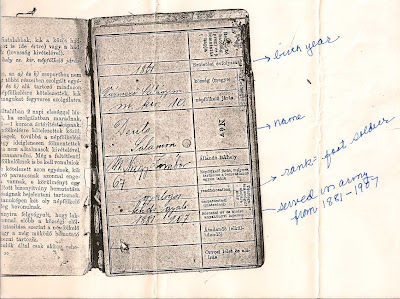
Here's an inside page with some translation notes. 1881-1907 is now given as his years of service. Some internet research indicates age 19 or 20 was a common age to enter the army. From 1881-1895 he must have been in training, in reserves, or some other non-active category. Similarly from 1904-1907.
At the top of the form, 'kozseg' means 'village'. Szilagy is a Hungarian county in Transylvania. I believe the town is Varmezo (or Buciumi, Romania)
 This page further clarifies his years of service. Signed on December 31, 1894, it seems to say he would be a Foot Soldier First Class until December 31, 1898, and Second Class until 1903. The information on the right hand side is repetitive from other pages.
There are still a lot of words untranslated, but I have been able to build upon the translation notes that had previously been made, and I have a better understanding of my great grandfather's military service.
He married my great grandmother in 1898 (according to an audiotape my grandfather made in the 1970s) and my grandfather also believed he had a prior wife, and children who remained in Hungary. My grandfather was born in 1907, but several older siblings were born during the period 1899-1903, so his service as a foot soldier included some family leave time, at least in the post-1898 period.
I wondered with the help of Google's Translator if I could verify the original translations, and perhaps learn a bit more about the documents. Computer translations are notorious for hacking up languages, but I figured it should get me at least close. And I was correct.
Here's the front and back of the booklet (click on any image to enlarge):

As you can see, none of it is translated - there's only the identification of the crest.
Google Translator had no idea what Nepfolkelesi meant. It told me that Nepfolkelesi igazolvanyi konyv means Nepfolkelesi paper card. So I knew it meant an identification card of some sort. I conducted a Google web search and there found someone with the exact document I had seeking a translation. It means 'popular uprising'. When I put those words into the translator, it returns the Hungarian words: Népszerű felkelés. So it appears that Nepfolkelesi is a 'portmanteau' - a blend of two or more words. The translation given on the website said "Popular Uprising identification card." which is what I figured. And we were off.
I recognized my great grandfather's name, Salamon Deuts. He went by both Salamon and Samuel, and the surname was originally Deuts. The following line says he was a foot soldier (gyalogos) in the 57th regiment.
The next line says "Year of Birth" - 1861. It would have been nice if any of the documents got more specific, but they don't. Still, it provides a good source for the year.
The table at the bottom was difficult to interpret because I think the individual who filled out the form filled it out incorrectly. The top rows should be his years as a recruit (hadkiegeszito). Instead, it was filled out as 1/1 (January 1) 1895. Starting in 1896 and ending (beszarolag) in 1903 he was in the service.
I'd love to know what all the calculations on the back of the booklet mean.

Here's an inside page with some translation notes. 1881-1907 is now given as his years of service. Some internet research indicates age 19 or 20 was a common age to enter the army. From 1881-1895 he must have been in training, in reserves, or some other non-active category. Similarly from 1904-1907.
At the top of the form, 'kozseg' means 'village'. Szilagy is a Hungarian county in Transylvania. I believe the town is Varmezo (or Buciumi, Romania)
 This page further clarifies his years of service. Signed on December 31, 1894, it seems to say he would be a Foot Soldier First Class until December 31, 1898, and Second Class until 1903. The information on the right hand side is repetitive from other pages.
There are still a lot of words untranslated, but I have been able to build upon the translation notes that had previously been made, and I have a better understanding of my great grandfather's military service.
He married my great grandmother in 1898 (according to an audiotape my grandfather made in the 1970s) and my grandfather also believed he had a prior wife, and children who remained in Hungary. My grandfather was born in 1907, but several older siblings were born during the period 1899-1903, so his service as a foot soldier included some family leave time, at least in the post-1898 period.
Thursday, February 5, 2009
Genealogy Can Save Your Life - 2009
I've blogged about this before, but I've decided to make an annual habit of it. It can't be repeated too often. Genealogy can save your life. It would have saved mine if I hadn't already known what I needed to know.
The American Cancer Society recommends the 'average' person to start getting checked for Colon cancer at age 50. However, for those with a history of the disease in the immediate family, they recommend to start the tests ten years prior to the earliest it has been diagnosed. My maternal grandmother died at age 51. So I was prepared to start getting tested at age 40. Then a close kin, slightly older, had their test, and polyps were discovered and removed. So last year, at age 39, I decided there wasn't any good reason to wait on ceremony, and my doctor agreed. I had my first colonoscopy, and 2 polyps were removed, one of which was pre-malignant. If I had waited until I was 50, there's a chance I wouldn't have made it. Since I knew to check early, the polyps were caught before they could become dangerous, and hopefully any future polyps will also be caught beforehand.
[Note: As I understand it, the causal connection between polyps and cancer actually isn't conclusive. Scientists haven't proven that pre-malignant polyps always become malignant, or that polyps always lead to cancer. Nor that everyone who gets cancer had pre-malignant polyps at one time that could have been detected. But they know enough to remove the polyps when they see them.]
Other diseases have genetic predispositions. So it is important to know the medical histories of your parents, grandparents, and where possible, your great grandparents. The primary method of doing this, for those who are deceased, is to find their death certificates. It is rare to find any prior to 1900, but for those who lived into the 20th century, especially those who lived past 1920, finding death certificates, while not always easy, isn't usually difficult - if you know when and where they died.
1) Local Courthouses
Most counties in America house archives of their Vital Records (birth, marriage, death.) A few have strict restrictions on who can request copies, limiting them to 'immediate family' which may not include grandchildren.
2) State Archives
State archives often have copies of the county records, with fewer restrictions on access.
3) Online Databases
Some counties and states have begun putting their records online. Ancestry, FamilySearch, and Footnote also have some databases available to search.
4) Funeral Homes
Funeral homes often retain their own copy of the death certificate, and their copy may differ slightly from that held by the County or State. It may contain details about where in a cemetery plot the individual was buried, or details about the funeral itself. If you don't know the funeral home, search in archives of local newspapers and try to find an obituary, as obituary notices often include this information. The funeral home copy may also be at times the only copy you have access to if the county and state are too restrictive.
Once you have found the death certificate, if you don't recognize instantly the words written under 'cause of death' conduct an internet search on them at Google or Yahoo. My family history made identifying "Carc. of Col." as "Carcinoma of Colon" fairly easy, though I suspect some might have stumbled over the abbreviation. Several ancestors were diagnosed with "Interstitial Nephritis." I'd never heard of this before, but it is a kidney ailment often caused by a reaction to pain medication. Unfortunately, the death certificates didn't indicate the cause of the original pain.
The American Cancer Society recommends the 'average' person to start getting checked for Colon cancer at age 50. However, for those with a history of the disease in the immediate family, they recommend to start the tests ten years prior to the earliest it has been diagnosed. My maternal grandmother died at age 51. So I was prepared to start getting tested at age 40. Then a close kin, slightly older, had their test, and polyps were discovered and removed. So last year, at age 39, I decided there wasn't any good reason to wait on ceremony, and my doctor agreed. I had my first colonoscopy, and 2 polyps were removed, one of which was pre-malignant. If I had waited until I was 50, there's a chance I wouldn't have made it. Since I knew to check early, the polyps were caught before they could become dangerous, and hopefully any future polyps will also be caught beforehand.
[Note: As I understand it, the causal connection between polyps and cancer actually isn't conclusive. Scientists haven't proven that pre-malignant polyps always become malignant, or that polyps always lead to cancer. Nor that everyone who gets cancer had pre-malignant polyps at one time that could have been detected. But they know enough to remove the polyps when they see them.]
Other diseases have genetic predispositions. So it is important to know the medical histories of your parents, grandparents, and where possible, your great grandparents. The primary method of doing this, for those who are deceased, is to find their death certificates. It is rare to find any prior to 1900, but for those who lived into the 20th century, especially those who lived past 1920, finding death certificates, while not always easy, isn't usually difficult - if you know when and where they died.
1) Local Courthouses
Most counties in America house archives of their Vital Records (birth, marriage, death.) A few have strict restrictions on who can request copies, limiting them to 'immediate family' which may not include grandchildren.
2) State Archives
State archives often have copies of the county records, with fewer restrictions on access.
3) Online Databases
Some counties and states have begun putting their records online. Ancestry, FamilySearch, and Footnote also have some databases available to search.
4) Funeral Homes
Funeral homes often retain their own copy of the death certificate, and their copy may differ slightly from that held by the County or State. It may contain details about where in a cemetery plot the individual was buried, or details about the funeral itself. If you don't know the funeral home, search in archives of local newspapers and try to find an obituary, as obituary notices often include this information. The funeral home copy may also be at times the only copy you have access to if the county and state are too restrictive.
Once you have found the death certificate, if you don't recognize instantly the words written under 'cause of death' conduct an internet search on them at Google or Yahoo. My family history made identifying "Carc. of Col." as "Carcinoma of Colon" fairly easy, though I suspect some might have stumbled over the abbreviation. Several ancestors were diagnosed with "Interstitial Nephritis." I'd never heard of this before, but it is a kidney ailment often caused by a reaction to pain medication. Unfortunately, the death certificates didn't indicate the cause of the original pain.
Sunday, February 1, 2009
Gamer's Guide to Genealogy
You may be familiar with just the traditional 6-sided die. And when someone says "dice" that is the image that comes to mind. However, those who play Role Playing Games (RPGs) such as Dungeons and Dragons are familiar with a number of other variations:

The common shorthand for each is dX where X is the number of sides, so the traditional 6-sided die becomes known as a d6.
It occurred to me that when I reach a point where I am not sure what to do next in my genealogy research, letting the dice decide might be appropriate, or at least fun. So I came up with a system using a d20, and two rolls. (A d6 doesn't have nearly enough choices.)
First Roll - Selecting an Individual
To come up with 20 options, I started with the 16 Great-Great Grandparents, numbers 16-31 ahnentafel. So if 1 through 16 are rolled I allow myself to choose the ancestor listed, collateral descendants, or one of their ancestors.
I've listed mine below, along with their Ahnentafel numbers (binary and decimal)
1 Samuel Newmark (10000 – 16)
2 Rose Cantkert Newmark (10001 – 17)
3 Moshe Leyb Cruvant (10010 – 18)
4 Minnie Mojsabovski Cruvant (10011 – 19)
5 Selig (Dudelsack) Feinstein (10100 – 20)
6 Annie Perlik Feinstein (10101 – 21)
7 Morris Blatt (10110 - 22)
8 Beila Wyman Blatt (10111 - 23)
9 Abraham Deutsch (11000 – 24)
10 Sarah Weiss Deutsch (11001 – 25)
11 Israel Lichtman (11010 – 26)
12 Betty Adler Lichtman (11011 – 27)
13 Samuel Van Every (11100 – 28)
14 Abigail Stuart Van Every (11101 - 29)
15 Ebenezer Denyer (11110 - 30)
16 Sarah Hartley Denyer (11111 – 31)
I rounded out the 20 with four remaining categories:
17 Paternal Grandparents
18 Maternal Grandparents
19 Parents
20 Myself
Roll 2: Action
(I came up with ten actions, so I repeated each one. But a d10 could be used. Or maybe you can come up with ten more.)
1. Google Search (google.com ; books.google.com; news.google.com; groups.google.com)
2. Subscriber Site Search (e.g. Ancestry, Footnote, GenealogyBank)
3. Search for online databases in related locales that are new, or you may have missed.
4. Check Source Citations (Verify all data on individual in your database has a cited source.)
5. Interview someone about the individual (or write down your own recollections)
6. Write to a cousin descended from the individual
7. Transcribe a letter/document from, to, or about individual
8. Research the time/place the individual lived.
9. Scan photos/documents related to individual
10. Blog about the individual
11. Google Search (google.com ; books.google.com; news.google.com; groups.google.com)
12. Subscriber Site Search (e.g. Ancestry, Footnote, GenealogyBank)
13. Search for online databases in related locales that are new, or you may have missed.
14. Check Source Citations (Verify all data on individual in your database has a cited source.)
15. Interview someone about the individual (or write down your own recollections)
16. Write to a cousin descended from the individual
17. Transcribe a letter/document from, to, or about individual
18. Research the time/place the individual lived.
19. Scan photos/documents related to individual
20. Blog about the individual
Naturally, if you roll a combination that results in an impossible task (e.g. You don't have any letters to transcribe relating to X) roll again.
If you don't know where the closest store is where you can find a set of dice, you can find them online. Gamer's dice are usually sold in sets of 7: a d4, d6, d8, 2 d10s, a d12 and a d20. (the 2 d10s are numbered 1-10 and 10-100). You may be able to find many uses for these die for things in your life you are willing to randomize a bit.
Example, with a d6:
1) Do laundry
2) Clean bathroom
3) Feed dog
4) Feed kids
5) Check Email
6) Hit the snooze bar
If you feel 20 choices isn't enough, they do sell d100s.

The common shorthand for each is dX where X is the number of sides, so the traditional 6-sided die becomes known as a d6.
It occurred to me that when I reach a point where I am not sure what to do next in my genealogy research, letting the dice decide might be appropriate, or at least fun. So I came up with a system using a d20, and two rolls. (A d6 doesn't have nearly enough choices.)
First Roll - Selecting an Individual
To come up with 20 options, I started with the 16 Great-Great Grandparents, numbers 16-31 ahnentafel. So if 1 through 16 are rolled I allow myself to choose the ancestor listed, collateral descendants, or one of their ancestors.
I've listed mine below, along with their Ahnentafel numbers (binary and decimal)
1 Samuel Newmark (10000 – 16)
2 Rose Cantkert Newmark (10001 – 17)
3 Moshe Leyb Cruvant (10010 – 18)
4 Minnie Mojsabovski Cruvant (10011 – 19)
5 Selig (Dudelsack) Feinstein (10100 – 20)
6 Annie Perlik Feinstein (10101 – 21)
7 Morris Blatt (10110 - 22)
8 Beila Wyman Blatt (10111 - 23)
9 Abraham Deutsch (11000 – 24)
10 Sarah Weiss Deutsch (11001 – 25)
11 Israel Lichtman (11010 – 26)
12 Betty Adler Lichtman (11011 – 27)
13 Samuel Van Every (11100 – 28)
14 Abigail Stuart Van Every (11101 - 29)
15 Ebenezer Denyer (11110 - 30)
16 Sarah Hartley Denyer (11111 – 31)
I rounded out the 20 with four remaining categories:
17 Paternal Grandparents
18 Maternal Grandparents
19 Parents
20 Myself
Roll 2: Action
(I came up with ten actions, so I repeated each one. But a d10 could be used. Or maybe you can come up with ten more.)
1. Google Search (google.com ; books.google.com; news.google.com; groups.google.com)
2. Subscriber Site Search (e.g. Ancestry, Footnote, GenealogyBank)
3. Search for online databases in related locales that are new, or you may have missed.
4. Check Source Citations (Verify all data on individual in your database has a cited source.)
5. Interview someone about the individual (or write down your own recollections)
6. Write to a cousin descended from the individual
7. Transcribe a letter/document from, to, or about individual
8. Research the time/place the individual lived.
9. Scan photos/documents related to individual
10. Blog about the individual
11. Google Search (google.com ; books.google.com; news.google.com; groups.google.com)
12. Subscriber Site Search (e.g. Ancestry, Footnote, GenealogyBank)
13. Search for online databases in related locales that are new, or you may have missed.
14. Check Source Citations (Verify all data on individual in your database has a cited source.)
15. Interview someone about the individual (or write down your own recollections)
16. Write to a cousin descended from the individual
17. Transcribe a letter/document from, to, or about individual
18. Research the time/place the individual lived.
19. Scan photos/documents related to individual
20. Blog about the individual
Naturally, if you roll a combination that results in an impossible task (e.g. You don't have any letters to transcribe relating to X) roll again.
If you don't know where the closest store is where you can find a set of dice, you can find them online. Gamer's dice are usually sold in sets of 7: a d4, d6, d8, 2 d10s, a d12 and a d20. (the 2 d10s are numbered 1-10 and 10-100). You may be able to find many uses for these die for things in your life you are willing to randomize a bit.
Example, with a d6:
1) Do laundry
2) Clean bathroom
3) Feed dog
4) Feed kids
5) Check Email
6) Hit the snooze bar
If you feel 20 choices isn't enough, they do sell d100s.
Saturday, January 31, 2009
The Happy Dance
One occasion I recall was when I received my maternal grandmother's "Official Personnel Folder" from the US Government. She had worked for the Post Office from 1921-1936. My maternal grandfather's OPF contained 50 pages of material from his career. My grandmother's 3. Her signed Oath of Office taken in 1921 was nice, but it's not my only copy of her signature. The document entitled "Report of Separation" didn't have a lot of useful information. It noted that her 'last date of pay' was Jan 21, 1937 - which was a fun coincidence since it was exactly 32 years before I was born.The theme for the 65th Carnival of Genealogy: "The Happy Dance. The Joy of Genealogy. Almost everyone has experienced it. Tell us about the first time, or the last time, or the best time. What event, what document, what special find has caused you to stand up and cheer, to go crazy with joy?

It was the third document that caused the Happy Dance
 A year by year accounting of her career, including her name changes in 1927 and 1929. At that point in my research, from letters she had saved from her father, I knew she had been planning to marry someone named Dale in 1927. I also knew from my mother that there had been one or two husbands prior to my grandfather. But we had no last name. After opening the package, I instantly called my mother to give her the information, which I then passed along to an aunt in an email.
Another happy dance occurred upon my discovery of testimony my maternal Hartley ancestors gave in front of the American Dawes Commission - backing up the family story that we have Choctaw ancestry.
On my paternal ancestry, I'd have to include my discovery that my second great grandfather Selig Feinstein had received a patent for improvements to a fire hydrant. At this point in my research this was confusing because I thought his career was limited to real estate and laundry. A week later I discovered he spent ten years as a shoer/blacksmith.
Sunday, January 25, 2009
Black Swan Fallacy
The Black Swan Fallacy is taught in college logic courses. "I've never seen a black swan," the logic goes, "so black swans don't exist."
The logic is obviously absurd. No one has the opportunity to personally examine the color of every swan on the planet. That doesn't stop us from accidentally falling into this logical trap. We may be very familiar with American swans, for example, and think our experience is sufficient. But black swans actually exist in Australia, if not elsewhere.
There are also people who are very adamant that no two snowflakes look alike, or that there's no such thing as an honest politician. Science tells us the truth about snowflakes. Though I fear the existence of an honest politician is an element of faith one must either have, or not have.
In genealogy we run across this fallacy when one assumes that their search for a particular document has been exhaustive, and thus, the document doesn't exist.
For example, you may find two marriage documents for the same individual, but be unable to find record of an intervening divorce. That doesn't necessarily mean the individual was a bigamist. Before the 20th century divorces were uncommon, and in some places illegal, but even in the 20th century, one doesn't have to file divorce papers in the same county/state where one was married.
Sometimes an ancestor's residence is fairly stationary, narrowing options. However, other ancestors were more mobile. Some might decide that verifying whether everything was legal isn't vital, and focus on other research.
The Genealogical Proof Standard includes a "reasonably exhaustive search." Though we must remember reasonably exhaustive will still miss records. And truly exhaustive is next to impossible. If my maternal grandmother, Myrtle Van Every, hadn't saved a copy of her divorce proceedings, I doubt I would ever have discovered where and when she had married her second husband, Dale Ridgely. They were married and divorced in San Francisco, CA over a period of five months in 1927. There wasn't a single St. Louis City Directory my grandmother missed from 1921-1929. At some point the California marriage records might get indexed on some online database, but I'd have had no reason to look.
The logic is obviously absurd. No one has the opportunity to personally examine the color of every swan on the planet. That doesn't stop us from accidentally falling into this logical trap. We may be very familiar with American swans, for example, and think our experience is sufficient. But black swans actually exist in Australia, if not elsewhere.
There are also people who are very adamant that no two snowflakes look alike, or that there's no such thing as an honest politician. Science tells us the truth about snowflakes. Though I fear the existence of an honest politician is an element of faith one must either have, or not have.
In genealogy we run across this fallacy when one assumes that their search for a particular document has been exhaustive, and thus, the document doesn't exist.
For example, you may find two marriage documents for the same individual, but be unable to find record of an intervening divorce. That doesn't necessarily mean the individual was a bigamist. Before the 20th century divorces were uncommon, and in some places illegal, but even in the 20th century, one doesn't have to file divorce papers in the same county/state where one was married.
Sometimes an ancestor's residence is fairly stationary, narrowing options. However, other ancestors were more mobile. Some might decide that verifying whether everything was legal isn't vital, and focus on other research.
The Genealogical Proof Standard includes a "reasonably exhaustive search." Though we must remember reasonably exhaustive will still miss records. And truly exhaustive is next to impossible. If my maternal grandmother, Myrtle Van Every, hadn't saved a copy of her divorce proceedings, I doubt I would ever have discovered where and when she had married her second husband, Dale Ridgely. They were married and divorced in San Francisco, CA over a period of five months in 1927. There wasn't a single St. Louis City Directory my grandmother missed from 1921-1929. At some point the California marriage records might get indexed on some online database, but I'd have had no reason to look.
Around the Genea-Web
This is by no means a complete list, but here are several blog articles I found poignant, entertaining, or informational in the past few weeks:
When You Assume at 24-7 Family History Circle.
Tri-Racial Isolate: A Hidden Ancestry at Desktop Genealogist Unplugged
Building for Others at Gtownma's Genealogy. (The poem included is The Bridge Builder by Will Allen Dromgoole
How Will the Economy Affect Genealogy at GeneaMusings
The Burrough Family:Poignant Story Told in Stone at Hill Country of Monroe County
And while not genealogically related, the writer and poet in me enjoyed
Literary Follies: Lipogrammatic Writing at Hill Country of Monroe County. For those seeking unusual writing restraints, I recommend the Table of Forms at Spineless Books.
When You Assume at 24-7 Family History Circle.
Tri-Racial Isolate: A Hidden Ancestry at Desktop Genealogist Unplugged
Building for Others at Gtownma's Genealogy. (The poem included is The Bridge Builder by Will Allen Dromgoole
How Will the Economy Affect Genealogy at GeneaMusings
The Burrough Family:Poignant Story Told in Stone at Hill Country of Monroe County
And while not genealogically related, the writer and poet in me enjoyed
Literary Follies: Lipogrammatic Writing at Hill Country of Monroe County. For those seeking unusual writing restraints, I recommend the Table of Forms at Spineless Books.
Saturday, January 17, 2009
64th Edition of Carnival of Genealogy
The 64th Edition of the Carnival of Genealogy has been Posted by CreativeGene with 31 submissions of Winter Photo Essays.
The topic for the next edition of the Carnival of Genealogy is: "The Happy Dance. The Joy of Genealogy. Almost everyone has experienced it. Tell us about the first time, or the last time, or the best time. What event, what document, what special find has caused you to stand up and cheer, to go crazy with joy? If you haven't ever done the Happy Dance, tell us what you think it would take for you to do so." The deadline for submissions is Feb. 1st. More information.Themes for the upcoming editions for most of 2009 have already been decided and can be seen in advance on the left sidebar of CreativeGene's blog. (Some editions are still open for volunteers to host.)
Subscribe to:
Posts (Atom)


 Posts
Posts