Friday, July 1, 2011

A Toast to the First and the Fourth

A Toast to the First and the Fourth of July
for David Van Every (1757-1820)
©July 2009 - John Newmark

For two years my fourth great fought
for the creation of our nation
then in seventeen seventy seven
he deemed his disloyalty a disservice
and joined the other side.
Finally, he and his family fled to Canada.

His motivations are unrecorded.
Beyond his appearance on muster rolls,
a few brief mentions elsewhere,
we have nothing. No inkling
of the wherefores behind his decision
either in seventy five, or seventy seven.

In July’s opening barrage
of national celebrations
I honor both of his decisions -
whatever the reasons, and his willingness
to fight for what he believed
even when those beliefs changed.

***
July 1 is Canada Day
July 4 is Independence Day

This poem was based on information I'd found on the web, citing The Records of the Van Every Family, by Mary Blackadar Piersol, 1947.  After writing this poem, I discovered the muster rolls for David Van Every on Footnote that put the information somewhat in doubt.

The muster rolls suggest he enlisted on July 4, 1775, and deserted on Sept 12 (or Sept / 2) 1775. And re-enlisted on May 23, 1777, and redeserted in June of 1777. So in total it would have been for three months, not two years.

Also, since writing the poem, I obtained a copy of The Records of the Van Every Family, by Mary Blackadar Piersol. She only mentions David joining and deserting in 1777. So she didn't know about the 1775 muster roll. Somebody else must have found documentation that he joined in 1775, and an incorrect interpretation was made that he remained in service between 1775 and 1777.

It's impossible to assign motivation to the enlistments and desertions. David was 18 and 20 years old in 1775 and 1777. He may have just been a very confused young man.

While McGregory Van Every and his children ultimately joined the Loyalist camp, and fled to Canada, there were many Van Everys who fought as Patriots throughout the war.  They just aren't my ancestors.  As one researcher notes concerning David and his brother, Benjamin:
David and Benjamin Van Every perhaps had decided to join the New York Militia, as it was in this Regiment that the cousins of their father, McGregory Van Every had been serving: Martin as a Lieutenant, Cornelius (1730 - 1815) as an Ensign and later as a Lieutenant, and Rynier as a Captain. However, soon after deserting from the New York Militia, both David and Benjamin transferred themselves to Butler's Rangers, within which they fought for the duration of the American Revolution, David as a Sergeant and Benjamin as a regular soldier.

---
"Warner Cemetery: an important piece of Canada's heritage worth preserving," Robert Collins McBride, The Loyalist Gazette, March 22, 2000. 

Monday, June 27, 2011

Amanuensis Monday: Dawes Commission - Robert Hartley

Amanuensis: A person employed to write what another dictates or to copy what has been written by another.

I continue my project to transcribe family letters, journals, newspaper articles, audiotapes, and other historical artifacts. Not only do the documents contain genealogical information, the words breathe life into kin - some I never met - others I see a time in their life before I knew them.

I began this project back in February of 2009, and since then, many others have joined in on the meme.  Why do we transcribe?  I provide my three reasons in the linked post.  You may find others.  If you participate, feel free to leave a link to your post in the comments.

***

This week, I continue with the application my maternal grandmother's aunts, uncles, and cousins made in 1900 to the Dawes Commission to be accepted as Mississippi Choctaws. Previously I have transcribed the testimony given by
  1. MCR 1050 - Samuel T Hartley – Nov 21, 1900 (Brother of my great great grandmother, Sarah Hartley Denyer Foster)
  2. MCR 1053 - Sophronia Hartley Cagle - Nov 21, 1900 (Daughter of Samuel T Hartley) 
  3. MCR 1054 - Melvin Elijah Van Every – Nov 21, 1900 (My great grandfather)
  4. MCR 1055 - Samuel W Denyer - Nov 21, 1900 (Brother of my great grandmother, Margaret Denyer Van Every)
  5. MCR 1069 - Eliza Caroline Foster Reeves – Nov 26, 1900 (Half-sister of my great grandmother)
  6. MCR 5842 - Georgia Hartley Phillips – June 17, 1902 (Daughter of Samuel T Hartley)
  7. MCR 5842 - Samuel T Hartley – June 17, 1902 
and the ultimate decision - July 11, 1902  (A rejection.)

Below is the testimony given by Robert Hartley, a son of Samuel T Hartley, and a first cousin to my great grandmother, Margaret (Denyer) Van Every

Sunday, June 26, 2011

Week in Review

It's been eight months, and I am unsure whether or not I will be returning to doing this regularly.  But below are some noteworthy news stories and blog posts I have read in the past week that deal with my overlapping interests in Genealogy, History, Heritage, and Technology.

Genealogy Research
  • James Tanner at Genealogy's Star begins to address the topic of Evidence and Proof from the perspective of a lawyer, and continues by discussing the difference between probative and non-probative facts in Digging into Evidence.  The connections to genealogy research are clear.
Poetry
    Digital Archives 
      • Meredith D. at NARAtions announced the addition of Tagging for he National Archives "Online Public Access Prototype" 
      Recent uploads to the National Archives Flickr set
        • Executive Order 9981 in which President Harry S. Truman bans the segregation of the Armed Forces., 07/26/1948, Page 1/2, Page 2/2
        Technoloy/Internet
        •  ICANN announced that they will begin accepting applications for unlimited new Top Level Domains in January of next year. Currently TLDs include .com, .net, .org, etc  If there is interest from more than one source for a TLD it will be auctioned.  (Do you think Ancestry.com or FamilySearch will bid highest for .genealogy ?  Will anyone bid for the misspelled .geneology ?)  One of the interesting features of this announcement I've noticed, is that they will allow different language sets.  So there could be a TLD using Hebrew or Chinese characters.
        •  Dick Eastman reviews  the ABBYY TextGrabber app for iPod/iPad2/iPhones. While the application looks useful, and I may test it out myself, the review is also a great illustration of the weaknesses of Optical Character Recognition (OCR).

          Monday, June 20, 2011

          Amanuensis Monday: Dawes Commission - Sophronia Cagle

          Amanuensis: A person employed to write what another dictates or to copy what has been written by another.

          I continue my project to transcribe family letters, journals, newspaper articles, audiotapes, and other historical artifacts. Not only do the documents contain genealogical information, the words breathe life into kin - some I never met - others I see a time in their life before I knew them.

          I began this project back in February of 2009, and since then, many others have joined in on the meme.  Why do we transcribe?  I provide my three reasons in the linked post.  You may find others.  If you participate, feel free to leave a link to your post in the comments.

          ***

          This week, I continue with the application my maternal grandmother's aunts, uncles, and cousins made in 1900 to the Dawes Commission to be accepted as Mississippi Choctaws. Previously I have transcribed the testimony given by
          1. Samuel T Hartley – Nov 21, 1900 (Brother of my great great grandmother, Sarah Hartley Denyer Foster)
          2. Melvin Elijah Van Every – Nov 21, 1900 (My great grandfather)
          3. Samuel W Denyer - Nov 21, 1900 (Brother of my great grandmother, Margaret Denyer Van Every)
          4. Eliza Caroline Foster Reeves – Nov 26, 1900 (Half-sister of my great grandmother)
          5. Georgia Hartley Phillips – June 17, 1902 (Daughter of Samuel T Hartley)
          6. Samuel T Hartley – June 17, 1902 
          and the ultimate decision - July 11, 1902  (A rejection.)

          Below is the testimony given by Sophronia Hartley Cagle, another daughter of Samuel T Hartley.

          Monday, June 13, 2011

          Amanuensis Monday: Dawes Commission - Samuel W Denyer

          Amanuensis: A person employed to write what another dictates or to copy what has been written by another.

          I continue my project to transcribe family letters, journals, newspaper articles, audiotapes, and other historical artifacts. Not only do the documents contain genealogical information, the words breathe life into kin - some I never met - others I see a time in their life before I knew them.

          I began this project back in February of 2009, and since then, many others have joined in on the meme.  Why do we transcribe?  I provide my three reasons in the linked post.  You may find others.  If you participate, feel free to leave a link to your post in the comments.

          ***

          This week, I return to the application my maternal grandmother's aunts, uncles, and cousins made in 1900 to the Dawes Commission to be accepted as Mississippi Choctaws. Previously I have transcribed the testimony given by
          1. Samuel T Hartley – Nov 21, 1900 (Brother of my great great grandmother, Sarah Hartley Denyer Foster)
          2. Melvin Elijah Van Every – Nov 21, 1900 (my great grandfather)
          3. Eliza Caroline Foster Reeves – Nov 26, 1900 (Half-sister of my great grandmother, Margaret Denyer Van Every)
          4. Georgia Hartley Phillips – June 17, 1902 (Daughter of Samuel Hartley)
          5. Samuel T Hartley – June 17, 1902 
          and the ultimate decision - July 11, 1902  (A rejection.)

          Below is the testimony given by Samuel William Denyer, brother to my great grandmother, Margaret Denyer Van Every.

          Monday, June 6, 2011

          Amanuensis Monday: Draft Registration for Herman Feinstein

          Amanuensis: A person employed to write what another dictates or to copy what has been written Iby another.

          I continue my project to transcribe family letters, journals, newspaper articles, audiotapes, and other historical artifacts. Not only do the documents contain genealogical information, the words breathe life into kin - some I never met - others I see a time in their life before I knew them.

          I began this project back in February of 2009, and since then, many others have joined in on the meme.  Why do we transcribe?  I provide my three reasons in the linked post.  You may find others.  If you participate, feel free to leave a link to your post in the comments.

          ***

          This week, in honor of the anniversary of D-Day, I continue to look through various wartime documents.  While this week's anniversary pertains to a different war, I decided to transcribe another World War I draft registration - this time that of my great grandfather, Herman Feinstein.  

          Wednesday, June 1, 2011

          Wordless Wednesday - Van Every Estate - Mimico, Toronto, Ontario

          Caption: Photo of the Van Every settlers house on Lake Shore (between Dwight and Royal York) in Mimico (1920) (source)

          Monday, May 30, 2011

          Amanuensis Monday: Draft Registration for Aaron Feinstein

          Amanuensis: A person employed to write what another dictates or to copy what has been written Iby another.

          I continue my project to transcribe family letters, journals, newspaper articles, audiotapes, and other historical artifacts. Not only do the documents contain genealogical information, the words breathe life into kin - some I never met - others I see a time in their life before I knew them.

          I began this project back in February of 2009, and since then, many others have joined in on the meme.  Why do we transcribe?  I provide my three reasons in the linked post.  You may find others.  If you participate, feel free to leave a link to your post in the comments.

          ***

          This week, in honor of Memorial Day, I looked through various wartime documents.  I decided to transcribe the World War I draft registration of Aaron Feinstein, the youngest brother of my great grandfather, Herman Feinstein.  

          On Memorial Day


          The above image comes from the Memorial Day page at the US Department of Veterans Affairs, explaining that Memorial Day is a day for remembering those who died in the service of their country.  [Read the full text of the poem.]
          Memorial Day is a United States federal holiday observed on the last Monday of May. Formerly known as Decoration Day, it commemorates U.S. men and women who died while in the military service. First enacted to honor Union soldiers of the American Civil War (it is celebrated near the day of reunification after the civil war), it was expanded after World War I to include American casualties of any war or military action. [source]


          Unnamed Remains the Bravest Soldier - by Walt Whitman (From 'Specimen Days')

          OF scenes like these, I say, who writes—whoe’er can write the story? Of many a score—aye, thousands, north and south, of unwrit heroes, unknown heroisms, incredible, impromptu, first-class desperations—who tells? No history ever—no poem sings, no music sounds, those bravest men of all—those deeds. No formal general’s report, nor book in the library, nor column in the paper, embalms the bravest, north or south, east or west. Unnamed, unknown, remain, and still remain, the bravest soldiers. Our manliest—our boys—our hardy darlings; no picture gives them. Likely, the typic one of them (standing, no doubt, for hundreds, thousands,) crawls aside to some bush-clump, or ferny tuft, on receiving his death-shot—there sheltering a little while, soaking roots, grass and soil, with red blood—the battle advances, retreats, flits from the scene, sweeps by—and there, haply with pain and suffering (yet less, far less, than is supposed,) the last lethargy winds like a serpent round him—the eyes glaze in death—none recks—perhaps the burial-squads, in truce, a week afterwards, search not the secluded spot—and there, at last, the Bravest Soldier crumbles in mother earth, unburied and unknown.

          The cartoon above is by John T. McCutcheon - published circa 1900

          In honor of Memorial Day, below are the names of ancestors, and their siblings, who I know served their nation's military, either in a time of war, or in a time of peace. 

          Fifth Great Grandfathers
          McGregory Van Every (1723-1786) Loyalist/Butler's Rangers
          Michael Showers (1733-1796) Loyalist/Butler's Rangers

          Fourth Great Grandfather
          David Van Every (1757-1820) Loyalist/Butler's Rangers (served briefly as a Patriot in the NY militia)

          Fifth Great Uncle
          Benjamin Van Every (1759-1795) Loyalist/Butler's Rangers(served briefly as a Patriot in the NY militia)
          William Van Every (1765-1832) Loyalist/Butler's Rangers
          Peter Van Every (1771-bef 1816) Loyalist/Fifth Lincoln and Second York regiments (War of 1812)

          Fourth Great Uncles
          David Van Every Jr. (1782-1847) Loyalist/Second York regiment (War of 1812)
          Michael Van Every (1790-?) Loyalist/Fifth Lincoln and Second York regiments (War of 1812)

          Second Great Grandfather
          Ebenezer Denyer (1828-1872) (Confederate Army)

          Third Great Uncles
          Samuel Jennings Denyer (1822-1861) (Gonzales County Minute Men - Republic of Texas -1841)
          Samuel T Hartley (1830-1920) (Confederate Army)

          Great Grandfather
          Samuel Deutsch (1861-1938) (Franz Josef's Austro-Hungarian Army)

          Grandfathers
          Melvin L Newmark (1912-1992), WWII
          Martin J Deutsch (1907-1991), WWII

          Great Uncles
          Jerry Deutsch (1909-1950), WWII
          Allen Deutsch (1914-1988), WWII
          Harold Newmark (1915-2003), WWII
          Mandell Newmark (1923-1945), WWII (Killed in Action)
          Bernard Feinstin (1913-1968), WWII
          Seymour Feinstein (1917-1999), WWII

          Uncle
          Stevan J Newmark (1942-1997) Army Reserves

          Thursday, May 26, 2011

          Carnival of Genealogy - 4th Annual Swimsuit Edition

          It's time for 106th edition of the Carnival of Genealogy, and the theme is the 4th annual Swimsuit Edition.

          I participated in 2008 and 2009, but missed participating last year.

          This year I'm sharing a photograph of my grandfather, Melvin Newmark, about to jump off a dock.  The year is approximately 1930, and he's wearing a one-piece suit that was common for men in the era, but would be rare today.  The photograph comes from my grandmother's scrapbook, so I assume she was the photographer, though the photograph pre-dates their 1936 marriage.

          I don't know the other individuals in the photograph.  The child in the background would be about the right age for my grandfather's younger brother, Mandell (born in 1923), though the kid in the picture appears to have slightly darker hair than other photos of Mandell I have at that age.  Though it could be a matter of lighting.


          Jewish Mysticism, Genealogy, and Tombstones

          Expanded upon from a 2008 post

          One aspect of Kabbalah, a Jewish form of mysticism, is the interplay between numbers and letters.
          "Kabbalah teaches every Hebrew letter, word, number, even the accent on words of the Hebrew Bible contains a hidden sense; and it teaches the methods of interpretation for ascertaining these meanings." - source
          Three of these methods are Notarikon, Gematria, and Temurah. While primarily used as a means to interpret the scriptures, they can be used elsewhere, so an overview of the methods can be helpful to the genealogist with Jewish ancestry. (An overview is pretty much all I know and can provide; I don't have deep knowledge.)
          Notarikon – A method of using the initial and/or final letters in a group of words to form words/phrases.
          My great-great grandfather, Moshe Leyb Cruvant, was referred to as Moshe Leyb "the king" by at least one of his daughters, probably as a Hebrew joke, based on the initials of his name. (The Hebrew letters of   Mem-מ, Lamed-ל, Kopf-ך spell the word,  Melek-מלך, meaning King.) This is a usage of Notarikon.

          Similarly, Moshe Leyb was honored with several grandchildren, one named Melvin Lester, another Monroe Leslie, and a third Morris Louis. Without knowing the importance of initials in mystical thought, this might appear to be a coincidence of names instead of grandchildren being named after their deceased grandfather.

          Note: Leyb is the Yiddish word for Lion. Leyb was one of several new animal names which became popular in the European Jewish community in the 18th century. Prior to that animal names were common, but were limited to those that had appeared in the bible. Philip Trauring at Blood and Frogs writes more about Jewish animal names.

          Both Yiddish and Hebrew variants are used, and sometimes interchangeably. One of my ancestors on some documents was Zev Perlik and others Vulf Perlik. (Wolf. Since many English words are Germanic in root, and since Yiddish has Germanic roots, sometimes Yiddish and English words are similar.)

          Many immigrant Jews Americanized their names, and often they did this by finding a common American name that began with the same initial letter(s). Until recent research, I thought Vulf Perlik's name was "William" as that is how it was recorded in our family documents. 'William,' of course, shares the first two consonants with 'Vulf.' (Like Latin, and some other languages, there is no 'W' sound in the Hebrew alphabet.) Vulf didn't immigrate, but some of his children 'changed' his name to 'William' in the oral history.

          Similarly, another ancestor's Hebrew name was 'Zvi,' or 'deer.' The Yiddish variant is 'Hirsch', and a common Americanization is, "Harry.” Without knowing the animal names, and the process of Notarikon, one might be very confused how the name 'Harry' was derived from 'Zvi'.

          This tradition of using the initial letter or letters to change names can be useful for parents in naming their children if an ancestor had a name that is uncommon today.
          Gematria – A method of assigning numerical values to letters, calculating the numerical value of words/phrases, and associating them with other words/phrases of matching value.
          Perhaps the best known example of Gematria is with the Hebrew word, 'chai,' meaning 'life.' Formed with the Hebrew letters Chet-(8)-ח and Yod-(10)-י, the numerical value is 18. Many Jews will give charitable donations in multiples of $18 to symbolize 'life'.

          Leah is a very common Hebrew name for girls. The reason goes beyond her appearance in the Torah as one of Jacob’s wives. Her Hebrew name לאה (Lamed-30-ל + Aleph-1-א + Hay-5-ה) is equivalent to 36, or double 18.

          Hebrew letters are commonly used as equivalents to the numbers, and of particular importance to the genealogist, they are used when writing years, such as on tombstones.  However, usually the first digit of the year is left off.  For example, the current Hebrew year of 5771 would be written as 771 (or actually, as: 400-300-70-1) - תשעא (more detailed explanation)

          (Hebrew tombstones have a "Year 6000" problem, but it's 229 years away.)

          Two websites I have found helpful in computing Gematria are Numberman’s Gematria Calculator
          and The Bible Wheel’s Hebrew and Greek Gematria Database

          The Bible Wheel has a Biblical concordance, including the New Testament, and allows you to search for words using the English translation, though it uses the King James Version of both testaments. Numberman’s Gematria Calculator is useful if you already know the Hebrew characters for the word you are looking up.

          When you use The Bible Wheel’s concordance you have to be somewhat careful as Hebrew frequently attaches endings to words adding prepositions, and the like. For example, if you search for the number 42, twelfth in the results you will see “Leah.” If you look at the Hebrew you will notice it has an extra letter than what I have above, and if you follow the link to the Biblical passage in Genesis, you will see the word that appears in that passage really means “and Leah.”

          Let's take a look at how this might appear on a tombstone. Below is the tombstone of my great grandfather's brother, Max Newmark

          • Above the English surname, in the middle of the Star of David, are the letters Pay-Nun This is an abbreviation for Po Nikbar, meaning "here lies."
          • The first line of Hebrew reads: "Meyer Vulf."  The second line reads: "Bar (son of) Samuel Yosef Newmark."
          • It is the third line where numbers are first used.  The first word is "Niftar" meaning "Died."  The second word is: Yod (10) - Daled (4).  The third word is Sh'vat , the name of a Jewish month. The final word is: Tav (400) - Resh (200)  - Tzade (90) - Aleph (1) .  
          • So the date of his death was the 14th day of the Hebrew month of Sh'vat, in the year 5691.  (Remember, the first digit of the year is usually dropped.) This converts to Feb 1, 1931.  I happen to know Max died on January 31.  Why is it a day off?  Because he died after sunset, and the Hebrew day begins at sunset on the previous Gregorian date.
          • The final line of Hebrew is clearly an acronym on this tombstone, but the periods are often removed, and it appears as if it were a single word. It is usually at the bottom of a stone, as it is here.  It's based on a biblical passage from the Book of Samuel (25:29) and translates to: "May his soul be bound up in the bond of eternal life."
          Temurah – Exchanging letters in words to create new ones. There are three primary types of Temurah. (I'll use the Roman alphabet to illustrate)
          1) (Atbash) A exchanged with Z, B exchanged with Y, C exchanged with X...
          2) (Avgad) A becomes B, B becomes C, C becomes D...Z becomes A.
          3) (Albam) A exchanged with N, B exchanged with O, C exchanged with P…M exchanged with Z.

          I don't know of any examples in my family tree, where names were created using one of these methods, and I haven't heard of it happening in other families. However, there is one example from literature.

          Some creative readers suggested that Arthur C Clarke came up with the name for his misbehaving computer in the novel, 2001, through a reverse-Avgad technique -- HAL being derived from IBM. Clarke has denied this, insisting it was a coincidence, and that the name is actually a Shakespearean reference to Henry V, referred to as Prince Hal in the drama, Henry IV. Clarke probably expects readers to believe that since he is British, he is more likely to make a Shakespearean reference than a reference to an American computer company. Yeah, right.

          ***

          I've not been trained in any of these methods specifically. I knew about gematria growing up solely through the importance of Chai and the number 18. Some examples appear in the book/film The Chosen by Chaim Potok, which I remember reading in high school. I read the book, The Bible Code a few years ago which goes into some more detail.

          I've been fascinated with numerology for a long time.. When a nephew was born at 6:37 pm, I 'rounded down' in 'military time' to 18:36:54. I'll now never forget the time he was born. Interestingly, I discovered in my maternal grandfather's address book that next to my birthday was written the time I was born. (12:05 pm) I have no idea why it interested him, but the time is not written next to any other birthday. Jokes have been made over the years that I was 'born just in time for lunch."

          Resources

          Monday, May 23, 2011

          Amanuensis Monday: Martin Deutsch - Official Personnel Folder resume

          Amanuensis: A person employed to write what another dictates or to copy what has been written by another.

          I continue my project to transcribe family letters, journals, newspaper articles, audiotapes, and other historical artifacts. Not only do the documents contain genealogical information, the words breathe life into kin - some I never met - others I see a time in their life before I knew them.

          I began this project back in February of 2009, and since then, many others have joined in on the meme.  Why do we transcribe?  I provide my three reasons in the linked post.  You may find others.  If you participate, feel free to leave a link to your post in the comments.

          ***

          This week I transcribe a page from my maternal grandfather's Official Personnel Folder from the US Postal Service. Dated at some point after 1959, it covers most, but not all of his career. He retired in 1968.

          Saturday, May 21, 2011

          Surname Saturday: Lichtman

          It's been almost six months since the last installment, but I return with the Surname Saturday blogging meme.
          Discuss a surname and mention its origins, its geographical location(s) and how it fits into your genealogy research.
          Lichtman is an occupational surname for a chandler, being derived from Likht, the Yiddish word for candle.  My Lichtman ancestors were from an area of Transylvania, at the time under the rule of Austria-Hungary.  Today the towns are part of Romania.  My great grandmother Helen (nee Lichtman) Deutsch immigrated to the US in 1912, settling in Chicago.  A few of her siblings immigrated around the same time, while a few others remained in Hungary.  Of those who remained, most died in the Holocaust, though two nieces survived, and made it to Israel in 1964. One of their daughters made contact with our family a couple decades ago.  I know less dates for this surname branch than some others, but I include the information I do have.

          The numbering below follows the d'Aboville system, slightly modified to indicate half-siblings.
          The first digit represents the order surnames make their first appearance on my ahnentafel.
          I've emboldened my direct ancestors, and __s indicate living, or potentially living, relatives.

          7. Herman Lichtman
          7.1 Israel Lichtman married (a) Betty Adler and (b) Sara Jonas (1858- ?)

           7.1a.1 Helen (Hermina) Lichtman (1881-1958) married Samuel Deutsch (1861-1938)

          7.1b.1 Bertha Lichtman married Gold
          7.1b.2 David Lichtman
          7.1b.3 Frank (Fere) Lichtman
          7.1b.4 Gizela Lichtman married Hoffman
          7.1b.5 Rosa Lichtman ( - 1933)
          7.1b.6 Eugene Lichtman (1896 - ?)

          7.1a.7.1 Jean Deutsch (1899-1965) - married Bernard Kamerman (1889-1958)
          7.1a.7.2 Armon Deutsch (1900-1908)
          7.1a.7.3 Theodore Deutsch (902 –1980) married Frances Levy
          7.1a.7.4 Edward Deutsch (1904 – 1973) - changed surname to Kameran
          7.1a.7.5 Martin Deutsch (1907 – 1991) married (1) Myrtle Van Every (1900-1951) (2) Marjorie Shelp (1911-1985)
          7.1a.7.6 Maurice Gerald Deutsch (1909 – 1950) married Dorothy Arkin (1906-1995)
          7.1a.7.7 Berta Deutsch (1911 – 2003) married Herman Freed
          7.1a.7.8 Allen Deutsch (1914 – 1988) married Jean Collier

          7.1b.1.1 William Gold (1906 - ?)
          7.1b.1.2 Emile Gold (1910 - ?) married Fox
          7.1b.1.3 Albert Gold (1915 - ?)

          7.1b.3.1 Andre Lichtman
          7.1b.3.2 Ella Lichtman
          7.1b.3.3 Mick Lichtman
          7.1b.3.4 Sanyi Lichtman
          7.1b.3.5 Ana Lichtman (1924 - 1989) married ___ Knapp (1924 - )

          7.1b.4.1 ___ Hoffman
          7.1b.4.2 ___ Hoffman
          7.1b.4.3 Estyne Hoffman (1920-2006) married Jerome Cohler (1925-2003)
          7.1b.4.4 Helen Hoffman (1922-1998) married ____ Ploetz

          7.1b.6.1 __ Lichtman married Geraldine ___ (1925-2004)
          7.1b.6.2 __ Lichtman

          My number is: 7.1a.7.5.1.3

          Wednesday, May 18, 2011

          Wordless Wednesday: A Royal Wedding - 1943

          The marriage (and divorces) took place on July 6, 1943.  (source)
          This news clipping was found with other wartime clippings saved by my maternal grandmother, Myrtle Van Every Deutsch.

          Tuesday, May 17, 2011

          Naturalizations Ordered

          Following the guidance at Blood and Frogs, I have been ordering several batches of Naturalization Records from the National Archives (NARA) recently.   The cost is inexpensive at $7.50, and they don't charge for the research, so you only pay if they find something.

          Newmark Family
          Samuel Newmark (Declaration of Intent only....probably didn't complete citizenship process)
          Barnet Newmark (Declaration of Intent, Petition, Certificate of Arrival)

          There are a few others I could order.  Barney's brothers Sol, Max and Israel David all went through the citizenship process. I have all three of their Declarations of Intent from the local library's microfilm. However, there are no current mysteries that their petitions are likely to solve.

          Dudelsack/Feinstein Family
          Selig Dudelsack (changed name to Feinstein) - (NARA unable to locate records, though he is listed as Naturalized in census.)
          Julius Dudelsack (changed name to Odelson) - (NARA unable to locate records, though he is listed as Naturalized in census.) -
          Aaron Oberman (husband of Toba Dudelsack, sister of Selig and Julius) - (NARA unable to locate records, though Toba is listed as Naturalized in the 1920 census)

          This is frustrating.  This is the only paternal branch of mine that I don't know the European city of origin. Selig's brother-in-law, Jacob Perlik, has Szdobirtzen, Russia  and Szdobeitzen, Poland on his petition and certificate respectively -- though no city with those names can be found.  The closest phonetic match I can find is Dobrzyn, though this is a guess.

          Cruvant Family
          Morris (Moshe Leyb) Cruvant

          I was informed by NARA that the naturalization didn't occur in a Federal Court, and was told the records could be retrieved from the Missouri State Archives.  They provided court, volume number, page number, and date.  (I knew about the Missouri State Archives records, but was curious if NARA had anything additional.)  I wasn't charged for this information.

          Blatt Family
          Morris Blatt

          As with Morris Cruvant, NARA informed me they had no records, as this wasn't a Federal naturalization, and provided me with the information necessary to retrieve the records from the Missouri State Archives.

          Deutsch Family
          Solomon Deutsch - Search Pending

          This also isn't a Federal Naturalization, and I have requested the documents from the Cook County Illinois court.

          Monday, May 16, 2011

          Amanuensis Monday: Martin Deutsch - Application for Certificate of Citizenship

          Amanuensis: A person employed to write what another dictates or to copy what has been written by another.

          I continue my project to transcribe family letters, journals, newspaper articles, audiotapes, and other historical artifacts. Not only do the documents contain genealogical information, the words breathe life into kin - some I never met - others I see a time in their life before I knew them.

          I began this project back in February of 2009, and since then, many others have joined in on the meme.  Why do we transcribe?  I provide my three reasons in the linked post.  You may find others.  If you participate, feel free to leave a link to your post in the comments.

          ***

          My grandfather, Martin Deutsch, was born in Transylvania (Hungary), and immigrated to America as a child in 1913.  He was naturalized as a dependent when his father became a citizen.  In 1958, when his mother passed away, he discovered in her effects a copy of his birth certificate.  Even though his citizenship was never in question during his many years of employ at the US Post Office, nor during his service in World War II, he decided he wanted an official Certificate of Citizenship, which his birth certificate allowed, so he filled out the application for one.  One of the things I am grateful for is the tendency of my maternal grandparents to save their copies of various documents  Unlike official Naturalization documents, while the INS received the application, I suspect their copy wasn't preserved.

          Saturday, May 14, 2011

          Origin of the Newmark Surname

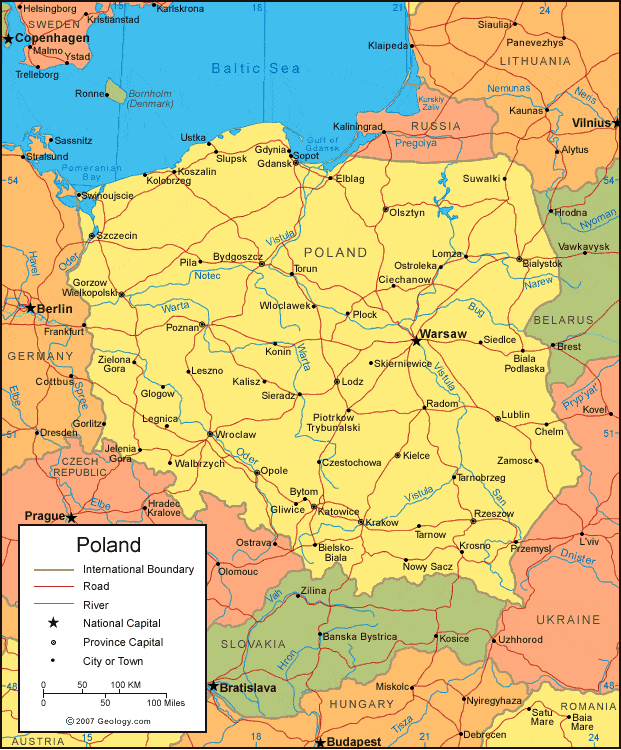
          When you're dealing with unfamiliar geography, especially historical geography, maps can be quite useful.

          I found this map of 1320 Brandenburg. (source) It is believed the territory called Neumark is the origin of our surname.  You can note that the Oder and Warthe rivers form one of the boundaries.


          I am only able to trace my particular Newmark ancestors back to Warka, Poland, near Warsaw. How did they travel there? They could have traveled most of the way by following Poland's river system, with minimal land crossing near Bydgoszcz.  (The Oder and Warta rivers can be found in the upper left.)  We have no idea when they left Neumark, and entered Poland.  All we know is that they were in Warka by the 1880s.

          (image source)

          Monday, May 9, 2011

          Amanuensis Monday: Petition for Naturalization of Barnet Newmark

          Amanuensis: A person employed to write what another dictates or to copy what has been written by another.

          I continue my project to transcribe family letters, journals, newspaper articles, audiotapes, and other historical artifacts. Not only do the documents contain genealogical information, the words breathe life into kin - some I never met - others I see a time in their life before I knew them.

          This week I transcribe the naturalization petition (Second Papers) of my great grandfather, Barnet ("Barney") Newmark. A few weeks ago I mentioned trying to obtain the petition for his father, Samuel, but discovering that his father likely never completed the citizenship process. However, Barney became a citizen on October 1, 1915. I have previously transcribed his Declaration of Intent. (First Papers)

          Amanuensis Monday: May 9

          Amanuensis: A person employed to write what another dictates or to copy what has been written by another.

          If you have an Amanuensis Monday post on your blog, please feel free to add a link below.  An explanation of this weekly blog theme follows.


          • Is there a letter, journal entry, speech, other document, or audio recording, written or delivered by or about an ancestor you wish to transcribe for future generations?
          • Are you engaged in a transcription project of an historical document?
          This is what Amanuensis Monday was created for. Amanuensis is an obscure word, but it derives from the Latin, ‘Manu’ meaning ‘hand’. I began this project back in February of 2009, and since then, many others have joined in on the meme.  Why do we transcribe?  I provide my three reasons in the linked post.  You may find others.

          Sunday, May 8, 2011

          Happy Mother's Day

          We wouldn't be who we are today without the loving mothers in our lives - past and present.

          Here are the eight female ancestors (besides my mother) for whom I currently have photographs.


          (click to enlarge)


          From left to right:
          Myrtle (Van Every) Deutsch - 1900-1951 (my maternal grandmother)
          Margaret (Denyer) Van Every - 1868-1923 (my maternal grandmother's mother)
          Helen (Lichtman) Deutsch - 1881-1958 (my maternal grandfather's mother)
          Bertha (Cruvant) Newmark - 1886-1978 (my paternal grandfathers mother)
          Minnie (Mojsabovski) Cruvant - 1863-1924 (my paternal grandfather's maternal grandmother)
          Rose (Cantkert) Newmark - 1865-1943 (my paternal grandfather's paternal grandmother)
          Annie (Blatt) Feinstein - 1889-1965 (my paternal grandmother's mother)
          Sissie (Feinstein) Newmark - 1914-2002 (my paternal grandmother)