Monday, February 1, 2021

Amanuensis Monday: Melvin Newmark's Speech to Maryville College - Feb 1958

Amanuensis: A person employed to write what another dictates or to copy what has been written by another. I continue my project to transcribe family letters, journals, newspaper articles, audiotapes, and other historical artifacts. Not only do the documents contain genealogical information, the words breathe life into kin - some I never met - others I see a time in their life before I knew them.

Today I share a speech my grandfather gave to Maryville College (now Maryville University) in St. Louis in February of 1958. He would have been 46 years old at the time. This was given in connection with National Brotherhood Week, which was promoted by the National Conference of Christians and Jews, of which my grandfather was an active member.

 For delivery February 13th 1958 Maryville College

This meeting this morning is one of many held during Brotherhood Week in Schools and colleges of America. It is an opportunity for students and teachers alike to reappraise the American goal of life, liberty and the pursuit of happiness — from our earnest studies of history we all have some knowledge of the dreams and aspirations of our founding fathers and their concepts of a truly democratic state. From our own daily experiences we all have some knowledge of the way in which those ideals have or have not been fulfilled. An opportunity, then, such as this one to examine wherein we have failed and to look for ways and means of improvement is essential to the orderly, progressive development of our democratic society.

Once, for instance, people of good intentions thought of America as a great melting pot — until we came to realize that you don’t solve problems of group differences by eliminating the difference — anymore than you would solve a headache by cutting off the head. It’s true there would be no more headache, but then neither would there be a you. And if the differences between the peoples and groups of this great country were eliminated the strength and vigor of America would be sapped and democracy would have been dealt a death blow.

Today people of goodwill understand the differences and no longer fear them. Whenever tensions do develop you can be sure that lack of understanding and baseless fears have blinded some from the truth. And sometimes evil men, who prosper on discord, try to mislead us and distort the meaning of our democracy. Ignorance is our worst enemy — truth and understanding our only hope.

However imperfect is our present form of government, however impatient some of us may at times seem, none of us doubts the ultimate success of our system to establish a climate where all of us, regardless of our differences, whether they be race or religion, will be able to live and prosper together in peace and harmony.

We fully believe so because we know that the ideal of American democracy is simply a fulfillment of the one basic law common to both science and religion.

From science we have learned the value of cooperation. The way in which single, simple cells unite, for instance, to join together to form more complex patterns of living matter. The history, for instance, of evolution which reveals the pattern of progress and survival through cooperation. Countless other examples testify to the scientific proof that the basic law of nature is cooperation. We know now that it is not enough to say “live and let live”, we must say “live and help live.”

From the religions of our Judean-Christian civilization we learn, too, there is one basic law, one commandment, which seems to sum up everything that God has ever revealed to mankind. That law, that commandment is “Love thy neighbor”. Hate, we know, will destroy us, but love will fulfill us.

Love and cooperation are different words meaning the same thing.

The democracy our forefathers established in America actually began when Moses led the Hebrews out of Egyptian slavery. His goal was freedom, not just freedom alone from restrictive tyranny, but freedom as well for restraining law - so that free people could thereafter live together without fear or hatred. The laws and commandments then revealed to Moses established the only kind of freedom possible, a freedom, if you will, that simply makes your feel easy in your harness, and these laws and commandments were preserved by the great Christian religions and are the backbone of our American democracy.

The uniqueness of this democracy is the degree of unity we are able to achieve without at the same time giving up our differences.

If everyone thought alike and looked alike and prayed alike, or if everyone did not pray at all, then there would be, for sure, unity, but no diversity, and we would thus have totalitarianism.

If everyone did just whatever he pleased and acted however he pleased and no two people thought alike, we would of course have diversity but without any unity this diversity would result in anarchy.

Only in a democracy can there be, in fact, must there be, both unity and diversity.

Today we see our democracy as a symphony, each of the groups an instrument, all blending together in a glorious harmony, and we all contribute to the richness of the music.

What can we as members of different [faiths] do to preserve and strengthen this God given ideal — from Him who is the Father of all of us.

As a Jew it is my most sacred duty to live up to the loftiest commandment of my faith “to love thy neighbor as myself”. As Christians it is your most sacred duty to live up to the same commandment as explained by your great Savior to mean “do unto others as you would have others do unto you.” The Hebrew Psalms say “Olam Chesed Yiboneh” — the world is founded upon love alone. [Psalms 89:3] Coleridge, my favorite poet, I think, said it best in these words

He Prayeth best who loveth best — All things both great and small — for the dear God who loveth us — He made and loveth us all.


Notes:

1) I had heard about the Symphony alternative to the Melting Pot, so I went in search of who first suggested it. It was Horace Kallen in an article for The Nation, Democracy Versus the Melting Pot, in 1915. It is sad that kids were still being taught the Melting Pot metaphor when I was a kid in the 80s, and there are still people promoting it today.

2) It is great to see my grandfather's evolution as a thinker and speech writer over the 12 years since the speech he wrote in 1946. It was also good to learn the name of at least one of his favorite poets. His bookshelves were rather large. As are mine. 

Saturday, January 30, 2021

The Professions of David Orel Kruvand (1805-?)

Below are some index records I found on Ancestry pertaining to my third great grandfather, David Orel Kruvand. I do not believe the original records are accessible anywhere online, yet. 

The first record is from 1840, and the second 1852. In those 12 years he went from being a Miller to being a Butcher. What caused this change of occupation? What happened to the mill? Nothing certain, but one can certainly imagine several hypotheses.  In the first record - a census - he was 35 years old, and the second 47. It seems rather late in life, in that era, for a career change. But it is possible the mill belonged to his father, and he was not successful in keeping it up.  Or one of a multitude of other possibilities.

I recently found both records in a search, but it is interesting to speculate what I, or another genealogist, might conclude if only one record had turned up. If one only knew about his job as a Miller, one might conclude the family was, if not wealthy, successful. The physical requirements of a mill probably limited the number of millers in a town, and limited competition. This is not necessarily the case for butchers. So his success as a butcher might have depended upon the amount of competition he had as well as his skills. 

Butcher is a slightly humorous occupation for him to have gone into. Why? I learned a few years ago that the Lithuanian word, "Kruvinas," means 'bloody," and the town Kruvandai was named after a particularly bloody war. Kruvandai is near Cekiske, and everyone in town would have known from where the family got their surname. But there would likely have been a slight chuckle among residents that someone with that surname was a butcher. Under Kosher dietary laws blood has to be drained from meat, so "Kruvand meat" might have had negative connotations, even if everyone understood the origin of the surname.

I don't know yet when David Orel Kruvand passed away. The next generation started immigrating to America in the 1870s and 1880s.


Wednesday, January 27, 2021

Finding Your Roots - Andy Cohen

This post has mostly been written in advance of the airing of Finding Your Roots - Season 7 - Episode 2 with Andy Cohen. Not sure whether or not I should say this, but the episode was recorded back in 2019. Andy is my fourth cousin, and information got shared. I kept quiet. I didn't want to get anyone in trouble. But the episode has now aired. I’ve made some edits as naturally not everything that got shared with Andy made the show. There wasn’t enough time.

I actually learned from his family that his genealogy was being researched when the research began, so I have an idea how long that research can take. It was long enough I wondered if they had given up on finding anything of interest. I'll leave it at that. I was not contacted in any way by any of the researchers during the research of the episode.

I will say, though it won't be mentioned in the episode, unless they went back and recorded an extra scene [which didn’t happen] that Andy's bout with Covid this year gave me a personal scare. We may not be close cousins genetically, but we went to school together a year apart, and our families are close.

How are we related? Those who watched the episode and have been followers of my blog may have recognized the surname I have often spelled (C/K)r(u/oo)van(t/d). Almost every conceivable permutation exists on at least one branch of the family. The family surname comes from the town of Kruvandai in Lithuania. The town's name comes from the Lithuanian word for 'bloody' and was named for a bloody battle. My second great grandfather, Moshe Leyb Cruvant, and Andy's second great grandfather, Samuel (Simon) Cruvand, were brothers.

Here's some links to a few past blog posts that touch upon some of the same people, places, and events from the show.

I believe the only post I’ve made since the recording of the episode which referenced Cekiske, and the Cruvant family in Lithuania, was the one I made a couple weeks ago about the synagogue in Burlington, Vermont. There will be more.


Monday, January 25, 2021

Amanuensis Monday: Melvin Newmark's Speech to the Samaritan Methodist Church 1946

Amanuensis: A person employed to write what another dictates or to copy what has been written by another. I continue my project to transcribe family letters, journals, newspaper articles, audiotapes, and other historical artifacts. Not only do the documents contain genealogical information, the words breathe life into kin - some I never met - others I see a time in their life before I knew them.

Today I share a speech my grandfather gave to the Samaritan Methodist Church of St. Louis in October of 1946. He would have been 34 years old at the time. My grandfather was active in interfaith organizations such as the National Conference of Christians and Jews. He had spoken at the church in February, probably in connection with National Brotherhood Week, and was invited back in October by the pastor, so apparently had made a good impression.

October 10, 1946

Rev G.F. Tipton [Samaritan Methodist Church]
4118 Cook Ave
St. Louis, Missouri

Dear Rev. Tipton:

It was certainly good to hear from you and to receive your kind invitation to be with you at your vesper services on October 27.

I shall certainly do everything in my power to be with you that evening. If there is any particular subject that you would like me to choose, I would appreciate your advising me.

Thanks again for your invitation, and be assured that I am looking forward to being with you and your congregation on October 27.

Sincerely yours,

Melvin L. Newmark

***

Recently I received one of the nicest compliments ever paid me — Rev. Tipton’s kind invitation to meet again with you good people — having stood on this pulpit only eight months ago, I was at first reluctant to accept for fear I would, “so to speak”, “Wear out my welcome”— but the happy prospect of enjoying your friendliness was too much to resist — so in spite of the qualms that are inherent in repetition I came again to enjoy one of your most inspirational services — perhaps too, my return is the result of coincidental timing. Some time ago my office, and in particular my senior associate, Victor Packman, was retained with Henry Espy to represent a group of negro train porters — very likely the case is familiar to all or most of you — the issue involved is heart-rending; it is typical of the sort of problem we are encountering, but it stands out because of the inhumane boldness of the Brotherhood of Railroad Trainmen — a lily-white organization. For years the Frisco railroad has employed negroes in the dual capacity of brakemen and porters. But only so with the reluctant approval of the Brotherhood.. This year when the time came to renegotiate the various labor contracts involved, the brotherhood decreed that hereafter negroes would no longer be permitted to engage in that capacity, and in accordance with the agreement made, the Railroad served notice on the negro employees involved that they would be fired — fired outright, mind you, in spite of the fact that most of these men had 15, 20, 25 years of valuable seniority with the company. Our job was to get the Federal Court here in St. Louis to enjoin the railroad from firing those negro employees who were fired only — and for no other reason than — that they were Negroes. We won the first round with the aid of the Lord, and a temporary injunction was issued. Round two came up a few weeks ago and a decision is expected shortly after the first of the year. If necessary we will continue fighting until the United States Supreme Court itself has had the opportunity to pass on it. But that case itself is not the basis for my discussion this evening, though well it might be.

Since it is a matter that at this very moment is pending before the court, propriety prevents me from discussing it in any greater detail than I already have. But it was the occasion of this case pending in my office, and the pitiful things I learned, and the tearful experiences encountered in working on the case that made me welcome so much the opportunity to talk to you again, as I did eight months ago on the unholiness and evilness of prejudice, hatred and bigotry.

How many times, since the end of the war, has each of you asked — either to yourself or to others — did we really win what we were fighting for? Is the war really over—Is Fascism really ended? On the occasion of the hanging of the 10 Nazi leaders a few weeks back, those questions were especially in everyone’s mind. The two great newspapers in St. Louis had a good deal to say about those questions — Let me read a few lines from each of the editorials that were printed.

“The gallows at Nuremberg ended a regime; It could not kill the ghastly, corrupt and inhuman impulses which created the regime. Hitler, Goering and the rest have returned to the dust, but the things they stood for live everywhere in the minds of other men, and the world must be on guard lest Fascism — once supreme in Germany, Italy and Japan — should again become triumphant.”

And a few days before the Post said that, the Star-Times on Friday October 18, said:

“Naziism was the repudiation of liberty, of equality of fraternity. You do not kill that philosophy when you have done no more than hang a few men or watch a few others gurgle their way to an ignominious death. Nazism lives in every man who denies democracy. It lives in every man who would erect barriers of economic or social, or racial or credal caste in the nation. It lives in every sword-rattling jingo, every war-mongering nationalist. Sometimes it is called the Ku Klux Klan, and sometimes it is called the Order of the Silver Shirts, and sometimes it is called by more respectable names. But always it is the same, and always it is a dread threat to man’s dignity — IT STILL LIVES.”

Yes, unfortunately, the newspapers are right — Fascism is not dead — not yet are we able to say — we won the war — we won what we were fighting for — we can not say we won the war if the Frisco Railroad can fire those trusted employees only because they were negroes — nor when Gerald KKK Smith is afforded the dignity of our great municipal auditorium to spread his nasty lies of hate — Nor when a situation can develop like that at Columbia, Tennessee. Now when — after working in my office Mr. Espy and Mr. Houston (Mr. Houston is a negro lawyer from Wash. D.C., who came here to help us on the Howard cause — perhaps some of you know him — he happens to be one of the leading members of the American Bar — White or Colored — the former dean of Howard University, a graduate of Amherst, Howard and Columbia, a citizen all America can and should be proud of—) As I started to say — you can not say we won the war when after working in my office with those two men we can not find a restaurant downtown where we can even have lunch together!!

We can not say the we have won the war when a certain US Senator — you know who I mean — can write this letter,

“If Jews of your type don’t quit sponsoring and fraternizing with the negro race you are going to arouse so much opposition to all of you that they will get a very strong invitation to pack up and resettle in Palestine, the homeland of the Jews, just as we propose to provide for the voluntary resettlement of the American Negro in West Africa, their fatherland” —

Except for the signature I would swear that Hitler himself wrote that letter — and not a US Senator — let me read you a passage from Hitler’s “Mein Kampf” and you’ll see what I mean.

“From time to time it is demonstrated to the German that for the first time here or there a Negro has become a lawyer, teacher, clergy, or even a leading opera tenor or something of that kind. It is a sin against the will of the eternal Creator to let his most talented beings degenerate while Hottentots are trained for intellectual vocations. The Jew knows very slyly how to construe from this a new proof of the correctness of his theory of the equality of men which he means to instill into the nations.”

But the question in our minds is — What can we do about it? The answer is — Plenty — as long as we live in a democracy.

First of all, we must learn — and re-learn — what Democracy is. What does it mean? What is its value? Some of you may be thinking — we know what Democracy is — but do you? Does Mr. American Citizen know what Democracy is? How many of you know what the Bill of Rights is? Its contents? If you are average, 79% of you will have to admit that you don’t know. The National Opinion Research Center of the University of Denver recently completed a nationwide survey on that very question. Only 21% had a reasonably accurate idea of the Bill of Rights contents.

In other words, only one person out of five knows that the American Bill of Rights consists of the first 10 amendments to the Federal Constitution. Only one person out of five knows that these amendments protect the basic liberties of the individual citizen from encroachment by the government. Only one person out of five can identify the very heart and center — the well-spring of American Democracy.  Let me urge you first then to learn what Democracy is.

Secondly, you must learn what Fascism is — and how to recognize it. Here too, you might say — We know what Fascism is. But do you? And even more important, do you know how to recognize Fascism when you see it? Can you see behind its sugar coatings and its false fronts? Do you recognize Jim Crow, and anti-Semitisms and discriminations against foreign born — discrimination against all minorities — as tools of fascism. Our general knowledge of Fascism is weak — we need to be informed. The Library of Congress is now preparing a report for the American people to the end that they may recognize Fascism and be armed against it. When that report comes out, study it; Knowledge is your only weapon.

Thirdly, by actual participation in our government, if you fail to vote in a primary or election or if you use your vote carelessly, you are doing yourself a grave injustice. The most valuable right that you have is your right to vote; don’t waste it or squander it. And don’t just stop with voting. If a candidate is running who has proven by his past record that he is worthy of support, get out and work for him — let him know it — and when he gets elected let him know how you feel on important issues. Yes, influence him if you will, on those issues that spell success for democracy. And at this point I wonder if it would bee all fright for me to say something in my heart — I happen to know Congressman John Sullivan personally — I can tell you honestly that he is your friend — but you don’t need me to tell it to you — his wonderful record speaks for itself — I think you owe it to yourself and your children to see that he is reelected —

But actual participation in government means more than voting — it means democracy in action — it means taking advantage of every law and statute — and instituting legal action where necessary — to protect and maintain your freedom — Legal action is one of your finest weapons — and under our system your surest guaranty of freedom. Court action is not only a means of testing a statute or enforcing it — it can also build community sentiment, get the people aroused, not exclusively on the particular case at issue, but on broad principles. So that even if the case itself is lost, the principle involved becomes important and.later legislation may be proposed that will put into the statute books the issue that was lost in the courtroom. Legal action of this sort is most important. The suits that have been filed to eliminate restrictions in deeds is a good example, as is the case against the railroad I talked about earlier and others that you are all familiar with —

These things can be done — and many others — so take hope in the future. The will to live a better life for ourselves and our children lies in our own hands. With an unswerving faith in God we will not fail.


Notes:

1) Genealogically there is little here except that my grandfather was involved with NCCJ, which is confirmed by some letters back and forth that were retained with the speech text. But having a written document containing my grandfather’s thoughts on Fascism, racism, and bigotry as a young man following his participation in WW2 is marvelous. Especially since they are thoughts I can unequivocally be proud about.

2) My grandfather stated his law firm was ready to take the court case he mentioned all the way to the Supreme Court if necessary. It was. They won in 1952.

3) The US Senator who wrote the horrific letter described was Mississippi Senator Theodore Bilbo. Pete Seeger recorded the song, Listen, Mr. Bilbo in the same year that my grandfather gave this speech.

4) A next step a historian might take might be to find the editorials that are quoted in part within the speech to see what they said in whole. They might be found in online newspaper archives. However, that is unnecessary as my grandfather retained clippings of the sources for his speeches in the same folder.

5) My grandfather’s speech folder doesn’t contain a copy of the speech he gave in February 1946, but it does have a short summary. I suspect he didn’t save a copy, and perhaps wrote the summary in October from memory. There aren’t a lot of speeches in the folder, so he was selective. I believe this is the earliest speech of his that he saved, but there are some undated ones. A speech he gave 12 years later in connection with National Brotherhood Week is also in the folder, and I will share it next week. National Brotherhood Week was the third week of February, though it ceased being observed in the 1980s. Perhaps we need its return. 

Monday, January 18, 2021

Amanuensis Monday: Samuel J. Denyer and the Santa Fe Expedition

Amanuensis: A person employed to write what another dictates or to copy what has been written by another.I continue my project to transcribe family letters, journals, newspaper articles, audiotapes, and other historical artifacts. Not only do the documents contain genealogical information, the words breathe life into kin - some I never met - others I see a time in their life before I knew them.

Today I share a news article containing a narration of some of the events of the Texan Santa Fe Expedition by Samuel J. Denyer, the brother of my second great grandfather, Ebenezer Denyer. I do not know how closely this narration resembles what other survivors said. or how it compares to the historical record. Reading it from the perspective of our own times, it is easy to see a markedly different narration of events could be written by other participants.

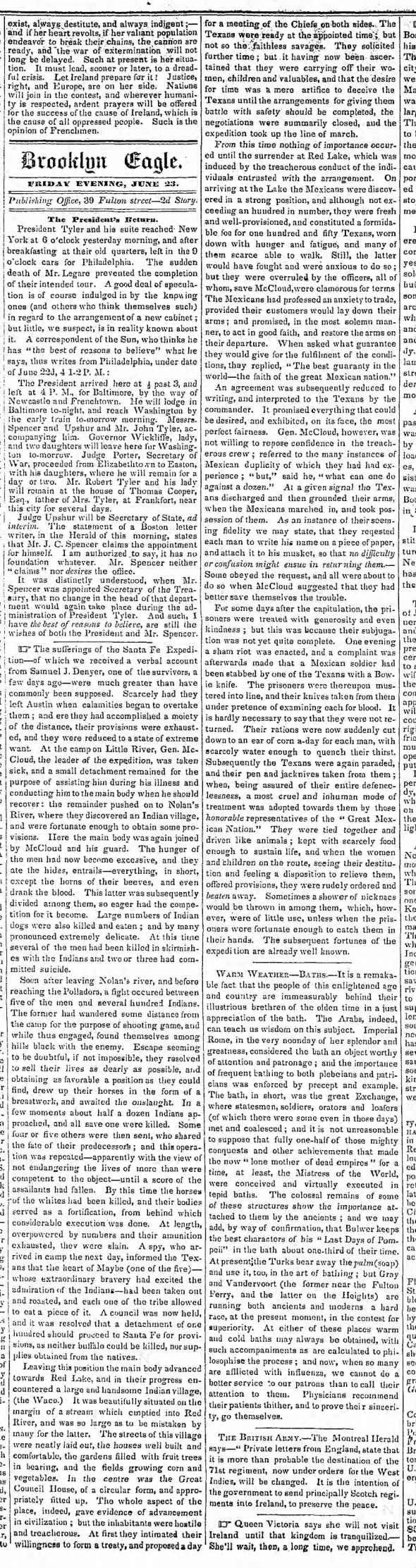
Santa Fe Expedition as told by Samuel J DenyerThe Brooklyn Daily Eagle 
Brooklyn, New York 
23 Jun 1843, Fri • Page 2

The sufferings of the Santa Fe Expedition — of which we received a verbal account from Samuel J. Denyer, one of the survivors, a few days ago — were much greater than have commonly been supposed. Scarcely had they left Austin when calamities began to overtake them ; and ere they had accomplished a moiety of the distance, their provisions were exhausted, and they were reduced to a state of extreme want. At the camp on Little River, Gen. McCloud, the leader of the expedition, was taken sick, and a small detachment remained for the purpose of assisting him during his illness and conducting him to the main body when he should recover: the remainder pushed onto Nolan's River, where they discovered an Indian village, and were fortunate enough to obtain some provisions. Here the main body was again joined by McCloud and his guard. The hunger of the men had now become excessive, and they ate the hides, entrails everything, in short, except the horns of their beeves, and even drank the blood. This latter was subsequently divided among them, so eager had the competition for it become. Large numbers of Indian dogs were also killed and eaten : and by many pronounced extremely delicate. At this time several of the men had been killed in skirmishes with the Indians and two or three had committed suicide.

Soon after leaving Nolan's river, and before reaching the Polladora, a fight occurred between five of the men and several hundred Indians. The former had wandered some distance from the camp for the purpose of shooting game, and while thus engaged, found themselves among hills black with the enemy. Escape seeming to be doubtful, if not impossible, they resolved to sell their lives as dearly as possible, and obtaining as favorable a position as they could find, drew up their horses in the form of a breastwork, and awaited the onslaught. In a few moments about half a dozen Indians approached, and all save one were killed. Some four or five others were then sent, who shared the fate of their predecessors ; and this operation was repeated apparently with the view of not endangering the lives of more than were competent to the object until a score of the assailants had fallen. By this time the horses of the whites had been killed, and their bodies served as a fortification, from behind which considerable execution was done. At length, overpowered by numbers and their ammunition exhausted, they were slain. A spy, who arrived in camp the next day, informed the Texans that the heart of Maybe (one of the five) whose extraordinary bravery had excited the admiration of the Indians hid been taken out and roasted, and each one of the tribe allowed to eat a piece of it. A council was now held, and it was resolved that a detachment of one hundred should proceed to Santa Fe for provisions, as neither buffalo could be killed, or supplies obtained from the natives.

Leaving this position the main body advanced towards Red Lake, and in their progress encountered a large and handsome Indian village, (the Waco.) It was beautifully situated on the margin of a stream which emptied into Red River, and was so large as to be mistaken by many for the latter. The streets of this village were neatly laid out, the houses well built and comfortable, the gardens filled with fruit trees in bearing, and the fields growing corn and vegetables. In the centre was the Great Council House, of a circular form, and appropriately fitted up. Tho whole aspect of the place, indeed, gave evidence of advancement in civilization ; but the inhabitants were hostile and treacherous. At first they intimated their willingness to form a treaty, and proposed a day for a meeting of the Chiefs on both sides. The Texans were ready at the appointed time, but not so the faithless savages. They solicited further time ; but it having now been ascertained that they were carrying off their women, children and valuables, and that the desire for time was a mere artifice to deceive the Texans until the arrangements for giving them battle with safety should be completed, the negotiations were summarily closed, and the expedition took up the line of march.

From this time nothing of importance occurred until the surrender at Red Lake, which was induced by the treacherous conduct of the individuals entrusted with the arrangement. On arriving at the Lake the Mexicans were discovered in a strong position, and although not exceeding an hundred in number, they were fresh and well-provisioned, and constituted a formidable foe for one hundred and fifty Texans, worn down with hunger and fatigue, and many of them scarce able to walk. Still, the latter would have fought and were anxious to do so ; but they were overruled by the officers, all of whom, save McCloud, were clamorous for terms. The Mexicans had professed an anxiety to trade, provided their customers would lay down their arms; and promised, in the most solemn manner, to act in good faith, and restore the arms on their departure. When asked what guarantee they would give for the fulfillment of the conditions, they replied, "The best guaranty in the world the faith of the great Mexican nation."

An agreement was subsequently reduced to writing, and interpreted to the Texans by the commander. It promised everything that could be desired, and exhibited, on its face, the most perfect fairness. Gen. McCloud, however, was not willing to repose confidence in the treacherous crew ; referred to the many instances of Mexican duplicity of which they had had experience ; " but," said he, "what can one do against a dozen." At a given signal the Texans discharged and then grounded their arms, when the Mexicans marched in, and took possession of them. As an instance of their seeming fidelity we may state, that they requested each man to write his name on a piece of paper, and attach it to his musket, so that no difficulty or confusion might ensue in returning them. Some obeyed the request, and all were about to do so when McCloud suggested that they had better save themselves the trouble.

For some days after the capitulation, the prisoners were treated with generosity and even kindness ; but this was because their subjugation was not yet quite complete. One evening a sham riot was enacted, and a complaint was afterwards made that a Mexican soldier had been stabbed by one of the Texans with a Bowie knife. The prisoners were thereupon mustered into line, and their knives taken from them under pretense of examining each for blood. It is hardly necessary to say that they were not returned. Their rations were now suddenly cut down to an ear of corn a-day for each man, with scarcely water enough to quench their thirst. Subsequently the Texans were again paraded, and their pen and jacknives taken from them; when, being assured of their entire defenselessness, a most cruel and inhuman mode of treatment was adopted towards them by those honorable representatives of the " Great Mexican Nation." They were tied together and driven like animals ; kept with scarcely food enough to sustain life, and when the women and children on the route, seeing their destitution and feeling a disposition to relieve them, offered provisions, they were rudely ordered and beaten away. Sometimes a shower of nicknacs would be thrown in among them, which, however, were of little use, unless when the prisoners were fortunate enough to catch them in their hands. The subsequent fortunes of the expedition are already well known.


Notes:

1) My third great grandfather, William Denyer, the father of Samuel Denyer and his brother, my second great grandfather, Ebenezer Denyer, was born in England and immigrated to the US in the early 1820s. Samuel was born in Baltimore, Maryland in 1822 and Ebenezer in Bucks County, Pennsylvania in 1828. It's not clear exactly when the family headed south to the Republic of Texas, but at least Samuel was clearly there before Texas became a State in 1845, and likely the rest of the family as well. William died in Louisiana in 1848, and was likely a resident of three countries during his lifetime. Samuel Denyer was killed by an "Indian" April 30,1861.

Monday, January 11, 2021

Amanuensis Monday: Selig Feinstein and the Progressive Order of the West - Unity Lodge 104

Amanuensis: A person employed to write what another dictates or to copy what has been written by another.

I continue my project to transcribe family letters, journals, newspaper articles, audiotapes, and other historical artifacts. Not only do the documents contain genealogical information, the words breathe life into kin - some I never met - others I see a time in their life before I knew them.

Today I’m sharing lists of names of delegates to several annual conventions of the Progressive Order of the West - a Jewish fraternal organization that was founded in 1896 and headquartered in St. Louis Missouri. My maternal great grandfather, Samuel Deutsch, was buried in the Progressive Order of the West section of Waldheim Cemetery in Chicago in 1938. I knew my second great grandfather, Selig Feinstein, was a member of a fraternal order from his son's wedding announcement,  however I didn't know which ones, until finding his name in these lists. While there may have been multiple lodges in the St. Louis area, since I don't know the locations for all of the lodges, I am going to focus on just the lodge Selig was a member of: Unity, 104.

Progressive Order of the West 7th Annual Convention Delegates
The Jewish Voice, Jan 24, 1902, page 3

Unity, 104
A. Rosentreter, Dr. M.I. DeVorkin, H. Elbert, Jos. Lehr, S. Feinstein, H. German, H. Maizner

Progressive Order of the West 9th Annual Convention Delegates
The Jewish Voice, Jan 29, 1904, page 6.

"Unity" 104

Delegates:

Dr. M.I. DeVarkin
Rev. A. Rosentreter
H. Elbert
J. Lehr
S. Feinstein
M. Zuckerman
A. German
J. Becker
H. Bearken
W. Schwartz
M. Pearl
M. Laski
A. Kristel

Alternates:
M. Weiselman
D. Roodman
H. Hirsch
L. Roodman
S. Cohen
I. Reifler
S. Honeck
A. Rosenfeld
W. Grassblatt
J. Davis
G. Elbert
I. Rosen
J. Sheffer

Grand Lodge Officers - 1913
The Jewish Voice, July 25, 1913, page 8


Following is the list of Grand Lodge Officers for the past term: 
B. Frank, Grand Master. 
H. L. Brody, 1st Deputy Grand Master. 
Abe Levy, 2nd Deputy Grand Master. 
J. Zuckerman, 3rd Deputy Grand Mas. 
N. Koffman, 4th, Deputy Grand Mas. 
Michael Sack, 5th Deputy Grand Mas. 
Morris Shapiro, Grand Secretary. 
Jacob Lasky, Grand Treasurer. 
Sam Kranzberg, Beneficiary Treas. 
Ben. E. Cohen, Grand Counsellor. 
Dr. M. I. DeVorkin. Grand Med. Ex. 
Chas. Schneider, Grand Chaplain. 
D. Reichman, Beneficiary Chairman. 
Adolph Cohen, Chairman of Finance. 
Harry Specter, Committee on Finance. 
Mike Novack, Committee on Finance. 
Ed. Lasky, Chairman on Supplies. 
Max Levy, Chairman of Appeals. 
M. Rubin, Chairman on Reserve Fund. 
Chas. I. Mahler, Chair. State of Order. 
B. Stein, Chairman on Propaganda. 
M. Lowenstine, Chairman of Rituals. 
Philip Fishman, Chair on Disability. 
S. Goldman, First Trustee. 
S. Feinstein, Second Trustee. 
J. Guttmann, Third Trustee. 
J. Jacobson, Grand Sentry.


Notes

The above indicates my second great grandfather was at least a member from 1902-1913. Selig died in 1915, and was likely a member at his death. M(ax) Weiselman, who was an alternate delegate in 1904, was Selig's business partner. Max was from Zhitomir, Volhynia, and I know the Feinsteins were from Volhynia as well. I do not know if the Weiselmans and Feinsteins knew each other in the Old Country.

Saturday, January 9, 2021

Do I Have Cousins in Burlington, Vermont?

 In the 1880s a group of immigrants to Burlington, Vermont founded Chai Adam Synagogue. These immigrants came from ÄŒekiÅ¡kÄ—, Lithuania - the same shtetl my Cruvant ancestors came from. Do I have kin in Burlington?

Chai Adam founders included: 

  • Morris Levin
  • Abraham Mowsowitz
  • Max Samuelson
  • Joseph Trotchky
  • Hyman D. Segel
  • M.L. Levin
  • Abram Kaplan
  • Isaac Levin
  • Sam Trotchky
  • Lewis Greenstein

Surname Kaplan

  • Hannah Kaplan married a second great granduncle, Girsha Abram Kruvond.  
  • Hannah's brother, Louis, went by Louis Cohen, and he married a first cousin three times removed, Sarah Cruvand.
  • Julius Kaplan married second cousin twice removed, Fannie Cruvand. (I only know he came from Lithuania. I believe they married in the U.S. His father's name was Max.)

While Hannah and Louis definitely came from ÄŒekiÅ¡kÄ—, Cohen/Kaplan is an extremely common Jewish surname. Further research was required to see if Chai Adam founder Abram Kaplan is related. (More closely related than being a descendant of Aaron, brother of Moses.) 

I found who I believe is the same Abram Kaplan on Geni. While from nearby Josvainiai, Lithuania, his wife is from ÄŒekiÅ¡kÄ—, so it could be the same individual. I asked Geni to find the shortest connection between us, and I was told it was through his wife. That doesn’t mean there isn’t a connection through him that Geni doesn’t know about yet.

Surname: Greenstein
  • Abraham Greenstein married first cousin three times removed, Rebekka Kroovand. (They were married in New York, and I am not sure where he immigrated from.) If I can confirm he came from the vicinity of ÄŒekiÅ¡kÄ—, I'll research further to see if he is related to Lewis Greenstein.
Surname: Trotchky
  • No known relatives. Just a small note that Russian revolutionary, Leon Trotsky, was born in Bereslavka, Ukraine about 1200 km (745 miles) from ÄŒekiÅ¡kÄ—. His surname at birth was Bronstein. He changed his surname to Trotsky after the surname of a Siberian prison warden.
The linked website at the beginning of this post has some great pictures from inside the Čekiškė synagogue I posted about a few years ago.

Note: Senator Sanders was born in Brooklyn, NY and later moved to Burlington. He is not a descendant of the Burlington Chai Adam founders. Alas.


Monday, January 4, 2021

Amanuensis Monday: Mabel Fulkerson is Hit by a Car - November 1961

Amanuensis: A person employed to write what another dictates or to copy what has been written by another.

I continue my project to transcribe family letters, journals, newspaper articles, audiotapes, and other historical artifacts. Not only do the documents contain genealogical information, the words breathe life into kin - some I never met - others I see a time in their life before I knew them.

Today I’m sharing the transcription of three newspaper articles concerning my wife's great grandmother, Mabel (Fulkerson) Gober (1901-1991). In November of 1961 she was hit by a car, and she remained in the hospital until February of 1962.


WOMAN HURT WHEN STRUCK BY AUTO IN FRONT OF HOME 
St. Louis Post Dispatch, 26 Nov 1961, Page 12 

Mrs. Robert L Gober, 60 years old, suffered fractures of the jaw, ribs and right hip last night when she was struck by an automobile in front of her home, 4111 Jennings Road, Pine Lawn. 

The driver of the automobile, Harry B. Frye, 9834 Colony drive, Bellefontaine Neighbors, said he was driving south in Jennings road when Mrs. Gober stepped into the path of his car from between two cars which were stoped in the northbound lane. She was taken to St. Louis County Hospital. 


from NEWS IN BRIEF 
Daily Standard, Sikeston, Missouri, 07 Dec 1961, page 3 

Word was received Wednesday from Mrs. Mabel Gober, a patient in St. Luke’s Hospital, St. Louis, that she is still on the Improving List. Mrs. Gober’s room number is 5109. She is a sister of Mrs. Ellis Alcorn, Sikeston; Mrs. Virgie Williams of Sikeston, who is spending the winter in Memphis; and Mrs. John Healy of Dexter. 


from NEWS IN BRIEF 
Daily Standard, Sikeston, Missouri, 08 Feb 1962, page 6 

Mrs. Ellis Acorn reports that her sister, Mrs. Mabel Gober of St. Louis who was struck by a car in St. Louis, November 25, was released from the St. Luke Hospital, this past Sunday. Mrs. Gober is now able to be around in a walker and wishes to thank all friends and relatives who were so kind and thoughtful doing her stay in the hospital.


Notes

I was already aware of the names of Mabel's brothers-in-law so the traditional naming format wasn't particularly frustrating. If I hadn't been, identifying which sister married which man could be my next challenge. Julia Fulkerson married Virgil Williams, Wrista Lou Fulkerson married Ellis Alcorn. Bertha Priscilla Fulkerson married John Healy.

I doubt a newspaper today would print the hospital room someone was staying in. It appears after being taken to St. Louis County Hospital (a 200-bed facility that opened in 1929 and closed in 1986), she was later transferred to St. Luke's Hospital for her recuperation.

Monday, December 28, 2020

Amanuensis Monday: The Separation of Ben and Goldie Cruvant

Amanuensis: A person employed to write what another dictates or to copy what has been written by another.

I continue my project to transcribe family letters, journals, newspaper articles, audiotapes, and other historical artifacts. Not only do the documents contain genealogical information, the words breathe life into kin - some I never met - others I see a time in their life before I knew them.

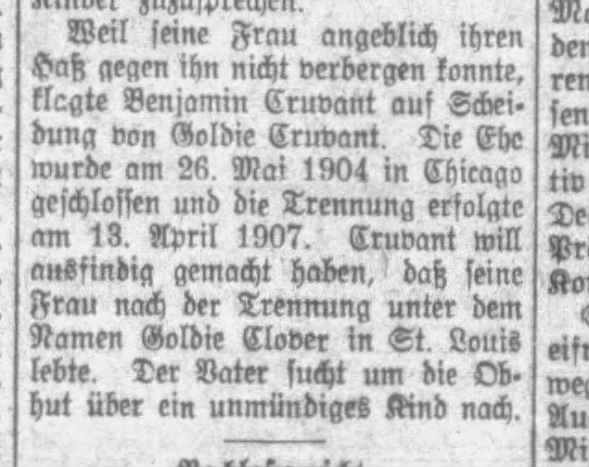
Today I’m sharing a newspaper article from a local German newspaper and Google’s translation of an OCR transcript. While not exact, I am hopeful that it is close. It concerns the separation of a great grandmother’s brother from his first wife. 

Sat, Apr 18, 1908 – 5 · Westliche Post (St. Louis, Missouri) · Newspapers.com Because his wife allegedly could not hide her hatred of him, Benjamin Cruvant sued Goldie Cruvant for the injuries. The marriage was concluded on May 26, 1904 in Chicago and the separation took place on April 13, 1907. Cruvant claims to have found that his wife lived under the name Goldie Clover in St. Louis after the separation. The father is looking for the custody of an underage child.

Notes:

1. A June 1907 article describes the disappearance of Ben on April 19 implying it was due to the objections of his parents to their marriage based on Goldie not being Jewish. I had found record of their divorce being filed in 1908, but hadn’t yet uncovered the details of what had been claimed. This article provides a different reason for the breakup, but Ben likely had legal reasons to claim injuries and blame Goldie. This article suggests he sought custody of one of the two children. Both children were residing with the mother in the 1910 census. Goldie’s maiden name was White and it’s unclear why she used the Surname Clover, if that claim is accurate.  

Thursday, November 26, 2020

Happy Thanksgiving 2020

 This has been an unusual and difficult year for many, but there is lots to be thankful for. 

Below are several poems for the holiday


Gratitude - by Edgar A. Guest (©1917)

Be grateful for the kindly friends that walk along your way;
Be grateful for the skies of blue that smile from day to day;
Be grateful for the health you own, the work you find to do,
For round about you there are men less fortunate than you.

Be grateful for the growing trees, the roses soon to bloom,
The tenderness of kindly hearts that shared your days of gloom;
Be grateful for the morning dew, the grass beneath your feet,
The soft caresses of your babes and all their laughter sweet.

Acquire the grateful habit, learn to see how blest you are,
How much there is to gladden life, how little life to mar!
And what if rain shall fall to-day and you with grief are sad;
Be grateful that you can recall the joys that you have had.


Looking Back - by Edgar Guest (©1921)

I might have been rich if I'd wanted the gold instead of the friendships I've made.
I might have had fame if I'd sought for renown in the hours when I purposely played.
Now I'm standing to-day on the far edge of life, and I'm just looking backward to see
What I've done with the years and the days that were mine, and all that has happened to me.

I haven't built much of a fortune to leave to those who shall carry my name,
And nothing I've done shall entitle me now to a place on the tablets of fame.
But I've loved the great sky and its spaces of blue; I've lived with the birds and the trees;
I've turned from the splendor of silver and gold to share in such pleasures as these.

I've given my time to the children who came; together we've romped and we've played,
And I wouldn't exchange the glad hours spent with them for the money that I might have made.
I chose to be known and be loved by the few, and was deaf to the plaudits of men;
And I'd make the same choice should the chance come to me to live my life over again.

I've lived with my friends and I've shared in their joys, known sorrow with all of its tears;
I have harvested much from my acres of life, though some say I've squandered my years.
For much that is fine has been mine to enjoy, and I think I have lived to my best,
And I have no regret, as I'm nearing the end, for the gold that I might have possessed.


A Song of Thanks - by Edward Smyth Jones (©1922)

FOR the sun that shone at the dawn of spring,
For the flowers which bloom and the birds that sing,
For the verdant robe of the gray old earth,
For her coffers filled with their countless worth,
For the flocks which feed on a thousand hills,
For the rippling streams which turn the mills,
For the lowing herds in the lovely vale,
For the songs of gladness on the gale,—
From the Gulf and the Lakes to the Oceans’ banks,—
Lord God of Hosts, we give Thee thanks!

For the farmer reaping his whitened fields,
For the bounty which the rich soil yields,
For the cooling dews and refreshing rains,
For the sun which ripens the golden grains,
For the bearded wheat and the fattened swine,
For the stalled ox and the fruitful vine,
For the tubers large and cotton white,
For the kid and the lambkin frisk and blithe,
For the swan which floats near the river-banks,—
Lord God of Hosts, we give Thee thanks

For the pumpkin sweet and the yellow yam,
For the corn and beans and the sugared ham,
For the plum and the peach and the apple red,
For the dear old press where the wine is tread,
For the cock which crows at the breaking dawn,
And the proud old “turk” of the farmer’s barn,
For the fish which swim in the babbling brooks,
For the game which hide in the shady nooks,—
From the Gulf and the Lakes to the Oceans’ banks—
Lord God of Hosts, we give Thee thanks!

For the sturdy oaks and the stately pines,
For the lead and the coal from the deep,
dark mines, For the silver ores of a thousand fold,
For the diamond bright and the yellow gold,
For the river boat and the flying train,
For the fleecy sail of the rolling main,
For the velvet sponge and the glossy pearl,
For the flag of peace which we now unfurl,—
From the Gulf and the Lakes to the Oceans’ banks,—
Lord God of Hosts, we give Thee thanks!

For the lowly cot and the mansion fair,
For the peace and plenty together share,
For the Hand which guides us from above,
For Thy tender mercies, abiding love,
For the blessed home with its children gay,
For returnings of Thanksgiving Day,
For the bearing toils and the sharing cares,
We lift up our hearts in our songs and our prayers,—
From the Gulf and the Lakes to the Oceans’ banks,—

Tuesday, November 10, 2020

Veterans Day - Nov 11, 2020


Caption for photo to left: Human Statue of Liberty. 18,000 Officers and Men at Camp Dodge, Des Moines, Iowa. Colonel William Newman, Commanding. Colonel Rush S. Wells, Directing. Mole & Thomas, 09/1918. (source)

Wednesday, November 11 is Veterans Day in the US, and Remembrance Day in the UK, Canada, Australia, France and Belgium. In Poland it is celebrated as National Independence Day.

Below are the names of ancestors, and their siblings, who I know served their nation's military, either in a time of war, or in a time of peace. I am including my Loyalist ancestors; their nation was Great Britain. Canada became their country after the war. I am including my Confederate ancestors too, despite their desire to form a separate nation. I am also including a Conscientious Objector ancestor since the DAR counts him as a Patriot.

Fifth Great Grandfathers
McGregory Van Every (1723-1786) Loyalist/Butler's Rangers
Michael Showers (1733-1796) Loyalist/Butler's Rangers
Mark Fretz (1750-1840) Patriot (Inactive Duty) Pennsylvania militia

Fourth Great Grandfather
David Van Every (1757-1820) Loyalist/Butler's Rangers (served briefly as a Patriot in the NY militia)

Fifth Great Uncle
Benjamin Van Every (1759-1795) Loyalist/Butler's Rangers (served briefly as a Patriot in the NY militia)
William Van Every (1765-1832) Loyalist/Butler's Rangers
Peter Van Every (1771-bef 1816) Loyalist/Fifth Lincoln and Second York regiments (War of 1812)

Fourth Great Uncles
David Van Every Jr. (1782-1847) Loyalist/Second York regiment (War of 1812)
Michael Van Every (1790-?) Loyalist/Fifth Lincoln and Second York regiments (War of 1812)

Second Great Grandfather
Ebenezer Denyer (1828-1872) (Mexican-American War) (Confederate Army)

Third Great Uncles
Samuel Jennings Denyer (1822-1861) (Gonzales County Minute Men - Republic of Texas -1841)
Samuel T Hartley (1830-1920) (Confederate Army)

Great Grandfather
Samuel Deutsch (1861-1938) (Franz Josef's Austro-Hungarian Army)

Second Great Uncle
Nelson D Van Every (1845-1926) (Union Army)

Grandfathers 
Melvin L Newmark (1912-1992), WWII
Martin J Deutsch (1907-1991), WWII

Great Uncles
Jerry Deutsch (1909-1950), WWII
Allen Deutsch (1914-1988), WWII
Harold Newmark (1915-2003), WWII
Mandell Newmark (1923-1945), WWII (KIA)
Bernard Feinstin (1913-1968), WWII
Seymour Feinstein (1917-1999), WWII

Uncle
Stevan J Newmark (1942-1997) Army Reserves

Photographs of those who served in World War II

My grandfathers Melvin Newmark (1912-1992) and Martin Deutsch (1907-1991)


Allen Deutsch (1914-1988) and Maurice "Jerry" Deutsch (1909-1950).


Harold Newmark (1915-2003) and Mandell Newmark (1923-1945).


Bernard "Benny" Feinstein (1913-1968) and Seymour "Babe" Feinstein (1917-1999)

Saturday, October 17, 2020

Thoughts on Geni and Relationships to Celebrities

 Five years ago I made fun of Geni's twisted relationship finder that determined how William Shatner was 'related' to Leonard Nimoy.


A month ago, I uploaded portions of my family tree data to Geni, and have been playing with it for the past month. I still find what they term an "in-law relationship" to be rather silly at times. For example, Ruth Bader Ginsberg is my first cousin twice removed's wife's niece's husband's second cousin once removed. Can you follow that?

George Washington is my "fifth great uncle's great uncle's wife's niece's 2nd husband." Neither of these are as tortuous as Kirk and Spock's relationship above, though neither is a blood relationship. The George Washington connection goes through the ancestry of my fourth great grandmother, Sarah Showers Van Every. I have not confirmed all of the steps. I do know that I have a much less tortuous in-law relationship to our first President, but I didn't upload the data in my family tree for a cousin, so Geni doesn't tell me about it. George Washington's father is an ancestor of some first cousins, through one of his half-siblings. 

If one can confirm ancestry to Colonial Americans, which I can, in a lot of cases connections to European royalty have been traced by others. Whether these connections are all accurate and truthful is open to question at times. As I did with Ancestry's discontinued We're Related App, I use the information it provides for my 'new' ancestors as a basis to research, and I essentially trust the ancestry done for the famous celebrities. 

Geni makes it easy to search for the closest in-law and closest blood relationship paths of pretty much any public figure. (I do have a fourth cousin who is fairly well-known, but who isn't on the Geni website. I didn't upload his data to the site, and don't plan to. My second cousin twice removed, David "Jay and the Americans Black" Blatt isn't on the website either. As long as he is living, I won't be the one to enter his data, and if I did, I'd mark it as private.) I have discovered that I am 90th+ cousins with a few celebrities. How is that possible?

Well, those royal families had their ancestries traced back to the Bible. Some people trust those ancestries. So Abraham the Patriarch is my shared ancestor for a few. Intriguingly, Isaac is a great...great-uncle. I have not been able to trace my Jewish ancestral lines far enough back. And while I thought the Royals traced their ancestry back to King David, apparently my Royal ancestors did not, and their line to Abraham is through Ishmael. To connect with Isaac, a lot of Jewish lines go through Rashi. Rashi's Biblical descent is missing a few generations. 22 generations, traditionally. That's a lot of generations to skip, and trust, based on Tradition. Traditionally, my great grandfather was a Cohen, and thus a direct descendant of Aaron, Moses's brother. That's skipping a lot more generations, but the tradition is equally acceptable to my mind.

While seeing the connections to famous people still fascinates me at times, I hope to use the blood relationships it provides to actually help research/confirm some of my own ancestral lines a little further than I have.

Friday, September 25, 2020

The Three Sisters of Selig Dudelczak Feinstein

 Back in 2018 I found the obituaries of my 2nd great grandfather's sisters - Sylvia Dudelczak Blufston Babchick, Lottie Dudelczak Getz Goldstein, and Rebecca Dudelczak Portnoy. While I had found photos of some of the gravestones online, I didn't have a chance to visit the cemetery to look for them myself, until today.

When I looked up online the locations of the sisters' graves, I learned they were all in the same numbered section of the cemetery, but that's all I knew. I wondered how close they would be to each other.

This close. 
All three were married, but none of their husbands are buried next to them.

Here lies Woman, Baila, daughter of R. Shmuel Zvi, Portnoy...
Ylota, daughter of R. Shmuel Zvi...

Shprintze, daughter of R. Shmuel Zvi...

I did find Sylvia/Shprintze's husband. 

I was under the impression that Sylvia had two husbands. A Jacob Babchik and a Jacob Blufston. Her death certificate records her name at death as Sylvia Babchik. Her obituary states Sylvia Blufston Babchik, and lists her children with the surname Blufston. Jacob's death certificate lists his name as Jacob Babchik, and his father as Wulf Babchik.

His tombstone has the additional surname of Blufston on it. I guess there is a small chance his children put their father's surname on their step-father's tombstone - which would be highly irregular. It makes more sense that there is only one husband, and at some point he changed his surname from Blufston to Babchik, and his wife followed suit, but not the children. Why did he change his name? That is not what I would consider an Americanization of an Eastern European surname.
Yakov Meyer, son of Zev Babchik...
(Zev is Hebrew, and Wulf is Yiddish. They are the same name.)


Sunday, September 20, 2020

Ancestral photographs

It's been a long while since I've been able to add a photograph to my ancestral montages below. It's exciting to be able to do so.


Left to Right: Grandfather, Melvin Newmark; Great Grandfather, Barney Newmark; Great Grandfather Herman Feinstein; Great Great Grandfather, Samuel Newmark; Great Great Grandfather, Moshe Leyb Cruvant; Great Great Grandfather, Morris Blatt; Grandfather, Martin Deutsch; Great Grandfather, Melvin Van Every; Great Grandfather, Samuel Deutsch; Great Great Grandfather, Samuel Van Every; Great Great Grandfather, Israel Lichtman [2 grandfathers, 4 great grandfathers, 5 great great grandfathers]

I have three un-photographed great great grandfathers. 

  1. Ebenezer Denyer died in 1872, so I doubt I will find a photo of him.
  2. I might have a photograph of Abraham Deutsch. This photograph was originally found in the same folder as the one of Israel and Sarah Lichtman. It would make logical sense if they were the other set of my maternal grandparents' parents. But there is no way I can make that assumption. 
  3. The remaining un-photographed great great grandfather is Selig Dudelczak Feinstein. He died in 1915, so it is conceivable that there is a photograph out there in some cousin's archives.


Left to Right: Grandmother, Myrtle Van Every Deutsch; Great Grandmother Margaret Denyer Van Every; Great Grandmother, Helen Lichtman Deutsch; Great Grandmother, Bertha Cruvant Newmark; Great Great Grandmother Minnie Mojsabovsky Cruvant; Great Great Grandmother, Rose Cantkert Newmark; Great Grandmother, Annie Blatt Feinstein; Grandmother Belle "Sissie" Feinstein Newmark [2 grandmothers, 4 great grandmothers, 2 great great grandmothers]

I have 6 un-photographed great great grandmothers. 
  1. Chaia Bela Boksern Blatt died in 1892 in Poland. 
  2. Sarah Weiss Deutsch may be in the same photograph I link to above which might contain Abraham Deutsch. 
  3. Israel Lichtman's first wife, Betty Adler, probably died in the early 1880s.
  4. Abigail Stuart Van Every died in 1866. 
  5. Sarah Hartley Denyer died in 1898. There is a photograph of her grandchildren from the 1890s, but I doubt I will find a photograph of her.
  6. Annie Perlik Feinstein died in 1932. If I am going to find another female ancestor's photograph, hers is the most likely. I feel a photograph has to be hiding somewhere in some cousin's archives. 
There are a handful of ancestors who might have had portraits done of them. So far I have not found any.

Thursday, September 17, 2020

Israel and Sarah Lichtman - 1915


I posted the below photo in 2009 as an Unidentified Family phOto. Going through some family folders, the image was used on a family reunion packet back in 1992, and the photo was identified as Israel and Sarah Lichtman, 1915, Austria-Hungary. 

Israel was my 2nd great grandfather, and Sarah Jonas Lichtman was his second wife. (My 2nd great grandmother was his first wife, Betty Adler.) I have no other photographs of Israel to compare, so I will just accept the identification from the family reunion packet. Especially since there was a date given, with no indication that it was an estimate, the information probably came from the back of the original.

My Great grandparents (Samuel and Helen Lichtman Deutsch) immigrated to the US in 1912 and 1913, so this photograph was apparently taken after they had left.

Sunday, August 9, 2020

Belle Wyman Korn and Cary Grant - 1972

Belle Wyman Korn (1914-2015) was my grandmother's first cousin. They were the same age, and were best of friends. The Wymans moved to California in the 1930s, and this is Belle at a pool in 1972. That is Cary Grant standing next to her. I am told that it was at Charlie (Kewpie) Rich’s estate. (Charlie Rich and Belle’s brother, Sid Wyman, were co-owners of the Las Vegas Dunes hotel.) For comparison, I've included a photograph I found online of Grant and Ingrid Bergman from 1972. It's definitely him.
 

Thursday, August 6, 2020

Two Affidavits of Birth - One Person - Two Dates

My maternal grandmother, Myrtle Vanevery Deutsch, had her sister sign an affidavit of birth for her twice. In 1942, and again in 1945.

In 1942 my grandmother was living in Clayton, Missouri (part of St. Louis County). In 1945 she was in West Palm Beach, Florida. In 1945 my grandfather was returning to the states after serving in Africa and the Middle East during WWII. My grandmother took the kids to Florida to join him for the remainder of the war.

In 1942 my great aunt declared my grandmother was born on March 21, 1900. In 1945 she declared my grandmother was born on March 21, 1905. In both she states she was present at the birth. She provides several more details in 1942, such as the attending physician. In 1945 she simply states she was present. (I suspect she wasn't all too happy about filling out the affidavit in 1945, but was willing to do it for her sister. I suspect my grandmother was looking for a job and wanted to be five years younger.)

There is no question as to which is the correct affidavit. My grandmother is on the 1900 census, and is mentioned in the testimony given to the Dawes Commission in 1901 on the family's alleged Choctaw ancestry.

I have had a copy of the 1945 affidavit in my records for several years, having uncovered it in some folders at my parent's house over a decade ago. My parents gave me 20 boxes of family photos and documents this week, and in one I found the 1942 affidavit.

Update: I’ve been given another explanation for the second affidavit. My grandmother didn’t want anyone at the army base to know she was 7 years older than my grandfather. 

Tuesday, August 4, 2020

Days of Love - 2020

Tu b'Av is a relatively obscure Jewish holiday that falls on the fifteenth day of the month of Av (sundown Tuesday Aug 4 to sundown Wednesday Aug 5 this year).

The fifteenth day of each month on the Hebrew calendar falls on a full moon, and the holiday was observed as a sort of fertility festival during the period of the Second Temple. After the destruction of the Second Temple, it was forgotten for the most part in the Diaspora, only to be revived in modern times as a Jewish alternative to St. Valentine's Day.

To some, St. Valentine's Day, or Tu B'Av, may feel manufactured for greeting card companies, florists, and chocolatiers. However, most couples have their own personal "Days of Love." Whether the annual date commemorates a first date, an engagement, a marriage, or another anniversary, it's significant only to the individual couple. The memories connected with these dates are often stronger than the ones associated with the annual religious or societal holidays. Still, any reason for two people to celebrate their love for one another is a good reason.

To A Lady
by Victor Hugo,
From Les Feuilles D'Automne

Child, were I king, I'd yield my royal rule,
     My chariot, sceptre, vassal-service due,
My crown, my porphyry-basined waters cool,
My fleets, whereto the sea is but a pool,
     For a glance from you!

Love, were I God, the earth and its heaving airs,
     Angels, the demons abject under me,
Vast chaos with its teeming womby lairs,
Time, space, all would I give--aye, upper spheres,
     For a kiss from thee!

translation by Thomas Hardy
photogravure by Goupil et Cie, from a drawing by Deveria, appears in a collection of Hugo's poetry published by Estes and Lauriat in the late 1800s.

Sunday, May 31, 2020

1913 Benton Basketball Team - Robert Lee Gober - Genealogy and Algebra


Robert Lee Gober (1895-1971) is on the far left in the photograph below, holding the basketball. He is my wife's great grandfather. Benton is the County Seat for Scott County, in Southeastern Missouri. 

Born in 1895, Robert Lee Gober would have been 18 in 1913. We know as an adult he was 6'4" tall, though we do not know if he had stopped growing by the time of this photograph. I don't know the identities of any of the other young men, but I was curious how much they varied in height. Let's assume he was 6'4" tall. Can we estimate the height of the shortest teammate? Definitely. 

Examining the photograph in my photo-editor, RL Gober is 1,775 pixels in height, and the shortest teammate is 1,515. (I measured from the top of the head to the bottom of the foot, choosing the back foot for both individuals)

76 inches / 1775 pixels = X inches / 1,515 pixels
Solving for X, he is 64.87 inches tall. Or 5'5. Almost a full foot shorter than Robert.
Naturally, there is some room for error in how I calculated the pixels.

(You didn't realize algebra would come in handy for genealogy, did you?)

Sunday, May 24, 2020

Memorial Day Weekend 2020

Below is my annual post for Memorial Day.

A post on what Memorial Day is for, besides barbecues.

The above image comes from a past version of the Memorial Day page at the US Department of Veterans Affairs, explaining that Memorial Day is a day for remembering those who died in the service of their country.  [Read the full text of the poem.]
Memorial Day is a United States federal holiday observed on the last Monday of May. Formerly known as Decoration Day, it commemorates U.S. men and women who died while in the military service. First enacted to honor Union soldiers of the American Civil War (it is celebrated near the day of reunification after the civil war), it was expanded after World War I to include American casualties of any war or military action. [source]
[More on the history of Memorial Day]


Unnamed Remains the Bravest Soldier - by Walt Whitman (From 'Specimen Days')

OF scenes like these, I say, who writes—whoe’er can write the story? Of many a score—aye, thousands, north and south, of unwrit heroes, unknown heroisms, incredible, impromptu, first-class desperations—who tells? No history ever—no poem sings, no music sounds, those bravest men of all—those deeds. No formal general’s report, nor book in the library, nor column in the paper, embalms the bravest, north or south, east or west. Unnamed, unknown, remain, and still remain, the bravest soldiers. Our manliest—our boys—our hardy darlings; no picture gives them. Likely, the typic one of them (standing, no doubt, for hundreds, thousands,) crawls aside to some bush-clump, or ferny tuft, on receiving his death-shot—there sheltering a little while, soaking roots, grass and soil, with red blood—the battle advances, retreats, flits from the scene, sweeps by—and there, haply with pain and suffering (yet less, far less, than is supposed,) the last lethargy winds like a serpent round him—the eyes glaze in death—none recks—perhaps the burial-squads, in truce, a week afterwards, search not the secluded spot—and there, at last, the Bravest Soldier crumbles in mother earth, unburied and unknown.

The cartoon above is by John T. McCutcheon - published circa 1900

I have many ancestors and kin who served in their nation's armed forces during war-time. I honor them on Veterans Day.

However, the closest relative who was killed in action was my grandfather's brother, my great-uncle, Mandell Newmark.

Mandell was born Jan 31, 1923. He was almost certainly named after his great-grandfather Mandell Mojsabovski. He enlisted in the army on Feb 22, 1943, and served as a Sgt. Technician Fifth Grade, in the 163rd infantry. He was killed in action on April 15, 1945. Less than a month prior to VE day

My grandfather also had a second cousin, Arnold Kruvant, who was killed in action during the D-Day invasion.