Amanuensis: A person employed to write what another dictates or to copy what has been written by another.
I continue my project to transcribe family letters, journals, newspaper articles, audiotapes, and other historical artifacts. Not only do the documents contain genealogical information, the words breathe life into kin - some I never met - others I see a time in their life before I knew them.
I began this project back on February 16, 2009. Since I began, many others have joined in on the meme. I am thrilled that this meme I started has inspired so many to transcribe their family history documents. Why do we transcribe? I provide my three reasons in the linked post. You may find others.
This week I transcribe the death certificate of my great grandfather, Barney Newmark. He died November 25, 1956.
Monday, November 25, 2013

Monday, November 11, 2013
Amanuensis Monday: James W Usrey - WW2 Submarine Veteran
Amanuensis: A person employed to write what another dictates or to copy what has been written by another.
I continue my project to transcribe family letters, journals, newspaper articles, audiotapes, and other historical artifacts. Not only do the documents contain genealogical information, the words breathe life into kin - some I never met - others I see a time in their life before I knew them.
I began this project back on February 16, 2009. Since I began, many others have joined in on the meme. I am thrilled that this meme I started has inspired so many to transcribe their family history documents. Why do we transcribe? I provide my three reasons in the linked post. You may find others.
In honor of Veterans Day, this week I transcribe a Veterans ID card of my wife's great uncle, James Wesley Usrey (1925-2010), half-brother to her maternal grandmother.
I continue my project to transcribe family letters, journals, newspaper articles, audiotapes, and other historical artifacts. Not only do the documents contain genealogical information, the words breathe life into kin - some I never met - others I see a time in their life before I knew them.
I began this project back on February 16, 2009. Since I began, many others have joined in on the meme. I am thrilled that this meme I started has inspired so many to transcribe their family history documents. Why do we transcribe? I provide my three reasons in the linked post. You may find others.
In honor of Veterans Day, this week I transcribe a Veterans ID card of my wife's great uncle, James Wesley Usrey (1925-2010), half-brother to her maternal grandmother.
Veterans Day, 2013

November 11 is Veterans Day in the US, and Remembrance Day in the UK, Canada, Australia, France and Belgium. In Poland it is celebrated as Independence Day.
Below are the names of ancestors, and their siblings, who I know served their nation's military, either in a time of war, or in a time of peace. I am including my Loyalist ancestors; their nation was Great Britain. Canada became their country after the war. I am including my Confederate ancestors too, despite their desire to form a separate nation.
Fifth Great Grandfathers
McGregory Van Every (1723-1786) Loyalist/Butler's Rangers
Michael Showers (1733-1796) Loyalist/Butler's Rangers
Fourth Great Grandfather
David Van Every (1757-1820) Loyalist/Butler's Rangers (served briefly as a Patriot in the NY militia)
Fifth Great Uncle
Benjamin Van Every (1759-1795) Loyalist/Butler's Rangers (served briefly as a Patriot in the NY militia)
William Van Every (1765-1832) Loyalist/Butler's Rangers
Peter Van Every (1771-bef 1816) Loyalist/Fifth Lincoln and Second York regiments (War of 1812)
Fourth Great Uncles
David Van Every Jr. (1782-1847) Loyalist/Second York regiment (War of 1812)
Michael Van Every (1790-?) Loyalist/Fifth Lincoln and Second York regiments (War of 1812)
Second Great Grandfather
Ebenezer Denyer (1828-1872) (Mexican-American War) (Confederate Army)
Third Great Uncles
Samuel Jennings Denyer (1822-1861) (Gonzales County Minute Men - Republic of Texas -1841)
Samuel T Hartley (1830-1920) (Confederate Army)
Great Grandfather
Samuel Deutsch (1861-1938) (Franz Josef's Austro-Hungarian Army)
Grandfathers
Melvin L Newmark (1912-1992), WWII
Martin J Deutsch (1907-1991), WWII
Great Uncles
Jerry Deutsch (1909-1950), WWII
Allen Deutsch (1914-1988), WWII
Harold Newmark (1915-2003), WWII
Mandell Newmark (1923-1945), WWII (Killed in Action)
Bernard Feinstin (1913-1968), WWII
Seymour Feinstein (1917-1999), WWII
Uncle
Stevan J Newmark (1942-1997) Army Reserves
Photographs of those who served in World War II


My grandfathers Melvin Newmark (1912-1992) and Martin Deutsch (1907-1991)


Allen Deutsch (1914-1988) and Maurice "Jerry" Deutsch (1909-1950).


Harold Newmark (1915-2003) and Mandell Newmark (1923-1945).


Bernard "Benny" Feinstein (1913-1968) and Seymour "Babe" Feinstein (1917-1999)
Saturday, November 9, 2013
Nov 9: International Day Against Fascism and anti-Semitism

November 9th, 1938. That was the date of Germany’s pogrom where they set fire to synagogues, and broke the glass on many Jewish businesses. At the time, they called it Night of the Broken Glass (or Kristallnacht). Some have argued we shouldn’t refer to it as Kristallnacht today, since that is the euphemism Hitler's government chose, and instead we should refer to it as what it was — a pogrom. Those who feel this way often call the day Pogromnacht. Others argue that over the decades the word has developed a connotation that cancels out any original euphemistic intent. Anyway, it is considered by many as the symbolic beginning of the Holocaust.
Last year's post delved into a few other events that have happened historically on November 9th, as well as into some numerology.
This year, I'll share a video of Billy Bragg covering Woody Guthrie's song: All You Fascists Bound to Lose.
Sunday, October 20, 2013
Ancestry Updates their DNA Results
Ancestry last week updated the ethnicity breakdowns on their DNA tests. Some received their update a month ago in a small 'beta preview,' but I was one of the many who had to wait for them to roll it out to everyone.
Here are my original results, which I discussed back in August of 2012, followed by the new results.


Notes
Primarily located in: Iran, Georgia, Armenia, Iraq, Syria, Turkey, Azerbijan
Also found in: Turkmenistan, Kuwait, Bulgaria, Romania, Greece, Italy, Jordan, Palestine
The 5% could be entirely from my maternal grandfather's Transylvanian ancestry. Combined with the East Europe and European Jewish, that would bring the representation of those three grandparents up to 74%. As I noted in my original post last year, I know that the only thing I can be certain about is that my mother provided 50% of my DNA, and my father provided the other 50%. To assume I have exactly 25% of my DNA from each grandparent would be foolish. There are no countries, however, on that list that I currently have discovered in my maternal grandmother's ancestry, and Romania is the country that makes the most sense otherwise. (Of course, If I trace my Jewish ancestry back far enough, I'm sure all three branches reach Palestine.)
Iberian Peninsula
Primarily found in: Spain, Portugal
May also be found in: France, Morocco, Algeria, Italy
While the approximation is less than 1%, if I really have Iberian DNA, I wonder if it represents Spanish Jews who fled the inquisition in the late 15th century? I know my maternal grandmother had some ancestors from Alsace-Lorraine, so there is a chance this DNA comes from them.
Melanesia
Primarily located in: Papua New Guinea, Bougainville, Fiji, Aboriginal Australia
Also located in: Solomon Islands, New Caledonia
While less than 1%, if I really have some Melanesian DNA, I have no clue which line it comes from. British or Dutch ancestors who were among the original explorers of the Pacific Islands, met up with natives, and returned? Australia was discovered by the Dutch in 1606, and my 8th great grandfather, Myndert Fredericksen, was allegedly born in Holland in 1636. Nothing is known about Myndert's mother. The British didn't arrive in Australia until 1780 which I feel is a bit late to intersect with my known British ancestors, and European explorers don't appear to have made it to the islands in the Pacific until the late 18th century either.
Here are my original results, which I discussed back in August of 2012, followed by the new results.
Notes
- There is no longer an 'uncertain' category, dashing all my hopes of being part alien.
- While each percentage is actually within a range one sees after clicking for more information, using the approximate numbers given, my "European Jewish" percentage has increased from 53% to 67%, and my Eastern European percentage has dropped from 17% to 2%. This isn't really much of a change - just putting a different label meaning the same thing to me on the DNA. I am pretty certain all of the Eastern European DNA comes from my three Jewish grandparents. Ancestry now provides a detailed list of countries where the regional DNA has been found. For Eastern Europe they say: Primarily located in: Poland, Slovakia, Czech Republic, Austria, Hungary, Slovenia, Romania, Bulgaria, Serbia, Ukraine, Belarus, Moldova, Lithuania, Latvia, Estonia, Kosovo, Croatia, Bosnia and Herzegovina. Also located in: Germany, Russia, Montenegro, Macedonia. I do have some German ancestry on my maternal grandmother's side, but I am still willing to bet that the 2% remaining "Europe East" is from one of my other three grandparents. I have known ancestors for these three from Poland, Hungary, Romania, Ukraine, and Lithuania.
- There are a few new regions that provided a little bit of a surprise:
Caucasus
Primarily located in: Iran, Georgia, Armenia, Iraq, Syria, Turkey, Azerbijan
Also found in: Turkmenistan, Kuwait, Bulgaria, Romania, Greece, Italy, Jordan, Palestine
The 5% could be entirely from my maternal grandfather's Transylvanian ancestry. Combined with the East Europe and European Jewish, that would bring the representation of those three grandparents up to 74%. As I noted in my original post last year, I know that the only thing I can be certain about is that my mother provided 50% of my DNA, and my father provided the other 50%. To assume I have exactly 25% of my DNA from each grandparent would be foolish. There are no countries, however, on that list that I currently have discovered in my maternal grandmother's ancestry, and Romania is the country that makes the most sense otherwise. (Of course, If I trace my Jewish ancestry back far enough, I'm sure all three branches reach Palestine.)
Iberian Peninsula
Primarily found in: Spain, Portugal
May also be found in: France, Morocco, Algeria, Italy
While the approximation is less than 1%, if I really have Iberian DNA, I wonder if it represents Spanish Jews who fled the inquisition in the late 15th century? I know my maternal grandmother had some ancestors from Alsace-Lorraine, so there is a chance this DNA comes from them.
Melanesia
Primarily located in: Papua New Guinea, Bougainville, Fiji, Aboriginal Australia
Also located in: Solomon Islands, New Caledonia
While less than 1%, if I really have some Melanesian DNA, I have no clue which line it comes from. British or Dutch ancestors who were among the original explorers of the Pacific Islands, met up with natives, and returned? Australia was discovered by the Dutch in 1606, and my 8th great grandfather, Myndert Fredericksen, was allegedly born in Holland in 1636. Nothing is known about Myndert's mother. The British didn't arrive in Australia until 1780 which I feel is a bit late to intersect with my known British ancestors, and European explorers don't appear to have made it to the islands in the Pacific until the late 18th century either.
- Cousin Matches: The old results provided a caveat with the cousin matches that there were a high number of false-positives for European Jewish DNA. I am unable to find this caveat anymore with the new results. Does this mean that the update removed all the false-positives? I'm unsure, as for the most part I ignored any match for which I didn't see a shared surname, which was most of them. I still have a large number of matches. Over 5500 matches in total, including those that Ancestry indicates they have 'low confidence' in. I'm unsure if this is large compared to others.
Wednesday, October 16, 2013
Human Rights and Genealogy
Blog Action Day is a "free annual event, that has run since 2007. Its aim is to unite the world’s bloggers by posting about the same issue, on the same day, in order to raise awareness and trigger a positive global discussion around an important issue that impacts us all, raises awareness or even funds for not-for-profits associated to the theme issue."I participated in 2008 when the theme was poverty.
I participated in 2010 when the theme was water.
 This year the theme is Human Rights.
We hold these truths to be self-evident, that all men are created equal, that they are endowed by their Creator with certain unalienable Rights, that among these are Life, Liberty and the pursuit of Happiness. - US Declaration of Independence, 1776
All human beings are born free and equal in dignity and rights. They are endowed with reason and conscience and should act towards one another in a spirit of brotherhood.
Everyone is entitled to all the rights and freedoms set forth in this Declaration, without distinction of any kind, such as race, colour, sex, language, religion, political or other opinion, national or social origin, property, birth or other status. Furthermore, no distinction shall be made on the basis of the political, jurisdictional or international status of the country or territory to which a person belongs, whether it be independent, trust, non-self-governing or under any other limitation of sovereignty. - The Universal Declaration of Human Rights[Image: Eleanor Roosevelt and the United Nations Universal Declaration of Human Rights in Spanish text.]
How have my ancestors interacted with Human Rights issues? Have they been the victims, or the perpetrator of human rights abuses? Have they fought for the human rights of others on political or martial battlefields? The answer, for me, is, 'yes.' All of the above.
I have written several posts in the past that are appropriate to re-share today.
On slave-owning ancestors
- The Labors of Hercules - where I discuss my discovery that an ancestor owned a slave.
- Following the Citations - where I possibly clear the name of an ancestor others alleged owned a slave
On the impact of the Holocaust on my relatives
- Central Database of Shoah Victims Names and Central Database of Shoah Victim Names Part II - where I conducted some research on my Deutsch, Lichtman and Cantkert branches.
On those who fought
- Every Veterans Day I share a list of those in my family who served in their nation's military - in many instances, such as World War II, fighting for the human rights of others.
I'm not proud to say a first cousin, ten times removed, is William Stoughton, the justice who presided over the Salem Witch Trials. However, through the same line, I am cousin to Samuel Huntington, who in addition to being a signer of the Declaration of Independence, and President of the Continental Congress from 1779-1781, is also said to have been an abolitionist.
More recent generations have been active in various civil rights movements. There are some who try to distinguish 'Civil Rights' from 'Human Rights,' but they can be viewed as a subset.
More recent generations have been active in various civil rights movements. There are some who try to distinguish 'Civil Rights' from 'Human Rights,' but they can be viewed as a subset.
Teachers tend to present the ‘civil rights movement’ as a distinctly American event, from ‘Montgomery to Memphis,’ with the Voting Rights Act of 1965 as its crowning moment. The term ‘civil rights’ limits our understanding, since it refers specifically to rights guaranteed by the Constitution or protected through legislation. It fails to encompass the cultural, social and economic goals of the struggle. Desegregation and voting rights were a means to achieve broader goals, such as overcoming social forces that limit freedom and opportunity. (source)As I wrote five years ago, apathy is foreign to my genes. As I research my lineage I am proud to see ancestors and kin, near and far, who have and had an interest in the freedom of others.
Monday, September 30, 2013
Amanuensis Monday: The Van Every Family in San Marcos - 1883-1885
Amanuensis: A person employed to write what another dictates or to copy what has been written by another.
I continue my project to transcribe family letters, journals, newspaper articles, audiotapes, and other historical artifacts. Not only do the documents contain genealogical information, the words breathe life into kin - some I never met - others I see a time in their life before I knew them.
I began this project back on February 16, 2009. Since I began, many others have joined in on the meme. I am thrilled that this meme I started has inspired so many to transcribe their family history documents. Why do we transcribe? I provide my three reasons in the linked post. You may find others.
This week I continue with three final unconnected entries I found relating to the Van Every family in the San Marcos Free Press at Chronicling America.
I continue my project to transcribe family letters, journals, newspaper articles, audiotapes, and other historical artifacts. Not only do the documents contain genealogical information, the words breathe life into kin - some I never met - others I see a time in their life before I knew them.
I began this project back on February 16, 2009. Since I began, many others have joined in on the meme. I am thrilled that this meme I started has inspired so many to transcribe their family history documents. Why do we transcribe? I provide my three reasons in the linked post. You may find others.
This week I continue with three final unconnected entries I found relating to the Van Every family in the San Marcos Free Press at Chronicling America.
Monday, September 23, 2013
Amanuensis Monday: Van Every's Restaurant and Boarding House - San Marcos, TX 1887-1888
Amanuensis: A person employed to write what another dictates or to copy what has been written by another.
I continue my project to transcribe family letters, journals, newspaper articles, audiotapes, and other historical artifacts. Not only do the documents contain genealogical information, the words breathe life into kin - some I never met - others I see a time in their life before I knew them.
I began this project back on February 16, 2009. Since I began, many others have joined in on the meme. I am thrilled that this meme I started has inspired so many to transcribe their family history documents. Why do we transcribe? I provide my three reasons in the linked post. You may find others.
As I mentioned last week, I found several references to the Van Every family in the San Marcos Free Press at Chronicling America. Unfortunately, not every reference included a first name, and there were at least three "Mr. and Mrs. Van Everys" in town at the time. Samuel and Margaret (Watkins) Van Every, Melvin and Margaret (Denyer) Van Every, and George and Caroline (Allen) Van Every. Samuel was my second great grandfather, and Melvin and Margaret were my great grandparents. George was another son of Samuel's. It appears one of the couples briefly operated a restaurant and boarding house.
I continue my project to transcribe family letters, journals, newspaper articles, audiotapes, and other historical artifacts. Not only do the documents contain genealogical information, the words breathe life into kin - some I never met - others I see a time in their life before I knew them.
I began this project back on February 16, 2009. Since I began, many others have joined in on the meme. I am thrilled that this meme I started has inspired so many to transcribe their family history documents. Why do we transcribe? I provide my three reasons in the linked post. You may find others.
As I mentioned last week, I found several references to the Van Every family in the San Marcos Free Press at Chronicling America. Unfortunately, not every reference included a first name, and there were at least three "Mr. and Mrs. Van Everys" in town at the time. Samuel and Margaret (Watkins) Van Every, Melvin and Margaret (Denyer) Van Every, and George and Caroline (Allen) Van Every. Samuel was my second great grandfather, and Melvin and Margaret were my great grandparents. George was another son of Samuel's. It appears one of the couples briefly operated a restaurant and boarding house.
Thursday, September 19, 2013
Jewish Pirates: Ahoy Vey!
Repost with slight changes
 Today is International Talk Like a Pirate Day. The Jewish New Year began two weeks ago.
What would be an appropriate topic, albeit perhaps a little afield from the subject of genealogy, for a blog post combining the two?
How about Jean Lafitte, the possibly Jewish Pirate?
 Today is International Talk Like a Pirate Day. The Jewish New Year began two weeks ago.
What would be an appropriate topic, albeit perhaps a little afield from the subject of genealogy, for a blog post combining the two?
How about Jean Lafitte, the possibly Jewish Pirate?
[image - late 19th century artist's conception. [source]
As a St. Louisan, this last definitely interests me. Though I have been unable to determine where John Lafflin (whether or not in reality Jean Lafitte) is supposed to be buried. Mysteries tend to surround pirates, don't they?
The facts of his origins, and those of his demise as well, depend upon whether you believe the "Journal of Jean Lafitte" is a forgery or not. Discovered in the possession of a claimed descendant.
"My grandmother was a Spanish-Israelite. ... Grandmother told me repeatedly of the trials and tribulations her ancestors had endured at the time of the Spanish Inquisition. ... Grandmother's teachings ... inspired in me a hatred of the Spanish Crown and all the persecutions for which it was responsible -- not only against Jews." [source]
According to one account, Jean Lafitte was killed upon the General Santander, an armed private vessel in the service of Columbia, on Feb. 5, 1823, at the age of 41. In the Gulf of Honduras, the General Santander encountered two Spanish privateers or warships, and was mortally wounded in a brief battle with the vessels and buried at sea ...
According to Lafitte's Journal ( which many believe to be a hoax, claimed to have been found by a great grand son of Lafitte) written by Lafitte himself in 1851, he took the name John Lafflin and died in St. Louis in his 70s. [source]
However, while the origins of Jean Lafitte are controversial, in Jewish Pirates of the Caribbean, author Edward Kritzler makes the claim for several others. Some of the earlier ones are said to have gone into the piracy business as revenge against the inquisition.
One such pirate was Moses Cohen Henriques, who helped plan one of history's largest heists against Spain. In 1628, Henriques set sail with Dutch West India Co. Admiral Piet Hein, whose own hatred of Spain was fueled by four years spent as a galley slave aboard a Spanish ship. Henriques and Hein boarded Spanish ships off Cuba and seized shipments of New World gold and silver worth in today's dollars about the same as Disney's total box office for "Dead Man's Chest." [source]Of course, pirates tend to break a few commandments in their daily routine. Ends rarely justify the means, and revenge isn't generally considered a morally appropriate explanation for deeds. One wonders if the above Jewish pirates recited the Al Chet (confession of sins) yearly on Yom Kippur.
Monday, September 16, 2013
Amanuensis Monday: Samuel Van Every's obituary - 1888
Amanuensis: A person employed to write what another dictates or to copy what has been written by another.
I continue my project to transcribe family letters, journals, newspaper articles, audiotapes, and other historical artifacts. Not only do the documents contain genealogical information, the words breathe life into kin - some I never met - others I see a time in their life before I knew them.
I began this project back on February 16, 2009. Since I began, many others have joined in on the meme. I am thrilled that this meme I started has inspired so many to transcribe their family history documents. Why do we transcribe? I provide my three reasons in the linked post. You may find others.
This weekend I returned to Chronicling America to see if there were any new finds since the last time I checked. The Library of Congress is continually adding newspapers, and I have found the collection useful for ancestors and kin who lived in small towns. I found that one recent addition was the San Marcos Free Press (1877-1892). My great grandparents, Melvin and Margaret (Denyer) Van Every, and my great-great grandfather Samuel Van Every (and his third wife Margaret) lived in San Marcos during those years. My great grandfather's older brother, George, and his family also lived there. Unfortunately, there are several references in the newspaper to "Mr. Van Every" without identifying which one. Below, however, I was able to identify who they meant, and the entries provide me with a cause of death for my great great grandfather.
I continue my project to transcribe family letters, journals, newspaper articles, audiotapes, and other historical artifacts. Not only do the documents contain genealogical information, the words breathe life into kin - some I never met - others I see a time in their life before I knew them.
I began this project back on February 16, 2009. Since I began, many others have joined in on the meme. I am thrilled that this meme I started has inspired so many to transcribe their family history documents. Why do we transcribe? I provide my three reasons in the linked post. You may find others.
This weekend I returned to Chronicling America to see if there were any new finds since the last time I checked. The Library of Congress is continually adding newspapers, and I have found the collection useful for ancestors and kin who lived in small towns. I found that one recent addition was the San Marcos Free Press (1877-1892). My great grandparents, Melvin and Margaret (Denyer) Van Every, and my great-great grandfather Samuel Van Every (and his third wife Margaret) lived in San Marcos during those years. My great grandfather's older brother, George, and his family also lived there. Unfortunately, there are several references in the newspaper to "Mr. Van Every" without identifying which one. Below, however, I was able to identify who they meant, and the entries provide me with a cause of death for my great great grandfather.
Sunday, September 1, 2013
Happy Labor Day
I've been busy lately with purchasing a home, packing, etc. I hope to return to writing for this blog soon. For the Labor Day holiday, I thought I'd reshare the below poems and music.
Most of us have ancestors for whom the words might ring true.
Evan Greer - Never Walk Across a Picket Line
Billy Bragg - There is Power in a Union
Dropkick Murphys - Worker's Song
Rome never looks where she treads,
Always her heavy hooves fall,
On our stomachs, our hearts or our heads;
And Rome never heeds when we bawl.
Her sentries pass on—that is all,
And we gather behind them in hordes,
And plot to reconquer the Wall,
With only our tongues for our swords.
We are the Little Folk—we !
Too little to love or to hate.
Leave us alone and you'll see
How we can drag down the Great!
We are the worm in the wood !
We are the rot at the root!
We are the germ in the blood !
We are the thorn in the foot !
Mistletoe killing an oak—
Rats gnawing cables in two—
Moths making holes in a cloak—
How they must love what they do!
Yes,—and we Little Folk too,
We are as busy as they—
Working our works out of view—
Watch, and you'll see it some day!
No indeed ! We are not strong,
But we know Peoples that are.
Yes, and we'll guide them along,
To smash and destroy you in War!
We shall be slaves just the same ?
Yes, we have always been slaves;
But you—you will die of the shame,
And then we shall dance on your graves.
We are the Little Folk, we ! etc.
End of Summer Rituals
by John Newmark ©August 2001
On September Third
Millions of Americans
Will celebrate the End of Summer
By having a barbecue.
Few know where the name
Of this holiday came from.
To most, it seems ironic
Since none but a few work.
Labor Day now means
The changing color of trees,
The start of the school year,
Or just another day off.
Any connection to unions
Or the forbidden word, "Socialism,"
Is obscured by the distance
From the First of May.
If we're to return to the roots
Of this annual worker's holiday
We need to barbecue Phil Knight
Over a bonfire of shoes
Or observe how Bill Gates
Changes colors
As we remove his tongue
And he can't speak a Word.®
Most of us have ancestors for whom the words might ring true.
Evan Greer - Never Walk Across a Picket Line
Billy Bragg - There is Power in a Union
Dropkick Murphys - Worker's Song
A Pict Song - Rudyard Kipling (1917)
- Fellow Citizens - Carl Sandburg (1912)
- I DRANK musty ale at the Illinois Athletic Club with
- the millionaire manufacturer of Green River butter
- one night
- And his face had the shining light of an old-time Quaker,
- he spoke of a beautiful daughter, and I knew he had
- a peace and a happiness up his sleeve somewhere.
- Then I heard Jim Kirch make a speech to the Advertising
- Association on the trade resources of South America.
- And the way he lighted a three-for-a-nickel stogie and
- cocked it at an angle regardless of the manners of
- our best people,
- I knew he had a clutch on a real happiness even though
- some of the reporters on his newspaper say he is
- the living double of Jack London's Sea Wolf.
- In the mayor's office the mayor himself told me he was
- happy though it is a hard job to satisfy all the office-
- seekers and eat all the dinners he is asked to eat.
- Down in Gilpin Place, near Hull House, was a man with
- his jaw wrapped for a bad toothache,
- And he had it all over the butter millionaire, Jim Kirch
- and the mayor when it came to happiness.
- He is a maker of accordions and guitars and not only
- makes them from start to finish, but plays them
- after he makes them.
- And he had a guitar of mahogany with a walnut bottom
- he offered for seven dollars and a half if I wanted it,
- And another just like it, only smaller, for six dollars,
- though he never mentioned the price till I asked him,
- And he stated the price in a sorry way, as though the
- music and the make of an instrument count for a
- million times more than the price in money.
- I thought he had a real soul and knew a lot about God.
- There was light in his eyes of one who has conquered
- sorrow in so far as sorrow is conquerable or worth
- conquering.
- Anyway he is the only Chicago citizen I was jealous of
- that day.
- He played a dance they play in some parts of Italy
- when the harvest of grapes is over and the wine
- presses are ready for work.
Rome never looks where she treads,
Always her heavy hooves fall,
On our stomachs, our hearts or our heads;
And Rome never heeds when we bawl.
Her sentries pass on—that is all,
And we gather behind them in hordes,
And plot to reconquer the Wall,
With only our tongues for our swords.
We are the Little Folk—we !
Too little to love or to hate.
Leave us alone and you'll see
How we can drag down the Great!
We are the worm in the wood !
We are the rot at the root!
We are the germ in the blood !
We are the thorn in the foot !
Mistletoe killing an oak—
Rats gnawing cables in two—
Moths making holes in a cloak—
How they must love what they do!
Yes,—and we Little Folk too,
We are as busy as they—
Working our works out of view—
Watch, and you'll see it some day!
No indeed ! We are not strong,
But we know Peoples that are.
Yes, and we'll guide them along,
To smash and destroy you in War!
We shall be slaves just the same ?
Yes, we have always been slaves;
But you—you will die of the shame,
And then we shall dance on your graves.
We are the Little Folk, we ! etc.
End of Summer Rituals
by John Newmark ©August 2001
On September Third
Millions of Americans
Will celebrate the End of Summer
By having a barbecue.
Few know where the name
Of this holiday came from.
To most, it seems ironic
Since none but a few work.
Labor Day now means
The changing color of trees,
The start of the school year,
Or just another day off.
Any connection to unions
Or the forbidden word, "Socialism,"
Is obscured by the distance
From the First of May.
If we're to return to the roots
Of this annual worker's holiday
We need to barbecue Phil Knight
Over a bonfire of shoes
Or observe how Bill Gates
Changes colors
As we remove his tongue
And he can't speak a Word.®
Tuesday, August 6, 2013
Blog Action Day 2013 - October 16th
Blog Action Day is a "free annual event, that has run since 2007. Its aim is to unite the world’s bloggers by posting about the same issue, on the same day, in order to raise awareness and trigger a positive global discussion around an important issue that impacts us all, raises awareness or even funds for not-for-profits associated to the theme issue."I participated in 2008 when the theme was poverty.
I participated in 2010 when the theme was water.
This year the theme will be Human Rights.
- Do we have ancestors or kin whose human rights were violated?
- Do we have ancestors or kin who violated the human rights of others?
- Do we have ancestors or kin who fought for human rights, in the military or on political battlefields?
[Image: Eleanor Roosevelt and the United Nations Universal Declaration of Human Rights in Spanish text.]
Sunday, August 4, 2013
Don't Jump to Conclusions
I was looking at the marriage license application for some distant cousins, and it appeared that the uncle of the groom signed the document as the father of the bride. The document, as many marriage applications do, testified that the couple were not first cousins. The bride wasn't of legal age, which is why the father had to sign his permission.
No, I'm not going to post images, or name names. The marriage took place in 1938, and while the bride and groom are deceased, I'm sure there are living relatives.
I am positive it isn't a coincidence of names. The father/uncle's 1969 obituary clearly identifies the bride as his daughter, and the groom's mother as his sister.
However, there are two pieces of evidence that suggest the marriage was not as it seems.
1) The bride was born in 1920. She doesn't appear in the 1930 census with the father who signed her marriage license application in 1938.
2) Her tombstone follows the Jewish custom of including the father's Hebrew given name. And the inscribed given name doesn't match.
So my current hypothesis is that at some point between 1930 and 1938 she was adopted. So the marriage wasn't one of genetic first cousins. I'm unsure how the law at the time treated relationship through adoption.
Unfortunately, her death was too recent for her death certificate to be public, and I am not a close enough relative to request a copy. So the easiest way for me to confirm this would be to contact family members. While we live in the same area, this isn't a branch of the family that my family has maintained contact with over the years, and I have only learned about them through research. Even if I have found or do find close living relatives, delicate questions such as these aren't the ideal ice-breakers.
No, I'm not going to post images, or name names. The marriage took place in 1938, and while the bride and groom are deceased, I'm sure there are living relatives.
I am positive it isn't a coincidence of names. The father/uncle's 1969 obituary clearly identifies the bride as his daughter, and the groom's mother as his sister.
However, there are two pieces of evidence that suggest the marriage was not as it seems.
1) The bride was born in 1920. She doesn't appear in the 1930 census with the father who signed her marriage license application in 1938.
2) Her tombstone follows the Jewish custom of including the father's Hebrew given name. And the inscribed given name doesn't match.
So my current hypothesis is that at some point between 1930 and 1938 she was adopted. So the marriage wasn't one of genetic first cousins. I'm unsure how the law at the time treated relationship through adoption.
Unfortunately, her death was too recent for her death certificate to be public, and I am not a close enough relative to request a copy. So the easiest way for me to confirm this would be to contact family members. While we live in the same area, this isn't a branch of the family that my family has maintained contact with over the years, and I have only learned about them through research. Even if I have found or do find close living relatives, delicate questions such as these aren't the ideal ice-breakers.
Wednesday, July 31, 2013
The Fine Art of Record Destruction
If everything goes according to plan...and the puzzle pieces are coming together...my wife and I will be moving to a new home in a month.

I don't think I need to save all my school papers. The collection of newspaper articles I wrote for a college newspaper, and a collection of English papers from my Senior year in high school should be sufficient. I don't want anyone reading anything earlier than that anyway. Except, perhaps, a poem I wrote when I was six, but since I scanned in the crumbling pages, I don't really need to save the original. (My handwriting has improved, a little, but not my artistic skills.)


I do wish I had a copy of several letters I've written over the years, but alas, that is the way things are with letters. The sender doesn't usually retain a copy. That is an advantage with email - if one doesn't delete them.
The photograph of some pigs I took at summer camp when I was 14 can be pitched, along with several other similar photographs. I'll try to follow the Practical Archivist's advice on what to keep, and what to toss.

Monday, July 22, 2013
Tu b'Av - A Day of Love
Tu b'Av is a relatively obscure Jewish holiday that falls on the fifteenth day of the month of Av (sundown Sunday, July 21 to sundown Monday, July 22 this year).
The fifteenth day of each month on the Hebrew calendar falls on a full moon, and the holiday was observed as a sort of fertility festival during the period of the Second Temple. After the destruction of the Second Temple, it was forgotten for the most part in the Diaspora, only to be revived in modern times as a Jewish alternative to Valentine's Day.
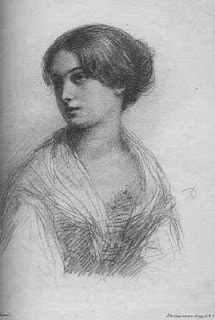 To A Lady
by Victor Hugo,
From Les Feuilles D'Automne
Child, were I king, I'd yield my royal rule,
My chariot, sceptre, vassal-service due,
My crown, my porphyry-basined waters cool,
My fleets, whereto the sea is but a pool,
For a glance from you!
Love, were I God, the earth and its heaving airs,
Angels, the demons abject under me,
Vast chaos with its teeming womby lairs,
Time, space, all would I give--aye, upper spheres,
For a kiss from thee!
translation by Thomas Hardy
photogravure by Goupil et Cie, from a drawing by Deveria, appears in a collection of Hugo's poetry published by Estes and Lauriat in the late 1800s.
The fifteenth day of each month on the Hebrew calendar falls on a full moon, and the holiday was observed as a sort of fertility festival during the period of the Second Temple. After the destruction of the Second Temple, it was forgotten for the most part in the Diaspora, only to be revived in modern times as a Jewish alternative to Valentine's Day.

by Victor Hugo,
From Les Feuilles D'Automne
Child, were I king, I'd yield my royal rule,
My chariot, sceptre, vassal-service due,
My crown, my porphyry-basined waters cool,
My fleets, whereto the sea is but a pool,
For a glance from you!
Love, were I God, the earth and its heaving airs,
Angels, the demons abject under me,
Vast chaos with its teeming womby lairs,
Time, space, all would I give--aye, upper spheres,
For a kiss from thee!
translation by Thomas Hardy
photogravure by Goupil et Cie, from a drawing by Deveria, appears in a collection of Hugo's poetry published by Estes and Lauriat in the late 1800s.
Monday, July 15, 2013
Amanuensis Monday: New Institute for Hebrew Children - December 13, 1900
Amanuensis: A person employed to write what another dictates or to copy what has been written by another.
I continue my project to transcribe family letters, journals, newspaper articles, audiotapes, and other historical artifacts. Not only do the documents contain genealogical information, the words breathe life into kin - some I never met - others I see a time in their life before I knew them.
I began this project back on February 16, 2009. Since I began, many others have joined in on the meme. I am thrilled that this meme I started has inspired so many to transcribe their family history documents. Why do we transcribe? I provide my three reasons in the linked post. You may find others.
This week I look at another newspaper article found at Chronicling America, which doesn't reference a relative, but does provide some history on Jewish education in the St. Louis area at the turn of the 20th century.
I continue my project to transcribe family letters, journals, newspaper articles, audiotapes, and other historical artifacts. Not only do the documents contain genealogical information, the words breathe life into kin - some I never met - others I see a time in their life before I knew them.
I began this project back on February 16, 2009. Since I began, many others have joined in on the meme. I am thrilled that this meme I started has inspired so many to transcribe their family history documents. Why do we transcribe? I provide my three reasons in the linked post. You may find others.
This week I look at another newspaper article found at Chronicling America, which doesn't reference a relative, but does provide some history on Jewish education in the St. Louis area at the turn of the 20th century.
Monday, July 8, 2013
Amanuensis Monday: Virginia Cruvant Zimmerman Sharp (1915-2013) - from Flower Girl to Great Grandmother
Amanuensis: A person employed to write what another dictates or to copy what has been written by another.
I continue my project to transcribe family letters, journals, newspaper articles, audiotapes, and other historical artifacts. Not only do the documents contain genealogical information, the words breathe life into kin - some I never met - others I see a time in their life before I knew them.
I began this project back on February 16, 2009. Since I began, many others have joined in on the meme. I am thrilled that this meme I started has inspired so many to transcribe their family history documents. Why do we transcribe? I provide my three reasons in the linked post. You may find others.
This week I look at a newspaper article found in ProQuest's Historical Newspapers' St. Louis Post Dispatch archives through using my local library card. A cousin of my grandfather makes an appearance at the age of four. She passed away earlier this year, one of the last of her generation of descendants of my second great grandfather, Moshe Leyb Cruvant.
I continue my project to transcribe family letters, journals, newspaper articles, audiotapes, and other historical artifacts. Not only do the documents contain genealogical information, the words breathe life into kin - some I never met - others I see a time in their life before I knew them.
I began this project back on February 16, 2009. Since I began, many others have joined in on the meme. I am thrilled that this meme I started has inspired so many to transcribe their family history documents. Why do we transcribe? I provide my three reasons in the linked post. You may find others.
This week I look at a newspaper article found in ProQuest's Historical Newspapers' St. Louis Post Dispatch archives through using my local library card. A cousin of my grandfather makes an appearance at the age of four. She passed away earlier this year, one of the last of her generation of descendants of my second great grandfather, Moshe Leyb Cruvant.
Friday, July 5, 2013
C-Span Video - For Genealogists
Back in 2010 C-Span uploaded almost its entire video library - covering 23 years, and they have added to it since then. All accessible online for free.
One could spend days (months, years) reliving history. C-Span isn't only Congressional Hearings, and I found several things that might be of interest to genealogists and family historians.
One could spend days (months, years) reliving history. C-Span isn't only Congressional Hearings, and I found several things that might be of interest to genealogists and family historians.
- Genetic Testing and Privacy - Aug 31, 2009
- Identification of an Unknown Soldier - June 30, 1998
- Book Discussion of The Seven Daughters of Eve - July 19, 2001
- Book Discussion on The Genealogy of Greek Mythology - Dec 11, 2003
- Book Discussion on American Tapestry - June 19, 2012
- Roots and Ancestry - Jan 15, 2000
Thursday, July 4, 2013
Happy Independence Day
Happy Independence Day!
 | The New Colossus Emma Lazarus Not like the brazen giant of Greek fame, With conquering limbs astride from land to land; Here at our sea-washed, sunset gates shall stand A mighty woman with a torch, whose flame Is the imprisoned lightning, and her name Mother of Exiles. From her beacon-hand Glows world-wide welcome; her mild eyes command The air-bridged harbor that twin cities frame. "Keep ancient lands, your storied pomp!" cries she With silent lips. "Give me your tired, your poor, Your huddled masses yearning to breathe free, The wretched refuse of your teeming shore. Send these, the homeless, tempest-tost to me, I lift my lamp beside the golden door!" |
Monday, July 1, 2013
Amanuensis Monday: A Concert in Carr Park - August 10, 1902
Amanuensis: A person employed to write what another dictates or to copy what has been written by another.
I continue my project to transcribe family letters, journals, newspaper articles, audiotapes, and other historical artifacts. Not only do the documents contain genealogical information, the words breathe life into kin - some I never met - others I see a time in their life before I knew them.
I began this project back on February 16, 2009. Since I began, many others have joined in on the meme. I am thrilled that this meme I started has inspired so many to transcribe their family history documents. Why do we transcribe? I provide my three reasons in the linked post. You may find others.
This week I look at another newspaper article found at ChroniclingAmerica about the Carr Square neighborhood of St. Louis City from the early 1900s, where several of my paternal ancestors lived. If these articles are representative, the language of the news was a lot more 'colorful' back then.
I continue my project to transcribe family letters, journals, newspaper articles, audiotapes, and other historical artifacts. Not only do the documents contain genealogical information, the words breathe life into kin - some I never met - others I see a time in their life before I knew them.
I began this project back on February 16, 2009. Since I began, many others have joined in on the meme. I am thrilled that this meme I started has inspired so many to transcribe their family history documents. Why do we transcribe? I provide my three reasons in the linked post. You may find others.
This week I look at another newspaper article found at ChroniclingAmerica about the Carr Square neighborhood of St. Louis City from the early 1900s, where several of my paternal ancestors lived. If these articles are representative, the language of the news was a lot more 'colorful' back then.
Subscribe to:
Posts (Atom)


 Posts
Posts