Friday, January 24, 2020

Mineral Wells Texas - What Were Morris & Mollie Blatt Doing There?

Back in 1987, my paternal grandmother was interviewed, and she stated that her mother, Anna Blatt Feinstein, first arrived in the United States in Mineral Wells, Texas. In 2010, when I transcribed the interview, I knew there had to be some story behind this, as no one comes up with the town Mineral Wells, Texas out of thin air.

However
  • My great grandmother, Anna, was born in 1890, in Poland.
  • In 1893 my great great grandfather Moshe "Morris" Blatt married his second wife, Mollie, in St. Louis.
  • In 1898 their first child, Henry, was born, in St. Louis
  • In 1900 they, and his daughters from his first marriage, Anna and Blanche, are all recorded in St. Louis
  • In 1903 Morris and Mollie's second child, Pearl was born, in St. Louis
  • In the 1910 census they are all still recorded in St. Louis.
So I was left wondering.

Below is a page from the 1907 Mineral Wells, Texas City Directory

There is a Moses (and Mallie) Blatt
And in the next line there is an Annie.

Moses is a tailor, which matches my 2nd great grandfather's profession.

In 1909 Moses and Mallie were still in Mineral Wells, though Annie doesn't appear in that city directory.

City directories prior to 1907 currently aren’t available online.

So, while these could be different Blatts, it is likely I have confirmed they did spend some time in that city, and have an approximate time-span.

But why did they move to Mineral Wells, Texas, and why did they return to St. Louis? Will I ever know?

I will also note I still have not found my great grandmother's immigration records. So it is possible that at some point in time between 1890 and 1900 she did immigrate to the US through Texas, with other relatives perhaps, met up with her father in St. Louis, and then returned briefly around 1907.

Possible record sources for further research might include researching the community to see if there were any synagogues in or near Mineral Wells at the time and seeing if any membership records still exist.

Wednesday, January 22, 2020

Wordless Wednesday: Advertising Slogans

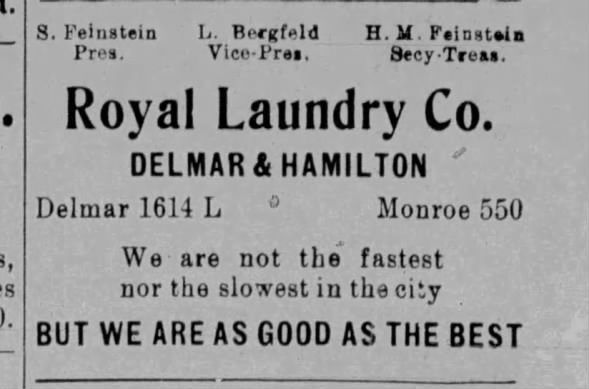
My second great grandfather, Selig Feinstein, and my great grandfather, Herman M Feinstein, may not have been the best at coming up with advertising slogans for their laundry.

Royal Laundry AdvertisementRoyal Laundry Advertisement Fri, Aug 26, 1910 – 1 · The Jewish Voice (St. Louis, Missouri) · Newspapers.com

Saturday, November 9, 2019

Veterans Day/Remembrance Day 2019

Caption for photo to left: Human Statue of Liberty. 18,000 Officers and Men at Camp Dodge, Des Moines, Iowa. Colonel William Newman, Commanding. Colonel Rush S. Wells, Directing. Mole & Thomas, 09/1918. (source)

Monday, November 11 is Veterans Day in the US, and Remembrance Day in the UK, Canada, Australia, France and Belgium. In Poland it is celebrated as National Independence Day.

Below are the names of ancestors, and their siblings, who I know served their nation's military, either in a time of war, or in a time of peace. I am including my Loyalist ancestors; their nation was Great Britain. Canada became their country after the war. I am including my Confederate ancestors too, despite their desire to form a separate nation. I am also including a Conscientious Objector ancestor since the DAR counts him as a Patriot.

Fifth Great Grandfathers
McGregory Van Every (1723-1786) Loyalist/Butler's Rangers
Michael Showers (1733-1796) Loyalist/Butler's Rangers
Mark Fretz (1750-1840) Patriot (Inactive Duty) Pennsylvania militia

Fourth Great Grandfather
David Van Every (1757-1820) Loyalist/Butler's Rangers (served briefly as a Patriot in the NY militia)

Fifth Great Uncle
Benjamin Van Every (1759-1795) Loyalist/Butler's Rangers (served briefly as a Patriot in the NY militia)
William Van Every (1765-1832) Loyalist/Butler's Rangers
Peter Van Every (1771-bef 1816) Loyalist/Fifth Lincoln and Second York regiments (War of 1812)

Fourth Great Uncles
David Van Every Jr. (1782-1847) Loyalist/Second York regiment (War of 1812)
Michael Van Every (1790-?) Loyalist/Fifth Lincoln and Second York regiments (War of 1812)

Second Great Grandfather
Ebenezer Denyer (1828-1872) (Mexican-American War) (Confederate Army)

Third Great Uncles
Samuel Jennings Denyer (1822-1861) (Gonzales County Minute Men - Republic of Texas -1841)
Samuel T Hartley (1830-1920) (Confederate Army)

Great Grandfather
Samuel Deutsch (1861-1938) (Franz Josef's Austro-Hungarian Army)

Second Great Uncle
Nelson D Van Every (1845-1926) (Union Army)

Grandfathers
Melvin L Newmark (1912-1992), WWII
Martin J Deutsch (1907-1991), WWII

Great Uncles
Jerry Deutsch (1909-1950), WWII
Allen Deutsch (1914-1988), WWII
Harold Newmark (1915-2003), WWII
Mandell Newmark (1923-1945), WWII (KIA)
Bernard Feinstin (1913-1968), WWII
Seymour Feinstein (1917-1999), WWII

Uncle
Stevan J Newmark (1942-1997) Army Reserves

Photographs of those who served in World War II

My grandfathers Melvin Newmark (1912-1992) and Martin Deutsch (1907-1991)


Allen Deutsch (1914-1988) and Maurice "Jerry" Deutsch (1909-1950).


Harold Newmark (1915-2003) and Mandell Newmark (1923-1945).


Bernard "Benny" Feinstein (1913-1968) and Seymour "Babe" Feinstein (1917-1999)

Tuesday, October 22, 2019

AncestryDNA Ethnicity Results

DNA Ethnicity results aren't an exact science, and in some respects, are mostly for entertainment purposes. A large number of genealogists will tell you they do the DNA tests in order to find living relatives to communicate with, not for ancestral ethnicity. For that knowledge, we research the records.

In 2012 AncestryDNA described my Ethnicity like this. I knew I should be about 75% European Jewish, if I inherited exactly 25% of my DNA from each grandparent, but 53+17 came pretty close.


In October of 2013 they updated their results, and the Uncertain amount disappeared.

The trace amounts of Pacific Islander surprised me. Caucasus can include Russia, so that wasn't too surprising. Though I later learned that the Caucasus was on my maternal line, which meant either some of my Transylvanian Jewish ancestors came from Russia originally, or there were some Caucasus roots elsewhere.

The breakdown has remained pretty consistent at Ancestry. At some point in the past 7 years, they  added their information on Communities, but the overall ethnicity breakdown has remained the same for me. Until a recent update:


No more Caucasus. No more Pacific Islander. And I am 79% European Jewish. (That's actually the high end of a 66%-79% range. So I think it's a pretty good estimate. And illustrates how useless DNA ethnicity charts are for most European Jews. Yes, the community information is nice, but Ancestry is unable to currently tell us how much from each.) The composition of the remaining 21% of my ancestry doesn't divert much from my research. 5% is almost one second great grandparent, so that feels a little high for my Irish/Scottish ancestry, but I know I have some. I don't know who my Finnish ancestors are.

Sunday, September 1, 2019

Labor Day Weekend 2019

As you light up your barbecues this weekend and enjoy your day off from work Monday (those who have the day off) - take some part of the day to consider the advancements we have made in workers' rights over the last century - Many of us may have ancestors who worked in the coal mines or sweatshops.

Also, consider in what ways the struggles aren't over.

Here's a playlist of songs which may help.


A Pict Song - Rudyard Kipling (1917)

Rome never looks where she treads,
Always her heavy hooves fall,
On our stomachs, our hearts or our heads;
And Rome never heeds when we bawl.
Her sentries pass on—that is all,
And we gather behind them in hordes,
And plot to reconquer the Wall,
With only our tongues for our swords.

We are the Little Folk—we !
Too little to love or to hate.
Leave us alone and you'll see
How we can drag down the Great!
We are the worm in the wood !
We are the rot at the root!
We are the germ in the blood !
We are the thorn in the foot !

Mistletoe killing an oak—
Rats gnawing cables in two—
Moths making holes in a cloak—
How they must love what they do!
Yes,—and we Little Folk too,
We are as busy as they—
Working our works out of view—
Watch, and you'll see it some day!

No indeed ! We are not strong,
But we know Peoples that are.
Yes, and we'll guide them along,
To smash and destroy you in War!
We shall be slaves just the same ?
Yes, we have always been slaves;
But you—you will die of the shame,
And then we shall dance on your graves.

We are the Little Folk, we ! etc.

Friday, August 9, 2019

Missouri Historical Society Library and Research Center databases

I received my copy of the Missouri Historical Society’s Genealogy and House History monthly eNewsletter yesterday.

They too mentioned the ongoing digitization of St. Louis area newspapers by Ancestry.com, which was announced back in April. Apparently they also have a subscription to the ProQuest version of Newspapers.com, and visitors can access it at their Library and Research Center.
.
I go to the St. Louis County Library headquarters for most of my library-based genealogy research, but I have a nostalgic fondness for the Library and Research Center building. It used to be a synagogue. The reading room is the former sanctuary where I became a Bar Mitzvah in 1982, and where my grandmother was confirmed in 1930.

I decided to see what other subscription databases they might offer

1) America: History and Life
2) Ancestry.com (the library edition)
3) Fold3
4) Frontier Life (includes the journals of Lewis and Clark)
5) JSTOR
6) Newspapers.com (library edition)
7) WorldCat Discovery (with links to full text results from America: History and Life, and JSOR)
8) World’s Fairs: A Global History of Expositions

St. Louis County Library has Ancestry, Fold3, and Newspapers.com, however it doesn’t have America: History and Life, or JSTOR. Access to these is definitely worth making the 7 mile trip to visit my childhood sanctuary on a more regular basis. They don’t have evening hours, but they are open on Saturdays.

Friday, August 2, 2019

Cousin to Boris Johnson - Oy Vey!

American Ancestors – the website of the New England Historic Genealogical Society (NEHGS) – has released a press release on “The American Ancestry of Boris Johnson, Prime Minister of the United Kingdom, Is Revealed by American Scholar

The American scholar is Gary Boyd Roberts, Senior Research Scholar Emeritus at NEHGS. The press release and Gary Boyd Roberts' research suggests Johnson is descended from Samuel Lathrop and Elizabeth Scudder. I have posted before that I am not related to all Lathrop descendants, but I am related to Samuel Lathrop’s descendants through his wife Elizabeth Scudder. 

The American Ancestors article states:
Lathrop descendants include U.S. First Ladies Edith Kermit (Carow) Roosevelt and Nancy (Davis) Reagan; Canadian Prime Minister Sir Robert Laird Borden; the traitor Benedict Arnold; politicians William Jennings Bryan, Thomas E. Dewey, John Foster Dulles, and George and Mitt Romney; poet Henry Wadsworth Longfellow; Oliver Wendell Holmes Sr. and Jr.; inventor Eli Whitney; financier J. P. Morgan Jr.; artist Georgia O’Keeffe; composer Charles Ives; Church of Jesus Christ of Latter-day Saints founder Joseph Smith Jr.; Cecil B. DeMille and Agnes de Mille; aviator Amelia Earhart; and, among actors, Julie Harris, Clint Eastwood, Cissy Spacek, and Ben and Casey Affleck.
I’d have to conduct some research on those listed to see which Lathrops were their ancestors. From past research I’ve read, I believe Longfellow, Romney, and Holmes are all among my list of cousins.


Friday, July 26, 2019

The Value of a Library Card - St. Louis

Post updated from 2015

I conduct a lot of genealogy research from the comfort of my home computer. One of the key resources I use is my St. Louis County Public Library Card. (Other library systems, as well as some genealogy societies, provide similar resources for their users.)

Here's a sampling of databases I can search/browse from the comfort of my home, for free (complete list) I have indicated the subscription price I'd have to pay without the library card

Databases I could subscribe to as an individual
  • NewspaperArchive.com ($75/6 mos)
  • AccessibleArchives: ($90/year)
    • African American Newspapers 19th century
    • A Newspaper Perspective
  • Newspapers.com ($45/6 mos)
    • I am assuming that the ProQuest library edition is similar to the Newspapers.com Basic subscription
  • Fold3 ($80/year)
Databases only available to libraries and other institutions - not by individual subscription
  • Fire Insurance Maps Online
  • HeritageQuest Online
  • Newsbank: St. Louis Post Dispatch (1981-Current) 
  • Newsbank: Access World News (1978-current) 
  • Newsbank: America's Obituaries
  • ProQuest: Historical New York Times (1851-2011)
  • ProQuest: Historical St. Louis Post Dispatch (1874-1922)
  • ProQuest Digital Microfilm - St. Louis Post Dispatch 1989-Present
  • Gale Group: Nineteenth Century US Newspapers
  • EBSCOhost: Academic Search Elite (1985-current)
  • EBSCOhost: AAS Historical Periodicals Collection (1684-1912)
  • HistoryGeo (searchable database of 12.3 million names connected to land ownership maps covering the 29 public land states and Texas)
And while I can't access it from home, it is available to me at the library:
  • Ancestry Library Edition ($99/6 mos)
  • American Ancestors ($95/year)
  • FindMyPast ($129/year)
  • Archion (baptisms, confirmations, marriages and burials for Protestant churches in Germany. 16th-19th century) $200/year (at current Euro to $ rates)
So calculating only the databases which I could purchase access to as an individual, I am saving $1,127/year with my library card. Then there are the databases I can't purchase access to as an individual.

I know I am lucky to live in St. Louis, as not every library has equivalent resources. However, if you don't check, you won't know what your library has to offer.

Monday, July 22, 2019

Amanuensis Monday: Simon Cruvant breaks his leg - 1889

Amanuensis: A person employed to write what another dictates or to copy what has been written by another.

I continue my project to transcribe family letters, journals, newspaper articles, audiotapes, and other historical artifacts. Not only do the documents contain genealogical information, the words breathe life into kin - some I never met - others I see a time in their life before I knew them.

Today I transcribe a newspaper clipping describing a horse and wagon accident a brother of my second great grandfather was involved in. This clipping was found on Newspapers.com

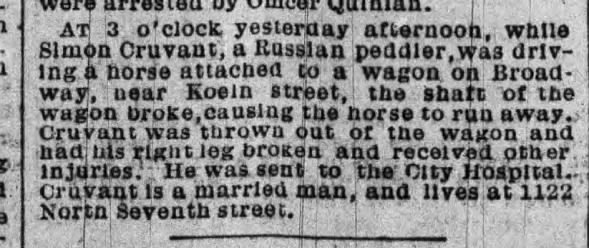
At 3 o'clock yesterday afternoon, while Simon Cruvant, a Russian peddler, was driving a horse attached to a wagon on Broadway, near Koeln street, the shaft of the wagon broke, causing the horse to run away. Cruvant was thrown out of the wagon and had his right leg broken and received other injuries. He was sent to the City Hospital. Cruvant is a married man, and lives at 1122 North Seventh street.

Horse-wagon accident involving Simon CruvantHorse-wagon accident involving Simon Cruvant Fri, Oct 25, 1889 – 5 · St. Louis Globe-Democrat (St. Louis, Missouri) · Newspapers.com
Notes:

1. Samuel "Simon" Cruvand (1841-1895) would have been 48 years old at the time of this incident, with four children. His brother, Moshe Leyb Cruvant, was my second great grandfather. The family came from the town of Kruvandai in Lithuania, and different branches spelled the surname differently. At least five different phonetic spellings have been used by those who settled in the US: Cruvant, Cruvand, Kruvant, Kruvand, and Kroovand. I believe the 'Cruvand' spelling may no longer be in use. This is the second oldest newspaper article mentioning one of my paternal kin I have currently found.

Monday, July 15, 2019

Amanuensis Monday: Play Ball! - Junior Baseball League 1914

Amanuensis: A person employed to write what another dictates or to copy what has been written by another.

I continue my project to transcribe family letters, journals, newspaper articles, audiotapes, and other historical artifacts. Not only do the documents contain genealogical information, the words breathe life into kin - some I never met - others I see a time in their life before I knew them.

Today I transcribe a newspaper clipping listing the teams of a municipal junior baseball league from 1914. While I don't know any of the youth on the teams, one of the teams appears to have been sponsored by my second great grandfather, and/or a combination of his sons. This clipping was found on Newspapers.com

St. Louis Globe Democrat
19 April 1914 Page 47

Junior League Will Meet Monday Night

The Junior Baseball League umpires, managers and captains of teams will meet in room 304 City Hall Monday evening at 8 o’clock. General instructions will be given in order that a thorough understanding between all will be had. The league is composed of ten teams: Day Ice Cream Company, Welsbach Company, H.N.’s, Lamoth Piano Company, Newmark Tailors, Claxton Juniors, Rock Islands, Majestic, A.C. Empires and American Steel and Foundry Company.

The Schedule Committee will meet Tuesday to arrange schedule and all necessary details for the opening of the season, which will be Sunday afternoon April 26, as follows: Preliminary games on grounds No. 8, Forest Park; grounds 2 and 4 at fair grounds and a double header at O’Fallon Park grounds No. 1. The double-umpire system will be in use at all games. All teams have strong line-ups and the public should witness some of the most interesting games in the Muney League on Sunday afternoon during the season.

Notes:

1) My second great grandfather, Samuel Newmark and his family immigrated to St Louis 1908-1909. Samuel and his sons Sol, Barney, and Max were all tailors. I can’t imagine they had any experience with baseball as a sport in Poland or England (where they lived for 15 years before immigrating to St. Louis.). However, they were sponsoring a team, not playing. From other articles I know  the players were age 14-16, and there were no Newmarks of that age in 1914.

Amanuensis Monday: The Education of Herman Feinstein

Amanuensis: A person employed to write what another dictates or to copy what has been written by another.

I continue my project to transcribe family letters, journals, newspaper articles, audiotapes, and other historical artifacts. Not only do the documents contain genealogical information, the words breathe life into kin - some I never met - others I see a time in their life before I knew them.

Today I transcribe a newspaper clipping mentioning a great grandfather's schooling. The St. Louis Globe-Democrat has recently been added to the digitized holdings at Newspapers.com. Born in 1886, my great grandfather Herman Feinstein was 15 years old in 1901.

St. Louis Globe-Democrat, 17 April 1901, page 9. 
JEWISH ALLIANCE SCHOOL
Closing Exercises Held Last Night at Jefferson Building.

The closing exercises of the Jewish Alliance night schools, at the Jefferson school building, at Ninth and Wash streets, were held last night under the direction of Prof. Emil Mayer, the principal. An attractive program was presented. It was opened by a song, “The Flag of the Free,” sung by the school. Recitations were presented by Ida Gellman, Louis Lambrakis, Ralph Goldman, Simon Shipper, Fannie Brenholz, Beckie Herman, Jacob Frelich, Annie Hall, Ike Stern and Mary Fridkin; orations by Sam Shor and Sam Shipper; dialogue by Esther Sherman, Sadie Greenspan, Carrie Dubinsky, Jenny Mason, Herman Feinstein and Jacob Rosenblatt; debate on “Resolved, That education should be compulsory,” by Emil Goldstein on the affirmative and Simon Ludwig on the negative; a song, “The Linden Tree,” by Fannie Brenholz, Rose Alberstein, Jennie Mason and Sam Shor; essay by Harry Singman, and the song, “Good Night,” by the school. A number of prizes were distributed by Rabbi Samuel Sale, and short addresses were made by Rabbis H. J. Messing and Moritz Spitz.

The enrollment for the term, which began in October, was about 350. Six assistant teachers were employed, Misses Sophie Barron, Rose and Minnie Kahn and Fishell, Isaacs and Goldberg. The school is maintained by the Associated Jewish Charities for purpose of affording opportunities for acquiring an education to the younger Jewish element of that locality who are employed in the daytime. It is under the management of a board of directors, the officers of which are Elias Michael, president; Louis Bry, Vice President; Albert Loth, secretary, and Isaac Schwab, treasurer. The next term of the school will begin in the new building that is being erected by the Jewish Charitable and Educational Association at Ninth and Carr streets. The new building is a three-story structure, 150x50 feet in area, and will cost upward of $40,000.

Notes:

1) Closing exercises doesn't necessarily mean graduation. From the description it appears all students at the night school participated, and there is no indication which students would be returning the following term. From this article I know my great grandfather in 1901 at age 15 had a job during the day and was receiving the equivalent of a secondary education at night. I also have insight into the type of education he was receiving.

2) I wonder if the presentation category of "Dialogue" was similar to the "Dramatic Interpretation" or "Duo Interpretation" categories in modern Speech and Debate competitions.

Thursday, June 6, 2019

D-Day Plus 75 Years

Today marks the 75th anniversary of D-Day

The closest relative I have found involved in the D-Day invasion was Arnold Burton Kruvant, a second cousin of my paternal grandfather. The details of his death were, I believe, first described in a book on his battalion published in 2016. While apparently several surviving members of his battalion witnessed his death, they decided not to share the details with his family, due to its gruesome nature.

First Lt. Arnold Kruvant of New Jersey was a Camp Claiborne original. He transferred to the 37th Parachute Artillery Battalion and became the S-3, jumping into Normandy even though he had never had jump training. Kruvant carried in with him the funds for the battalion, $500 in U.S. currency. He is listed as KIA and MIA on June 6. He was twenty-six years old.

Kruvant’s widow was well known and well liked by the men of the 321st. They decided at the time that she would not be told of her husband’s gruesome death. Several 321st officers recalled that Kruvant was bayoneted to death while hung up in his parachute harness, dangling from a tree just off the ground. Why his body was never positively identified remains a mystery to this day. (Source: Screaming Eagle Gliders: The 321st Glider Field Artillery Battalion of the 101st Airborne Division in World War II, G. J. Dettore, Rowman & Littlefield, 2016, pp 83-85. Image: East Orange High School Yearbook, 1936, p. 44. Retrieved from Ancestry.com June 5, 2019.)

***

Note: A week and a half ago I neglected to make my annual Memorial Day post. On future Memorial Days, I believe I will honor Arnold Kruvant's service in addition to that of my great uncle, Mandell Newmark. (Mandell and Arnold were second cousins.)

Tuesday, May 7, 2019

National Genealogical Society Conference 2019

Four years ago, the National Genealogical Society Family History Conference was in St. Charles, MO, 15-20 minutes from me. So I attended, and blogged about my experiences. It's back in St. Charles this week, so I will be attending again.

I have updated all the links on my 2015 blog post of Dining Recommendations. My personal recommendations are pretty much the same. However, there is a new excellent Kosher restaurant in St. Louis for those with dietary considerations. Cafe Coeur. About a 20 minute drive from the conference center, it offers a blend of Japanese and Italian cuisine. (Yes, sushi and pizza, but more.) The restaurant is about a month old, so reservations are recommended.

I didn't sign up for any of the Pre-Conference events today, so I will be headed there tomorrow for the Opening Ceremonies. I had a lot of educational fun four years ago, and I'm looking forward to the next few days.

Tuesday, April 23, 2019

Tombstone Tuesday: John Davenport Sr. 1784-1851

John Devenport and his wife Delilah Abernathy Devenport are my wife's fifth great grandparents.


This tombstone is filled with information. (The accuracy of the information depending entirely on the knowledge of whoever provided it.)

1) John's profession: Justice of the Peace
2) Where he was born: Virginia
3) His wife's maiden name: Abernathy
4) Where she was born: North Carolina
5) When they moved to Missouri: 1820
6) And that he was the first to be buried in the cemetery. (Old Union Methodist Church Cemetery; Bessville, Bollinger County, Missouri)

There are North Carolina marriage records for John and Delilah.
There is a likely father for John, William Devenport (1756 VA - 1826 NC).
William's will does mention a son by the name of John, and a witness on several of the documents has the surname Abernathy.


Monday, April 22, 2019

Amanuensis Monday: Melvin Van Every and Cotton in the El Paso Valley - 1917

Amanuensis: A person employed to write what another dictates or to copy what has been written by another.

I continue my project to transcribe family letters, journals, newspaper articles, audiotapes, and other historical artifacts. Not only do the documents contain genealogical information, the words breathe life into kin - some I never met - others I see a time in their life before I knew them.

Today I transcribe two newspaper clippings. One my great grandfather's obituary from 1929, and a letter to the editor one of his daughters, Minnie Van Every Benold, wrote in 1965. Both discuss my great grandfather's role in growing cotton in the El Paso valley.

El Paso Times, May 28, 1929, page 14 

MELVIN E. VAN EVERY, 60, died at Garfield, N.M., Sunday. Services will be held at 4 o’clock this afternoon at the chapel of Kaster & Maxon the Rev. W. Angie Smith officiating. Burial will be in Evergreen cemetery.

Mr. Van Every was one of the pioneer residents of the lower valley and was engaged in cotton growing and ginning. He was the builder of the first cotton gin in the valley.

He is survived by his widow, Mrs. Josie Van Every, three daughters, Mrs. Minnie Benold and Mrs. I.T. Herrin, both of El Paso, and Miss Myrtle Van Every of Kansas City, Mo., also by one son, Dr. S.O. Van Every of Kansas City, Mo. Pallbearers will be selected from the W.O.W. of which he was a member.

El Paso Times, Feb 12, 1965, p.4. 

Dear Mr. Hooten: I have just read your request for information as to who raised the Valley’s first cotton. I think I know!

My father, M.E. Van Every “scouted” for good cotton land in 1917 from South Texas to California and bought land two miles below Fabens. There he cleared and ditched the land for irrigation in time to plant cotton for the spring of 1918.

Louis J. Ivey was his good friend and may have experimented before, but all had decided the summers were too short. My father contended that some seasons were not and planted 11 acres, from which he harvested 14 bales, taking the cotton somewhere over in Texas for ginning. He then built a cotton gin in Fabens or Tornillo.

This set the Valley “on fire” and the farmers turned their alfalfa and wheat fields and orchards into cotton patches! He sent letters and telegrams to us, begging us to move out, until we did in 1919 to take charge of my uncle’s farm who was to ill to farm.

This is the story of how our family came West. That year we made enough on our cotton to buy a car and put $1,000 in the bank. Cotton was 39 cents a pound, the highest since the Civil War. I believe this to be the true story of cotton here.

Notes:

1) My great grandfather and Louis.J. Ivey were both mentioned in a 1919 article on El Paso cotton growing.

2) An obituary I previously transcribed from May 29th states he was 66. 66 is the correct age.

3) Minnie's letter clarifies that my great grandfather scouted out land in El Paso while his family remained in San Marcos, on the opposite side of Texas. Minnie, the eldest child, was 33 in 1917. His youngest child, my grandmother, Myrtle, was only 17 in 1917.

4) Minnie is the same great-aunt who wrote a series of letters to the Houston Post as a child for their Happy Hammers children's section.

Thursday, April 18, 2019

Twelve Years of Genealogy Research

I've been blogging about something since May 2002.

  • In March of 2007 I wrote about my great grandfather Barney and his claim he was born in Dublin on March 17th.
  • A friend read my post, and sent me a census record with my great grandfather on it.
  • I had no previous idea what was online.
  • On April 16, 2007 I wrote my first two blog posts concerning research

In 2007 I wrote 131 blog posts.
2008: 263
2009: 323 (almost, but not quite, one per day)
2010: 293 (I began dating the woman of my dreams in May)
2011: 165 (We became engaged)
2012: 114 (We were married)
2013: 90 (We bought a home)
2014: 50 (We adopted twin 1 year old boys)
2015: 54
2016: 86
2017: 59
2018: 23

My research continues; I've just been blogging less.

  • Six years ago, the last time I looked at database statistics, my database had slightly over 2800 individuals, and my wife's had 340.
  • Today: There are over 4700 individuals in my database, and over 1700 in my wife's database.
I'm very pleased with the discoveries I have made, and I'm confident I will continue to make more. I missed my annual St. Patrick's Day post this year, but you can read all my past ones here.


Wednesday, April 17, 2019

Partnership between St. Louis County Library and Newspapers.com

According to the April edition of PastPorts (the St. Louis County Library's History and Genealogy Newsletter)
St. Louis County Library signed a cooperative agreement with Newspapers.com on March 13 to digitize newspaper microfilm in its History & Genealogy (H&G) collection. The project will for the first time provide online electronic access to the St. Louis Globe-Democrat, 1853–1963; Anzeiger des Westens, 1843–1898; and Westliche Post, 1857–1938. Other newspapers include those that once served St. Louis African American, French-speaking, and Jewish communities. 
Over 2000 microfilm reels will be shipped in Mid-May to Newspapers.com. (They may have been considering the NGS Conference in early May when they scheduled the shipment.)

They don't list all the newspapers being digitized, but below are some of the defunct titles that could be included in the list. (It would be nice if they have worked out deals with some additional newspapers that are still ongoing.)
  • Jewish Free Press, 1885 – 1887
  • Jewish Tribune, Aug 29, 1879 – 1884
  • Jewish Voice, Jan 6, 1888 – Dec 31, 1920
  • Modern View-St. Louis (Jewish), Mar 21, 1913 - Aug 27, 1920; Mar 4, 1921 - Feb 10, 1928; Aug 24, 1928 - Jul 28, 1938; Feb 2, 1939 - Jul 25, 1940
  • La Revue de l'Ouest (French), Jan 1854 – Dec 1854
  • Le Patriote (French), 1878 – 1887
  • St. Louis Palladium (African American), Jan 10, 1903 – Oct 5, 1907
  • Przewodnik Polski (Polish), Jan. 8, 1903 – July 7, 1910; Feb. 27, 1913 – July 11, 1929; Feb 2, 1945 – Feb 22, 1945 
  • St. Louis La Lega Italiana, Oct 9, 1914 – Dec 25, 1920 
  • St. Louiske' Listy (Czech), Oct 23, 1902 – Sept 1, 1923
The digitization of the St. Louis Globe Democrat archives will likely be what interests most researchers. The St. Louis Post Dispatch has already been digitized, and made available through Newspapers.com, and for decades the two newspapers were the primary dailies. But the weekly specialized newspapers will be of great interest to many as well.

I've been slowly working my way backwards through the Modern View microfilm looking for ancestral surnames. It will be a pleasure to be able to search the digitized records from home. The quality of the microfilm isn't consistent, so Optical Character Recognition will be poor in spots. This will require browsing the newspapers as I am currently doing. However, I will be able to do it from home. Several of my ancestors came from Poland, though I suspect if they are going to appear in a local community paper, it will be one of the Jewish ones.

Pastports also says:
Researchers will be able to view newspaper images on the Newspapers.com website and search them by name or keyword. Newspapers.com can be used at St. Louis County Library locations and remotely by library cardholders living in the St. Louis metro area.
I wasn't aware Newspapers.com had been added to the library databases. It's the ProQuest Library Edition. The description states 4,000+ newspaper titles. Newspapers.com Basic has 11,400+ newspaper titles. Newspapers.com Premium has even more. If all of the newspapers that the library is digitizing will be available through ProQuest, I *suspect* they will also be available through a Newspapers.com Basic subscription.

Tuesday, November 20, 2018

Happy Hanuka!

Hanuka isn’t going to be celebrated for a couple weeks. It begins on the evening of December 2nd, this year. However, tomorrow is the day Hanuka would fall on if instead of the Hebrew calendar, we used the Gregorian calendar. The 25th day of the Hebrew month of Kislev in 164 BCE fell on November 21.

Of course, Pope Gregory hadn’t been born yet in 164 BCE. Jesus hadn’t been born yet. Not only was there no such thing as the Gregorian calendar, Julius Caesar hadn’t been born, so there was no Julian Calendar.

Moreover, the Hebrew calendar wasn’t standardized yet. Each Hebrew month began after two people declared they saw the crescent moon. So two different communities could be slightly off from one another, but each month there was a reboot.

So November 21 is an estimate.
The 25th of Kislev is an estimate too.

Happy Hanuka!

Monday, November 5, 2018

Amanuensis Monday: A Protest Against Agitation Against Japanese Farmers - 1919

Amanuensis: A person employed to write what another dictates or to copy what has been written by another.

I continue my project to transcribe family letters, journals, newspaper articles, audiotapes, and other historical artifacts. Not only do the documents contain genealogical information, the words breathe life into kin - some I never met - others I see a time in their life before I knew them.

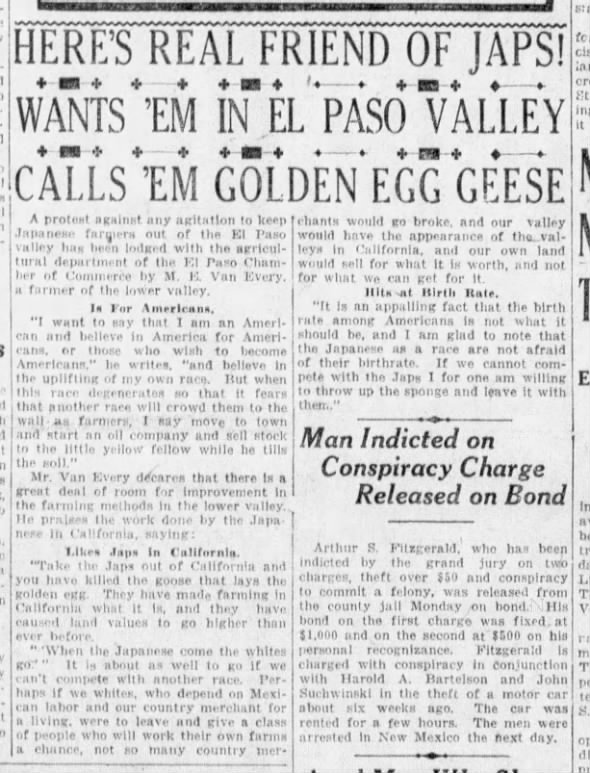
Today I transcribe a newspaper transcript of a protest my maternal grandmother's father lodged with the agricultural department of the El Paso Chamber of Commerce against any agitation to keep Japanese farmers out of the El Paso valley. It's not clear if the newspaper included the entire text of the protest. Some of the language makes me cringe, but giving some leeway for the year, I am glad my great grandfather didn't fall victim to the xenophobia of his times.

Tue, Nov 18, 1919 – 8 · El Paso Times (El Paso, El Paso, Texas, United States of America) · Newspapers.com
HERE’S REAL FRIEND OF JAPS!
WANTS ‘EM IN EL PASO VALLEY
CALLS ‘EM GOLDEN EGG GEESE

A protest against any agitation to keep Japanese farmers out of the El Paso Valley has been lodged with the agricultural department of the El Paso Chamber of Commerce by M.E. Van Every, a farmer of the lower valley.

Is For Americans

“I want to say that I am an American and believe in America for Americans, or those who wish to become Americans,” he writes, “and believe in the uplifting of my own race. But when this race degenerates so that it fears that another race will crowd them to the wall as farmers, I say move to town and start an oil company and sell stock to the little yellow fellow while he tills the soil.”

Mr. Van Every declares that there is a great deal of room for improvement in the farming methods in the lower valley. He praises the work done by the Japanese in California, saying:

Likes Japs in California

“Take the Japs out of California and you have killed the goose that lays the golden egg. They have made farming in California what it is, and they have caused land values to go higher than ever before.

“’When the Japanese come the whites go.’ It is about as well to go if we can’t compete with another race. Perhaps if we whites, who depend on Mexican labor and our country merchant for a living, were to leave and give a class of people who will work their own farms a chance, not so many country merchants would go broke, and our valley would have the appearance of the valleys in California, and our own land would sell for what it is worth, and not for what we can get for it.

Hits at Birth Rate.

“It is an appalling fact that the birth rate among Americans is not what it should be, and I am glad to note that the Japanese as a race are not afraid of their birthrate. If we cannot compete with the Japs I for one am willing to throw up the sponge and leave it with them.”

Wednesday, September 19, 2018

Ahoy Vey! -- Jewish Pirates

Repost with slight changes

Today is International Talk Like a Pirate Day. As well as the Jewish holiday of Yom Kippur.

What would be an appropriate topic, albeit perhaps a little afield from the subject of genealogy, for a blog post combining the two?

How about Jean Lafitte, the possibly Jewish Pirate?


[image - late 19th century artist's conception. [source]

The facts of his origins, and those of his demise as well, depend upon whether you believe the "Journal of Jean Lafitte" is a forgery or not. Discovered in the possession of a claimed descendant.
"My grandmother was a Spanish-Israelite. ... Grandmother told me repeatedly of the trials and tribulations her ancestors had endured at the time of the Spanish Inquisition. ... Grandmother's teachings ... inspired in me a hatred of the Spanish Crown and all the persecutions for which it was responsible -- not only against Jews." [source]
According to one account, Jean Lafitte was killed upon the General Santander, an armed private vessel in the service of Columbia, on Feb. 5, 1823, at the age of 41. In the Gulf of Honduras, the General Santander encountered two Spanish privateers or warships, and was mortally wounded in a brief battle with the vessels and buried at sea ...  
According to Lafitte's Journal ( which many believe to be a hoax, claimed to have been found by a great grand son of Lafitte) written by Lafitte himself in 1851, he took the name John Lafflin and died in St. Louis in his 70s. [source]
As a St. Louisan, this last definitely interests me. Though I have been unable to determine where John Lafflin (whether or not in reality Jean Lafitte) is supposed to be buried. Mysteries tend to surround pirates, don't they?

However, while the origins of Jean Lafitte are controversial, in Jewish Pirates of the Caribbean, author Edward Kritzler makes the claim for several others. Some of the earlier ones are said to have gone into the piracy business as revenge against the inquisition.
One such pirate was Moses Cohen Henriques, who helped plan one of history's largest heists against Spain. In 1628, Henriques set sail with Dutch West India Co. Admiral Piet Hein, whose own hatred of Spain was fueled by four years spent as a galley slave aboard a Spanish ship. Henriques and Hein boarded Spanish ships off Cuba and seized shipments of New World gold and silver worth in today's dollars about the same as Disney's total box office for "Dead Man's Chest." [source]
Of course, pirates tend to break a few commandments in their daily routine. Ends rarely justify the means, and revenge isn't generally considered a morally appropriate explanation for deeds. One wonders if the above Jewish pirates recited the Al Chet (confession of sins) yearly on Yom Kippur.