Amanuensis: A person employed to write what another dictates or to copy what has been written by another.
Apple has been transcribing a huge collection of letters for over six months, and her efforts are inspirational. Though not nearly as large a collection as hers, I have many letters and other documents I've scanned in that I wish to transcribe, as well as a handful of audiotapes, and I thought setting up a day of the week where I would post transcriptions might encourage me to do so.
Popular weekly blog memes include Wordless Wednesday, Tombstone Tuesday, and Friday Five. Alliteration seems to be a necessity, and as a poetry aficionado, it appeals to me as well. So, searching for an appropriate alliterative title, I decided to go with "Amanuensis Monday." It's a fairly obscure word, but fits my purpose. It also provides me with the weekend to prepare the posts.
Here's my first entry.
I am going to attempt to do this weekly, and others are welcome to participate. Feel free to leave a link to your transcription in the comments.
Testimony delivered by Samuel T. Hartley in front of The Dawes Commission, 1900
Department of the Interior
Commission to the Five Civilized Tribes,
Muskogee, I.T. Nov. 21, 1900.
In the matter of the application for identification as Mississippi Choctaws of Samuel T. Hartley and his three minor children. Samuel T. Hartley being duly sworn by Acting Chairman Bixby, testified as follows:
Examination by the Commission.
Q. What is your name? A. Samuel T. Hartley.
Q. What is your age? A. I am 70.
Q. What is your post-office address? A. Turnerville, Texas.
Q. Are you a resident of the state of Texas? A. Yes sir.
Q. How long have you resided in Texas? A. I have been in Texas about sixty years I reckon.
Q. Have you maintained a continuous residence in Texas for sixty years? A. Yes sir.
Q. Where did you live prior to that time? A. Mississippi.
Q. What part of Mississippi? A. Choctaw County.
Q. Were your people recognized members of the Choctaw tribe of Indians in Mississippi in 1830? A. My grandmother.
Q. Wasn’t your mother? A. Yes sir, my mother too.
Q. What is your mother’s name? A. Eliza Beasley.
Q. Is she living? A. No sir.
Q. What is your father’s name? A. George W. Hartley.
Q. That is your mother’s maiden name? A. Yes sir.
Q. Is your father living? A. No sir, he’s dead.
Q. Through which one of your parents do you claim your Choctaw blood? A. My father.
Q. How much Choctaw blood do you claim? A. One fourth.
Q. Was your father a recognized member of the Choctaw tribe of Indians in Mississippi in 1830? A. I don’t know, I reckon so.
Q. When did you leave Mississippi? A. I left Mississippi in ’35 I believe.
Q. Did your father come with you? A. Yes sir, come to Little Rock, Arkansas and died.
Q. Your father left Mississippi in 1835 then? A. Yes sir.
Q. Where did he start for? A. He started for Texas.
Q. Do you know anything about his possession in the state of Mississippi? A. No, I do not.
Q. Do you know whether he ever received any land in Mississippi as a beneficiary under the provisions of the 14th article of the treaty of 1830? A. I do not.
Q. That is the article of the treaty under which you are making your claim is it not? A. Yes sir.
Q. Did any of your ancestors ever comply with the provisions of that article of that treaty? A. Not as I know of anything about it.
Q. Why did your father leave Mississippi? A. Because he wanted to come to Texas.
Q. What did he want to come to Texas for? A. I do not know.
Q. Did he signify to the United States Indian Agent for the Choctaw Indians in Mississippi that the wanted to stay there and become a citizen of the states? A. I don’t know that.
Q. Did he remain there the five years as required by the provisions of that article of the treaty? A. I don’t know that.
Q. Did any of your ancestors ever receive or claim any land in Mississippi as beneficiaries under the provisions of the 14th article of the treaty of 1830? A. No sir, I don’t think they did.
Q. If your father was a recognized member of the Choctaw tribe of Indians in Mississippi in 1830 why did he not remove to the Indian territory with the other members of the tribe? A. I don’t know.
Q. What do you know about your father’s Choctaw Indian citizenship in Mississippi? A. I know my father was a one fourth Choctaw.
Q. Was any provisions ever made that you should receive any land in Mississippi under the provisions of the 14th article of the treaty of 1830? A. Not as I know of.
Q. When were you born? A. In 1830.
Q. What month? A. In March, the fourteenth.
Q. You were living on the 27th of September, 1830 were you not? A. I guess I was.
Q. You are aware of the fact that under the provisions of the 14th article of the Treaty of 1830 that you were entitled to certain considerations thereunder as a child? A. Yes sir.
Q. Did you ever receive any benefits under that article of that treaty? A. Never did.
Q. Are you making this claim under any other provisions of any other treaty between the United States and the Choctaw Indians? A. No sir.
Q. Are you married? A. Yes sir.
Q. What is your wife’s name? A. Nannie V. Hartley.
Q. Is she a white woman? A. Yes sir.
Q. Never made any claim to Indian citizenship by blood? A. No sir.
Q. Are you making any claim for her now? A. No sir.
Q. When did you marry her? A. In ’90.
Q. Where were you married to her? A. In Texas.
Q. Married in accordance with the laws of the state of Texas? A. Yes sir.
Q. Have you your marriage license and certificate? A. Yes sir.
Q. Have you them with you? A. No sir.
Q. It will be necessary for the Commission to be supplied with evidence of your marriage to your wife in the matter of the identification of your children. Have you any children under 21 years of age and unmarried for whom you desire to make application? A. Three.
Q. What are their names and ages? A. Ammie Hartley.
Q. How old is she? A. Nineteen.
Q. Who is the mother of Ammie Hartley? A. My first wife.
Q. What was her name? A. Margaret Hartley.
Q. Is she dead? A. Yes sir.
Q. Have you your marriage license and certificate to Margaret Hartley? A. Yes sir.
Q. It will be necessary for the Commission to be supplied with evidence of your marriage to your first wife in the matter of the application for the identification of this child. What are the names and ages of your other two children? A. Samuel H. Hartley. Sixteen.
Q. This same mother? A. Yes sir.
Q. The next one? A. By my second wife, Eddie R.
Q. How old is he? A. Ten years old.
Q. This child is by your second wife? A. Yes sir.
Q. These children all live with you at your home? A. Yes sir.
Q. You and your wife living together? A. Yes sir.
Q. Any additional statement you desire to make in support of this application? A. No sir.
Q. Is there any written evidence that you desire to offer the commission for consideration in support of this application?
Here attorney for applicant asks leave to file written evidence in support of this claim in 15 days from this date.
Permission is granted the attorney for the applicant to file written evidence in support of this application provided the same is offered for filing with this Commission within fifteen days from the date thereof.
By L.P. Hudson, attorney for the applicant.
Q. Mr. Hartley is it your intention to remove to the Indian Territory for the purpose of making a home here? A. Yes sir.
Q. And to do that in the near future? A. Yes sir.
By the Commission.
The decision of the Commission as to your application and the application you make on behalf of your three minor children for identification as Mississippi Choctaws will be mailed to you in writing sometime in the near future to your present post-office address.
Myra Young, having been first duly sworn upon her oath states that as stenographer to the Commission to the Five Civilized tribes she reported in full all the proceedings had in the above entitled cause on the 21st day of November, 1900, and that the above and foregoing is a full, true and correct transcript of her stenographic notes of said proceedings on said date.
(signature of Myra Young)
Subscribed and sworn to before me this 22nd day of November, 1900.
(signature of Guy L Emerson, Notary Public)
Questions emphasized above to improve readability.
Samuel Tillman Hartley (burial info) was the brother of my second great grandmother, Sarah Ann (Hartley) Denyer. His first wife was Margaret Rawls, and his second wife was Nannie Virginia Rock (burial info).
I first blogged about discovering these records on Footnote back in September. As you can see, while there wasn't enough evidence for the Commission to recognize the family as Choctaws, there was still a lot of good genealogical information to be discovered within the testimony.
I am going to limit myself to items that are either public record, like the above, or were written by relatives who have been deceased at least fifty years. (Unless I receive permission otherwise from the author, if still alive, or their children.) In a post last September, Geneablogie explained the current death+70 restriction on unpublished works doesn't usually apply to pre-1976 works, though with works by family members I am going to proceed with caution.
Monday, February 16, 2009

Saturday, February 14, 2009
66th Carnival of Genealogy: 2nd Annual iGene Awards
 The topic for the 66th Carnival of Genealogy is the 2nd Annual iGene Awards: It's time for the Academy of Genealogy and Family History, aka AGFH, to honor their best blog posts of 2008 in the following 5 categories:
Best Picture - Best old family photo that appeared on your blog in 2008. Tell us which you liked best and why.
Best Screen Play - Which family story that you shared in 2008 would make the best movie? Who would you cast as your family members?
Best Documentary - Which was the best informational article you wrote about a place, thing, or event involving your family's history in 2008?
Best Biography - Which was the best biographical article you wrote in 2008?
Best Comedy - Which was the best funny story, poem, joke, photo, or video that you shared on your blog in 2008?
Best Picture
The winner is:
The Van Every Apiary - a photograph of what may be my great grandfather, Melvin Van Every's bee colonies, and possibly my grandmother, Myrtle, standing on a hopefully empty box.
Best Screenplay
The winner is:
A combination of two posts on my great uncle Samuel Van Every
With Apologies to Uncle Sam and Uncle Sam and Uncle Sam
To make a good movie a family story must have conflict, and a little bit of mystery doesn't hurt. The details of my Uncle Samuel Van Every's life - his possibly multiple wives, his problems with alcohol, the death of his son in a tragic accident, as told in his FBI file and various other documents could do just that.
Who do I cast in the leading role? I'd probably want to go with someone who might bear a resemblance. Unfortunately, while I may have some photographs of my grandmother with her brother, none of them are labeled as such. Maybe I could choose one of my actor cousins with a Stoughton descent.
Uncle Sam was born in Texas, and was a wanderer. The word 'ranger' comes to mind instantly. So how about Viggo Mortensen, Jr? He and I are likely 10th cousins, so Uncle Sam would have been 8th cousins with Viggo's grandfather.

Best Documentary
The winner is:
Another combination of two posts
St. Louis City 1908 and and Returning to St. Louis City 1908
In these two posts I look at a study the Civic League of St. Louis conducted in 1908 on a neighborhood in which all of my paternal great grandparents lived at one time.
Best Biography
The winner is:
Myrtle Ethel Van Every Deutsch - 1900-1951
A year-by-year chronology of the events in my maternal grandmother's life.
Best Comedy
The winner is:
A tie between two poems.
Our Mother was the Pussy-Cat - The less-known unfinished sequel Edward Lear wrote to his classic children's poem
and Ode to a Microspatula - a poem I wrote.
Best Special FX
This is a category I had to create for myself. Best usage of graphics, or other effects, in a post.
The winner is:
Face Recognition, and the follow-up post What Does this Mean? where I spent a lot of time playing with MyHeritage's Look-alike Meter
Last year's awards
Wednesday, February 11, 2009
Happy 277th (or 278th) Birthday, George Washington
Most Americans consider Feb 22nd to be George Washington's birthday, as that is what we are taught in school. And we assume everything we are taught in school is correct.
However, the "Father of our Country" was born prior to that pesky Julian/Gregorian calendar switch. According to the Julian calendar, he was born on Feb 11, 1731. According to the Gregorian calendar, he was born on Feb 22, 1732. You decide how old he is.
When the Federal Government moved George Washington's birthday to "The Third Monday in February" they made it impossible for it to ever be celebrated accurately on either calendar, as the earliest it can fall is Feb 15, and the latest it can fall is Feb 21.
The National Archives explains that there is no such Federal Holiday as "President's Day" and the 3rd Monday in February is only for George. It isn't for Abe or any other presidents.
Curiously, Abe's birthday was Feb 12th, so arguably, if there were a Federal Holiday honoring both Presidents, it might be better situated on the Second Monday, as that should fall in the same week as the 11th and 12th each year.
However, the "Father of our Country" was born prior to that pesky Julian/Gregorian calendar switch. According to the Julian calendar, he was born on Feb 11, 1731. According to the Gregorian calendar, he was born on Feb 22, 1732. You decide how old he is.
When the Federal Government moved George Washington's birthday to "The Third Monday in February" they made it impossible for it to ever be celebrated accurately on either calendar, as the earliest it can fall is Feb 15, and the latest it can fall is Feb 21.
The National Archives explains that there is no such Federal Holiday as "President's Day" and the 3rd Monday in February is only for George. It isn't for Abe or any other presidents.
Curiously, Abe's birthday was Feb 12th, so arguably, if there were a Federal Holiday honoring both Presidents, it might be better situated on the Second Monday, as that should fall in the same week as the 11th and 12th each year.
Tuesday, February 10, 2009
What we used to wear
The word prompt for the 10th Edition of Smile For The Camera is Costume? No, not as in Halloween. Costume as in dress in general; especially the distinctive style of dress of a people, class, or period. Show us that picture that you found with your family collection or purchased that shows the costumes of the rich to the not so rich, from the civil war to the psychedelic sixties. I know you have them, so share. Admission is free with every photograph!I'm going to share two photos. I'm going to start with the psychedelic 60s, and the year of my birth, 1969. Though the representative I am going to choose for that era is a surprising one to even me. My paternal grandfather, Melvin Newmark, who was 57 years old in 1969, according to the writing on the back of a Polaroid, attended a 'Chod Party.' What is Chod? According to Wikipedia:
Chöd (Sanskrit: ccheda-sadhana, Tibetan: gChod sgrub thabs)is a tantric ritual practice primarily found in Tibetan Buddhism. A form of Chod that combined the philosophy of the Prajnaparamita (see also Diamond Sutra), with specific meditation methods and application to the practitioner's daily activities was practiced in India by the Buddhist Mahasiddha, prior to the 10th Century. Chod as it is practiced today belongs to the entwined traditions of certain Indian Tantric sects and the sadhana of Mahasiddha, Bonpo and Tibetan Buddhist Vajrayana lineages.

I think this is an excellent photo of what I will call the "Dedicated Parent" as I suspect he was trying hard to understand the interests of his youngest child, an uncle of mine. Back in August I posted a picture of my grandfather two years later in definite era garb, but without the wig, and sporting some plaid pants.
Next up, we will travel further back in time, and head a little south:

Above is a photo of a second great aunt, Pearl Van Every. Sister to my great grandfather, Melvin Van Every, she was born in 1873, and it's possible she had married Albert Sidney Mooney in 1898 by the time of this picture. It's probably prior to her marriage to George Ward in 1913. But I am only judging by how old she looks. (years retrieved from unsourced Ancestry Family Tree)
Correction: Biographies of Western Photographers, p. 410 states that Bolton & Mitchell was active in San Antonio, Texas from 1894-1897, so that narrows down considerably the date range of the above photo, predating her first marriage, and putting Pearl between 21 and 24 years old.
Saturday, February 7, 2009
A kink in moving bees

Source: Scholl, Louis. "Bee-Keeping in the Southwest." Gleanings in Bee Culture 15 Apr 1909: 227. (Digitized by books.google.com Jan, 9, 2008)
M.E. Van Every is my great grandfather Melvin E Van Every. 1909 is now the earliest record I have of him being an apiarist. Here's a possible photograph of one of his apiaries.
Recipe for Me
Mardi Gras two weeks away, I decided to break my heritage down as if it were a mixed drink. This is as accurate as I am currently able to calculate it:
24 parts Polish or Russian (depending upon where the border was drawn at a given moment in time)
16 parts Transylvanian (could similarly say Hungarian or Romanian, but in this case there is a name for the geographic region)
8 parts Lithuanian
(or 48 parts Jewish, but while I identify with the tribal aspects of the religion, I also see value in remembering which nations my ancestors came from, as their experiences differed.)
7 parts British
6 parts Dutch
Dutch can have one of two meanings, and in this case, I'm mixing both. My Van Every ancestors are generally thought to have come from the Netherlands, but some researchers think it is equally likely that they were German. I have other ancestors who were definitely German, or at least Alsacian, while Alsace was under the control of Germany.
3 parts Native American (another tribal culture, a mixture of Choctaw and Cherokee)
Shaken, not stirred.
A complicated mixed drink, to be sure. However, I am 100% American in nationality, and 100% Jewish both religiously and tribally.
Note: Naturally, Mardi Gras is a local custom for me, not a religious custom. St. Louis likes to celebrate its French heritage, and our Mardi Gras celebration is generally considered to be the second largest in the nation.
(or 48 parts Jewish, but while I identify with the tribal aspects of the religion, I also see value in remembering which nations my ancestors came from, as their experiences differed.)
Dutch can have one of two meanings, and in this case, I'm mixing both. My Van Every ancestors are generally thought to have come from the Netherlands, but some researchers think it is equally likely that they were German. I have other ancestors who were definitely German, or at least Alsacian, while Alsace was under the control of Germany.
Shaken, not stirred.
A complicated mixed drink, to be sure. However, I am 100% American in nationality, and 100% Jewish both religiously and tribally.
Note: Naturally, Mardi Gras is a local custom for me, not a religious custom. St. Louis likes to celebrate its French heritage, and our Mardi Gras celebration is generally considered to be the second largest in the nation.
In the service of Franz Josef
This morning I scanned in my great grandfather, Samuel Deutsch's, military papers. They're in Hungarian. I don't know Hungarian. Several years ago the documents were translated by some cousins familiar with the language. Not every word was translated, but enough to get the gist of the documents.
I wondered with the help of Google's Translator if I could verify the original translations, and perhaps learn a bit more about the documents. Computer translations are notorious for hacking up languages, but I figured it should get me at least close. And I was correct.
Here's the front and back of the booklet (click on any image to enlarge):

As you can see, none of it is translated - there's only the identification of the crest.
Google Translator had no idea what Nepfolkelesi meant. It told me that Nepfolkelesi igazolvanyi konyv means Nepfolkelesi paper card. So I knew it meant an identification card of some sort. I conducted a Google web search and there found someone with the exact document I had seeking a translation. It means 'popular uprising'. When I put those words into the translator, it returns the Hungarian words: Népszerű felkelés. So it appears that Nepfolkelesi is a 'portmanteau' - a blend of two or more words. The translation given on the website said "Popular Uprising identification card." which is what I figured. And we were off.
I recognized my great grandfather's name, Salamon Deuts. He went by both Salamon and Samuel, and the surname was originally Deuts. The following line says he was a foot soldier (gyalogos) in the 57th regiment.
The next line says "Year of Birth" - 1861. It would have been nice if any of the documents got more specific, but they don't. Still, it provides a good source for the year.
The table at the bottom was difficult to interpret because I think the individual who filled out the form filled it out incorrectly. The top rows should be his years as a recruit (hadkiegeszito). Instead, it was filled out as 1/1 (January 1) 1895. Starting in 1896 and ending (beszarolag) in 1903 he was in the service.
I'd love to know what all the calculations on the back of the booklet mean.
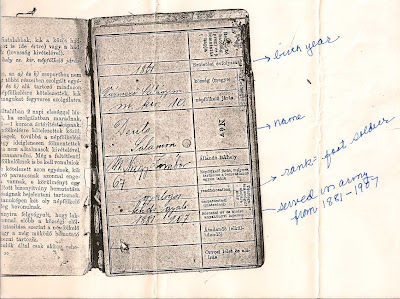
Here's an inside page with some translation notes. 1881-1907 is now given as his years of service. Some internet research indicates age 19 or 20 was a common age to enter the army. From 1881-1895 he must have been in training, in reserves, or some other non-active category. Similarly from 1904-1907.
At the top of the form, 'kozseg' means 'village'. Szilagy is a Hungarian county in Transylvania. I believe the town is Varmezo (or Buciumi, Romania)
 This page further clarifies his years of service. Signed on December 31, 1894, it seems to say he would be a Foot Soldier First Class until December 31, 1898, and Second Class until 1903. The information on the right hand side is repetitive from other pages.
There are still a lot of words untranslated, but I have been able to build upon the translation notes that had previously been made, and I have a better understanding of my great grandfather's military service.
He married my great grandmother in 1898 (according to an audiotape my grandfather made in the 1970s) and my grandfather also believed he had a prior wife, and children who remained in Hungary. My grandfather was born in 1907, but several older siblings were born during the period 1899-1903, so his service as a foot soldier included some family leave time, at least in the post-1898 period.
I wondered with the help of Google's Translator if I could verify the original translations, and perhaps learn a bit more about the documents. Computer translations are notorious for hacking up languages, but I figured it should get me at least close. And I was correct.
Here's the front and back of the booklet (click on any image to enlarge):

As you can see, none of it is translated - there's only the identification of the crest.
Google Translator had no idea what Nepfolkelesi meant. It told me that Nepfolkelesi igazolvanyi konyv means Nepfolkelesi paper card. So I knew it meant an identification card of some sort. I conducted a Google web search and there found someone with the exact document I had seeking a translation. It means 'popular uprising'. When I put those words into the translator, it returns the Hungarian words: Népszerű felkelés. So it appears that Nepfolkelesi is a 'portmanteau' - a blend of two or more words. The translation given on the website said "Popular Uprising identification card." which is what I figured. And we were off.
I recognized my great grandfather's name, Salamon Deuts. He went by both Salamon and Samuel, and the surname was originally Deuts. The following line says he was a foot soldier (gyalogos) in the 57th regiment.
The next line says "Year of Birth" - 1861. It would have been nice if any of the documents got more specific, but they don't. Still, it provides a good source for the year.
The table at the bottom was difficult to interpret because I think the individual who filled out the form filled it out incorrectly. The top rows should be his years as a recruit (hadkiegeszito). Instead, it was filled out as 1/1 (January 1) 1895. Starting in 1896 and ending (beszarolag) in 1903 he was in the service.
I'd love to know what all the calculations on the back of the booklet mean.

Here's an inside page with some translation notes. 1881-1907 is now given as his years of service. Some internet research indicates age 19 or 20 was a common age to enter the army. From 1881-1895 he must have been in training, in reserves, or some other non-active category. Similarly from 1904-1907.
At the top of the form, 'kozseg' means 'village'. Szilagy is a Hungarian county in Transylvania. I believe the town is Varmezo (or Buciumi, Romania)
 This page further clarifies his years of service. Signed on December 31, 1894, it seems to say he would be a Foot Soldier First Class until December 31, 1898, and Second Class until 1903. The information on the right hand side is repetitive from other pages.
There are still a lot of words untranslated, but I have been able to build upon the translation notes that had previously been made, and I have a better understanding of my great grandfather's military service.
He married my great grandmother in 1898 (according to an audiotape my grandfather made in the 1970s) and my grandfather also believed he had a prior wife, and children who remained in Hungary. My grandfather was born in 1907, but several older siblings were born during the period 1899-1903, so his service as a foot soldier included some family leave time, at least in the post-1898 period.
Thursday, February 5, 2009
Genealogy Can Save Your Life - 2009
I've blogged about this before, but I've decided to make an annual habit of it. It can't be repeated too often. Genealogy can save your life. It would have saved mine if I hadn't already known what I needed to know.
The American Cancer Society recommends the 'average' person to start getting checked for Colon cancer at age 50. However, for those with a history of the disease in the immediate family, they recommend to start the tests ten years prior to the earliest it has been diagnosed. My maternal grandmother died at age 51. So I was prepared to start getting tested at age 40. Then a close kin, slightly older, had their test, and polyps were discovered and removed. So last year, at age 39, I decided there wasn't any good reason to wait on ceremony, and my doctor agreed. I had my first colonoscopy, and 2 polyps were removed, one of which was pre-malignant. If I had waited until I was 50, there's a chance I wouldn't have made it. Since I knew to check early, the polyps were caught before they could become dangerous, and hopefully any future polyps will also be caught beforehand.
[Note: As I understand it, the causal connection between polyps and cancer actually isn't conclusive. Scientists haven't proven that pre-malignant polyps always become malignant, or that polyps always lead to cancer. Nor that everyone who gets cancer had pre-malignant polyps at one time that could have been detected. But they know enough to remove the polyps when they see them.]
Other diseases have genetic predispositions. So it is important to know the medical histories of your parents, grandparents, and where possible, your great grandparents. The primary method of doing this, for those who are deceased, is to find their death certificates. It is rare to find any prior to 1900, but for those who lived into the 20th century, especially those who lived past 1920, finding death certificates, while not always easy, isn't usually difficult - if you know when and where they died.
1) Local Courthouses
Most counties in America house archives of their Vital Records (birth, marriage, death.) A few have strict restrictions on who can request copies, limiting them to 'immediate family' which may not include grandchildren.
2) State Archives
State archives often have copies of the county records, with fewer restrictions on access.
3) Online Databases
Some counties and states have begun putting their records online. Ancestry, FamilySearch, and Footnote also have some databases available to search.
4) Funeral Homes
Funeral homes often retain their own copy of the death certificate, and their copy may differ slightly from that held by the County or State. It may contain details about where in a cemetery plot the individual was buried, or details about the funeral itself. If you don't know the funeral home, search in archives of local newspapers and try to find an obituary, as obituary notices often include this information. The funeral home copy may also be at times the only copy you have access to if the county and state are too restrictive.
Once you have found the death certificate, if you don't recognize instantly the words written under 'cause of death' conduct an internet search on them at Google or Yahoo. My family history made identifying "Carc. of Col." as "Carcinoma of Colon" fairly easy, though I suspect some might have stumbled over the abbreviation. Several ancestors were diagnosed with "Interstitial Nephritis." I'd never heard of this before, but it is a kidney ailment often caused by a reaction to pain medication. Unfortunately, the death certificates didn't indicate the cause of the original pain.
The American Cancer Society recommends the 'average' person to start getting checked for Colon cancer at age 50. However, for those with a history of the disease in the immediate family, they recommend to start the tests ten years prior to the earliest it has been diagnosed. My maternal grandmother died at age 51. So I was prepared to start getting tested at age 40. Then a close kin, slightly older, had their test, and polyps were discovered and removed. So last year, at age 39, I decided there wasn't any good reason to wait on ceremony, and my doctor agreed. I had my first colonoscopy, and 2 polyps were removed, one of which was pre-malignant. If I had waited until I was 50, there's a chance I wouldn't have made it. Since I knew to check early, the polyps were caught before they could become dangerous, and hopefully any future polyps will also be caught beforehand.
[Note: As I understand it, the causal connection between polyps and cancer actually isn't conclusive. Scientists haven't proven that pre-malignant polyps always become malignant, or that polyps always lead to cancer. Nor that everyone who gets cancer had pre-malignant polyps at one time that could have been detected. But they know enough to remove the polyps when they see them.]
Other diseases have genetic predispositions. So it is important to know the medical histories of your parents, grandparents, and where possible, your great grandparents. The primary method of doing this, for those who are deceased, is to find their death certificates. It is rare to find any prior to 1900, but for those who lived into the 20th century, especially those who lived past 1920, finding death certificates, while not always easy, isn't usually difficult - if you know when and where they died.
1) Local Courthouses
Most counties in America house archives of their Vital Records (birth, marriage, death.) A few have strict restrictions on who can request copies, limiting them to 'immediate family' which may not include grandchildren.
2) State Archives
State archives often have copies of the county records, with fewer restrictions on access.
3) Online Databases
Some counties and states have begun putting their records online. Ancestry, FamilySearch, and Footnote also have some databases available to search.
4) Funeral Homes
Funeral homes often retain their own copy of the death certificate, and their copy may differ slightly from that held by the County or State. It may contain details about where in a cemetery plot the individual was buried, or details about the funeral itself. If you don't know the funeral home, search in archives of local newspapers and try to find an obituary, as obituary notices often include this information. The funeral home copy may also be at times the only copy you have access to if the county and state are too restrictive.
Once you have found the death certificate, if you don't recognize instantly the words written under 'cause of death' conduct an internet search on them at Google or Yahoo. My family history made identifying "Carc. of Col." as "Carcinoma of Colon" fairly easy, though I suspect some might have stumbled over the abbreviation. Several ancestors were diagnosed with "Interstitial Nephritis." I'd never heard of this before, but it is a kidney ailment often caused by a reaction to pain medication. Unfortunately, the death certificates didn't indicate the cause of the original pain.
Sunday, February 1, 2009
Gamer's Guide to Genealogy
You may be familiar with just the traditional 6-sided die. And when someone says "dice" that is the image that comes to mind. However, those who play Role Playing Games (RPGs) such as Dungeons and Dragons are familiar with a number of other variations:

The common shorthand for each is dX where X is the number of sides, so the traditional 6-sided die becomes known as a d6.
It occurred to me that when I reach a point where I am not sure what to do next in my genealogy research, letting the dice decide might be appropriate, or at least fun. So I came up with a system using a d20, and two rolls. (A d6 doesn't have nearly enough choices.)
First Roll - Selecting an Individual
To come up with 20 options, I started with the 16 Great-Great Grandparents, numbers 16-31 ahnentafel. So if 1 through 16 are rolled I allow myself to choose the ancestor listed, collateral descendants, or one of their ancestors.
I've listed mine below, along with their Ahnentafel numbers (binary and decimal)
1 Samuel Newmark (10000 – 16)
2 Rose Cantkert Newmark (10001 – 17)
3 Moshe Leyb Cruvant (10010 – 18)
4 Minnie Mojsabovski Cruvant (10011 – 19)
5 Selig (Dudelsack) Feinstein (10100 – 20)
6 Annie Perlik Feinstein (10101 – 21)
7 Morris Blatt (10110 - 22)
8 Beila Wyman Blatt (10111 - 23)
9 Abraham Deutsch (11000 – 24)
10 Sarah Weiss Deutsch (11001 – 25)
11 Israel Lichtman (11010 – 26)
12 Betty Adler Lichtman (11011 – 27)
13 Samuel Van Every (11100 – 28)
14 Abigail Stuart Van Every (11101 - 29)
15 Ebenezer Denyer (11110 - 30)
16 Sarah Hartley Denyer (11111 – 31)
I rounded out the 20 with four remaining categories:
17 Paternal Grandparents
18 Maternal Grandparents
19 Parents
20 Myself
Roll 2: Action
(I came up with ten actions, so I repeated each one. But a d10 could be used. Or maybe you can come up with ten more.)
1. Google Search (google.com ; books.google.com; news.google.com; groups.google.com)
2. Subscriber Site Search (e.g. Ancestry, Footnote, GenealogyBank)
3. Search for online databases in related locales that are new, or you may have missed.
4. Check Source Citations (Verify all data on individual in your database has a cited source.)
5. Interview someone about the individual (or write down your own recollections)
6. Write to a cousin descended from the individual
7. Transcribe a letter/document from, to, or about individual
8. Research the time/place the individual lived.
9. Scan photos/documents related to individual
10. Blog about the individual
11. Google Search (google.com ; books.google.com; news.google.com; groups.google.com)
12. Subscriber Site Search (e.g. Ancestry, Footnote, GenealogyBank)
13. Search for online databases in related locales that are new, or you may have missed.
14. Check Source Citations (Verify all data on individual in your database has a cited source.)
15. Interview someone about the individual (or write down your own recollections)
16. Write to a cousin descended from the individual
17. Transcribe a letter/document from, to, or about individual
18. Research the time/place the individual lived.
19. Scan photos/documents related to individual
20. Blog about the individual
Naturally, if you roll a combination that results in an impossible task (e.g. You don't have any letters to transcribe relating to X) roll again.
If you don't know where the closest store is where you can find a set of dice, you can find them online. Gamer's dice are usually sold in sets of 7: a d4, d6, d8, 2 d10s, a d12 and a d20. (the 2 d10s are numbered 1-10 and 10-100). You may be able to find many uses for these die for things in your life you are willing to randomize a bit.
Example, with a d6:
1) Do laundry
2) Clean bathroom
3) Feed dog
4) Feed kids
5) Check Email
6) Hit the snooze bar
If you feel 20 choices isn't enough, they do sell d100s.

The common shorthand for each is dX where X is the number of sides, so the traditional 6-sided die becomes known as a d6.
It occurred to me that when I reach a point where I am not sure what to do next in my genealogy research, letting the dice decide might be appropriate, or at least fun. So I came up with a system using a d20, and two rolls. (A d6 doesn't have nearly enough choices.)
First Roll - Selecting an Individual
To come up with 20 options, I started with the 16 Great-Great Grandparents, numbers 16-31 ahnentafel. So if 1 through 16 are rolled I allow myself to choose the ancestor listed, collateral descendants, or one of their ancestors.
I've listed mine below, along with their Ahnentafel numbers (binary and decimal)
1 Samuel Newmark (10000 – 16)
2 Rose Cantkert Newmark (10001 – 17)
3 Moshe Leyb Cruvant (10010 – 18)
4 Minnie Mojsabovski Cruvant (10011 – 19)
5 Selig (Dudelsack) Feinstein (10100 – 20)
6 Annie Perlik Feinstein (10101 – 21)
7 Morris Blatt (10110 - 22)
8 Beila Wyman Blatt (10111 - 23)
9 Abraham Deutsch (11000 – 24)
10 Sarah Weiss Deutsch (11001 – 25)
11 Israel Lichtman (11010 – 26)
12 Betty Adler Lichtman (11011 – 27)
13 Samuel Van Every (11100 – 28)
14 Abigail Stuart Van Every (11101 - 29)
15 Ebenezer Denyer (11110 - 30)
16 Sarah Hartley Denyer (11111 – 31)
I rounded out the 20 with four remaining categories:
17 Paternal Grandparents
18 Maternal Grandparents
19 Parents
20 Myself
Roll 2: Action
(I came up with ten actions, so I repeated each one. But a d10 could be used. Or maybe you can come up with ten more.)
1. Google Search (google.com ; books.google.com; news.google.com; groups.google.com)
2. Subscriber Site Search (e.g. Ancestry, Footnote, GenealogyBank)
3. Search for online databases in related locales that are new, or you may have missed.
4. Check Source Citations (Verify all data on individual in your database has a cited source.)
5. Interview someone about the individual (or write down your own recollections)
6. Write to a cousin descended from the individual
7. Transcribe a letter/document from, to, or about individual
8. Research the time/place the individual lived.
9. Scan photos/documents related to individual
10. Blog about the individual
11. Google Search (google.com ; books.google.com; news.google.com; groups.google.com)
12. Subscriber Site Search (e.g. Ancestry, Footnote, GenealogyBank)
13. Search for online databases in related locales that are new, or you may have missed.
14. Check Source Citations (Verify all data on individual in your database has a cited source.)
15. Interview someone about the individual (or write down your own recollections)
16. Write to a cousin descended from the individual
17. Transcribe a letter/document from, to, or about individual
18. Research the time/place the individual lived.
19. Scan photos/documents related to individual
20. Blog about the individual
Naturally, if you roll a combination that results in an impossible task (e.g. You don't have any letters to transcribe relating to X) roll again.
If you don't know where the closest store is where you can find a set of dice, you can find them online. Gamer's dice are usually sold in sets of 7: a d4, d6, d8, 2 d10s, a d12 and a d20. (the 2 d10s are numbered 1-10 and 10-100). You may be able to find many uses for these die for things in your life you are willing to randomize a bit.
Example, with a d6:
1) Do laundry
2) Clean bathroom
3) Feed dog
4) Feed kids
5) Check Email
6) Hit the snooze bar
If you feel 20 choices isn't enough, they do sell d100s.
Saturday, January 31, 2009
The Happy Dance
One occasion I recall was when I received my maternal grandmother's "Official Personnel Folder" from the US Government. She had worked for the Post Office from 1921-1936. My maternal grandfather's OPF contained 50 pages of material from his career. My grandmother's 3. Her signed Oath of Office taken in 1921 was nice, but it's not my only copy of her signature. The document entitled "Report of Separation" didn't have a lot of useful information. It noted that her 'last date of pay' was Jan 21, 1937 - which was a fun coincidence since it was exactly 32 years before I was born.The theme for the 65th Carnival of Genealogy: "The Happy Dance. The Joy of Genealogy. Almost everyone has experienced it. Tell us about the first time, or the last time, or the best time. What event, what document, what special find has caused you to stand up and cheer, to go crazy with joy?

It was the third document that caused the Happy Dance
 A year by year accounting of her career, including her name changes in 1927 and 1929. At that point in my research, from letters she had saved from her father, I knew she had been planning to marry someone named Dale in 1927. I also knew from my mother that there had been one or two husbands prior to my grandfather. But we had no last name. After opening the package, I instantly called my mother to give her the information, which I then passed along to an aunt in an email.
Another happy dance occurred upon my discovery of testimony my maternal Hartley ancestors gave in front of the American Dawes Commission - backing up the family story that we have Choctaw ancestry.
On my paternal ancestry, I'd have to include my discovery that my second great grandfather Selig Feinstein had received a patent for improvements to a fire hydrant. At this point in my research this was confusing because I thought his career was limited to real estate and laundry. A week later I discovered he spent ten years as a shoer/blacksmith.
Sunday, January 25, 2009
Black Swan Fallacy
The Black Swan Fallacy is taught in college logic courses. "I've never seen a black swan," the logic goes, "so black swans don't exist."
The logic is obviously absurd. No one has the opportunity to personally examine the color of every swan on the planet. That doesn't stop us from accidentally falling into this logical trap. We may be very familiar with American swans, for example, and think our experience is sufficient. But black swans actually exist in Australia, if not elsewhere.
There are also people who are very adamant that no two snowflakes look alike, or that there's no such thing as an honest politician. Science tells us the truth about snowflakes. Though I fear the existence of an honest politician is an element of faith one must either have, or not have.
In genealogy we run across this fallacy when one assumes that their search for a particular document has been exhaustive, and thus, the document doesn't exist.
For example, you may find two marriage documents for the same individual, but be unable to find record of an intervening divorce. That doesn't necessarily mean the individual was a bigamist. Before the 20th century divorces were uncommon, and in some places illegal, but even in the 20th century, one doesn't have to file divorce papers in the same county/state where one was married.
Sometimes an ancestor's residence is fairly stationary, narrowing options. However, other ancestors were more mobile. Some might decide that verifying whether everything was legal isn't vital, and focus on other research.
The Genealogical Proof Standard includes a "reasonably exhaustive search." Though we must remember reasonably exhaustive will still miss records. And truly exhaustive is next to impossible. If my maternal grandmother, Myrtle Van Every, hadn't saved a copy of her divorce proceedings, I doubt I would ever have discovered where and when she had married her second husband, Dale Ridgely. They were married and divorced in San Francisco, CA over a period of five months in 1927. There wasn't a single St. Louis City Directory my grandmother missed from 1921-1929. At some point the California marriage records might get indexed on some online database, but I'd have had no reason to look.
The logic is obviously absurd. No one has the opportunity to personally examine the color of every swan on the planet. That doesn't stop us from accidentally falling into this logical trap. We may be very familiar with American swans, for example, and think our experience is sufficient. But black swans actually exist in Australia, if not elsewhere.
There are also people who are very adamant that no two snowflakes look alike, or that there's no such thing as an honest politician. Science tells us the truth about snowflakes. Though I fear the existence of an honest politician is an element of faith one must either have, or not have.
In genealogy we run across this fallacy when one assumes that their search for a particular document has been exhaustive, and thus, the document doesn't exist.
For example, you may find two marriage documents for the same individual, but be unable to find record of an intervening divorce. That doesn't necessarily mean the individual was a bigamist. Before the 20th century divorces were uncommon, and in some places illegal, but even in the 20th century, one doesn't have to file divorce papers in the same county/state where one was married.
Sometimes an ancestor's residence is fairly stationary, narrowing options. However, other ancestors were more mobile. Some might decide that verifying whether everything was legal isn't vital, and focus on other research.
The Genealogical Proof Standard includes a "reasonably exhaustive search." Though we must remember reasonably exhaustive will still miss records. And truly exhaustive is next to impossible. If my maternal grandmother, Myrtle Van Every, hadn't saved a copy of her divorce proceedings, I doubt I would ever have discovered where and when she had married her second husband, Dale Ridgely. They were married and divorced in San Francisco, CA over a period of five months in 1927. There wasn't a single St. Louis City Directory my grandmother missed from 1921-1929. At some point the California marriage records might get indexed on some online database, but I'd have had no reason to look.
Around the Genea-Web
This is by no means a complete list, but here are several blog articles I found poignant, entertaining, or informational in the past few weeks:
When You Assume at 24-7 Family History Circle.
Tri-Racial Isolate: A Hidden Ancestry at Desktop Genealogist Unplugged
Building for Others at Gtownma's Genealogy. (The poem included is The Bridge Builder by Will Allen Dromgoole
How Will the Economy Affect Genealogy at GeneaMusings
The Burrough Family:Poignant Story Told in Stone at Hill Country of Monroe County
And while not genealogically related, the writer and poet in me enjoyed
Literary Follies: Lipogrammatic Writing at Hill Country of Monroe County. For those seeking unusual writing restraints, I recommend the Table of Forms at Spineless Books.
When You Assume at 24-7 Family History Circle.
Tri-Racial Isolate: A Hidden Ancestry at Desktop Genealogist Unplugged
Building for Others at Gtownma's Genealogy. (The poem included is The Bridge Builder by Will Allen Dromgoole
How Will the Economy Affect Genealogy at GeneaMusings
The Burrough Family:Poignant Story Told in Stone at Hill Country of Monroe County
And while not genealogically related, the writer and poet in me enjoyed
Literary Follies: Lipogrammatic Writing at Hill Country of Monroe County. For those seeking unusual writing restraints, I recommend the Table of Forms at Spineless Books.
Saturday, January 17, 2009
64th Edition of Carnival of Genealogy
The 64th Edition of the Carnival of Genealogy has been Posted by CreativeGene with 31 submissions of Winter Photo Essays.
The topic for the next edition of the Carnival of Genealogy is: "The Happy Dance. The Joy of Genealogy. Almost everyone has experienced it. Tell us about the first time, or the last time, or the best time. What event, what document, what special find has caused you to stand up and cheer, to go crazy with joy? If you haven't ever done the Happy Dance, tell us what you think it would take for you to do so." The deadline for submissions is Feb. 1st. More information.Themes for the upcoming editions for most of 2009 have already been decided and can be seen in advance on the left sidebar of CreativeGene's blog. (Some editions are still open for volunteers to host.)
Smile for the Camera 9th Edition Posted
The 9th Edition of Smile for the Camera has been posted.
I count 47 bloggers who are seeking assistance in identifying individuals in photographs. And as usual, The footnoteMaven has done an amazing job introducing each one.
For February:
More Information
I count 47 bloggers who are seeking assistance in identifying individuals in photographs. And as usual, The footnoteMaven has done an amazing job introducing each one.
For February:
The word prompt for the 10th Edition of Smile For The Camera is Costume? No, not as in Halloween. Costume as in dress in general; especially the distinctive style of dress of a people, class, or period. Show us that picture that you found with your family collection or purchased that shows the costumes of the rich to the not so rich, from the civil war to the psychedelic sixties. I know you have them, so share. Admission is free with every photograph!Deadline for submission is February 10th at midnight PT
More Information
Wednesday, January 14, 2009
The St. Louis "Snow Event" of 1982
The topic for the 64th edition of the Carnival of Genealogy: A Winter Photo Essay. Show us those wintertime photo(s) of your ancestors or family members and tell us the story that goes along with them. Winter is here! Let's record it and celebrate it!
 Image Source: National Weather Service.
The word 'winter' and 'snow' quickly bring to my mind the year 1982.
On January 30th and 31st 1982, a 1-in-70 year snow event occurred from the eastern Ozarks to central Illinois with the heaviest axis of snow blanketing St. Louis, Missouri. The snow began during the evening of January 30th, a Saturday, and ended during the afternoon of Sunday, January 31st.
The National Weather Service explains, despite what St. Louisans almost universally call it, it wasn't technically a blizzard. But not calling it a blizzard is sort of like not calling Pluto a planet. If you look at the map above, the purple section in the middle is St. Louis, and the key shows that close to two feet of snow fell. I was 13, and remember the weekend well. According to the National Weather Service linked to above:
The storm was not well forecast by the National Weather Service, private meteorologists, local television and radio meteorologists, nor local university meteorologists. The consensus the night before the event was for light snow to occur with a few inches of accumulation.
As you can see, 'not well forecast' is an understatement. Local TV stations were still saying 'a few inches' when residents could look out their window and easily see those few inches had been long surpassed. I remember going outside Sunday morning with a yardstick.
As a 13 year old, I was overjoyed with two feet of snow. I'm sure my parents weren't. [They were also a little concerned about its timing, and this perhaps would have concerned me too, but they were smart enough not to let me know they were concerned.] My parents called around and actually found a restaurant (the Parkmoor) that managed to be open for breakfast on Sunday morning within walking distance, and the family made our way through the fallen snow. (I have no idea how they managed it. Maybe they had enough dedicated employees within walking distance.)
I know this carnival is supposed to be a Photo Essay, but I don't have any personal photographs of the snowstorm to share. However there are some good photographs at the National Weather Service link above.
What I do have is a photograph taken one week later, on February 6th, 1982. Still winter time by all definitions. The photo was taken inside, but it is due to this event that there is no way for me to forget when the snowstorm occurred. It's also what concerned my parents - whether or not the snow would be cleared in time for my Bar Mitzvah, so delivery trucks could make it into St. Louis - trucks carrying the food and table flowers for the event. Apparently, it was close, but the roads opened up by the latter half of the week.

(Me and four grandparents. My paternal grandparents Melvin and Sissie (Feinstein) Newmark on the left, and on the right my maternal grandfather, Martin Deutsch, and his second wife, Marjorie (Shelp Helmkampf) Deutsch.)
The photograph was taken at United Hebrew Congregation. The building was sold in the late 1980s to the Missouri Historical Society, and it now houses their research library which I visited last weekend.
A final religious note: The weekly Torah portion that would have been read the weekend of January 30, 1982, preceding the snowfall, was Exodus 10:1-13:16 which describes the twelve plagues. It's possible one or two people noted this irony at the time.
Monday, January 12, 2009
Private Browsing
The ACLU's blog had a recent post on How Private is Private Browsing. While not directly related to genealogy, those who use shared computers at libraries or genealogical societies may be interested. Or, of course, if you share a computer at home and want to hide your browsing activities from family.
[Note: The ACLU blog post links to the main sites for Microsoft IE and Mozilla Firefox. I have linked directly to the pages with the beta download, since the non-beta releases don't have private browsing yet.]
‘Tis the season for private browsing, or so it seems. Apple’s Safari Web browser led the pack in introducing a “private browsing mode” in 2005; in recent months, the other browsers on the market have finally followed suit, with Google’s recently-released Chrome and beta versions of Mozilla Firefox and Microsoft Internet Explorer adding similar features.The article has a detailed answer to that question, and shows where the functionality of the browsers differ, helping you to choose which one offers the better private browsing for your needs. Of course, you may be limited to the options on the shared computer, but often libraries will have multiple browsers installed, so you will have a choice.
What does “private browsing” mean, however? For the most part, these “private” modes are designed to protect your privacy only vis-a-vis other users of the same computer, whether you’re at an Internet cafe or just trying to avoid letting your partner know what you’re doing with their laptop (which earned these features the moniker “Porn Mode”). But do these “private” modes prevent Web sites from identifying you and tracking your actions? If so, how, and how effectively?
[Note: The ACLU blog post links to the main sites for Microsoft IE and Mozilla Firefox. I have linked directly to the pages with the beta download, since the non-beta releases don't have private browsing yet.]
Sunday, January 11, 2009
Missouri History Museum Research Library
Back on Wednesday, I mentioned that I was going to visit the Missouri History Museum on Saturday.
It was a fun experience. First time visitors are asked to read a list of procedures, which are all basic stuff. Treat the documents with care. No pens are allowed - pencils only.
Somewhat frustrating is their insistence that staff do the photocopying. I understand it. They have some fragile books, and staff are trained on how to make photocopies while doing the least damage to the books. But there were a couple photocopies made yesterday for me that weren't as good as the others, and I don't know if it was due to the condition of the book, or whether a better job could have been done. All the photocopies were of high school yearbook photos spanning the years 1917-1933 for some collateral kin. The photocopies only cost 25 cents apiece, which easily justifies the trip if you live in the vicinity.
I had also found in my search of their index a scrapbook, "St. Louis in World War II" which contains several volumes of newspaper clippings. My grandfather appeared in one article, but it was a listing of several dozen St. Louisans headed off to Red Cross training, and didn't provide any information I didn't already have. There was a similar article that mentioned a cousin of his headed for naval training.
They have several card catalogs that aren't yet in the online index. A brief search through them revealed they have a collection of obituaries, though it is a relatively recent one, as I saw no relatives who passed prior to 1980 in the catalog.
I will probably have to go back for a more in-depth search of their holdings at some point.
It was a fun experience. First time visitors are asked to read a list of procedures, which are all basic stuff. Treat the documents with care. No pens are allowed - pencils only.
Somewhat frustrating is their insistence that staff do the photocopying. I understand it. They have some fragile books, and staff are trained on how to make photocopies while doing the least damage to the books. But there were a couple photocopies made yesterday for me that weren't as good as the others, and I don't know if it was due to the condition of the book, or whether a better job could have been done. All the photocopies were of high school yearbook photos spanning the years 1917-1933 for some collateral kin. The photocopies only cost 25 cents apiece, which easily justifies the trip if you live in the vicinity.
I had also found in my search of their index a scrapbook, "St. Louis in World War II" which contains several volumes of newspaper clippings. My grandfather appeared in one article, but it was a listing of several dozen St. Louisans headed off to Red Cross training, and didn't provide any information I didn't already have. There was a similar article that mentioned a cousin of his headed for naval training.
They have several card catalogs that aren't yet in the online index. A brief search through them revealed they have a collection of obituaries, though it is a relatively recent one, as I saw no relatives who passed prior to 1980 in the catalog.
I will probably have to go back for a more in-depth search of their holdings at some point.
Friday, January 9, 2009
How Genealogy Can Determine Your Age - 2009
Back in May I showed you how Genealogy Can Determine Your Age. I indicated that the procedure would have to be altered slightly each year. So, I have done so:
***
This takes less than a minute. Work this out as you read.
Be sure you don't read the bottom until you've worked it out!
1. How many Great-Grandparents do you have full name, date of birth, and date of death for?
Secondary spouses don't count. Only (pardon the redundancy) direct ancestors count.
2. Multiply by the number of biological parents you have, regardless of whether or not you have any information on them. (Everyone should have the same answer here. 2.)
3. Add the decimal number next to your paternal grandmother on your ahnentafel chart. (Once again, everyone should have the same number. 5.)
4. To honor the year the Roman Emperor, Claudius, adopted Nero -- Multiply it by 50
5. To honor the marriage of George Washington and Martha Dandridge Custis, add 1759. [Genealogical note: George Washington may be considered by many Americans as "Father" of the nation, but he had no children, so he has no biological descendants.]
6. If you haven't had your birthday yet this year, subtract 1.
7. Now subtract the four digit year that you were born.
You should have a three digit number
The first digit of this is the number of great grandparents you have all that information on!
The next two numbers are:
YOUR AGE
Don't deny it!
Note: This will not work if you are at least 100 years old. (But, congratulations!) This will also have to be tweaked, just a little, in future years. Only one step will have to be changed, though. I'll leave it up to you to figure out which one.
***
This takes less than a minute. Work this out as you read.
Be sure you don't read the bottom until you've worked it out!
1. How many Great-Grandparents do you have full name, date of birth, and date of death for?
Secondary spouses don't count. Only (pardon the redundancy) direct ancestors count.
2. Multiply by the number of biological parents you have, regardless of whether or not you have any information on them. (Everyone should have the same answer here. 2.)
3. Add the decimal number next to your paternal grandmother on your ahnentafel chart. (Once again, everyone should have the same number. 5.)
4. To honor the year the Roman Emperor, Claudius, adopted Nero -- Multiply it by 50
5. To honor the marriage of George Washington and Martha Dandridge Custis, add 1759. [Genealogical note: George Washington may be considered by many Americans as "Father" of the nation, but he had no children, so he has no biological descendants.]
6. If you haven't had your birthday yet this year, subtract 1.
7. Now subtract the four digit year that you were born.
You should have a three digit number
The first digit of this is the number of great grandparents you have all that information on!
The next two numbers are:
YOUR AGE
Don't deny it!
Note: This will not work if you are at least 100 years old. (But, congratulations!) This will also have to be tweaked, just a little, in future years. Only one step will have to be changed, though. I'll leave it up to you to figure out which one.
Thursday, January 8, 2009
Do you know Jack?
The word prompt for the 9th Edition of Smile For The Camera is Who Are You - I Really Want To Know? Show us that picture that you found with your family collection or purchased, but have no idea who they might be.
I have an idea who the man below is, but if I am correct, I only know his first name, which isn't much, and I'd like to know more.


(click to enlarge)
My maternal grandmother, Myrtle Van Every (1900-1951), received letters from both of her parents circa 1919-1920 consoling her on a divorce from a guy named Jack. This would have likely been her first of three marriages. I know she was married again in 1927 for about 2 months. She married my grandfather in 1936, and the third time was the charm. She was 38 years old when her first child was born.
Unfortunately, her parents didn't include Jack's surname in the consolation letters. The photographs above come from my grandmother's photo album, and while it's definitely not certain, I feel there is a strong possibility the man in the photographs is Jack. It's clear he is a 'beau' from the picture on the left, and a few others. And the date is right.
In 1919 the Van Every family lived in El Paso, TX, which borders both New and Old Mexico. They had a farm in Fort Hancock, TX. My grandmother's oldest sister, Minnie, had a farm in Old Mexico. So there are a variety of places my grandmother and Jack could easily have gotten married/divorced making the search for those records more complicated.
Wednesday, January 7, 2009
Missouri History Museum Research Library
I made a decision that I was going to visit the Missouri History Museum's Research Library this Saturday, so I visited their website to see what I could learn of their holdings before my trip.
[Note: This 'trip' will be a 10 minute drive for me, and the only reason I can come up with for postponing it until now is an emotional one. In the 1980s the congregation my family attended built a new synagogue and sold the one I grew up with to the Missouri History Museum, which converted it into their research library. The building could have been torn down, so I should be happy it was preserved, but I definitely have an emotional attachment to it.]
The Missouri History Museum website has a Genealogy and Local History Index, which I am certain wasn't there the last time I visited their website. The database is flexible and allows you to search by personal name, business name, street address, or by source (currently 'over 125 distinct sources' are indexed).
Images aren't provided, but you are able to request a photocopy of the indexed page - $4 if you are a member of the history museum, $5 if you are a resident of St. Louis City or County, or $7 for anyone else.
I found several items I am going to look up on Saturday. In particular, I am going to head straight for their section with high school yearbooks, as I found several hits from the 1920s and 30s in them. None direct ancestors, but several cousins.
The website also has a growing digital archive. For example, here's a 1910 prediction of 2010 downtown St. Louis (pdf).
[Note: This 'trip' will be a 10 minute drive for me, and the only reason I can come up with for postponing it until now is an emotional one. In the 1980s the congregation my family attended built a new synagogue and sold the one I grew up with to the Missouri History Museum, which converted it into their research library. The building could have been torn down, so I should be happy it was preserved, but I definitely have an emotional attachment to it.]
The Missouri History Museum website has a Genealogy and Local History Index, which I am certain wasn't there the last time I visited their website. The database is flexible and allows you to search by personal name, business name, street address, or by source (currently 'over 125 distinct sources' are indexed).
Images aren't provided, but you are able to request a photocopy of the indexed page - $4 if you are a member of the history museum, $5 if you are a resident of St. Louis City or County, or $7 for anyone else.
I found several items I am going to look up on Saturday. In particular, I am going to head straight for their section with high school yearbooks, as I found several hits from the 1920s and 30s in them. None direct ancestors, but several cousins.
The website also has a growing digital archive. For example, here's a 1910 prediction of 2010 downtown St. Louis (pdf).
Monday, January 5, 2009
99+ Genealogy Things Meme
The latest meme to hit the genea-blogosphere, created by the combined effort of the bloggers behind Kinexxions, Destination: Austin Family, Past Prologue, Looking4Ancestors, Geniaus, and California Genealogical Society
The list should be annotated in the following manner:
Things you have already done or found: bold face type
Things you would like to do or find: italicize (color optional)
Things you haven’t done or found and don’t care to: plain type
The list should be annotated in the following manner:
Things you have already done or found: bold face type
Things you would like to do or find: italicize (color optional)
Things you haven’t done or found and don’t care to: plain type
- Belong to a genealogical society.
- Researched records onsite at a court house.
- Transcribed records.
- Uploaded tombstone pictures to Find-A-Grave.
- Documented ancestors for four generations (self, parents, grandparents,
great-grandparents). - Joined Facebook.
- Helped to clean up a run-down cemetery.
- Joined the Genea-Bloggers Group on Facebook.
- Attended a genealogy conference.
- Lectured at a genealogy conference.
- Spoke on a genealogy topic at a local genealogy society.
- Been the editor of a genealogy society newsletter.
- Contributed to a genealogy society publication.
- Served on the board or as an officer of a genealogy society.
- Got lost on the way to a cemetery. (but did get lost in a cemetery)
- Talked to dead ancestors.
- Researched outside the state in which I live.
- Knocked on the door of an ancestral home and visited with the current occupants.
- Cold called a distant relative.
- Posted messages on a surname message board.
- Uploaded a gedcom file to the internet.
- Googled my name.
- Performed a random act of genealogical kindness.
- Researched a non-related family, just for the fun of it.
- Have been paid to do genealogical research.
- Earn a living (majority of income) from genealogical research.
- Wrote a letter (or email) to a previously unknown relative.
- Contributed to one of the genealogy carnivals.
- Responded to messages on a message board or forum.
- Was injured while on a genealogy excursion.
- Participated in a genealogy meme.
- Created family history gift items (calendars, cookbooks, etc.).
- Performed a record lookup for someone else.
- Went on a genealogy seminar cruise.
- Am convinced that a relative must have arrived here from outer space.
- Found a disturbing family secret.
- Told others about a disturbing family secret.
- Combined genealogy with crafts (family picture quilt, scrapbooking).
- Think genealogy is a passion not a hobby.
- Assisted finding next of kin for a deceased person (Unclaimed Persons).
- Taught someone else how to find their roots.
- Lost valuable genealogy data due to a computer crash or hard drive failure.
- Been overwhelmed by available genealogy technology.
- Know a cousin of the 4th degree or higher.
- Disproved a family myth through research.
- Got a family member to let you copy photos.
- Used a digital camera to “copy” photos or records.
- Translated a record from a foreign language.
- Found an immigrant ancestor’s passenger arrival record.
- Looked at census records on microfilm, not on the computer.
- Used microfiche.
- Visited the Family History Library in Salt Lake City.
- Visited more than one LDS Family History Center.
- Visited a church or place of worship of one of your ancestors.
- Taught a class in genealogy.
- Traced ancestors back to the 18th Century.
- Traced ancestors back to the 17th Century.
- Traced ancestors back to the 16th Century.
- Can name all of your great-great-grandparents. (I have 16 names...but they aren't all verified)
- Found an ancestor’s Social Security application.
- Know how to determine a soundex code without the help of a computer.
- Used Steve Morse’s One-Step searches.
- Own a copy of Evidence Explained by Elizabeth Shown Mills.
- Helped someone find an ancestor using records you had never used for your own research.
- Visited the main National Archives building in Washington, DC.
- Visited the Library of Congress.
- Have an ancestor who came over on the Mayflower.
- Have an ancestor who fought in the Civil War.
- Taken a photograph of an ancestor’s tombstone.
- Became a member of the Association of Graveyard Rabbits.
- Can read a church record in Latin.
- Have an ancestor who changed their name.
- Joined a Rootsweb mailing list.
- Created a family website.
- Have more than one "genealogy" blog.
- Was overwhelmed by the amount of family information received from someone.
- Have broken through at least one brick wall.
- Visited the DAR Library in Washington D.C.
- Borrowed a microfilm from the Family History Library through a local Family History Center.
- Have done indexing for Family Search Indexing or another genealogy project.
- Visited the Allen County Public Library Genealogy Center in Fort Wayne, Indiana.
- Had an amazing serendipitous find of the "Psychic Roots" variety.
- Have an ancestor who was a Patriot in the American Revolutionary War. (collateral but not direct)
- Have an ancestor who was a Loyalist in the American Revolutionary War.
- Have both Patriot & Loyalist ancestors.
- Have used Border Crossing records to locate an ancestor.
- Use maps in my genealogy research.
- Have a convict ancestor who was transported from the UK.
- Found a bigamist amongst the ancestors.
(bigamy not definitively proved, as divorce from first wife may have occurred. Not having found documentation doesn’t equal non-existent.) - Visited the National Archives in Kew.
- Visited St. Catherine's House in London to find family records.
- Found a cousin in Australia (or other foreign country).
- Consistently cite my sources.
- Visited a foreign country (i.e. one I don't live in) in search of ancestors.
- Can locate any document in my research files within a few minutes.
- Have an ancestor who was married four times (or more). [3 times is maximum confirmed.]
- Made a rubbing of an ancestor’s gravestone.
- Organized a family reunion. (in process of organizing one.)
- Published a family history book (on one of my families).
- Learned of the death of a fairly close relative through research.
- Have done the genealogy happy dance.
- Sustained an injury doing the genealogy happy dance.
- Offended a family member with my research.
- Reunited someone with precious family photos or artifacts.
A few I will add:
- Have an ancestor who served in a nation's military other than your own.
- Transcribed letters, journal, or other writings of ancestors.
- Written poetry about your ancestors (if considered separate from #38)
Sunday, January 4, 2009
Weekly Picks
Weekly Picks for December 27 - January 3
Lee Drew at FamHist in Full Circle or Infinite Loop writes about discovering his old data online, with the errors he had since corrected, and considers whether the internet will preserve and spread our mistakes, as well as discusses the problems of copying/stealing the work of others without verifying the information.
Baroque in Hackney has a detailed post on a descent from the poet John Milton, and if you aren't aware of what famous American personage is descended from the poet, you are likely to be surprised.
Old Picture of the Day has a photograph of some Titanic survivors on the Carpathia.
The Daily History Dose is a new blog sharing stories of a few events daily that happened on that day of the year.
Randy Seaver at Geneamusings reminds us that the World War II collection at Footnote is still available for free for a limited time.
Finally, Randy also discovered The Mom Song on YouTube, and it is awesome in its accuracy.
Lee Drew at FamHist in Full Circle or Infinite Loop writes about discovering his old data online, with the errors he had since corrected, and considers whether the internet will preserve and spread our mistakes, as well as discusses the problems of copying/stealing the work of others without verifying the information.
Baroque in Hackney has a detailed post on a descent from the poet John Milton, and if you aren't aware of what famous American personage is descended from the poet, you are likely to be surprised.
Old Picture of the Day has a photograph of some Titanic survivors on the Carpathia.
The Daily History Dose is a new blog sharing stories of a few events daily that happened on that day of the year.
Randy Seaver at Geneamusings reminds us that the World War II collection at Footnote is still available for free for a limited time.
Finally, Randy also discovered The Mom Song on YouTube, and it is awesome in its accuracy.
Saturday, January 3, 2009
All-a-Twitter
Randy at Geneamusings asks are any other Genea-bloggers Twittering?, and receives a yes from several, including myself.
Twitter is a social networking application which asks the user "What Are You Doing?" and provides 140 characters to continually update your response. You can follow other people, and they can follow you. You can reply to other's "twitters" or "tweets" (There hasn't been universal agreement yet on which term is best) Replies can be seen by everyone, but you can also send "Direct Messages" that only the recipient can view. (Direct Messages can only be sent to people who are following your tweets.)
My first tweet was on July 27, 2007: I'm waiting for an SS-5 of an ancestor. I've been waiting for about a month, but they cashed my check a week ago. 5:03 PM Jul 27th, 2007
Other early tweets included:
Decompressing from 4 days of nonstop fun at NASFiC. Rcvd ancestor's SS-5 finally from SSA over the weekend. 9:07 PM Aug 5th, 2007
Saw Les Miserables at The MUNY tonight. Well performed all around. Several scenes were cut a bit, but it still flowed nicely. 12:33 AM Aug 16th, 2007
The problem I had with my early usage is that none of my friends were using it to my knowledge, so I was just speaking to the ether. In early January 2008 I grew tired of this and wrote: Either: 1) sleeping 2) eating 3) drinking 4) working 5) reading 6) writing 7) interacting 8) necessary bodily functions. 5:37 PM Jan 9th, 2008 [I was pretty sure that covered all the bases.]
and stopped using Twitter for several months.
Then sometime in spring of 2008 some friends started joining, and conversations started happening. Twitter asks you "What Are You Doing?" but not everyone takes that literally. Twitter has been referred to as "Microblogging" since tweets are similar to blog posts except limited to 140 characters. Twitter lends itself very well to tweets such as "I'm headed to the corner bar, see ya there!" as well as "Have you heard the one about the bishop, the priest, and the rabbit?"
Those familiar with Instant Messenger (IM), Internet Relay Chat (IRC), or the old-timers familiar with Bitnet Relay (Relay) are familiar with the conversations that take place with these applications.
Due partially to President-Elect Obama's campaign's usage of Twitter, the usage of this social networking tool has grown more quickly than some others. Non-bloggers are discovering it is much easier to come up with 140 characters. And since tweets can be sent and recieved through cell phone text messaging, it has become one way for the youth who are attached to their cell phones to communicate with their parents who are attached to their computers. (Don't ask me how to hook up Twitter to your cell phone - I don't know how.)
While several of my early tweets were related to my genealogy research, when my friends joined in I knew they were less interested about that, so I migrated towards our shared interests. Now that several genea-bloggers are creating accounts, I suspect I will start tweeting genealogy again.
Dean at Genlighten has an idea on how Twitter could be used productively by the Genealogy community.
Users should be aware that a complete history of your tweets can, by default, be read by anyone. Not just those who are in your "Followers List". By default, twitter feeds can also be read through Really Simple Syndication (RSS) on any newsreader.
Here's a link to my Twitter page; I use the pseudonym Gavroche. (The name of the mischievous gamin from the book/musical Les Miserables.) If you scroll down the page you will see an RSS link. Here's my twitter RSS feed for anyone who has a 'Newsreader' such as Bloglines or Google Reader and wishes to follow me without joining Twitter.
[I have added a 'TwitterRoll' to the sidebar on the right using the RSS feeds.]
Some may have noticed that above I use the phrase "by default." If you want only those who you approve to be able to read your twitter feed, you can click on "settings" at the top of your page, and on the bottom of the initial tab "Account" there is the option "Protect my Updates." Put a tick in the box next to that, and only those you approve will be able to read your updates, and it won't be available through RSS.
Twitter Feeds of a handful of Notable People
WilW [Wil Wheaton, former child-actor (Stand by Me, Star Trek:TNG) current author.]
levarburton [Levar Burton, actor (Roots, Reading Rainbow, Star Trek:TNG)]
WarrenEllis [Warren Ellis, author of comics and novels]
AlGore [Former Vice President. It could be him, or someone from his official website algore.com]
Scalzi [John Scalzi, author]
CraigNewmark [Craig Newmark, founder of Craigslist - and not related to my knowledge.]
DaveJMatthews [Dave Matthews, Musician]
MCHammer [MC Hammer, Musician]
cst_roeper [Richard Roeper, columnist for the Chicago Sun Times]
Twitter is a social networking application which asks the user "What Are You Doing?" and provides 140 characters to continually update your response. You can follow other people, and they can follow you. You can reply to other's "twitters" or "tweets" (There hasn't been universal agreement yet on which term is best) Replies can be seen by everyone, but you can also send "Direct Messages" that only the recipient can view. (Direct Messages can only be sent to people who are following your tweets.)
My first tweet was on July 27, 2007: I'm waiting for an SS-5 of an ancestor. I've been waiting for about a month, but they cashed my check a week ago. 5:03 PM Jul 27th, 2007
Other early tweets included:
Decompressing from 4 days of nonstop fun at NASFiC. Rcvd ancestor's SS-5 finally from SSA over the weekend. 9:07 PM Aug 5th, 2007
Saw Les Miserables at The MUNY tonight. Well performed all around. Several scenes were cut a bit, but it still flowed nicely. 12:33 AM Aug 16th, 2007
The problem I had with my early usage is that none of my friends were using it to my knowledge, so I was just speaking to the ether. In early January 2008 I grew tired of this and wrote: Either: 1) sleeping 2) eating 3) drinking 4) working 5) reading 6) writing 7) interacting 8) necessary bodily functions. 5:37 PM Jan 9th, 2008 [I was pretty sure that covered all the bases.]
and stopped using Twitter for several months.
Then sometime in spring of 2008 some friends started joining, and conversations started happening. Twitter asks you "What Are You Doing?" but not everyone takes that literally. Twitter has been referred to as "Microblogging" since tweets are similar to blog posts except limited to 140 characters. Twitter lends itself very well to tweets such as "I'm headed to the corner bar, see ya there!" as well as "Have you heard the one about the bishop, the priest, and the rabbit?"
Those familiar with Instant Messenger (IM), Internet Relay Chat (IRC), or the old-timers familiar with Bitnet Relay (Relay) are familiar with the conversations that take place with these applications.
Due partially to President-Elect Obama's campaign's usage of Twitter, the usage of this social networking tool has grown more quickly than some others. Non-bloggers are discovering it is much easier to come up with 140 characters. And since tweets can be sent and recieved through cell phone text messaging, it has become one way for the youth who are attached to their cell phones to communicate with their parents who are attached to their computers. (Don't ask me how to hook up Twitter to your cell phone - I don't know how.)
While several of my early tweets were related to my genealogy research, when my friends joined in I knew they were less interested about that, so I migrated towards our shared interests. Now that several genea-bloggers are creating accounts, I suspect I will start tweeting genealogy again.
Dean at Genlighten has an idea on how Twitter could be used productively by the Genealogy community.
Users should be aware that a complete history of your tweets can, by default, be read by anyone. Not just those who are in your "Followers List". By default, twitter feeds can also be read through Really Simple Syndication (RSS) on any newsreader.
Here's a link to my Twitter page; I use the pseudonym Gavroche. (The name of the mischievous gamin from the book/musical Les Miserables.) If you scroll down the page you will see an RSS link. Here's my twitter RSS feed for anyone who has a 'Newsreader' such as Bloglines or Google Reader and wishes to follow me without joining Twitter.
[I have added a 'TwitterRoll' to the sidebar on the right using the RSS feeds.]
Some may have noticed that above I use the phrase "by default." If you want only those who you approve to be able to read your twitter feed, you can click on "settings" at the top of your page, and on the bottom of the initial tab "Account" there is the option "Protect my Updates." Put a tick in the box next to that, and only those you approve will be able to read your updates, and it won't be available through RSS.
Twitter Feeds of a handful of Notable People
WilW [Wil Wheaton, former child-actor (Stand by Me, Star Trek:TNG) current author.]
levarburton [Levar Burton, actor (Roots, Reading Rainbow, Star Trek:TNG)]
WarrenEllis [Warren Ellis, author of comics and novels]
AlGore [Former Vice President. It could be him, or someone from his official website algore.com]
Scalzi [John Scalzi, author]
CraigNewmark [Craig Newmark, founder of Craigslist - and not related to my knowledge.]
DaveJMatthews [Dave Matthews, Musician]
MCHammer [MC Hammer, Musician]
cst_roeper [Richard Roeper, columnist for the Chicago Sun Times]
Thursday, January 1, 2009
Year in Review in Twelve Sentences
For those who like memes, here's a fun one to consider. Now is a time for looking back on the past year. Here's a way to quickly create a brief summary of the past year on your blog. Take the first sentence from the first post of each month. You will end up with only twelve sentences. Post those twelve sentences.
I didn't have twelve months last year to do this here, but I did on my non-genealogy blog in both 2007 and 2006.
TransylvanianDutch - A Year in Review -2008
TransylvanianDutch is going to take a break from our usual focii to present you a Tabloid News Exclusive!
Names on a theme from various databases at Ancestry.com
Can anybody read the occupation on the left?
Janice, at CowHampshire, has challenged other GeneaBloggers to post Lolcats.
This takes less than a minute.
The Carnival of Genealogy is upon us, and this is apparently "The Swimsuit Issue"
This is the third in a series of “Brick Wall” posts.
Here's a poem I discovered in a box of my maternal grandmother's.
I thought I could focus my attentions elsewhere, and then Tom Kemp on his GenealogyBank blog says he's a cousin to Alaska Governor, Sarah Palin, and that she is descended from a Rev John Lathrop.
Using mitochondrial DNA, researchers are able to prove that Vikings conquered much of the British Isles.
The word prompt for the 7th Edition of Smile For The Camera is Oh, Baby
Received an email with lots of pictures of dogs with funny captions.
I didn't have twelve months last year to do this here, but I did on my non-genealogy blog in both 2007 and 2006.
TransylvanianDutch - A Year in Review -2008
Monday, December 29, 2008
Symphonic Studies
Currently I am over 2000 miles from St. Louis, however, I found a poem by Emma Lazarus I thought would be appropriate to share here.
Lazarus is best known for her sonnet, The New Colossus, the final lines of which are engraved on the pedestal of the Statue of Liberty:
..,"Give me your tired, your poor,
Your huddled masses yearning to breathe free,
The wretched refuse of your teeming shore.
Send these, the homeless, tempest-tost to me,
I life my lamp beside the golden door!"
Below, however, is part of a series of sonnets she wrote, entitled: Symphonic Studies.
Symphonic Studies: IV
Emma Lazarus
Hark! from unfathomable deeps a dirge
Swells sobbing through the melancholy air:
Where love has entered, Death is also there.
The wail outrings the chafed, tumultuous surge;
Ocean and earth, the illimitable skies,
Prolong one note, a mourning for the dead,
The cry of souls not to be comforted.
What piercing music! Funeral visions rise,
And send the hot tears raining down our cheek.
We see the silent grave upon the hill
With its lone lilac-bush. O heart, be still!
She will not rise, she will not stir nor speak.
Surely, the unreturning dead are blest.
Ring on, sweet dirge, and knell us to our rest!
Lazarus is best known for her sonnet, The New Colossus, the final lines of which are engraved on the pedestal of the Statue of Liberty:
..,"Give me your tired, your poor,
Your huddled masses yearning to breathe free,
The wretched refuse of your teeming shore.
Send these, the homeless, tempest-tost to me,
I life my lamp beside the golden door!"
Below, however, is part of a series of sonnets she wrote, entitled: Symphonic Studies.
Symphonic Studies: IV
Emma Lazarus
Hark! from unfathomable deeps a dirge
Swells sobbing through the melancholy air:
Where love has entered, Death is also there.
The wail outrings the chafed, tumultuous surge;
Ocean and earth, the illimitable skies,
Prolong one note, a mourning for the dead,
The cry of souls not to be comforted.
What piercing music! Funeral visions rise,
And send the hot tears raining down our cheek.
We see the silent grave upon the hill
With its lone lilac-bush. O heart, be still!
She will not rise, she will not stir nor speak.
Surely, the unreturning dead are blest.
Ring on, sweet dirge, and knell us to our rest!
Saturday, December 27, 2008
Weekly Picks
I've been inspired by others who do this to put together a weekly list of blog posts that I have found notable, and related to genealogy, in some fashion.
Weekly Picks for December 20-26
Internet / Technology
Thomas MacEntee at Destination: Austin Family describes How to Make Your Blog Available to Amazon Kindle Users. Not only are Amazon Kindles for reading e-books, users can subscribe to blogs through them. And owners of blogs can make money from those subscriptions.
Arlene Eakle heard Paul Nauta, Public Affairs Director for the Family History Library, give a speech on the past, present and future of the Family History Library, and she provides a summary.
GoogleBlog announces the ability to Search Google Images by Style. Results for image searches can be restricted just to photographs, line art, clip art, or just images that contain faces. All the options are selectable through Advanced Image Search.
Genealogy/Family History Tips
The Missouri State Genealogical Association Messenger links to some tips on writing your life story.
History
Lee Drew at FamHist describes how wearing Scottish tartans was banned in the 18th century.
Photography
Two cool Christmas Eve photographs were posted. One from 1968, taken by Apollo 8 astronauts, was posted by Craig Manson at GeneaBlogie. Another from 1898 appeared at Old Picture of the Day.
Weekly Picks for December 20-26
Internet / Technology
Genealogy/Family History Tips
History
Photography
Wednesday, December 24, 2008
Divergent Yet Intersecting
Both ReadWritePoem and Totally Optional Prompts have weekly writing prompts - both with a deadline of Thursday. The creative juices still have a tendency to flow even while on vacation.
This week's prompt at ReadWritePoem was Go Ancestral, which wasn't specific enough for me, since I think and write about my ancestry often. I needed a secondary prompt, which Totally Optional Prompts provided: Opposites.
Divergent Yet Intersecting
Transylvania, Holland, Alsace, Poland,
England, Germany, Lithuania and Texas
all contain soil upon which ancestors dwelt;
Farmers, beekeepers, shepherds,
tailors, blacksmiths, salesmen,
clergy, judges, and doctors.
As I research ancestral lines I discover
some ancestors celebrated Hanuka,
others Christmas, and still others
the Green Corn Ceremony;
Jewish, Methodist Episcopalian,
Puritan, Christian Scientist, Mennonite,
Choctaw, and Cherokee.
I shall never find the records
for my distant ancestors
who either came to this continent
by crossing the Land Bridge,
or originally emerged
from the Nanih Waiya in Mississippi.
I delve through obituaries,
microfilm depositories,
internet databases;
I interview relatives,
and rummage through attics.
What I find doesn't alter who I am;
It illuminates the divergent,
yet still intersecting
paths of my ancestors.
This week's prompt at ReadWritePoem was Go Ancestral, which wasn't specific enough for me, since I think and write about my ancestry often. I needed a secondary prompt, which Totally Optional Prompts provided: Opposites.
Divergent Yet Intersecting
Transylvania, Holland, Alsace, Poland,
England, Germany, Lithuania and Texas
all contain soil upon which ancestors dwelt;
Farmers, beekeepers, shepherds,
tailors, blacksmiths, salesmen,
clergy, judges, and doctors.
As I research ancestral lines I discover
some ancestors celebrated Hanuka,
others Christmas, and still others
the Green Corn Ceremony;
Jewish, Methodist Episcopalian,
Puritan, Christian Scientist, Mennonite,
Choctaw, and Cherokee.
I shall never find the records
for my distant ancestors
who either came to this continent
by crossing the Land Bridge,
or originally emerged
from the Nanih Waiya in Mississippi.
I delve through obituaries,
microfilm depositories,
internet databases;
I interview relatives,
and rummage through attics.
What I find doesn't alter who I am;
It illuminates the divergent,
yet still intersecting
paths of my ancestors.
Monday, December 22, 2008
Happy Hanuka
Happy Hanuka to all who celebrate.
Last night was the first night of the holiday, and my family (parents, siblings, nephews, niece) celebrated in the Caribbean.
It is now 1:45 in the afternoon - but still the first day of Hanuka - as like all Jewish holidays, it runs from sunset to sunset. I spent a couple hours at a beach - it's a nice way to celebrate.
I don't expect to do much genealogy research over the next week - or much blogging - but spending time with the extended family often yields stories to preserve.
Last night was the first night of the holiday, and my family (parents, siblings, nephews, niece) celebrated in the Caribbean.
It is now 1:45 in the afternoon - but still the first day of Hanuka - as like all Jewish holidays, it runs from sunset to sunset. I spent a couple hours at a beach - it's a nice way to celebrate.
I don't expect to do much genealogy research over the next week - or much blogging - but spending time with the extended family often yields stories to preserve.
Monday, December 15, 2008
Dear Genea-Santa
It's time for the Carnival of Genealogy, and this issue's theme is: 3 Wishes!
This is your chance to write a letter to Genea-Santa. Make a list of 3 gifts you would like to receive this holiday season from 3 of your ancestors. These have to be material things, not clues to your family history (we're talking gifts here, not miracles!). Do you wish your great grandmother had gifted you a cameo broach? Or maybe you'd like to have the family bible from great great grandpa Joe? How about a baby doll that once belonged to your dear Aunt Sarah? This is a fantasy so you can dream up gift items. They don't have to be actual items that you know your ancestors owned. However, they do have to be historically accurate to the time period in which your ancestor lived. Do your research. No asking for a new computer from your great grand aunt! Genea-Santa wouldn't like that ;-)
Dear Genea-Santa,
I believe I’ve been a good boy this year. I know some of these three wishes may be difficult ones to grant, and may be beyond your ability to produce, but I know they would make me very very very very very very very happy. Very.
1) The military uniform my great grandfather, Samuel Deutsch, wore while he served in the Austria-Hungarian army of Emperor Franz Josef from 1881-1907.
2) If I am correct about the origin of the surname, a dudelsack (bagpipe) constructed or played by a Dudelsack ancestor.
3) The copy of Les Miserables that my mother tells me was on my grandfather’s bookshelf. He moved to a retirement home before I became a fan of the novel and author, and most of his books were given to Goodwill.
4) Photographs of my second great grandmothers: Annie Perlik Feinstein, Bella Wyman Blatt, and Sarah Hartley Denyer Foster. I am trying to be realistic here, as there are others I am missing photographs for, but I know photography wasn't really existent until the civil war, and wasn't really common until the late 19th century. Annie Perlik Feinstein lived until 1930, there's got to be a photograph of her somewhere in some cousin's collection. Bella Wyman Blatt died in approximately 1892 in Poland, but there are some photographs of some possible cousins. Sarah Hartley Denyer Foster lived until 1898 in Texas.
Yes, I know I went over 3 wishes, Genea-Santa. That will give you more of an opportunity to fulfil some of them.
This is your chance to write a letter to Genea-Santa. Make a list of 3 gifts you would like to receive this holiday season from 3 of your ancestors. These have to be material things, not clues to your family history (we're talking gifts here, not miracles!). Do you wish your great grandmother had gifted you a cameo broach? Or maybe you'd like to have the family bible from great great grandpa Joe? How about a baby doll that once belonged to your dear Aunt Sarah? This is a fantasy so you can dream up gift items. They don't have to be actual items that you know your ancestors owned. However, they do have to be historically accurate to the time period in which your ancestor lived. Do your research. No asking for a new computer from your great grand aunt! Genea-Santa wouldn't like that ;-)
Dear Genea-Santa,
I believe I’ve been a good boy this year. I know some of these three wishes may be difficult ones to grant, and may be beyond your ability to produce, but I know they would make me very very very very very very very happy. Very.
1) The military uniform my great grandfather, Samuel Deutsch, wore while he served in the Austria-Hungarian army of Emperor Franz Josef from 1881-1907.
2) If I am correct about the origin of the surname, a dudelsack (bagpipe) constructed or played by a Dudelsack ancestor.
3) The copy of Les Miserables that my mother tells me was on my grandfather’s bookshelf. He moved to a retirement home before I became a fan of the novel and author, and most of his books were given to Goodwill.
4) Photographs of my second great grandmothers: Annie Perlik Feinstein, Bella Wyman Blatt, and Sarah Hartley Denyer Foster. I am trying to be realistic here, as there are others I am missing photographs for, but I know photography wasn't really existent until the civil war, and wasn't really common until the late 19th century. Annie Perlik Feinstein lived until 1930, there's got to be a photograph of her somewhere in some cousin's collection. Bella Wyman Blatt died in approximately 1892 in Poland, but there are some photographs of some possible cousins. Sarah Hartley Denyer Foster lived until 1898 in Texas.
Yes, I know I went over 3 wishes, Genea-Santa. That will give you more of an opportunity to fulfil some of them.
Saturday, December 13, 2008
The 8 Days of Hanuka
Since many fellow genea-bloggers are getting into the spirit of the holiday season with lots of festive posts, here is a series of 8 posts I posted last year on my non-genealogy blog. I rewrote the lyrics to 12 Days of Christmas, removed four verses, and for each post included a video from YouTube with another song for the holiday of Hanuka. I also included some notes on my song choice, and on Hanuka itself. Three of the songs I mentioned yesterday are there, plus several others.
On the first day of Hanukkah, YouTube gave to me a lesson in the spelling. (video: LeeVee's How do you spell Channukkah?)
On the Second Day of Hanuka YouTube gave to me…two barenaked ladies. (video: The Barenaked Ladies singing Light the Menorah. Commentary: The difference between a 'menorah' and a 'Chanukiah')
On the Third Day of Chanukkah YouTube gave to me three folk stars. (video: Peter, Paul and Mary singing Light One Candle)
On the fourth Day of Hannukah YouTube gave to me: Four dreidel sides (Video: A children's song about playing with dreidels)
On the Fifth Day of Khanike YouTube gave to mefive golden rings five torah books. (Video: Miami Boy's Choir singing Maoz Tzur or Rock of Ages. Commentary: The similarities in the sometimes alleged origins of 12 Days of Christmas and Dreidels)
On the Sixth Day of Januca YouTube gave to me six muppets singing (Video: A medley of four children's songs)
On the Seventh Day of Hanukka YouTube gave to me seven sons refusing (Video: a choir singing Who Can Retell. Commentary: Hannah and her Seven Sons)
On the first day of Hanukkah, YouTube gave to me a lesson in the spelling. (video: LeeVee's How do you spell Channukkah?)
On the Second Day of Hanuka YouTube gave to me…two barenaked ladies. (video: The Barenaked Ladies singing Light the Menorah. Commentary: The difference between a 'menorah' and a 'Chanukiah')
On the Third Day of Chanukkah YouTube gave to me three folk stars. (video: Peter, Paul and Mary singing Light One Candle)
On the fourth Day of Hannukah YouTube gave to me: Four dreidel sides (Video: A children's song about playing with dreidels)
On the Fifth Day of Khanike YouTube gave to me
On the Sixth Day of Januca YouTube gave to me six muppets singing (Video: A medley of four children's songs)
On the Seventh Day of Hanukka YouTube gave to me seven sons refusing (Video: a choir singing Who Can Retell. Commentary: Hannah and her Seven Sons)
On the Eighth day of Hanuka YouTube gave to me Eight Nights of Presents (Video: Two versions of The Hanukka Song. Adam Sandler's version, and an Aussie Punk version. Commentary: On giving presents.)
Friday, December 12, 2008
Minnesota Onlnie Marriage System
Minnesota marriage database with ability to order certificates online. Dates indexed vary by county. Some go back to the 1870s, and some are up to current. I found a few individuals with my favorite surnames, but I am unsure of their relationship.
Hat tip to Stephen Wainer
Hat tip to Stephen Wainer
Blog Caroling
The FootnoteMaven has set December 12th as Blog Caroling Day.
1) Adam Sandler's Original Hanukkah Song
[I like this concert video since he used the concert video screens to display pictures of all the people mentioned in the song.]
2) The Leevee's "How do you spell Channukkahh?"
[Pedantic note: There is no one proper way to spell the word in English. Since the Hebrew alphabet uses different characters, any English spelling is a phonetic approximation. And as the song points out, in Spanish, the initial 'H' sound is spelled with a J.]
3) Tom Lehrer's "Hanukkah in Santa Monica"
4) Peter Yarrow, Paul Stookey, and Mary Travers performing "Light One Candle" [Written by Peter Yarrow]
(Yes, I like the serious songs too.)
And my favorite Christmas Carol, which I have difficulty listening to without crying.
5) Skip Ewing's "My Name is Christmas Carol"
[I chose this particular video since it provides the lyrics as well]
Yes, even bloggers have traditions. From the comfort of my blog, with Hot Toddy in hand, my flannel jammies and furry slippers on, I will blog my favorite Christmas Carol on Friday, December 12.Here are my four favorite Hanuka song YouTube Videos
So my fellow GeneaBloggers, I challenge each of you to blog your favorite Christmas Carol - Blog Caroling. We'll all sing along!
1) Adam Sandler's Original Hanukkah Song
[I like this concert video since he used the concert video screens to display pictures of all the people mentioned in the song.]
2) The Leevee's "How do you spell Channukkahh?"
[Pedantic note: There is no one proper way to spell the word in English. Since the Hebrew alphabet uses different characters, any English spelling is a phonetic approximation. And as the song points out, in Spanish, the initial 'H' sound is spelled with a J.]
3) Tom Lehrer's "Hanukkah in Santa Monica"
4) Peter Yarrow, Paul Stookey, and Mary Travers performing "Light One Candle" [Written by Peter Yarrow]
(Yes, I like the serious songs too.)
And my favorite Christmas Carol, which I have difficulty listening to without crying.
5) Skip Ewing's "My Name is Christmas Carol"
[I chose this particular video since it provides the lyrics as well]
Subscribe to:
Posts (Atom)


 Posts
Posts