Tuesday, August 17, 2010

Tuesday Tech Tip: Google's "Site:" command is not always better

Kerry Scott over at the Clue Wagon discusses Google's site search function.
  1. Go to the Google homepage.
  2. Type in site:[name of site] [keywords] For example, if you wanted to search for mentions of Glenbeulah on this site, you’d type in site:cluewagon.com Glenbeulah.
As she points out, this can be a very useful function for searching websites that don't have a search function.  However, she concludes:
I almost never use a site’s native search box, because I prefer the consistent results of doing it this way.
Be careful.  Google doesn't index every page of every website.  And the pages it indexes, it doesn't always capture every word.  In many cases, if a blog or website provides a native search function, it will actually yield more results than Google will.

Below are the Google results searching my non-genealogy blog for the word 'Napoleon'.  It yields 8 results.
Here are the results if you use the Wordpress search box on the blog.  There are 9 results.  The entry Google missed contains the word 'Napoleonic.'  That's only part of the reason Google missed it.
Two identical searches, conducted about 3 minutes apart, with different results.  So Google's results aren't even consistent.  However, even if it were consistent, Wordpress's ability to find different word-endings of the same word makes it a superior method.


What about for this blog? 
Here I use Blogger, which is owned and operated by Google.  Does this make a difference?

When I use Blogger's search function on this blog, and search for Horton, I get 17 results.

Google gives me 68 results.  This at first glance seems a marked improvement.  However, the word "Horton" appears on my blog's sidebar, and Google's search function can't tell the difference between the sidebar and the blog entry.  Theoretically, Google should return all 925 entries as hits, if it counts the sidebar.  Not counting the entries in the results that only appear there because of the sidebar, I think there are 11 results.  I don't feel like spending the time figuring out which entries it missed, but I'm pretty sure it did miss some.  And the extra chaff it provides makes it more difficult to find the wheat.

What about using the site: command at Google's blogsearch?

This provides interesting results.  Blogsearch finds all 17 entries for Horton (and only these 17 entries.)  Google's Blogsearch understands the difference between sidebar and entry, while Google's main search site doesn't.  And (maybe) because Blogger is a Google product, they've indexed Blogger blogs better.

My search for Napoleon at Blogsearch yields only two results.


This isn't an adequate study, but I think I might avoid using blogsearch for non-blogger blogs.

Blogger and Wordpress blogs make up a sizable number of the blogs out there, and I am quite happy with the results their database search functions yield.  Google's results are inconsistent, and incomplete. But if you are at a site that doesn't have a search function, Google's sitesearch command is useful to remember.  It's better than nothing.

Monday, August 16, 2010

Amanuensis Monday: Myrtle V Ridgely and the US Post Office

Amanuensis: A person employed to write what another dictates or to copy what has been written by another.

I continue my project to transcribe family letters, journals, audiotapes, and other historical artifacts. Not only do the documents contain genealogical information, the words breathe life into kin - some I never met - others I see a time in their life before I knew them. If you choose to join me in Amanuensis Monday and post your transcriptions, feel free to add a link to your post in the comments.

A few weeks ago I transcribed the severance papers and letters of recommendation documenting the move of my grandmother, Myrtle Van Every, from the El Paso, Texas QuarterMaster Corps to the St. Louis, Missouri Post Office.  She worked at the post office from November 20, 1920 until May 17, 1927.  And then she resigned, as she was getting married. This marriage to Dale Ridgely lasted three months. So she returned to the Post Office.  But they refused to give her back her old job at her old salary, and forced her to start again as a junior substitute clerk.  She fought hard, and tried to pull every string she could:

Sunday, August 15, 2010

Weekly Genealogy Picks

Weekly Genealogy Picks --August 8 to August 14
from genealogy blogs, newspaper articles and elsewhere

This week, the Geneablogging community lost one of its own.  Terry Thornton of the Hill Country of Monroe County, MS and Hill Country H.O.G.S. Webbpress blogs, and founder of the Association of Graveyard Rabbits, passed away on August 9, 2010.

Many have been posting memories and tributes.  Below are a few of them:
Most of us only knew him through the words he wrote, but those words were inspirational to many.  He was constantly encouraging others to share their stories. When he created the H.O.G.S. blog concept back in 2007, I joined up with a few modifications, and declared myself G.H.O.T.I. (pronounced 'fish.') My heartfelt condolences to his family and friends - online and off.


Other Weekly Lists
The genealogy bloggers below provide their selections for the week - many different from my own.
Amanuensis Monday: August 9th participants
[Amanuensis Monday is a weekly blogging theme I began in February of 2009, where participants transcribe letters, audio, and other documents.  Why I do this.]

Apple at Apple's Tree
Randy Seaver at Genea-Musings
Ginger Smith at Genealogy by Ginger 
Leah at The Internet Genealogist
Barbara Poole at Life from the Roots
Anonymous at Nolichucky Roots
Heather Wilkinson Rojo at Nutfield Genealogy
Lisa Wallen Logsdon at Old Stones Undeciphered
Martin Hollick at The Slovak Yankee (2 entries)
RootsResearcher at So That's Where I Get it From
John Newmark at Transylvanian Dutch
Kevin Walker at Who We Were, Are & Will Be Our Family

If you participated, but don't appear on this list, please, let me know.

Monday, August 9, 2010

Amanuensis Monday: Interview with Melvin Lester Newmark - Conclusion

Amanuensis: A person employed to write what another dictates or to copy what has been written by another.

I continue my project to transcribe family letters, journals, audiotapes, and other historical artifacts. Not only do the documents contain genealogical information, the words breathe life into kin - some I never met - others I see a time in their life before I knew them. If you choose to join me in Amanuensis Monday and post your transcriptions, feel free to add a link to your post in the comments.

This week I conclude transcribing an interview of my paternal grandfather, Melvin Lester Newmark, conducted on December 23, 1987, by a personal historian.  A good portion of the final fifteen minutes has been edited out below either because I was unable to understand what was on the tape, or it directly mentions a living person.  These portions have been indicated by: [...]

Sunday, August 8, 2010

Weekly Genealogy Picks

Weekly Genealogy Picks --August 1 to August 7
from genealogy blogs, newspaper articles and elsewhere
  • James Tanner at Genealogy's Star discusses Notes and Note Taking, and how he made it through law school without being good at taking notes, and what he is now doing as a genealogist to counter this deficiency.
  • Carol at Reflections from the Fence also discusses how death certificates can have errors in them, with a personal narrative about her mother-in-law's recent passing.
    Press Releases
    These may appear at multiple sites, but I have chosen one representation.
    Carnivals
    Social Networking
    Other Weekly (and monthly) Lists
    The genealogy bloggers below provide their selections for the week - many different from my own.
    Amanuensis Monday: August 2nd participants
    [Amanuensis Monday is a weekly blogging theme I began in February of 2009, where participants transcribe letters, audio, and other documents.  Why I do this.]

    Valerie C at Begin with Craft
    Randy Seaver at Genea-Musings
    Ginger Smith at Genealogy by Ginger
    Heather Wilkinson Rojo at Nutfield Genealogy
    Lisa Wallen Logsdon at Old Stones Undeciphered
    Martin Hollick at The Slovak Yankee 
    Chris Staats at Staats' Place
    John Newmark at Transylvanian Dutch

    If you participated, but don't appear on this list, please, let me know.

    Pet Peeves

    Since I know more people read this weekly post than any other post on my blog, and since I see this error often, and saw it again just this weekend in some submission guidelines for a poetry competition, I am going to remind all my readers:

    Copywrite and Copyright are both English words.  However, they have different meanings.

    Copywriting is the process of creating copy to promote a person, place, or business - often copywriters are hired by companies for advertising, marketing, public relations, etc.  Copywriters write for a living, hence the word 'write' is found within the job title.

    Copyright refers to the rights granted to the creator or author of a work (or assigned to someone else).  It has nothing to do with writing since copyright can refer to photographs, artwork, recordings, etc.  It has to do with legal rights.  That's how you tell the difference.

    When someone uses the wrong spelling, I assume they don't know the meaning of the word, for if they did, they wouldn't get confused.

    Monday, August 2, 2010

    Amanuensis Monday: Interview with Melvin Lester Newmark - Part 8

    Amanuensis: A person employed to write what another dictates or to copy what has been written by another.

    I continue my project to transcribe family letters, journals, audiotapes, and other historical artifacts. Not only do the documents contain genealogical information, the words breathe life into kin - some I never met - others I see a time in their life before I knew them. If you choose to join me in Amanuensis Monday and post your transcriptions, feel free to add a link to your post in the comments.

    This week I continue transcribing an interview of my paternal grandfather, Melvin Lester Newmark, conducted in 1987 by a personal historian. My grandfather is discussing starting his own law practice in approximately 1938.

    Sunday, August 1, 2010

    Weekly Genealogy Picks

    Weekly Genealogy Picks --July 25 to July 31
    from genealogy blogs, newspaper articles and elsewhere

    Randy Seaver at Genea-Musings, posted some information about his Horton descent.  JT at filioagnostic commented and posted some additional information.  If JT is correct, I am cousin to both of them through a Joseph Horton (1572-1640), father of Barnabas Horton.

    Michael deGroot, in The Mormon Times, wrote about the coming genealogical dark ages. There have been many responses in the geneablogging community.  (See my post yesterday.)

    Schelly Talalay Dardashti at MyHeritage Genealogy Blog suggests: Make Someone Happy, Talk Tradition.  She has learned, as a journalist, that starting a conversation with family history, even when the interview isn't about family history, is a great ice-breaker.  At Tracing the Tribe, Schelly discusses DNA and the recent FDA hearings.

    Martin Hollick at The Slovak Yankee has written several posts this week about his application to become a Certified Genealogist, and their rejection of said application: C.G. Application; Why I applied; Acknowledgements; What I Did Wrong; Why I Won't Apply Again; Aftermath. His detailed account of where he went wrong in his application could be of great assistance to someone else going through the process.

    James Tanner at Genealogy's Star asks Are there limits to genealogical research? -- addressing those who claim to have researched their ancestors "back to Adam."

    Linda Hall-Little at Passage to the Past shares some suggestions on finding living relatives after the 1930 census.

    Lindsay at Genealogy Insider asks Is Lindsay the Intern a Mayflower Descendant?  She details some research she has done on that question.

    Lynn Palermo at The Armchair Genealogist shares some pros and cons of Private vs Public Family Trees.

    Dan Curtis shares 15 movies of interest to Personal Historians
     
    Senator Claire McCaskill (MO) believes that between 4900-6000 graves at Arlington National Cemetery may be unmarked or misidentified on cemetery maps.  This estimate far exceeds a prior Army estimate of 211.

    And while not genealogically related:

    Kyle Komarnitsky shares an amazing video of a hummingbird feeding its babies. (hat/tip: Craig Newmark, who, to my knowledge, isn't related to me. )

    Other Weekly Lists
    The genealogy bloggers below provide their selections for the week - many different from my own.
    Amanuensis Monday: July 26th participants
    [Amanuensis Monday is a weekly blogging theme I began in February of 2009, where participants transcribe letters, audio, and other documents.  Why I do this.]

    Valerie C at Begin with Craft
    "anonymous" at filioagnostic
    Randy Seaver at Genea-Musings
    "anonymous" at Nolichucky Roots 
    Heather Wilkinson Rojo at Nutfield Genealogy
    Lisa Wallen Logsdon at Old Stones Undeciphered
    Martin Hollick at The Slovak Yankee 
    John Newmark at Transylvanian Dutch
    Bill West at West in New England

    If you participated, but don't appear on this list, please, let me know.

    Saturday, July 31, 2010

    The Genealogical Dark Ages - Yeah, right.

    I sense a meme...
    Are all a response to an article which appeared in The Mormon Times by Michael deGroot called The coming genealogical dark ages.  He was reporting on comments made by Curt B. Witcher, manager of The Genealogy Center at the Allen County Public Library in Fort Wayne, Ind.  Witcher's comments were made at Brigham Young University's Conference on Family History and Genealogy.

    What do I have to add to the conversation?

    There are basically two parts to the article.

    1) Disappearing vital records
    "I believe we have a crisis in our midst," Witcher said. "We have left the care of our written records largely in the hands of disinterested strangers." He said these records include everything from birth records to tombstones — and more and more they are disappearing.
    Libraries are limiting hours and public access to materials. Courthouses are engaging in "radical sampling," where they take a few samples of large collections of old records and destroy the rest. "This is going on now," Witcher said.
    In my belief, libraries limiting hours and public access is a factor of the economy.  When the local governments have more money to spend, they will keep the libraries open longer.  The concept of 'radical sampling' I hadn't heard about, and it is disturbing if it is happening.  What I have heard about is courthouses digitizing all their records, and then destroying the originals.  Which may be OK, if the digital counterparts are all backed up, and re-backed up regularly, and are moved to new storage mediums as new storage mediums are invented.  Maintaining digital records takes less space, but is more work than maintaining paper records.

    Digital records will be lost.  Most people have probably suffered hard drive crashes where we've lost important documents.  This will happen to some digital records preserved by the government.  Just as some paper documents have been lost to fire.  Every means of storing information has an achilles heal.  We, as a society, need to learn the weaknesses of these new storage systems, and what we need to do to avoid them.

    Looking at Ancestry.com, FamilySearch.org, and other genealogy websites, I can't look at the phrase "Genealogy Dark Ages" without laughing.  Some records will be lost.  But overall, the technology of computers and the internet is preserving records, and making them more accessible, not destroying them or making them less accessible.

    2) The Decline of Letter Writing
    Records are also disappearing on a personal level. "Who is writing letters anymore?" Witcher asked. "When was the last time you received a letter?"
    But even if letters are a thing of the past, Witcher worries about e-mail. "Do you organize your e-mail well? All those Christmas greetings? All those family stories that have been exchanged through e-mail? How are you doing with that file management? It's a part of living history."
    This isn't a new complaint.  I've written twice on this topic.

    Decline of Letter Writing (Apr 29, 2008)
    Decline of Letter Writing (Feb 27, 2009)
    and now it's July 31, 2010

    Let me sum up my major points in those two entries:

    1) It is not email's fault.  People like to blame email for the decline of letter writing, but the things that I usually get in my email box from friends and family aren't the things I see in letters my ancestors and their kin sent.  Silly jokes, and are you interested in breakfast/lunch/dinner/happy hour?

    About the only thing that gets sent via email that got sent via letter, is the enclosed photograph.  (And of course, the technology of the internet is making this easier, so more photographs are being sent -- and likely being preserved -- via email than via post office in the past.)

    If laying blame is important, it is most likely the fault of the telephone and free long distance.  Why write a letter to the relative who lives a few states away, or further, when you can pick up the phone and talk to them directly?  

    2) Instead of being the cause, email is the cure.  Those letters are now easier to send. As long as the emails are preserved, but that's the way things were with the letters too.  Many letters weren't saved.  Many emails are being deleted.  Those who care about preserving their family history need to learn not to delete those emails, how to print them to pdf documents (and/or print them to their printer),  how to make backup copies.  These are new storage techniques that must be learned, but it's not like it can't be done.

    While I may not agree with the "dark age crisis" mentality, I do agree with the suggestions.
    To counteract the trend, Witcher encouraged people to write. "Write as you never have written before." This writing can be about memories, describing a family photograph or center on themes such as a family's rituals.
    After something is written, Witcher said to share it with others. Otherwise, he said "many of those precious pieces of living history go into landfills."
    As I said above, it's always been this way.  If our family history wasn't written about, it got lost.  If it wasn't shared, it got lost.  This isn't a new trend.  What did Joe the Caveman think, feel?  We don't know.  It wasn't written down.  I have boxes of letters my maternal grandparents preserved.  Very few from or to my paternal grandparents.  I doubt they didn't receive the same amount of letters.  They just didn't preserve them as well.

    What's new is it's actually now easier to write and share.  So, yes.  Let's do it.

    Have you heard about my Amanuensis Monday project?  Combined with the popular "Sentimental Sunday" and "Memory Monday" memes, there is a lot of weekly preservation going on in the geneablogger community.

    Friday, July 30, 2010

    Family History Interviews

    I have listened to and transcribed two sets of family history interviews.  There is the recording my maternal grandfather, Martin Deutsch, his brother, Ted Deutsch, and sister, Berta Deutsch Freed put together in 1977.  My grandfather took on the role of interviewer, though he actively participated in the discussion.  There is also the interviews of my paternal grandmother and grandfather conducted by a professional personal historian in 1987.

    I think I've noticed things I like about each, and problems with each, and perhaps my reflection on these tapes might help someone considering interviewing their own family members make a decision.

    1) My maternal grandfather, and his siblings, each had their own recollections of the events.  As they talked, they helped each other bring up old memories.  Sometimes their memories were opposed to one another.  I was happy to see my great uncle, Ted, remained firm in his recollections, when my grandfather questioned them.  Ted was the older, and more likely to remember things correctly.  And the documents that have been found have supported Ted's memories.

    However, this could have gone awry.  My grandfather's faulty recollections could have persuaded his older brother to question his.  This is one reason personal historians use to explain to potential clients that hiring someone is actually better than doing it yourself.  In his book, Annie's Ghosts, reporter Steve Luxenberg uses the legal phrase, 'leading the witness.'

    2) The personal historian who interviewed both of my paternal grandparents, grew up in St. Louis as well, in the same general area.  While a few years younger, her shared experiences helped her ask the right questions to spur their memories.  She knew which parks they were likely to have picnicked in.  She knew street names and streetcar lines. 

    I've seen advertisements online where you can hire someone to interview a relative by phone.  If there is no one in your community to hire, I think I might recommend doing it yourself, as long as you are capable of remaining neutral enough to avoid prejudicing the answers.  Someone who doesn't know the community, no matter how much experience they have, aren't going to do as good of a job. 

    Similarly...if you grew up half way across the country from your grandparents, and only occasionally visited, you might not be as good an interviewer as someone in their hometown, even if you have some experience.

    3) During the interview process, don't interrupt a story with a question.  Write your question down, and ask the interviewee when they are finished.  I cringed several times when my grandfather interrupted a story his brother was telling, and sidetracked the conversation.

    4) Take notes during the interview.  Listening to the tapes, it's clear the personal historian took excellent notes while interviewing my grandparents.  She was able to keep family relationships straight, so when my grandparents mentioned a name later on, she knew who they were.

    5) Go chronological.  It provides order to the interview, and helps both interviewer and interviewee keep straight what happened when.

    6) Unless you plan on doing a series of interviews, cover the interviewees life up to that point.  Don't decide just to interview them on their childhood.  I am certainly not ungrateful for the information contained on the tapes my maternal grandfather and  his siblings made.  I love what I learned.  But their focus on their childhood in Transylvania, and the first few years in Chicago was somewhat frustrating, as they were battling their dissipating memories.  All three of them could have spoken at great length on their young adulthoods with greater certainty.

    They probably thought their childhood in a foreign country was the 'most interesting' part of their lives to pass on to posterity, and perhaps, to a non-family member it might be.  But 'most' isn't equivalent to 'only.'

    Click on Amanuensis Monday Index at the top of the page to find links to the transcriptions of all three interviews.

    Tuesday, July 27, 2010

    Wolfram|Alpha Widgets - Calendar Converter

    Note: the widget below will not be visible via RSS feed, or on Facebook.  Follow this link.

    Wolfram|Alpha - the computational engine/database which provides quick answers to mathematical problems and relationships as well as pulls information from its databases of facts - has released a Widget Developer.

    This allowed me to create this calendar widget:


    The input boxes can be modified from their default values.  I was unable to figure out how to populate a pull-down menu, but possible calendars include:

    Gregorian Calendar
    Julian Calendar
    Jewish Calendar
    Islamic Calendar
    Chinese Lunar Calendar

    If you wished to convert from January 1, 2010 - Julian to Gregorian, in the first input box you would enter:

    January 1, 2010 Julian Calendar

    and in the second input box you would enter

    Gregorian Calendar

    Otherwise, it assumes "January 1, 2010" is Gregorian.
    The other calendars have different names for the months, so it knows what you mean.

    If you follow the link to the widget above, you can access the code to embed it on any page you want.  Or follow instructions on how to customize the widget, or build an entirely new one.

    Monday, July 26, 2010

    Amanuensis Monday; Interview with Melvin Lester Newmark - Part 7

    Amanuensis: A person employed to write what another dictates or to copy what has been written by another.

    I continue my project to transcribe family letters, journals, audiotapes, and other historical artifacts. Not only do the documents contain genealogical information, the words breathe life into kin - some I never met - others I see a time in their life before I knew them. If you choose to join me in Amanuensis Monday and post your transcriptions, feel free to add a link to your post in the comments.

    This week I continue transcribing an interview of my paternal grandfather, Melvin Lester Newmark, conducted in 1987 by a personal historian. My grandfather is discussing dating my grandmother, even though they lived on separate sides of town, and he often didn't have much money beyond what he needed for the car fare to get back and forth.

    Sunday, July 25, 2010

    Weekly Genealogy Picks

    Weekly Genealogy Picks --July 18 to July 24
    from genealogy blogs, newspaper articles and elsewhere

    Randy Seaver at Genea-Musings looks at the maps and other information provided by FamilySearch's England Jurisdictions 1851.  As he points out, the URL is a generic: maps.familysearch.org.  So while currently the title of the subdomain is "England Jurisdictions 1851," that could become more generic in the future, if FamilySearch has, or develops plans for more maps.

    Randy also reminds us about the New Genealogy Message Searcher Chris Dunham at The Genealogue created in 2007.  It still works, and is still useful.  Though, arguably, it is no longer "new."

    Linda Hall-Little at Passages to the Past illustrates how the American Genealogical Biographical Index can be useful, and lead you places Google Books and The Internet Archive won't lead you to on their own.

    Digital Content Quarterly issue #3 has been released, with articles on The Internet Archive, Wikipedia, and more.  (hat/tip: Digitization 101)

    Katherine at NARAtions discusses the records kept by the Department of State on the Overseas Deaths of US Citizens. The records from 1963-1974 are available at Ancestry.com, and prior to 1963 can be ordered from the National Archives.  (Unless the deceased was active military personnel, in which case the death was reported to the Department of Defense)

    Dick Eastman at Eastman's Online Genealogy Newsletter discusses Google's entry into the E-book market with Google Editions.

    After World War II, Jewish emigres in France were encouraged by the state to Frenchify their surname.  Many descendants now want to change them back. (hat/tip: JewishGen Blog)

    Megan Smolenyak Smolenyak, at The Huffington Post writes Don't Protect Us From Our Own Genetic Information - arguing against expansion of FDA regulation of Direct-to-Consumer DNA tests.

    I like how Tom Kemp at the official GenealogyBank Blog responds regularly to user mail.  This week he helped a reader find a newspaper article, illustrating that searches on surname only are the way to go, if the surname is unique enough.

    Justin at The Footnote Blog announces their Interactive Slave Records Collection formed through a partnership between Footnote and Lowcountry Africana.

    LineageKeeper at FamHist reminds us that faulty memories can impact the information on death certificates.

    Schelly Talalay Dardashti at Tracing the Tribe writes of her trip to the 7th Sephardic Bnai Anousim Conference.  (Bnai Anousim are the descendants of Jews who were forced to convert to Catholicism due to the Spanish inquisition)

    A Scottish author is seeking the descendants of the 6,500 Lost Boys.

    Other Weekly Lists
    The genealogy bloggers below provide their selections for the week - many different from my own.
    Amanuensis Monday: July 19th participants
    [Amanuensis Monday is a weekly blogging theme I began in February of 2009, where participants transcribe letters, audio, and other documents.]

    "anonymous" at Family History Writing
    Sherry Stocking Kline at Family Tree Writer 
    "anonymous" at filioagnostic
    Randy Seaver at Genea-Musings
     Leah at The Internet Genealogist 
    "anonymous" at Nolichucky Roots 
    Heather Wilkinson Rojo at Nutfield Genealogy
    Lisa Wallen Logsdon at Old Stones Undeciphered
    Martin Hollick at The Slovak Yankee 
    "anonymous" at So That's Where I Get it From
    John Newmark at Transylvanian Dutch
    Bill West at West in New England
     Kevin Walker at Who We Were, Are & Will Be Our Family

    If you participated, but don't appear on this list, please, let me know.

    Saturday, July 24, 2010

    Tu b'Av - A Day of Love

    Tu b'Av is a relatively obscure Jewish holiday that falls on the fifteenth day of the month of Av (sundown Sunday, July 25 to sundown Monday, July 26 this year).

    The fifteenth day of each month on the Hebrew calendar falls on a full moon, and the holiday was observed as a sort of fertility festival during the period of the Second Temple.  After the destruction of the Second Temple, it was forgotten for the most part in the Diaspora, only to be revived in modern times as a Jewish alternative to Valentine's Day.

    To A Lady
    by Victor Hugo,
    From Les Feuilles D'Automne


    Child, were I king, I'd yield my royal rule,
         My chariot, sceptre, vassal-service due,
    My crown, my porphyry-basined waters cool,
    My fleets, whereto the sea is but a pool,
         For a glance from you!

    Love, were I God, the earth and its heaving airs,
         Angels, the demons abject under me,
    Vast chaos with its teeming womby lairs,
    Time, space, all would I give--aye, upper spheres,
         For a kiss from thee!


    translation by Thomas Hardy
    photogravure by Goupil et Cie, from a drawing by Deveria, appears in a collection of Hugo's poetry published by Estes and Lauriat in the late 1800s.

    Friday, July 23, 2010

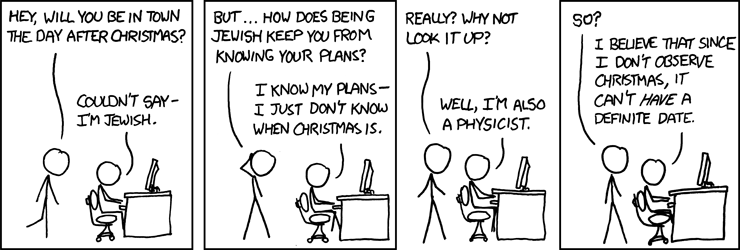
    Xmas in July

    As Wikipedia says: "Christmas in July celebrations may be held in July to provide a second joyful celebration in the year."  Many of those in the Southern Hemisphere celebrate the arrival of winter weather commonly associated with Christmas, and many of those in the Northern Hemisphere start to miss that winter weather, as they are sweltering in the summer heat.

    While the comic below originally appeared in December of last year, I find it a perfect fit for this post. 


    Click on the image to go to the comic, and read the "mouseover" text.

    I should note, the comic doesn't fit 'me' very well.  I do observe the gift giving aspects of December's Christmas, and I'm not a physicist, but I still find it humorous.

    For those interested in understanding the physics behind the comic:
    "Schrödinger's Cat" shouldn't be confused with "Schrödinger the Cat" -- who, when I last observed him, was sitting on a chair a few feet away from me.  Yep, still there.


      Last year's Xmas in July posts

      Tuesday, July 20, 2010

      Don't use shorthand, abbr., or otherwise leave out

      Inspiration for blog posts can come from anywhere, including the daily comics:

      Dilbert.com
      In the above Dilbert comic, the humor is predicated on the assumption Dilbert makes (and most readers will make, too) -- that the pointy-haired boss implies an "if I were you" at the end of his initial statement.  He reveals in he final panel that he doesn't.  And it completely changes the meaning of his statement.

      It's good advice not to leave out information in your genealogy record keeping.  You may know what you mean, but someone else looking at your work later on might not.  And few genealogists are writing down the information for themselves only.  Here are a few examples:

      1) If you are labeling a photograph, don't forget to identify yourself, as well as the person standing next to you.  Use last names.  You know who "Jack" is, but your grandchildren might not.

      2) Names of people can be similar.  Sometimes exactly the same.  Nicknames, vital dates, and phrases such as "son/daughter of ___" can help to clarify who you mean.

      My second great grandfather, Selig Feinstein, had several grandsons named after him.  Three had the name "Seymour Feinstein".  All three of them were the youngest of siblings, and two ended up with the nickname "Babe."  I distinguish them by the identity of their fathers, Harry, Herman, and Morris.

      3) For geographical entries, include city, county, state, and country.  If all four exist.  (Don't make something up if it doesn't.)

      For example, I write a lot about "St. Louis."  There is a St. Louis in Missouri, Saskatchewan, Michigan, and Mauritius.  Not to mention a St. Louis Park, in Minnesota. Using abbreviations for some of these could lead to confusion. (You may also note that indicating the country is helpful, but doesn't solve all the issues.)

      Furthermore, in Missouri, the City of St. Louis is independent  The complete description is "St. Louis City, Missouri, USA."  St. Louis City is its own county, so inserting "St. Louis" into the description as the county, actually makes it incorrect.  It has been this way since 1876.   Tamura Jones' Place Name Standardisation Basics is a good primer on how to record place names.

      Note: Non-commercial usage of the comics at Dilbert.com is permitted, provided you use the embedding code they provide.

      Monday, July 19, 2010

      Amanuensis Monday: The Severance Papers of Myrtle Van Every

      Amanuensis: A person employed to write what another dictates or to copy what has been written by another.

      I continue my project to transcribe family letters, journals, audiotapes, and other historical artifacts. Not only do the documents contain genealogical information, the words breathe life into kin - some I never met - others I see a time in their life before I knew them. If you choose to join me in Amanuensis Monday and post your transcriptions, feel free to add a link to your post in the comments.

      This week I return briefly to the documents preserved by my maternal grandmother, Myrtle Van Every Deutsch. I have long been amazed at how much she (and my maternal grandfather) kept. I know I inherited some of my "pack rat" nature from them. Many people save mementos of celebratory points in their lives - weddings, births, etc. How many people save severance papers?

      The below documentation adds details to a crucial turning point in my grandmother's life - when she left El Paso, Texas for St. Louis, Missouri at the age of 20.  90 years ago.  If the events that led to this move hadn't happened, I wouldn't be here today.

      Sunday, July 18, 2010

      Weekly Genealogy Picks

      Weekly Genealogy Picks --July 11 to July 17
      from genealogy blogs, newspaper articles and elsewhere

      The Eastern Washington Genealogical Society Blog posted an article detailing the differences between Ancestry.com and Ancestry Library Edition.  The article is three years old, but illustrates that not everything on the website is available on the edition that may be available at your library.

      Tamura Jones at Modern Software Experience looks at the past and future of genealogy.

      The Missouri State Genealogical Association is seeking complimentary copies of "recently published books on family histories, genealogies, local histories, and any other books relevant to genealogists. Every book will be reviewed in the MoSGA Journal, and a copy of the review will be sent to the author."

      Britain appears to have decided to stop their decennial national census, and are seeking cheaper ways to count their population. (hat/tip: EOGN)

      Schelly Talalay Dardashti at MyHeritage's GenealogyBlog announces a partnership between MyHeritage and JewishGen.

      Deborah Gurtler at ProGenealogists reminds us that not all compiled genealogies and online family trees are gospel.

      Relatively Curious at Relatively Curious about Genealogy learns that it is possible to order Family History Library microfilm from your home, if you live in Australia, New Zealand, or the United Kingdom.  It will be introduced in the US "in the near future" (whatever that means.)

      For those who enjoy political satire, the Land of the Pigs gives us: Link Discovered Between George W Bush and Killer of Jesus. 

      Other Weekly Lists
      The genealogy bloggers below provide their selections for the week - many different from my own.

      Amanuensis Monday: July 12th participants
      [Amanuensis Monday is a weekly blogging theme I began in February of 2009, where participants transcribe letters, audio, and other documents.]

      Apple at Apple's Tree
      Terri Buster at SouthwestArkie
      "anonymous" at filioagnostic
      Martin Hollick at The Slovak Yankee
      Lisa Wallen Logsdon at Old Stones Undeciphered
      J.M. at Tracing My Roots
      Randy Seaver at Genea-Musings
      Judith Richards Shubert at Genealogy Traces
      "anonymous" at So That's Where I Get it From

      If you participated, but don't appear on this list, please, let me know.

      Thursday, July 15, 2010

      Favorite Genealogy Websites

      Randy Seaver at Genea-Musings suggested participating in the same poll the NEHGS is giving its members.
      Namely, to rank 8 websites in their importance to our research.  Here are the 8 in my order of use.
      1. Ancestry
      2. FamilySearch
      3. Google
      4. Rootsweb
      5. Footnote 
      6. New England Ancestors (The New England Historic Genealogical Society) 
      7. USGenWeb 
      8. World Vital Records
      I wonder when these polls will stop listing Ancestry and Rootsweb separately. Perhaps they need to be to separate subscription from free services.  But it is still basically the same website.

      I should note that I don't use New England Ancestors, but when it comes time for me to put some additional effort into researching my New England roots, I'm likely to subscribe.

      Also...FamilySearch is on its way to making a battle for #1.

      Other websites that would be on my list

      3.1 St. Louis County Library (which gives me home access to NewspaperArchive, Missouri and Illinois Sanborn Maps, the St. Louis Post Dispatch 1874-1922. and a lot more.)
      3.2 GenealogyBank (for their collection of obituaries)
      3.3 Missouri Digital Heritage (Missouri vital record databases, naturalizations, and more)
      3.4 FindAGrave
      3.5 JewishGen

      And adding these five, pushes NEHGS, USGenWeb and WorldVitalRecords off of my top ten list.

      Monday, July 12, 2010

      Amanuensis Monday: On Vacation

      Amanuensis: A person employed to write what another dictates or to copy what has been written by another.

      I am in the midst of family reunion festivities.  I am taking a vacation from my project to transcribe family letters, journals, audiotapes, and other historical artifacts.  I know I said this last week, and a few hours later posted a transcription.  I don't expect this to happen this week.

      Sunday, July 11, 2010

      Weekly Genealogy Picks

      Weekly Genealogy Picks --July 4 to July 10
      from genealogy blogs, newspaper articles and elsewhere

      Note: It appears I'm not very good at this 'taking a vacation' thing.  I am attending a family reunion - this is being composed Thursday morning in Mendocino, CA., a day before the reunion begins.  I have a few picks below from the first part of this week.

      Family Tree Magazine releases its list of the 101 best genealogy websites of 2010. (hat/tip: Genea-Musings.)

      Mike Reardon of Open Mike wonders if the concept of an American Wake has been rendered unnecessary by Facebook.  (One might argue it isn't Facebook that did this, but the internet in general.)

      Dear Myrtle reminds us A marriage license doesn't mean they got married.

      Arlene Eakle has noticed a major shift in content in the quarterlies and journals published by genealogy societies.

      At the request of Schelly Talalay Dardashti of Tracing the Tribe - Footnote.com is opening their Holocaust archives for free access July 9th through 19th.

      Carnivals
      Other Weekly Lists
      The genealogy bloggers below provide their selections for the week - many different from my own.

      Amanuensis Monday: July 5th participants
      [Amanuensis Monday is a weekly blogging theme I began in February of 2009, where participants transcribe letters, audio, and other documents.]

      Apple at Apple's Tree
      Martin Hollick at The Slovak Yankee
      Lisa Wallen Logsdon at Old Stones Undeciphered
      J.M. at Tracing My Roots
      John Newmark (w/guest amanuensis) at TransylvanianDutch
      Heather Wilkinson Rojo at Nutfield Genealogy
      Randy Seaver at Genea-Musings
      Ginger Smith at Genealogy by Ginger
      Kevin Walker at Who We Were, Are & Will Be our Family

      If you participated, but don't appear on this list, please, let me know.

      Saturday, July 10, 2010

      SNGF: Clerihew

      Randy Seaver's Saturday Night Genealogy Fun challenge is to write a clerihew.  I am in the midst of a family reunion weekend, but I had a few minutes to compose a poem or two.  Especially a clerihew -- since that ties so well in with family.

      Randy's definition "a four-line irregular poem or verse that follows an AABB rhyme scheme" departs slightly from the traditional clerihew. 

      In addition to the requirements he mentions
      • It is biographical and usually whimsical
      • The first line consists solely (or almost solely) of the subject's name.
      (It's also usually about notable individuals, but notability is subjective.  Many genealogists consider all of our ancestors notable.)

      Here's my first one.  

      Goldfinch, Barnard
      or so I have heard
      was a maker of sails, in Portsea
      and left his children each a thousand pound annuity

      I hear the sound of relatives, so I will return later.

      Later

      Moshe Leyb Cruvant --
      our ancestral immigrant
      why St. Louis he chose
      over Lithuania, no one knows.

      Monday, July 5, 2010

      Amanuensis Monday: The Will of Barnard Goldfinch (w/guest Amanuensis)

      Amanuensis: A person employed to write what another dictates or to copy what has been written by another.

      I know I said I was taking a vacation, but I received an amazing email this morning from geneablogger, Martin Hollick of The Slovak Yankee.  Apparently he has experience with 16th century English script, so 18th century was easy for him to read.  So when he saw my post this morning concerning the will of Barnard Goldfinch, it didn't take him long to transcribe it.  I plan to use his transcription to try to familiarize myself with this style so I am able to do the same in the future.

      London Lives - Barnard Goldfinch

      I've extended one branch a generation further back this week.  I was inputting some surnames into London Lives, a new website recently mentioned by the Genealogy Insider.

      I discovered the abstract of a will for a Barnard Goldfinch.

      ForenameBarnard
      SurnameGoldfinch
      OccupationSailmaker
      Parish, CountyPortsea , Hampshire
      Parish NamePortsea
      County, or CountryHampshire
      Date Proven27 June 1789

      My fourth great grandfather, William Denyer, married a Jane Goldfinch in 1791.  I knew from the marriage record I had found online that Jane was from Portsea, and William was from Farlington.

      Denyer, William, of Farlington, lime-burner, 21, b., & Jane Goldfinch, of Portsea, 21, sp., at P., 22 Oct., 1791.  (from Hampshire allegations for marriage licences granted by the Bishop of Winchester: 1689 to 1837 - Vol 35, p. 217.) [The b. and sp. mean bachelor and spinster, and the 'at P.' most likely means 'at Portsea'.] 

      I figured this Barnard Goldfinch was a likely candidate for a relative.  Not necessarily an ancestor, but possibly that too.  So before heading to the UK Archives to obtain a copy of the will, I did a google search on "Barnard Goldfinch."

      There were a total of 8 results, including an index to baptisms in Farlington Parish from 1766-1812.  Apparently, a Barnard Goldfinch Denyer was born to a William (and Ann) Denyer on August 17, 1800.  Ann?  That's close to Jane.  Clerical or transcription error perhaps?

      The parish index listed a total of 8 Denyers born to a William from 1793-1807, and the other seven had a mother named Jane.  My third great grandfather appears to be among them.  So it seems a likely clerical error.  Sure, there could be a child with a different mother -- but to name him after the other woman's father would be slightly unorthodox.  And at this point, I was suspecting that's what he was.  Still, I was less interested in the parentage of Barnard, than in the parentage of Jane.  I was certain I wanted to obtain that will.

      The UK National Archives charges a fee per record.  (3.50 pounds)  However, you can immediately download the record.  Instant gratification.

      Sort of.  I'd like to go back in time and invent the typewriter a few centuries early please!

      [Image of will removed due to copyright/permission issues with the UK National Archives.]

      It's going to take some work to transcribe (decipher) this, but my initial perusal finds no mentions of a wife, and mention of only one child, a spinster daughter named Jane.  Since my fourth great grandmother wasn't married yet to William Denyer, this is a very likely fifth great grandfather.

      Whether or not he is descended from the Barnard Goldfinch who was born in 1643 in Winchester at the Goldfinch Cottage - is an unknown.
      Correction: I have received some help in transcribing this, and there appears to have also been a son named Joseph, which could be helpful.

      Amanuensis Monday: On Vacation

      Amanuensis: A person employed to write what another dictates or to copy what has been written by another.

      Due to focusing on last minute preparations for a family reunion, I am taking a vacation from my project to transcribe family letters, journals, audiotapes, and other historical artifacts.  

      Sunday, July 4, 2010

      Weekly Genealogy Picks

      Weekly Genealogy Picks --June 27 to July 3
      from genealogy blogs, newspaper articles and elsewhere

      Note: I am attending a family reunion, and will be mostly away from keyboard from Wednesday July 7 to Wednesday July 14.  Which means there will be no Weekly Genealogy Picks next Sunday.

      Miriam Robbins Midkiff of Ancestories was asked by Google to record a video showing how to use Google Books for researching one's ancestry.

      Leland Meitzler of Genealogy Blog discusses countries that have restrictions on allowable baby names.

      Joseph F. Martin at Upfront with NGS discusses the case of his missing grandfather.

      The list of the French who collaborated with the Nazis during WWII will be published online, but not until 2015.  (hat/tip JewishGen blog.)

      Jenna at Desperately Seeking Surnames reminds us not to forget to use the simple tools.

      Thomas MacEntee at Geneabloggers shows bloggers how to install the JISC TechDis Toolbar - which allows users to increase the text size, have the page converted to audio, and a few other features making a blog more accessible to the diabled.

      Google has added Optical Character Recognition to their Google Docs features.  You can upload scanned (typed) text to Google Docs - and have it convert it to text for you using the same software Google Books uses.  (However, the maximum file size is 2 mb...which is easy to exceed when you are scanning a page of text.)

      For humor - The Onion offers us Wikipedia Celebrates 750 Years of American Independence. You'll be surprised to learn a lot of 'new information' in this column.

      Carnivals
      Other Weekly/Monthly Lists 
      Amanuensis Monday: June 28th participants
      [Amanuensis Monday is a weekly blogging theme I began in February of 2009, where participants transcribe letters, audio, and other documents.]

      Apple at Apple's Tree
      Valerie C. at Begin with Craft
      Martin Hollick at The Slovak Yankee
      Leah at The Internet Genealogist
      Lisa Wallen Logsdon at Old Stones Undeciphered
      J.M. at Tracing My Roots
      John Newmark at TransylvanianDutch
      "anonymous" at Nolichucky Roots
      Heather Wilkinson Rojo at Nutfield Genealogy
      Randy Seaver at Genea-Musings


      If you participated, but don't appear on this list, please, let me know.

      Friday, July 2, 2010

      A Toast to the First and the Fourth of July

      The poem below was written and posted last year at this time


      A Toast to the First and the Fourth of July
      for David Van Every (1757-1820)
      ©July 2009 - John Newmark

      For two years my fourth great fought
      for the creation of our nation
      then in seventeen seventy seven
      he deemed his disloyalty a disservice
      and joined the other side.
      Finally, he and his family fled to Canada.

      His motivations are unrecorded.
      Beyond his appearance on muster rolls,
      a few brief mentions elsewhere,
      we have nothing. No inkling
      of the wherefores behind his decision
      either in seventy five, or seventy seven.

      In July’s opening barrage
      of national celebrations
      I honor both of his decisions -
      whatever the reasons, and his willingness
      to fight for what he believed
      even when those beliefs changed.

      This poem was based on information I'd found on the web, citing The Records of the Van Every Family, by Mary Blackadar Piersol, 1947.

      After writing this poem, I discovered the muster rolls for David Van Every on Footnote.com that put the information somewhat in doubt.

      The link above is to the records on Footnote.  Their Revolutionary War records are FREE access through July 7th.

      The muster rolls suggest he enlisted on July 4, 1775, and deserted on Sept 12 (or Sept / 2) 1775.  And re-enlisted on May 23, 1777, and redeserted in June of 1777.  So in total it would have been for three months, not two years.

      Also, since writing the poem, I obtained a copy of The Records of the Van Every Family, by Mary Blackadar Piersol.  She only mentions David joining and deserting in 1777.  So she didn't know about the 1775 muster roll.  Somebody else must have found documentation that he joined in 1775, and an incorrect interpretation was made that he remained in service between 1775 and 1777.

      It's impossible to assign motivation to the enlistments and desertions.  David was 18 and 20 years old in 1775 and 1777.  He may have just been a very confused young man.  The first line of the poem might not be accurate, but the gist of the poem still is.

      Follow Friday: Usenet/Google Groups

      Usenet began in the 1980s as a collection of discussion groups, mostly for college students and staff on any topic the users decided they wanted to talk about. Anything without limitations. Whenever a quorum decided a new topic was needed, it was added.

      A company called DejaNews began organizing the Usenet archives in the late 1990s, and Google bought them in 2001 and formed Google Groups. Google Groups serves as both an archive going back to 1981 and a continuation of all the discussion groups. (This has frightened many former college students who began to ask, "Everything I posted there is now available for potential employers - or my kids! - to read? Forever?" Google used to provide a method of claiming old posts and deleting them, but that help page is no longer there, and they only explain how to delete more recent posts to Google Groups.)

      A few of the groups that might be of of obvious interest to genealogists and family historians: Alt.Obituaries, and two dozen groups or so under the heading Soc.Genealogy.

      Of course you can search all groups at once on the main page, including newer ones created under the auspices of Google Groups. Just be forewarned. In the search results, before clicking on something, take a look at what the title of the discussion-group is. This will likely give you a clue as to what posts you are likely to find in that group. This could change your mind on whether or not to read the post.

      This post was adapted from a post back in August of 2007.