Tuesday, April 13, 2010

Excuse Me, What is This?

James Tanner at Genealogy’s Star has a post about Genealogy Software on the Mac.

The gist is that the offerings aren’t as feature-rich as PC genealogy software, with the best option a solution for Mac users being to run Windows using the Parallels software, if they are familiar enough with both Mac and PC environments to not be confused by it. [Sentence revised based on follow-up entry at Genealogy's Star.]

Having used Mac software since I began my family history obsession 3 years ago, I can’t really argue with his premise that PC software is better, as I haven’t used any of the PC software.

However, he links to a Software Review site, TopTenReviews, which lists Mac Genealogy software, and itemizes which ones have which features. I was shocked, looking down the list of features my software allegedly doesn’t have.

We’re going to play a game now I have entitled, “Excuse me, what is this?” I will list a feature that TopTenReviews claims that iFamily software doesn’t have, and then I will display a screenshot, or two.

1) Filtering Options “Filters individuals in database according to user specified criteria”

If you only wish to filter on the contents of one field, the easiest way to accomplish this is the search box on the main navigation window:
Above we see a list of criteria we can filter upon


And here I have filtered a list of individuals who died in Texas.

For more complex filters, there's the Filtered People Report

Above I am filtering for the surname Newmark, birth year prior to 1950, and birth place in London.

2) Flags/Labels “puts flags or labels on incomplete or noteworthy individuals”

You will note that in the search box above, one of the categories you can search on is “Notes.” You can put any coded labels you want to put into the notes section of an individual’s entry, and then search for that label.

3) Geographic tracking “tracks locations of ancestors and events”

iFamily has a nice Google Maps interface. Pictured below.


There may be other geographic functions iFamily doesn't do.

4) Ancestor chart


(The names are cutoff as I sized the chart to the window, and I am using a small laptop.  iFamily does work a little better on larger desktop monitors, and the iFamily website recommends a 17inch screen.)

5) Descendant chart


 6) output formats

a) web/html


b) cd/dvd

You can certainly burn a CD or DVD if you are exporting a website, as you can see above.

c) pdf

Well, first, you can print. And on most printers today, I believe, you can print to PDF. But let's say your printer doesn't do that.


 Do you see the "Save as PDF" button above for this descendant chart?

(Horizontal charts are possible, as well as the traditional vertical charts I showed in #4 and #5.)

The navigation window for iFamily is an ancestor/descendant chart in itself, and you can print directly from it. (If I had a larger monitor, more generations would be readable.)  As you can see below, PDF is one of the export options.


Finally, under user support, TopTenReviews claims there is no User Forum.  (I've linked to the User Forum for you.  The oldest post on the user forum is dated 2006.)

It also claims there is no email contact


The contact button on the left is a direct email link.  You can also see a link to the forums.

I admit I am not as familiar with the other Mac Software Apps.  I've experimented with MacFamilyTree and Reunion, but felt their graphical user interfaces weren't as welcoming as iFamily's. Still, if the TopTenReviews itemization is filled with inaccuracies for iFamily, I don't put a lot of faith in their list of features for the other software. 

iFamily is the least expensive of the primary Mac software options, and I will be the first to admit that there are some deficiencies, primarily in the area of charts and reports.  For many the biggest void may be the ability to print ahnentafel and register reports.

However, Personal Ancestry Writer II is a free software program you can download and use whenever you want to print out either one of these reports.  It has a primitive interface, which I wouldn't want to use for everything else, but you can open any gedcom in it and print out the reports you need.

GRAMPS (free/open source) is also working on a Mac Version, which I reviewed back in September.  I haven't checked to see if they've fixed the bugs I noted back then, but it has Register, Ahnentafel, and Henry reports.

In short -- Mac genealogy software may not be as feature rich as some PC options.  I have no means of comparison.  But the checklist of features on TopTenReviews Mac Genealogy page is filled with inaccuracies when it comes to at least one software package.

Monday, April 12, 2010

Amanuensis Monday: A Wedding and a War

Amanuensis: A person employed to write what another dictates or to copy what has been written by another.

I continue my project to transcribe family letters, journals, audiotapes, and other historical artifacts. Not only do the documents contain genealogical information, the words breathe life into kin - some I never met - others I see a time in their life before I knew them. If you choose to join me in Amanuensis Monday and post your transcriptions, feel free to add a link to your post in the comments.

This week I continue a transcription of a family history tape recorded in 1987 between my grandmother, "Sissie" (Feinstein) Newmark, and a professional oral historian. This section begins after my grandmother has finished discussing her graduation from high school.

Sunday, April 11, 2010

Ancestor Approved Award

TransylvanianDutch has been chosen for the “Ancestor Approved” award by four separate blogs:

Ginisology
Wild Rhododendrons
Climbing My Family Tree
My Ancestors and Me

I want to express my gratitude to all four bloggers. I like to think my ancestors do approve of what I am doing here.

This award has been making the rounds on genealogy blogs. It was initiated a couple weeks ago by Leslie Ann Ballou at Ancestors Live Here
As a recipient of this award I ask that you list ten things you have learned about any of your ancestors that has surprised, humbled, or enlightened you and pass it along to ten other bloggers who you feel are doing their ancestors proud.
Ten things I've learned which have surprised, humbled, or enlightened.

1) My second great grandfather, Selig Feinstein, filed a patent
2) Selig was a blacksmith for his first ten years in America. The family knew of his success in the real estate business, but that was actually his third career.
3) I also discovered Selig was very active in the local religious charitable community, helping to form schools, and raise funds for the poor.
4) My great grandfather, Herman Feinstein, drove a jitney taxi.
5) My grandfather, Martin Deutsch, may have been a direct male descendant of Aaron
6) My Denyer ancestors may have emigrated from America for a couple years, before America expanded to include them again. It’s unclear when they entered Texas.
7) A bit of humor my great grandmother, Bertha Cruvant, liked to share, may have been rooted in Gematria.
8) Seven out of eight of my paternal second great grandparents are buried in St. Louis, where I have lived most of my life.
9) My eighth great grandfather, Myndert Frederickse, owned a slave.
10) Hartley and Denyer relatives testified in front of The Dawes Commission, hoping they would be granted land based on their Choctaw ancestry. (Their application was rejected, as they didn't have enough proof.)

I’m going to refrain from choosing ten blogs. It’s too difficult of a decision. However, I will pass it on to one. This sounds like it would be a more difficult decision, but it’s easy – Leslie Ann Ballou, of Ancestors Live Here.

It appears, even though she began this, and passed it on to the first ten people, no one has given it back to her yet – or at least, she hasn’t listed her “ten things that surprised, humbled, or enlightened.” It's now her turn.

Weekly Genealogy Picks

Weekly Genealogy Picks -- April 4 to April 10
from genealogy blogs, newspaper articles and elsewhere

Nancy at My Ancestors and Me provides a few forms she has created for research purposes, including a checklist and a Fact/Opinion/Search chart.

An authorless news article declares that family tree research can cause family conflict. Of course tactless researchers are likely to come into conflict with family members over other reasons, if not family research.

Dan Curtis discusses steps to starting your own personal historian business.

Find My Ancestor discusses Graveyard Preparedness, providing tips to prepare the researcher for a trip to the cemetery. This is the fifth part in a series.

Sharon at Kindred Footprints discusses a recent trip to Thorold, Ontario, where many Loyalist families ended up after the American Revolution (including my Swayze ancestors). She also shares some photographs of the area.

Kimberly Powell at About.com Genealogy explains why your ancestor's name was likely not changed at Ellis Island. (Shortly afterwards, by your ancestor, possibly. But not by someone at Ellis Island.)

Randy Seaver at the Graveyard Rabbit Online Journal researches the European practice of renting and reuse of burial plots.

ProGenealogists has an organized list of genealogical fallacies. (hat/tip: Midwestern MicroHistory)

Google Earth helped discover rare Hominid ancestor

Recently two elderly Florida men discovered they're half-brothers.

"In the fall of 1945, a Soviet soldier hoisted a 5-year-old boy aloft and paraded him through a Lithuanian synagogue that had been closed throughout a long Nazi occupation." Both recalled the incident, and over the years, told family, and friends. One of the tellings resulted in a song being written and recorded, and through the song, 65 years later, the two were reunited. The soldier had become a rabbi in Oak Park, Michigan. And the five year old kid... On the JewishGen blog you can read the story, and listen to the song. (Yom HaShoah - Holocaust Remembrance Day, begins at sunset tonight. Many sites say it began last night, but it is officially pushed forward or back a day so it isn't adjacent to the Sabbath.)

Schelly Talalay Dardashti at Tracing the Tribe highlights the Memorials for Vanished Communities database at the Israeli Genealogical Society. The database contains memorials for nearly 2,000 destroyed communities.

Other Weekly Lists
Amanuensis Monday: April 5th participants
If you participated, but don't appear on this list, let me know.

Friday, April 9, 2010

Parshat Shemini and me

As I recently learned there's a chance I am a descendant of Moses' brother, Aaron (my maternal grandfather being the most recent direct-male descendant in my line) - I found the below video more relevant. If Aaron is an ancestor, it's an animated song of a tragedy in my family's history.

G-dcast provides an animated synopsis of the weekly Torah portion, and Parshat Shemini is the weekly portion that will be read in Synagogues across the world this Shabbat. (Parshat is the Hebrew word for 'portion,' and Shemini is the Hebrew word for 'eighth.' The name of each Torah portion is just the first distinctive word in the section, and has no significance beyond that.)


Parshat Shemini from G-dcast.com

More Torah cartoons at www.g-dcast.com

Tuesday, April 6, 2010

What Do You Do with Conflicting Evidence

This entry has been percolating in my mind for a few weeks. In the first episode of Who Do You Think They Are viewers were shown that it is possible to find conflicting evidence. That historical documents aren't always correct.

Sarah Jessica Parker's ancestor, John Hodge, is mentioned in an obituary of his son as having died in 1849 enroute to California. But he appears in the 1850 California Census. Further research showed that he died in California in a gold-mining accident. Probably in the years between his death and his son's death "dying in California searching for gold" became "dying enroute to California." It's not unusual for family stories to be less than 100% accurate.

I wonder if some viewers jumped to the conclusion that the census was obviously the correct document, as it was more reliable than an obituary written years later. On the contrary, it was equally possible for the result of the research to be the opposite.

It was possible that the individual listed in the 1850 census and the individual listed in the Ohio obituary were the same, but the obituary was correct that he had died enroute to California.

At first glance this might seem an impossibility; If he died enroute, how could he end up in the census? But if there was someone in California waiting for him to arrive, a business partner perhaps, who didn't know he was dead, they could have mentioned his name to the census taker. Sure, they weren't supposed to do that. But maybe they figured that he was going to show up any day, and he ought to be counted.

Incorrect information on the census isn't uncommon. And it's not always the fault of the census taker. Lots of people lie. And others don't know the truth. I came across one census that listed children who had been dead for a decade. I have no clue who answered the door and provided this misinformation, or why. (But since the only census these two children should have appeared on was the 1890 census, which was destroyed, it is kind of nice, albeit morbid, that they appeared on the 1900 census too.)

Vital Records, even though they are usually considered "Primary Records," also have errors on them. The birth certificate of my great uncle, Allen Deutsch, gives his name as 'Adolph' - and no certificate of correction was ever filed. Family agrees his birth name wasn't "Allen," but say it was Abraham, after his grandfather. While there was certainly reason for the 'family story' to change post-1939, he was born in 1914, and there is no record of the name 'Adolph' being used in the early years. Abraham appears on the 1920 census, and Albert appears on the 1930 census, suggesting the migration to "Allen" had begun.


There are other errors on the document. It says Allen was the 7th child, but he was the 8th, as one had died in Europe. The document says both parents were born in Varmezo. This matches his father's military documents. However, it's known his mother came from the village of Margitta.

Birth Affidavits (filled out when birth certificates were unavailable) also can be unreliable for obvious reasons. Either the individual didn't know the truth, or intentionally provided incorrect information. While I would like to find evidence to support the former, with respect to my maternal grandmother's Birth Affidavit, I have difficulty believing she and her sister forgot what year she was born. Every census my grandmother appears in, including the 1945 Florida State Census, her age is correct. However, in October of 1945, she declared she was born five years later, and her older sister acted as witness. My best guess is my grandmother thought she might have to look for a job, and felt it would be easier if she were 40, rather than 45.

When conflicting evidence is discovered, there's no quick and easy Rock-Paper-Scissors (or even a Rock-Paper-Scissors-Lizard-Spock) method to figuring out which document is correct. Vital records don't always beat census reports, which don't always beat family lore. The only solution is further research, with the hope of uncovering more documentation that clarifies the situation.

Monday, April 5, 2010

Amanuensis Monday: 1909 Postcards to my Great Grandmother

Amanuensis: A person employed to write what another dictates or to copy what has been written by another.

I continue my project to transcribe family letters, journals, audiotapes, and other historical artifacts. Not only do the documents contain genealogical information, the words breathe life into kin - some I never met - others I see a time in their life before I knew them. If you choose to join me in Amanuensis Monday and post your transcriptions, feel free to add a link to your post in the comments.

This week I am sharing a couple postcards my great grandmother, Margaret Jane (Denyer) Van Every received from her son and daughter-in-law in 1909.

Sunday, April 4, 2010

Weekly Genealogy Picks

Weekly Genealogy Picks -- March 28 to April 3
from genealogy blogs, newspaper articles and elsewhere

James Tanner at Genealogy's Star suggests there's a genealogical goldmine at Google Maps. He's right. I was unaware that the 'browse directory' tab in the My Maps feature led to apps. I'd seen it before, but assumed they were public maps other users had created.

Julie Cahill Tarr at GenBlog reminds us that a book's index isn't always complete.

Carolyn Barkley at Genealogy and Family History discusses using Ebay as a genealogy research tool. While I had already been conducting surname searches on it, I hadn't considered using it in some other ways she mentions.

Ask Olive Tree discusses the markings on passenger manifests.

Dick Eastman at Eastman's Online Genealogy Newsletter says You are Probably Descended from Charlemagne. He says, "professional genealogists tell us that Charlemagne appears in almost every European descendant's family tree." I accept that, mathematically. I also know that the earlier 'proven' ancestries linking my ancestors through Anneka Jans to William the Silent have been called into question, as have the connections drawn between another ancestor, Barnabas Horton's wife, Sarah Wines, and her Mapes descent from Charlemagne. The issue is not whether mathematically we all must be descended from Charlemagne - the issue is can we accept as accurate any descent that claims we are?

Lynn Palermo at The Armchair Genealogist asks Are We Overcoming the Genealogy Stereotype?

Wired Magazine notes that on March 30, 1848, the Niagara Falls stopped. And disappeared. And everyone freaked out. It was only temporary, though. I have relatives who may have been in the area at the time. I wonder how they reacted.

Megan Smolenyak Smolenyak at The Huffington Post reports that The Belgian Red Star Line is seeking emigrant stories.

Apple at Apple's Tree shares an important blogging tip. Provide some way for readers to contact you. This becomes crucial if your comment-system is broken. And that happens more often than you might think. If we can't comment, and you don't have an email address listed on your blog, there's no way for us to tell you we can't comment.

The Southern California Genealogical Society seems to have been the first to note that Who Do You Think You Are altered their episode schedule. They replaced a new episode on April 9th with a repeat of the first episode. April 16th remained a skipped week, resulting in an extension of the run.

Jasia at CreativeGene has released the 92nd Carnival of Genealogy (theme: Dance!) The theme for the next edition will be "series how-to" articles. More information.

Other Weekly Lists
I'm also going to start listing those who joined me in the past week with the Amanuensis Monday blogging meme.

Amanuensis Monday: March 29th participants
If you participated, but don't appear on this list, let me know.

Saturday, April 3, 2010

What You May Have Missed

Are you reading this on Facebook? Or perhaps through Google’s Reader, Bloglines, or another newsreader?

If so, and you haven’t actually visited my blog lately, there are a few things you might have missed.

Here, have a visit

At the top of the screen, below the masthead, you will see links to
I have gathered together some of my local favorite genealogy research sites for the states of Missouri and Illinois, where a lot of my research has focused, as well as some more general resources that cover a broader geographical scope.

Under Family History Documents I’ve linked to genealogy books and other resources I’ve found digitized online that relate to my family history. This mostly pertains to my maternal ancestry, though I have found some online interviews of paternal cousins, to which I link.

I also have a chronological timeline of all my Amanuensis Monday entries.

On the left hand side, underneath all the methods of subscribing to my blog posts (email, audio, and traditional RSS feeds) you’ll see a link to my ahnentafel chart (a chart of my ancestors).

If you continue scrolling down, past the monthly archives of posts, you’ll see links to categories. These are helpful if you are interested in seeing all the posts I have written mentioning a particular surname, or geographical location.

If you scroll all the way down, past my ‘blogroll’ (a list of blogs I read, which I have just updated.) You’ll ultimately see a poem I wrote in 2008 entitled, “Divergent, yet Intersecting.”

SNGF: Degrees of Separation

This week's Saturday Night Genealogy Fun over at Genea-Musings looked fun, but was slightly depressing.
1) Find an ancestral line that stretches back to the time of the US Revolutionary War (1775-1783), about 230 years. Define your person-to-person connection (the person actually met the next person on the list) back to a historical figure from that time.
Since the challenge only specified time, and not location, I actually considered seeing what I could do with my father's chart. The earliest ancestor I have is a Meer Kruvond born "before 1795." I can definitely imagine parents, but I have no idea who they would have come in contact with in Cekiske, Kaunas, Lithuania. I remember my great grandmother, Bertha (Cruvant) Newmark, quite well, so I could get off to a very good start on that chain.

So I turned my attention to my mother's side, and that's when I realized how few generations I was able to skip in the process.

1) I know my mother.
2) My mother knew her mother, Myrtle (Van Every) Deutsch (1900-1951).
3) Myrtle Van Every knew her father, Melvin Van Every (1863-1929)
4) Melvin Van Every knew his grandfather, Andrew Van Every (1798-1873). (In a letter Melvin wrote Myrtle, he recalls receiving a half-dime from his grandfather.)
5) Andrew Van Every knew his father, David Van Every (1757-1820)

David Van Every, a loyalist from Poughkeepsie, NY, served under the leadership of Colonel John Butler, in Butler's Rangers. David also served very briefly in the New York militia, before joining the Loyalist side...I'm not sure who he met while there.

Or I could take a slight detour

4) Melvin Van Every knew his mother, Abigail Stuart (1825-1866), albeit only for three years.
5) Abigail most likely knew her grandfather, Israel Swayze, Jr (1753-1844)

Israel Swayze, Jr was a loyalist from Hope, New Jersey. I'm not sure where he served, but once he migrated to Niagara, he himself became quite prominent locally.
THE BEAVERDAMS CHURCH 1832: Early in the 1790's a group of settlers in this area had been converted to Methodism and formed a Class with in 1795, was included in the newly-established Niagara Circuit. Services were held in the home of a prominent local settler, Israel Swayze, and camp meetings took place on his property. - Beaverdams Church Historical Plaque
Town meetings were also held in his home between 1806 and 1809.

Note: Israel Jr's grandfather, Judge Samuel Swayze, is my shared ancestor with the late actor.

Thursday, April 1, 2010

Genealogy Shocker: Lucille Ball married her grandson

Every genealogist knows that everything in the Family Trees uploaded to Ancestry.com is undeniably true.

So it's a fact: Lucille Ball married her grandson

Since you have to have an account on Ancestry to view the page, I have converted it to graphic form. Apparently Desi is related to a whole bunch of people -- I only show the first of six pages below. They are all undeniably true.

Ignore the warning box Ancestry includes in the upper right.

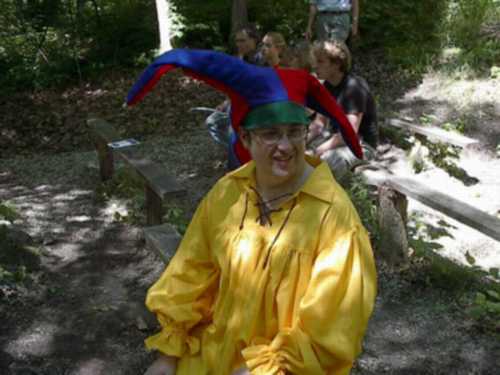
Happy April Fools Day

John the Jester wishes everyone a Happy April Fools Day


The one day a year everyone acts foolish, on purpose!

(photograph from the 2002 St. Louis Renaissance Festival)

Another Easter Greeting - On Children - Khalil Gibran

The below letter was sent to my grandmother, Myrtle Van Every Deutsch (1900-1951), by her niece, Elizabeth Campbell (1914-1996), daughter of Evelyn Van Every Campbell Crabtree (1892-1982).

I don't have a year on the letter. Somewhere between 1941 and 1951.

My Darling Tante

Do you like this?

And a woman who held a babe against her bosom said, "Speak to us of Children."

And he said:

Your children are not your children.
They are the sons and daughters of life's longing for itself.
They come through you but not from you,
And though they are with you yet they belong not to you.

You may give them your love but not your thoughts,
For they have their own thoughts.
You may house their bodies, but not their souls,
For their souls dwell in the house of tomorrow, which you cannot visit, not even in your dreams.
You may strive to be like them, but seek not to make them like you.

You are the bows from which your children as living arrows are sent forth.
The Archer sees the mark upon the path of the infinite, and
He bends you with His might that His Arrow may go swift and far.
Let your bending in the Archer's hand be for gladness;
For even as he loves the Arrow that flies, so He loves also the bow that is stable.

This is from a book that was given me recently, and has enchanted me although I do not know whether it is because of the meaning in the words or just the beauty of their sound.

Happy Easter to you and Martin, and Barbara, and Peggy.

-- Betty

***

I post this today as well because it is the start of National Poetry Month. The poem, "On Children," was written by the Lebanese American poet, Khalil Gibran (1883-1931).

It has been set to music and recorded by at least two different artists/groups

On Children - Astrid Seriese


On Children - by Sweet Honey in the Rock

Wednesday, March 31, 2010

Wal-Mart encroaches on WDYTYA schedule

As others have noted the Who Do You Think You Are schedule for upcoming episodes has changed. (Link to Ancestry's page which has the full schedule. I was unable to find a schedule on NBC's site.)

April 9th they're re-airing the first episode with Sarah Jessica Parker. Repeats are common, and I don't find this horrible. I'm sure many missed it the first time.

April 16 - they're replacing Who Do You Think You Are with a Wal-Mart produced original movie: Secrets of the Mountain. View trailer below:


Family secrets are uncovered in the movie, and it's clear from the tagline "One family's adventure, every family's challenge" that they're linking the movie thematically to WDYTYA. It can be looked at as trying to garner viewership of the movie from WDYTYA fans - or trying to gain more viewership of the final episodes from those who are likely to tune into the movie. Likely both are intended. Whether the tactic will be successful in either direction is open to question.

Update 4/2: I found an old schedule listed somewhere and realized that April 16th was planned as a week off from the start. The change was a repeat being inserted on April 9th, extending the schedule one week.

Wordless Wednesday: Easter Greetings 1944

Easter greetings sent home by my grandfather, Martin Deutsch, in 1944, via v-mail.

Tuesday, March 30, 2010

PSA: Genealogy Can Save Your Life: 2010

This is now the third year I've posted this PSA. But it can't be repeated too often. Genealogy can save your life. It would have saved mine if I hadn't already known what I needed to know.

The American Cancer Society recommends the 'average' person to start getting checked for colon cancer at age 50. However, for those with a history of the disease in the immediate family, they recommend to start the tests ten years prior to the earliest it has been diagnosed. My maternal grandmother died at age 51. So I was prepared to start getting tested at age 40. Then a close kin, slightly older, had their test, and polyps were discovered and removed. So two years ago, at age 39, I decided there wasn't any good reason to wait on ceremony, and my doctor agreed. I had my first colonoscopy, and I had a 'pre-malignant' polyp removed. If I had waited until I was 50, there's a chance I wouldn't have made it. Since I knew to check early, the polyp was caught before it could become dangerous, and hopefully any future polyps will also be caught beforehand.

[Note: As I understand it, the causal connection between polyps and cancer actually isn't conclusive. Scientists haven't proven that pre-malignant polyps always become malignant, or that polyps always lead to cancer. Nor that everyone who gets cancer had pre-malignant polyps at one time that could have been detected. But they know enough to remove the polyps when they see them.]

Other diseases have genetic predispositions. So it is important to know the medical histories of your parents, grandparents, and where possible, your great grandparents. The primary method of doing this, for those who are deceased, is to find their death certificates. It is rare to find any prior to 1900, but for those who lived into the 20th century, especially those who lived past 1920, finding death certificates, while not always easy, isn't usually difficult - if you know when and where they died.

1) Local Courthouses

Most counties in America house archives of their Vital Records (birth, marriage, death.) A few have strict restrictions on who can request copies, limiting them to 'immediate family' which may not include grandchildren.

2) State Archives

State archives often have copies of the county records, with fewer restrictions on access.

3) Online Databases

Some counties and states have begun putting their records online. Ancestry, FamilySearch, and Footnote also have some databases available to search.

4) Funeral Homes

Funeral homes often retain their own copy of the death certificate, and their copy may differ slightly from that held by the County or State. It may contain details about where in a cemetery plot the individual was buried, or details about the funeral itself. If you don't know the funeral home, search in archives of local newspapers and try to find an obituary, as obituary notices often include this information. The funeral home copy may also be at times the only copy you have access to if the county and state are too restrictive.

Once you have found the death certificate, if you don't recognize instantly the words written under 'cause of death' conduct an internet search on them at Google or Yahoo. My family history made identifying "Carc. of Col." as "Carcinoma of Colon" fairly easy, though I suspect some might have stumbled over the abbreviation. Several ancestors were diagnosed with "Interstitial Nephritis." I'd never heard of this before, but it is a kidney ailment often caused by a reaction to pain medication. Unfortunately, the death certificates didn't indicate the cause of the original pain.

Monday, March 29, 2010

Amanuensis Monday: The 'Gorgeous' Pevely Fountain, The 04, and California

Amanuensis: A person employed to write what another dictates or to copy what has been written by another.

I continue my project to transcribe family letters, journals, audiotapes, and other historical artifacts. Not only do the documents contain genealogical information, the words breathe life into kin - some I never met - others I see a time in their life before I knew them. If you choose to join me in Amanuensis Monday and post your transcriptions, feel free to add a link to your post in the comments.

This week I continue a transcription of a family history tape recorded in 1987 between my grandmother, "Sissie" (Feinstein) Newmark, and a professional oral historian. This section begins with my grandmother talking about moving to Clayton, a suburb of St. Louis City. [After the transcription I include several notes, researching a few of the things she mentions, as well as questioning a few of her statements.]

Sunday, March 28, 2010

Weekly Genealogy Picks

Weekly Genealogy Picks -- March 21 to March 27
from genealogy blogs, newspaper articles and elsewhere

Jack Simpson at Basics of Genealogy Reference discusses Mapping Land Records Using EarthPoint (and Google Earth)

John at NARAtions clears up some common misperceptions in Deciphering Compiled Service Record Jackets.

FamHist discusses the Missouri Death Certificate database (which has just added the 1959 records) and how to use the IrfanView image editor in Saving Death Certificates.

KK Searle at The Texas History Page relays the announcement that the Star of the Republic Museum is searching for descendants of the 59 signers of the Texas Declaration of Independence. Here's a list of the signers.

Pam Cerruti at Upfront with NGS urges those with Massachusetts ancestors to fight the state bill to close all birth and marriage records after 1841. (Especially those who live in the state, as the state legislature is more likely to listen to constituents.)

Jasia at Creative Gene in her posts Melancholy and Melancholy Too shared some sad photos from a recent trip to Detroit to visit the homes of her ancestors.

Cheryl Fleming Palmer at Heritage Happens finds an interesting source of information and memories in Do These Hold Significance?

James Tanner at Genealogy's Star discusses Fair Use and Genealogy.

And just in time for the holiday, Passover Viral Video Collection 2010 (My favorite is the Matzo Ball Olympics) and Passover FAQ.

Other Weekly Lists

Saturday, March 27, 2010

Scrap-book Alternatives

Scrap-book: “A blank book in which pictures, newspaper cuttings, and the like are pasted for preservation.” – Oxford English Dictionary
Whenever a scrap-book evangelist asks you if you are scrap-booking your family photos, if you have anything that meets the OED’s definition, you can say, ‘yes.’ A photo album is a scrap-book. Don’t let anyone tell you any different. Who are they that their definition outweighs the OED?

But please…don’t use what The Practical Archivist refers to as a Chemical Sandwich of Doom. There are now photo albums that don’t destroy the photos.

That said, as someone without much artistic ability, I’d like to provide some ideas of other things you can do with photographs. Things that don’t involve designing cute or fancy backgrounds, or cropping the photographs into weird shapes.

1) Photo-travelogues

Using a 4*6 photo album with the sleeves that fit one photograph, alternate between photograph and a written (or typed) description of the people, places, and events. This works great for creating a gift to give children or grandchildren to commemorate family trips. (Inspiration: My mother has done this for her grandchildren.)

2) Poetry

Perhaps you don’t consider yourself an artist, but you do enjoy writing poetry. You can write poems to accompany photographs.

I composed the below prior to composing the Tombstone Tuesday entry earlier this week.


Hands

I look at the hands
On the tombstone
Of my great grandfather
And wonder
If he was descended
From Vulcans
Or Aaron, brother of Moses.

I suspect the latter,
Keeping one foot in reality
At all times, but either
Would be new information,

And both descents
Equally difficult
To trace.

3) Collage

This alternative comes closest to the traditional idea of scrap-booking, though it doesn’t involve background art. Combining photographs and document clippings that complement one another. My example below illustrates my initial reaction upon seeing my paternal grandparents’ honeymoon photo. (There are other photographs from the honeymoon that don't elicit the same response.)


(In creating this collage, I went to my grandmother's scrapbook, looking for a saved matchbook cover to scan; she saved several. I was 'gobsmacked' by what I discovered - a 79 year-old cigarette, preserved. I believe she received it for her 17th birthday.)

4) A blog

Every blog entry begins as a blank page. They contain pictures and text. If you want, you could print them out, and bind them. If you are a family history blogger, you are creating a digital scrapbook with every blog entry you compose.