For more information on members of my family who attended this school, see Monday's post.
Wednesday, June 1, 2016
Monday, May 30, 2016
Amanuensis Monday: London School Records for Nelly and Bella Newmark - 1898
Amanuensis: A person employed to write what another dictates or to copy what has been written by another.
I continue my project to transcribe family letters, journals, newspaper articles, audiotapes, and other historical artifacts. Not only do the documents contain genealogical information, the words breathe life into kin - some I never met - others I see a time in their life before I knew them.
Below I transcribe some school records from the Westminster Jews Free School (obtained from Ancestry.com) referencing a Nelly and Bella Newmark. Are they the sisters of my great grandfather, Barney? Quite Possibly. If it is them, it provides the earliest record of their dates of birth - and neither date provided matches later records.
Register of Admission
Admission Number: 1325
Date of Admission or ReAdmission: 93.10
Name of Child: Newmark Nelly
Birth Date (Exact Date) 25.12.86
Name and Address of Parent or Guardian: 36 Broad St. Golden Sq.
Whether Exemption from Religious Instruction is Claimed: No
Last School (if any) attended: Not Any
In What Class at Admission: 5
Date of Leaving 8.7.98
Remarks: Required at Home
Admission Number: 1326
Date of Admission or ReAdmission: 93.10
Name of Child: Bella
Birth Date (Exact Date): 14.3.89
Name and Address of Parent or Guardian: 36 Broad St. Golden Sq.
Whether Exemption from Religious Instruction is Claimed: No
Last School (if any) attended: Not Any
In What Class at Admission: 5
Date of Leaving: 8.7.98
Remarks: Work
Notes:
1. Dates of Birth: Since the Polish birth records haven't yet been found, this would be the earliest document with their dates of birth if we accept this as them. Later records indicate Bella was born on March 14, 1890. This document states March 4, 1889. It's not uncommon for a year to be subtracted from someone's age. The similarity in month and date reinforces the likeliness of this being a match.
Later documents indicate a date of birth for Nelly of March 1889, this document states December 25, 1886. This is a significant difference. However, the 1901 UK census indicates a 2-year difference between sisters and ages that correspond with the document above. Alone, the 1901 census wasn't enough to suggest the family records were wrong. Mistakes by census takers are common. But this document seems to confirm the 1901 census with respect to age differences, and the census seems to confirm this document is for the same Nelly and Bella.
If Nelly was born in December of 1886, and my great grandfather was born in March of 1886, there was nine months difference between them.
2) The sisters in this document, while born a little over two years apart, were both enrolled in the school in October of 1893 and were both in the same class at admission. (Class doesn't necessarily refer to grade level.) With the last sibling of my great-grandfather born in Poland thought to have been born in 1892 and the first sibling born in London known to have been born in 1894, 1893 has long been the estimate for immigration. (Passenger manifests from Europe to the United Kingdom are not available.)
3) Below is a current map of the Soho area with the addresses marked where I now know my second great grandparents and their family lived between 1893 and 1908. They lived at 55 New Compton in 1894 and 1895, and at 56 Wells Street in 1901 and 1904. It's not clear from the above document whether they lived on Broad Street in 1893 when Nelly and Bella were enrolled, or 1898 when they left. Hanway Place is where the Westminster Jews Free School was located. Broad Street changed its name to Broadwick. #36 would have been on the corner of Poland Street. #28 Broad Street was the birthplace of poet, William Blake.
4) The book of records this page comes from lists only the girls admitted 1868-1896, in admission order. The order suggests the address would apply to admission date. If that is the case, the Newmark family didn't remain long on Broad Street, since they were at 55 New Compton Street by November of 1894 when Kate was born.
There doesn't appear to be a companion book online yet for boys. Though Ancestry notes that the records come from the London Metropolitan Archives, which could have additional records.
I continue my project to transcribe family letters, journals, newspaper articles, audiotapes, and other historical artifacts. Not only do the documents contain genealogical information, the words breathe life into kin - some I never met - others I see a time in their life before I knew them.
Below I transcribe some school records from the Westminster Jews Free School (obtained from Ancestry.com) referencing a Nelly and Bella Newmark. Are they the sisters of my great grandfather, Barney? Quite Possibly. If it is them, it provides the earliest record of their dates of birth - and neither date provided matches later records.
Register of Admission
Admission Number: 1325
Date of Admission or ReAdmission: 93.10
Name of Child: Newmark Nelly
Birth Date (Exact Date) 25.12.86
Name and Address of Parent or Guardian: 36 Broad St. Golden Sq.
Whether Exemption from Religious Instruction is Claimed: No
Last School (if any) attended: Not Any
In What Class at Admission: 5
Date of Leaving 8.7.98
Remarks: Required at Home
Admission Number: 1326
Date of Admission or ReAdmission: 93.10
Name of Child: Bella
Birth Date (Exact Date): 14.3.89
Name and Address of Parent or Guardian: 36 Broad St. Golden Sq.
Whether Exemption from Religious Instruction is Claimed: No
Last School (if any) attended: Not Any
In What Class at Admission: 5
Date of Leaving: 8.7.98
Remarks: Work
Notes:
1. Dates of Birth: Since the Polish birth records haven't yet been found, this would be the earliest document with their dates of birth if we accept this as them. Later records indicate Bella was born on March 14, 1890. This document states March 4, 1889. It's not uncommon for a year to be subtracted from someone's age. The similarity in month and date reinforces the likeliness of this being a match.
Later documents indicate a date of birth for Nelly of March 1889, this document states December 25, 1886. This is a significant difference. However, the 1901 UK census indicates a 2-year difference between sisters and ages that correspond with the document above. Alone, the 1901 census wasn't enough to suggest the family records were wrong. Mistakes by census takers are common. But this document seems to confirm the 1901 census with respect to age differences, and the census seems to confirm this document is for the same Nelly and Bella.
If Nelly was born in December of 1886, and my great grandfather was born in March of 1886, there was nine months difference between them.
2) The sisters in this document, while born a little over two years apart, were both enrolled in the school in October of 1893 and were both in the same class at admission. (Class doesn't necessarily refer to grade level.) With the last sibling of my great-grandfather born in Poland thought to have been born in 1892 and the first sibling born in London known to have been born in 1894, 1893 has long been the estimate for immigration. (Passenger manifests from Europe to the United Kingdom are not available.)
3) Below is a current map of the Soho area with the addresses marked where I now know my second great grandparents and their family lived between 1893 and 1908. They lived at 55 New Compton in 1894 and 1895, and at 56 Wells Street in 1901 and 1904. It's not clear from the above document whether they lived on Broad Street in 1893 when Nelly and Bella were enrolled, or 1898 when they left. Hanway Place is where the Westminster Jews Free School was located. Broad Street changed its name to Broadwick. #36 would have been on the corner of Poland Street. #28 Broad Street was the birthplace of poet, William Blake.
4) The book of records this page comes from lists only the girls admitted 1868-1896, in admission order. The order suggests the address would apply to admission date. If that is the case, the Newmark family didn't remain long on Broad Street, since they were at 55 New Compton Street by November of 1894 when Kate was born.
There doesn't appear to be a companion book online yet for boys. Though Ancestry notes that the records come from the London Metropolitan Archives, which could have additional records.
Sunday, May 29, 2016
Memorial Day 2016
Below is my annual post for Memorial Day Weekend.
A post on what Memorial Day is for, besides barbecues.
The above image comes from a past version of the Memorial Day page at the US Department of Veterans Affairs, explaining that Memorial Day is a day for remembering those who died in the service of their country. [Read the full text of the poem.]

Unnamed Remains the Bravest Soldier - by Walt Whitman (From 'Specimen Days')
OF scenes like these, I say, who writes—whoe’er can write the story? Of many a score—aye, thousands, north and south, of unwrit heroes, unknown heroisms, incredible, impromptu, first-class desperations—who tells? No history ever—no poem sings, no music sounds, those bravest men of all—those deeds. No formal general’s report, nor book in the library, nor column in the paper, embalms the bravest, north or south, east or west. Unnamed, unknown, remain, and still remain, the bravest soldiers. Our manliest—our boys—our hardy darlings; no picture gives them. Likely, the typic one of them (standing, no doubt, for hundreds, thousands,) crawls aside to some bush-clump, or ferny tuft, on receiving his death-shot—there sheltering a little while, soaking roots, grass and soil, with red blood—the battle advances, retreats, flits from the scene, sweeps by—and there, haply with pain and suffering (yet less, far less, than is supposed,) the last lethargy winds like a serpent round him—the eyes glaze in death—none recks—perhaps the burial-squads, in truce, a week afterwards, search not the secluded spot—and there, at last, the Bravest Soldier crumbles in mother earth, unburied and unknown.
The cartoon above is by John T. McCutcheon - published circa 1900
I have many ancestors and kin who served in their nation's armed forces during war-time. I honor them on Veterans Day.
However, the closest relative who was killed in action was my grandfather's brother, my great-uncle, Mandell Newmark.
A post on what Memorial Day is for, besides barbecues.
The above image comes from a past version of the Memorial Day page at the US Department of Veterans Affairs, explaining that Memorial Day is a day for remembering those who died in the service of their country. [Read the full text of the poem.]
Memorial Day is a United States federal holiday observed on the last Monday of May. Formerly known as Decoration Day, it commemorates U.S. men and women who died while in the military service. First enacted to honor Union soldiers of the American Civil War (it is celebrated near the day of reunification after the civil war), it was expanded after World War I to include American casualties of any war or military action. [source][More on the history of Memorial Day]

Unnamed Remains the Bravest Soldier - by Walt Whitman (From 'Specimen Days')
OF scenes like these, I say, who writes—whoe’er can write the story? Of many a score—aye, thousands, north and south, of unwrit heroes, unknown heroisms, incredible, impromptu, first-class desperations—who tells? No history ever—no poem sings, no music sounds, those bravest men of all—those deeds. No formal general’s report, nor book in the library, nor column in the paper, embalms the bravest, north or south, east or west. Unnamed, unknown, remain, and still remain, the bravest soldiers. Our manliest—our boys—our hardy darlings; no picture gives them. Likely, the typic one of them (standing, no doubt, for hundreds, thousands,) crawls aside to some bush-clump, or ferny tuft, on receiving his death-shot—there sheltering a little while, soaking roots, grass and soil, with red blood—the battle advances, retreats, flits from the scene, sweeps by—and there, haply with pain and suffering (yet less, far less, than is supposed,) the last lethargy winds like a serpent round him—the eyes glaze in death—none recks—perhaps the burial-squads, in truce, a week afterwards, search not the secluded spot—and there, at last, the Bravest Soldier crumbles in mother earth, unburied and unknown.
The cartoon above is by John T. McCutcheon - published circa 1900
I have many ancestors and kin who served in their nation's armed forces during war-time. I honor them on Veterans Day.
However, the closest relative who was killed in action was my grandfather's brother, my great-uncle, Mandell Newmark.
Sunday, May 22, 2016
Some Mistakes I've Made
Elizabeth O'Neal over at Little Bytes of Life is trying to breathe some life into the old Carnival of Genealogy, rebranding it a Genealogy Blog Party. For May she asks:
Instead of just one, I'll admit to having made a handful of mistakes.
1) The first one is illustrated by two photographs of the same gravestone. Front and Back.


Do you notice anything unusual?
Yes! They were taken in different seasons. (Leaves had fallen in the photograph on the right.)
Just like a photograph, a tombstone has a backside. Make sure you look.
2) Here's another mistake I made in a cemetery. You may be searching for one tombstone in particular, but don't be in such a hurry that you don't look around at neighboring stones.
[My own camera alerted me to my mistake, but only after I got home. Cissie Newmark Gold was a daughter of Samuel and Rose.]
3) Don't upload private information to a public database
That pretty much goes without saying, but I did so without realizing it, and correcting the mistake wasn't simple. Not only did I have to remove the data from the entry, I had to remove the cached pages on multiple search engines. Each search engine has different procedures for removing a page.
4) Keep an open mind to the possibility that you have transcribed a document incorrectly
I originally read the manifest clipping above to indicate the passengers (a great grandfather, and a great great grandfather) landed in Quebec in May of 1904 on the Tunisian, and crossed the Canadian border into the US on July 15, 1907. I knew that 4s and 7s often look similar, but the document is in a single individual's handwriting. The year in column 31 is definitely a different number than the year in column 33. Well, it looks that way. But, no. I found the manifest for the Tunisian from May of 1907. My ancestors were only in Quebec for two months.
I've made other mistakes, but that's enough for now.
For this month's Genealogy Blog Party, tell us about a mistake you've made in your genealogy research, how you discovered it, and ultimately, how you solved it.The point, of course, is for others to learn from the mistakes you made, so they don't have to learn it the hard way.
Instead of just one, I'll admit to having made a handful of mistakes.
1) The first one is illustrated by two photographs of the same gravestone. Front and Back.


Do you notice anything unusual?
Yes! They were taken in different seasons. (Leaves had fallen in the photograph on the right.)
Just like a photograph, a tombstone has a backside. Make sure you look.
2) Here's another mistake I made in a cemetery. You may be searching for one tombstone in particular, but don't be in such a hurry that you don't look around at neighboring stones.
[My own camera alerted me to my mistake, but only after I got home. Cissie Newmark Gold was a daughter of Samuel and Rose.]
3) Don't upload private information to a public database
That pretty much goes without saying, but I did so without realizing it, and correcting the mistake wasn't simple. Not only did I have to remove the data from the entry, I had to remove the cached pages on multiple search engines. Each search engine has different procedures for removing a page.
4) Keep an open mind to the possibility that you have transcribed a document incorrectly
I originally read the manifest clipping above to indicate the passengers (a great grandfather, and a great great grandfather) landed in Quebec in May of 1904 on the Tunisian, and crossed the Canadian border into the US on July 15, 1907. I knew that 4s and 7s often look similar, but the document is in a single individual's handwriting. The year in column 31 is definitely a different number than the year in column 33. Well, it looks that way. But, no. I found the manifest for the Tunisian from May of 1907. My ancestors were only in Quebec for two months.
I've made other mistakes, but that's enough for now.
Monday, May 16, 2016
Amanuensis Monday: Melvin Newmark on Being a Judge
Amanuensis: A person employed to write what another dictates or to copy what has been written by another.
I continue my project to transcribe family letters, journals, newspaper articles, audiotapes, and other historical artifacts. Not only do the documents contain genealogical information, the words breathe life into kin - some I never met - others I see a time in their life before I knew them.
Below I transcribe a quote from my grandfather, Melvin Newmark, which appeared in a much longer news article that interviewed several local municipal judges. (The image is from family records, and not the newspaper.)
Notes:
1. My grandfather was municipal court judge from 1962-1967, so this quote is from five years after he resigned. It's great to have 'on record' the reason he left the position.
I continue my project to transcribe family letters, journals, newspaper articles, audiotapes, and other historical artifacts. Not only do the documents contain genealogical information, the words breathe life into kin - some I never met - others I see a time in their life before I knew them.
Below I transcribe a quote from my grandfather, Melvin Newmark, which appeared in a much longer news article that interviewed several local municipal judges. (The image is from family records, and not the newspaper.)
St. Louis Post-Dispatch, Feb 22, 1972, page 5.
Once a municipality has obtained a good judge, it may have a problem keeping him.
Melvin L. Newmark, a lawyer who resigned after several years on the municipal bench in Olivette, did so because he had become discouraged about the public’s attitude toward the lower courts.
“I quit because being a judge got to be a problem, “ Newmark says. “Friends expected me to do favors for them. I thought my job was to enforce the ordinances, but some of my neighbors wouldn’t talk to me because I wouldn’t fix a ticket.”
“I’m disappointed about the attitude of the public towards traffic courts,” Newmark said. “Often the people who yell and scream for strict law enforcement are the same people who would not hesitate to get a ticket fixed.”
Once a municipality has obtained a good judge, it may have a problem keeping him.
Melvin L. Newmark, a lawyer who resigned after several years on the municipal bench in Olivette, did so because he had become discouraged about the public’s attitude toward the lower courts.
“I quit because being a judge got to be a problem, “ Newmark says. “Friends expected me to do favors for them. I thought my job was to enforce the ordinances, but some of my neighbors wouldn’t talk to me because I wouldn’t fix a ticket.”
“I’m disappointed about the attitude of the public towards traffic courts,” Newmark said. “Often the people who yell and scream for strict law enforcement are the same people who would not hesitate to get a ticket fixed.”
Notes:
1. My grandfather was municipal court judge from 1962-1967, so this quote is from five years after he resigned. It's great to have 'on record' the reason he left the position.
Thursday, May 12, 2016
The Amen Stone - by Yehuda Amichai
In honor of Israeli Independence Day and Jewish Heritage Month, here is part of a poem by Yehuda Amichai (1924-2000) - considered by many to be one of Israel's greatest modern poets.
The Amen Stone
By Yehuda Amichai
Translated by Chana Bloch
On my desk there is a stone with the word “Amen” on it,
a triangular fragment of stone from a Jewish graveyard destroyed
many generations ago. The other fragments, hundreds upon hundreds,
were scattered helter-skelter, and a great yearning,
a longing without end, fills them all:
first name in search of family name, date of death seeks
dead man’s birthplace, son’s name wishes to locate
name of father, date of birth seeks reunion with soul
that wishes to rest in peace. And until they have found
one another, they will not find a perfect rest.
Only this stone lies calmly on my desk and says “Amen.”
The rest of the poem
The Amen Stone
By Yehuda Amichai
Translated by Chana Bloch
On my desk there is a stone with the word “Amen” on it,
a triangular fragment of stone from a Jewish graveyard destroyed
many generations ago. The other fragments, hundreds upon hundreds,
were scattered helter-skelter, and a great yearning,
a longing without end, fills them all:
first name in search of family name, date of death seeks
dead man’s birthplace, son’s name wishes to locate
name of father, date of birth seeks reunion with soul
that wishes to rest in peace. And until they have found
one another, they will not find a perfect rest.
Only this stone lies calmly on my desk and says “Amen.”
The rest of the poem
Monday, May 9, 2016
Amanuensis Monday: Minnie Van Every Visits Her Uncle - June 1898
Amanuensis: A person employed to write what another dictates or to copy what has been written by another.
I continue my project to transcribe family letters, journals, newspaper articles, audiotapes, and other historical artifacts. Not only do the documents contain genealogical information, the words breathe life into kin - some I never met - others I see a time in their life before I knew them.
I transcribed several letters back in 2010 which my great-aunt, Minnie Van Every, wrote to the Houston Post's Children's Section 1897-1902. I discovered a handful of other letters at ChroniclingAmerica which hadn't turned up in my earlier searches. (They still don't, if I only search for her surname. But each letter's byline had the town along with the name, and searching for the towns I knew she lived in, I uncovered the additional letters.)
From the earlier letters, I knew the Van Every family had left Maxwell, Texas in November of 1897 for Ganado, Texas, and was back in Maxwell by May 1899. These new letters narrow that gap down.
Notes:
1. It's not completely clear whether Minnie means April 1898 or April 1897 by her phrase "Last April." Regardless, the family is back in Maxwell by June of 1898. I know from the Dawes Testimony filed by Minnie's father that Minnie's grandmother, Sarah Hartley Denyer Foster, died in 1898 while she was living with her daughter and grandchildren. My conclusion that they were in Ganado when she died is put into question since I don't know the month of her death.
So, I now know that they left Maxwell for Ganado in November of 1897, were still there in February of 1898 (due to another letter), and were back in Maxwell by June of 1898. Possibly spending April of 1898 near Green Lake in Calhoun County.
2. Minnie's "Uncle Willie" would be Samuel William Denyer, the brother of her mother Margaret Denyer Van Every. While it seems she went with her father on the trip, her father had no brothers named William who survived infancy.
3) Melvin Theodore died in 1899.
I continue my project to transcribe family letters, journals, newspaper articles, audiotapes, and other historical artifacts. Not only do the documents contain genealogical information, the words breathe life into kin - some I never met - others I see a time in their life before I knew them.
I transcribed several letters back in 2010 which my great-aunt, Minnie Van Every, wrote to the Houston Post's Children's Section 1897-1902. I discovered a handful of other letters at ChroniclingAmerica which hadn't turned up in my earlier searches. (They still don't, if I only search for her surname. But each letter's byline had the town along with the name, and searching for the towns I knew she lived in, I uncovered the additional letters.)
From the earlier letters, I knew the Van Every family had left Maxwell, Texas in November of 1897 for Ganado, Texas, and was back in Maxwell by May 1899. These new letters narrow that gap down.
June 19, 1898, Houston Daily Post
CAUGHT PLENTY OF FISH
Maxwell Texas
Dear Happyhanmers: After an absence ever since February, I will endeavor to wrlte to our growing band. Last April about Easter time, papa, my brother, and 1 went to my uncle's. I intended to tell
the Haps of our trip down here but as space is precious I will just tell about going fishing on Green lake while we were there.
My uncle and family and ourselves went on Easter Monday We got there by dinner. We fished until nearly sundown and by that time had caught one fish weighing about two pounds and another about twenty-five pounds. Then my aunt and I set our hooks and went to get supper. Papa and Uncle Willlie were busy taking care of the hooks. By bedtime we had five fish weighing about twenty pounds each and five more which weighed about five pounds each. I saw some alligators but
would not go near them.
Haps, I have the sweetest little brother you ever saw. 1 think we will name him Melvin Theodore.
Guy Fagen's death is surely a blow to the club for he was loved by all. His name was
mentioned so much in the letters that papa asked me If he wasn't the leader ouf our band.
I agree with Mrs. Lewls about putting a monument over his grave. I now contribute 10 cents to help pay for n monument. A true and faithful Hap.
Minnie Van Every
1. It's not completely clear whether Minnie means April 1898 or April 1897 by her phrase "Last April." Regardless, the family is back in Maxwell by June of 1898. I know from the Dawes Testimony filed by Minnie's father that Minnie's grandmother, Sarah Hartley Denyer Foster, died in 1898 while she was living with her daughter and grandchildren. My conclusion that they were in Ganado when she died is put into question since I don't know the month of her death.
So, I now know that they left Maxwell for Ganado in November of 1897, were still there in February of 1898 (due to another letter), and were back in Maxwell by June of 1898. Possibly spending April of 1898 near Green Lake in Calhoun County.
2. Minnie's "Uncle Willie" would be Samuel William Denyer, the brother of her mother Margaret Denyer Van Every. While it seems she went with her father on the trip, her father had no brothers named William who survived infancy.
3) Melvin Theodore died in 1899.
Monday, May 2, 2016
Amanuensis Monday: Mandell Newmark Comes Home - 1948
Amanuensis: A person employed to write what another dictates or to copy what has been written by another.
I continue my project to transcribe family letters, journals, newspaper articles, audiotapes, and other historical artifacts. Not only do the documents contain genealogical information, the words breathe life into kin - some I never met - others I see a time in their life before I knew them.
This week I look at newspaper articles concerning the death and burial of my great uncle, Mandell Newmark.
St. Louis Post-Dispatch, May 1, 1945, page 5.
Sgt. Mandell Newmark, 21, medical corpsman, died April 15 of wounds suffered in action in the Philippines. His parents, Mr. and Mrs. Barney Newmark, live at 5573 Delmar Boulevard.

St. Louis Post Disptach, Aug 14, 1948, page 8
BODIES OF WAR DEAD BEING BROUGHT HERE
34 From This Area, Originally Interred in Philippine Cemeteries.
Bodies of 34 service men from the St. Louis area who lost their lives during World War II are being brought here. They are aboard the United States Army transport Dalton Victory, which will dock at San Francisco. Most of the dead originally were interred in temporary cemeteries in the Philippine Islands.
The names, branch of service and names and addresses of next of kin were announced by the Army as follows:
St. Louis
….Cpl. Mandell Newmark, Army, Barney Newmark, 5573 Delmar boulevard.

St. Louis Post-Disptach, Aug 29, 1948, page 33.
NEWMARK, MANDELL, Technician 5th Grade; killed in action Apr. 15, 1945 at Jolo Island, dear son of Barney and Bertha Newmark, dear brother of Melvin and Harold Newmark, our dear brother-in-law, cousin, uncle and nephew.
Graveside service Sun., 12 noon, at Mt. Olive Cemetery. OXENHANDLER Service.
Notes:
1) Before the Post Dispatch put their digital archives online recently, I only knew of the 1945 notice. I had found a copy of the form my great grandfather filled out in 1948 to order a headstone, so I had a good idea when the body was transferred, but I hadn't searched the microfilm archives yet to verify.
I continue my project to transcribe family letters, journals, newspaper articles, audiotapes, and other historical artifacts. Not only do the documents contain genealogical information, the words breathe life into kin - some I never met - others I see a time in their life before I knew them.
This week I look at newspaper articles concerning the death and burial of my great uncle, Mandell Newmark.
Sgt. Mandell Newmark, 21, medical corpsman, died April 15 of wounds suffered in action in the Philippines. His parents, Mr. and Mrs. Barney Newmark, live at 5573 Delmar Boulevard.
St. Louis Post Disptach, Aug 14, 1948, page 8
BODIES OF WAR DEAD BEING BROUGHT HERE
34 From This Area, Originally Interred in Philippine Cemeteries.
Bodies of 34 service men from the St. Louis area who lost their lives during World War II are being brought here. They are aboard the United States Army transport Dalton Victory, which will dock at San Francisco. Most of the dead originally were interred in temporary cemeteries in the Philippine Islands.
The names, branch of service and names and addresses of next of kin were announced by the Army as follows:
St. Louis
….Cpl. Mandell Newmark, Army, Barney Newmark, 5573 Delmar boulevard.
St. Louis Post-Disptach, Aug 29, 1948, page 33.
NEWMARK, MANDELL, Technician 5th Grade; killed in action Apr. 15, 1945 at Jolo Island, dear son of Barney and Bertha Newmark, dear brother of Melvin and Harold Newmark, our dear brother-in-law, cousin, uncle and nephew.
Graveside service Sun., 12 noon, at Mt. Olive Cemetery. OXENHANDLER Service.
Notes:
1) Before the Post Dispatch put their digital archives online recently, I only knew of the 1945 notice. I had found a copy of the form my great grandfather filled out in 1948 to order a headstone, so I had a good idea when the body was transferred, but I hadn't searched the microfilm archives yet to verify.
Monday, April 25, 2016
Amanuensis Monday: Arson at 1106 North Eighth Street - 1892
Amanuensis: A person employed to write what another dictates or to copy what has been written by another.
I continue my project to transcribe family letters, journals, newspaper articles, audiotapes, and other historical artifacts. Not only do the documents contain genealogical information, the words breathe life into kin - some I never met - others I see a time in their life before I knew them.
My second great grandfather, Selig Feinstein, first appears in the St. Louis City Directories in 1892. He is recorded as a Shoer, working at 1106 North Eighth Street.
He arrived in America in 1890, but his wife and children didn't arrive until October of 1891. It's possible they migrated to St. Louis after that. When did they arrive? When did he start working at 1106 North Eighth? The 1892 directory was published in April of 1892.
The below newspaper article, dated Feb 11, 1892, describes a fire at 1106 North Eighth Street.
ACCUSED OF ARSON
Two Men Charged With Burning Stable and Horses
WARRANTS ISSUED AGAINST SAM BANKS AND HENRY STERNS
They Are Alleged to Have Set Fire to the Place of Rival Junk Dealers – Both Men Assert Their Innocence – An Insane Butcher’s Deed – Other Police News of the Day
Six horses perished in a stable in the rear of 1106 North Eighth street which was destroyed by fire early this morning and Henry Sterns and Sam Banks are locked up at the Four Courts accused of setting fire to the place. Sam Banks, who has been arrested before on charges of arson, is a junk dealer, in business at 616 Lucas avenue, formerly Christy avenue, and lives with his wife and several children in a suite of rooms over his shop. His is about 80 year of age and has been in the junk business about eight years. He was taught the business by Wm. Welsman, whose stable was burned and who owns another junk shop in partnership with William Larner at 607 Lucas avenue, a few doors further east on the same street. Harry Sterns is about 2? Years of age, in the employ of Banks, and lives with his parents at Seventh and Wash streets. There is an intense business rivalry between Banks, his man Stern and Welsman and Larner, but Banks claims it was only business rivalry and not prejudice or unfriendly feelings.
Welsman and Larner kept six horses, their harness, feed and other belongings in a stable in the rear of 1108 North Eighth street. Every morning very early Moses Welsman and Charles Slinsky in the employ of Welsman and Larner, go to the stables to groom and feed the horses and prepare for the day’s work. When they reached the stable this morning they saw flames breaking out of the structure in several places and at the same time noticed two men sneaking away. They chased the men some distance, but the fellows were more fleet on foot than their pursuers and escaped.. Slinsky ran to the engine house on Eighth street and gave the alarm. When the firemen arrived the stable was one great flame in which the fire was too hot for the firemen to attempt any rescue, and they saw the horses fall one by one before the water thrown on the fire had any perceptible effect on the flames. The stable and outhouses were completely destroyed, causing a loss of $100 to the structure and $400 to the horses, harness and feed. There was no insurance on either the building or contents.
I continue my project to transcribe family letters, journals, newspaper articles, audiotapes, and other historical artifacts. Not only do the documents contain genealogical information, the words breathe life into kin - some I never met - others I see a time in their life before I knew them.
My second great grandfather, Selig Feinstein, first appears in the St. Louis City Directories in 1892. He is recorded as a Shoer, working at 1106 North Eighth Street.
He arrived in America in 1890, but his wife and children didn't arrive until October of 1891. It's possible they migrated to St. Louis after that. When did they arrive? When did he start working at 1106 North Eighth? The 1892 directory was published in April of 1892.
The below newspaper article, dated Feb 11, 1892, describes a fire at 1106 North Eighth Street.
ACCUSED OF ARSON
Two Men Charged With Burning Stable and Horses
WARRANTS ISSUED AGAINST SAM BANKS AND HENRY STERNS
They Are Alleged to Have Set Fire to the Place of Rival Junk Dealers – Both Men Assert Their Innocence – An Insane Butcher’s Deed – Other Police News of the Day
Six horses perished in a stable in the rear of 1106 North Eighth street which was destroyed by fire early this morning and Henry Sterns and Sam Banks are locked up at the Four Courts accused of setting fire to the place. Sam Banks, who has been arrested before on charges of arson, is a junk dealer, in business at 616 Lucas avenue, formerly Christy avenue, and lives with his wife and several children in a suite of rooms over his shop. His is about 80 year of age and has been in the junk business about eight years. He was taught the business by Wm. Welsman, whose stable was burned and who owns another junk shop in partnership with William Larner at 607 Lucas avenue, a few doors further east on the same street. Harry Sterns is about 2? Years of age, in the employ of Banks, and lives with his parents at Seventh and Wash streets. There is an intense business rivalry between Banks, his man Stern and Welsman and Larner, but Banks claims it was only business rivalry and not prejudice or unfriendly feelings.
Welsman and Larner kept six horses, their harness, feed and other belongings in a stable in the rear of 1108 North Eighth street. Every morning very early Moses Welsman and Charles Slinsky in the employ of Welsman and Larner, go to the stables to groom and feed the horses and prepare for the day’s work. When they reached the stable this morning they saw flames breaking out of the structure in several places and at the same time noticed two men sneaking away. They chased the men some distance, but the fellows were more fleet on foot than their pursuers and escaped.. Slinsky ran to the engine house on Eighth street and gave the alarm. When the firemen arrived the stable was one great flame in which the fire was too hot for the firemen to attempt any rescue, and they saw the horses fall one by one before the water thrown on the fire had any perceptible effect on the flames. The stable and outhouses were completely destroyed, causing a loss of $100 to the structure and $400 to the horses, harness and feed. There was no insurance on either the building or contents.
Notes:
1) There is more to the news story, but I haven't transcribed it all, since my ancestor isn't mentioned. According to a later news article, Sam Banks was acquitted of the charge. I do not know about Henry Sterns. What interests me is that we know there was a stable, and horses, which might mean there were shoers employed as well as groomers.
2) In 1900, when Selig finished his career as a shoer/blacksmith, he entered into the junk store business himself.
1) There is more to the news story, but I haven't transcribed it all, since my ancestor isn't mentioned. According to a later news article, Sam Banks was acquitted of the charge. I do not know about Henry Sterns. What interests me is that we know there was a stable, and horses, which might mean there were shoers employed as well as groomers.
2) In 1900, when Selig finished his career as a shoer/blacksmith, he entered into the junk store business himself.
Monday, April 18, 2016
Amanuensis Monday: Selig Feinstein Elected President of Tpheris Israel Congregation
Amanuensis: A person employed to write what another dictates or to copy what has been written by another.
I continue my project to transcribe family letters, journals, newspaper articles, audiotapes, and other historical artifacts. Not only do the documents contain genealogical information, the words breathe life into kin - some I never met - others I see a time in their life before I knew them.
This week I look at the newspaper article concerning the congregation my second great grandfather helped found in 1899. In 1899 he was the initial vice president.
Israel Congregation Elections
I continue my project to transcribe family letters, journals, newspaper articles, audiotapes, and other historical artifacts. Not only do the documents contain genealogical information, the words breathe life into kin - some I never met - others I see a time in their life before I knew them.
This week I look at the newspaper article concerning the congregation my second great grandfather helped found in 1899. In 1899 he was the initial vice president.
November 22, 1903, St. Louis Post-Dispatch
Israel Congregation Elections
At the fifth annual election of the Tpheris Israel congregation, Ninth and Wash streets, the following officers were elected for the ensuing year: S. Feinstein, president; F. Yedlin, first vice-president; D. Yavitz, second vice-president; M. Rich, secretary; S. Weisberg, financial secretary; J. Ellman, treasurer; L. Kaupman, M. Rubenstein, S. Siegel, trustees; D. Goldberg sexton; M. Shapiro, first gabi; H. Spector, second gabi; S. Rosenberg, reverend.
Notes:
1) This is another instance where searching for a surname is unhelpful, because the search engine at Newspapers.com returns no matches for 'Feinstein' on this page. Why not? Probably another instance of Optical Character Recognition failure. But I knew my ancestor helped found the congregation, so I conducted a search on 'Tpheris."
2) It is still difficult for me to get used to seeing Rabbis referred to as 'reverend,' as apparently it was a custom at the time. 'Gabi' is likely an alternate spelling for 'gabbai', which may have performed multiple roles.
Notes:
1) This is another instance where searching for a surname is unhelpful, because the search engine at Newspapers.com returns no matches for 'Feinstein' on this page. Why not? Probably another instance of Optical Character Recognition failure. But I knew my ancestor helped found the congregation, so I conducted a search on 'Tpheris."
2) It is still difficult for me to get used to seeing Rabbis referred to as 'reverend,' as apparently it was a custom at the time. 'Gabi' is likely an alternate spelling for 'gabbai', which may have performed multiple roles.
Monday, April 11, 2016
Amanuensis Monday: Obituary for Morris Blatt - 1926
Amanuensis: A person employed to write what another dictates or to copy what has been written by another.
I continue my project to transcribe family letters, journals, newspaper articles, audiotapes, and other historical artifacts. Not only do the documents contain genealogical information, the words breathe life into kin - some I never met - others I see a time in their life before I knew them.
This week I look at the obituary from the St. Louis Post-Dispatch for my second great grandfather, Morris Blatt.
BLATT- Entered into rest Tuesday, April 13, 1926 at 3 a.m., Morris Blatt, age 61, husband of Mollie Blatt, dear father of Mrs. J. Wyman, Mrs. H. Feinstein, Henry Blatt, Mrs. Dankner.
Funeral Tuesday, April 13, at 2:30 p.m.
Notes:
1) I do not like the old style of identifying women by their husband's name/initial, either from the perspective of equality, or genealogical helpfulness. However, I already know the identities of my ancestors' children, so this doesn't yield any confusion.
Mrs. J(acob) Wyman is Blanche (Blatt) Wyman. Mrs. H(erman) Feinstein is Anna (Blatt) Feinstein. Mrs. Dankner is Pearl (Blatt) Dankner. The mother of Blanche and Anna died in Poland. Henry and Pearl were born in Missouri, the children of Morris and Mollie (Kellner Katz) Blatt.
I continue my project to transcribe family letters, journals, newspaper articles, audiotapes, and other historical artifacts. Not only do the documents contain genealogical information, the words breathe life into kin - some I never met - others I see a time in their life before I knew them.
This week I look at the obituary from the St. Louis Post-Dispatch for my second great grandfather, Morris Blatt.
BLATT- Entered into rest Tuesday, April 13, 1926 at 3 a.m., Morris Blatt, age 61, husband of Mollie Blatt, dear father of Mrs. J. Wyman, Mrs. H. Feinstein, Henry Blatt, Mrs. Dankner.
Funeral Tuesday, April 13, at 2:30 p.m.
Notes:
1) I do not like the old style of identifying women by their husband's name/initial, either from the perspective of equality, or genealogical helpfulness. However, I already know the identities of my ancestors' children, so this doesn't yield any confusion.
Mrs. J(acob) Wyman is Blanche (Blatt) Wyman. Mrs. H(erman) Feinstein is Anna (Blatt) Feinstein. Mrs. Dankner is Pearl (Blatt) Dankner. The mother of Blanche and Anna died in Poland. Henry and Pearl were born in Missouri, the children of Morris and Mollie (Kellner Katz) Blatt.
Monday, April 4, 2016
Amanuensis Monday: The Obituary and Will of Louis Cohen
Amanuensis: A person employed to write what another dictates or to copy what has been written by another.
I continue my project to transcribe family letters, journals, newspaper articles, audiotapes, and other historical artifacts. Not only do the documents contain genealogical information, the words breathe life into kin - some I never met - others I see a time in their life before I knew them.
This week I look at the obituary from the St. Louis Post-Dispatch, and an article about the will for Louis Cohen (1867-1926), the husband of my great grandmother's first cousin.
St. Louis Post-Dispatch, September 13, 1926, Page 11
LOUIS COHEN, WHOLESALE GROCERY FIRM HEAD, DIES
Was Director of Jewish Organizations; Funeral To Be at 2 p.m. Tomorrow.
The funeral of Louis Cohen, 59 years old, president of the L. Cohen Wholesale Grocery Co., who died yesterday at his home, 5129 Vernon Avenue, following a heart attack, will be at 2 p.m. tomorrow from B'Nai Amoona Congregation, Academy and Vernon avenues.
Mr. Cohen was born in Lithuania. In 1890 he established a retail grocery at Seventh and Wash streets, later changing to wholesale. He was a member of the directorates of the Federation of Jewish Charities, Hebrew Free School Association and Jewish Old Folks' Home. He is survived by his widow, Mrs. Sarah Cohen; three sons, Nathan, Samuel and Ralph Cohen, and five daughters, Mrs. Anna Rosinsky, Mrs. Esther Lippman, Mrs. Jennie Franzel, Mrs. Blanche Steele and Miss Goldie Cohen.
St. Louis Post Dispatch, Sept 21, 1926, page 19
$3000 Left to Jewish Charities
The will of Louis Cohen, pioneer grocer, who died Sept. 13 at his home, 5129 Vernon avenue, was filed in Probate Court yesterday. He bequeathed $3000 to Jewish charities and the remainder of his estate to the widow and two sons and six daughters after making bequests of $1000 to a sister, Hannah Kruvant, living in Russia; $2500 to each of four grandchildren, and $500 each to two nieces. Mrs. Cohen gets one-half of the residue, the other half going to the sons and daughters.
Notes:
1) Louis Cohen was married to Sarah Kruvand, a first cousin of my great grandmother, Bertha Cruvant. Sarah was a minor (17) at the time of marriage, and with the marriage documentation there was a note saying her parents were in Europe and approved the marriage. Family lore suggested that they didn't know each other prior to her arrival in the United States, and that it might have been an arranged marriage.
2) When reading the newspaper article about the will, my first thought naturally was that the 'sister' Hannah Kruvant, was a sister-in-law. But wills are usually quite specific about relationships. So I checked if the will was part of Ancestry.com's collection, and it was. The will also mentioned a nephew, Archik Kruvand. He wasn't mentioned in the newspaper, since he was already deceased. (I transcribed his will previously.) That told me exactly who Louis's sister married. Past research had identified her as "Hannah Kaplan." However, the surname Kaplan is an alternative form of Cohen.
3) David Kruvand had six sons, three of whom were Girsh, Samuel, and Moshe Leyb. Girsh remained in Lithuania, but his son, Archik immigrated to America. Samuel immigrated to America after his daughter, Sarah, travelled alone prior to marry Louis Cohen. (The marriage was in 1886, and Samuel was in St. Louis by 1889) Louis Cohen's sister was Archik's mother. Moshe Leyb was my second great grandfather.
4) Interestingly - Some of the Kruvant family branches have changed their surname to Cohen, believing themselves to be Cohanim (male-lineal descendants of Aaron.) It is not surprising that Cohanim would want their daughters to marry other Cohanim such that marriages would be arranged. Since Cohanim status is determined through male-lineal descent, it would be the only way to keep the grandchildren Cohanim.
I continue my project to transcribe family letters, journals, newspaper articles, audiotapes, and other historical artifacts. Not only do the documents contain genealogical information, the words breathe life into kin - some I never met - others I see a time in their life before I knew them.
This week I look at the obituary from the St. Louis Post-Dispatch, and an article about the will for Louis Cohen (1867-1926), the husband of my great grandmother's first cousin.
LOUIS COHEN, WHOLESALE GROCERY FIRM HEAD, DIES
Was Director of Jewish Organizations; Funeral To Be at 2 p.m. Tomorrow.
The funeral of Louis Cohen, 59 years old, president of the L. Cohen Wholesale Grocery Co., who died yesterday at his home, 5129 Vernon Avenue, following a heart attack, will be at 2 p.m. tomorrow from B'Nai Amoona Congregation, Academy and Vernon avenues.
Mr. Cohen was born in Lithuania. In 1890 he established a retail grocery at Seventh and Wash streets, later changing to wholesale. He was a member of the directorates of the Federation of Jewish Charities, Hebrew Free School Association and Jewish Old Folks' Home. He is survived by his widow, Mrs. Sarah Cohen; three sons, Nathan, Samuel and Ralph Cohen, and five daughters, Mrs. Anna Rosinsky, Mrs. Esther Lippman, Mrs. Jennie Franzel, Mrs. Blanche Steele and Miss Goldie Cohen.
St. Louis Post Dispatch, Sept 21, 1926, page 19
$3000 Left to Jewish Charities
The will of Louis Cohen, pioneer grocer, who died Sept. 13 at his home, 5129 Vernon avenue, was filed in Probate Court yesterday. He bequeathed $3000 to Jewish charities and the remainder of his estate to the widow and two sons and six daughters after making bequests of $1000 to a sister, Hannah Kruvant, living in Russia; $2500 to each of four grandchildren, and $500 each to two nieces. Mrs. Cohen gets one-half of the residue, the other half going to the sons and daughters.
Notes:
1) Louis Cohen was married to Sarah Kruvand, a first cousin of my great grandmother, Bertha Cruvant. Sarah was a minor (17) at the time of marriage, and with the marriage documentation there was a note saying her parents were in Europe and approved the marriage. Family lore suggested that they didn't know each other prior to her arrival in the United States, and that it might have been an arranged marriage.
2) When reading the newspaper article about the will, my first thought naturally was that the 'sister' Hannah Kruvant, was a sister-in-law. But wills are usually quite specific about relationships. So I checked if the will was part of Ancestry.com's collection, and it was. The will also mentioned a nephew, Archik Kruvand. He wasn't mentioned in the newspaper, since he was already deceased. (I transcribed his will previously.) That told me exactly who Louis's sister married. Past research had identified her as "Hannah Kaplan." However, the surname Kaplan is an alternative form of Cohen.
3) David Kruvand had six sons, three of whom were Girsh, Samuel, and Moshe Leyb. Girsh remained in Lithuania, but his son, Archik immigrated to America. Samuel immigrated to America after his daughter, Sarah, travelled alone prior to marry Louis Cohen. (The marriage was in 1886, and Samuel was in St. Louis by 1889) Louis Cohen's sister was Archik's mother. Moshe Leyb was my second great grandfather.
4) Interestingly - Some of the Kruvant family branches have changed their surname to Cohen, believing themselves to be Cohanim (male-lineal descendants of Aaron.) It is not surprising that Cohanim would want their daughters to marry other Cohanim such that marriages would be arranged. Since Cohanim status is determined through male-lineal descent, it would be the only way to keep the grandchildren Cohanim.
Thursday, March 31, 2016
Searching Digital Newspaper Archives: Don't stop with the names
My great grandfather's name is Barney Newmark, with a 'W.' How do you think I found the below article in my search of the St. Louis Post-Dispatch archives at Newspapers.com?
Because of this, it's important to search for more than just an ancestor's name. If you know it, search for their address as well. The article above doesn't reveal much about my ancestor, but the classified below, from the August 10, 1952 edition, tells me when my great-great uncle, David Cruvant, put his pawnshop up for sale before moving to Louisiana, an approximate date for when the shop opened (I don't trust that it was exactly 1920), and it tells me his move was for health reasons.
Classified ads from 1954 also tell me that the business that bought the location and moved in was Veterans Linoleum and Tile, which became Becky's when the next generation of the family-owned business took over. Becky's Carpet and Tile closed in 2012, but had become an extremely well-known local business, so knowing that their first store was in the same store front as my great-great uncle's pawnshop means something to me. (And I'm looking for a photograph of Veterans Linoleum's Collinsville Avenue location to compare it to this 1920s-1930s photo.)
Also search for business names. The classified ad below, from May 4, 1902, doesn't say much, but it is the only appearance I've found other than in the City Directories of my second great grandfather, Selig Feinstein's, junk store, which he operated 1901-1902.
Maybe you know a relative was an officer of a local organization, and there is a newspaper article that mentions them by title and not by name?
Finally, a search for names of neighborhoods can also yield important information. My research on the neighborhoods of Little Jerusalem and Carr Square has uncovered descriptions of the conditions my paternal ancestors lived in during the late 19th early 20th century. I even discovered a photograph which could be of family, though it isn't definite.
In short, search for everything you can think of connected with your ancestor. You don't know when your ancestor may be referred to, or even photographed, but not named. And you can't control mistakes made by faulty Optical Character Recognition.
Monday, March 28, 2016
Amanuensis Monday: Max Newmark Killed by Robbers - 1931
Amanuensis: A person employed to write what another dictates or to copy what has been written by another.
I continue my project to transcribe family letters, journals, newspaper articles, audiotapes, and other historical artifacts. Not only do the documents contain genealogical information, the words breathe life into kin - some I never met - others I see a time in their life before I knew them.
This week I look at a newspaper artcile from the St. Louis Post-Dispatch mentioning the murder of my great great uncle, Max Newmark - brother of my great grandfather, Barney Newmark. (I previously transcribed the St. Louis Globe Democrat's report, but this provides additional information.)
St. Louis Post Dispatch, Feb 1, 1931, page 2
EAST SIDE GROCER SHOT BY ROBBERS DIES OF WOUNDS
Max Newmark and a Customer Fired on in Store When Dog Tries to Defend Its Master.
Max Newmark, East St. Louis grocer, died late yesterday afternoon of bullet wounds suffered early yesterday in a holdup, when three Negroes opened fire after a small dog attacked one of the robbers.
Newmark, who was 38 years old and lived over his store at 512 South Twentieth street, was shot in the right side, right shoulder and abdomen. A Negro customer, Walter Hurnton, 26, 1927 Piggott avenue, who was shot in the right breast, is in serious condition at St. Mary's Hospital, where Newmark died.
Newmark armed with a revolver in a holster at his side, opened the store at 6 a.m. and was walking from the rear with a cigar box containing about $60 when the robbers entered with drawn revolvers.
At the command "Stick 'em up," Newmark placed the box on the counter and raised his hands. At the same moment, his dog, Peggie, darted from behind the counter, barking viciously at the leader of the robbers.
The robber kicked the dog away and fired two shots as it advanced again. One bullet grazed the dog's shoulder and it fled to the rear of the store.
Hurnton walked into the store as the leader, with his back to the door, fired three shots at Newmark, who was standing with hands raised. A second robber fired two shots at Hurnton, one of which struck him, while the third robber fired one shot in the direction of Newmark.
The leader seized the money box and snatched Newmark's revolver from its holster. Hurnton ran outside and collapsed on the sidewalk, followed by the robbers who fled south in Twentieth street on foot.
Newmark's wife and two sons, sleeping upstairs, were awakened by the shots and heard the grocer crying for them to call an ambulance.
Notes:
1) Max and Dora's sons Nelson and Harold were 16 and 12 at the time.
2) Compared to the Globe Democrat article, this report provides greater detail of the sequence of events, and indicates the family's residence was above the store - his wife and sons awakened by the shots. It also consistently gets the spelling of the surname correct.
I continue my project to transcribe family letters, journals, newspaper articles, audiotapes, and other historical artifacts. Not only do the documents contain genealogical information, the words breathe life into kin - some I never met - others I see a time in their life before I knew them.
This week I look at a newspaper artcile from the St. Louis Post-Dispatch mentioning the murder of my great great uncle, Max Newmark - brother of my great grandfather, Barney Newmark. (I previously transcribed the St. Louis Globe Democrat's report, but this provides additional information.)
St. Louis Post Dispatch, Feb 1, 1931, page 2
EAST SIDE GROCER SHOT BY ROBBERS DIES OF WOUNDS
Max Newmark and a Customer Fired on in Store When Dog Tries to Defend Its Master.
Max Newmark, East St. Louis grocer, died late yesterday afternoon of bullet wounds suffered early yesterday in a holdup, when three Negroes opened fire after a small dog attacked one of the robbers.
Newmark, who was 38 years old and lived over his store at 512 South Twentieth street, was shot in the right side, right shoulder and abdomen. A Negro customer, Walter Hurnton, 26, 1927 Piggott avenue, who was shot in the right breast, is in serious condition at St. Mary's Hospital, where Newmark died.
Newmark armed with a revolver in a holster at his side, opened the store at 6 a.m. and was walking from the rear with a cigar box containing about $60 when the robbers entered with drawn revolvers.
At the command "Stick 'em up," Newmark placed the box on the counter and raised his hands. At the same moment, his dog, Peggie, darted from behind the counter, barking viciously at the leader of the robbers.
The robber kicked the dog away and fired two shots as it advanced again. One bullet grazed the dog's shoulder and it fled to the rear of the store.
Hurnton walked into the store as the leader, with his back to the door, fired three shots at Newmark, who was standing with hands raised. A second robber fired two shots at Hurnton, one of which struck him, while the third robber fired one shot in the direction of Newmark.
The leader seized the money box and snatched Newmark's revolver from its holster. Hurnton ran outside and collapsed on the sidewalk, followed by the robbers who fled south in Twentieth street on foot.
Newmark's wife and two sons, sleeping upstairs, were awakened by the shots and heard the grocer crying for them to call an ambulance.
Notes:
1) Max and Dora's sons Nelson and Harold were 16 and 12 at the time.
2) Compared to the Globe Democrat article, this report provides greater detail of the sequence of events, and indicates the family's residence was above the store - his wife and sons awakened by the shots. It also consistently gets the spelling of the surname correct.
Saturday, March 26, 2016
My Ancestral Location Chart
Lots of genealogy bloggers are posting ancestral birth charts illustrating where their ancestors were born through five generations. I figured it would be an interesting thing to do, so I borrowed a template that Judy G. Russell, the Legal Genealogist offered. I decided to add the locations of death for my grandparents and earlier generations. (My parents, and I, are living.) I thought it would better illustrate the migration. The colors represent location of birth.
I don't have birth certificates for most of my ancestors in the fourth and fifth generation, but the locations are likely accurate.
My paternal grandfather was on vacation when he died, but otherwise the location of death matches where the ancestor lived at the time.
I don't have birth certificates for most of my ancestors in the fourth and fifth generation, but the locations are likely accurate.
My paternal grandfather was on vacation when he died, but otherwise the location of death matches where the ancestor lived at the time.
Monday, March 21, 2016
Amanuensis Monday: Morris Blatt Burglarized Three Times - 1897
Amanuensis: A person employed to write what another dictates or to copy what has been written by another.
I continue my project to transcribe family letters, journals, newspaper articles, audiotapes, and other historical artifacts. Not only do the documents contain genealogical information, the words breathe life into kin - some I never met - others I see a time in their life before I knew them.
This week I look at a newspaper artcile from the St. Louis Post-Dispatch mentioning my second great grandfather, Morris Blatt.
St. Louis Post Dispatch, May 17, 1897, page 2
THEY LIKE HIM
Burglars Have Thrice Visited Morris Blatt's Store.
Morris Blatt, a dry goods dealer at 800 Carr street, has been made a mark for burglars, according to the story he told at the Four Courts Monday.
Blatt says that his place was entered Sunday night by burglars and $200 worth of goods carried away. He said there were four dozen skirts and a number of silk waists taken. The thieves gained entrance be breaking the windows on the Eighth street side.
Three weeks ago, Blatt said, burglars visited his place and using the same method to gain entrance, took forty-one yards of velvetine and a lot of laces and ribbons, the total value of which is $50. Another time thieves broke the windows, but were frightened away before they entered.
Blatt's store is in the building formerly occupied by Harry M. Sheolink, who is now serving a jail sentence for receiving property stolen from the Malinckrodt Chemical Works.
Notes:
1) According to the 1897 City Directory, my 2nd great grandfather had a tailor shop at 1401 North 7th Street, which is about 3 blocks north of Carr. There is only one Morris Blatt in Missouri in the 1900 census. (None near St. Louis in Illinois, either.) Could he have had two businesses?
I continue my project to transcribe family letters, journals, newspaper articles, audiotapes, and other historical artifacts. Not only do the documents contain genealogical information, the words breathe life into kin - some I never met - others I see a time in their life before I knew them.
This week I look at a newspaper artcile from the St. Louis Post-Dispatch mentioning my second great grandfather, Morris Blatt.
St. Louis Post Dispatch, May 17, 1897, page 2
THEY LIKE HIM
Burglars Have Thrice Visited Morris Blatt's Store.
Morris Blatt, a dry goods dealer at 800 Carr street, has been made a mark for burglars, according to the story he told at the Four Courts Monday.
Blatt says that his place was entered Sunday night by burglars and $200 worth of goods carried away. He said there were four dozen skirts and a number of silk waists taken. The thieves gained entrance be breaking the windows on the Eighth street side.
Three weeks ago, Blatt said, burglars visited his place and using the same method to gain entrance, took forty-one yards of velvetine and a lot of laces and ribbons, the total value of which is $50. Another time thieves broke the windows, but were frightened away before they entered.
Blatt's store is in the building formerly occupied by Harry M. Sheolink, who is now serving a jail sentence for receiving property stolen from the Malinckrodt Chemical Works.
Notes:
1) According to the 1897 City Directory, my 2nd great grandfather had a tailor shop at 1401 North 7th Street, which is about 3 blocks north of Carr. There is only one Morris Blatt in Missouri in the 1900 census. (None near St. Louis in Illinois, either.) Could he have had two businesses?
Thursday, March 17, 2016
Corned Beef on Rye (repost)
Corned Beef and Cabbage on Rye
To the left is a bio my great-grandfather Barney Newmark submitted to the North St. Louis Businessman's Association for their 1925 publication.Are such bios trustworthy sources? Let's take a look.
Proprietor of a tailor shop, 1520 St. Louis avenue;
Yes.
Native of Dublin, Ireland;
Attended public schools in Ireland;
Not quite. While we don't have a birth certificate, all evidence suggests he was born in what I like to call a suburb of Dublin, known as Warka, Poland. Google Maps will provide driving directions, and it will only take you 23 hours. (With the help of some ferries.)
Student at Oxford;
Barney doesn't say "Oxford University" or "Oxford College". During the 14 years spent in London, England, he lived within walking distance of Oxford Street, and the Oxford Circus Railway Station. He was a student of life. Perhaps there was even a local school on Oxford Street.
Learned the tailoring trade at the London Polytechnic, London, England;
For a while it was assumed this was also a stretch of his imagination. But research revealed that the London Polytechnic was short for The London Polytechnic Young Men's Christian Institute, and like some branches of its American cousin, they provided skills training to local youth. Certainly, Barney learned the tailoring trade from his father, who was also a tailor. However, he may have had instruction at the local Y as well.
***
Everything after that is also true. So the only outright fib was his country of origin. There was a large Irish community in St. Louis, and my suspicion is that since "Barney" isn't an uncommon Irish name, many of his customers would ask him if he were Irish, and he finally decided to say "yes." (With his fourteen years in England as an explanation of the absence of the accent.)
He also would say that his birthday was March 17th. His birthday appears as March 25th and April 14th on a few documents. The Gregorian and Julian calendars might partially account for the different dates. He also said the year was 1886, so this is (or it will soon be) his 130th birthday.
Nine years ago, after I discussed my great grandfather's 'blarney', a friend sent me a link to an online census document. I had always been interested in my ancestry, but had no clue what was available online. The rest, as they say, is family history.
Happy St. Patrick's Day
Past St. Patrick's Day posts
March 17, 2015: Corned Beef on Rye
March 16, 2014: Happy St. Patrick's Day 2014
March 16, 2013: Happy St. Patrick's Day
March 17, 2012: Happy 126th Birthday to my Great Grandfather
March 17, 2011: Happy St. Patrick's Day
March 17, 2010: Barney's Birthday and Birthplace
March 17, 2009: On St. Patrick's Day Everyone is Irish
March 17, 2008: My 'Irish' Great Grandfather
March 15, 2007: Corned Beef
Monday, March 14, 2016
Amanuensis Monday: Barney Newmark Denies Knowledge of Stench Activity
Amanuensis: A person employed to write what another dictates or to copy what has been written by another.
I continue my project to transcribe family letters, journals, newspaper articles, audiotapes, and other historical artifacts. Not only do the documents contain genealogical information, the words breathe life into kin - some I never met - others I see a time in their life before I knew them.
This week I look at a newspaper article from the St. Louis Post-Dispatch, which mentions my great grandfather, Barney Newmark.
St. Louis Post Dispatch, December 1, 1937, page 3.
STENCH FLUID SPRAYED INTO CLEANER'S SHOP
Owner Says Two Men Previously Tore Down Notice of Cut Prices, Threatened Him.
Police discovered early today that stench fluid had been sprayed into the shop of the Best Cleaners, 2825 North Vandeventer avenue.
A hold had been broken in the glass in a rear door and stench liquid introduced into the shop with a sprayer, officers reported. Members of the bombing squad said this was an effective means of saturating clothing with the offensive odor.
Tony Christopher, owner of the shop, told police that two weeks ago he cut prices. Subsequently two men visited his shop, tore down signs advertising the reduced prices and threatened to blow up the place, Christopher said.
Barney Newmark, 5946 Kingsbury avenue, business agent for the Local Union 27, Cleaners & Dyers, was taken into custody at his home for questioning. The union affiliated with the A. F. of L. is an organization of small cleaning shop owners. Newmark denied knowledge of the stench activity at the Best Cleaners.
[Deleted paragraph] ... Both men were released after questioning.
Notes:
1) From this news article I have recorded the 1937 address for my great grandfather, and that he was a business agent for Local Union 27, Cleaners & Dyers.
He denied any knowledge of the 'stench activity,' and was released after questioning. I have found no other news articles concerning this case.
2) Barney celebrated his birthday on March 17th, and claimed to have been born in 1886. Thus, Thursday would be his 130th birthday. (There is some question as to the exact date of his birth; three different dates appear on separate documents. But with lack of a birth certificate, the day he chose to celebrate with family is as good as either of the other two.)
I continue my project to transcribe family letters, journals, newspaper articles, audiotapes, and other historical artifacts. Not only do the documents contain genealogical information, the words breathe life into kin - some I never met - others I see a time in their life before I knew them.
This week I look at a newspaper article from the St. Louis Post-Dispatch, which mentions my great grandfather, Barney Newmark.
STENCH FLUID SPRAYED INTO CLEANER'S SHOP
Owner Says Two Men Previously Tore Down Notice of Cut Prices, Threatened Him.
Police discovered early today that stench fluid had been sprayed into the shop of the Best Cleaners, 2825 North Vandeventer avenue.
A hold had been broken in the glass in a rear door and stench liquid introduced into the shop with a sprayer, officers reported. Members of the bombing squad said this was an effective means of saturating clothing with the offensive odor.
Tony Christopher, owner of the shop, told police that two weeks ago he cut prices. Subsequently two men visited his shop, tore down signs advertising the reduced prices and threatened to blow up the place, Christopher said.
Barney Newmark, 5946 Kingsbury avenue, business agent for the Local Union 27, Cleaners & Dyers, was taken into custody at his home for questioning. The union affiliated with the A. F. of L. is an organization of small cleaning shop owners. Newmark denied knowledge of the stench activity at the Best Cleaners.
[Deleted paragraph] ... Both men were released after questioning.
Notes:
1) From this news article I have recorded the 1937 address for my great grandfather, and that he was a business agent for Local Union 27, Cleaners & Dyers.
He denied any knowledge of the 'stench activity,' and was released after questioning. I have found no other news articles concerning this case.
2) Barney celebrated his birthday on March 17th, and claimed to have been born in 1886. Thus, Thursday would be his 130th birthday. (There is some question as to the exact date of his birth; three different dates appear on separate documents. But with lack of a birth certificate, the day he chose to celebrate with family is as good as either of the other two.)
Wednesday, March 9, 2016
Wordless Wednesday: Myrtle Deutsch at the YWCA - 1947
St. Louis Post-Dispatch, February 7, 1947, page 1D
(Position the mouse over the photo for additional information.)
Monday, March 7, 2016
Amanuensis Monday: Melvin Newmark's Mustache and Sideburns
Amanuensis: A person employed to write what another dictates or to copy what has been written by another.
I continue my project to transcribe family letters, journals, newspaper articles, audiotapes, and other historical artifacts. Not only do the documents contain genealogical information, the words breathe life into kin - some I never met - others I see a time in their life before I knew them.
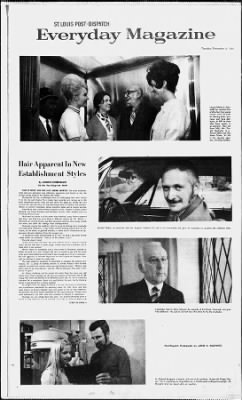
This week I look at a newspaper article from the St. Louis Post-Dispatch, which not only mentions my grandfather, Melvin L. Newmark, but provides a photograph, as well.
St. Louis Post Dispatch, November 6, 1969, p. 71
Top Photo Caption: Lawyer Melvin L. Newmark has received lots of attention from young women since he grew his flowing silver mustache and long sideburns. At left he chats with three women in an elevator. They are (from left): Mrs. Ronald Oestreich, Mrs. Robert Miller and Miss Karen Scherr. At left is the elevator operator, Van Dyke Johnson.
Hair Apparent In New Establishment Styles
By Connie Rosenbaum
Of the Post-Dispatch Staff
Hair is here and not just among hippies. The most Establishment men are sprouting long sideburns, mustaches and beards to join the current young swing to the sensual and tactile.
Throughout the city, middle-aged men are challenging their sons’ claims to be far out and freaky. As a result, fuzzy growths are turning up in the most unexpected places. They are still above the upper lip, beside the ears or over the chin but they are now decorating faces in doctors’ and dentists’ offices, in lawyers’ chambers, behind executive desks and in funeral parlors.
Inspired by such varied figures as Gen. Ulysses S. Grant, Luther Burbank, the Smith Brothers and Abraham Lincoln, older modern men are imitating famous faces.
Motivated by fashion and fun rather than rebellion, many fathers reported that their new look has given them a different outlook on life. Melvin L. Newmark, an over-50 lawyer, said that increased attention from young women has more than offset the ribbings from contemporaries.
Newmark reports that suddenly, after he grew his flowing silver mustache and long bushy sideburns, young women started flocking around him. In elevators, on the street, in gasoline stations, in stores and in restaurants his appearance attracts attention from the younger set.
“I was never really noticed before in my life,” he said, a big smile clearly visible below his mustache. “Now all of a sudden, I am.”
His wife doesn’t mind.
“Life is much more fun now,” she said. “Melvin loves to shop for colored shirts and we both like to dress young. People tease him sometimes, but I think they’re just jealous.”
Notes:
1) I was born in 1969 and never knew my grandfather before he grew his mustache and sideburns. He kept them after the fashion subsided. It was fun reading about his decision to grow them.
I continue my project to transcribe family letters, journals, newspaper articles, audiotapes, and other historical artifacts. Not only do the documents contain genealogical information, the words breathe life into kin - some I never met - others I see a time in their life before I knew them.
This week I look at a newspaper article from the St. Louis Post-Dispatch, which not only mentions my grandfather, Melvin L. Newmark, but provides a photograph, as well.
St. Louis Post Dispatch, November 6, 1969, p. 71
Top Photo Caption: Lawyer Melvin L. Newmark has received lots of attention from young women since he grew his flowing silver mustache and long sideburns. At left he chats with three women in an elevator. They are (from left): Mrs. Ronald Oestreich, Mrs. Robert Miller and Miss Karen Scherr. At left is the elevator operator, Van Dyke Johnson.
Hair Apparent In New Establishment Styles
By Connie Rosenbaum
Of the Post-Dispatch Staff
Hair is here and not just among hippies. The most Establishment men are sprouting long sideburns, mustaches and beards to join the current young swing to the sensual and tactile.
Throughout the city, middle-aged men are challenging their sons’ claims to be far out and freaky. As a result, fuzzy growths are turning up in the most unexpected places. They are still above the upper lip, beside the ears or over the chin but they are now decorating faces in doctors’ and dentists’ offices, in lawyers’ chambers, behind executive desks and in funeral parlors.
Inspired by such varied figures as Gen. Ulysses S. Grant, Luther Burbank, the Smith Brothers and Abraham Lincoln, older modern men are imitating famous faces.
Motivated by fashion and fun rather than rebellion, many fathers reported that their new look has given them a different outlook on life. Melvin L. Newmark, an over-50 lawyer, said that increased attention from young women has more than offset the ribbings from contemporaries.
Newmark reports that suddenly, after he grew his flowing silver mustache and long bushy sideburns, young women started flocking around him. In elevators, on the street, in gasoline stations, in stores and in restaurants his appearance attracts attention from the younger set.
“I was never really noticed before in my life,” he said, a big smile clearly visible below his mustache. “Now all of a sudden, I am.”
His wife doesn’t mind.
“Life is much more fun now,” she said. “Melvin loves to shop for colored shirts and we both like to dress young. People tease him sometimes, but I think they’re just jealous.”
Notes:
1) I was born in 1969 and never knew my grandfather before he grew his mustache and sideburns. He kept them after the fashion subsided. It was fun reading about his decision to grow them.
Subscribe to:
Posts (Atom)