Monday, January 12, 2026

Sale of 1122 North Eighth - 1895

Amanuensis: A person employed to write what another dictates or to copy what has been written by another. 

I continue my project to transcribe family letters, journals, newspaper articles, audiotapes, and other historical artifacts. Not only do the documents contain genealogical information, the words breathe life into kin - some I never met - others I see a time in their life before I knew them.

I've written before of the "Eighth Street Yard" - located at 1122 North Eighth Street in the City of St. Louis's third district. According to the 1900 census, my second great grandfather, Selig Feinstein, was the owner. I wondered when he purchased the building, and have finally located a newspaper article describing the sale. Written in 1895, the article is filled with racist language and purple prose that one would not find in today's papers.


Sale of 1122 North Eighth to Selig Feinstein and Max Wieselman

Article from Jun 28, 1895 St. Louis Globe-Democrat (St. Louis, Missouri)

 PASSING OF A CRIME CENTER. 

The "Eighth Street Yard" to Be Made the Home of Peace. 

Warfare and Wassail No Longer Prevail in the Place that Made the Third District Notorious -- "Little Jerusalem" Will Absorb It. 

"Ichabod" is written in dull, dead letters all over the "Eighth Street Yards," and their somber hues have spread over all the Third Police District, enveloping it in a haze of gloom. Silence and somnolence reign in the place of rum, ruin and riot, and the queen of Castle. Thunder, the Liliuokalani of North St. Louis, has been deposed. The vigilant guardian of the public peace now walks his beat in solitude, and hears not the sound of the growler as it moveth in the alley, and starts no more at the ripping sound of the knife as It plows its way through Ethiopian cuticle. The echo of the bulldog revolver has died away; the pickaninnies and their progenitors have gone hence. The Eighth Street Yards are deserted, and Capt. Peter Joyce and his vigilantes mourn because of their desolation and refuse to be comforted. Has not the "Bloody Third" become the abode of peace? There is nothing left but to mourn. 

The Eighth Street Yards, the scene of more bloodshed and crime than any other spot in St. Louis, have been notorious for a quarter of a century. They are located at 1116-1122 North Eighth street, extending back to the alley which runs through the square from Carr to Biddle street. The houses facing on Eighth street are located 10 feet above the level of the street, and are reached by means of winding steps. Between the street and the alley, bounded on the north and south by tenement houses, is a clear area about 40 feet square which has been soaked with human blood ten times over. The houses are all brick structures, scarcely fit for habitation by human beings, yet within their dingy walls for more than a score of years negro roustabouts and other offscourings of the race have met for revel and battle. Years ago the place became notorious, and did much toward winning for the district the sobriquet of the "Bloody Third." The yards are only half a square from the police station. Immediately at the north, in the alley between Seventh and Eighth and Biddle and O'Fallon streets, is the equally notorious "Wild-Cat Chute," while just east of the station, between Sixth and Seventh, Wash and Carr streets, is "Clabber Alley,' whose euphonious title has long: been familiar to the crime-reading public. This trio of rallying places for the infamous made life in the "Bloody Third" a hideous nightmare for many, and Capt. Peter Joyce, a graduate of West Point, a veteran of the civil war and a fighter of the redman, found it impossible to subdue their inmates, not being allowed the use of cavalry and cannon in his crusade against crime. 

But what the police failed to do a peaceful transaction has accomplished, and the Eighth Street Yards have gone "glimmering through the gleam of things that were." The houses have been sold to Max Wissellman and S. Feinstein, of 1108 North Eighth street, and they will be remodeled and refurnished and rented to Jewish families. The work of reconstruction has already commenced, and a boys' school is temporarily in operation in one of the rooms adjoining Castle Thunder. The "yards" will soon be an addition to "Little Jerusalem." 

The passing of the Eighth Street Yards recalls many tales which have long since become incorporated in the unwritten history of the place. The gleam of the razor, the echo of the revolver, the rattle of the patrol wagon, the shouts of hate and derision and the vigorous thump of the policeman's club all come back as plain as yesterday. In the background along with others who come. trooping at memory's call, is the herculean frame of "Big-Lip Lou," King of the Eighth Street Yards. Years ago he took up his abode in Castle Thunder, and his prowess in attempting to extend the power of his razor and his big right arm into the confines of Wild-Cat Chute and Clabber alley won for him the title of king. Lou was one of the biggest roustabouts that ever "run the river." His word was law to his scores of black subjects, and many a charge he led against the denizens of the two settlements which aspired to be more bloody than his own. For months and years he reigned with absolute tyranny, but dissensions finally arose in the midst of his bailiwick, and he went down before the hand of one of his own subjects. 

There, too, is "Beggie," the Bacchanalian Queen, whose dynasty perished with her. Beggie had two sons, both well-to-do, but she foreswore their love protection for that of John Barleycorn, and many a night she spent in his company in Castle Thunder, where she finally died amid the turbulency of her surroundings. The negroes regarded her with admiration, and the power which she wielded over them was second only to that of a cannibal queen. 

Capt. Joyce regards with apprehension the decline his domain, and Patrolmen Simcox, Knollhoff, Mader, and Taylor sigh disconsolately as they muse upon the fall of the empire which each of them invaded many times, and oft with results more than once deadly and disastrous. Patrolman Mader, now of the Fifth District, once went into the yards to arrest a negro, and was shot in the groin. The negro attempted to escape amid the confusion, but a bullet from the officer's revolver killed him instantly, and the policeman, who had gone in single-handed, was glad to escape with his life. Patrolman Simcox, they say, is more melancholy than all the others, and often twangs his club viciously on the sidewalk at the dead of night, as though all joy had been taken out of the police business and there were no further use of living. In the meantime the desk sergeant at the station smiles, the turnkey is happy, and at police headquarters there is a general feeling of relief.

Notes:

1) The article spells my ancestor's partner's name as Max Wisselman, but I know it is Max Wieselman, with whom he filed a patent in 1898. I was unaware he was a partner in the real estate purchase as well.

2) It appears the Jewish School at 1122 North Eighth in the 1909 Sanborn Maps was created in 1895, when my second great grandfather purchased the building, so it is likely my great grandfather attended the school.

Sunday, March 23, 2025

Identifying Photographs

 It's a frustrating experience going through old photographs that aren't labeled on the back. Sometimes you can tell who people are from what else is in the picture, or who they are with. Sometimes you can make educated guesses, but those guesses can turn out wrong.

For example: There is a photograph from the wedding of my great-grandfather's brother, Harry Feinstein. 

Family identified the four men standing next to him as his brothers. However, I knew this couldn't be the case as the youngest brother would have been 7 at the time of the wedding. Ultimately I found a newspaper article listing all the groomsmen and bridesmaids. I still can't for certain identify which is which, but I have a list. The newspaper article didn't identify the flower girls.


So what do you do when you find an image of an alleged relative online? Do you trust that the photo was identified correctly? The two images below are identified as Andrew David Van Every (1795-1873) and his wife Nancy Lucinda Van Sellas Van Every (1803-1880). They were my third great-grandparents. They would be the only third great-grandparents I have photographs of. 

Photography existed in the 1860s and 1870s. And the photographs look contemporary to that era. I've contacted the individuals who posted these images online to see if they have more information - such as what year they were taken. But knowing how easy it is to misidentify a photograph, I hesitate adding these photographs to my collection with any certainty.


Thursday, February 27, 2025

A Unique Family Heirloom

 Below is a picture of a wishbone from a turkey.

A turkey my grandmother baked for her parents’ 50th Wedding Anniversary in 1962


I think I can safely say the wishbone is at least 63 years old. 

I do not know the age of the turkey when it was slaughtered.

Some might question why I have it.

1) My mother only found the wishbone and note in her items a month or so ago. Obviously, she knew what to do with it. She called me.

2) If anything else was going to be done with the wishbone, it had to have been done 63 years ago. At this point, it would be a crime not to see how many more generations it can be passed down.

3) There have been discussions involving appropriate preservation and display options.

4) I did take a photograph. Just in case it mysteriously disappears.

Here is a photograph of my great grandparents - Herman and Annie (Blatt) Feinstein from May of 1962.

I know the date of the photograph due to a black and white version which appeared in their community newsletter congratulating them on their anniversary.


Monday, February 24, 2025

St. Louis's Lung Block - Carr Square

I wrote about the neighborhood my second great-grandfather Selig Feinstein lived in, which was known by several colorful names due to a reputation for criminal activity - Eighth Street Yard, Castle Thunder, and Wild Cat Chute.

He is not the only ancestor who lived in a locally well-known neighborhood. My second great grandparents Sam and Rose Newmark, and their family lived in the 1600 block of Wash Street in the 1910 census, and the 1500 block in 1920. (I have marked in blue where they lived.)

The 1908 Housing Report ended at 14th Street, on the other side of Carr Square, but I have a feeling their conditions may have only been slightly better, if at all. The neighborhood became known as The Lung Block. (A term possibly borrowed from New York City.)

From Rediscovering St. Louis's Lung Block

In early 1940s, well before the infamous Pruitt-Igoe housing complex would be built and destroyed just a few blocks south-east, another North Central St. Louis neighborhood stood condemned. Carr Square was known by its nickname “the lung block” for its high rates of tuberculosis deaths, and had been designated a blighted neighborhood to be torn down in one of the first slum-clearing projects in St. Louis made possible by the federal New Deal.

The article states that the reputation for high levels of tuberculosis in the neighborhood date back to the early 1900s. The below WPA map from the article visually illustrates the concentration of tuberculosis deaths in the city in the early 1930s.


Tuesday, February 18, 2025

A Place of Many Names - Eighth Street Yard, Castle Thunder, Wild Cat Chute

When researching the neighborhoods your ancestors lived in, it's important to know all the names the area was known by. Sometimes there were many.

My second great-grandfather, Selig Feinstein, resided in the city of St. Louis, Missouri at 1122 North Eighth Street in 1900 with his family. (Including his mother, wife, and seven children). According to the census he was the owner of the building, and in addition to his 10-member family, 26 other individuals lived at the same address. Two of those 26 were Selig's sister, Rebecca, and her husband, Reuben Portnoy. The other 24 were, to my knowledge, unrelated, but all immigrated to America from Russia. They lived in the tenement district. The 1908 Civic League of St. Louis Report - Housing Conditions in St. Louis - provides a detailed description of the neighborhood.

A couple years ago I discovered that the block where the Feinstein family lived was also known as the Eighth Street Yard, and was well-known for criminal activity in the 1880s and 1890s. Newspaper stories about the address stop prior to 1900.

The Eighth Street Yard isn't the only term reporters used for the area. It took me a while to realize this, but the reporters occasionally wrote in the residents' dialect, so I found a few news stories by searching for "Ate Street Yard."

Another colorful phrase they used, as the article below points out, was "Wild Cat Chute."

De Ate Street Yard (8th Street Yard)

Article from Jul 31, 1892 St. Louis Post-Dispatch (St. Louis, Missouri)

The building next door, comprising 1124, 1126, and 1128 North Eighth Street, was known as Castle Thunder. (Named after a Confederate prison in Virginia.). The 1882 article below provides its entire history, from when it was built, and through a series of owners.

History of St. Louis's Castle Thunder

Article from Jul 20, 1882 St. Louis Globe-Democrat (St. Louis, Missouri)

 The below article provides some sketches of the inside of "Castle Thunder," and some vivid descriptions. While the article is from 1884, a good fifteen years before my ancestors may have moved in, and the Castle Thunder building was next door to the one Selig Feinstein and his family lived in, from the 1908 Housing Report on the tenements, I suspect the conditions were similar.

Sketches and Description of Castle Thunder

Article from Dec 6, 1884 St. Louis Post-Dispatch (St. Louis, Missouri)

The 1909 Sanborn Fire Insurance map provides the layout of the block. I believe the pink buildings are made of stone or brick, while the yellow are wood frame. The map shows how 1124, 1126, and 1128 are all one building. That's Castle Thunder. The empty space between the tenements is the Eighth Street Yard. By the 1910 census my second great-grandfather is no longer living at 1122, however, his sister Shprintze (Sylvia) Babchick and her family is. 

I've written past posts on the conditions in the tenements

It's disturbing to think about the squalor my ancestors lived in. However, I am proud of and thankful for their ability to climb their way out of those conditions.

Sunday, February 16, 2025

Community History Archives

Recently I learned about a new free archive website - Community History Archives

From their website:

The archives are across the United States and Canada. You can search or browse for communities, and then choose from one or more libraries nearby.

The number of participating libraries varies widely by location. Iowa has 247 libraries participating. Canada has 3. Texas has 57. Missouri has 2.

You are unable to do a sitewide search. You have to go to each community archive separately and search there. However, I have already found newspaper articles I had not found on other newspaper archive websites.

Including this little blurb by a newspaper's editor praising my great-grandfather's honey. 

It's also interesting to see that in 1905 there were already enough people choosing to have some food items shipped to them that the newspaper would address them.


The Hays County Time.
July 28, 1905

The finest honey on the market, so far as we have observed, is that shipped here by Mr M E Van Every, of Maxwell. Here is another pointer for those who would "live at home."

Monday, November 18, 2024

Barney Newmark's 1921 Oakland

Over the weekend St. Louis County Library shared a link to their Digital Archives on social media. It's been around since March, but I hadn't realized it.

Searching the archives, I found a reference to my great grandfather in the 1921 St. Louis City/County Auto Registrations Directory

Organized by registration number, these would be next to impossible to browse if they weren't digitized and made searchable. I knew Barney's address from city directories and census records.

Oakland, a division of General Motors, would later change its name to Pontiac. 

I've long had a photograph in my collection of my great grandfather, Barney, great grandmother Bertha, and their two sons, Melvin and Harold - standing in front of a car. There was no date on the photograph. Since there are multiple cars in the background, I surmised they were on a parking lot. But they could easily be on a sales lot as well. In 1921 Melvin would have been 9 and Harold 6. That seems about right for the photograph.


The directory only tells us the make, not the model. We don't see much of the car in the background. But assuming it's a 1921 Oakland, I have been able to find online images of a coupe, touring car, and a sedan. For a family of four, it's not difficult to guess which one they bought. 

There's no guarantee that the photograph is of them purchasing the car, but it seems likely. 

This doesn't add a lot of genealogical information, but it does provide a very likely year for a photograph. 

Monday, March 4, 2024

Amanuensis Monday: Biography of Martin Deutsch - 1963

Amanuensis: A person employed to write what another dictates or to copy what has been written by another. 

After a long hiatus, I continue my project to transcribe family letters, journals, newspaper articles, audiotapes, and other historical artifacts. Not only do the documents contain genealogical information, the words breathe life into kin - some I never met - others I see a time in their life before I knew them.

Below I transcribe an article found at Newspapers.com providing a nice biography of my maternal grandfather, late in his career.


Martin Deutsch, bio

Article from Apr 18, 1963 The Crane Chronicle (Crane, Missouri)
Meanwhile, for the local postal dedication, the Postmaster announced that the principal speaker will be Mr. Martin J Deutsch, Director, Engineering and Facilities Division. St Louis Regional Office. 

Mr. Deutsch was raised in Chicago where he attended the public schools, including a technical High School and Junior College. He received a LLB from DePaul University and is a member of the Illinois Bar. He has been with the Postal Service during his entire adult life, starting out as a postal clerk in the Chicago Post Office in 1925. He was a Postal Inspector (St. Louis Division) for about 25 years, specializing in buildings and facilities in Missouri, Iowa, and Arkansas. Subsequently, he was re-assigned as Real Estate Officer in the St. Louis Region. He has occupied his present position as Director Engineering and Facilities Division, St Louis Region, since establishment of the office in late 1962. 

Mr. Deutsch served in Africa and the Caribbean Area with the Air Transport Command during World War II. He has two married daughters _______, Pt Washington, New York, and _______ Lincoln, Nebraska.
 
Notes

1) I continue my practice of leaving out the names of living relatives. However I will note that in both instances the individuals were residing in locations they were only in briefly, so it was a well-timed newspaper article.

2) I am fascinated by the detail the newspaper article went into the career and family of my grandfather when he was simply a speaker at a building dedication.

3) This does suggest he maintained his membership with the Illinois Bar Association even though he never practiced as a lawyer.

Saturday, November 18, 2023

Solving the Blatyta Wajman (Blatt Wyman) Conundrum

I’ve written before about a conundrum between records uncovered and family lore in my Blatyta/Blatt line. I’ve uncovered a possible explanation behind the conundrum.

Family lore:

  • Morris Blatt (Moshe son of Jacob) and Belle Wyman were married in Łosice, Poland.  
  • They had two daughters: Blanche and Annie. 
  • Belle died of a bee sting in Poland, but likely after Morris and Belle had separated/divorced. 
  • Morris, Blanche, and Annie immigrated to America (St. Louis, Missouri). 
  • Morris married Mollie Kellner in St. Louis, and they had two more children. 
  • Blanche married Joe Wyman, and there were family jokes about whether she married a cousin.

Earlier Research:

Early in my research, I received well-cited research done by a cousin stating a Moshe (son of Yankiel) Blatyta married Chaia Beila Boksern in Losice. Yankiel is a common nickname for Jacob. When I uncovered the actual marriage record, it confirmed that this was the first marriage for both individuals.

How could Chaia Beila’s daughters be confused about their mother’s maiden name to the point that a family joke developed? Perhaps there were Wymans in her family tree, but there seemed to be some certainty that Belle was a Wyman herself. Could there be two Moshe sons of Jacob? We did not have birth records for Blanche or Anna. The records for their years of assumed birth do not appear to have survived. Even for years that records survived, the records are likely not complete.

Morris arrived in America in September 1889. In 1900 he, Blanche, Anna, his second wife, and their one son, are all living in St. Louis. (Morris and Mollie’s second child, a daughter, would be born in 1903.) Additional records uncovered there was a son of Morris and Molile who died as an infant in the intervening years.

Of course, there's an 11-year gap between 1889 and 1900. The missing 1890 census rears its ugly head.

Recent Research:

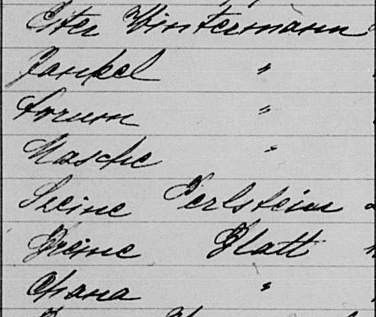
Recently I uncovered the immigration records for Blanche and Annie – in 1899. Ten years after their father. They were traveling under the Hebrew names of Breine and Chana, with Esther Winterman and her children, Yankel (Jacob), Abram, and Masche (Mary).


The manifest records them all as meeting a B. Winterman in St. Louis, with him identified as Esther’s husband, and the father of both the Winterman and Blatt children. In 1900 Esther and her children are living in St. Louis with Henry/Harry Winterman. (Confusion of first names isn’t impossible. Multiple names are common.)


We were familiar with the Winterman family. We knew them as some sort of Wyman cousins. We hadn’t yet identified how.

It’s possible if Morris and Belle really did separate as family lore suggests, the children remained with the mother. After Chaiia Bella died, it appears Blanche and Annie were raised by the Wintermans. So they could easily have viewed Esther as sort of a mother figure, even if they knew it wasn’t biological. 

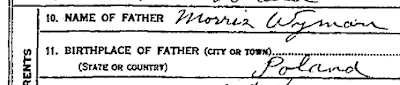
According to her death certificate, Esther’s maiden name was Wyman. 


With the assistance of the cousin I mentioned in the first paragraph, we have uncovered Esther Wajman’s birth record in Polish archives, along with the birth records for two of her three children on the manifest. 

It isn’t difficult to hypothesize confusion – not on the maiden name of their mother – but a confusion of details between biological and adoptive mothers.

I still need to figure out how Esther Wyman Winterman and Chaia Beila Boksern Blatyta were related, if they were. But absent birth records for Blanche and Annie, I am more confident Chaia Beila was their mother. We may never be able to find those records, so we need to do the best we can with the records that have survived.

Sunday, November 5, 2023

Timeline for Samuel Joseph Newmark 1862-1940

Timelines can be a great tool. They can illustrate what records have been obtained, and what might be missing. Gaps of knowledge can sometimes be better seen. Last year I posted timelines for three of my four paternal 2nd great-grandfathers. I actually created the below timeline back then as well, but didn't post it. There may have been some dates I wanted to look up.

For Sam, and his wife Rose, most of the records I have, beyond passenger manifests, are dates pertaining to the life events of his children. The dates for all events in Poland are based on when anniversaries were observed, or dates recorded on later records.

Timeline for my 2nd great grandfather, Samuel Joseph Newmark
    • 1862 - Samuel Joseph Newmark was born to Israel David & Leah in Warka, Poland 
    • Dec 17, 1880 - married Rose Cantkert 
    • Sept 15, 1882 - Son, Solomon born in Warka 
    • March 25, 1886 - Son, Barney born in Warka 
    • Dec 25, 1886 - Daughter, Nellie, born in Warka 
    • March 4, 1890 - Daughter, Bella, born in Warka 
    • Aug 16, 1892 - Son, Meier/Max, born in Warka 
    • 1893 - Family immigrates to London, England 
    • October 1893 -- Nellie and Bella enroll at Westminster Jews Free School in London. (Boys records did not survive)
    • Nov 27, 1894 - Daughter, Kate, born in London 
    • Aug 16, 1896 - Daughter, Cecile, born in London 
    • August 1898 - Nellie and Bella leave Westminster Jews Free School (Reasons given: Required at Home/Work) 
    • Aug 31, 1902 - Son, Solomon, marries Sarah Nathan at the Great Synagogue in London
    • Apr 3, 1903 - Son Israel David born in London 
    • Nov 30, 1903 - According to a passenger manifest, Samuel may have traveled to the US. 
    • March 9, 1904 - Granddaughter, Minnie Bertha, born to Sol and Sarah in London
    • March 21, 1905 - Grandson, Israel David, born to Sol and Sarah in London
    • Aug 27, 1906 - Grandson Moses (Maurice) born to Sol and Sarah in London
    • May 11, 1907 - With son, Barney, visited North America. Landed in Quebec. Crossed the border to the US in July. Returned to London.
    • Oct 14, 1908 - With sons, Sol & Barney, arrived in the US
    • March 21, 1909 - Rose and the remaining children and grandchildren arrive in the US.
    • April 19, 1909 - Granddaughter Esther born to Sol and Sarah (dies as an infant)
    • Jan 30, 1910 - Daughters Nellie and Bella marry Morris Fudemberg and Charles Cohen in a double wedding in St. Louis
    • Feb 7, 1911 - Granddaughter Bess born to Bella and Charles Cohen
    • Aug 27, 1911 - Son, Barney, marries Bertha Cruvant
    • April 27, 1912 - Granddaughter Sylvia born to Nellie and Morris Fudemberg
    • Aug 27, 1912 - Grandson, Melvin, born to Barney and Bertha
    • Feb 6, 1913 - Daughter Kate marries Phillip Jacobs in St. Louis, MO
    • Feb 7, 1913 - Son, Max, marries Dora Neustetter in Chicago, IL
    • Dec 16, 1913 - Daughter Natalie born to Kate and Philip Jacobs in Chicago
    • About 1914 - Daughter Cecile marries Hyman Gold in St. Louis
    • April 14, 1914 - Grandson Adolph Abraham (Andy) born to Bella and Charles Cohen
    • June 27, 1914 - Grandson  Nelson born to Max and Dora Newmark
    • Dec 23, 1914 - Granddaughter Nellie, born to Sol and Sarah
    • Sept 26, 1915 - Granddaughter Bernice, born to Cecile and Hyman Gold in St. Louis
    • Dec 17, 1915 - Grandson Harold Carl, born to Nellie and Morris Fudemberg
    • July 27, 1916 - Grandson Harold Irving David born to Kate and Philip Jacobs in Chicago
    • April 6, 1918 - Grandson Harold born to Max and Dora Newmark
    • Oct 11, 1918 - Grandson Paul William born to Nellie and Morris Fudemberg
    • Feb 24, 1923 - Granddaughter Minnie Bertha dies.
    • Feb 27, 1923 - Grandson Irving born to Nellie and Morris Fudemberg
    • July 13, 1923 - Granddaughter Bernice born to Bella and Charles Cohen
    • Jan 1927 - Son Israel David marries Clara Rubin 
    • Sept 25, 1928 - Grandson Victor born to Cecilie and Hyman Gold, in East St. Louis, IL
    • Dec 9, 1928 - Grandson Philip born to Israel David and Clara
    • Jan 31, 1931 - Son, Max, died. (Shot by burglar) 
    • March 28, 1932 - Grandson, Mark, born to Israel David and Clara
    • Dec 4, 1934 - Son, Sol, died. 
    • 1936 - Grandson, Melvin, marries Belle Feinstein
    • 1938 - Great Grandson, ___, born to Melvin and Belle 
    • July 20, 1940 - Samuel Joseph died.
    Notes

    1) Samuel Joseph and his wife, Rose, were my only 2nd great-grandparents to live to see a great-grandchild. (I tend to leave out names and dates for living kin.)

    2) February 6th and 7th 1913 was a Thursday and a Friday. Did Sam and Rose manage to attend both of their kids' weddings, one in St. Louis, and one in Chicago, one day apart? What about the siblings? It's a six-hour drive, and there were trains, so it's not impossible. Couldn't the couples have arranged that better for the family?


    Saturday, October 28, 2023

    The Jersey Settlers of Adams County MS

    I haven't posted in awhile, but there are several entries in my drafts folder, which I will finish editing..

    Recently I went in search for information on Rev. Samuel Swayze, the brother of my 5th great grandfather, Israel Swayze. My search led me down a fascinating trail. My ancestor, Israel, like many Loyalists, fled to Canada after the Revolutionary War. But his brother, Samuel, left New Jersey in 1773 for the British Colony of West Florida.

    Most people, including me until recently, when asked would say Florida was a Spanish colony. And it was. But Spain traded it to Britain for Cuba in the 1760s. Britain divided it, and territory received from France, into East Florida and West Florida

    During the Revolution, Florida mostly remained Loyal. When Britain lost, it appears they essentially abandoned their newer colony as well, so Spain retook control.

    Rev. Samuel Swayze, his family, and 14 other interrelated families are known as The Jersey Settlers of Adams County, MS. (Natchez). 

    1. Swayze, Rev. Samuel and wife, Hannah Horton
    2. Coleman, Jeremiah and wife, Hannah (Swayze) Coleman (1733-1807)
    3. Unknown and wife, Phoebe Swayze (1735-bef.1787)
    4. Samuel Swayze Jr (1737-1800) and wife, Elizabeth Putnam
    5. Nathan Swayze (abt.1740-1819) and wife, Bethia (Hopkins) Swayze (1747-1840)
    6. Elijah Swayze (1741-abt.1814) and wife, Polly White
    7. Stephen Swayze (1743-1776) and wife, Rachel Hopkins
    8. Obidiah Brown and wife, Penelope Swayze (1756-1836)
    9. Swayze, Richard and wife, Sarah (Horton) Swayze
    10. Gabriel Swayze (1745-1814) and wife, ______ Clark
    11. King, Caleb and wife, Mary Swayze
    12. King, Justus and wife, Sarah (Swayze) King (abt.1740-)
    13. Richard Swayze Jr (abt.1746-) and wife, Hannah Budd|
    14. Cory, Job and wife, Lydia Swayze (abt.1755-)
    15. Luce, Israel and wife, Deborah (Swayze) Luce (abt.1754-1828)

    I’m related to several families on the list. Shared surnames include Swayze, Horton, Coleman, Clark and King. Without more information on Gabriel Swayze's wife, I am uncertain if it is the same Clark family, but there is a good chance. My fourth great-grandfather, Israel's mother-in-law was Abigail Clark Coleman. The linked website has a lot of research on the families demanding my attention.

    Notable descendants of these settlers include actor, Patrick Swayze (1952-2009), and cartoonist, Marc Swayze (1913-2012), co-creator of DC's Mary Marvel.

    Tuesday, May 30, 2023

    Chloe Cooley, Adam William Vrooman, and My Family Tree

    I've written a few times about my Van Every ancestors ties to slavery.
    I am back again with their ties to another slave. A historical one, that many Canadian schoolchildren might have been able to tell me about ten years ago if they read my posts.

    Who was Chloe Cooley?

    Chloe Cooley was a young black woman held as a slave in Fort Erie and Queenston, Upper Canada in the late 1700s, as the area was being settled by Loyalists from the United States. Her owner forced her into a boat to sell her in 1793 across the Niagara River in the United States.

    This incident was observed by several witnesses, who petitioned the Executive Council of Upper Canada. Although charges were dropped against Cooley's owner, the incident is believed to have led to passage of the Act Against Slavery, 1793, in Upper Canada. It prevented slaves from being imported into the province and provided for gradual abolition of slavery within a generation among those held there. 

    Who was the Loyalist owner? Adam Vrooman. (Some sources give his name as William)

    Source (Wikipedia entry)

    About 1784 Adam Vrooman and my ancestor, McGregory Van Every likely shared a lot. 

    Source: Niagara Historical Society Publication Number 27.

    Geo Vanevery is almost certainly McGregory. No known son or close kin of McGregory was named George. McGregory is listed as one of the original 1782 settlers in the First Census of Niagara, 25th of August, 1782. 

    In that census there was one male slave, belonging to Thomas McMicken. That slave had been incorrectly assigned to McGregory by some researchers, which I clarified in Following the Citations in 2012. Vrooman isn’t in the original census, so he arrived between 1782 and 1784. 

    Why would Adam Vrooman and McGregory Vanevery share a lot?

    Good question. I have a couple possible answers. 

    1) They were cousins. Or at least the families were close.

    Looking at my family tree, it suggested a Sara Meyndertse married a Jacob Vrooman in the early 1700s. There was no specific date, and no source. It's continually frustrating that I wasn't very good at citing sources in early research. 

    Sara appears to be the great-granddaughter of Myndert Fredericksen. McGregory was the great-grandson of Myndert, so second cousins with Sara. His children would have been third cousins with any children of Sara and Jacob.

    Wikitree says Adam’s parents were Jacob Vrooman and Rachel Van Woert. And that Jacob and Rachel were married in 1743. 

    Wikitree has no definite spouse of Sara Meyndertse, but questions whether she married Jacob Vrooman. If you look at the entry, you will see I added her entry in 2011. Since then someone has questioned her spouse. Did I make a mistake? 

    FamilySearch agrees with me, as does Ancestry, and they both cite New York Marriages, 1686-1980 for a 1742 marriage. So I have now added that as a source. 

    So there is a possibility there was a brief marriage between Sara and Jacob Vrooman, and that Jacob's children, including Adam, were not actually DNA cousins with my ancestors, though the families may have remained close. There is also a possibility there were two Adam Vroomans, marrying separate women.

    2) There are also suggestions that Abigail VanEvery, daughter of McGregory married either a Peter Vrooman or an Isaac Vrooman. There are also suggestions that this Vrooman spouse died in 1782 in New York. I am not certain what Abigail and a possible child did at that time, but joining her father in Niagara is certainly a possibility. Possibly along with some Vrooman kin. 

    Back to the events of 1793. 

    There was growing sentiment in Canada to free slaves, and owners were deciding to sell before being forced to free. Vrooman arranged a sale across the Niagara River in New York. Cooley fought back. 

    Vrooman beat Cooley, tied her up and forced her into a small boat, aided by two other men. (Wikipedia entry above)
    Who were the two other men? 

    Adam’s brother, Isaac, and one of the sons of McGregory Van Every. (Canadian Encyclopedia)

    [Another Isaac]

    Which son of McGregory? Every source I can find refers to the third individual in the same format. I suspect there is no document that specifically identifies him

    Records suggest, when Adam arrived in Niagara, he had another slave named Tom. Even if Adam was the owner, if the lot was a partnership with my ancestor, and they had familial ties, my ancestor likely directly benefitted, and likely approved. McGregory died in 1786, but at least one of his sons was close enough with Adam Vrooman ten years later to provide his assistance in what Canadians call the Chloe Cooley Incident. 

    Chloe Cooley received a postage stamp earlier this year. 

    Note: There are no known images of Cooley, so all images are artistic renderings.

    Other resources:


    Thursday, April 27, 2023

    National Library Week: Usefulness of a Library Card

     April 23-29 is National Library Week in the United States

    In 2010, 20122015, and 2019 I looked at the value of my St. Louis County Library Card with respect to genealogy research. I thought I would do that again.

    Here are 30 databases I can use to research genealogy courtesy of my library card. For most of them I can access the database at home, though a few are in-library only. Unfortunately, I don't get to the library very often, as the location closest to me is under construction.

    1. A to Z Maps Online
    2. A to Z the USA
    3. AAS Historical Periodicals Collection
    4. Academic Search Elite [EBSCO]
    5. Access World News
    6. African American History Online
    7. African American Newspapers: 19th Century
    8. American Ancestors (In Library Only)
    9. American Indian History Online
    10. Ancestry Library Edition (In Library Only) - Ancestry provided remote access for the first couple years of the pandemic, but they have stopped doing so.
    11. Archion (vital records for Protestant churches in Germany)
    12. Civil War: A Newspaper Perspective
    13. eBooks on EBSCOhost
    14. Ethnic NewsWatch [ProQuest]
    15. Factiva
    16. FindMyPast (In Library Only)
    17. Fire Insurance Maps Online (Missouri and Illinois)
    18. Fold3
    19. HeritageHub (Formerly America’s Obituaries and Death Notices)
    20. HeritageQuest Online
    21. Historical New York Times (ProQuest)
    22. Historical Newspapers US Major Dailies (ProQuest)
    23. Historical St Louis Post Dispatch (ProQuest)
    24. History Vault: Southern Life, Slavery, and the Civil War 1 & 2
    25. MyHeritage Library Edition
    26. NewsBank
    27. NewspaperArchive
    28. Newspapers.com
    29. Nineteenth Century US Newspapers
    30. ProQuest Digital Microfilm (NYTimes, St. Louis Post Dispatch)

    AmericanAncestors, Ancestry, FindMyPast, Fold3, MyHeritage, and Newspapers.com are all major subscription genealogy websites. Having free access to even basic/library versions is excellent.

    However - the St. Louis County Library system card is not the only library card I have.

    Six months ago I started employment at a local university. 
    So now I have access to their databases as well. Here's a selection:

    1. Academic Search Complete (1975-present)
    2. Adams Papers Digital Edition (Rotunda) (John Adams' papers)
    3. African Americans, Communists, and the National Negro Congress (Archives Unbound)
    4. African American Newspapers (ProQuest)
    5. African American Newspapers: 19th Century
    6. Al-Ahram Digital Newspaper Archive (Egyptian newspaper)
    7. Amateur Newspapers from the American Antiquarian Society (Archives Unbound)
    8. America in Protest: Records of Anti-Vietnam War Organizations, The Vietnam Veterans Against the War (Archives Unbound)
    9. America’s Historical Imprints
    10. American Civil War: Letters and Diaries
    11. American Hebrew and Hebrew Messenger 1867-1922 (New York newspaper weekly)
    12. American Historical Periodicals from the American Antiquarian Society
    13. American Israelite 1854-2000 (Cincinnati newspaper weekly)
    14. American National Biography
    15. American Periodicals 1740-1940
    16. American Religion: Denominational Newspapers
    17. Ancestry Library Edition (Still has Remote Access)
    18. Associated Press Collections Online
    19. Atlanta Constitution 1868-1945
    20. Atlanta Daily World 1931-2000
    21. Australian Dictionary of Biography

    And that's just a selection of resources starting with the letter A!

    The larger someone's family database is, the more it is true:
    you never know where someone's name will appear. 
    The university has over 1,100 online databases.
    I'm finding a lot of interesting things, even though I haven't been writing about them.


    Tuesday, January 10, 2023

    Tombstone Tuesday: Robert Lee (1895-1971) and Mabel Ada (1901-1991) Gober

     Robert Lee Gober (1895-1971) and Mabel Ada (Fulkerson) Gober (1901-1991) were my wife's great grandparents. The photograph below was taken July 3, 2015.


    Monday, January 9, 2023

    Amanuensis Monday: 1925 Trip of Myrtle Van Every

    Amanuensis: A person employed to write what another dictates or to copy what has been written by another. 

    I continue my project to transcribe family letters, journals, newspaper articles, audiotapes, and other historical artifacts. Not only do the documents contain genealogical information, the words breathe life into kin - some I never met - others I see a time in their life before I knew them.

    Below I transcribe an article found at Newspapers.com mentioning my maternal grandmother. It's very brief, but corroborates some photographs I have in my collection.


    El Paso, Texas
    28 Jun 1925, Sun
    Page 13

    Myrtle Van Every, formerly of El Paso and now of St Louis, is visiting her aunt Mrs. A.A.. Benold, of 908 Octavia street Last week Miss Van Every visited her sister at Fort Hancock. She will leave soon for California, stopping at the Grand Canyon. She will also go over the Canadian Rockies while she is away


    Notes

    1) Mrs. A. A. Benold (Minnie) was my grandmother's sister. Not her aunt. There were 16 years separating them in age. There were eight years separating my grandmother from her sister, Eva, who lived in Fort Hancock. 

    2) I have some photographs from the Grand Canyon. I do not know who her companion was.


    3) I also have a photograph I believe is from California. While I suspected she was in Hollywood from the caption, the article confirms she went to California as part of the same trip. I don't know her companions here, either. However, I do know she had first cousins living in California, and there is a good chance these may have been them. (Her father was one of over 20 siblings. While not all lived to adulthood, she had a lot of cousins.)


    Thursday, January 5, 2023

    Tracking Down a Death Record

    A search on a local genealogy society website uncovered a burial record for an infant in 1908. No given name, so I knew the child, if not stillborn, lived only a brief period of time.

    Unfortunately, while the index survived, the actual microfilm records for the particular month in 1908 did not survive. 

    So I contacted the cemetery. Only the book containing names and dates survived. The book with other information, such as parent names, did not. 

    That left me contacting the County Clerk. I was trying to avoid that until I verified that the infant was a kin. There are a limited number of potential fathers with the surname in the area, but not all are related to me. And I really do not like spending money on documents for non relatives, even if it is minimal. And in this case it was $20 plus VitalChek’s processing fee, which I do not consider minimal.

    I emailed the clerk and asked if they had any other process than VitalChek for non-certified copies. I got a very kind “Not usually, but I checked to see if we had the record, and there’s not much info on it. Here’s the scan. Happy New Year!” (Not exact wording.)

    It never hurts to ask. The clerk was correct - there wasn’t much info, but it did have the birthplace for both parents. (Not their names - just the birthplaces.) If that info is correct, the infant was not related to me. Related to somebody, though, so I will save it in my files in case I ever run into a researcher for that family.

    Sunday, November 27, 2022

    Ancestry U.S. Social Security Applications and Claims Index - App vs Website

    The information presented by Ancestry.com for the U.S. Social Security Applications and Claims Index is different depending upon whether you view it on a web browser, or their phone app.

    Here is what I see on a web browser (With name and SSN info removed. The individual is a second cousin of a grandparent. I am not in contact with their descendants.)

    ____ in the U.S. Social Security Applications and Claims Index 

    Name:
    Gender:Female
    Race:White
    Birth Date:26 Nov 1915
    Birth Place:St Louis, Missouri
    Death Date:14 May 1986
    Father:
    Mother:
    SSN:
    Notes:Nov 1936: Name listed as ________; Oct 1943: Name listed as _____; : Name listed as _______; 24 Mar 1988: Name listed as _______

    Here is what I see on my iPhone app for the exact same record:

    U.S. Social Security Applications and Claims Index 

    Name:
    Gender: Female
    Birth Date: 26 Nov 1915
    Birth Location: St. Louis, Missouri
    Death Date: 14 May 1986
    Father:
    Mother:

    As you can see there are a handful of fields that are completely left off of the record on the app. 
    • Race
    • SSN
    • Notes
    There is absolutely no indication on the app that they have expurgated this information from the record. Some sort of warning would be nice - informing the researcher they need to use a web browser to view all available information. (Or even better, include all of the information on the app.)

    In this case, the Notes information is critical. This is an index, and transcription errors can occur easily. While there is no reason to call into question the death date when viewed on the app, when viewed on the browser, the Notes section clearly indicates something is fishy. Why is a change in how the name is listed recorded two years after the supposed death?

    The tombstone and obituary for this individual indicate that the date of death was indeed in March of 1988. I fully suspect that something did occur in May of 1986. Possibly the change in name listing that has no date in the notes. And this somehow got recorded as the death date in the indexing. However, without having the additional records to refer to, if I relied solely on the information presented on the app, I would enter the wrong information into my tree, without questioning it at all.

    Sunday, November 6, 2022

    Did my second great grandfather, Samuel Newmark, make up a cousin while crossing a border?

    When my great grandfather, Barney, in July of 1907 crossed the Canadian border into the US, the Border Crossings document indicates the following:

    Barney Newmark, age 22, Tailor, Citizen of Canada, Hebrew, Last Resided in Winnipeg, Nearest Relative Mother Rosa Newmark in London, Final Destination St. Paul Minnesota, Joining a cousin, Joseph Newmark, on 344 Eagle Land Street, place of birth London England.

    Barney's father, Samuel, indicated at the same border crossing that he was:

    45, a tailor, citizen of Canada, Hebrew, Last resided in Winnipeg, Nearest relative wife, Rosa in London, visiting the same cousin, Joseph in St. Paul, and place of birth Warsaw, Poland. 

    Barney was not born in London. Later, for a local Who's Who of businessmen, he would claim he was born in Dublin, Ireland. It is almost certain he was born in either Warka or Warsaw, Poland, like his father. They were also not citizens of Canada. They had only spent three months in Canada, and I don't believe anyone in the family obtained citizenship in London even though they were there for 15 years. 

    Who is the cousin, Joseph, in St. Paul Minnesota? Is he another figment of  imagination? Eagleland is a very curious name for a street since America has an eagle for a symbol, and I am unable to find such a street in St. Paul or its vicinity The only Eagleland Street I can find is in Texas. Samuel's middle name was Joseph.

    However - nearby in Minneapolis, in 1907, there were families with the surname: Newmark, Neimark and Naymark. None that I can find with the given name Joseph. I suspect this cousin was an invention. But there remains a possibility that they existed.


    Tuesday, November 1, 2022

    Tombstone Tuesday: Sarah and Sol Newmark

    It’s been awhile since I participated in Tombstone Tuesday. I think I’ve shared all the images I have of ancestral tombstones, but I do have some of their siblings. 

    Sol Newmark was the eldest brother of my great grandfather, Barney Newmark. His wife, Sarah, was the daughter of Nathan Sandler. She alternated between using Nathan and Sandler as her maiden name.


    The Hebrew on the tombstone indicates that Solomon Hyman's religious name was the inverted Chaim Shlomo. Sarah's religious name was Sarah Tzerel, the latter a common Yiddish diminutive for Sarah. Her father's religious name was given as Nachum Aaron. The engraving on his tombstone is mostly gone, and only the first initial of his name readable. The rest of the Hebrew inscription provides the Hebrew calendar date for their deaths.

    Monday, October 31, 2022

    Amanuensis Monday: 1804 Origin of the Kruvand Surname

    Amanuensis: A person employed to write what another dictates or to copy what has been written by another. 

    I continue my project to transcribe family letters, journals, newspaper articles, audiotapes, and other historical artifacts. Not only do the documents contain genealogical information, the words breathe life into kin - some I never met - others I see a time in their life before I knew them.

    Below I transcribe an article found in The Historical Jewish Press archives at the National Library of Israel.


    Print Date: 29 October 2022. Source: Page 9, Indiana Jewish Post & Opinion, 15 October 1976 *** "Historical Jewish Press", The National Library of Israel and Tel Aviv University

    Your Name
    By NORBERT PEARLROTH

    Dear Mr. Pearlroth: I would like to know the meaning of, and whatever information you can give me on the following: KROOVAND - Father born in Lithuania. Very sincerely, William H. Kroovand.

    Kroovand is a family name of geographical origin. It is derived from the name of the district of Kruwonda located near Kovno in Lithuania. Kroovand is apparently an anglicized version of the geographical name. The district contained no villages or towns. It embraced 15 landed estates belonging to 15 land owning families. Your ancestor who adopted the name in 1804 was probably an employee of one of those landowners. 

    Notes

    1) Norbert Pearlroth (1893-1983) was the primary researcher for Ripley's Believe it or Not, 1923-1975, and wrote the weekly Your Name column for the Jewish Post of New York, researching origins of Jewish surnames.

    2) William H. Kroovand (1915-1987) was my second cousin twice removed. His father, Clarence, was indeed born in Lithuania in 1885 according to my records. The ancestor who adopted the surname in 1804 was either my 4rh great grandfather, Me'er Kruvand, who we only know was born before 1790, or his father, whose name we do not know.

    3) I wondered as to Pearlroth's source for the surname adoption in 1804, as well as the information on the number of estates. Pearlroth seems to imply the 15 estates existed around the time of the surname adoption. Though this is not clear. My ancestors left in the 1880s.

    The 1804 date turns out to almost certainly be based on Czar Alexander I's Edict of 1804, which

    required all Jews living in the Pale of Settlement (the territory where Jews were permitted to live in the Russian Empire, encompassing modern Poland, Lithuania, Belarus, Ukraine and Moldova) to adopt permanent surnames.

    Using the spelling of the town Pearlroth uses, which appears to be a Polish spelling, I found a source for the 15 landowners: Słownik geograficzny Królestwa Polskiego i innych krajów słowiańskich. T. 4, Warszawa : nakł. Filipa Sulimierskiego i Władysława Walewskiego, 1880-1914 (Geographical Dictionary of the Kingdom of Poland and other Slavic countries. T. 4, Warsaw: nakł. Filip Sulimierski and Władysław Walewski, 1880-1914)

    Computer translation of 2 entries:
    • Kruwonda, n. , the left tributary of the Łazdona, which flows into Dubissa, near her sink with the Nemunas. 
    • Kruwondy, the area of ​​gentry, on the riverside Kruwonda, poviat, Kaunas, parish Czekiszki, it has a wooden chapel, 15 owners, a loamy, fertile ground
    This may actually have been Pearlroth’s source, as bios say he knew multiple languages. If Polish was one of them, this is a likely book to be on his shelf if he’s going to write this weekly column. It's still not clear what year(s) the 15 owners references, but it seems to suggest it was true in the 1880s when my ancestors left. This adds to some information I learned about the town a few years ago.