Wednesday, January 23, 2008

Time Machine

Earlier this month there was a meme going around about where our ancestors were in 1908.

Donna, at What's Past is Prologue asks the obvious next question:

where were our ancestors in 1808?

I know less details about 1808. On my father's side, I know I had Cruvant ancestors in Cekiske, Lithuania, and Blatt ancestors in Losice, Poland. I know names and dates for some of them, but nothing more. My guess is that the Newmarks were in Poland or Russia, as were my other paternal ancestors, but I'm not certain exactly where.

On my mother's side, the Deutsch family was most likely in the Transylvania region. The earliest birthdate I have in that line is 1861, for my great grandfather, Samuel Deutsch, but I believe I know his grandfather's name, and that probably gets me close to 1808.

My Loyalist ancestors, the Van Everys, were still in Ontario, Canada, where they had fled after the Revolutionary War didn't go the way they had bet upon. Andrew Van Every was born in 1798 in Ontario, and he died there in 1873. His son, Samuel, is the same Samuel Van Every I once blogged about, who had 22 children. Samuel was born in Ontario in 1820, and he's the one who moved the family South, stopping for several years in Michigan, but heading further south until he couldn't go much further - in Texas.

Johanna Swayze and Elihu Stuart, parents of Abigail Stuart, Samuel Van Every's second wife, were also in Canada in 1808.

William Denyer was probably still in Hampshire, England. It's not certain when he immigrated. However he was born in 1794, so he would only have been 14, and there is no evidence he came as a child. However, he was in the US by 1821, when he married. His wife, Elizabeth Sliver, was a ten year old in Bucks County, Pennsylvania in 1808. Her great-grandfather, Henry Rosenberger, would be alive for one more year.

***
I'm going to pre-empt the next questions, and take this as far as I can now:

Where were my ancestors in 1708?

I'm going to guess my Cruvant ancestors at this point are in Kruvandai, Lithuania. It is thought that that is where their surname comes from.

Here's a picture of current day Kruvandai:


(found on photogalaxy, which allows personal usage in exchange for a link.)

I have no clue about any other paternal ancestors. On my mother's side I have more information.

Judge Samuel Swayze is on Long Island, NY, and his soon-to-be wife, Penelope Horton may still be in Cutchogue, NY, or perhaps Long Island, where they will raise a family.

Martin Van Iveren, born in 1685 in Kingston, NY, is probably still there. His son, McGregor Van Every, would be born in 1723 in Orange, NY.

***
Where were my ancestors in 1608?

Myndert Fredericksen was born in Everinghe, Holland in 1636, the son of Frederick Van Iveren. So it's a good guess Frederick, or Frederick's parents were in Everinghe in 1608.

John Swasey, born in 1600, was still in England, probably Suffolk where his son, John, would be born in 1619. Both would immigrate to Long Island.

Barnabas Horton, born in 1600, was also still in England, probably Mowsley.

***
Where were my ancestors in 1508?

Ancestry's OneWorldTree can give me some answers, but I have no reason to believe, or not to believe them. So we'll stop here.

Baby Names

Here are the Most Popular US Baby Names for 2006 (2007 won't be released for a few more months.)

Non-Geneablogger Slacktivist notes that biblical names are more popular for boys, and suggests seven women in the bible parents might wish to honor - and seven they might not.

I think his advice is pretty good.

Monday, January 21, 2008

Service to the Community

"Dr. Martin Luther King, Jr. sought to forge the common ground on which people from all walks of life could join together to address important community issues. On January 21st, 2008, millions of Americans across the country will once again honor his legacy by taking part in a wide range of service projects—conducting food drives, painting schools and community centers, recruiting mentors for needy youth, and bringing meals to homebound neighbors, to name but a few." -- MLKday.gov
It's also appropriate perhaps to honor the community service activities of our ancestors.

Tuesday night I made a discovery about my second great grandfather, Selig Feinstein. Apparently he was active in the Chesed Shel Emeth Society.

The Society was originally founded by Russian Orthodox Jews in St. Louis to provide free burial services to the entire Jewish Community. By not charging anyone, the needy didn't have to prove a level of need at a time of mourning. Once the cemetery was established, they moved on to other things, like establishing an Old Folks Home.

Selig’s name is mentioned in Zion in the Valley: The Jewish Community of St. Louis. This book was published in 1997, and is searchable at Google Books, which is where I found the information.
Those efforts reached a climax in the early 1900s. On February 15, 1906, at a banquet given by the Chesed Shel Emeth Society, some of its members proposed "to establish a home for old and infirm Jews and Jewesses where they shall be enabled to spend their remaining days in peace and comfort without being compelled to deny themselves their religious inclinations." With an overwhelming approval of those present, Society President John Ellman appointed a committee of Meyer Shapiro, Hyman Albert, and Selig Feinstein to consider further action. The committee in turn convened a mass meeting chaired by Rabbi Adolph Rosentreter to test reaction from more of the Jewish community. Both turnout and financial pledges at the gathering far surpassed even the most optimistic of expectations.
Selig's mother would die six months later in August of 1906, and it's possible he had some first-hand experience with the problems caring for an aging parent which may have been part of the reason he was assigned to the committee.

In the footnote, the book cited four issues of a newspaper I had never heard of - The St. Louis Jewish Voice. It was a newspaper of the local Jewish community from 1884-1920. A quick search turned up microfilm at the local library. Yesterday I spent an hour reading old news stories, and I could have spent more, as I had difficulty remaining focused on just looking up the four issues. It was a weekly newspaper, and each issue was only 8 pages long, so it wouldn’t be difficult to scan through them for names. If I could train myself not to stop and read.

Unfortunately, the four issues didn’t contain any additional information on Selig. His name was mentioned in the May 31, 1912 issue, and the article was a 5-year recollection of the founding of the home, so the sentence he appeared in was almost identical to the one in the book.

The Chesed Shel Emeth Society still exists, but they are focused on the cemetery. Selig is buried there along with seven other Feinsteins, including his mother, wife, three sons, and two grandsons. I am going to have to find out if the society has any archives of minutes, or any other information on Selig’s activities.

Friday, January 18, 2008

40th Carnival of Genealogy posted

Jasia at CreativeGene has posted the 40th Carnival of Genealogy. There are a lot of good entries on making connections with cousins and other kin -- several from newcomers to the carnival.

I also learned a lesson. I don't think I will post my submission to a carnival in the morning again, as it seems while I wrote it, and posted it, I neglected to go to the submission page, and submit it. I checked my mail archives for the automatic email receipt one gets when submitting an entry, and realized I don't have one for this carnival, meaning it was most definitely my error.

The topic for Carnival 41 (deadline Feb 1) sounds fun.

If you could have dinner with four of your ancestors who would they be and why? Here's a chance to exercise your imagination... Would you have dinner in the present day or in one of their eras? Would you dine out or opt for a home cooked meal? What would you discuss at the dinner table? What would you most like to share with them about your life?
Limiting it to four might be difficult. I may have to schedule two dinner parties.

Friday Five

This is another Friday Five where the names from various census databases at Ancestry actually spell out a hidden message about something that's coming up. (This case it is both upcoming, and already past, depending upon perspective.) See if you can decode it.

1920 - Civil Turner – F - age 2 – Geneva Alabama
1870 – Rights Southern – M – age 8 – Henry, Georgia
1910 – Leader Underwood – F – age 6 – Mobile, Alabama
1930 – Martin L King, Jr – M – age 1 – Fulton, Georgia (*)
1900 – Birthday Thompson – F – age 6 – Choctaw Nation, Indian Territory

Small Curiosity: According to the Texas Birth Index on Ancestry, between 1963 and 1978 there were five Martin Luther Kings born in Texas, and between 1988 and 1993 four children were born to a father with the name. I’m surprised it’s that low.

(*)Originally indexed under "Marvin L King Jr" two people have added 'alternate names' of Martin L, and Martin Luther. MLK's mother was Alberta, and he was born in Fulton in 1929, there's no question it's him, but the indexer did their job, since that job is to enter what is there, not what they think should be there. And the census taker either wrote down 'Marvin', or forgot to cross his 't'. Comparing the 't' in his mother's name, I'd say the former.

Thursday, January 17, 2008

Local Blogs, for Local People

Denise Olson of Family Matters challenged bloggers to spotlight local history or genealogy blogs, and Jasia at CreativeGene followed up. Now it's my turn.

I was unaware this morning of any other genealogy blogs in the area of St. Louis. Truly. But I started searching to see if I could find one or two to mention.

Society Blogs

1) Ozarks Genealogical Society Computer Special Interest Group

There I learned about a James' Brothers archive project, preserving documents relating to Frank and Jesse.

2) Missouri State Genealogical Society

Only blogging since November, they are averaging five posts a day. My daily reading is certainly going to increase. Today's posts include a list of upcoming shows on The History Channel that might be of interest to genealogists, events in St. Clair and Madison County, Illinois, new databases at Ancestry, and a Civil War Virtual Cemetery.

Personal Blogs

1) OakvilleBlackWalnut

My guess is the author, David, lives in Oakville, MO - it's part of St. Louis County. (I was wrong with my guess) David's been blogging since 2005. Before I continue, let me say that I don't watch the local news. I don't watch the national news. I read newspapers online. It works well for most things, but sometimes things happen a block or two away from me that I wish I had known.

For example, a week ago, there were Used Headstones Free in St. Louis. I had no clue. If I watched television news, I would likely have known. If I read David's blog, I know I would have.

2) T-Mom is wading through the genealogical swamp of "West Central Illinois."

I don't know exactly where that is, but I found a link to her site at the Missouri State Genealogical Society blog. She has some enjoyable posts on her own family research.

And for fans of British television who understood the humor in the subject line: Welcome to Royston Vasey, You'll Never Leave!

Wednesday, January 16, 2008

Photographs from the Library of Congress

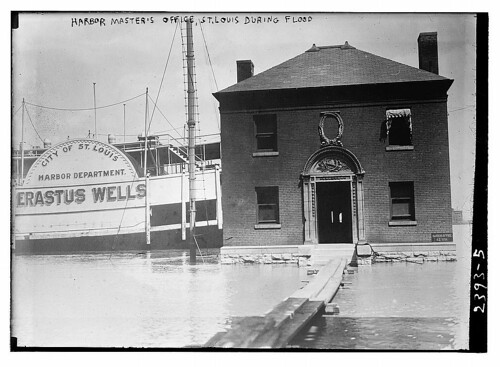
The Library of Congress has a Flickr page where they've currently uploaded 3115 photographs from their historical collection. There are two sets: News in the 1910s (1500 photos) and 1930s-40s in Color (1615 photos). The photo on the left is obviously from the 1910s set. It's a photo taken during a flood of St. Louis.

Patently Amazing


Today I learned my second-great grandfather Selig patented some improvements to fire hydrants back in 1898.

I wouldn't normally have searched the patent database for his name, because I wouldn't expect to see anything. I've put some of my more uncommon surnames through it, but I didn't bother with "Feinstein" as I'm not related to most of them. However, today I checked "Google Scholar" for Selig specifically - don't ask me why - and it includes the patent database.

His professions during his life included real estate and laundry. Apparently he knew something about fire hydrants, too. A renaissance man.

So don't assume your relative didn't patent something. You never know.

Monday, January 14, 2008

With a Little Help From my Kin

There is absolutely no question in my mind where I would be in my genealogy research if I were alone, and hadn’t yet been in contact with any relatives. I’d have made a handful of discoveries, but they would pale in comparison to what I now know. I’ve found relatives, and relatives have found me in a variety of fashions.

[All names of people in "s are fictitious]

Ancestry/Rootsweb Messageboards

One of the first things I did upon discovering Ancestry & Rootsweb was to browse their Surname message boards. I found several posts that seemed to connect with my surnames – most of them five years old, or older. I responded, hoping the people would still have accounts. Not all did.

However, I did see a post by a “David” mentioning an ancestor, Jacob. I recognized the name of the ancestor as the brother of Selig DUDELSACK's wife. So I responded – is this the Jacob who had a sister named Anna?

I’ll admit I was somewhat paranoid when initially posting. I figured there could be crazy people, or lonely people out there who will read the queries, and then respond, “We’re cousins!” pretty much repeating back what you put in your post, perhaps doing a little research and coming up with some additional information. So I made my reply as simple as possible, and waited for the response.

My profile did indicate I am in St. Louis, and "David" posted back that Jacob indeed had a sister named Anna who settled in St. Louis, but he provided some other collateral surnames he knew about but was unclear how they connected. I knew. Since then we have exchanged emails and have carried on an extensive conversation, filling in the descendants of Jacob and Anna for each other. He is in Chicago, and there may be a Cubs-Cards game/Family Reunion in the future.

I've also posted a few queries myself. I haven't heard back, but I might have to wait five years.

Blog

I haven’t had my blog long, but I’ve already gotten a few emails from people curious about my surnames. The first person to respond was “Mike”, a DUDELSACK/FEINSTEIN cousin. I’ve posted enough on the Dudelsack surname, it isn’t a surprise. He wasn’t a previously unknown cousin, and not very distant – our grandparents were siblings - but he doesn’t live in the Midwest, and it was good “speaking” with him. He said he would be following my blog, so, “Hi, “Mike”!”

In this past week, while I’ve been pondering this post, I have received two emails from my blog. One concerning my BLATT surname, and another concerning my SLUPSKY. (The latter arriving today) It’s not clear if either are related to me, but the former email came from someone doing research for a friend, and in the process, I have gained some information. He sent me the death certificates for two great-grandparents. They both died post 1956, so they weren’t online at the Missouri government website. I knew I could order them from the state, or possibly the local courthouse. I hadn’t yet done the research to figure out how to get them as other things had higher priority. My contact had received them from the funeral home. This wasn’t an option I had considered. I knew I could obtain funeral home records, but I didn’t know those records contained copies of the death certificates. Additionally, the funeral home included a copy of the obituary – saving me the trouble of researching the newspaper's microfilm archives at the local library. The obituary mentioned my great-grandfather, Herman FEINSTEIN, was a mason, just like my great-grandfather Barney NEWMARK, but was also a member of the Moolah Shrine.

Family Networking

“"Agnes", my son, John is doing some genealogy research, didn’t you tell me your brother, "Rupert" was doing some a few years ago?”

Two windfalls have come from this method. The biggest is from a cousin who has spent the past twenty years researching the CRUVANT surname, in all directions possible. The Register is approximately 300 pages long.
I've tried to help her with a few details here and there. I have also received some information from a BLATT cousin extending that line back a few generations. The latter is somewhat questionable. The information from Poland is highly researched with citations from birth and marriage registers, but the missing link connecting these people to my known relatives is weak, and there are some surnames that don’t match family lore, leading me to wonder if we might actually have two different families. It will take some additional research on my end to decipher this.

Family Associations

I have written an email to one Family Association – The FRETZ Family Association. They have published four volumes of family genealogy. I was able to find Volume 1 at the local library - and later learned that photocopies of the pertinent pages were actually already in my parents' genealogy files, given to them by my mother's aunt probably decades ago. I emailed to ask them how much information they had in volumes 2-4 on the descendants of Ebenezer Opham DENYER. They were kind enough to tell me that they had very little. Knowing full well they had probably lost the sale of three books – but they exist for the benefit of the families, not to make a profit. They even sent me what information they did have. I mean to send them a descendant chart to fill in the gaps that I can in their database, but I haven’t yet done that.

Blind Letters

As I mentioned a couple days ago,
I have mailed off two partially-blind letters to people that I was 90% sure are cousins. Neither know me from "Adam", though. I have still only heard back from one of them. The one in Texas could be composing a letter to send back to me. I did include a phone number and an email address, but they might not want to make a long distance call, and they might not have access to a computer. (It’s possible.)

Dilemma of National Proportions

If in November, the US election is between Obama and McCain all American descendants of William the Lion will be emotionally torn: which cousin will they vote for?.

If this genealogy is correct, William I was a descendant of Charlemagne. There are some who claim I am too. I don't necessarily believe these claims, but for the sake of this post, I will count myself a cousin of Obama and McCain.

I suspect if I really do go back to Charlemagne, I'm related to a few other important historical figures. Some have argued, that mathematically, everyone in the Western World is descended from Charlemagne *and* Muhammad. Of course, statistically speaking, there are 0 people in the US with the surname Barrymore. Comes as a surprise, doesn't it?

So if we hypothesize that the statistical calculations that went into computing the likelihood of the Barrymore Surname failed in that case, can we also hypothesize that the statistical calculations that computed everyone in the Western world are descended from Charlemagne and Muhammad are also possibly in error?

Saturday, January 12, 2008

Massive cemetery desecration in NJ

four teenagers over two nights, toppled 500 tombstones in a New Brunswick, NJ Jewish cemetery.

I don't know of any relatives buried in the cemetery, but the photographs, and video are heartrending. The police haven't yet found evidence of it being a hate-based crime, but I just can't comprehend why the teens would have done this. There was a lot of hatred against society in general at least to compel them to go through the physical labor of that level of destruction.

A cemetery restoration fund has been established by the local community.

Friday, January 11, 2008

My Surnames

At the beginning of every meeting of the St. Louis Genealogical Society the attendees are asked, "Is there anybody here for the first time?" If there is they are asked to introduce themselves, and tell everyone the surnames they're researching. The latter makes a lot of sense at a local society since it's not completely unlikely you might run into a distant or not-so distant relative you were previously unaware of.

But it's also a small world, sometimes, and I don't think I've done that yet. I've introduced myself in several ways over the past few months, and mentioned surnames here and there in various posts, but I haven't created a single post that lists all my surnames. A complete surname list could get rather lengthy. But if I limit it to surnames of direct ancestors, it's more manageable.

There are several ways I could organize these names. I decided to alphabetize them, but group them by how many generations they are away from me.

Some may notice there are 17 names in the first list, when some might expect only 16. That's because there was a surname change. There are a couple surname changes in the earlier generations as well.

1-4 generations

ADLER, BLATT, BOKSERN, CANTKERT, CRUVANT, DENYER, DEUTSCH, DUDELSACK, FEINSTEIN , HARTLEY, LICHTMAN, MOJSABOVSKI, NEWMARK, PERLIK, STUART, VAN EVERY, WEISS

5-8 generations

BEASLEY, BLATYTA, COLEMAN, FRETZ , GOLDFINCH, GOLDSTEIN, HOLMES, HORTON, KIPERSZTOK, LIPMAN, LUCELLAS, OBERHOLTZER, ROSENBERGER, SHOWERS, SLIVER, SLUPSKY, SWAYZE, VAN IVEREN, WILCOX

9-12 generations

BETTS, BURGER, CHAMBERLAIN, FREDERICKSEN, HAYNE, KINGE, LANGTON, MEYER, SCHUYLER, WINES

I am going to link to this post from my sidebar, and I will update it as I have names to add (or change).

Friday Five

The five names below were found in the referenced US census, as indexed at Ancestry.com:

Broccoli Adele – 1930 – age 46 – Plymouth, MA – Female
Carrot Resh – 1850 – age 6 – Hall, IN – Male
Strawberry Savage – 1920 – age 10 – Detroit, MI – Female
Banana Nixon – 1900 – age 1 – Houston, Georgia – Female
Apple Pie – 1870 – age 40 – Memphis, TN – Male

One of my resolutions this year was to go on a diet. Could you tell?

Thursday, January 10, 2008

DNA Surname Studies

Megan Smolenyak Smolenyak of RootsTelevision has a fun video on whether she married her cousin, and the value of DNA surname studies.


At the end she says to find out if there is a DNA surname study for your surname already, go to Google or another search engine and type in: YourSurname DNA Genealogy. She says the surname study should be the #1 hit.

When I do that, my blog is the #1 hit. I realized I shouldn't be too surprised. Possibly if there was a surname study it would be ranked higher. Someday I may find out. I could only find one of my great grandparents' surnames with a current study - sort of. Feinstein. However, my ancestor changed his surname to Feinstein, so I'm not related to any Feinstein who isn't descended from my great-great-grandfather, and that's pretty limiting. Ironically, the Feinsteins in the surname study are also 'New Feinsteins'. They're really Talalays, who changed their name to Feinstein in Philadelphia. The study is headed by Schelly Talalay Dardashti of Tracing the Tribe.

After realizing the only surname study even tangentially related to my tree was started by a blogger who I've been reading for several months, who I may not be related to at all, I next wondered how many families changed their name to Feinstein when coming to America. What the proportion of "New" Feinstein families were to "Old" Feinstein families, what it would mean if there were more "New" ones, and how far back did a surname have to go for it to be 'old' in my mind.

Tree Deletion

I received an email today from someone who says they found me through my blog, and a family tree I posted at Ancestry. I was glad to help them, and did so primarily by redirecting them to a cousin who knew the branch of the the family they were interested in better than me.

But I was thankful for their email in reminding me of the tree I posted on Ancestry the first few weeks after I discovered the website. It was pretty early in my research - the information was full of errors - and on some entries missing something very crucial in any family tree posted to Ancestry - birth and death dates. Ancestry assumes people without dates are dead.

I had a little difficulty deleting it though, because when I first discovered Ancestry it took me awhile to decide whether or not I was going to subscribe. So I signed up several times under their 2-week trial period. This isn't difficult to do, as all one needs is a new email address, and since I own several domains, it's easy for me to create email addresses. John@domain1.org John23@domain2.org etc. I could get Ancestry free for life, but registering with a new email address every 2 weeks would be annoying. It's just easier (and more honest) to pay.

I had to sign in to my current account to send an email to my old account so that I could find out what email address that account had used. Then I had to tell Ancestry that the owner of that email address had forgotten their password, because he had. They sent me to a page where I could pick a new one. Then I signed in, went to My Ancestry, and deleted the tree.

It's now gone. I might create it again, but if I do, it will be more accurate, have dates, and locations, and probably won't include any living people.

Wednesday, January 9, 2008

Astronomic Genealogy

There are a lot of different branches of genealogy I have heard about. Genetic and Forensic, for example. But I hadn't heard about the Astronomic. Apparently, though, scientists have discovered the ancestors of the Milky Way. So I'm sure the term, Astronomic Genealogy isn't too far away from being coined.

Astronomers at Rutgers and Penn State universities have discovered galaxies in the distant universe that are ancestors of spiral galaxies like our Milky Way.

These ancient objects, some of the first galaxies ever to form, are being observed as they looked when the universe was a mere two billion years old. Today, scientists peg the universe’s age at 13.7 billion years, so light from these galaxies traveled almost 12 billion years to reach Earth.


You might think that Astronomic Genealogy is very different from what we do.

The astronomers discovered these galaxies as part of a five-year-old census of galaxies...


Maybe not. Though I suspect the spelling on their censuses is more uniform.

50% response rate

I mentioned Sunday that I was mailing out two letters Monday morning. It's Wednesday, and so far I have a 50% response rate. I probably should give the second letter a couple more days, especially since that is the one that was going to Texas. The response came from someone who lives five minutes away. I could have knocked on his door, or picked up the phone, but both would have been somewhat stalkerish, and the individual was born in 1925, so I wrote a letter, and he called me tonight.

He was very friendly. Most importantly, to me, he confirmed my suspicions that Tillie was the sister of Selig (Dudelsack) Feinstein. I was already pretty confident of this, due to Tillie's death certificate (her father was listed as 'Duderzock'), but while my cousin didn't recollect anything about Tillie's parents, he did remember one of Selig's daughters, Pearl. He couldn't remember how they were related, but I know that, so there is no longer any doubt. I'll mail him a family tree he can pass on to his daughter.

He apologized for his fading recollections, but did tell me a few things about his uncles and aunts, and provided the addresses of two younger cousins. While I don't know much that is really new information, it was exciting to talk to a grandnephew of Selig. There aren't many of his generation left on my side of the tree.

Tuesday, January 8, 2008

Professional

The APG-L mailing list (Association of Professional Genealogists) has been discussing what defines a professional, and what to call a non-professional.

Just because someone doesn’t get paid, doesn’t mean the quality of their work is amateurish. Some people don’t like the connotation of the term ‘hobbyist’, though denotatively, all it means is one doesn’t get paid. 'Avocational' has been suggested. It’s denotation is identical with hobbyist, though since it is used a lot less, it hasn’t developed a negative connotation in some minds.

Note: “Denotation” is the literal meaning, the dictionary definition, and ‘connotation’ is the positive and negative emotions that are usually associated with the word. For example, both of the words “denotation” and “connotation” have erudite associations connected with them. Whether erudition is positive or negative depends upon who you are. ‘Avocational’ is also erudite, in my opinion. Hobbyist works for me. Genealogy Hobbyist.

I considered suggesting Armchair Genealogist briefly, though that’s not the exact meaning required. (“Remote from active involvement”) It would, though, have a very useful application. Those genealogists who remain glued to the chair in front of their computer. I’ve done a lot of that sort of genealogy, but I haven’t limited myself to it.

Someday I would like to be a professional author. I have published a handful of poems, and one work of short fiction, for money, but my total income is miniscule. I also received some money for performing my poetry, once, but it is still on the level of a hobby. However, while I aspire to be a professional, I never expect to make my sole income from writing fiction or poetry. Very few authors do. That doesn't mean they aren't professionals.

I am a professional writer (not an author) as I get paid to write grant proposals for a local non-profit. However, if I am in a smart-alecky mood, I will often refer to my job as professional beggar, or I’ll use the Yiddish term, ‘schnorrer.’ I’m begging for the benefit of others, and not for myself, but it is how I make my living.

I am an armchair blogger, but few bloggers blog anywhere else.

Monday, January 7, 2008

Where was my family in 1908?

Lisa at 100 Years in America began this meme: Where was my family in 1908? Several others have picked up on it. I have found it interesting comparing the several branches of my family, and following the paths that led them all together.

I. The Deutsch Family: Transylvania

Martin Deutsch, was born in 1907 in Transylvania, in what is now Salaj County, Romania. In 1908 his brother Armon would have still been alive. It's not certain, but my best guess is that The Accident I wrote about back in October occurred in 1909. They came to the US in 1913, and settled in Chicago.

II. The Van Every Family: Texas

Myrtle Van Every, was born in 1900 in Texas. In 1908 she was probably in Caldwell County. That's where her father was in 1910, but no one is listed with her father on the 1910 census, which is extraordinarily strange. Her oldest sister, Minnie, born in 1884, was already married. Myrtle wouldn't meet Martin until the 1930s - both of them ending up in St. Louis following jobs. They were married in 1936.

III. The Newmark Family: A Year of Travel

Samuel and Rose Newmark, with children, including my great-grandfather Barney were all over the place in 1908. In 1904, Samuel and Barney traveled to Canada, and had spent 3 years there, crossing the border into America in July, 1907. They claimed they were headed to St. Paul MN to visit a cousin named Joseph. No one knows who this cousin was, or if he even existed. Samuel's middle name was Joseph, and the cousin could have been an invention. The next record has them, and brother Sol, arriving at Ellis Island in October of 1908. So they had traveled back to London, picked up Sol, and returned to NY in that time. Now they claimed they were headed to Memphis. Since the 1909 immigration records for the rest of the family claim they are headed to Memphis too, it's probably likely that Samuel, Barney and Sol really were in Memphis the last few months of 1908 while the rest of the family remained in London., where they had been while Samuel and Barney traveled through Canada and the US. In 1909 Sol's wife, Sarah gave birth to a daughter in St. Louis, and the whole family is in St. Louis in 1910 for the census. What happened to Memphis is unclear.

Update: Samuel and Barney actually arrived in Canada in 1907 and were only in Canada for 2 months. My original error was based on this border crossing document. It appeared they landed in May 04, but that should say May 07.

IV. The Cruvant Family: Flip a coin. Heads: St. Louis, Tails: Chicago.

I really don't know. I hope to figure out through perhaps the voting records. I have a cousin who has done a lot of research on the Cruvants, including going through the city directories. From 1889-1901, for almost every year, I have the St. Louis City address for patriarch Moshe Leyb (Morris) Cruvant - and assumedly the rest of the family. In 1904, Morris is in Chicago, along with his son, Ben. I have no idea where everyone else is. Did they go to Chicago with them? Did they remain in St. Louis? In 1904, Ben marries a woman in Chicago, and then proceeds to have two children. Both Ben and Morris are in East St. Louis in 1910. Ben's wife, and children, are in Chicago in 1910, she is listed as a widow, though Ben is alive, just 600 miles away, waving goodbye to his first family, and marrying wife number two in 1912. This is also about the same time Ben's sister, Bertha gets married to Barney Newmark, and my grandfather is born. My guess is in 1908 Bertha was either in St. Louis City, or East St. Louis. Though her father may have still been in Chicago.

V. The Feinsteins and the Blatts: St. Louis City

In 1908, Anna Blatt, daughter of Morris, is about nineteen years old and living in St. Louis. Two years later she is a lodger in an apartment next door to where her older sister, Blanche, is living with her husband and growing family. Blanche married about 1903. It's likely in 1908 Anna was already next door. They got out of the family house as soon as they could, because they had a stepmother, and the step-family apparently didn't treat Anna and Blanche well.

Nothing at all unusual about the Dudelsack-Feinsteins. They are in St. Louis City as well. The father is in the Laundry business, and the children help. Son, Herman will marry Anna Blatt in 1912, and my grandmother will be born in 1914.

1908: Transylvania, Texas, possibly St. Paul, Atlantic Ocean, London, Ellis Island, Memphis, St. Louis, and perhaps Chicago.

Impatience

I think I have found a perfect example of my level of impatience. When I was a teenager family members accused me of having a type-z personality. Those stress-indicators that hospitals hand out that you press your finger on the card for 30 seconds, and it turns black if you are stressed, bright blue if you are relaxed, was always bright blue for me, even on the morning of high school exams.

About the only time I notice myself getting impatient now is when I am standing still, and want to move forward. This happens a lot in cars. I’m usually alone in a car, so my family has never heard the things I have said at these moments.

But figuratively, it can happen in family history research. I noticed over the weekend that the Missouri Death Certificate index online still only goes up to 1956. I was expecting 1957 to be added. It is only January, though, and there are still several years in their index, which are not scanned in, so I figure they’re focusing on that.

I also emailed the VR dept of the Cook County govt this weekend asked them about the Chicago Vital Records. You may recall in September there were announcements in newspapers they would be online in January. I’ve learned that there have been some setbacks, and they now estimate July. I guess I can wait. (What choice do I have? Drive five hours to Chicago and spend a day researching there? Yes, that is my option, and I would rather wait until July.)

Is it July yet?

Sunday, January 6, 2008

Living People

Randy asks if he should be helping clients find living people.

Yesterday, Cyndi of Cyndi's List, was saying that searching for live people wasn't genealogy. Several people disagreed with her in the comment thread.

Of course the examples they came up with - searching for lost - or formerly unknown - cousins, hoping they have the missing information they've been seeking - is not the same as a client seeking help in finding a grade school classmate.

I am reminded of my discovery back in September of the online Texas vital records. One of the two blind letters I finished writing yesterday was to a cousin in Texas. It will be mailed tomorrow. The other is to a cousin here in St. Louis. I've never met either of them, and didn't know they existed until recently. I'm hopeful they will be happy to be found - and happy to find me.

I'm not sure what I would do if someone asked me to help them find a non-relative. While I am by no means a professional yet, I now know several techniques I didn't know a year ago, which means I know more than the average person. I'd probably help a friend out (someone I knew wasn't the stalker type), but I would hesitate helping a stranger. of course, they could go hire a private detective. People are findable - depends upon how hard you want to find them. I think I recall reading that the #1 most requested job of private detectives is simply finding people. A lot of us are lost.

A private detective blogger suggests if you are unsure about a client, when you find the missing person, instead of giving the client the information, you contact the missing person and ask for permission to give the client the information. Or you agree to deliver a letter from the client to the individual. That seems like a good precaution. The post also details some rather specific true-life horror stories. (I also had to remind myself several times while reading the post that one doesn't judge the quality of a private detective by how well they use the English language.)

Saturday, January 5, 2008

Today's Activities

  • This morning I added several sites to my blogroll on the left that I have been reading, but hadn't yet made it to the list.
  • Then I headed to the first meeting of the St. Louis Genealogical Society of the year. Interstate 40/64 for a several mile stretch in St. Louis has shut down on January 2nd for a year for construction. Next year, another stretch will be shut down. Many people in the area are in a total mess of confusion. The dividing spot West of which is shut down this year, and East of which will be shut down next year, is where I live. So while I normally would take the interstate to the meeting, I had to find another route. It added a little excitement to my morning, but I made it.
  • The meeting was interesting. It was on 'creating a master plan' as it relates to solving genealogical puzzles. The speaker led us down two case histories where she researched two 'apparent aliens' who had landed on Earth, and their descendants had no clue what planet they had come from. Hearing the processes she went through gave me some ideas.
  • This evening I finished up some blind letters I had been working on to send to some distant likely-relatives.
  • A few minutes ago I was looking through the list of topics the St. Louis Genealogical Society will be discussing each month in 2008. September's topic caught my eye. "Voting Records." I hadn't thought about those. "Are they available?" I asked myself. I figured the answer was probably, 'Yes,' or the September presentation would be awfully short. I didn't want to wait eight months though. So I went to the Stlgs website and found the information there.
Voter registration records may provide important naturalization information, a birth date, and a signature. In August 1920, women were given the right to vote, thus a large number of registrations occurred that fall. The women that registered were U.S. citizens by birth, those who were naturalized via marriage to a U.S. citizen, or women who were naturalized at the same time as their father or husband. In 1922 women were required to naturalize as individuals, without their father or husband.

Before 1937, voters had to register every four years. The microfilmed ledger books show the voter’s signature, address, and voting record over that period of time.
City records, where most of my family lived in the first half of the 20th century, are available from 1897-1977 in the same library I was at this morning. It might help me track my ancestors' locations between censuses. County records are available from 1924 on in different locations.

Three out of four sets of my father's great-grandparents were in St. Louis by 1897. The Newmarks arrived in 1909. If it went back a few more years, it could help fill in for the missing 1890 census. (At least for the fraction of the citizens who could vote). St. Louis also has city directories which are helpful for those years, but the voting records will have signatures, which could be helpful for those whose names seem to change from one directory to another, unless the signature is just an X. It should also be interesting to discover how regular my ancestors were in voting.

Friday, January 4, 2008

39th Carnival of Genealogy

Jasia at CreativeGene has posted the 39th edition of the Carnival of Genealogy. As genealogy bloggers weigh in on their New Years Resolutions, the C0G is now officially older than I am. While I will turn 39 in a few weeks, the CoG will turn 40 one week beforehand, and after that, I'll be left in the dust fairly quickly.

Though only actively researching for about 9 months, I think I may have something to say on the topic for #40, and look forward to gathering and organizing my thoughts:

Living-relative connections made during your research processes and/or blog. Who found you or how did you find them? Were they helpful or did they send you on a wild goose chase for further information? How much and what kind of information did they share with you? What did you share with them? What kinds of contacts have you had... in person, via phone, online chat, email, snail mail, web casts? (If you're not comfortable using their real names you might want to consider using pseudonyms.)

Presidential Audio Recordings

Of possibly historical interest, here is the earliest known audio recording of any President of the United States: Benjamin Harrison, sometime in 1889 (Real Audio, and MP3 versions)

Text: "As president of the United States, I was present at the first Pan-American congress in Washington D.C. I believe that with God's help, our two countries shall continue to live side-by-side in peace and prosperity. . . Benjamin Harrison."

The website contains audio recordings from several other presidents

Thursday, January 3, 2008

A President and a King

I've written posts before mocking some of the weird relationships Ancestry's OneWorldTree generates - probably the best example is how Catherine the Great is the 19th-great grandmother of Henry David Thoreau (with only 100 years separating them - generations averaging 5 years - the pedigree has to be seen to be believed.)

As Ancestry admits:
Keep in mind--The possible relationship information we show is only as accurate as the member-contributed family tree information found in OneWorldTree. We are unable to verify whether these results are in fact accurate. Of course, that's part of the fun of family history--digging into the research.
I won't argue with that. It is fun. When I first discovered that my maternal grandmother allegedly was related to such diverse individuals as Flannery OConnor, Werner Von Braun, George W. Bush, Ray Bradbury, Elvis Presley, Amelia Earhart, Shirley Temple, JP Morgan, and to top it off, a direct descendant of Geoffrey Chaucer, I didn't know quite how to respond. One relative, when I mentioned it, came up with a one-word colorful description of what he thought of it all - bullshit.

I wasn't quite ready to dismiss all of it. I knew her ancestry went back to 18th century New York, and once you're in that early colonial melting pot, a lot of families are intermingling. It's not impossible to imagine a handful of the proposed lineages were actually correct. The question was which ones were true, and which ones were like Thoreau and Catherine?

Since then I have discovered my connection with the Sweezey/Swayze clan is rather well documented. Tonight I returned to OneWorldTree and started going through the 35 famous people they list, and discovered that a couple of the descendancies come through the Sweezeys. I was able to "confirm" the connections at Sweezey.net. Browsing through the site, and seeing notes on various entries, they appear to be concerned with accuracy.

So I feel fairly certain that US President, Benjamin Harrison (through the wife of William Henry Harrison) is on my tree. Fifth cousins, three times removed. Elvis Presley may also be my cousin, but he doesn't appear at Sweezey.net, and the Sweezeys don't appear on the Presley genealogy at Genealogy.com. There is one link in his OneWorldTree ancestral chain that is questionable. A recent unofficial genealogy that purports to go back fifty generations contains the missing link, but it's the only place I've found it (besides OneWorldTree) and it seems of questionable veracity.

So right now, with 35 data points, it seems OWT is somewhere between 2.8% and 5.7% accurate. Maybe over time I'll discover it has a better record.

Tuesday, January 1, 2008

Pedigree Collapse

TransylvanianDutch is going to take a break from our usual focii to present you a Tabloid News Exclusive!

Here's an excellent illustration of Pedigree Collapse:


These aren't all direct ancestors. I'm descended from Rev. Samuel Swayze's brother, Israel. So Barnabas Horton and Sarah Wines only appear once in my direct lines. However, a certain actor happens to be a direct descendant...

This isn't too uncommon. The whole idea of pedigree collapse is that it is common. It's still legal in some areas for first cousins to marry, and I certainly have no malicious intent, but for additional legal protection, and for the citations I'm sure some will want, here are the Descendants of Barnabas Horton, and the Ancestry of Patrick Swayze. All the people in that graphic above can be found on those two websites. It only takes the simplest of work to combine the two. Both sites cite sources for most of the information, so if any of it is incorrect, those sites should be contacted.

This has been a TransylvanianDutch Tabloid News Exclusive

(Note: It turns out I am not the first to discover this.)

Monday, December 31, 2007

Happy New Year

Auld Lang Syne on a Dudelsack

2008 Genealogy Goals

I like to look at my annual lists as goals, as opposed to resolutions. It helps when I don't achieve them. For breaking resolutions has a different connotation than falling short of a goal. This is especially true when the achievements I seek rely on some outside forces beyond my control.

1) Organize my information. For the past 9 months, as I've joyfully discovered all the avenues of exploration available to me, mostly online, I have done a lot of research, and a lot of research lies ahead, but before I continue I need to develop a better system of organizing the information.

2) Get out of my house and into my car. There are several places nearby I wish to visit. This includes: The Missouri Historical Society, Missouri Archives in Jefferson City, local archives in St. Louis County, MO and St. Clair County, IL, and a handful of cemeteries. The only trip that will really require some gas is Jefferson City. That's a 4-5 hour round trip. But I occasionally have to drive down there for work, and when I do, it's usually only for a 1-2 hour morning conference, so I can spend the afternoon in the Missouri Archives. I might also end up traveling to Springfield, IL, but I'll need to have a better idea of what I want to find in their archives before I make that trip.

3) Learn to navigate the Polish Vital Records system. It doesn't sound too difficult, with the language barrier being the biggest hurdle. But this guide, and this one should help me write the letter, and this guide should help me read their response.

Year in Review - Documents

The month of December is one of reflection and as part of the final days, and as an extension of my thoughts back in October, I have considered what I have spent on documents over the past 9 months, and what I have learned. (I started my research back in April)

UK General Register Office
1 Marriage Certificate
4 Birth Certificates
Total: $72 (The cost is 7 pounds with a small shipping charge. If the rate of exchange improves from the current 2-1 the $US cost will decrease.)

The certificates give a snapshot of where the Newmark family was on each date, and the earlier certificates show my great-great-grandfather’s progression from Journeyman Tailor to Master Tailor. I learned the dates of birth for the youngest three of my great-grandfather’s siblings – the ones not born in Poland. There was a sibling, who went by the name Max, who could have been born in either location. The given name, Morris, on the fourth certificate was pretty close, so I had to order it to see the parents’ names. I now have a certificate for a likely non-relative, but if it had turned out to be Max, it would have been worth it. The most important thing I learned from the birth certificates was my great-great-grandmother’s maiden name, or at least I now have a fair sense of how it was likely pronounced, even if I don’t know its proper spelling. Since we had her in our records as Rose Garten, with no supporting documents, and now she is Rose Cantkert, with some supporting documentation, I consider that major progress. I also like what I learned about London’s Great Synagogue as a result of the research I did from the marriage certificate. The couple had four children in London between 1902 and 1909, but neither parents nor children are direct ancestors, so I am going to see if I can convince some of my cousins to order the certificates.

UK National Archives
1 will - $7 (3.5 pounds)

The will was for a William Denyer of Hampshire - d. 1732. I have traced my ancestry back to a William Denyer of Hampshire born in 1770. How the two connect, if the two connect is unknown.

State of Missouri

Thanks to Missouri scanning in death certificates, I downloaded about a dozen for free, learning dates, addresses, burial locations, and more.

St. Louis City, Missouri
1 marriage license & application for license - $3

So far this is the only certificate I had to get up off my posterior to get. (Without counting the activity it takes to mail a letter.) I could have paid the county clerk to do the research, but walking into the courthouse and just paying the cost of the copy made more sense. The one inconvenience is that the office hours are 8-5 Monday to Friday. So I actually took a vacation day to do this. I had hoped to find two marriage certificates, and several birth certificates. However, I learned the birth records are all in Jefferson City, and one set of paternal great-grandparents, Barney Newmark and Bertha Cruvant, were married elsewhere. Probably in St. Louis County or St. Clair, IL. (St. Louis City is a separate county from the neighboring St. Louis County, and East St. Louis, IL, is in St. Clair County, which can confuse some researchers.) I retrieved the marriage certificate of my great-grandparents Herman Feinstein and Annie Blatt. The most interesting thing perhaps learned was the name of the Rabbi who married them, and thus possibly the congregation to which at least one of them belonged. Unfortunately, the congregation disbanded in the 1940s, and its records have been lost.

State of Texas
1 Death Certificate - $20

I learned the date, burial location, and cause of death for Margaret Denyer Van Every, my maternal great-grandmother. I later discovered an aunt had taken photographs of two Margaret Van Every tombstones on a trip she made to visit relatives in Texas several years ago. She hadn’t been sure who was who, but I was able to match up the dates. The other was a step-mother-in-law. (my most prolific ancestor's third wife)

Gonzales County Texas
1 Marriage Certificate - $1

I learned the date of marriage (May 14, 1854) for great-great grandparents Ebenezer Denyer and Sarah Ann Hartley. (The date of marriage is actually online at the Gonzales County website, so I didn’t really learn it from the certificate, but I have the documentation to back it up, and it was only $1.) It’s not a great photocopy. I’d be willing to pay more for a better reproduction, but it’s not exactly common that county records go that far back, so that I have anything is a miracle.

US Govt
1 SS-5 - $27

I learned a little about my great-grandfather, Herman Feinstein. However, I was hoping to find out where he was born. Both of his parents had died by 1936 when Social Security began, and all he knew was that he was born in Russia.

Total: $130 spent over a nine-month period. I feel it is worth the information I learned. I suspect the number of documents will ultimately go down, as there is a finite number of individuals I am currently interested in documenting, but the cost may go up if I start looking for the Polish and Russian records.

Wednesday, December 19, 2007

Christmas Carol

FootnoteMaven has challenged geneaBloggers to post their favorite carols.

I tend to prefer the seasonal ones over the religious ones, since I don't celebrate the religious side of the holiday. As a child, my favorite was "Please Bring Some Snow (for Johnny)". As I grew up, I realized the song wasn't really written for me.

One of my current favorites is by Country artist, Skip Ewing.
"My Name is Christmas Carol". It always brings tears to my eyes.

I was playing Santa Claus downtown on Christmas Eve,
when a little girl of 3 or 4 climbed up onto my knee,
I could tell she had a Christmas wish behind those eyes of blue,
so I asked her what's your name and what can Santa do for you?

She said my name is Christmas Carol, I was born on Christmas Day.
I don't know who my daddy is and mommy's gone away.
All I want for Christmas is someone to take me home!
Does anybody want a Christmas Carol of their own?

Well all that I could say was Santa would do the best he could.
Then I sat her down and told her now remember to be to be good.
She said "I will" then walked away, turned to wave good-bye.
And I'm glad she wasn't close enough to see Ole Santa cry!

She said my name is Christmas Carol, I was born on Christmas Day.
I don't know who my daddy is and mommy's gone away.
All I want for Christmas is someone to take me home!
Does anybody want a Christmas Carol of their own?

Early Christmas morning I got up and dialed the phone.
I made a few arrangements at the County Children's home.
They told me it would be alright to pick her up today.
Now my little Christmas Carol won't ever have to say,

My name is Christmas Carol, I was born on Christmas Day.
I don't know who my daddy is and mommy's gone away.
All I want for Christmas is someone to take me home!
Does anybody want a Christmas Carol of their own?

Tuesday, December 18, 2007

Carnival of Genealogy

The 38th Carnival of Genealogy has been posted. Several people were better able to remember what happened on December 31, 1999 or December 31, 2000 than I was. Susan Kitchens, of Family Oral History using Digital Tools, has been blogging since then. I started blogging in 2002, but reading her entry I recalled that I purchased my own domain name in early 2000. Alas, it was in February. So I still don't know what I was doing a month earlier.

The 39th Carnival is our New Year's Resolutions with respect to genealogy research.

As the year winds to a close in the next couple weeks it's a good time to review the progress made in our genealogy research and to make a plan for next year. So what did you accomplish last year and what road blocks did you encounter? What are your research goals for next year and how do you resolve to attain them?
While I am in the Caribbean from this Friday until December 30th, I will give this some thought, and I'll write those thoughts up when I return.

Monday, December 17, 2007

This post is for the dogs

On a recent trip with some friends to Springfield, Missouri, we were walking out of the Lincoln home, and the tour-guide was mentioning the Lincoln pets, and I said “The dog’s name was Fido.”
The tour-guide confirmed the information.
A friend looked at me, “how the heck did you know that?”
“It says so in the foyer of the museum we were in twenty minutes ago.”
“There you go, reading again.”

Here’s a brief biography of Fido Lincoln, with three photographs.
Around 1855 Abraham Lincoln's beloved Fido was born. He was a mutt so to speak but as far as the Lincolns were concerned, Fido was royalty. He was often seen with his master around Springfield carrying a newspaper in his mouth. He was a brownish dog with more or less yellow in his coat, resembling perhaps a shepherd.
I like that under the heading it says, “uncertain ancestry.” That’s what the world needs – professional dog genealogists. However, I was shocked to learn of Fido’s end. The blurb at the museum, which included this portrait


also mentioned that he hadn’t gone to DC with the Lincolns, the newly elected President not certain the beloved dog would survive the trip. Fido was left with neighbor boys, John and Frank Roll, with explicit instructions that he be pampered in the style to which he had been accustomed. However, the museum's blurb didn't mention that Fido Lincoln Roll’s death mirrored that of his former master.
One year later, Fido was also "assassinated" or killed by a man, who, in a drunken rage, stabbed the dog to death. Fido had playfully put his paws up on the man who was sitting on the street curb. Fido had strayed from his home with the Rolls, and like his master, was assassinated.
Extremely sad, but Fido did live ten years, in a manner most 19th century canines could only dream about.

For those who like to play the game of comparison between Lincoln and Kennedy, one might also add to the list that in 1966, one century after Fido was stabbed to death, President Lyndon Baines Johnson's dog, Him, was run over by a car. (Linked news story is actually about the death of Buddy, Clinton's dog, but it mentions LBJ's dog.)

A month ago I was looking at some photos in my late grandfather’s collection, and noticed a photograph of my great-grandmother holding a pup. I was told by my mother the dog’s name was Choo-Choo.


I came to the conclusion that Choo-choo, and all the other pets of importance to family members, deserved mention in my genealogy database. Perhaps entire entries. But how do I do that? I’m not so far over the edge that I would indicate a pet as a person’s child. “Adopted” doesn’t quite work either. (Close, but I wouldn't want anyone to get confused...)

So I went to the IFamilyForTiger forums and made the suggestion.

Keith Wilson, the developer behind the software, gave me a few ideas for recording pets as the software currently stood, and also said there was a potential for an AssociatedPerson entity in the future. While meant for friends, business associates, etc, it could certainly be expandable to our animal companions. I look forward to that extension, for recording animal companions, but also because I can think of a few friends and associates for whom I would write entries. However, I know other features may be ahead of it on his list. I also know he is busy working on IFamilyForLeopard which I expect to be updating to when it is released.

Where Was I?

Miriam at Ancestories, and Tim at Genealogy Reviews Online, have begun a meme asking the question - where were you for the census of your life?

('Census' is a Supine noun, so in Latin the plural would be 'census.' Of course, we don't speak Latin; the proper English plural is probably 'censuses.' Still, I like using the Latin plural.)

1970 – I was 1 year old. Regardless of what month the census was taken, my age shouldn’t waver, unless it was taken in the first three weeks of January. Even then, I know I would round up, and I think my parents would have too. I was living in the town of Clayton, in St. Louis County, MO. Both parents, 1 older brother, 1 older sister. I assume my parents filled the census out. (1 census likely filled out)

1980 – I was 11 years old. Still at same location as 1970. Same parents. Same siblings. Same assumption. (1 census likely filled out)

1990 – 21 years old. Where was I in 1990? Early months I was in Grinnell, IA, living in off-campus housing. My final semester there. Do colleges fill out census forms for students? If so, one may have been filled out for me there. Beginning in the summer I was in Washington, DC interning on the Hill. I was residing in Georgetown. I don’t recall ever filling out census forms. I don’t recall receiving any. There is an off-chance since I was sharing an apartment with someone else who owned the apartment, he may have filled it out for me. He didn’t tell me about it if he did. He would have had some of the correct information from my rental application. There was also a brief amount of time between Grinnell, IA and Washington, DC, when I was home. My parents were living in a home different from 1980, but still in Clayton. We had moved there in 1982. In 1990, I would be the only likely child on their census form. (A possibility of 3 census filled out for me by someone else. A possibility of 0 census filled out.)

2000 – 31 years old. I was living alone, renting a condo in the town of Brentwood, in St. Louis County, MO. I own the condo now. I have no recollection of receiving, filling out, or mailing off census forms. This doesn’t mean I didn’t receive them, didn’t fill them out, or didn’t mail them off. It’s a three-step process, and I could easily have done them all without remembering. I could also have done the first two steps without doing the third. In which case there’s a chance there’s some filled out census forms buried in some box of mine. Because I also don’t recall throwing them away. Which leads me to an idea. Whenever I fill out a census form in the future, and I do plan to, I’m going to scan the completed document for my records. That way future generations don’t have to wait 72 years to see the information. I may also encourage family members to photocopy or scan theirs and send them to me (blacking out financial or any other information they would rather not share with family until the 72 year privacy window has passed.)

Summary: Anywhere from 2-5 census forms filled out with me on them over a period of 4 census. I’m batting anywhere from .500 to over 1000. Future census I hope to do better, and encourage my family to do likewise.

Friday, December 14, 2007

TransylvanianDutch in 2008

I've been geneablogging for six months now, and it's approaching January, a natural time for reflection, so I've been asking myself where to go from here. What posts have garnered the most positive response?

There are two types of positive response in my mind
1) a reader saying: "Thanks for posting this"
2) a reader saying, "I think I'm related to you…lets exchange info!"

Call me selfish, but if a post generates positive reaction #2, I don't care if everyone else is bored silly by it. But considering how much I have been helped by other genea-bloggers in my research, I'd like to help/entertain others in return.

I think I've seen what has generated positive reaction #1.

1) Tech-geek posts. Examples include my recent post on downloading YouTube videos, and some earlier posts on Google Groups' Usenet archives, and Google Books. I've spent 10 years doing amateur web design, and I do internet research as part of my daily job, so I have some experience, and ideas to share. I think I may go into some detail on the process I've gone through in creating a family website.

2) Reviews. My review of Ancestry's latest 'book' offering, and earlier reviews of genealogy software. There may not be much for me to review, but if I see something, I will.

3) Poetry. While it might not be useful in the same way as the first two, there have been comments from people that they have enjoyed the poetry I've posted, and I like sharing poetry – my own, and that of others – so as long as some are enjoying it, I won't stop. I will try to keep it related. (pun intended.)

I like the idea of posting some family ahnentafls like I've seen others do, though unfortunately mine are relatively short. Of course, I haven't been doing research for very long. There are a handful of lines that do go back a distance, but one comes from research by a cousin who has not given me permission to share the research with the world, and I will honor my promise not to. The others come from questionably sourced material I have found on the internet, and elsewhere, but I could indicate that in the post.

In addition to not publishing research done by others without their permission, I have so far refrained from posting photos, and for the most part, writing anything about living kin. The only exception I can think of are a couple posts where I mentioned I was cousins with some individuals who are public or semi-public figures, but I didn't say much that wasn't public information. I don't see that changing as I don't really want any internal family squabbles to result from my blog.

I've begun a little research on my Swayze ancestors, because I think they arrived in the US earlier than any non-Native American ancestors (circa 1650). I could end up writing about what I'm discovering, but there would be no reason to write about any of their living descendents. Of course, if I turn up any black sheep, perhaps this blog could end up getting quoted in some tabloids.

Wednesday, December 12, 2007

Millennial Memories

The Genealogy Carnival for the 6th of Tevet is to remember what we were doing at the turn of the Millennium.

I’m confused. The millennium changed 768 years ago. I wasn’t alive. I have been unable to trace any of my ancestors back that far. The best I can do with one line is to take it back to 5229. I don’t expect to live to the year 6000. To do so would require some major advancement in science.

OK, so I’m not really confused. I actually had to find a calendar converter online to figure out the Hebrew date for December 15th this year, and to convert 1469. I did recently post a Xmas card my grandparents exchanged, after all.

I don’t recall what I was doing exactly on December 31, 1999 or December 31, 2000. Which one was the Millennium depends upon whether you are more interested in the calendar-odometer, and the ‘turning over’ of the numbers, or whether you’re counting from the ‘Year 1.’ Both years I know I was partying with friends, but we didn’t do anything particular to celebrate the Millennium.

Every day is the beginning of a new decade, a new century, and a new millennium. Arguably, every second is. There are just some decades, centuries and millenniums very few people care about. The millennium that lasted from January 23, 789 at 12:34:56 to January 23, 1789, at 12:34:55 is one of them. But it was exactly 1000 years long (if you stick to the same calendar - see next paragraph.)

Another question I never heard discussed (though I may not have been discussing it with the right people at the time) is whether the 'New Millennium' began on Jan 1, or Jan 14. That "Second Millennium" was 13 days short of 1000 years if you observed it on January 1. Thank Pope Gregory for that.

I am curious what my ancestors were doing on Dec 31, 1899. A little Google research turned up that in 1900, Samuel Clemens was in London, so it is conceivable that my Newmark ancestors crossed paths with him during the time he was there.

There are some people, however, who were in a metaphysical state of existence/non-existence on December 31, 1899. Erwin Schroedinger was only 12 years old, and in Vienna, at the time. Apparently on December 30, 1899, the captain of a passenger ship called the Warrimoo noticed that they were extremely close to the international date line, and the equator, with enough time to play the ultimate practical joke on all the passengers. So at midnight, December 30, the date line was crossed at the equator, jumping instantly to Jan 1. No December 31! And since they were at the equator, there was a moment in time they were half in one hemisphere, and half in the other, half in winter, half in summer, half in the 19th century, half in the 20th century. I have no idea if this was repeated 8 years ago. (source) I also can’t find a passenger list for the Warrimoo, so I don’t know who was on the ship.

Wikipedia - Part II: Editing Wikipedia

Anybody can edit Wikipedia. That includes you. So when you see a mistake, you can correct it. All you need to do is hit the 'edit' link at the top of the page, and make the edit.

Of course, that also means those with ill-intent can make changes too. And there is a lot of spam. However, there are enough users of Wikipedia that spam tends to last extremely short lengths of time.

There is also information added by people with good intent, but who aren't as knowledgeable about an area as they think they are. But, fortunately, more and more people are learning 'to light a candle, rather than curse the darkness.' That is, to fix it, rather than attack it. And contrary to another popular aphorism, the more cooks there are, the better the broth. (Especially if the professional cooks overcome any distaste of associating with the amateur cooks, and offer their expertise.)

Tips/Advice from someone who has edited Wikipedia entries.

1) Register and create a username. Your username doesn't have to be your real name. Some people use their real name because it sounds more professional, but it's not necessary, and people really won't think less of you if your pseudonym is DNAfreak (Some might think you're a fan of the late author, Douglas N. Adams though.)

You don't have to register. You can edit a page anonymously. (Your IP address will be recorded, so it's not really anonymously, but the IP address won't be traced unless you start posting libelious statements or something.) If all you are going to do is correct grammar and spelling mistakes, personally, I don't think registering is really important. But if you are going to add content, it's appropriate to register, so that people can identify X made this edit, and made this other edit 5 days ago. It builds a reputation.

2) You can click on your username at the top of the page (the link should be red), and create a userpage. Say who you are. You don't have to provide your real name, but can still tell people a little about yourself. Not everyone does this, but if you want people to know whether you are a 17 year old high school student, or a 50 year old professor, this is the place to do it. Once your userpage has been created, your username at the top of page will be blue. Any red link on Wikipedia means the page is empty.

3) When you add content, provide a source, or it might be deleted as unsourced content. You might be replacing unsourced content with your own unsourced content that you know is correct. However, other editors won't know this, and they might decide that sticking with the previous content is a better choice.

Two detailed instruction pages on:
1) How to edit a page on Wikipedia
2) how to cite sources

Tuesday, December 11, 2007

Wikipedia – Part I: Using Wikipedia for Research

Wikipedia is attacked often as a resource for inaccuracies. There have been studies done, however, that show it compares well to other encyclopedias. Of course, I recall being told as a college student that encyclopedias in general aren’t great reference citations. That’s because they’re secondary. Someone wrote the entry in the encyclopedia based on other sources. Go to those sources. That doesn’t mean an encyclopedia isn’t a good place to start research. And Wikipedia is no different in that regard. However, Wikipedia is a little different from the normal encyclopedia, in that it is constantly being edited, and it isn’t at first immediately clear at what stage of the editorial process a particular article is in. But there are ways to evaluate individual articles.

Whenever I am looking at a Wikipedia article for research purposes I:

1) Check to see if for the particular information I write down there is a source citation. I write that citation down so I can look that up later. Citations are heavily encouraged at Wikipedia, and an article that doesn't have them usually has a warning message on it at the top stating that the article lacks citations. (e.g. unfortunately, the entry on Genealogy) Particular facts within the article can also be labeled as needing a citation.

2) I look at the "History" of the article to see how old it is, and what the more recent changes have been. If it is a relatively new article, that decreases its reliability in my mind. The more people who have read it, and made changes to it, the more accurate it is likely to be. If it is a very new article, I may click on the names of the editors to look at their user profiles and see if they claim any expertise.

Due to recent controversies in this area, Wikipedia is now Wikipedia considered requiring people to submit proof of academic credentials to back up what they say on their user profiles. These proposals were ultimately rejected out of fear that it would lead to a less democratic system. Though while not required, more editors who do have professional experience will now provide some support of those statements on their profiles. While professionals are known to err at times, the knowledge that a professional worked on an entry does increase the odds that it is reliable. [paragraph revised due to blogger being a little sloppy and relying on memory of news articles over 8 months old.]

I also check the most recent edits to see if any of them impact the information I am interested in.

3) I look at the "Discussion" page to see if there have been any disputes over the content of the page.

Yes, this is more work. But these added steps do help one judge whether a particular article is reliable, and it is still quicker than going to the library. And if there is a source citation, I can take that to the library, and save a lot of time I would have spent there trying to find the information.

What people have to realize is that the editorial process that goes on at print encyclopedias goes on at Wikipedia too - it just happens live. There's no way to know at what point in the process the article is unless you check the history and the discussion page. Like many tools - Wikipedia is neither inherently bad or good – it depends upon how you use it

***

The above is edited slightly from a post I made recently to the APG-L list. I am not a professional genealogist, but I do subscribe to the list to hear the discussions of professional genealogists, and I occasionally contribute to the conversation when I think I have something of value to contribute. The subject of Wikipedia was raised, and I have had experience editing entries on the site, and I am a SysOp on a local St. Louis wiki.

Part II will focus on advice for the individual who wishes to edit an article. Anyone can.

Friday, December 7, 2007

How to Personalize a Xmas Card

Jasia at CreativeGene had a post recently on Christmas cards which reminded me of a recent discovery.

I was scanning a collection of letters my maternal grandparents wrote to my great grandmother. In the box was a Xmas card my grandmother sent my grandfather in 1942, when he was in Africa. And then he sent it back to her in 1943. I took a quick glance at the inside, saw the poem by Edgar Guest, and my grandmother's signature, my grandfather's note, and almost put it back in the envelope to set aside, as the sentiments were nice, but there was only a little more than their signatures. I was happy to see she appreciated the poetry of Edgar Guest, as I do. I figured I might scan it later, but I wanted to focus on the letters. And then I took a double-take.


My grandmother had cut her face from a photograph and pasted it onto the card. In my defense, I missed it at first partially because I never knew her. She passed away 18 years before I was born, and this is one of only a handful of photographs I have of her from the 1940s.

I like how she personalized the card. Sixty years before the advent of Photoshop -- proving you don't need a computer to do it.

Thursday, December 6, 2007

University of Florida Digital Archives

The University of Florida has some potentially useful digital archives.

Sanborn Fire Insurance Maps of Florida
The maps were mainly designed to help fire insurance agents determine the degree of damage to a property and show accurate information to help them determine risks and establish premiums. They showed the size (including color-coding), shape and construction of buildings (brick, adobe, frame, etc), dwellings (including hotels and churches), and other structures such as bridges, docks and barns. Along with fire stations, you could also find water facilities, sprinklers, hydrants, cisterns, and alarm boxes as well as firewalls, windows, doors, elevators and chimneys and roof types. The maps included street names, property boundaries and lot lines, and house and block numbers. Other information such as the latest census figures, prevailing winds; railroad lines and Indian reservations and topography were included. Today, the maps are an invaluable guide to inner-city history, land use, and historic preservation.
Sanborn maps from some other states are also available elsewhere. [And that link is to a blog called ResourceShelf where "dedicated librarians and researchers share the results of their directed (and occasionally quirky) web searches for resources and information."]

Oral History Collections
The Oral History Collections comprise the digital holdings of both the Matheson Museum and the Samuel Proctor Oral History Program at the University of Florida.
These are transcripts of over 1500 interviews. The only names I recognized were Dean Rusk, Gen William Westmoreland, George McGovern, Lawton Chiles, Shelby Foote, Tom Wolfe, and Sen. Eugene McCarthy. There may be a few other 'big names' I missed, but the majority aren't.

Samuel Proctor Oral History Program:
The Program's major collection has more than 900 interviews with Native Americans --including Seminoles, Cherokees, and Creeks. Other holdings include such diverse subjects as African Americans in Florida, civil rights activities in St. Augustine (1964), women in Florida, pioneer settlers, a history of Florida education, the citrus industry, and the Florida Highway Patrol.
Matheson Museum:
The Museum’s oral history collection includes 125 interviews of Alachua County residents from all walks of life. Topics include family history and genealogy, the home front experience during the World Wars, schools and businesses, development, race relations and integration, the University of Florida, and the experience of daily life and culture in Gainesville and Alachua County over a 100- year time span.
Florida Digital Newspaper Library

Searchable scanned issues from 214 newspapers across Florida. Issues dating as early as 1762 and as recent as 2006.

Monday, December 3, 2007

161 - Delayed

November is over, and I'm done attempting to write 50,000 words in one month. Alas, I didn't complete the task. But I wrote enough to see the full path my protagonist would follow so I should be able to complete the work.

Two weeks ago there was a meme I was tagged with which I didn't respond to. I hoped to reach page 161 of my 50,000 words, but I didn't quite make it. (about 40 pages shy)

Here is the sixth sentence of page 161 of the first book I picked up to read after National Novel Writing Month concluded:
There is always the obstacle, the barrier, the need for bravery.
Novel: Deryni Rising, by Katherine Kurtz. First novel in a long fantasy series. Sixteen books so far. I've read the books before, though I decided to do a reread of the first to gauge the reading/maturity level. I am uncle to a 9-year old who has read approximately 42-book-equivalents in the past 11 months. I use that strange term as she has read the same 7 books six times over. Her parents are a little desperate to get her to read something different. They have no problems with the seven books, they just feel six times is a bit obsessive. Especially since she isn't responding well to their helpful suggestion to read one "different" book inbetween re-readings.

I've decided the Deryni novels might be a bit more appropriate in a couple years. There's probably a little too much religion and court-politics in the books for her enjoyment right now.

I'm leaning either towards Madeline L'Engle's Time Quintet (which begins with A Wrinkle in Time) and Laura Ingalls Wilder's Little House series. The latter of course being a fictionalized family history.

Tuesday, November 27, 2007

I'm gonna wave my 'nique flag high!

Finding a rhyme for 'freak' was difficult, however, thanks to Creative Gene, I found We are Multicolored which allows you to create a flag from the components of flags from three different countries.

Choosing three can be difficult. I'm Romanian, Dutch, Polish, Lithuanian, Russian, and American. However, of my ancestors, the Polish, Lithuanian, Russian, and Romanian ones would likely argue that yes, they came from those countries, but they left those countries because they were no longer wanted there. They share more in common with each other than they do with others from their old lands. Which does bring me down to two nation's flags, and a symbol from a third. I'm not 100% thrilled with the design I made, but it is sufficient.

Sunday, November 25, 2007

How to download videos from YouTube

There's a video on YouTube - maybe it is produced by a relative, or has someone talking about a relative. You'd like to save the video to your computer so you can listen to it later, and you have no idea how long the video will actually be on YouTube. (Sometimes it shouldn't even be there due to copyright issues, and if you don't download it quickly, it will be gone tomorrow.)

YouTube doesn't tell you anywhere how to download a video, because doing so would be encouraging you to do it, and would get those whose copyrights are being violated even more upset. However, you only want to download the video for genealogical purposes, so it's OK.

1) Go to YouTube and copy the URL for the YouTube video.
This is what the URL for a YouTube video looks like:

http://www.youtube.com/watch?v=HYQDwHPSF5A

2) if you go to KeepVid, and paste the URL into the input box, and then click on 'download', a "download link" will appear on the page below the input box. (see image at bottom of entry)

3) The file downloaded will be called get_video. You will need to rename it 'filename.flv'.

FLV stands for 'Flash Video" and you need a flash video player to play it. Wimpy Player is a free flash video player, and there is both a Mac and a Windows version. (There are others out there. There are also programs that will convert flash video to more common video filetypes such as .avi .wmv and .mov. Information is on the KeepVid site.)

You will notice at KeepVid that in the dropdown menu next to the input box there is a long list of video sites. YouTube is one of many sites that KeepVid is able to download videos from.

Kvelling

kvell - (Yiddish - kveln - to be delighted, from Middle High German quellen to well, gush, swell)

I've just learned my great-great-grandfather is quoted in a popular work of political non-fiction. I'll probably have to add it to my holiday reading list:
The Greeks had a word for it, it was "hubris." My grandfather, Sam the tailor, also had a word for it, "chutzpah."

- Victor Gold, Invasion of the Party Snatchers, 2007.
This is a paraphrase, as the quote has been relayed to me by a relative who's read the book, but Samuel Newmark was the patriarch of our family that emigrated from Poland to England to the US at the end of the 19th and beginning of the 20th century. While I often don't agree with his politics, Victor Gold may be the best known 'Grandson of Sam'. (Probably not the best phrase to use, but irresistible.)

Due to the geographical closeness of Greece and Israel, and due to the similarity in the meanings of the words 'hubris' and 'chutzpah', one does wonder if there is any etymological connection, but I doubt it. Etymology, the genealogy of words, fascinates me as well.

---
On my mother's side, there's even more to kvell about. I recently found on the internet several photos from a 1971 issue of a popular magazine displaying a distant kin in all sorts of interesting poses. I don't know how we're related, but she has one of my surnames, and there's a good chance we're cousins. (3rd, 4th, maybe even 7th, but cousins.) There's probably an interview with her I can read if I find a copy of the magazine. I'm sure the interview will tell me a lot about my family.